
By now, reaching Madrid by train without anything remarkable to comment on is actually remarkable all by itself – there were actually no problems for once. I had booked a spot for a visit at noon, but since I don’t trust the rail service, I hopped on a train to be at Atocha Station around 10:00, and for once I was there right on time, maybe even a minute early!
As I walked up the street Paseo del Prado, I passed by the exhibition centre CaixaForum, where the Patagotitan still stands. Since it was still winter, the trees on both sides had little to no leaves, and I could see it from the opposite side. I of course said hi.

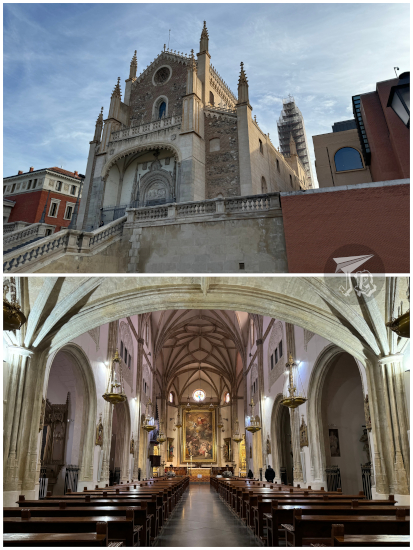
My first stop was the church Iglesia de San Jerónimo el Real, dedicated to St. Jerome, a late Gothic – early Renaissance building erected between 1502 and 1505. It belonged to a monkhood whose original monastery stood near the river. The stagnant waters caused illnesses among the brethren, who asked the Catholic Monarchs for a new location. The church for the new community was created from brick and masonry, and towers were added in the 17th century. The interior is decorated with two gothic altars to the sides, but no main altarpiece, as the original one has been lost to time. Instead, there is a painting by Rafael Tegeo La última comunión de San Jerónimo – Saint Jerome’s last communion – created in 1829.
Afterwards, I headed towards the National Museum of Anthropology Museo Nacional de Antropología, a small museum dedicated to the diversity of cultures in the world, particularly the Americas, Philippines, Africa and the “Far East”, focusing on traditions, culture and religion. It is covered by my national museum card.
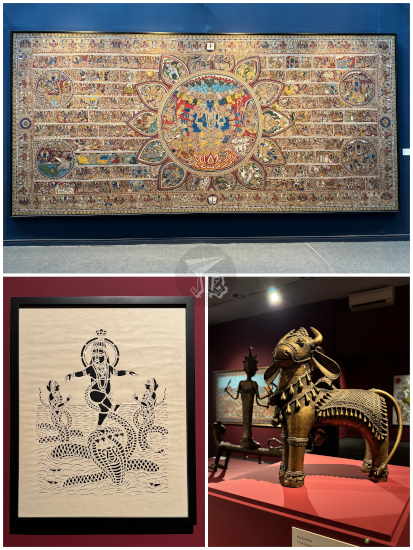
At the moment, the museum is running a temporal exhibit on art based on myths, legends, and sacred texts from India, Caminos místicos. Tradiciones vivas del arte de la India – Mystic Paths. Living Traditions of art from India. I was curious about it, but not expecting how much I liked it in the end. The pieces of the exhibit were mostly based on Hinduism (Sanātana Dharma, सनातन धर्म), the oldest religion in the world. According to Hindu tradition, the Supreme Being Brahma exists as themself, but also as the manifestation of the deities Brahma the Creator, Vishnu the Sustainer and Shiva the Destroyer, all of who at the same time have different avatars (avatāra, अवतार) or incarnations. One of the core principles of Hinduism is the concept of cosmic cause-and-effect justice, karma [कर्म]. Another is reincarnation (saṃsāra, संसार), an eternal cycle of life and death until the individual is liberated from it through self realisation or illumination. The religion is based on values like righteousness, truth, love, peace, and ethical conduct, and it is quite open to other beliefs and ethics.
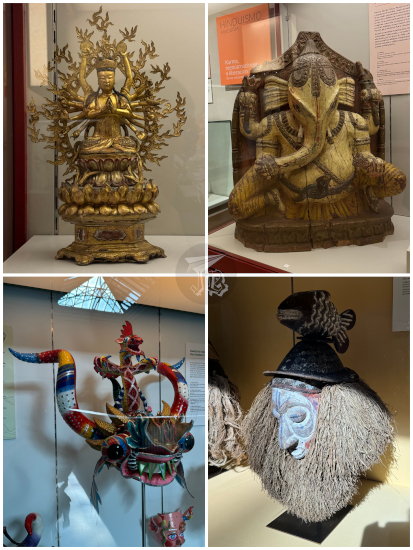
The Museum of Anthropology’s permanent exhibition has a lot of items from the Philippines on the ground floor, probably due to how long(1565–1898) the islands were a Spanish colony. There are clothes, tobacco items, ritual objects, and a small sample of how the local culture was throughout the 1800s. To the back, there is a room dedicated to the religions of Asia and the Middle East – Hinduism, Buddhism and Islam. The first floor is dedicated to Africa, combining a number of traditional exhibits with modern photographs of the traditional people’s way of life – baskets, pottery, leather and wooden objects, ritual masks… The second floor holds items from the Americas, especially from South America. Some of them include a Mexican Día de los Muertos (Day of the Dead) altar, Andean Carnival masks, Sioux-Lakota clothes, Inuit coats…
I remember visiting the museum when I was a child, and then feeling disappointed in it when I returned as an adult. This time around, I found the permanent and temporal exhibitions quite interesting, so it’s a good thing I headed there. It also helped make time until noon, when my next visit was due, to the only Ministry that can be visited – albeit not freely, by appointment and paying a fee – as it is a historical building.
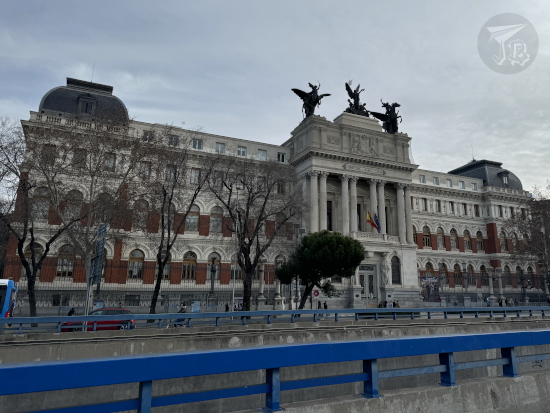
The current Agriculture Ministry is housed in the historical building known as Palacio de Fomento – Palace of Development. Its plans were originally drawn by architect Mariano Belmás y Estrada, aiming for an Arts and Craftwork School. Later, Eduardo Saavedra y Moragas took over to turn the design into a university. Finally, the project ended in the hands of architect Ricardo Velázquez Bosco, who erected the building between 1893 and 1897 to house the then Ministry of Development.
The Palace is an impressive construction. The original design had three floors, which have now been turned into five. From the outside, the building looks white and orange-brown, but a more focused look reveals decorative tiles by Daniel Zuloaga, who also collaborated with Velázquez Bosco in the ETSIME. The entrance is flanked by two caryatids and roof above there is a sculpture group – Glory and Pegasi La Gloria y los Pegasos, a bronze copy of an original marble by Agustín Querol.
Once you enter, you find yourself in a huge majestic hall, where we had to check in, since the building is a working Ministry. The email said to be there at 11:45 to go through security. I got there at 11:40 and went in at 11:44. They took my name (they did not care about the ticket) and they put my stuff in the X-ray machine. I had to go through the metal detector and when I asked whether I had to remove my belt, I was just told to put my hand over the buckle… So much for security, I thought, because I did not beep. Then I realised that I must look quite non-threatening as quite a few people were thoroughly searched as they set off the machine.
Beyond the hall where we were checked in, there is an imperial staircase in marble, and a vaulted frescoed ceiling. From there, we visited some offices and meeting rooms, and the portrait gallery – from which the ministers who held office during the Franco dictatorship had been removed. Finally, we visited one of the side inner courtyards, covered in a skylight with some ironwork.
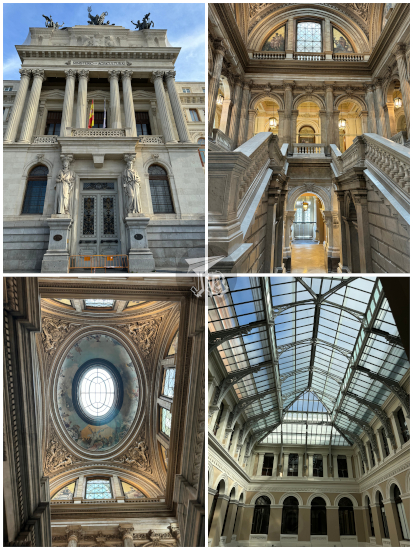
After the visit was over, the security guards saw us out and locked the doors. I walked around the building, because I had honestly never realised it was square. As the place was next to the Retiro Park, I had been considering looking for some archaeological spot they had opened. However, there were more ideas – Guadalajara was having the Botarga parade, and it was the fair weekend in Tendilla, though, a phone call informed me that traffic was horrid and that it was not a good idea to head there so late in the afternoon.
Eventually, I decided on the Parade. I bought some sandwiches and headed for the train. Though I got rained upon, it cleared up, and at 18:00 I was in Guadalajara to have a look at the traditional Parade of Carnival characters Desfile de Botargas – “creatures” from the whole area which meet up in the capital the Saturday before carnival, despite each character having its own schedule wherever it is rooted. The parade was a bit late, so I could talk the local botarga group – El Manda (the Order-giver), Los Mandaneros (the Order-receivers), and the Botarguilla (Little Botarga) – into posing for me. I watched and took pictures from two spots, but the parade moved really fast because they only had thirty minutes to do the route – last year they took well over an hour for that. I decided I did not want to run for it that much… I have to remember to find myself a vantage point next year, instead of trying to get the beginning of the parade…
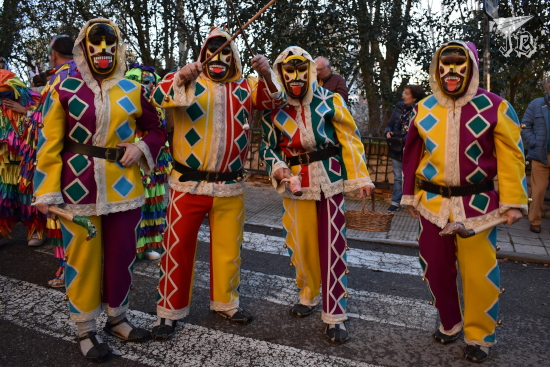
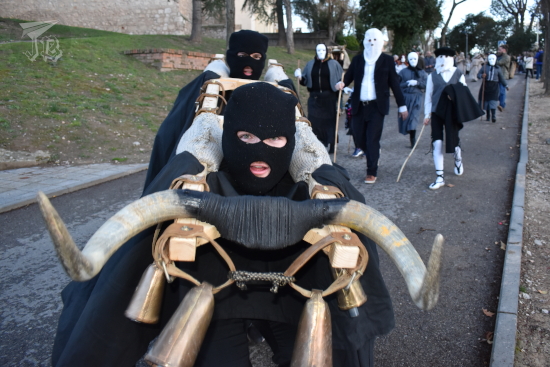
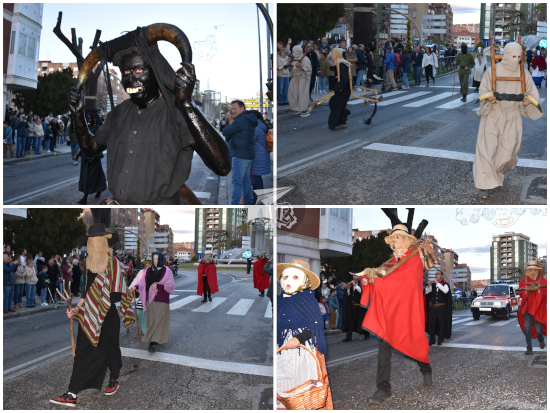
I got “attacked” a few times, and ended up with soot all over my face, but at least I avoided the guy painting people with mustard… The botargas seemed to zoom in on children and cameras, and so did the devils Diablos (from Luzón) and the heiferettes Vaquillas and Vaquillones (Villares de Jadraque, Robledillo de Mohernando, Luzaga, Riba de Saelices). It was fun. One of these days I might have to try to follow the botargas in their own villages…
 JBinnacle – A Travel Logbook