
Where should I get to see the Vienna Boy’s choir Wiener Sängerknaben? Vienna? Of course not! Madrid, of course. We did try to see them in their home town, but it did not work out, because they sang before we arrived, and while we were on our way to the airport on the day we left. However, chance wanted that their Schubert Choir Schubertchor would be touring Spain in March, and Madrid would be their first stop. We got good tickets by a hair’s breadth, because my parents do not believe in booking in advance – nor in me booking for everyone – but we got them, literally last row of stalls.
Nobody knows exactly when the historical Wiener Sängerknaben was established, but there are records of boys singing at the Imperial Chapel back in 1296, even before the chapel was in Vienna. The Boys Choir just performed for the Court until 1918, when the Austria-Hungary Empire collapsed. In 1924, the institution was re-established as a private non-profit. It remained boys-only until 2004, when the Girls Choir Wiener Chormädchen was founded.
The boys attend their own campus from primary to senior high school. There are 100 choristers divided in four choirs (Bruckner, Haydn, Mozart and Schubert), each of which tours for around 10 weeks per school year. They perform High Mass in the chapel of the Imperial Palace every Sunday as part of an ensemble called Hofmusikkapelle (Court Music Orchestra), formed by the boys and members of the choir and orchestra of the Vienna State Opera (Wiener Staatsope).
As part of those ten-week tours, it was announced that in 2025 the Schubert Choir would tour South Korea, Spain, Switzerland and Italy. In Spain, they were to perform four special concerts in Madrid, Seville, Alicante and Valencia. The Madrid show took place at 11:00 in the national auditorium Auditorio Nacional de Música. The auditorium was designed by architect José María García de Paredes and it opened in 1988. The largest music hall can host over 2400 spectators.

The Schubertchor has 22 members from all over the world – though most are Austrian, others come from China, Croatia, the Czech Republic, England, Germany, Hungary, Japan, South Korea and Ukraine. The boys’ names are not released, but they were touring with Peruvian conductor Andy Icochea Icochea, who had previously worked in the Wiener Sängerknaben between 2005 and 2011. Icochea seems to have specialised in training young choristers, and has had a long career with different choirs and orchestras, even with a music charity. He has collaborated with other directors such as Riccardo Muti, who conducted the 2024 Silvesterkontzert / 2025 New Year’s concert in Vienna.
The day of the concert started raining buckets, but we had decided to try public transport instead of driving to the area where the Auditorio Nacional de Música stands. Afterwards, we wanted to have lunch and head to Expominerales, which was held that same weekend. We arrived with plenty of time, and we had to find a café to pass the time until doors opened. Once that happened, it was a bit of a chaos of umbrellas and everybody trying to push in at the same time. If you think young people get excited before a concert, they’ve got nothing on senior citizens.
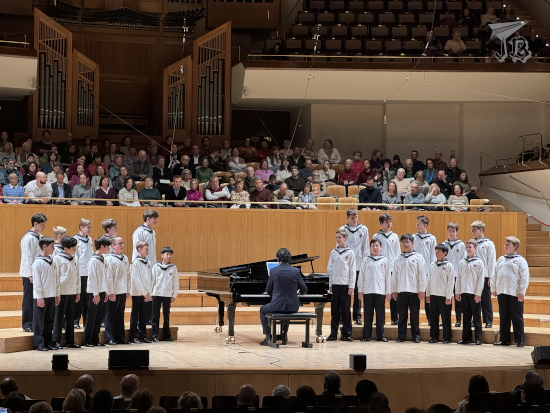
At 11:00 sharp, even before the hall had completely filled up – doors had opened kind of late in my opinion, less than half hour in advance – the children and the director came out. People were still being admitted during for the first couple of songs, and the auditorium staff were harassing patrons about where they had placed their jackets, or whether they were in their correct seats, well into the show. It was weird, and a bit disrespectful, those details should have been sorted beforehand. However, the concert itself were amazing. Most of it was sung a capella, and only a piano was used for accompanying the choristers in several songs, played by Icochea himself.
Setlist:
First part:
1. Kaiser-Walzer, Op. 437 (Emperor Waltz), composed by Johan Strauß II, with lyrics by Victor Gombocz and arranged by Gerald Wirth.
2. Der Wassermann (The Water Genie), composed by Robert Schumann, with lyrics by Justinus Kerner.
3. Hebe deine Augen auf zu den Bergen (Lift thine eyes), trio from Elias, Op. 70 (The Prophet Elijah), composed by Felix Mendelssohn from the lyrics of Psalm 121:1-4.
4. Die Meere, Op. 20 No. 3 (The Seas), composed by Johannes Brahms
5. Psalm 23, D.706, composed by Franz Schubert with Germany lyrics by Moses Mendelssohn.
6a. Nun stehen die Rosen in Blüte (Now the roses have bloomed) from Der Jungbrunnen, Op. 44 (The Fountain of Youth) composed by Johannes Brahms with lyrics by Paul Heyse.
6b. Die Berge sind spitz (The mountains are pointed) from Der Jungbrunnen, Op. 44 (The Fountain of Youth) composed by Johannes Brahms with lyrics by Paul Heyse.
6c. Am Wildbach die Weiden (The willows beside the stream) from Der Jungbrunnen, Op. 44 (The Fountain of Youth) composed by Johannes Brahms with lyrics by Paul Heyse.
6d. Und gehst du über den Kirchhof (And if you walk across the churchyard) from Der Jungbrunnen, Op. 44 (The Fountain of Youth) composed by Johannes Brahms with lyrics by Paul Heyse.
7. Inclina Domine aurem tuam ad me, Op. 118 (Incline your ear, Lord, to me), Josef Gabriel Rheinberger (Psalm 86).
8. Erlkonig (The Elven King) composed by Franz Schubert, with lyrics by Johann Wolfgang von Goethe, arranged by Oliver Gies.
9. Sängerslust, Polka française, Op. 328 (Singer’s Joy, French Polka), composed by Johann Strauß II with lyrics by Joseph Weil.
10. Wiener Blut, Walzer Op. 354 (Viennese Spirit), composed by Johann Strauß II, arranged by Helmuth Froschauer.
Second part:
11. 아리랑 [Arirang] (impossible to translate, but it might have meant “My beloved one” in Ancient Korean), arranged by Gerald Wirth, a traditional Korean love song from the Kyonggi Do province, with over 60 variations.
12. Vreneli abem Guggisberg (Vreneli from Guggisberg), Swiss folk song arranged by Gerald Wirth.
13. Müsle gang ga schlofa (Go to sleep, little mouse). Cradle song from Vorarlberg, Austria with lyrics by Walter Weinzierl, arranged by Gerald Wirth.
14. Unz Wättr isch winti (Until the weather is windy), written by Luis Stefan Stecher like an Italian folk song, with music by by Ernst Thoma.
15. O more duboko (Oh, deep sea), Croatian folk song, arranged by Gerald Wirth.
16. La Paloma (The Dove), Spanish habanera by Sebastián Yradier, arranged by Gerald Wirth.
17. Chim Chim Cher-ee from Mary Poppins (1964 film), by Richard M. Sherman and Robert B. Sherman, arranged by Christi Cary Miller.
18. What Was I Made For? from Barbie (2023 film), by Billie Eilish O’Connell and Finneas O’Connell, arranged by Jennifer Lucy Cook.
19. Under the Sea from The Little Mermaid (1989 film), by Alan Menken and Howard Ashman, arranged by Kirby Shaw.
20. For ever, Polka schnell, Op. 193 (Forever, Fast Polka) by Josef Strauß, arranged by Gerald Wirth with English lyrics by Tina Breckwoldt.
21. An der schönen blauen Donau, Op. 314 (The Blue Danube), composed by Johann Strauß II, with lyrics by Franz von Gernerth (1821-1900) and arranged Gerald Wirth.
Encore
22. Radetzky-Marsch, Op. 228 (Radetzky March), by Johann Strauß I, arranged by Gerald Wirth.
23. Un Elefante Se Balanceaba (An elephant swung), Spanish children counting song, probably arranged by Icochea.
Charming does not even come close to describing the show. I’d never understood the concept of “angelic voices” until now, and I found it really unfair that you can’t actually find out the names of the boys. I don’t know whether it is to protect their privacy as they are minors, but it would have been great to at least know the names of the soloists, because the powerful voices from those little bodies was amazing.
The children were organised by tone of voice, which was similar to size, with the highest voices (smallest boys) on the front left and the lowest voices (biggest kids) on the back right. They sang most of their numbers towards the stalls, but for one song they turned to the people behind them, to both sides of the organ. Highlights included any time a child sang a solo – particularly the first one during the Emperor Waltz, as people were still coming in. During another song, Icochea left the stage for another boy to direct.
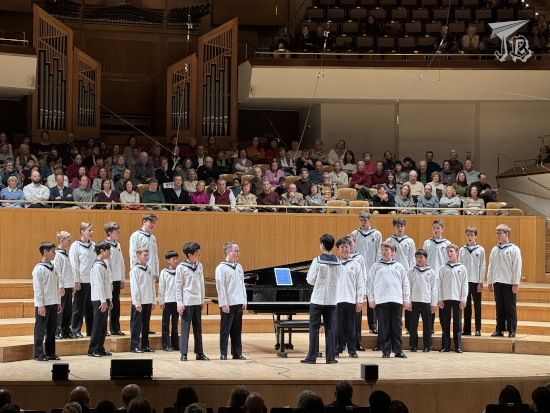
The oldest boy was in charge of having the audience clap during the Radetzky March, just like in the New Year’s Concert – and he looked right at that age when teens are all knees and elbows and awkwardness, but he seemed to be extremely proud of himself (well deserved!).
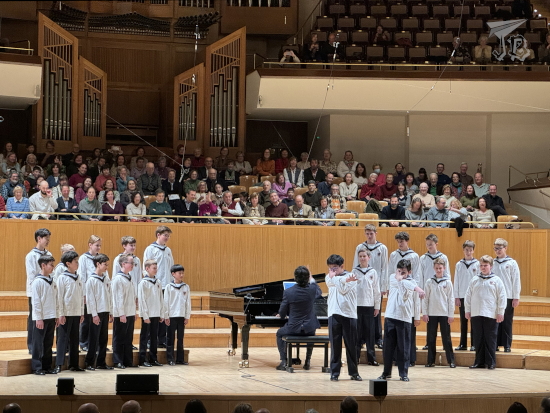
The last song of the encore was a total surprise. Before it started, the director invited us to “sing along if we were familiar with it”. This unexpected performance was a Spanish counting song, Un Elefante Se Balanceaba (An elephant swung), which goes “one elephant swung on a spiderweb – as it saw it did not fall down, it went to call another elephant. Two elephants swung on a spiderweb – as they saw they did not fall down, they went to call another elephant. Three elephants…” you get the idea – not precisely a philosophical song, but way less traumatic than say Hush little baby. One of the boys walked to the front and made a sort of trunk with one of his arms as he “swung” to the music. One by one, the others joined him until the proverbial spiderweb snapped and down to the floor all the children went. It was absolutely hilarious, and adorable.

It was still raining heavily when we left the auditorium. It was 13:15, so no real time to get to Expominerales before it closed between 14:00 and 16:00. Had the weather been nicer (decent, at the very least), I would have found something else to do before it re-opened. But it was still raining cats and dogs – and maybe some ice – so we just decided to call it a (half) day.
 JBinnacle – A Travel Logbook