22nd January 2026: The workshop that wasn’t (Madrid, Spain)

A while back I visited the printing museum Imprenta municipal in Madrid. I’ve since learnt that they have book-binding workshops, and I would very much like to attend one. So would at least one of my parents, and I was asked to sign them up online for one on the 22nd of January, a day when I was supposed to be at work. My project got delayed, so I ended up workshop-less and a bit envious. Just a bit. There’ll be other chances.

On the 21st, I received a notification that I could pick up some paperwork in town, so we arranged we would have lunch together after I had my documentation and they were done. We would all be taking the train, and I was a bit uneasy. I’ve complained about the railway system before, but just a few days before there had been a horrible train accident that killed over 40 people, and a slightly less horrific one that killed one person.

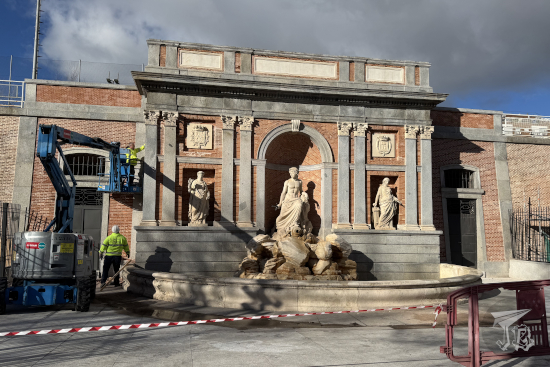
Though it did feel a bit uncomfortable when the train shook within the rails, we reached Madrid just a few minutes late, and I hopped off. It was extremely cold, not only because it was January, Spain had been hit with a string of storms just one after the other. After getting my documents, I realised I was rather close to the fountain I had missed when I was in the Bravo Murillo area exploring after Expogema, Fuente del Río Lozoya, which honours the river Lozoya, the source of the city’s drinking water. It was my third time trying to find the fountain and… it was getting cleaned, and thus empty and fenced off. I felt it was hilarious.

A fountain with female allegory decorations

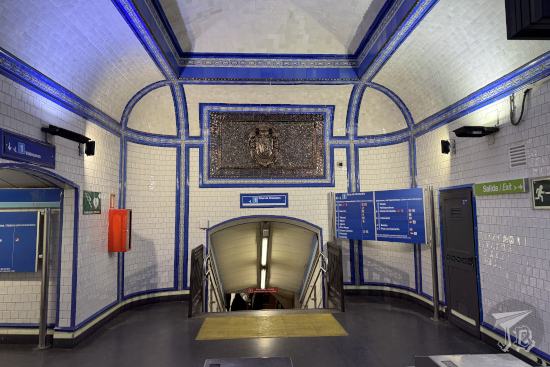
I headed towards the underground and headed towards Tirso de Molina station. The station opened in 1921, and one of the halls retains the original tiling and decoration, the historical hall – Vestíbulo Histórico de Tirso de Molina, which is considered part of the underground museum network Museos de Metro de Madrid. The station has a bit of a black urban legend / history. It is located underneath the square Plaza de Tirso de Molina, which honours a Spanish friar, dramatist and poet. The square named after him used to be home to his own convent, a building that was expropriated and demolished during the Ecclesiastical confiscations in the 19th century. Apparently, there was a small graveyard associated to the convent, and human remains were found (and quietly reburied behind the walls) during the construction of the station. Creepy.

The historical access hall to the underground station - white with blue decorative tiles

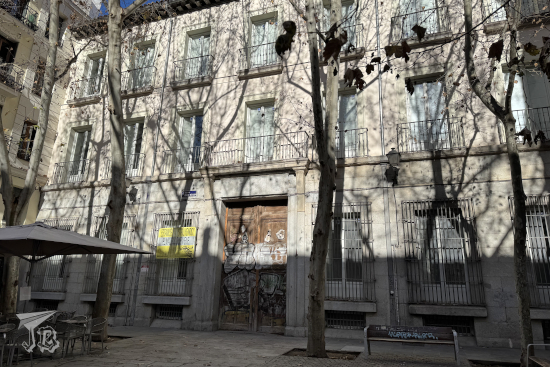
Quite close stands the manor known as Palacio de la Duquesa de Sueca, an Age of Enlightenment building which was for a while featured in one of the most successful fictions on Spanish TV – El Ministerio del Tiempo (The Ministry of Time). It has been abandoned forever, it seems, and nobody quite knows what to do with it, so it is slowly wasting away.

Façacde of a manor with many windows and balconies

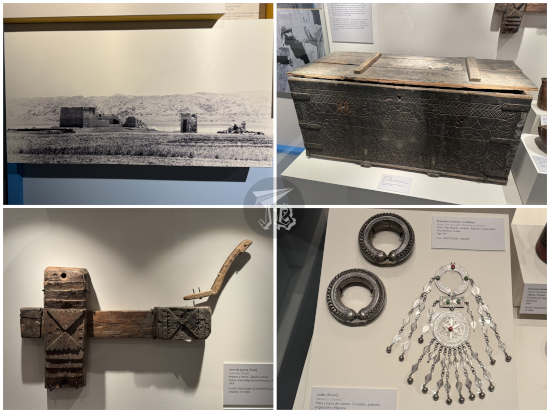
I walked to the small metropolitan museum Museo de San Isidro, which was running a special exhibition about the Temple of Debod and the town it used to stand on, fittingly called Debod. 1954-1964. Debod is the only free-standing Nubian temple outside Egypt. The building was dismantled during the International campaign to Save the Monuments of Nubia between 1960 and 1980, as the rising waters from the Nile, turning into Lake Nasser, swallowed them.

The exhibition did not only focus on the temple Templo de Debod, but put a lot of emphasis on the town of Debod itself, whose people were forcibly relocated to Kom Ombo. The region of Nubia stood between today’s Egypt and Sudan. It was home to the Kerma culture from around 2500 BCE until the area was conquered and incorporated to the New Kingdom of Egypt around 1500 BCE. Kerma culture is regarded as one of the earliest civilisations of Ancient Africa. A lot of knowledge about the region, including culture and customs, was lost with the move. It was a bit heart-wrenching, surprisingly even more than hearing about it in Egypt itself. The exhibit comprised a lot photographs and videos that showed the people who left, and you could see the desperation in their eyes.

A good part of the items shown were photographs of how the temple stood and how it was documented before getting dismantled in order to rebuild it – which in the end, they did wrong, as one of the entrance pillions was placed backwards. The building was originally erected in the 2nd century BCE, dedicated to the God Amun, creator and King of the Gods. He would later be merged with Ra, hence the Amun-Ra denomination for the Sun God. The small structure would be later expanded by Kings and Roman Emperors. It reached the Nile through a processional walkway that ended at a quay.

The temple was gifted to Spain in 1970, dismantled in 2,300 pieces. The whole thing was reconstructed as well as it could be, filling up the gaps with newer material in a process called anastylosis, and experts say it’s not even a good one. Today, the Templo de Debod stands in a park in the middle of Madrid, and can be accessed at weekends. Unfortunately, the sandstone is getting weathered, which threatens the integrity of the whole structuture. What is surprising is the contrast between all the photographs in the exhibition, and the complaint that there was not enough good documentation to re-erect the building.

Numibian archaeological artefacts (a chest, a hammer, bracelets and necklaces), and a b/w photograph of a small temple next to the Nile

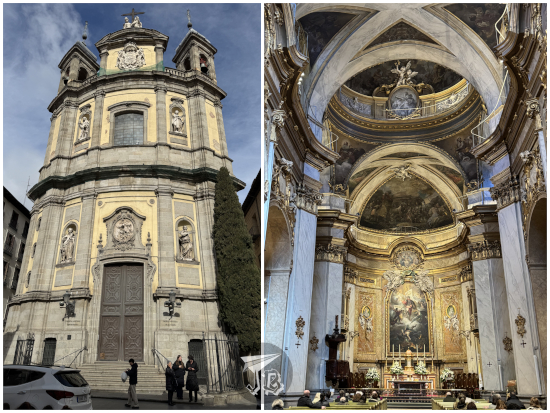
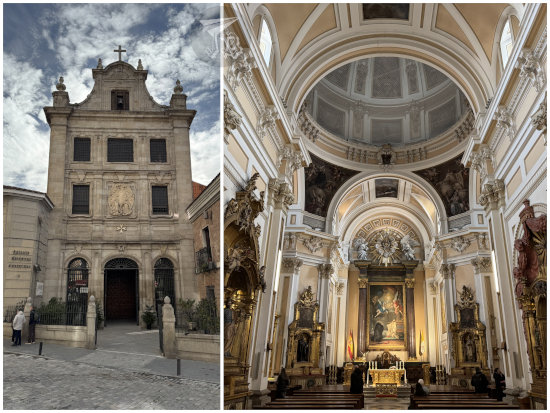
After the exhibition, I walked around the museum once, then went out in the cold again. At least it was sunny, and after noon, so not that bad. During a conversation about Madrid must-dos, someone had mentioned two churches I did not know, which happened to be rather close. The first one I found was the Cathedral Church of the Armed Forces Iglesia Catedral de las Fuerzas Armadas (also known as Church of the Sacrament Iglesia del Sacramento). Though Spain is technically a non-religious country, this has not always been so. For a long time it was an officially Catholic country, and there is a strong catholic tradition amongst the armed forces. As a matter of fact, there is even a Military Archbishopric of Spain (Arzobispado Castrense de España), with seat in this cathedral. I am not sure how one can be an soldier and a priest, much less a bishop / colonel, but I am not an expert.

The cathedral is a Baroque building designed by Juan Gómez de Mora, with a Neoclassical altarpiece and many frescoes. It was built between 1671 and 1744 to be the church of a convent that has since disappeared. The main façade was built by Pedro de Ribera towards the end of the construction period. Today it belongs to the Ministry of Defence – I did not know state agencies could own churches in Spain.

Inside and out of a Baroque church

Nearby stands another important church, the Pontifical Basilica of Saint Michael Basílica Pontificia de San Miguel, another Baroque structure – actually it is considered one of the most important buildings in the Spanish Baroque. It is attributed to Italian architect Giacomo Bonavia and dates from the 1730s. Unfortunately, it closed at 13:15 and it was 13:13, so I could not come in.

In front of the church there is a sculpture called The Reader El Lector, a bronze statue by Félix Hernando García. The statue was recently moved there as part of the urban sculpture program, since a library was installed there in 2011. It is apparently a homage to Carlos Cambronero y Martínez, apparently one of the first “Madrid Historians”.

I headed back towards where I had to meet with my parents, and though I was early, so were they. Their workshop, which was scheduled to finish at 14:00, wrapped up at 13:20, so in the end I had to head there in a bit of a hurry. Once I picked them up, we walked to “a random restaurant” in theory. In practice, one of them had a very specific place in mind – Museo del Jamón. Self-described as a “family chain of restaurant”, the idea of a ham-focused restaurant was born in 1978. Since then, they have opened seven different eateries specialising in ham and other pork products, alongside several typical tapas.

The Spanish word for ham is jamón. It is obtained from the hind leg of a Black Iberian pig, usually. The ideal ham-producing swine lives range-free in oak groves (the dehesa) so it can feed on acorns, as they lead to the best meat, apparently. After the animal is slaughtered, the hind legs are salted and left to dry, in a curing process that may take up to 48 months. How much acorn the pig consumes as part of its diet, and whether or not this is supplemented, determines the quality of the final product, with the best hams being “100% acorn fed” – jamón 100% ibérico de bellota, marked with a black label.

Of course, many other products might be obtained from a pig – the most important sausages are lomo, chorizo and salchichón. Lomo refers to the tenderloin, the piece of meat underneath the ribs and along the spine, cured for about four months after being marinated in spices – normally oregano, garlic and paprika. Chorizo is a sausage made from pork meat and fat with added garlic, and can be either cured or fresh (the former is eaten as is, the latter is usually cooked). The meat is seasoned with smoked paprika (pimentón), which determines how spicy it becomes, and gives it a bright red colour. The best chorizo comes in natural casings, usually the intestines of the pig, and the curing process can take several months. Salchichón is similar to cured chorizo but there are more spices added – salt, pepper (often black grains), oregano, nutmeg, and garlic – and curing can last for three months. If the animal was an acorn-fed black Iberian pig, the monicker ibérico de bellota is added to the name.

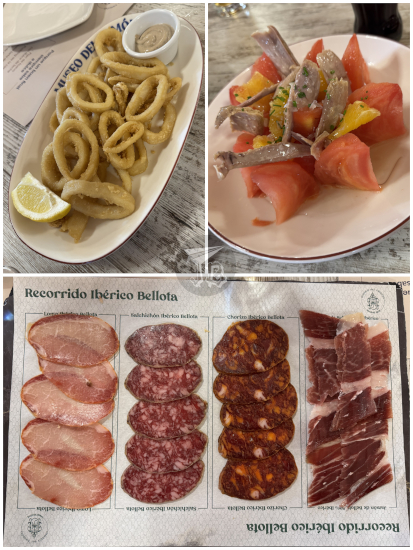
We shared a salad (Ensalada de tomate y ventresca de atún), with tomato, tuna and orange – because my parents are unable to be in a restaurant without ordering a salad. We also ordered some battered squid Calamares a la andaluza, and a dish called “Recorrido Ibérico Bellota” – with bits of the different pork cuts: jamón de Bellota 50% Ibérico, chorizo Ibérico de Bellota, salchichón Ibérico de Bellota and lomo Ibérico de Bellota. Despite Madrid being dead in the centre of Spain, battered squid is an extremely typical dish, especially in sandwich form.

Lunch - breaded squid, salad, sausages and ham

I had been extremely lucky that the rainy weather had given a reprieve and I could carry my paperwork around safely, but it was windy and not that nice. Thus, after lunch we headed back towards the train, and we were rather lucky with the connections, so we were home rather early. During the train ride, I learnt hat someone from the binding workshop had decided to leave in a huff because it was “too basic”. I could have totally taken that spot!

28th December 2025: Sabre-toothed cats in Alcalá de Henares (Spain)

For my last escapade of the year 2025, I chose a nearby low-effort one – Alcalá de Henares. I was checking out dates for upcoming events in Madrid when I saw that the palaeontology and archaeology museum Museo Arqueológico y Paleontológico de la Comunidad de Madrid (MARPA) had opened a special exhibition on sabre-toothed cats called Dientes de Sable.

I drove to Alcalá de Henares and parked a bit farther away from the centre, then walked. I really don’t enjoy driving there, especially now that they’re having construction in the main arteries of the city. On my way in, I followed the music to find one of the traditional parades displaying giant puppets – Pasacalles de los gigantes y cabezudos, which happens around Christmas.

I arrived at the MARPA just behind a family, who were told that the sabre-tooth cat exhibit was “good for kids”. I jokingly asked if it wasn’t good for adults and I was told that “kids enjoyed it more”. When I got to the temporal exhibition room to see Dientes de Sable (Sabretooth), I have to say that… no, it was not good for kids. The panels were interesting but… extremely technical. I have some knowledge of science, zoology and palaeontology, and way too much information flew over my head.

When I was in primary school, everything was either an animal, a plant or a rock, and nobody knew what to do about mushrooms. It turns out that biology is slightly more complicated than education in the 1980s tried to convey. Let’s start with what an animal is: an organism comprised by more than one cell, and these cells have a nucleus (which holds DNA) enclosed by a membrane. Having more than one cell allows animals to get pretty big.

Some organisms look more alike than others, which in general (though sometimes it is a fluke) means they are in a way “related”. These relations are scientifically called “taxonomy”, and the groups are bigger or smaller according to the shared characteristics. From more general to more specific they are: domain, kingdom (animals comprise one of these), phylum (for animals) or division (for plants), class, order, family, genus, and finally species. There are “clades” in-between which refer to groups of organisms composed of an identifiable common ancestor and all its descendants, and sub- and super- prefixes for many of the categories.

Mammals – which are animals with milk-producing glands, for feeding the young, among other characteristics – are a class (Mammalia). An order of mammals are Carnivora, creatures which specialise in eating flesh (hence the idea of a “carnivore”, literally meat-eater). Most of them are land-dwelling predators. Within them, we find two suborders – Feliformia (cat-like) and Caniformia (dog-like). For what is worth, seals belong in the dog-like category and hyenas in the cat-like one… so this is a bit more complicated and I am summarising.

Within Feliformia we find the family Felidae, which appeared around 25 million years ago, at the end of the Oligocene. Five million years later, there were two large types of felid groups – some had conical teeth and others developed sabre-shaped teeth – hence being collectively known as sabre-toothed cats. Conical-toothed cats are divided in Felinae or “small cats”, which includes anything smaller than a cheetah, including the domestic cat, and Pantherinae or “big cats”, which comprises leopards, tigers, lions and so on. The subfamily Machairodontinae held all the sabre-toothed cats, with three main subgroups or tribes, all extinct nowadays: Metailurini, Smilodontini and Homotherini or Machairodontini. I hope that was not too confusing, I made a schematic life tree chart to try and help…

The most famous genus of sabre-toothed cat is Smilodon, which jumped to fame hand-in-hand (paw-in-paw) with Diego, from the 2002 animated film Ice Age (also, the squirrel-character Scrat, from that same movie, might have sabre-shaped teeth, but it is a fictional animal, not a Machairodont). Smilodon is a very well-studied genus in science since the species Smilodon fatalis has been found in abundance (over two thousand individuals) in the Los Angeles palaeontological site of La Brea Tar Pits. For millennia, tar has been seeping from the underground, creating a pit so deep that it could (can) swallow an animal whole. However, this was not a fast process. When an animal wandered onto the pits, which were covered with leaves or dust, it became stuck and sank slowly. The dying animal attracted predators, which would also get stuck and end up sinking along after starving to death. This process generates what is known in palaeontology as a “predator trap”.

Spain did not have Smilodon or Tar Pits, but the palaeontological site known as Cerro de los Batallones has turned out to be another predator trap which yielded to many remains of Machairodonts, out of which apparently Machairodus aphanistus is the one getting better PR. The trap was different than the tar – the site was an underground structure or cave with round walls, opened at ground level. Animals fell into the hole and starved, and the stench attracted carnivores, which jumped in, but could not get out again, eventually dying themselves. The cave ended up filled with sediment, maybe in a mudslide or something similar that buried the skeletons. Some of them have even been found articulated, despite the geological phenomena that have affected the area – one of the skulls in the exhibits shows shearing, even.

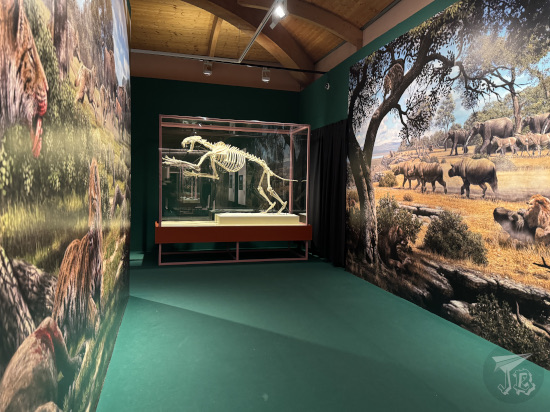
Confusing still? Try to condense all this informational dump in a few panels with drawings and schematics… I would not call this exhibition child-friendly at all. There is a lot of writing on the walls, along with life-like illustrations about how the animals and their environment would have looked. Regarding the actual items, there were a few replicas of skeletons, and several real pieces, mostly Machairodus from Cerro de los Batallones, as any palaeontological item recovered would be deposited in this museum. Actually, the first skeletal reconstruction you see on display is the one from MARPA’s permanent collection. I really wish they had taken that one out of a glass case, because I can never seem to take a good photography of it.

A room with a reconstruction of a sabretoothed cat skeleton and palaeoart on the walls, depicting the animal in real life.

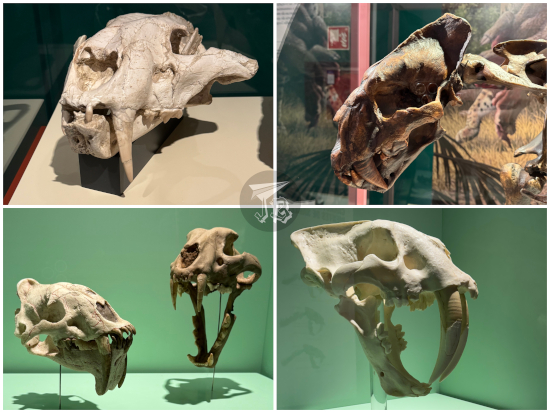
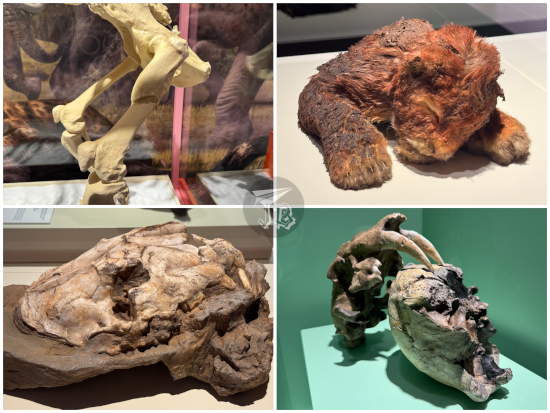
Dientes de Sable (Sabretooth) exhibition is divided in several sections – taxonomy, environment, palaeoecology, illness, restoration and reconstruction. There are a lot of explanatory panels and artists’ reinterpretation of the animals and their environment. There are three or four complete reconstructions of skeletons, a few skulls – real and casts – and a handful of actual fossils. One of the skeleton casts shows a healed fracture in the hind leg, which seems to imply that the animal lived in a pride and it was relatively taken care for by other members – as it did not starve to death.

Collage: Real sabretoothed cat skull and different reproductions. In all the cases the fangs protude way under the jaw.

There is also a reconstruction of a mummified cub that was found in Siberia in 2020, and a guess of how it would have looked in real life. Having an actual piece of fur helps cement the image of how any of the animals would have looked alive. However, most of it is speculative.

Collage: broken sabretoothed hind leg, mummified cub reproduction, skull fossil, reconstruction of the cat's bite on a hominini's skull.

Sabre-toothed cats coexisted with humans, or at least early Hominini, and maybe the two species even hunted each other. Dmanisi Hominini lived in the modern-day Georgia (country) area of the same name around 1.80 million years ago, so they are amongst the earliest Hominini fossilised in Eurasia. They created simple stone tools, but did not use fire yet, and probably lived in social groups. The scientific consensus is that they belong to the Homo genus, maybe Homo habilis or Homo erectus. One of the skulls found at the site presented unhealed wounds that are consistent with the fangs of a Machairodont animal of the genus Megantereon.

In order to flesh out the exhibition, there are comparisons with modern-day big-cat skeletons, such a tiger or a lion, but one needs to know way more comparative anatomy than myself in order to appreciate much more than the clear difference in the skulls and fangs.

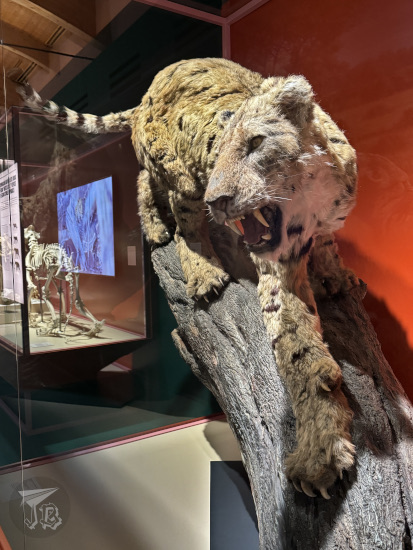
Reconstruction of a sabretoothed cat.

After I left the museum, my plan was to see a couple of the nativities in town, as Alcalá de Henares has a large association dedicated to the dioramas. I went to the exhibition hall and former hospital Antiguo Hospital de Santa María la Rica, where they had set up one of the nativity scenes, Gran Belén Tradicional, along with a few collections and miniatures they were displaying. Nativity scenes are a huge tradition around Christmastime in Spain, with hundreds of displays across town and cities, one in every church, and usually one from every government level.

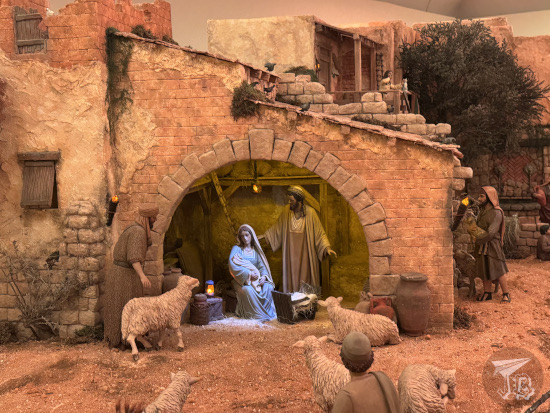
Spanish nativity displays tend to be structured in scenes, which are not always concurrent. They represent the birth of Jesus according to the Bible (Gospels of Luke and Matthew). There is an area with Mary and Joseph, baby Jesus, a mule, and an ox – usually a cave-like structure to represent the stable. Shepherds are represented heading towards the portal, starting from the Annunciation scene. The Three Wise Men approach, often riding dromedaries (usually referred to as camels though) from a different direction. Many scenes feature a village to show daily life, and usually a snapshot of Mary and Joseph running away to Egypt. Other snippets that might be represented are King Herod – either meeting the Magi or ordering the massacre of the Innocents – or Mary learning she is pregnant.

Bethlehem portal int he Nativity scene.

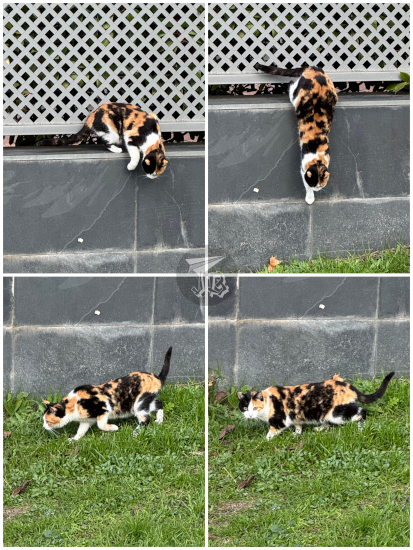
Since I was in town, I thought I’d check out the other famous nativity scene set up Gran Belén Monumental. I came across a modern felid on a hunt, too – a domestic cat prowling around a hotel garden. When finally I reached my destination, there was a long queue. I was not going to wait for 40 to 60 minutes to see a nativity scene, even if the day was not extremely cold – I was just there out of curiosity. Ergo, I turned on my heels and left. I did not feel like eating out, so I just headed home to munch on some Christmas leftovers.

House cat jumping onto the grass.

26th November 2025: Ningyō Exhibition (Alcalá de Henares, Spain)

Dolls have probably existed for as long as humans have been humans. The earliest known were found in Egyptian tombs from the 21st century BCE. Romans had rag dolls already around 300 BCE, and dolls with moving parts and removable cloths existed around the 200 BCE. They are not just children’s playthings, throughout history they have been used to teach, in rituals, and / or been infused with magical and spiritual meanings. The oldest Japanese dolls date from the Jōmon Period [縄文 時代], probably as early as 8000 BCE. The country has had an extremely long and strong connection with dolls for millenia.

Ningyō: Art and Beauty of Japanese dolls is a travelling exhibition by The Japan Foundation, designed to broadcast that connection. The word ningyō [人形] is composed of two kanji: 人 nin, which means human or person, and 形 gyō, form, shape or figure. Together, they translate as doll, puppet or marionette, particularly when referencing the traditional Japanese dolls, but literally mean “human shape”. It is not a bad description.

If one were to relate Japan with a religion, this would probably be Shinto – though it is more a philosophy rather than a religion. Shinto is greatly based on symbolism along with the respect of nature. From early times, paper dolls with vague human shapes were used in its purification or protection rituals. Later on, wooden dolls became decoration, depicting Imperial weddings or armoured heroes, to wish good growing to children.

As dolls grew more and more popular, craftsmen and artisans became more prominent. Different shapes and styles were particularly favoured by royalty, and the different Japanese regions developed their unique doll fashion. Complex traditional dolls are still made by hand – artisans create the individual parts and a final craftsman assembles them. More simple shapes are created and hand-painted by the same expert. Tradition spread to modern times with the arrival of plastic dolls imported from the US, which eventually gave way to the industry of collectible figures.

Dolls depicting the Renjishi (Two Lions) a kabuki dance with two men wearing long wigs, one white and one red, and bulky kimono.

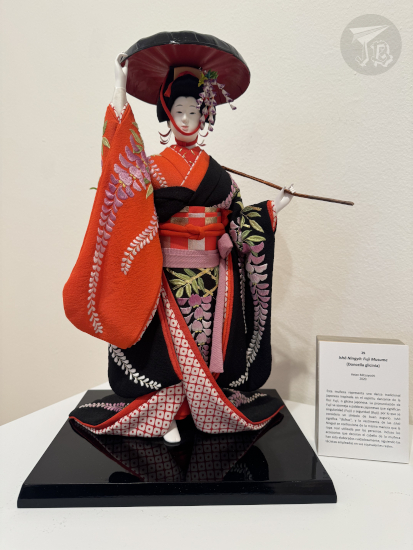
Fuji Musume (Wisteria maiden), a Japanese doll wearing a pretty kimono.

The Japan Foundation has two sets of dolls circulating throughout the world. November saw one of the sets in Alcalá de Henares, in the exhibition hall and former hospital called Antiguo Hospital de Santa María la Rica. The hospital was established in the late 13th or early 14th century bringing together several already-existing houses. It later passed onto a religious brotherhood and focused on tending to pilgrims until in the 19th century, it closed down. In the year 2000 it became the seat of the Cultural Council, and it is now used for travelling exhibitions.

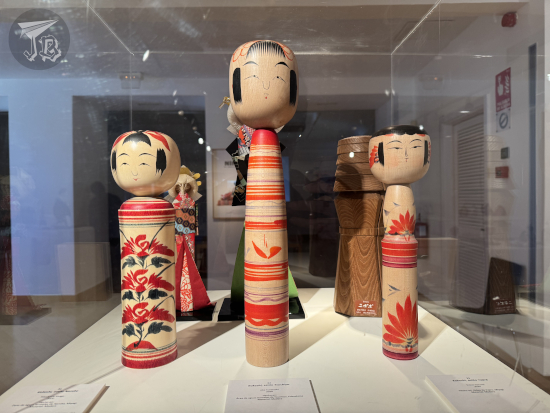
Wooden Kokeshi dolls.

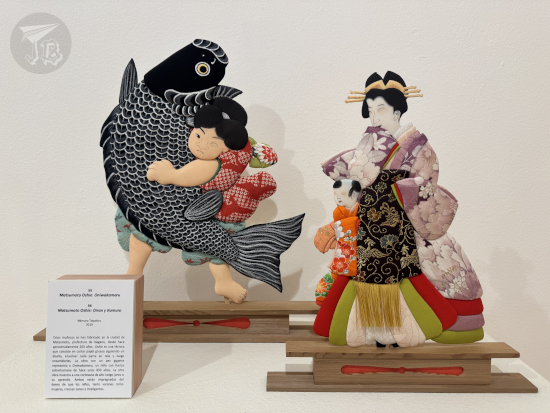
The exhibition displays about 70 pieces, all of them modern and mainly created by the same artisan, Mochizuki Reikou, whose studio was established in 1936. There was also a video explaining the same information that was displayed on the signs, but accompanied by testimonies of actual doll-makers and experts from the Tokyo National Museum (Tōkyō Kokuritsu Hakubutsukan [東京国立博物館]). I quite enjoyed it, but I would not like to be in that room alone with dimmed light… some of the dolls could be creepy.

Japanese wish dolls - you draw an eye when you make a wish, and the other when the wish is fulfilled.

Japanese dolls depicting the chold Oniwakamaru catching a fish, and an oiran (courtesan).

There was not much going on in town, as it was a weekday in that period in which everyone is getting ready for Christmas. However, it was the only free time I could muster within the month the exhibition was open due to work and other trips. I did not even stay for lunch, but headed home right after.

2nd November 2025: Chasing autumn (Guadalajara & Yebes, Spain)

I tend to judge the advance of autumn from the tree in front of my windows, but I’m starting to suspect it’s an early adopter. Mid-October it was completely gold, and when I left the house, about one third of its leaves had fallen and another third was completely brown. I thought I might get lucky with the forest Bosque de Valdenazar, and see it in its acclaimed fall colours (Spoiler: I didn’t). There had been a recent press release about the restoration and upcoming reopening of the nearby Poblado de Villaflores, so I decided to go check both out, telling myself that it was the last visit to the oak forest this year. Let’s see if I keep it up (Spoiler: I did).

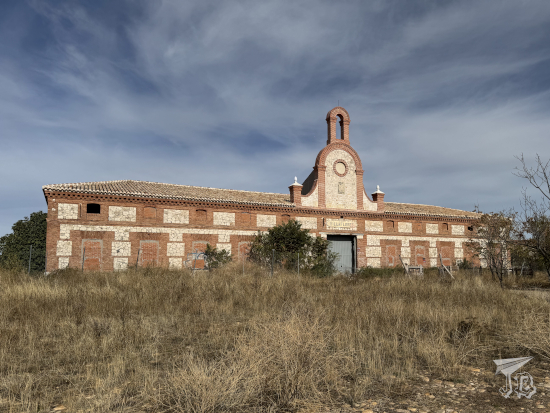
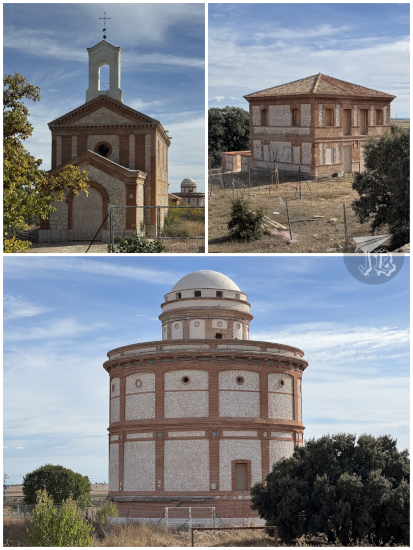
I got on the road mid-afternoon. I reached the entrance / detour / clearing where you drop off the car to Poblado de Villaflores, which technically belongs to the city of Guadalajara, around 14:00. The village was designed by architect Ricardo Velázquez Bosco in the 19th century, and though called a village, it is one of the few agricultural colonies ever built in Spain. The colonies were production units etected on fertile soils, usually designed to be self-sustaining. It’s debatable whether the actual place is located on fertile soil, but rumour has it that the Duchess of Sevillano, an important noblewoman and owner of the land, was more concerned with the actual construction, in order to have something to pay her workers for.

The village has a large farmhouse, several small building blocks, a chapel, and the most recognisable building – a dovecote. All structures were built combining limestone and brick. After the duchess died, the village became abandoned and almost forgotten, and it changed hands several times. Local politicians announced their intention to rehabilitate it in 2002. Nothing happened, even when the area was declared Important Cultural Property (BIC) in 2015. In 2016, the clock tower that crowned the façade of the main house collapsed. An emergency restoration project was finally approved in 2022, with an investment of over two million euro, but there was no serious work on the site until 2023.

I walked through a small oak tree forest and the cow path Cañada Real de Las Matas, and soon I found myself within the village limits. Of course, all the buildings were fenced off, but the restoration looks really good! The last couple of times I visited, everything was ruined and overgrown. It’s still overgrown, but the clock tower has been rebuilt (though the shield that was recovered from the collapse has not been replaced), doors at the houses have been installed, and the chapel completely re-erected. The buildings look clean and stable.

Farming house in brick and mortar, with a belltower at the centre.

Construction finished about a year ago, and the security warnings still look pretty new, but the restoration information sign has already been vandalised. There is no informational signage yet, and I fear the whole thing will end up all derelict again – nobody really knows what to do with the village. It would be such a pity, the whole thing is an interesting unit, though I am not sure what can be done with it. Maybe yet another perpetually-closed interpretation centre… Seriously though, with all the urban orchards boom and rural depopulation, along with the cow paths nearby, something related to actual agriculture or livestock would be fun. Or homing pigeons! I mean, the dovecote is there for a reason, right?

Buildings in Villafloes, in brick and mortar, by Ricardo Velazquez Bosco.

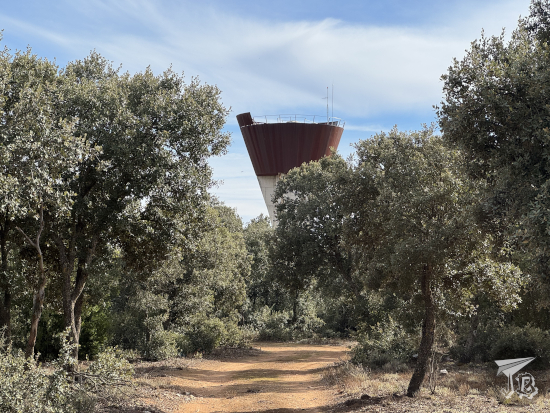
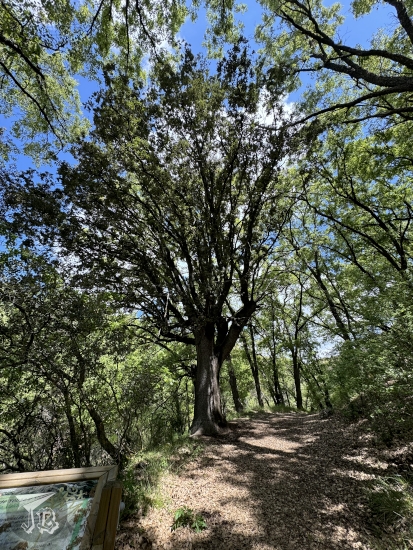
Afterwards, I crossed the road to explore the not-so-small Portuguese oak (Quercus faginea) forest along the cow path. The trail also goes above the main road, and it’s not accessible by car. It felt like a very nice place to explore in spring, though I can’t tell how many cows one would run into these days (and I’m okay with no more encounters of the moo kind). I wandered around for a bit, then headed back towards the car.

The cow path, still in summer colours.

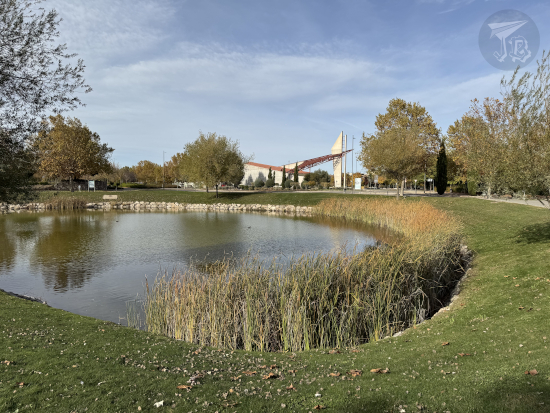
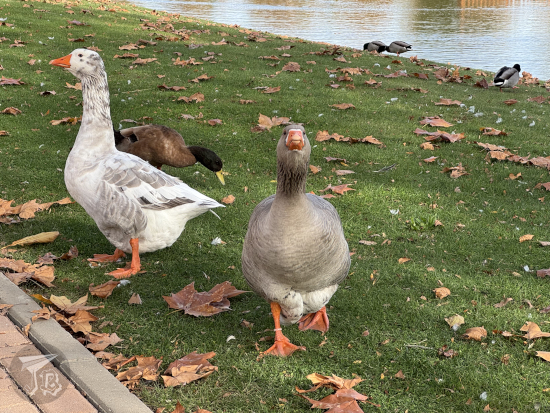
There was still a serious lack of autumn colours, but that was over when I reached Ciudad Valdeluz itself, a neighbourhood of Yebes. The local park Parque de la Paz y los Derechos Humanos did have trees that had turned gold, brown and red. There was also a pond full of fish and waterfowl, particularly a couple of very opinionated geese who quacked their disapproval that I was not carrying any snacks for them – the pond had until recently been quarantined due to avian flu, but the sanitary cordon had been taken down now.

Lake in the public park.

Geese and ducks. One of the geese is honking and almost launching itself at the camera.

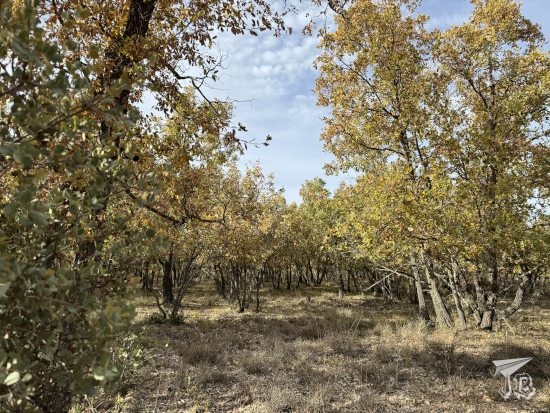
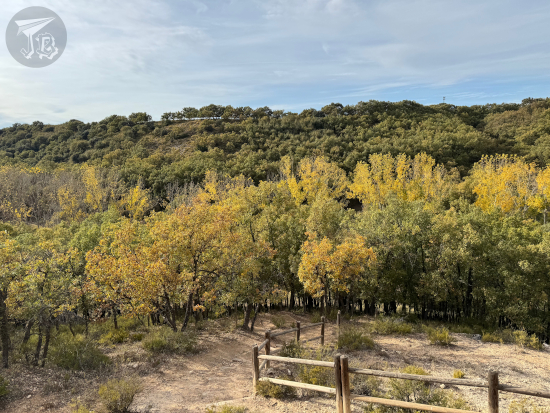
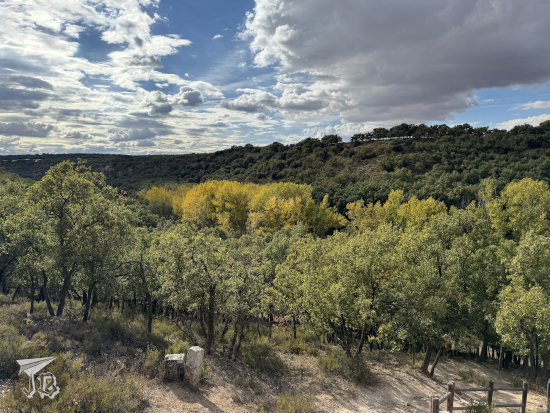
I continued on towards the Bosque de Valdenazar, mainly composed of Portuguese oaks (Quercus faginea), holly oaks (Quercus ilex) and a few riverbank species. The only animals I’ve ever seen are red squirrels (Sciurus vulgaris), but I’ve spotted some deer and boar tracks. The Portuguese oaks actually seem to just be a continuation of the part that I had seen on the other side of the road, along the cow path. It strengthened my idea that I need to explore the Cañada Real de Las Matas better. Unlike that area, the little forest was packed, including couples taking romantic pictures and families with young kids. The weather was nice, so there were quite a few people having a picnic. The colours were slightly more golden than the previous time, but not much. Since it was a Sunday and there were people around, there was no chance to catch a glimpse of any wildlife, so after taking the standard walk, route Ruta SPG-24, I left, hoping not to catch much of a traffic jam on my way back to the city.

The Valdenazar forest in autumn, seen from the viewpoint, halfway through turning gold

15th October 2025: The Antiqvarivm at Complvtvm (Alcalá de Henares, Spain)

Though October is usually my holiday month and I can go on long trips (such as Türkiye in 2024), this year I came across an unexpected project. That means extra money, but less time, and even though I had a blast in Loarre and Zaragoza, it was not really a holiday. I decided to take a day trip before the weather turned and work took over. I mulled over several ideas, and in the end I came down with two – basically an urban day trip or rural day trip, and in the end, I decided to go for the urban trip. A while back (longer than I thought), I visited Complutum, the archaeological remains of the Roman town which stood underneath what today is Alcalá de Henares. That time, one of the main buildings was closed off due to archaeological works, but it was now open. Furthermore, the city has recently opened a new museum. These factors pushed me to go there in the end. It helped that I needed to do some shopping.

The Romans first established provinces in Hispania around the 200 BCE, after the second Punic War. In the year 19 BCE, the first Roman Emperor, Augustus, formally added the Iberian Peninsula to the Empire. Despite some strife, Spain remained part of the Roman Empire until the latter collapsed in the 5th century CE. There’s a lot that Spaniards owe to the Romans, including a good road system, aqueducts and waterways, and lots of mosaics, a good number of them in the MARPA.

The city of Complutum was founded in the 1st century CE, and greatly expanded through the 3rd century. At the turn of the 2nd century, during the Christian persecution, two children were killed and are now considered martyrs. Unlike other sites, the city was never really abandoned, just gave way to newer civilisations and it was built over. During the 19th century, the archaeological sites were pillaged, and between 1970 and 1974 a lot of the remains were destroyed to build new dwellings. The archaeological site received protection from the 1985 Heritage Law, and further recognition as Cultural Asset (BIC) in 1992.

I did not feel like driving in the chaotic Alcalá de Henares traffic, especially now that they’re having construction along the main avenues, so I parked the car a bit away and walked – this is something I do when I go to the centre. The weather was nice so the 40 minutes did not feel long. I visited the three main spots: the larger archaeological site Ciudad Romana de Complutum, the new museum Antiquarium and, since I was not crazily far, the house Casa de Hippolytus.

I first headed off towards the Antiquarium, the “new” museum. I call it new because it has opened in 2025, though the building had been erected over a decade earlier at the very least. It is a large space which hosts some of the elements recovered in recent excavations – though due to the general pillage of the site in earlier centuries and all the losses due to modern construction, it is not as rich as it should be in its own right. There are two key elements in the museum – room F of the House of Griffins, and the mosaic of the Winning Chariot Racer.

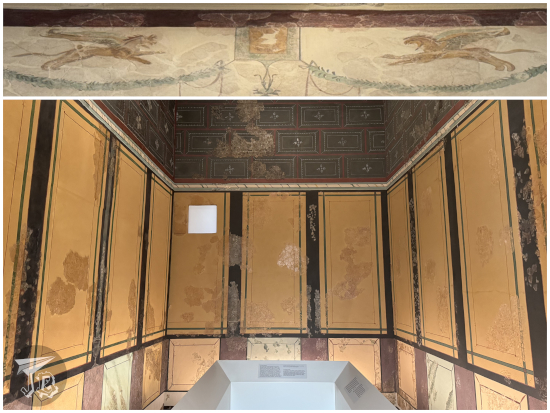
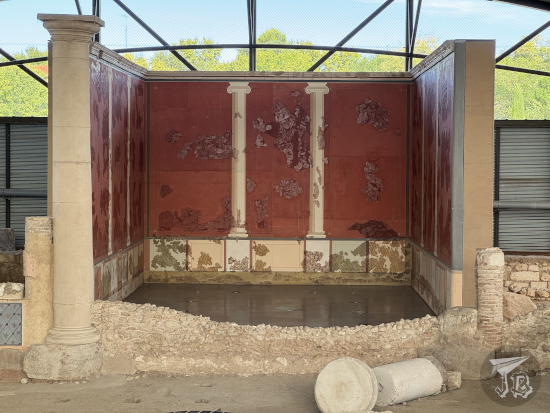
The House of Griffins, Casa de Los Grifos, is considered the best example of Roman mural painting in Spain. It was a large domus of 17 rooms at least. It was built in the 1st century CE, but it burnt and collapsed in a fire at the beginning of the 3rd century. Outside of Pompeii, it’s probably one of the best preserved houses I’ve ever seen, even if it is in two places. The room moved to the Antiquarium names the house. Amongst other mythological representation, the entrance is guarded by two griffins, animals with the head of an eagle and the body of a lion, facing each other.

(Collage) Casa de los Grifos - Roman chamber painted in yellow and black. The upper part of the collage shows the two griffin that name the house facing each other.

The other key exhibit is the mosaic El Auriga Victorioso, which was found in an outskirts villa where Romans bred horses. The museum has woven a whole story around the mosaic, to the point that you could actually believe that everything they tell you about the hypothetical character is based on facts instead of just speculation.

Roman Mosaic of an auriga, missing a chunk. The art depicts the auriga and four horses.

Outside the building there is a fountain Fuente del Juncal, part of the water distribution system of the city, channelling water from the nearby river Río Henares. It was heavily restored in the 19th century, so there is no way to know how it looked originally.

Old fountain with a small pond in front

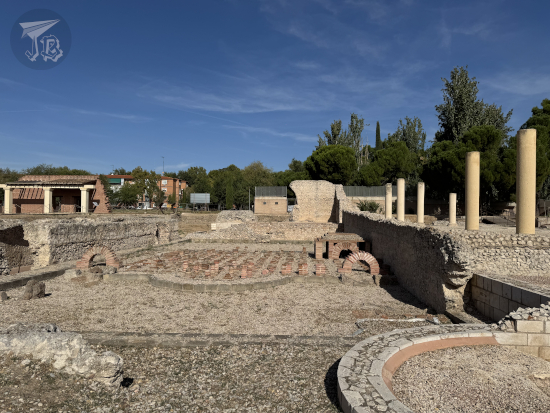
After the museum, I headed to the actual city to see the rest of the House of Griffins in situ, in the Ciudad Romana de Complutum Roman city. The vermilion walls which still stand were probably painted with cinnabar from Almadén. However, it was difficult to see from afar what parts were original and what had been restored. Other spaces that can be seen throughout the city are the foundations of a dwelling block, the forum and the therms. Two spaces require a lot of imagination – a piece of wall is supposed to be where the child martyrs Justus and Pastor were killed, and the restored auguraculum, where the oracles worked.

Casa de los Grifos in situ - a red chamber with painted columns

Ruins of the Roman City of Complutum

The last time I visited Complutum, the Antiquarium had not opened and the House of Griffins was closed due to excavation works there. I did visit the other house Casa de Hippolytus, which was completely accessible. However, since I was nearby, I decided to get there again. They have a very cool mosaic with Mediterranean fishery themes, including a moray eel, an octopus, a dolphin and a very-accurate lobster. Interestingly enough, Hippolytus was not the owner of the house, but the artist who signed this mosaic.

Fish mosaic, Casa de Hyppolitus

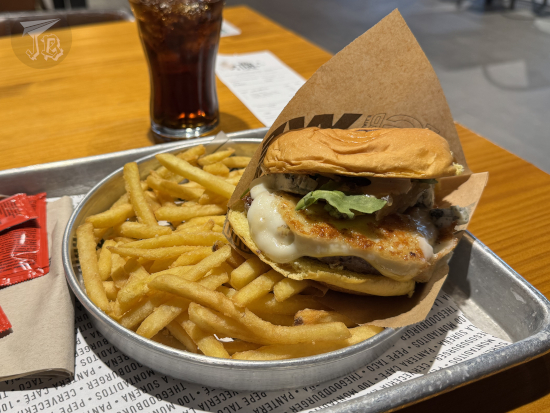
I headed back towards the shopping centre where I had left the car and went into a The Good Burger there, because I am very partial to their Cheese Lovers hamburger (and their soda refill policy). They had a menu option so I decided to go with the chips – I had the choice between chips with salt and chips with salt (and that’s not my typo). The burger in question is garnished with American cheese, goat cheese, Gorgonzola cheese, poached onion and honey-and-mustard sauce. Lots and lots of cheese, for real.

Actual cheese burger - a burger with a lot (and I mean a lot) of cheese, and chips.

I did not do much afterwards. I bought a few items I needed and headed to the car to drive home.

10th October 2025: Too early for autumn: Bosque de Valdenazar (Yebes, Spain)

A friend phoned me for a day out, and I gladly agreed. Their idea was to check out the small forest Bosque de Valdenazar, in Yebes. We were hopeful for some nice autumn colours, but as it turned out, we were a tad bit too early for them.

We both had done the route before, myself back in May. The forest is supposed to be astonishing in fall, with plenty of gold and red leaves. Unfortunately, weather in 2025 has been crazy, with summer-like temperatures right up to late October, so most trees were still green, and they would probably just lose their leaves before they could turn gold. I am not a fan of autumn weather, but the colours are pretty – I ended up taking another go later, even.

The route Ruta SPG-24 has recently gained traction as a pretty spot since the town hall fitted it around the neighbourhood called Ciudad Valdeluz. The population of the area has been steadily growing lately due to lower housing prices and an increase of services offered. But maybe, the biggest impulse that the Route had might have been that the local park has been quarantined due to an avian flu outbreak – everything was cordoned off.

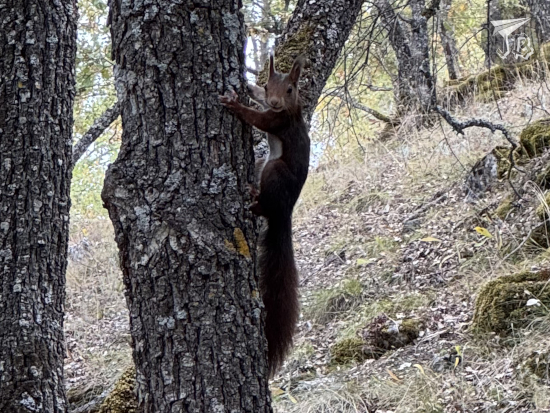
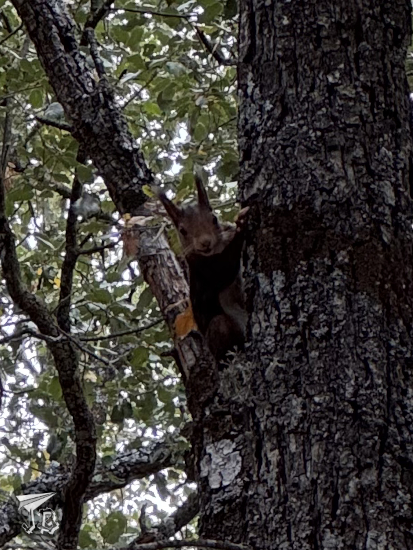
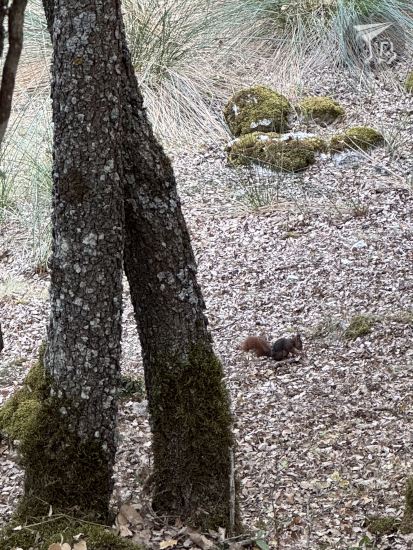
During the walk, which takes less than an hour, we spotted some red squirrels (Sciurus vulgaris). These rodents live on trees and enjoy nuts. In Spain, it is said that they love acorns – or at least, hoard them in autumn so they can feed through the winter. As a good part of the forest is composed of oaks, these two have a good chance to survive. We thought they might be a couple, but it turns out that squirrels just mate sporadically when they’re in season, so they were just neighbours, as red squirrels are not territorial.

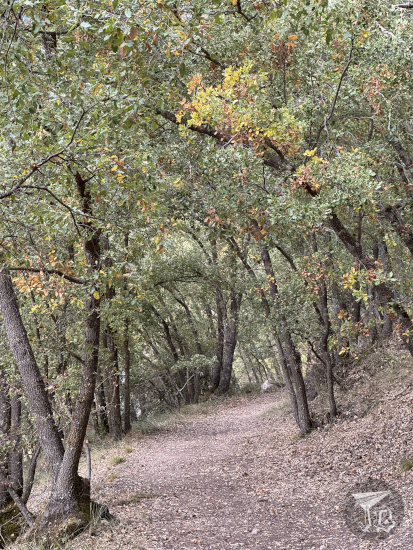
A view of an oak forest. Most of the trees are greyish green, but osme of them have started turning a bit yellow with autumn.

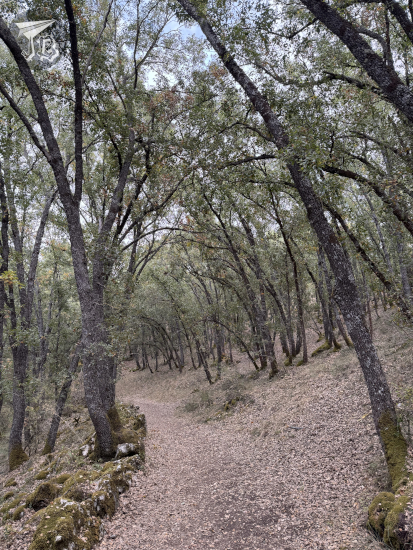
A path in an oak forest. The trees seem to arch over it. Some have started losing their leaves, which has carpeted the path with them. The trees have started showing yellow, brown and reddish colours, but the leaves on the ground are all brown-grey.

A red squirrel looks at the camera from a tree trunk.

A red squirrel peeks at the camera from behind a tree trunk, only its upper body is visible, but it seems to be smiling.

A red squirrel gathering acorns from a leaf-covered ground.

A path in an oak forest. The trees seem to arch over it. Some have started losing their leaves, which has carpeted the path with them.

We did not let the lack of autumn disappoint us, and grabbed the car to go back to town and enjoy some pancakes in a local café.

5th September 2025: Ara Malikian. Conciertos de la Muralla, Alcalá de Henares (Spain)

The “Wall Concerts” Conciertos de La Muralla is a late-summer music festival that takes place in Alcalá de Henares. As far as I have learnt, it has been going on for almost a decade, with “artists of the highest level”. I’ve only heard about a handful of the musicians that have played there, but I’m not much into the Spanish music scene. A while back, I read that violinist Ara Malikian would be making a stop in town as part of his promotional tour Intruso.

When checking for tickets, I found a lonely fifth-row empty seat in the arena, too good not to be bought. The show was to be held in the outdoors area known as Huerta del Obispo, where Alcalá de Henares also carries out its RenFair. Since tickets and seats were numbered, there was no need to queue or be there early. Though the show was outside and I was prepared for chill, it turned out to be just a bit windy so I did not need the extra layers of clothing I had brought with me.

Born in Lebanon to an Armenian family, Ara Malikian started playing violin in early childhood. He was good enough to give his first concert and 12 and be invited to study in Germany at 14. He went on to play with and for the best orchestras in the world. He has published 30 albums, composes, and covers classical and modern pieces.

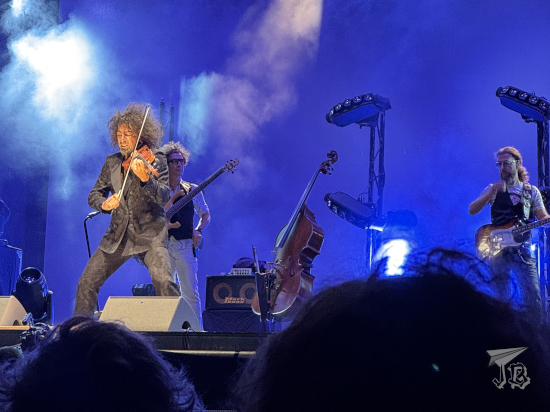
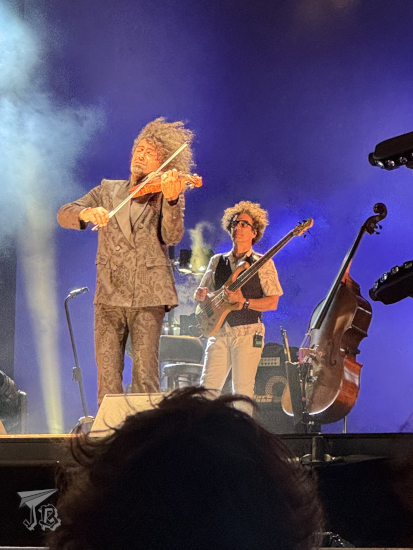
His stage persona is outlandish, with crazy hair and clothing. He tells stories on stage that are a little real and very embellished with fantastic details, to the point that you’re not even sure if the outrageous titles he’s quoting for the setlist are even the actual ones beyond the covers of famous composers and musicians.

Ara Malikian playing violin

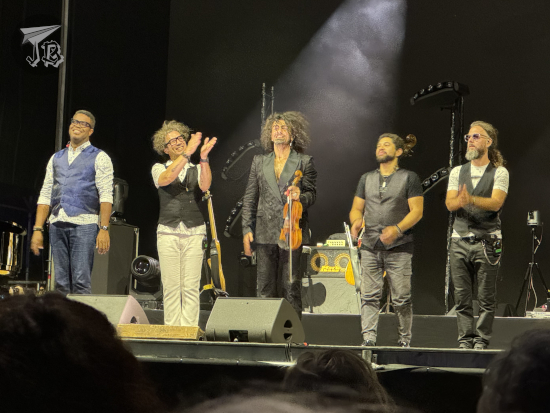
For this gig, Malikian was accompanied by drums, piano, guitar / bass and cello. He played alongside a quartet of Cuban musicians, whom he claims met in Havana 30 years ago. After he received a scholarship to go to Cuba to play a “contemporary piece” he did not prepare, he met these young artists who had not rehearsed either. Together, they decided to improvise while the composer yelled “imposters” and “pigs” at them, thus the piece being now called “Concert of Pigs and Imposters” Concierto para cerdos e impostores. The ensemble comprised Iván “Melon” Lewis on piano, who almost died a couple of times choking on his own laughter due to the bizarre stories that the violinist told; Ivan Ruiz Machado on classical double bass and regular bass; Georvis Pico, specialised on jazz, on drums; and finally Dayán Abad García on guitar.

Ara Malikian playing violin

Thus, Ara Malikian claims such titles as the aforementioned “Concert for Pigs and Imposters” or “Ratboy” (Niño Rata) or “Rhapsody of not doing anything” (Concierto Rapsódico de No Hacer Nada). The first comes with a tale of a quartet of musicians improvising with him on stage in spite of the composer of the piece they were supposed to play hurled insults at them. The second derives from a crazy story about being hired to stand in a bar and not doing anything to create curiosity amongst the patrons.

Ara Malikian playing violin

There were covers of famous composers, both classical – such as variations of Niccolò Paganini’s Caprice No. 24 in A minor – and more modern, like Paco de Lucía’s Zyryab. The concert ended with a beautiful song called Nana Arrugada (Wrinkled Cradle Song). All in all, I enjoyed the concert very much – though I could not find a believable setlist to compare my information anywhere.

Ara Malikian and his support musicians performing

My seat was honestly fantastic, and not even the wind could spoil the sound or the ambience. If any complaints, the fact that people seem not to understand that if they enter the area at 20:00 and drink a huge glass of beer, they are going to need a toilet before the concert is over – making everyone around them stand. Also, a concert might not be the best place for random people to yell political slogans…

Ara Malikian and his support musicians waving at the audience after the concert

I had a good time, and when the show was over, I walked around the city centre to see if there were any monuments lit up. There were some, and the main street was packed with people enjoying the last days of summer. I thought I would get some frozen yoghurt, but there was a queue. Thus, I decided to wait until I got to the ice-cream parlour a bit further up the street. Even a longer queue. And at the last parlour, it was even longer than both of the other two combined.

Façade of the classical University of Alcalá de Henares under a full moon

It became less crowded when I left the pedestrian area, but there were enough people so it did not feel dangerous to walk to the car – despite the town having been on the news due to violence a few times in the few previous weeks.

I was home before midnight, not even extremely tired. Since I had to do some shopping before the concert, I decided not to combine it with any visits or anything. And as there had been no ice-cream for me, I ended up having some home-grown watermelon I had been gifted…

6th July 2025: Brihuega, Yela & Cívica (Spain)

I was supposed to go to Madrid, as I had a free ticket to see the restoration of the façade of the local museum Museo de Madrid up close, but I ended up cancelling due to having been in Madrid the previous day. I really did not care much about the visit, but I had signed up because it was a limited-time thing, and to be honest, I get FOMO when I read “for so long only”. However, I had heard somewhere that there was a chance that the lavender fields would be left fallow the upcoming years, so I guess I felt FOMO in the opposite direction. I had already visited the lavender fields in Brihuega, collectively known as Campos de Lavanda de Brihuega during sunset a few years back, and while in theory the view is prettier, I found that the lavender did not look… purple enough. Maybe it was the angle of the light, maybe it was too late in the summer already, but the flowers looked greyish. Thus, I wanted to see them during normal light once.

The lavender sown around Brihuega is Lavandula angustifolia, a herbaceous plant native to the Mediterranean areas. It grows in small bushes with narrow leaves, and it is popular for its uses – it can be applied in traditional medicine, in the kitchen (as herb or tea) and commercially, to produce lavender essential oil, which has hundreds of cosmetic uses: perfumes, soaps, balms… While it was the region of Provence, in France, which put “lavender watching” out as an activity, for the last 15 years or so, the village of Brihuega has made a name for itself during July as a tourist destination.

I drove to the fields and I reached the makeshift parking lot around 9:00, when there were few cars and just a bus of tourists. I wandered around for around an hour and a half, doing my best not to damage the plants and get a good picture or two – including macros of bees. For the first while, I stayed in a smaller field to listen to the sounds, but then I moved onto the bigger fields for better views.

An inmense field full of purple lavender flowers with some patches of green because the photographer is too short to get the great angle with endless purple

Lines of flowering lavender bushes that reach the horizon

Close up of a lavander plant and a blurred background of endless purple

Close-up of a bee on a lavander flower


When I felt I was done, I hopped back on the car and set off towards a nearby place I had always wanted to see. The Sat-Nav sent me through Yela, a tiny hamlet with a Romanesque church Iglesia de Nuestra Señora de los Llanos and two medieval fountains. Technically, it is a neighbourhood of Brihuega, and it has a horrible road. However, it was still better than driving through Brihuega itself, which I had to do on my way back.

Reconstructed Romanesque church

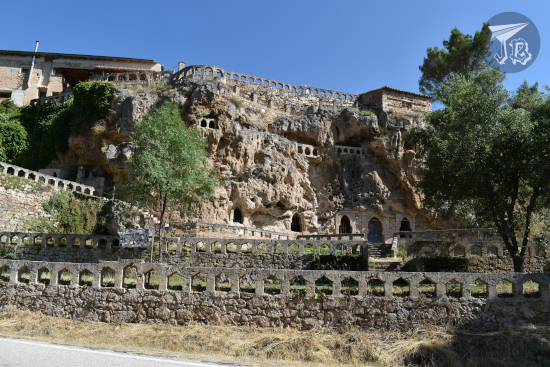
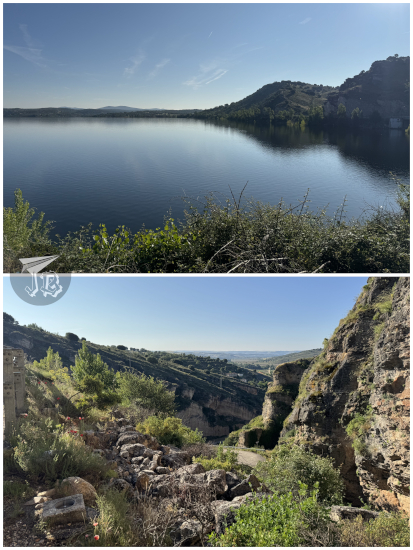
Fortunately, I did not come across any other car in the opposite direction, but I did breathe in relief when I got to the larger road, from which I accessed Cívica, population 14. There are remains of a Roman villa, and in recent times rumours spread of Medieval knights and Jews in hiding, but this Brihuega district is famous due to a structure built in the mid 20th century.

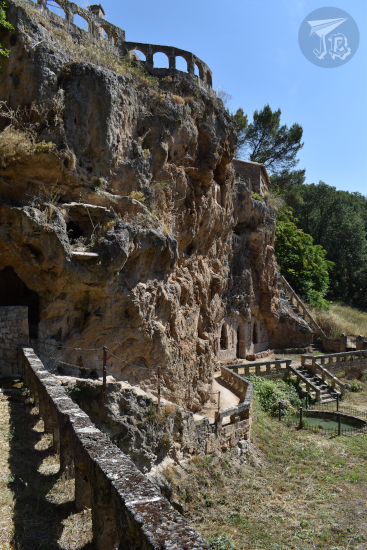
Though quite a few websites rant on about the “mysterious ruins” in the hamlet, their history is well-documented and widely known in the area. Between 1950 and 1970, a priest from a nearby village convinced a number of neighbours to buy the rocky land lot and work on it. He wanted a sanctuary, a bar, a chapel, all of the above at the same time. It was to be a magnificent complex. What the priest managed was to transform a karst rock wall with natural caves into an interesting façade with carved interiors that would serve for celebrations and debauchery. During the 1980s, it was all the rage amongst celebrities and rich people to go partying there, though it eventually lost its importance and closed down. Its ownership was inherited by a group of siblings who did not find it worth of any effort. A few years ago, it was bought by an entrepreneur who hopes to turn it into a rural hotel – and who shows it around at weekends for 2 € per person. There was a phone number to contact them for a visit, but I had no signal. Fortunately, I ran into the owner as he was starting a visit, so I joined in.

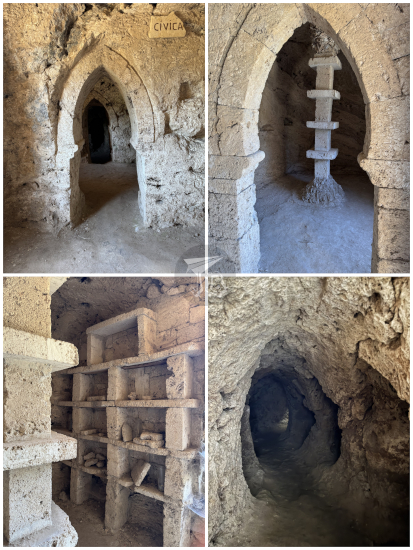
The façade of what can be called Caserío de Cívica has several arched doors (similar to the Visigoth arches in the Brihuega wine caves), balconies and stairs. The interior hosts bars and shelves. Deeper areas, the original caves, can double as wine cellars where drinks could be kept cold when they were still served. Though the Internet keeps saying that “the ruins are abandoned”, this is no longer true – they can be visited by appointment or at the weekend, especially if you are lucky enough to have signal to phone the owner so he shows them to you.

First we were shown the original bar, outside the property itself. Then we went in towards the second bar and the “caves”. Afterwards, we visited the party area, including the booths, which today are a dishevelled garden. Finally, we climbed all the way up to the modern caserío (homestead). Thus, the visit starts on the ground floor, next to the road, and you ascend through the different levels – the garden, the balcony and the upper area, where you can actually walk into one of the natural caves used for food storage in the past. To be honest, after reading so many conspiracy theories on the Internet, hearing the actual mundane story of the “ruins” was almost disappointing. However, it was really cool to check the inside, something that could not be done before – at least not legally.

Cívica, a venue built into a vertical wall, with balaustrades and balconies, from the ground

Cívica, a venue built into a vertical wall, with balaustrades and balconies, from the garden

Cívica, a venue built into a vertical wall, with balaustrades and balconies: walking around the balconies, which were carved into the rock itself

Cívica, a venue built into a vertical wall, with balaustrades and balconies: walking into the halls and tunnels

After the tour, I hopped into the car, and the Sat-Nav directed me back through the village of Brihuega itself. If driving there is difficult already (I ended up having to park outside the town last time), with the lavender activities, and it being a weekend, traffic was chaos. I was lucky I had the right of way so I could leave quickly, and I was soon on the speedway, having watched the lavender and learnt the secrets of Cívica.

8th June 2025: Atienza & its Drove of Horses (Spain)

Though today Atienza is a remote village with fewer than 500 inhabitants, during the Middle Ages it was an important fortified villa. It was a strategic site in Castile, close to the frontiers to both Aragon and Muslim-controlled areas.

When Sancho III of Castile died in 1158, his eldest son became Alfonso VIII of Castile, being three years old at the time. It was a time of instability, a civil war broke between the two most important Castilian noble families, and the neighbouring kingdoms took over territories and cities taking advantage of the situation. The young king was hidden in several towns to protect him from “the enemies” by several “allies” – who the loyal guys were depends on the story you read. One of the hiding spots was the villa of Atienza.

The king of León besieged Atienza in order to retrieve Alfonso. In order to get him out of the city, on Pentecost Sunday 1162, the Brotherhood of Muleteers requested permission to hold a short pilgrimage (romería) to the small hermit church outside the walls. The attacking army agreed – religion is weird, I guess – and the muleteers snuck the royal child out of the villa. The fastest riders then galloped for seven days to get the king to safety in Ávila. The scheme worked, and Alfonso lived until 1214.

Nowadays, the Brotherhood of the Holy Trinity Cofradía de la Santísima Trinidad carries out a similar pilgrimage, in traditional clothes, on Pentecost Sunday to “honour their ancestors and their feat”. There are several events: a cavalcade – the romería on horseback – a mass at the hermit church, a communal meal, dancing, and at the end of the day, a joust tournament. The whole festival is called “Drove of Horses of Atienza” Caballada de Atienza. As I was driving past the village on Saturday I thought that maybe my sibling would be interested in dropping by, and could do the driving.

On the way, now that I knew where to park, we could stop for a little while next to the reservoir Embalse de Alcorlo, whose dam was opened back in March so it became part of the reason the river Río Henares had so much water. The reservoir was still pretty full.

Alcorlo Reservoir, bustling with water

It was clear from the get-go that we would only stay for a couple of hours. Since we were improvising, staying for the whole thing, without lunch reservations or a definite plan, in the heat, would not have been a great idea. I just wanted to get the gist of how the festival went and how many people there were. Surprisingly, not as many as I thought. We dropped the car off at the entrance of the village and followed the signs towards the centre. We knew we were going in the right direction when we started seeing horses.

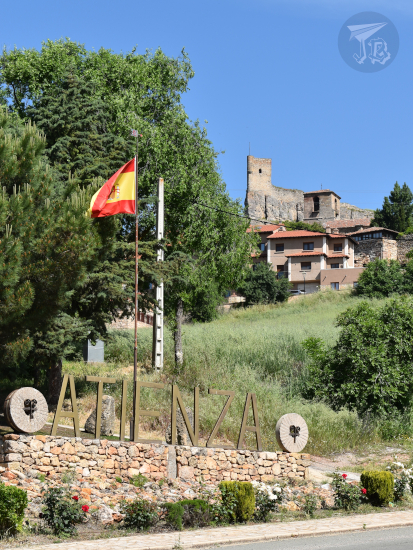
Entrance to the Medieval village of Atienza, with the name of the village, the Spanish flag and a castle in the background.

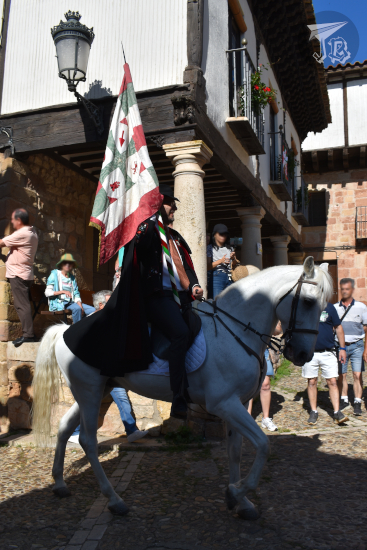
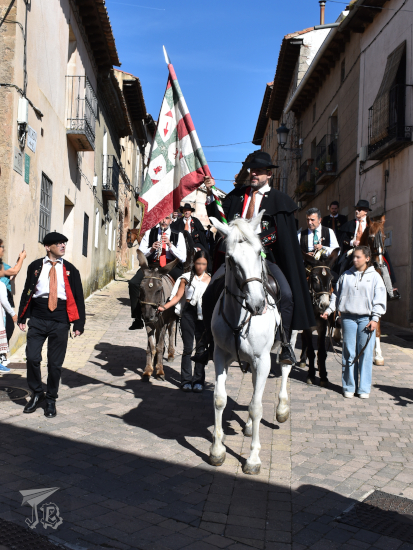
The festival starts at 10:00. The Brotherhood is called into order and they bid to carry the flag and open the pilgrimage behind the musicians. The brothers wear black suits and some are allowed to wear capes – not sure how the horses feel about that. This happens in a narrow street with way too many people and nervous horses. We decided it was safer to stay at the corner rather than trying to approach the scene – we had already witnessed a couple of them getting spooked by oblivious passers-by.

Caballada de Atienza: Horse parade in a Medieval Village. Senior brother carrying the flag

Caballada de Atienza: Horse parade in a Medieval Village. Three riders with to hats and black capes.

Caballada de Atienza: Horse parade in a Medieval Village. Senior brother with the flag, followed by musicians on mules.

Caballada de Atienza: Horse parade in a Medieval Village. Two lines of brothers along a street.

We watched the departure of the pilgrimage, and then jogged to a couple of other places for photos. We decided not to follow the cavalcade to the hermit church, because the return would have been at noon – way too hot. We waved the riders goodbye next to the remains of St. Francis’ convent, the ruins of a Gothic apse Ábside gótico del convento de San Francisco.

After the romería rode off towards the hermit church, we decided to explore the village a little. We went back to the Old Town Casco Antiguo de Atienza to have a look at the local monuments. We crossed the Medieval wall Muralla de Atienza through the arch Arco de la Virgen.

Atienza Medieval Walls

The Main Square is called Plaza del Trigo (Wheat Square), surrounded by traditional architecture, including the old council houses, a covered gallery, and the church of Saint John The Baptist Iglesia de San Juan Bautista. The current church was erected in Renaissance style in 16th century by architect Juan de la Sierra, to serve as substitute as the previous Romanesque parish.

Atienza Main Square: Plaza del Trigo, in severe Castilian architecture

Church of St John the Baptist, with a baroque altarpieceand rebuilt plaster vaults

Next to the church, serving as an exit from the square, stands the arch Arco de Arrebatacapas, the cape-stealing arch. Due to the configuration of the two squares it joins, a wind tunnel forms in the small alley – known to blow away capes or any other unsecured piece of clothing.

Medieval arch in Atienza

From an alleyway we got a good view of the castle – I’ll leave the visit for another time, when all the museums are open, and it is less hot. On the way out, we had a great view of the whole villa before we drove back for Chinese food and cold drinks.

Ruins of the Atienza Castle

11th May 2025: Ruta SPG-24: Bosque de Valdenazar in Spring (Yebes, Spain)

After the rainiest spring in ages, I had a couple of hours in a free morning – or actually, I just needed to do something for a little bit before I could become productive again. And the Internet helped supplying the information of this little route that could be done in under a couple of hours.

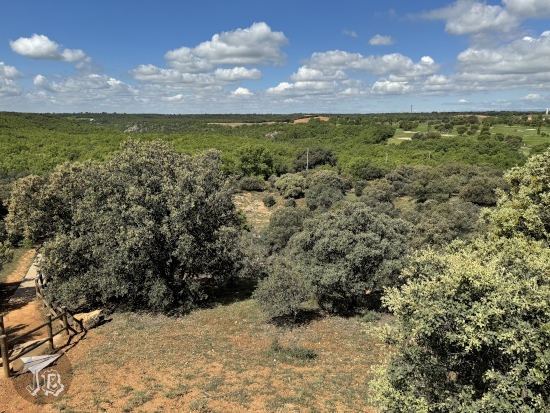
The route inches into the oak forest Bosque de Valdenazar, mainly composed of Portuguese oaks (Quercus faginea) and holly oak (Quercus ilex). The track was designed and is maintained by the municipality of Yebes. It delves into the forest and runs parallel to a small stream with bulrushes (Scirpus holoschoenus), rubuses and black poplars (Populus nigra). The area is home to roe deer, small raptors, and foxes, but none of them were around to be found – probably due to screaming kids. I did see some deer tracks.

It felt a bit silly to drive somewhere for a walk, but it was the only way to get there. Google maps was missing three roundabouts, but my Sat-Nav got me there without a hiccup – and considering that I’ve needed to MacGyver a stand for it because the wire keeps coming loose, I think that’s a feat. I parked at the entrance and set onto the hike.

The first stage was a small picnic area, after which came a bit of a steep slope with makeshift stairs. The route is mostly circular and I thought following the arrows was the way to go. At first I was alone, but then I started running into other walkers. The problem was that of course, they were chatting – and the families being a bit loud – and that made any possible fauna sighting impossible.

Valdenazar forest pathway

Valdenazar forest, start of the route

I had a look at what they call the carboneras, a bunch of oak trees that were repeatedly cut and slow-burnt to create carbon. That caused the living trees so they had strange-looking trunks, with several thick branches growing from the stumps. I found the viewpoint to look at the whole valley for a bit, before I walked into the actual forest. There is a wide track that feels a bit like the forest near The Shire in The Lord of The Rings, with the light sweeping through the leaves and the light breeze.

Valdenazar forest trail

Valdenazar forest

Valdenazar forest trail

I reached the stream and deviated to a sub-track known as Senda de la Fuente (Fountain Trail), parallel to the water flow. I expected an actual fountain at some point, but there was just a small waterspout. After that, it was just a bit of an uphill walk to get to the picnic area again.

Valdenazar forest trail

All in all, I was there for about an hour and a half. It was pretty but not the spectacular walk I had read about. I’ve read that it is incredible in autumn, so I might have to check it out again by then, but the truth is that the weather has been crazy in 2025, so I’m not sure we will even have an actual autumn… But all in all, the hike was nice and it cleared my head, which was exactly what I needed at that point.

15th April 2025: Kinetic art and Egyptian replicas (Guadalajara, Spain)

Rain and school holidays having thwarted my hiking plans yet again, I decided to make the most of half a non rainy morning when I was going to be around Guadalajara to check out a free exhibition and the museum of a local artist.

Francisco Sobrino (1932 – 2014) was a conceptual artist whose sculpture can be framed into the kinetic art and constructivism styles. The museum Museo Francisco Sobrino hosts some of his smaller works, mostly in colourful vinyls and experiments with materials, textures and light. Pretty colours and shapes, but I guess you need more knowledge of art than I have to appreciate the works and see… something different from pretty colours and shapes. But the museum is free and it is hosted in a historical building, the former slaughterhouse, built in traditional brick and stone. Though I’ve been around a few times, I’d never visited it before…

Francisco Sobrino Museum Guadalajara

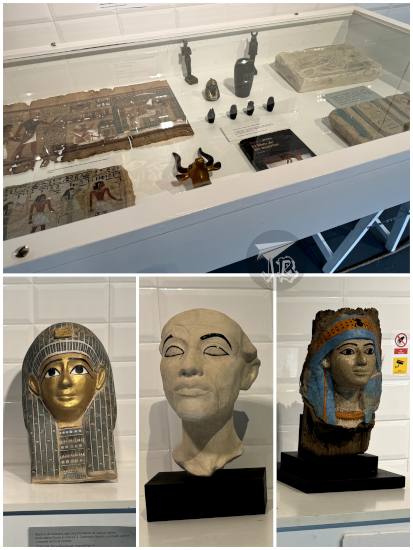
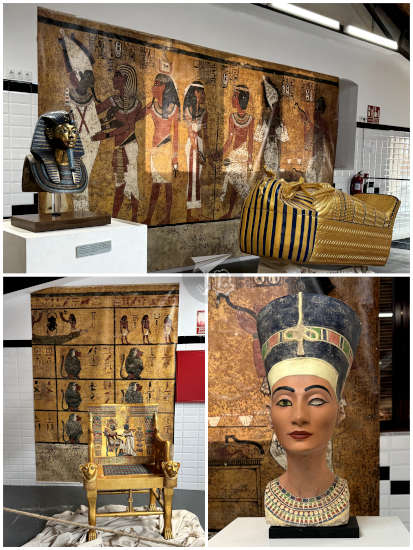
The exhibition on Ancient Egypt and King Tutankhamen’s tomb Tutankamón Secretos Revelados: La Exposición (Tutankhamen Secrets Revealed: The Exhibition) was endearing but lacking. It was located in another historical building, the traditional market Mercado de Abastos. It used to be a very successful local market, but the vendors lost most their clientele when it was closed for a few years to turn the place into a culture and bar hub. It was not successful at all, and now it’s a sad-looking place. The top floor hosted the exhibition, with a few posters with information and pictures, one of them being a very buff Anubis from the video-game franchise Assassin’s Creed. There were a few display cases with reproductions of Egyptian antiquated from private collections and books on Egypt. The largest part of the exhibition was a reproduction of several items found in Tutankhamen’s tomb: the wall paintings, a golden chair and the gold-plated sarcophagus. There were also a reproduction of the funerary mask, a brass tray and anything golden the curators seemed to have at hand, including a scarf. And the bust of Nefertiti for some reason.

Tutankhamun Exhibit Guadalajara

Tutankhamun Exhibit Guadalajara

I’m not going to say I was disappointed or that I expected more, it was a cute little exhibition that tried to do its best. Unfortunately, some of the information was inaccurate or outdated – they were showing a video from the 1980s, and archaeology has evolved a little since then.

However, I am still cackling at the low-resolution buff Anubis…

6th April 2025: Birds of Prey experience with Emociones Al Vuelo (Aranzueque, Spain)

The 2025 Medieval fair in Tendilla had fewer animals than usual, as the farm was not there on Sunday. However, there was a stand by a birds-of-prey rescue. I was sad I had missed the demonstration on Saturday till I got talking to the lady there. It turned out the rescue had visits. And activities. And activities you could book and pay for. This is important because animal interactions tend to favour kids, which is good for environmental education and all, but makes me jealous…

Emociones Al Vuelo is an education centre and birds-of-prey rescue / charity established in the small village of Aranzueque. It was set up in 2016 to fill a gap and take care of birds which could not be recovered nor released into nature due different circumstances – for example, a kestrel born in the wild, but taken as a chick to be sold in the black market. Or what’s even more shocking to me, hybrids! There are weirdos out there JurassicWorld’ing birds of prey (Your scientists were so preoccupied with whether or not they could, they didn’t stop to think if they should. Creepy). These animals often bounce from home to home as hunters acquire and then get rid of them, until the rescue intercedes. The rescue also takes care of animals that used to belong to negligent owners, with broken limbs, or out of breeders’ hands.

The organisation seems to be doing a good job. The birds looked relaxed and were allowed to… basically ignore their “jobs” until they were properly bribed with food, and if they did not want to “work”, they were properly excused. All the birds are tagged and have their names – all of them kind of nerdy: Star Wars, Game of Thrones… They seem to be quite comfortable with the handlers and with the strangers most of the time.

There are three ticket tiers: “basic”, “fly an eagle” and “emotion pass”, which allows you to hold – or be a perch for – five of the tamest birds, and fly the eagles on top of that. I decided that since the tickets were to support the rescue, I would make the sacrifice and get the highest tier… And we all know I’m lying, I totally got the highest tier because I was dying to play with the residents.

Birds of prey, sometimes called “raptors”, are a group of bird species who actively hunt and eat other vertebrates. These strict carnivores are fast flyers, have acute vision, and sharp talons and beaks to help them hunt. Some of them are also scavengers or piscivores. In general they’re characterised as active predators. Though the term “bird of prey” is not really “scientific”, it is very visual and easy to understand. They range from the smallest pygmy falcon, with a wingspan of around 40 cm to the largest Andean condor, whose wingspan can reach 3.3 m. In general, male and female of the same species are different in colours, and at the very least in size, with females usually bigger and stronger, even if usually raptors are lighter than their feathers make them look – on top of feathers having next to no weight, birds have hollow bones to help them fly. Fun fact: nocturnal raptors tend to have dark eyes, diurnal ones light-coloured eyes, and those which are active during dawn and dusk have reddish or golden eyes.

Birds of prey have been used for hunting – falconry – for over 4,000 years, with the earliest references coming from Mesopotamia and Mongolia. Writings from the 7th century CE describe it as widespread in Asia, but as it seems that nothing ever existed before the Europeans found out about it, one has to wait until Frederick II, Holy Roman Emperor (1194 – 1250) wrote his treatise On the Art of Hunting with Birds for it to become commonplace. During the Middle Ages, falconry became a symbol of power and status, especially for recreational hunting, until the raptors were substituted by firearms. Falconry became popular again in the 20th century, and in 2010, it was added to the UNESCO List of Intangible Cultural Heritage of Humanity.

While the birds in Emociones Al Vuelo are somewhat trained to at least tolerate human presence, what the rescue does cannot be considered falconry. The birds fly from protective glove to protective glove in search of treats, but they are not really trained for tricks. One of the things that we visitors were told is that the birds “fly off” the gloves, not made to take off, as you see in films.

I arrived in Aranzueque around 9:35 for the 10:00 show, with gates at 9:45. It was a crispy morning, but it had been raining all March, and finally there was sun and a decent forecast. I was wearing layer upon layer anyway, and was happy to shed them off as the day warmed up. To be honest, when I booked the place, I did ask if there would be a rescheduling should the weather be miserable, but aside from some mud on my boots, I had nothing to worry about.

Once gates opened, visitors parked inside – people from the rescue have maximising parking space down to an art – and checked in. I had paid when I booked, and I received a lanyard pass and a paper bracelet.

The base activity lasts about three hours. The guests sit on benches arranged in a circle under a tree – I found a spot and made sure my back was to the sun for pictures. There was a brief introduction of very logical rules for the animals’ wellbeing. The activity – I feel reluctant to call it a show – brought out 14 birds of nine species and I got to interact with five different species, and a total of six – seven animals.

The first bird to come out was Sansa, the (Western) barn owl (Tyto alba). Barn owls are mostly nocturnal birds, white to reflect the moonlight, and with brown specks on their back for camouflage on the ground. They are not the biggest raptors, though they can reach a wingspan of almost one metre. They’re mostly recognisable because they have a heart-shape face, and black eyes. At first, Sansa did not seem to want to make friends, and she flew high up the tree, but after some bribing she agreed to come say hi. She was the first bird we interacted with, she flew from glove to glove to snack.

Sansa, the (Western) barn owl

Sansa, the (Western) barn owl

The second raptor was a tiny one – a little owl (Athene noctua) called Xena. In Ancient Greece, little owls were considered the companions to Athena, Goddess of War and Wisdom. They’re small birds with yellow eyes and brown-and-white plumage which mimics the bark of trees. Xena was happy to be walked around and set on shoulders and heads for her interaction turns. She did not approve much of my glasses for some reason.

Xena the little owl

Afterwards, Nymeria was brought out. Nymeria is a rescue hybrid, born from combining a lanner falcon (Falco biarmicus) and a peregrine falcon (Falco peregrinus). She has never really flown and it was hard for the rescue to take care of her, since she had several congenital and behavioural issues when she was taken in. She’s still getting used to seeing people, but she is apparently getting better.
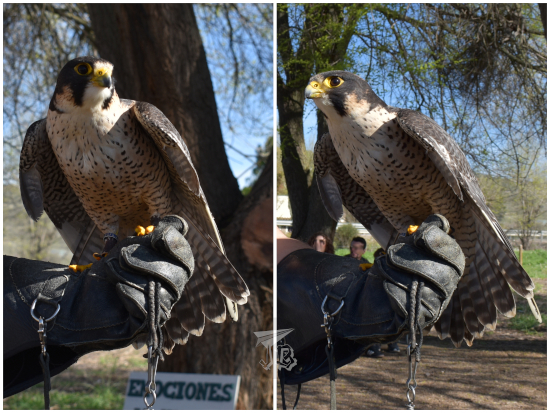
Nymeria the raptor hybrid

Another rescue was Ripley, a common kestrel (Falco tinnunculus). Kestrels can reach a wingspan of 80 cm, and though males and females look different, they tend to be chestnut brown with darker spots on the back, and lighter spots on the underside. They also have a black or darker mark around the cheek (malar stripe). Though they are not considered endangered, their nesting areas are protected in places like Plasencia. Ripley was chicknapped and ended up in a legal limbo – when she was found, she could not be kept, could not be released, until she found her home in the rescue. She was very happy to flop from glove to glove and snack on the fresh meat she was given as an incentive.
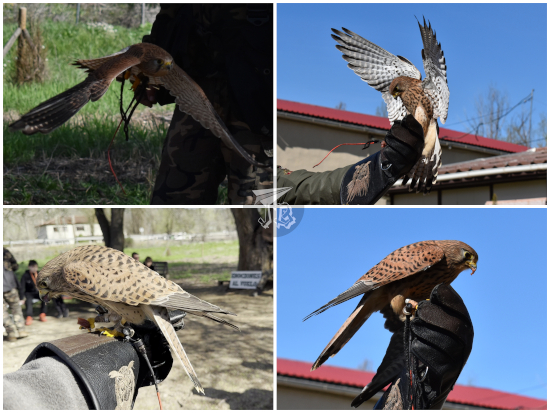
Ripley the common kestrel

The Eurasian eagle-owl (Bubo bubo) is a bird of prey that has always fascinated me, since I was really small and I heard that a) there was one in our attic and b) they could hunt and eat little children. Somehow, looking back, I doubt either of those statements were true. And despite it all, I was literally never allowed in that attic for the nine years we lived in the house… Eurasian eagle-owls are amongst the largest owls, with almost two metres of wingspan. They are easily recognised by their orange eyes and their facial feathers pointing upwards looking like “ears” or “eyebrows”. They always look like they disapprove of you. They camouflage really well against tree bark, being different shades of brown in spotted patches. The rescue has two of them – Dracarys, the male I got to hold, and Storm, a less tame female.

Dracarys the Eurasian eagle-owl

We then met Vader the common raven (Corvus corax). Ravens are not birds of prey, but are closely associated to them. In nature, when an animal dies, ravens are among the first scavengers to arrive. Their black-blue iridescent plumage is easily spotted by flying raptors, who come join the feast. Don’t get fooled, ravens are bigger than they look – they might reach a wingspan of 150 cm – but most importantly they’re smart – they analyse, problem solve, imitate, recognise individuals, and hold grudges. Vader has mastered the opening of lids in order to access snacks…
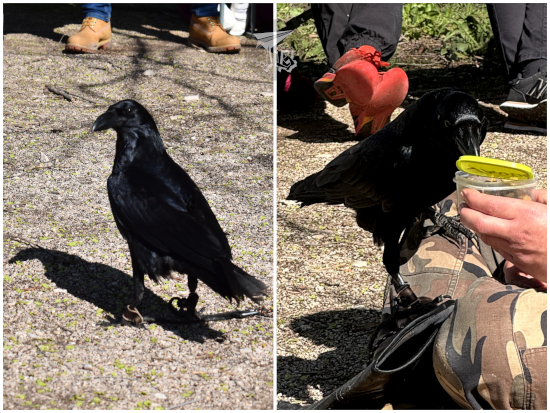
Emociones Al Vuelo Raven

Next came the oldie-but-goldie Blue, a female Eurasian goshawk (Astur gentilis), who was taken in from a breeder after 12 years of laying eggs for them. Goshawks are medium-large raptors (up to 130 cm) with a distinctive striped pattern across the underside, and a greyish back. They have piercing reddish eyes and one hell of an attitude. They are extremely territorial, and usually live in breeding pairs, though females are known for being able to kill the male if he does not bring food to the courtship.
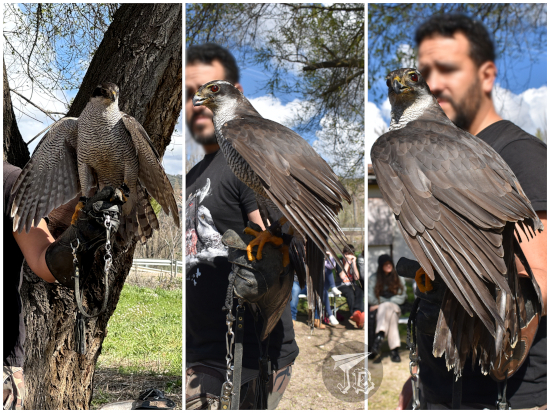
Blue the female Eurasian goshawk

Later came Valyria the Red-tailed hawk (Buteo jamaicensis). She seemed that she would be happier chomping on fingers than perching on gloves. Red-tailed hawks are endemic to North America, and they are diurnal hunters of up to 141 cm wingspan, with females being much larger than males. They do not fly around for prey, but hunt from a perch, and their brown and dark plumage helps them camouflage against the bark of trees, their tail is predictably reddish when seen in flight.

Valyria the Red-tailed hawk (Buteo jamaicensis)

The final species we got to see was the Harris’s hawk (Parabuteo unicinctus), which I’d also seen in the Medieval fair in Alcalá de Henares. They can reach 120 cm of wingspan and are also quite intelligent. They originate from the woodlands and semi-deserts in the Americas, thus they tend to be brown and black, with a little spotted white. They live and hunt in stable groups with a dominant female and her mate. They have developed pack-hunting strategies, with half of the group scouting and half of the group doing the killing. They currently are the most popular raptor in Western falconry, often used to control smaller birds’ population. They are apparently easy to train and they are quite social. There were three of these animals we got to interact with – Tyrion, Winter and Arya.

We could go out to the “flying field” and “play” with them. Tyrion did not seem to want to play a lot, and had to be benched. He actually did only two or three flights – the first one was towards me, and I got to hold him for a while longer since he did not want to fly away. Something that surprised me was how light all of the birds were – I had been worried I would be unable to hold them, but as I mentioned before, feathers and hollow bones make them absolutely… unheavy.

We had a few flights, which yielded to cool pictures, and then some “games” which involve trying to get the hawk to fly between two rows of people, or underneath someone else’s legs. There were some more explanations about behaviour in the wild and the dynamics of the birds and their human caretakers. We actually got to hear a lot about how the different birds interact with each other and their humans throughout the three hours the activity lasted.
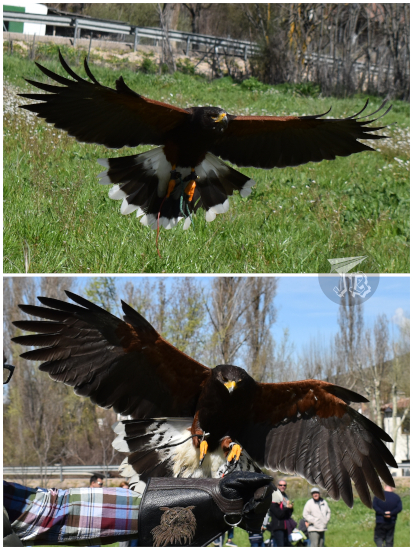
Harris's Hawks mid-flight, wings open

Harris's Hawks coming to the falconry glove

At the end, everyone – even those who had not got the interaction pass – could take a picture with one of the Harris’s hawks. I ended up signing up to another activity – a wildlife photography course – but that one was eventually cancelled due to lack of sign-ups. I drove back home, happy the weather had been almost perfect, and hoping I had not get sunburnt. I also managed to make it through the day without cracking a Jurassic Park joke, but obviously not a whole post – so I shall just remind you here that birds are direct descendants from dinosaurs… Or why do you think they chose “Blue” along all the Game of Thrones references?
27th March 2025: The Raven Age at ReviLive (Madrid, Spain)

Sometimes one has to wonder what guides music promoters to make certain decisions. It would be interesting to be aware of factors like costs of renting a venue, fuel, ticketing and so on. Because on occasion, it feels like tour schedules are suboptimal from all angles – acknowledging the lack of information. In the case of The Forsaken Tour by The Raven Age featuring Disconnected, I think that the most important factor that was considered was minimising bus-tour kilometres. Unfortunately, that placed their Madrid show on a Thursday, in a venue which… I’m pretty sure was inconvenient for everyone but myself.

The Raven Age is an English heavy metal band formed in 2009 by guitarists George Harris and Dan Wright – though Wright has since left the band. Current members are Harris and Tommy Gentry on guitars, Matt Cox on bass and backing vocals, Jai Patel on drums, and Matt James (MJ) on lead vocals. They have released three studio albums, and supported Iron Maiden, Anthrax and Apocalyptica during the Apocalyptica Plays Metallica Vol 2 Tour 2024. Though I saw Artics supporting that tour, my friend A****d saw The Raven Age and highly recommended them – actually she was the one who informed me of the upcoming tour and the Madrid date and place.

The Raven Age Tour Schedule

The concert was held in ReviLive, a concert and party venue associated with the musical studio ReviRock, which provides recording equipment, sets, rehearsal spaces… It is located near the Vicálvaro train station and Puerta de Arganda underground stop in Madrid. Unfortunately, it’s pretty far out from most commuting hubs. I had first thought about driving there, but my Sat-Nav has been failing lately. Furthermore, I did not feel comfortable parking and walking around the area – not the best – without knowing my way.

Since Vicálvaro was close and the way was rather straightforward, I decided to drive to a nearby station, then take a high-frequency train. But in the end, that day I had a headache, so I wanted to drive as little as possible. That meant risking it with the trains. I had previously checked finishing times and with doors at 19:00, I should be out at 22:30 latest. I had no intention to queue, so I took a train that arrived at the station around 18:50. That got me to the venue at 19:05. I was all right with staying back, but the crowd was so small that I found a spot at the barrier… And I was not wearing barrier shoes, at all. The good thing of a small side-lined venue is that security is nicer – and you are allowed to do outrageous things like bringing in your water bottle.

Supporting act throughout the tour was the French artists Disconnected, an independent French progressive metal band. Formed in 2016, it features Ivan Pavlakovic on vocals, Adrian Martinot and Florian Merindol on guitars, Romain Laure on Bass and Amaury Pastorelli on drums.

Doors ended up being at 19:30, not at 19:00, which was mean to the poor fans that had been there since early, particularly the meet & greet ones. I have to admit I did check for M&G tickets, but found no way to get them, else I would have. Maybe they were fanclub-only, I don’t know. I was hoping the venue would fill up more – similarly to La Riviera, where the crowd (that I’ve seen) skips the supporting act and drips in without queuing.

At 19:50, Disconnected started their act, and it was quite all right. What was unfortunately not so good was the sound. For such an empty venue, it was a pity, because it was not as if there was a roar from the attendees. The vocalist had great energy, and he was fun – though painfully aware of how few people there were. They sang in English and French, but the ratty sound made it a bit difficult to follow.

Disconnected’s setlist:
  1. Living incomplete
  2. I Fall Again
  3. The Wish
  4. La Puissance
  5. Unstoppable
  6. A World of Futile Pains
  7. Life Will Always Find Its Way
  8. We Carry On

The Raven Age Madrid Concert: Disconnected

The Raven Age Madrid Concert: Disconnected

Unfortunately, the venue had not filled up when it was time for the main act, and that was a bit sad. Despite the ongoing sound problems and the small crowd, The Raven Age had a great presence. The music did not sound as powerful as what I had been listening online though, and I am sure that they did not have any tea in their thermos bottles…

The Raven Age’s setlist:
  1. The Guillotine
  2. Promised Land
  3. Forgive & Forget
  4. Nostradamus
  5. Surrogate
  6. The Face That Launched A Thousand Ships
  7. Scimitar
  8. The Day The Earth Stood Still
  9. Essence of Time
  10. The Journey
  11. Seventh Heaven
  12. Angel in Disgrace
  13. Serpent’s Tongue
  14. Grave of the Fireflies
  15. Fleur de Lis

The Raven Age Madrid Concert: The Raven Age

It was extremely amusing to hear a heavy metal singer with such a strong British accent, talking in a natural way and dropping swearwords without sweating them. The members seemed to be quite happy taking over all the stage, and there was a lot of interaction, which is always good and fun. Unfortunately, considering that promoter was giving tickets away, I don’t think I’ll ever have the chance to see them close to home again.

The act was not long. They started at 20:50 and finished at 22:10, so it was a relatively short show, but it went by really fast. There was no real encore, because MJ said “this is the time when we go backstage, you guys yell for more, we come back and sing some more, so we’re going to skip all that and go on.” I approve of that.

The Raven Age Madrid Concert: The Raven Age

The Raven Age Madrid Concert: The Raven Age

The Raven Age Madrid Concert: The Raven Age

The Raven Age Madrid Concert: The Raven Age

The whole event had a weird atmosphere from start to end – the lack of a queue, the… chairs outside so we could wait… The… “hey, hold my spot, I’m going to change into this merch shirt I just got” and “Sure, but then hold mine while I go to the toilet” conversations… And especially, the lack of people. I really hoped that there would be more concertgoers after 20:00, and at least some more enthusiasm. When I saw Kamijo in Barcelona there was a small crowd, but it was loud. Here, it was lukewarm. I felt a bit heartbroken for the bands, because they both did a great job.

The train I was supposed to take back did not pass, so I had to wait almost 45 minutes at the Vicálvaro station. That was not fun because the only seats were in the open platform and my lower back hurt – bad choice of shoes. It was extremely cold, too, so I just huddled on a bench, and it felt good when the train finally came. I got to my car just before midnight, and home soon after. I was so tired I almost hit the kerb on my last curve, so it is good that I did not drive back and forth on the speedway, actually.

All in all, I enjoyed the day, the supporting act, and the concert. Would I travel abroad for The Raven Age? Probably not. Will I buy their CDs when I have money to spare? Probably yes. Although I keep getting sidetracked by activities and places to see and burning through my fun budget… Just you wait until there is a concert somewhere I want to visit, and I’ll be taking this whole “not travelling for The Raven Age” back.

22nd March 2025: The Historical Flow of River Henares (Guadalajara, Spain)

The presence of the anticyclone over Great Britain created an unusual rainy March in the centre of Spain, with four storms hitting almost back to back. An average March in Guadalajara sees 4.9 days of rain. Between the 1st and 25th of March 2025, it rained for 21 days. Storms Jana, Konrad, Laurence and Martinho delivered rainfall not seen in the area for 30 years or so.

Rain is measured using gauges and in a unit of “millimetres” – one millimetre of rain is equivalent to one litre of water per square metre. The average rainfall in the Guadalajara area is around 46 litres per square metre for the whole month of March. This four-storm period left over 150 litres per square metre. That’s a lot of rain on rain – dark clouds, soaked soil, wind blowing off the cherry plum blossoms (Prunus cerasifera).

Prune flowers in the storm

Guadalajara was built on the river Río Henares a tributary of a tributary of river Tagus. The Henares sprouts out of the mountain range Sierra Minsitra and runs about 160 km with a variable average flow between 10 and 40 cubic metres per second. The flow of the river and its tributaries is heavily regulated by the presence of a network of reservoirs in the area, designed to fight the cyclical droughts in central Spain, an arid plateau known as La Meseta (The Plateau). There are sixteen reservoirs in the province of Guadalajara, ten of them actively monitored. In March 2025, it rained so much that six of them (Alcorlo, Atance, Beleña, El Vado, La Tajera and Pálmaces) reached critical capacity and their floodgates had to be open, which dumped more water into the already “fattened” river. Furthermore, it was already thawing season, and the little snow that was on the peaks had started melting…

The result? The flow was up to over 300 cubic metres per second. That… is a lot. Official sources say that the water level increased by 40 cm, which of course caused the river to jump its usual banks. Along Guadalajara, this was mostly seen around the 10th century bridge Puente Califal (though other rivers were scary to cross). The structure was originally an Arab bridge, probably dating to the times of Abd al-Rahman III (Abd al-Rahmán ibn Muhámmad [عبد الرحمن بن محمد‎], 891 – 961 CE), though it was repeatedly damaged and repaired later on, particularly during the reign of Carlos III in the 18th century.

The bridge was built in ashlar masonry using a common technique from Al-Andalus architecture, stretcher and header soga y tizón, which means laying a layer of ashlar so the long side is outwards, then a layer so the short side is outwards, with the widest area always horizontal. The structure is almost 120 metres long, with five arches and four pillars, so thick that one of them allows for a spillway. Normally, only three of these arches are above water, allowing for most of the arch to be seen. This is a 2021 photograph which shows the usual situation underneath the bridge.

The normal state of the bridge - the low areas are dry, and only three arches have water running underneath

The humble bridge became the city’s most important tourist attraction during the storms period, as the river swelled and the water rose. Since I was in the area for work, I decided that I had to take a look. It was impressive. The water roared, and it had jumped the banks around the “park” area that has been built, along the footpaths.

Stone structure alongside the bridge, with water covering everything

Puente Califal Guadalajara during the March 2025 floods

River Henares underneath the Arab bridge

River Henares underneath the Arab bridge

Wideview of the Bridge, banks burst

9th March 2025: Expominerales 2025, the other half of the weekend’s plans (Madrid, Spain)

Since I had to be in Madrid to watch the fantastic concert by the Wiener Sängerknaben, the plan had been to attend the yearly Expominerales mineral fair in the Mine and Energy Engineering School Escuela Técnica Superior de Ingenieros de Minas y Energía (ETSIME) that same day. However, the fair closes on Saturdays between 14:00 and 16:00 for a lunch break, so since the weather was so horrid, I decided not to wait. On Sunday, the weather forecast was slightly less miserable, and in the end I was lucky with only some gentle rain as I walked between the train station and the Engineering School, nothing like the sleet deluge the previous day.

Expominerales fills the ETSIME with stalls selling minerals, fossils and crystals offered by reputable sellers. Here I’ve seen the biggest megalodon teeth in my life, held a plesiosaur vertebra – which I regret not buying when I had the chance – and discovered that moldavite exists – and which I regret not buying when I had the chance… do you spot a pattern here? I did not break it anyway, because in the end I cannot afford most of what is sold, and I already own most of what I can…

Overlook of ETSIME during Expominerales

I arrived at the School shortly after the exhibit opened around 10:00, and the area was still pretty empty. There were fewer stands than the previous years I’ve been there, and the moldavite stand was not there. Actually, there were very few meteorite-related stands this time around. I did see amazing modern-times frog fossils from Owens Lake. Owens Lake is called Patsiata in the Mono Native American language. In 1913, the lake dried out when the water from the Owens River was redirected and with years it has become a deadly salt flat, a source of alkali sand storms with a side of carcinogen materials. One of the minerals found in Owens Lake is trona, a crystal formed by the precipitation of sodium carbonate, making it a type of evaporite. In 2023, an atmospheric river caused floods in California, filling the lake up for the first time in over a century. The floods damaged infrastructure and created a surge of floodwater to the lake, which eroded surfaces and dragged a lot of small hibernating animals towards the lake, where they were killed instantly. Their soft tissues were quickly replaced by trona salt before the bodies even decomposed, creating a perfect cast of the poor critters. There were two on display at Expominerales and they were creepy!

Something else that caught my eye (and was actually within my doable price range) was a polished abalone shell. The Korean abalone (Haliotis discus) has been used for centuries in the art of najeonchilgi [나전칠기], which refers to decorating items with mother of pearl. The abalone can be polished in full, creating a whole iridescent body of nacre. These mollusks used to be collected by haenyeo [해녀], traditional female divers from the Jeju province, but most of them are farmed for food today. A small polished abalone came home with me.

Items from Expominerales

The School opens its classic museum during the exhibit, and I always enjoy visiting it. However, after wandering around for a bit (and spending some money), I moved onto what basically is the next building over to the ETSIME, the Spanish Mining and Geology Institute IGME – Instituto Geológico y Minero de España, which hosts the Geomineral Museum Museo Geominero. The original design of the building was conceived by Francisco Javier de Luque, and work started in 1921. Though a congress was held there in 1925, construction went on until 1941. The building has not been extensively restored, but it presents deviations from the original plans, and even from subsequent ones.

The museum is hosted in the former hall, and to get there, first you have to go through a very bored security guard – who first asked if I was sure I wanted to be there. Once inside the building, one goes up the main staircase towards the gallery underneath a glass-and-iron skylight with the logo of the Mining Institute. It was designed by Luque himself and created by the Madrid workshop La Veneciana, a glassware shop dating from 1876 and which, under a different name, still exists today.

Entrance staircase to the Geomineralogical museum

The museum is an open area, located underneath another incredible skylight. The displays are hosted in wooden cabinets in the main floor. The upper balconies can be accessed through spiral staircases and are protected by metalwork railings. One of the details I absolutely adore are the glassworks displaying geological sample cores of different surveys. I’ve never seen the library, but I was once part of a group which was allowed to play with some of the “lesser value” items they have as part of a training session, and that was super fun. The museum is probably one of my favourite spots in town.

The Geomineralogical Museum

From the architecture point of view, I like the building and the skylights. However, there are way more things to love in the museum, such as the wooden cabinets, full with samples of minerals, fossils and meteorites. The museum’s collection are divided into “Mineralogy and Petrology”, “Flora and Invertebrate fossils from Spain”, “Vertebrate fossils from Spain”, “Foreign fossils”, “Systematic invertebrate palaeontology”, “Micro-palaeontology”, “Fossil resin”, “Fossil tracks”, “Stromatolites”, and the “special exhibits”. One of these is a complete cavern bear (Ursus spelaeus), another one is an Ibex (Capra ibex). The last two have honour spots, with their own display.

When you come into the museum, one of the first things that you see, in front of the door, up on the first-floor balcony, is the cast of the most complete Tyrannosaurus rex skull ever found – Stan. Specimen BHI 3033, Stan, was found in 1987 and excavated in 1992, in South Dakota’s Hell Creek Formation. Stan lived around 65 million years ago, in the Cretaceous period. We know he fought for his life more than once – his ribs were broken and healed, two vertebrae were fused together, and he suffered a bite to his snout. Stan remains one of the most complete skeletons ever found, and probably the most-often cast. The skeleton made mainstream news when it was auctioned at Christie’s in New York due to money disputes among partners of the original owner-firm, Black Hills Institute. An anonymous buyer paid $31.8 million for it in October 2020. In 2022 it was disclosed that the Department of Culture and Tourism of Abu Dhabi had bought Stan for their projected new Natural History Museum.

On the ground floor there is a mastodon fossil Anancus arvernensis found in the 1990s. These animals related to modern elephants lived throughout the Miocene and went extinct in the Early Pliocene (two million years ago). The could have been around the size of a modern African bush elephants, but their tusks were mostly straight. They would have lived in steppe with dry and warm climate, but close to water. The fossilised bones were recovered are dated around 3.2 million years ago, and were dug from the Las Higueruelas site between 1948 and 1991.

Exhibits at the Museo Geominero

After I wandered the museum for a while, I left towards my train which was delayed… 43 minutes. Fortunately, so were the ones that had to pass before, so I ended catching one in the right direction after only a twenty-minute wait. And then I got junk food, because some days have to end in junk food…

8th March 2025: Wiener Sängerknaben Spain Tour, half of a weekend’s plan (Madrid, Spain)

Where should I get to see the Vienna Boy’s choir Wiener Sängerknaben? Vienna? Of course not! Madrid, of course. We did try to see them in their home town, but it did not work out, because they sang before we arrived, and while we were on our way to the airport on the day we left. However, chance wanted that their Schubert Choir Schubertchor would be touring Spain in March, and Madrid would be their first stop. We got good tickets by a hair’s breadth, because my parents do not believe in booking in advance – nor in me booking for everyone – but we got them, literally last row of stalls.

Nobody knows exactly when the historical Wiener Sängerknaben was established, but there are records of boys singing at the Imperial Chapel back in 1296, even before the chapel was in Vienna. The Boys Choir just performed for the Court until 1918, when the Austria-Hungary Empire collapsed. In 1924, the institution was re-established as a private non-profit. It remained boys-only until 2004, when the Girls Choir Wiener Chormädchen was founded.

The boys attend their own campus from primary to senior high school. There are 100 choristers divided in four choirs (Bruckner, Haydn, Mozart and Schubert), each of which tours for around 10 weeks per school year. They perform High Mass in the chapel of the Imperial Palace every Sunday as part of an ensemble called Hofmusikkapelle (Court Music Orchestra), formed by the boys and members of the choir and orchestra of the Vienna State Opera (Wiener Staatsope).

As part of those ten-week tours, it was announced that in 2025 the Schubert Choir would tour South Korea, Spain, Switzerland and Italy. In Spain, they were to perform four special concerts in Madrid, Seville, Alicante and Valencia. The Madrid show took place at 11:00 in the national auditorium Auditorio Nacional de Música. The auditorium was designed by architect José María García de Paredes and it opened in 1988. The largest music hall can host over 2400 spectators.

Auditorio Nacional, inside and out

The Schubertchor has 22 members from all over the world – though most are Austrian, others come from China, Croatia, the Czech Republic, England, Germany, Hungary, Japan, South Korea and Ukraine. The boys’ names are not released, but they were touring with Peruvian conductor Andy Icochea Icochea, who had previously worked in the Wiener Sängerknaben between 2005 and 2011. Icochea seems to have specialised in training young choristers, and has had a long career with different choirs and orchestras, even with a music charity. He has collaborated with other directors such as Riccardo Muti, who conducted the 2024 Silvesterkontzert / 2025 New Year’s concert in Vienna.

The day of the concert started raining buckets, but we had decided to try public transport instead of driving to the area where the Auditorio Nacional de Música stands. Afterwards, we wanted to have lunch and head to Expominerales, which was held that same weekend. We arrived with plenty of time, and we had to find a café to pass the time until doors opened. Once that happened, it was a bit of a chaos of umbrellas and everybody trying to push in at the same time. If you think young people get excited before a concert, they’ve got nothing on senior citizens.

At 11:00 sharp, even before the hall had completely filled up – doors had opened kind of late in my opinion, less than half hour in advance – the children and the director came out. People were still being admitted during for the first couple of songs, and the auditorium staff were harassing patrons about where they had placed their jackets, or whether they were in their correct seats, well into the show. It was weird, and a bit disrespectful, those details should have been sorted beforehand. However, the concert itself were amazing. Most of it was sung a capella, and only a piano was used for accompanying the choristers in several songs, played by Icochea himself.

Vienna Boys' Choir Madrid

Setlist:
  First part:
    1. Kaiser-Walzer, Op. 437 (Emperor Waltz), composed by Johan Strauß II, with lyrics by Victor Gombocz and arranged by Gerald Wirth.
    2. Der Wassermann (The Water Genie), composed by Robert Schumann, with lyrics by Justinus Kerner.
    3. Hebe deine Augen auf zu den Bergen (Lift thine eyes), trio from Elias, Op. 70 (The Prophet Elijah), composed by Felix Mendelssohn from the lyrics of Psalm 121:1-4.
    4. Die Meere, Op. 20 No. 3 (The Seas), composed by Johannes Brahms
    5. Psalm 23, D.706, composed by Franz Schubert with Germany lyrics by Moses Mendelssohn.
    6a. Nun stehen die Rosen in Blüte (Now the roses have bloomed) from Der Jungbrunnen, Op. 44 (The Fountain of Youth) composed by Johannes Brahms with lyrics by Paul Heyse.
    6b. Die Berge sind spitz (The mountains are pointed) from Der Jungbrunnen, Op. 44 (The Fountain of Youth) composed by Johannes Brahms with lyrics by Paul Heyse.
    6c. Am Wildbach die Weiden (The willows beside the stream) from Der Jungbrunnen, Op. 44 (The Fountain of Youth) composed by Johannes Brahms with lyrics by Paul Heyse.
    6d. Und gehst du über den Kirchhof (And if you walk across the churchyard) from Der Jungbrunnen, Op. 44 (The Fountain of Youth) composed by Johannes Brahms with lyrics by Paul Heyse.
    7. Inclina Domine aurem tuam ad me, Op. 118 (Incline your ear, Lord, to me), Josef Gabriel Rheinberger (Psalm 86).
    8. Erlkonig (The Elven King) composed by Franz Schubert, with lyrics by Johann Wolfgang von Goethe, arranged by Oliver Gies.
    9. Sängerslust, Polka française, Op. 328 (Singer’s Joy, French Polka), composed by Johann Strauß II with lyrics by Joseph Weil.
    10. Wiener Blut, Walzer Op. 354 (Viennese Spirit), composed by Johann Strauß II, arranged by Helmuth Froschauer.
  Second part:
    11. 아리랑 [Arirang] (impossible to translate, but it might have meant “My beloved one” in Ancient Korean), arranged by Gerald Wirth, a traditional Korean love song from the Kyonggi Do province, with over 60 variations.
    12. Vreneli abem Guggisberg (Vreneli from Guggisberg), Swiss folk song arranged by Gerald Wirth.
    13. Müsle gang ga schlofa (Go to sleep, little mouse). Cradle song from Vorarlberg, Austria with lyrics by Walter Weinzierl, arranged by Gerald Wirth.
    14. Unz Wättr isch winti (Until the weather is windy), written by Luis Stefan Stecher like an Italian folk song, with music by by Ernst Thoma.
    15. O more duboko (Oh, deep sea), Croatian folk song, arranged by Gerald Wirth.
    16. La Paloma (The Dove), Spanish habanera by Sebastián Yradier, arranged by Gerald Wirth.
    17. Chim Chim Cher-ee from Mary Poppins (1964 film), by Richard M. Sherman and Robert B. Sherman, arranged by Christi Cary Miller.
    18. What Was I Made For? from Barbie (2023 film), by Billie Eilish O’Connell and Finneas O’Connell, arranged by Jennifer Lucy Cook.
    19. Under the Sea from The Little Mermaid (1989 film), by Alan Menken and Howard Ashman, arranged by Kirby Shaw.
    20. For ever, Polka schnell, Op. 193 (Forever, Fast Polka) by Josef Strauß, arranged by Gerald Wirth with English lyrics by Tina Breckwoldt.
    21. An der schönen blauen Donau, Op. 314 (The Blue Danube), composed by Johann Strauß II, with lyrics by Franz von Gernerth (1821-1900) and arranged Gerald Wirth.
  Encore
    22. Radetzky-Marsch, Op. 228 (Radetzky March), by Johann Strauß I, arranged by Gerald Wirth.
    23. Un Elefante Se Balanceaba (An elephant swung), Spanish children counting song, probably arranged by Icochea.

Charming does not even come close to describing the show. I’d never understood the concept of “angelic voices” until now, and I found it really unfair that you can’t actually find out the names of the boys. I don’t know whether it is to protect their privacy as they are minors, but it would have been great to at least know the names of the soloists, because the powerful voices from those little bodies was amazing.

The children were organised by tone of voice, which was similar to size, with the highest voices (smallest boys) on the front left and the lowest voices (biggest kids) on the back right. They sang most of their numbers towards the stalls, but for one song they turned to the people behind them, to both sides of the organ. Highlights included any time a child sang a solo – particularly the first one during the Emperor Waltz, as people were still coming in. During another song, Icochea left the stage for another boy to direct.

Vienna Boys' Choir Madrid

The oldest boy was in charge of having the audience clap during the Radetzky March, just like in the New Year’s Concert – and he looked right at that age when teens are all knees and elbows and awkwardness, but he seemed to be extremely proud of himself (well deserved!).

The last song of the encore was a total surprise. Before it started, the director invited us to “sing along if we were familiar with it”. This unexpected performance was a Spanish counting song, Un Elefante Se Balanceaba (An elephant swung), which goes “one elephant swung on a spiderweb – as it saw it did not fall down, it went to call another elephant. Two elephants swung on a spiderweb – as they saw they did not fall down, they went to call another elephant. Three elephants…” you get the idea – not precisely a philosophical song, but way less traumatic than say Hush little baby. One of the boys walked to the front and made a sort of trunk with one of his arms as he “swung” to the music. One by one, the others joined him until the proverbial spiderweb snapped and down to the floor all the children went. It was absolutely hilarious, and adorable.

Vienna Boys' Choir Madrid

Vienna Boys' Choir Madrid singing the elephant song

It was still raining heavily when we left the auditorium. It was 13:15, so no real time to get to Expominerales before it closed between 14:00 and 16:00. Had the weather been nicer (decent, at the very least), I would have found something else to do before it re-opened. But it was still raining cats and dogs – and maybe some ice – so we just decided to call it a (half) day.

6th December 2024: Knowing people gets you places – Church of the Virgin Mary, Guadalajara (Spain)

Knowing people who know people is cool. It opens doors, too. I was in Guadalajara for personal reasons and an acquaintance of an acquaintance offered to show us around the co-cathedral of the Virgin Mary Santa María de la Fuente la Mayor. The church, built in the 14th century in the Mudejar style, shares rank with the co-cathedral of Sigüenza. The whole structure is made or covered in brick, with some traces of coloured ceramic tiles around the horseshoe arch entrance.

Santa María Guadalajara

The interior is covered in plaster, hiding away the original stonework. Golden decoration was added afterwards. The main altarpiece was built by Francisco Mir in the late Renaissance style, with scenes of the life of the Virgin Mary. It was designed in 1622 and decorated in more gold.

Altarpiece at Santa María in Guadalajara

The church has a Mudejar artesonado or Spanish ceiling (a ceiling structure halfway between support and decoration, made out of wood, usually decorated). The artesonado was covered up during the Baroque renovations of the church and recently restored. Furthermore, if you know people, they show it to you. Up the high choir we went, and past a narrow staircase, through a small walkway that has been built for the few privileged visitors who are admitted (a bunch of people apparently tried to emulate us but were declined). We “floated” above the ceiling and underneath the wood for a while, and it was really interesting. Though of course the wood has been restored, most it is the original one. You can also see the Baroque vaults from above, along the original brick ceilings and walls, hidden away in the nave.

Spanish celiling at Santa María in Guadalajara

Spanish celiling at Santa María in Guadalajara

We were invited to climb the bell tower, too. The structure has also been restored, following the original brickwork. The tower is narrower at the top than at the bottom, and the ascending path has vaulted ceilings in brick. On top, there are eight bells. One of them dates from the 18th century, two of them from the 19th century and the rest are newer. There was also a view of the city, but Guadalajara does not really have dramatic backdrops, I fear…

Bell at Santa María Guadalajara

Guadalajara skyline of sorts

It was not a big trip or anything, but apparently you have to know someone to get there. Thus, I guess it is worthy of its own mention, right?

26th November 2024: Another Concavenator visit (Alcalá de Henares, Spain)

I had to run some errands in Alcalá de Henares in the afternoon, so I decided I would get there in the morning, and walk to the Archaeology and Palaeontology museum Museo Arqueológico y Paleontológico de la Comunidad de Madrid, MARPA. The exhibition “Dragon HuntersCazadores de Dragones was still running and since it was a random weekday morning, I thought it would be empty.

I was right, it was deserted enough that the security guard looked at me weirdly. Yes, I’ve been there before. Twice. I hope to be back at least once more before the exhibit closes in January 2025. The security guard should not be remembering me, I did nothing weird. Taking a few hundred photographs of a fossil is completely normal.

Why am I so obsessed about the Concavenator? Well, one does not always have such a unique fossil so handy, and for free. Furthermore, the usual home of the Concavenator does not allow pictures. And lastly, I’m a nerd. The species Concavenator corcovatus was described in 2010 by Francisco Ortega, Fernando Escaso, and José Luis Sanz from a single skeleton found at Las Hoyas site in 2003. The specimen was officially catalogued as MCCM-LH 6666. The animal was a medium-sized carcharodontosaurid. Carcharodontosauria, which included the likes of Giganotosaurus, Mapusaurus or Carcharodontosaurus, were a group of large theropods from the Cretaceous period. The skeleton was almost complete, with the tail and neck contorted in rigor mortis. The fossil shows two things that make it special – a hump or sail created by the spines of the back vertebrae, and the fact that some pigments were found on the fossil. Not unique but rare enough findings include impressions of skin and scales, and smaller bones in the belly area, rests of undigested dinner. On the arm bones there are insertions for ligaments similar to those that modern birds have at the insertion of feathers.

Concavenator corcovatus

The Concavenator lived around 125 million years ago, in an area of wetlands. Its teeth, general shape (it walked on its two hindlegs and had small-ish arms), along with the remains of animals that it had eaten, tell us it was a carnivore, and its placement in the carcharodontosaurid family, that it was a predator. However, no large predator is known for rejecting a good scavenging feed. The spikes or hump on its back, above the hips, can be clearly seen on the fossil, but nobody has any idea of what it was for – speculations have been made for communication means, fat deposits and thermoregulation. When alive, the animal would have been around 5 metres long, two metres tall, and 450 kilograms heavy.

Concavenator corcovatus details

All that to end up being dug up and named… Pepito, which is the diminutive of the diminutive of the Spanish version of Joseph. The equivalent of Joseph would be José, nicknamed Pepe, and changing the last “e” into “ito” – the suffix for small – would yield to something like Joey. So this magnificent predator was either named after a mini-mini-Joseph, or a small meat sandwich, which is also referred to as a pepito. Seriously, what happened to the illustrious tradition of Boaty McBoatface? This would have been a glorious Toothy McToothface (“Spanishised” as Dientito Caradientez or something).

Anyway, after the visit I dropped by the museum shop to buy myself some Concavenator-related merchandise. When was there the first time, I bought the exhibition catalogue, but since then they had received some silly cute items – I bought a pin, a badge, and a magnet, just because I could. Maybe as the exhibit draws closer to the end there will be discounts on other things…

I left the museum and decided that since it was way past 14:00, I should grab a bite to eat. As I had parked my car next to a shopping centre, I headed there with the idea of some Asian food. However, there is a burger joint that usually has a long queue and that some friends had told me was really good – as good as fast food can be, I guess. It is called TGB – The Good Burger. It is supposed to serve “NYC style gourmet hamburgers”. The place was empty, so I decided to give it a try.

I ordered a “Cheese Lovers” burger, which consisted of a beef patty, American cheese, goat cheese, Gorgonzola, sautéed onions, arugula and honey mustard sauce. It was… very cheesy. It was nice, but nothing I feel I must try again, especially when there are cheaper options in the shopping centre. And sushi. But at least, I satisfied my curiosity before I went off towards all my dull, grown-up errands which I shall not bore you with…

The Cheese Lovers burger

22nd November 2024: “Wicked” (film) on opening day (Madrid, Spain)

There was a time when you could mute words on social media to avoid spoilers. Since the algorithms have taken over and you can’t curate what you see any more, I decided that the best way to avoid Wicked spoilers was trying to see it as early as possible, preferably on opening day. Ideally, on the first screening on opening day, an English version.

For a change, “ideally” worked. At least, I found a screening at 15:45 on the day the film came out. It was a cinema with Spanish subtitles but I can live with that. I have seen the musical twice in the Apollo Victoria Theatre in London and I’ve loved it both times. Not only I’m a firm believer in the message of Defying Gravity, I also give regular thought to Dancing Through Life. Sometimes I also listen to No One Mourns the Wicked and get all philosophical…

Anyway, I headed off to Madrid with next-to-no information and no expectations, hoping to enjoy the film. I had been slightly surprised that so many tickets were already booked when I bought my own, but I gave it no more than a couple of seconds’ worth of attention, I just thought I was running late since I made the decision the previous weekend before heading out to see Ha·Ya·To . Since the film was rather early in the afternoon, I had to get to Madrid with time for a bite. One of my options was Yatai Market but in the end I decided to grab brunch at Toby’s Brunch Club, where they run an all-day brunch (here I went, cheating the system again, just like I did at the James Joyce – twice in one week, too). I tried to book online but the system only took reservations for two or more. Since the Internet said that it was usually quite busy, just thought I still had Yatai as a backup plan…

I arrived at Atocha Station and walked towards the brunch place. As I did, I had to walk past Caixa Forum, which is still running the exhibit on Patagonian dinosaurs, and the Patagotitan smiled at me. I, of course, smiled back.

Patagotitan mayorum

The very-busy brunch place was empty – weekday “crowds” I guess. I was the only customer there for the duration. Usually, not being able to book for myself on my own discourages me from a place, but I’ve been wanting a “typical” brunch for a while now. The brunch consisted of a cold drink, coffee or tea and two courses (22€). For my cold drink, I ordered orange juice, and for the hot one a coffee latte. The first course was a basket of breads with butter, jams and tomato paste, and a yoghurt with fresh fruit. As my second course, I ordered eggs Benedict with smoked salmon. Because I really wanted eggs Benedict and I can’t cook them to save my life. Everything was delicious, especially the yoghurt. The eggs were perfect. I think this would kill me before noon though, so glad I used it as lunch.

Toby's breakfast club brunch

After my brunch / lunch I still had some time so I dropped by the art gallery Museo del Prado. I used my museum card Tarjeta de Museos Estatales and the lady at the ticket booth told me she had never seen a card like that before. She took it to the back shop, and when she came back, it turned out that the card had stuck to another card, which explained why she was confused. I finally managed to get in, and spent about an hour there. There was a small exhibit called El Taller de Rubens (Rubens’ workshop) which analysed the master’s works and that of his apprentices which was very interesting.

Afterwards, I walked towards Yelmo Cines Ideal (passing by and waving at the Patagotitan again) to watch Wicked. When I got there, the cinema was still closed, but as soon as I turned away to snoop into a shop across the street, the doors opened. I found my seat and I found myself seated between two groups of high school and university students, who were complaining that their life was very hard, and that they had barely had the time to eat lunch before getting to the cinema. And a few of them were threatening to cry. And they were telling each other not to sing along. I had not realised there was such a big following of Wicked from the younger crowd…

After a few minutes of hearing them babble excitedly, I realised that all of them had listened to the songs on the Internet, or something, but they had never had the chance to seen the musical themselves – it’s debuting in Spain in autumn 2025. It made me realise how lucky I am to be able to jump onto a red-eye flight at a random weekend and go to London, and be there for the 14:30 performance at the Apollo Victoria Theatre.

Wicked film poster

In general, I enjoyed the film. More than I believed I would, because I went with zero expectations and I had managed to avoid any kind of spoiler and previous knowledge, except that Jeff Goldblum was the Wizard. The main cast includes Cynthia Erivo as Elphaba, Ariana Grande as Glinda, Jonathan Bailey as Fiyero, Michelle Yeoh as Madame Morrible, Marissa Bode as Nessa (kudos for an actual disabled actor playing a disabled character!), Ethan Slater as Boq, Jeff Goldblum as The Wonderful Wizard of Oz; and Peter Dinklage as Dr. Dillamond (voice).

I do not believe what I am going to say – but I thought Goldblum was the weakest character. I mean, he keeps playing himself, and Jeff Goldblum is not the Wizard (I had the same feeling when I watched Jurassic World: Dominion; he played himself, not Ian Malcolm). On the contrary, Michelle Yeoh was fantastic, her sole presence in a take stole the whole screen. I enjoyed seeing the animal characters a lot, as it is the bit of the musical that always feels a bit off. The logistics of landscaping Oz was a bit awkward at points, but I guess that’s theatrics and not… geography.

I found the music decent. As for me the most important thing was for the story to be faithful to the musical – which is more up my alley than the novel – I was rather satisfied. The best song, in my opinion was What is this feeling?, the camerawork was stunning. It was also great to see the cameo of the actors who portrayed Glinda and Elphaba on Broadway for the first time, Kristin Chenoweth and Idina Menzel – known worldwide today for Frozen’s anthem Let it go. The library scene and choreography for Dancing through life was also impressive.

What I saw of the subtitles was not a good sign though, because the message of No One Mourns the Wicked loses most of its meaning if you translate it as “she’s finally dead”. However, I am rather good at ignoring subtitles anyway. I am not sold on Glinda being all pink either. Too many Legally Blonde vibes there, I prefer ice-blue.

The film ended at the end of the first act of the musical, with the “main event” of sorts – Defying Gravity. Very showy, okay music-wise. It was more visually impacting than musically, and my mind was dubbing it with Kristin Chenoweth’s version anyway. At this point, half the theatre was sobbing, which I found slightly amusing.

All in all, I enjoyed the day and the film. I am looking forward to the second part, and having affordable Wicked merchandise I don’t have to save for special occasions. After leaving the cinema, I walked back, and since it was cold, I got there in record time – and then I had to wait 40 minutes for the train because of course I did.

17th November 2024: Ha·Ya·To Drum Masters in Guadalajara (Spain)

A while back, I read on Keita Kanazashi’s Instagram that Ha·Ya·To Project was going to come back to Spain for a small tour with their show Ha·Ya·To: Drum Masters. The most convenient place for me to see them was Teatro Buero Vallejo in Guadalajara. I got tickets as soon as I realised they were out, and still I did not beat the local crowd who buy tickets for any and everything.

Ha·Ya·To Drum Masters promo

Ha·Ya·To: Drum Masters is a Japanese percussion show wadaiko [和太鼓]. While Ha·Ya·To is officially formed by the three Kanazashi brothers, Keita Kanazashi, Ryota Kanazashi, and Yuta Kanazashi, for Drum Masters they are joined by Koji Hada, Takayuki Hashiguchi, Makoto Sekine and Shunichiro Kamiya, along with special guest stars Chieko Kojima (first female wadaiko master) and Masato Shibata (Japanese guitar shamisen world champion).

The show depicts the seasons of the year. It starts in Spring, with flowering cherry blossoms and a slow build up that yields to a super-energetic Summer, full of bouncing and strong beats. Then there comes the break and afterwards there is Autumn, where Chieko Kojima really shines, though the rhythm is a bit lower and more melancholic. Finally, energy picks up again for Winter – because it’s cold and one needs to warm up.

Ha·Ya·To Drum Masters

Ha·Ya·To Drum Masters

Ha·Ya·To Drum Masters

Ha·Ya·To Drum Masters

The show was absolutely fantastic. Afterwards, there was a “collective M&G” with pictures with the musicians. I did not get any autographs, though Ms Kojima did notice that I was carrying the DVD I bought in 2018. That lead to her, Keita and myself talking a little. I also had a photograph with Keita from an event in 2019. Their manager is very strict, and once she decides picture time is over, she really ushers them away. I did manage to sneak a selfie with Makoto Sekine after the rest of the group had left though.

Ha·Ya·To Project

I love taiko. It really energises me, and it was a great way to spend the evening. I could’ve combined it with something else, but I had plans for the next couple of days. I was off to see Apocalyptica the following day.