
It was a grey morning in Prague [Praha] when we headed down for breakfast. The buffet was packed and the coffee horrible, but I was able to find cranberry juice, hard-boiled eggs, bread and cheese. The goal of the day was visiting other areas within the UNESCO World Heritage Site Historic Centre of Prague, starting from the castle to make our way down. Thus, we jumped onto the public transport system – my parents could ride free due to their ages, and my sibling and I bought tickets. The ticketing system allows you to ride for a set period of time after validating, which is done at the gate. We rode the underground to the Malostranská stop, at the foot of the hill where the castle was built. This area of the city is called Malá Strana, the Lesser Town – it is a historical name, because there is nothing “lesser” about it.
Prague Castle Pražský hrad is the largest ancient fortress in the world – a huge complex of buildings delimited by a defensive wall. It hosts the official residence of the current President of the Republic, and in the past it was the place from where the kings of Bohemia and Holy Roman Emperors ruled. Construction began around 870, with the establishment of a walled church on top of a hill overlooking the area. The current palace was built under the reign of Charles IV (Karel IV), who also reinforced the fortifications. The enclosure hosts several notable areas and buildings, such as the Cathedral and the Golden Lane.
The first step was, however, climbing up from the underground stop to the castle itself – literally. This was done via stairs, which fortunately were not frosty. They were… steep, steeper than they looked, considering how wide each step was. I was a bit out of breath by the time we were up… and once at the gate there was still more uphill way to walk!! We reached the ticket office and decided on a “Prague Castle – Main circuit” (Pražský hrad – hlavní okruh) ticket, which included the four key sites: the Old Royal Palace, St. George’s Basilica, the Golden Lane, and St. Vitus Cathedral.
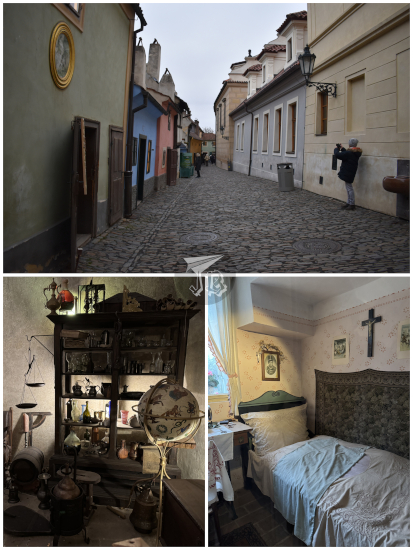
Right next to the ticket office there was the access to the Golden Lane Zlatá ulička. It was originally an area where the castle guards lived. Today, it is a narrow alley with coloured houses, many of which have been converted into souvenir shops or tiny ethnography museums, trying to show how people used to live there – the seamstress, the alchemist, the goldsmith, the fortune-teller… Some famous or important historical figures have dwelt there, most notably writers Franz Kafka – with a bookshop where he used to dwell – and Jaroslav Seifert (1984 Nobel Prize in Literature), and the fortune-teller Matylda Průšová. There is also a collection of weapons and armours.
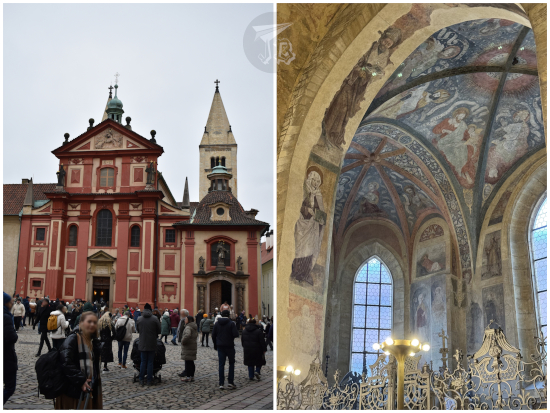
Our next stop was the Basilica of St George Bazilika svatého Jiří. Despite its Baroque façade from the late 17th century, the inside is purely Romanesque. The church is actually the oldest surviving building in the castle complex, consecrated in the year 921. Fortunately, the interior has been kept Baroque-free, and it displays a severe limestone appearance (though it had to be restored after World War II) with frescoes behind the altar.
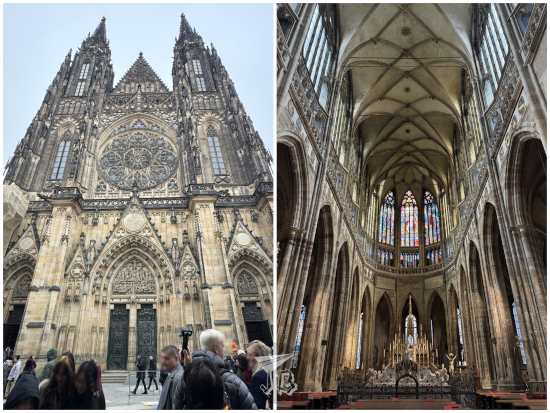
The crown jewel (in my not-so-humble gothic-loving opinion) of the castle is the Cathedral of St. Vitus – formally the Metropolitan Cathedral of Saints Vitus, Wenceslaus and Adalbert Katedrála svatého Víta, Václava a Vojtěcha. The current building is Gothic, and dates back from 1929. No, that’s not a typo. Although construction started in 1344, it did not end until the 20th century! The current building was erected over a previous Romanesque church when the latter became too small. It was sponsored by Charles IV (Karel IV) of Bohemia and originally designed by Matthias of Arras, who obviously did not live enough to see the work completed.
Prague’s Medieval history was heavily influenced by the Hussite Wars. The Hussites were reformists, an early movement of what would later become Protestantism, founded by Jan Hus (who ended up burnt to death for his trouble). The Hussite Wars lasted between 1419 and 1434, and were rather complicated, with people changing sides, a civil war, foreign interventions actually called “crusades”… In the end, the “moderate” Hussites allied themselves with the Catholics to defeat the “radical” Hussites, and eventually rose to power as George (Jiří) of Poděbrady was crowned the first protestant King of Bohemia in 1458. While the king himself was a Hussite, he was a moderate and thus tolerant of the Catholics and their rites.
However, with the Hussite uprising, works of the cathedral came to a stop. It stood half-built until the 17th century. Finally, the early 20th century saw serious efforts to finish it in time for St. Wenceslaus’ Jubilee in 1929. Despite its 600 years of construction, the building is simply magnificent, even if there was no sun to shine through the coloured windows. The pointed arches are just perfect, and the stonework has that lovely patina that they’ve cleaned out from Notre Dame in Paris.
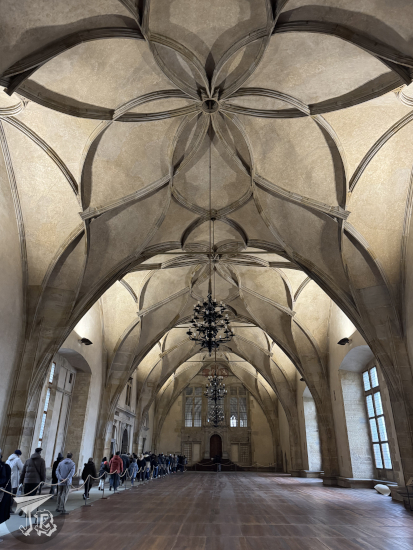
The final building included in our ticket / pass was the Old Royal Palace Starý královský palác, a magnificent Gothic – with some Renaissance touches – building dating back from the 12th century. The Vladislav Hall, built in the 14th century, is vaulted, with gothic nerves. There is a small room with a throne and replicas of some of the crown jewels. Upstairs, rooms with frescoes. To the side, there was a long queue to see the “Defenestration Window” – during the Hussite Wars, people developed a taste for throwing other people out of windows. In 1618, during one of the many Protestant-Catholic moments of tension, two regents and a secretary were pushed out of one of the windows in the palace. They survived. According to the side who tells the story, they were either saved by angels or by falling onto a pile of cow dung.
The family decided to get going. We passed by newer buildings, where the President lives, and headed down the hill. We found a restaurant that my parent seemed to like and we were lucky enough that they had room for us. The staff at U Dvou slunců was pretty nice, and despite me thinking I wanted some dumplings, I ended up ordering Smažený obalený sýr, fried breaded cheese with chips and homemade tartar sauce – just because I love cheese. It was delicious.
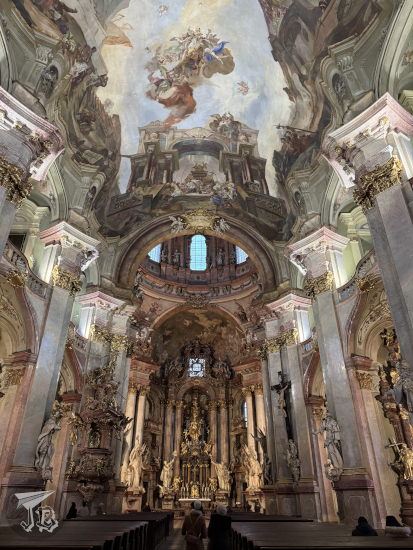
After lunch, we went to Malostranský chrám svatého Mikuláše, the church of St. Nicholas Church in Malá Strana. It is considered the most important Baroque church in town. There are frescoes all over the ceiling, and the decoration is not extremely over the top. The dome is 20 metres in diameter, and the columns are actually made of fake marble, but I would never have been able to tell. It hosts two organs, one of which was currently out of service for restoration.
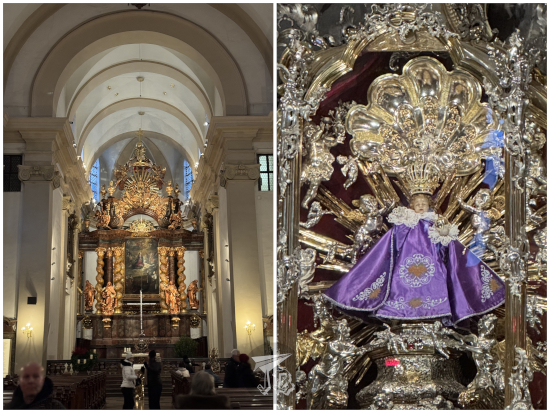
Then, we headed to the Church of Our Lady Victorious and The Infant Jesus of Prague (mouthful) – Kostel Panny Marie Vítězné a Pražské Jezulátko. The church was founded in 1584, and it is also Baroque. It is famous because it hosts the statue of the Infant Jesus of Prague Pražské Jezulátko, a small wooden sculpture of Spanish origin from the 16th century, which somehow made its way to Bohemia through the House of Habsburg. The centre of one of the major pilgrimages in Europe, the figure is about half a metre high, and it is displayed wearing embroidered vestments. On the day of our visit, the clothes were purple, as it was Advent. The church also has a display of nativity scenes and a small museum with different garments for the Infant Jesus that have been donated by wealthy benefactors. I have to say though that the poor thing is… hideous.
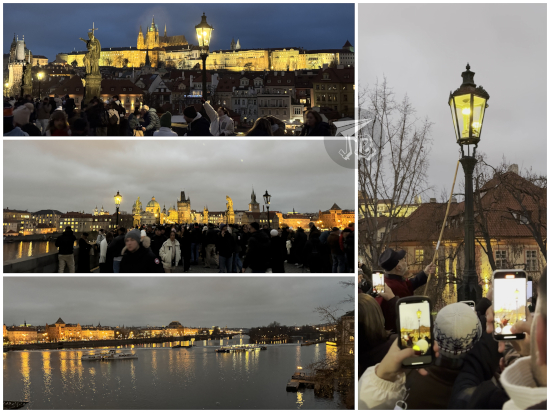
The sun was setting and it was time to cross Charles Bridge Karlův most over the Vltava river. It is a Medieval stone bridge, built between 1357 and 1402, over 500 metres long! There is a tower on each side – Malá Strana Bridge Tower (Malostranská mostecká věž) and Old Town Bridge Tower (Staroměstská mostecká věž), both gothic, and 50 statues along the way. There are also gas streetlamps that are manually lit during Advent! Unfortunately though, since the lighting is a thing, the bridge was swarmed, and it was extremely difficult not to lose each other, so we did not get to see much.
Back in the Old Town Staré Město pražské we got to see the Klementinum, a Baroque astronomical tower and library that I would have loved to visit, but it was not in the schedule – I would have prioritised it over the churches, but as I mentioned, I had not done any of the planning. My parents decided they were done then, so my sibling and I stayed behind again, after arranging to meet at 19:30. We explored some candy shops, and eventually caught the Astronomical Clock Pražský orloj at 17:00.
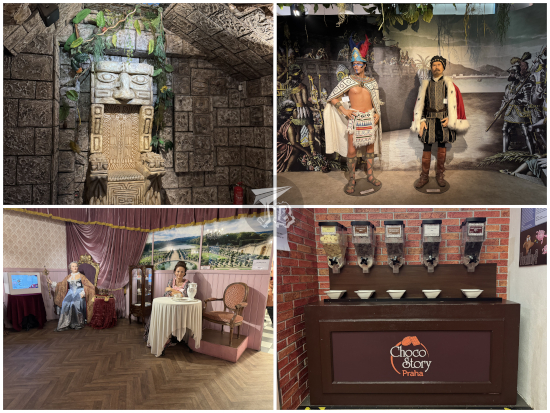
After the 17 bell strokes, I proposed my sibling to go to the chocolate museum, Choco-Story: Prague Chocolate Museum. It is not big, and it features different stages in the history of chocolate – its use in Pre-Columbian cultures, how the Spanish introduced it to Europe, and how it became a popular treat amongst the higher classes, then it became democratised. The last room was explicitly about a Czech company that used to sell chocolate. In the second-to-last exhibit there was an unlimited chocolate tasting station. Yes, the person at the entrance used the word “unlimited”. We of course took pictures with all the available props. And ate chocolate.
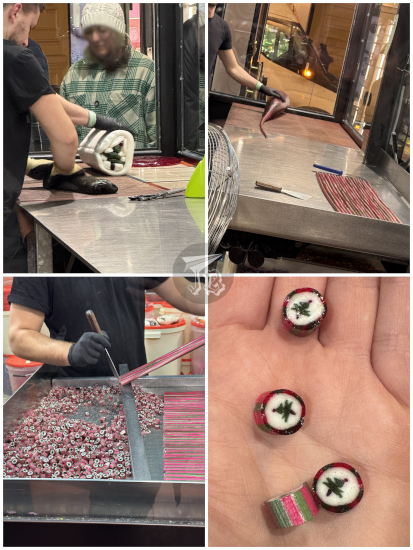
We eventually left the museum, and that placed us in the right place-and-time to see how they made candy from scratch. The two guys started with blocks of different colours – green, white and reddish. They worked the material until it was almost viscous. First, they made three “triangles” with the green material, which they put on top of each other. Then, they filled up with white until they had a cylinder, and wrapped that in red and green – it was a Christmas tree in the middle of a snowy circle! They ended up with something that had around 20 centimetres in diameter. And then suddenly they started pulling and pulling and made sweets that were no bigger than 1 cm, with the Christmas tree in the middle. It was astonishing!! And even better… they shared samples!
On the way out, we decided to be weak and bought the blueberry tartlets we had spotted the day before, along with some souvenirs. I got a silly Christmas bauble. We headed back to the room to eat the tartlets, and at 19:00 we dropped by our parents room to regroup. At first we considered having dinner in one of the Christmas Markets, but in the end, they decided that they did not want to eat standing up, and we went to a random sandwich shop the Palladium Prague shopping centre.
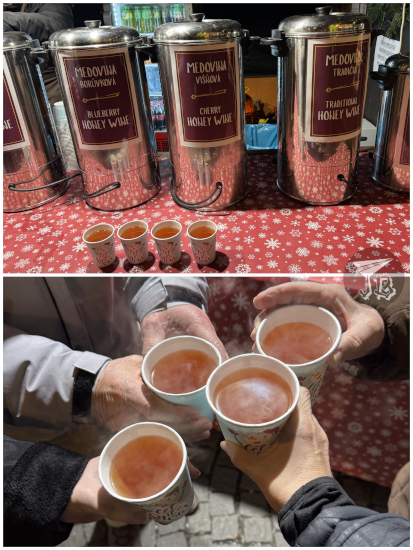
To end the day, however, we did go to the Christmas Market in Náměstí Republiky square, but not for food, just for a drink. A typical drink – traditional honey wine, which I didn’t know (because I don’t drink), but it is just another word for mead. So instead of gentle mulled wine, we got a kick out of Tradiční medovina. Boy, did we sleep well that night.
Before going to sleep though, I had been tasked with booking tickets for a light show the following evening, which was a bit of a challenge on the phone – no way I’m putting my credit card on public Wi-Fi – with a website that kept trying to change its language from English into Czech.
 JBinnacle – A Travel Logbook