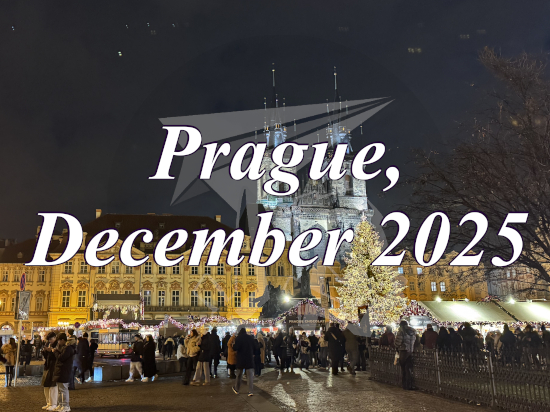
2nd December 2025: From the Pražský hrad Castle, downwards {Prague, December 2025}

It was a grey morning in Prague [Praha] when we headed down for breakfast. The buffet was packed and the coffee horrible, but I was able to find cranberry juice, hard-boiled eggs, bread and cheese. The goal of the day was visiting other areas within the UNESCO World Heritage Site Historic Centre of Prague, starting from the castle to make our way down. Thus, we jumped onto the public transport system – my parents could ride free due to their ages, and my sibling and I bought tickets. The ticketing system allows you to ride for a set period of time after validating, which is done at the gate. We rode the underground to the Malostranská stop, at the foot of the hill where the castle was built. This area of the city is called Malá Strana, the Lesser Town – it is a historical name, because there is nothing “lesser” about it.

Prague Castle Pražský hrad is the largest ancient fortress in the world – a huge complex of buildings delimited by a defensive wall. It hosts the official residence of the current President of the Republic, and in the past it was the place from where the kings of Bohemia and Holy Roman Emperors ruled. Construction began around 870, with the establishment of a walled church on top of a hill overlooking the area. The current palace was built under the reign of Charles IV (Karel IV), who also reinforced the fortifications. The enclosure hosts several notable areas and buildings, such as the Cathedral and the Golden Lane.

The first step was, however, climbing up from the underground stop to the castle itself – literally. This was done via stairs, which fortunately were not frosty. They were… steep, steeper than they looked, considering how wide each step was. I was a bit out of breath by the time we were up… and once at the gate there was still more uphill way to walk!! We reached the ticket office and decided on a “Prague Castle – Main circuit” (Pražský hrad – hlavní okruh) ticket, which included the four key sites: the Old Royal Palace, St. George’s Basilica, the Golden Lane, and St. Vitus Cathedral.

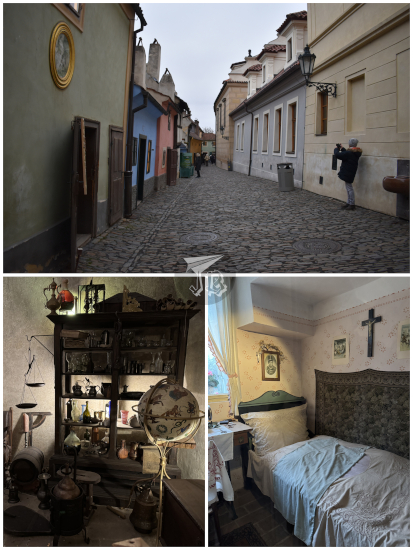
Right next to the ticket office there was the access to the Golden Lane Zlatá ulička. It was originally an area where the castle guards lived. Today, it is a narrow alley with coloured houses, many of which have been converted into souvenir shops or tiny ethnography museums, trying to show how people used to live there – the seamstress, the alchemist, the goldsmith, the fortune-teller… Some famous or important historical figures have dwelt there, most notably writers Franz Kafka – with a bookshop where he used to dwell – and Jaroslav Seifert (1984 Nobel Prize in Literature), and the fortune-teller Matylda Průšová. There is also a collection of weapons and armours.

Golden Alley and reconstructed dwellings: a bedroom and the alchemist's office.

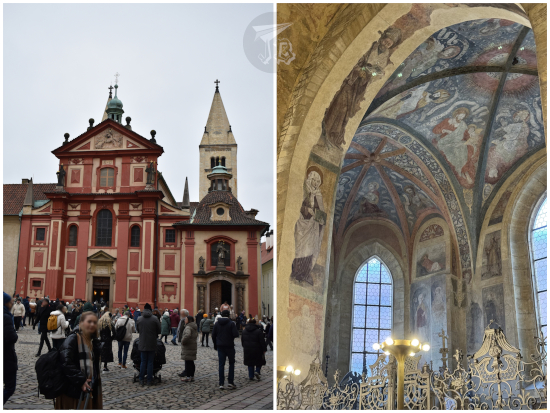
Our next stop was the Basilica of St George Bazilika svatého Jiří. Despite its Baroque façade from the late 17th century, the inside is purely Romanesque. The church is actually the oldest surviving building in the castle complex, consecrated in the year 921. Fortunately, the interior has been kept Baroque-free, and it displays a severe limestone appearance (though it had to be restored after World War II) with frescoes behind the altar.

Baroque exterior of the church of St George and Romanesque frescoes inside.

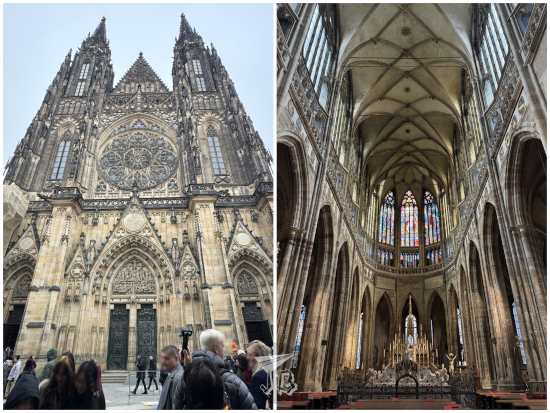
The crown jewel (in my not-so-humble gothic-loving opinion) of the castle is the Cathedral of St. Vitus – formally the Metropolitan Cathedral of Saints Vitus, Wenceslaus and Adalbert Katedrála svatého Víta, Václava a Vojtěcha. The current building is Gothic, and dates back from 1929. No, that’s not a typo. Although construction started in 1344, it did not end until the 20th century! The current building was erected over a previous Romanesque church when the latter became too small. It was sponsored by Charles IV (Karel IV) of Bohemia and originally designed by Matthias of Arras, who obviously did not live enough to see the work completed.

Gothic Cathedral of St Vitus.

Prague’s Medieval history was heavily influenced by the Hussite Wars. The Hussites were reformists, an early movement of what would later become Protestantism, founded by Jan Hus (who ended up burnt to death for his trouble). The Hussite Wars lasted between 1419 and 1434, and were rather complicated, with people changing sides, a civil war, foreign interventions actually called “crusades”… In the end, the “moderate” Hussites allied themselves with the Catholics to defeat the “radical” Hussites, and eventually rose to power as George (Jiří) of Poděbrady was crowned the first protestant King of Bohemia in 1458. While the king himself was a Hussite, he was a moderate and thus tolerant of the Catholics and their rites.

However, with the Hussite uprising, works of the cathedral came to a stop. It stood half-built until the 17th century. Finally, the early 20th century saw serious efforts to finish it in time for St. Wenceslaus’ Jubilee in 1929. Despite its 600 years of construction, the building is simply magnificent, even if there was no sun to shine through the coloured windows. The pointed arches are just perfect, and the stonework has that lovely patina that they’ve cleaned out from Notre Dame in Paris.

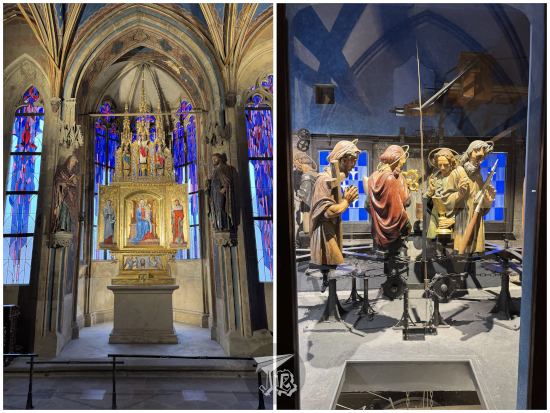
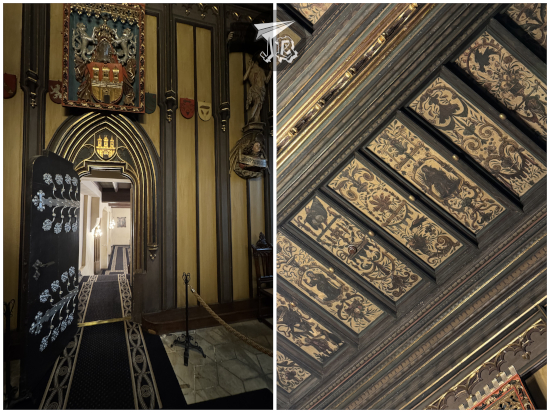
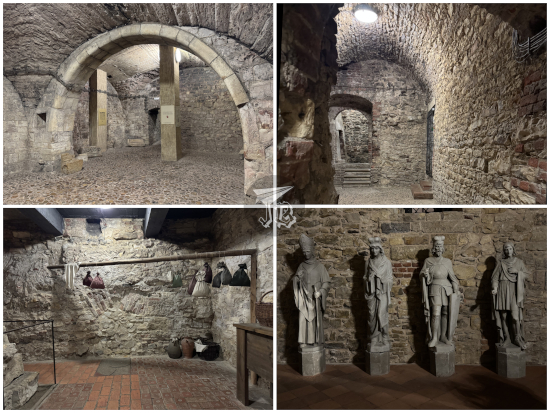
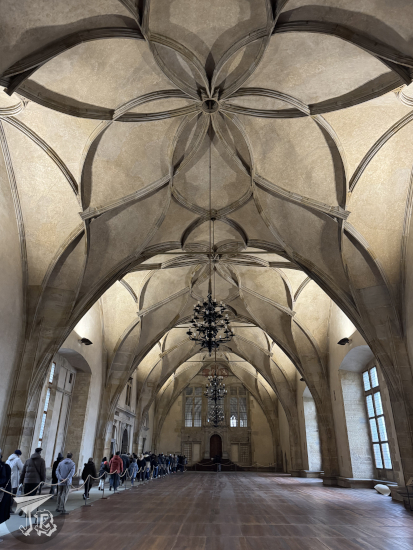
The final building included in our ticket / pass was the Old Royal Palace Starý královský palác, a magnificent Gothic – with some Renaissance touches – building dating back from the 12th century. The Vladislav Hall, built in the 14th century, is vaulted, with gothic nerves. There is a small room with a throne and replicas of some of the crown jewels. Upstairs, rooms with frescoes. To the side, there was a long queue to see the “Defenestration Window” – during the Hussite Wars, people developed a taste for throwing other people out of windows. In 1618, during one of the many Protestant-Catholic moments of tension, two regents and a secretary were pushed out of one of the windows in the palace. They survived. According to the side who tells the story, they were either saved by angels or by falling onto a pile of cow dung.

Interior of the former Bavarian Palace, with gothic vaults.

The family decided to get going. We passed by newer buildings, where the President lives, and headed down the hill. We found a restaurant that my parent seemed to like and we were lucky enough that they had room for us. The staff at U Dvou slunců was pretty nice, and despite me thinking I wanted some dumplings, I ended up ordering Smažený obalený sýr, fried breaded cheese with chips and homemade tartar sauce – just because I love cheese. It was delicious.

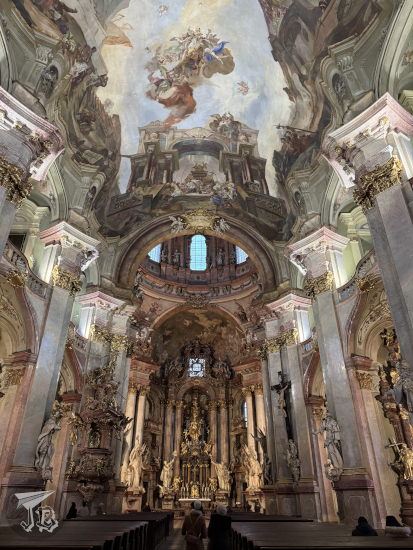
After lunch, we went to Malostranský chrám svatého Mikuláše, the church of St. Nicholas Church in Malá Strana. It is considered the most important Baroque church in town. There are frescoes all over the ceiling, and the decoration is not extremely over the top. The dome is 20 metres in diameter, and the columns are actually made of fake marble, but I would never have been able to tell. It hosts two organs, one of which was currently out of service for restoration.

Baroque interior of St Nicholas Malá Strana church, with frescoes on the ceiling.

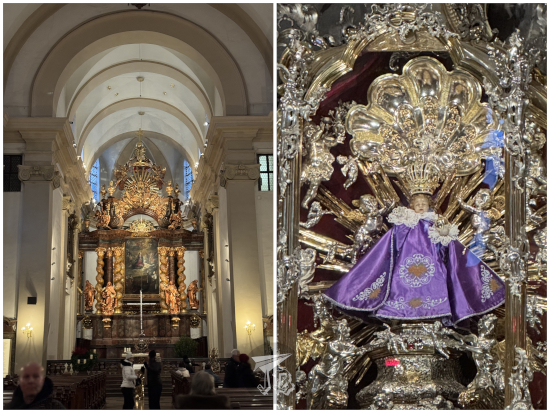
Then, we headed to the Church of Our Lady Victorious and The Infant Jesus of Prague (mouthful) – Kostel Panny Marie Vítězné a Pražské Jezulátko. The church was founded in 1584, and it is also Baroque. It is famous because it hosts the statue of the Infant Jesus of Prague Pražské Jezulátko, a small wooden sculpture of Spanish origin from the 16th century, which somehow made its way to Bohemia through the House of Habsburg. The centre of one of the major pilgrimages in Europe, the figure is about half a metre high, and it is displayed wearing embroidered vestments. On the day of our visit, the clothes were purple, as it was Advent. The church also has a display of nativity scenes and a small museum with different garments for the Infant Jesus that have been donated by wealthy benefactors. I have to say though that the poor thing is… hideous.

Baoque interior of Our Lady Victorious and the Child Jesus sculpture.

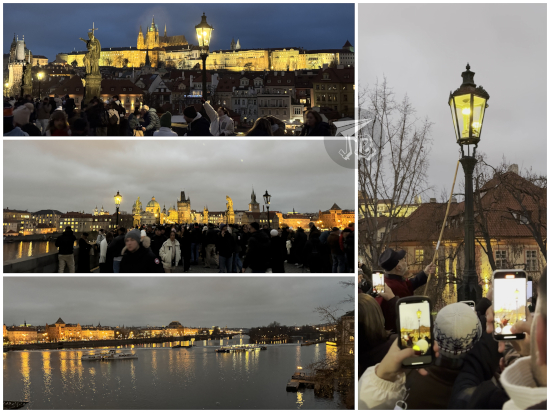
The sun was setting and it was time to cross Charles Bridge Karlův most over the Vltava river. It is a Medieval stone bridge, built between 1357 and 1402, over 500 metres long! There is a tower on each side – Malá Strana Bridge Tower (Malostranská mostecká věž) and Old Town Bridge Tower (Staroměstská mostecká věž), both gothic, and 50 statues along the way. There are also gas streetlamps that are manually lit during Advent! Unfortunately though, since the lighting is a thing, the bridge was swarmed, and it was extremely difficult not to lose each other, so we did not get to see much.

Charles bridge, with an official lighting a gas streetlight.

Back in the Old Town Staré Město pražské we got to see the Klementinum, a Baroque astronomical tower and library that I would have loved to visit, but it was not in the schedule – I would have prioritised it over the churches, but as I mentioned, I had not done any of the planning. My parents decided they were done then, so my sibling and I stayed behind again, after arranging to meet at 19:30. We explored some candy shops, and eventually caught the Astronomical Clock Pražský orloj at 17:00.

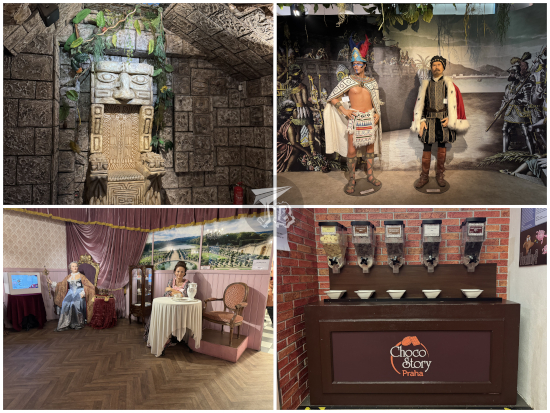
After the 17 bell strokes, I proposed my sibling to go to the chocolate museum, Choco-Story: Prague Chocolate Museum. It is not big, and it features different stages in the history of chocolate – its use in Pre-Columbian cultures, how the Spanish introduced it to Europe, and how it became a popular treat amongst the higher classes, then it became democratised. The last room was explicitly about a Czech company that used to sell chocolate. In the second-to-last exhibit there was an unlimited chocolate tasting station. Yes, the person at the entrance used the word “unlimited”. We of course took pictures with all the available props. And ate chocolate.

Choco Story Prague scenes related to chocolate history - from the Mayans to the Victorian to the present day, with the tasting station.

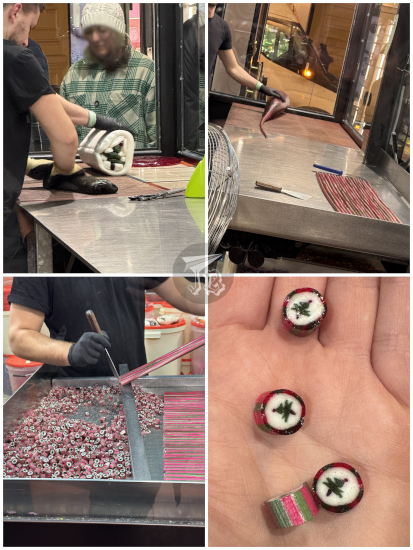
We eventually left the museum, and that placed us in the right place-and-time to see how they made candy from scratch. The two guys started with blocks of different colours – green, white and reddish. They worked the material until it was almost viscous. First, they made three “triangles” with the green material, which they put on top of each other. Then, they filled up with white until they had a cylinder, and wrapped that in red and green – it was a Christmas tree in the middle of a snowy circle! They ended up with something that had around 20 centimetres in diameter. And then suddenly they started pulling and pulling and made sweets that were no bigger than 1 cm, with the Christmas tree in the middle. It was astonishing!! And even better… they shared samples!

Candy-making show. The sweets have little Christmas trees inside.

On the way out, we decided to be weak and bought the blueberry tartlets we had spotted the day before, along with some souvenirs. I got a silly Christmas bauble. We headed back to the room to eat the tartlets, and at 19:00 we dropped by our parents room to regroup. At first we considered having dinner in one of the Christmas Markets, but in the end, they decided that they did not want to eat standing up, and we went to a random sandwich shop the Palladium Prague shopping centre.

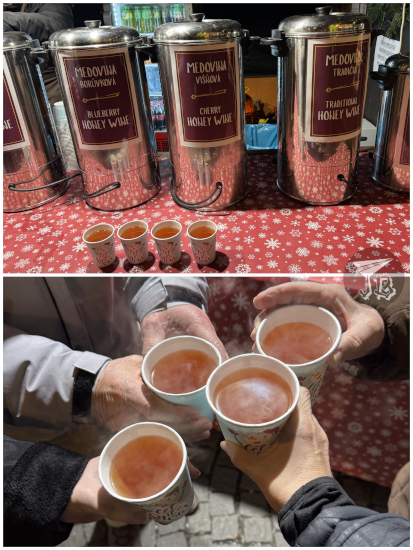
To end the day, however, we did go to the Christmas Market in Náměstí Republiky square, but not for food, just for a drink. A typical drink – traditional honey wine, which I didn’t know (because I don’t drink), but it is just another word for mead. So instead of gentle mulled wine, we got a kick out of Tradiční medovina. Boy, did we sleep well that night.

Honey Wine.

Before going to sleep though, I had been tasked with booking tickets for a light show the following evening, which was a bit of a challenge on the phone – no way I’m putting my credit card on public Wi-Fi – with a website that kept trying to change its language from English into Czech.

1st December 2025: Way too much food {Prague, December 2025}

I stayed over at my parents’ house so they could shave 15 minutes off driving, because 15 minutes of extra sleep at 5:00 matter. I gulped down a coffee and loaded my luggage in the car. We picked my sibling up and drove to the airport before the traffic jam even formed. We got on the shuttle a minute after parking, reached the terminal, and went through security without a hitch. There was really nothing noteworthy to the journey, really, once the check-in-your-hand-luggage extortion had been paid. We were picked up at the airport in Prague [Praha] and driven to the hotel, where we could not check in yet.

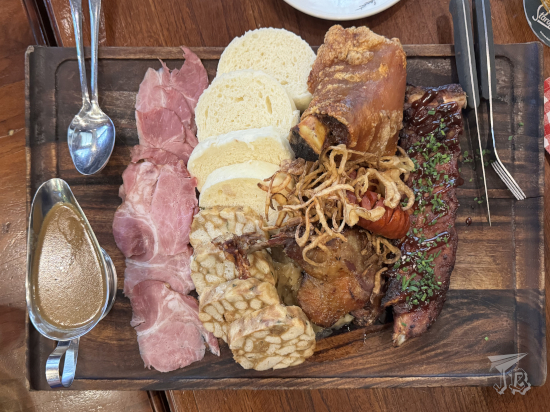
Thus, we headed to have lunch first. There was a restaurant in front of the hotel which served traditional Czech food, called La Republica, where my plenty and I shared a Staročeský talíř pro 2 osoby – Old Bohemian plate for two people, which comprised a duck leg (kachny), pork knuckle (vepřový kolena), pork ribs (vepřový žebra), smoked pork belly (uzený bůček), sausage (klobása), dumplings (karlovarský knedlík and houskové knedlík), white and red cabbage (zelí), with crispy onion liberally sprinkled on top. One kilo of food! Way too much!

Czech knedlík are somehow of a national staple – boiled dumplings, quite heavy on the dough, with optional fillings. Both houskové knedlík and karlovarský knedlík are considered “bread dumplings”, with a base of stale white bread, flour and eggs. They are supposed to be eaten dipped in the sauce that came along with the plate, and they were delicious. So were the pork ribs, and I’m not even a rib person!

Plate of meats and dumplins for two. Way too much food.

After lunch, we checked into the hotel, dropped our things at the room, and set off towards the Old Town Staré Město pražské, the preserved Medieval area of Prague [Praha], part of the Unesco World Heritage Site Historic Centre of Prague. The city is the capital of the Czech Republic [Česká republika], and formerly of the region of Bohemia. The origins of Prague can be traced back to the Palaeolithic, but it was around the 5th century BCE when a Celt tribe settle nearby and gave the historical region of Bohemia its name. During the 1st century BCE, Germanic tribes took their place, and in the 6th century CE, they too were replaced by Slavic tribes.

The city was a fortified settlement by the 9th century CE, when the castle construction started. After the turn of the first millennium, the city became an important trade point, and many Jews settled there. The first bridge over the river Vltava was erected in 1170 (though destroyed during a flood later) and building of the cathedral started in the 1340s. It was Charles IV (Karel IV), Holy Roman Emperor and King of Bohemia, who, between 1346 and 1378, brought the city its Medieval splendour.

After his death, his son Wenceslaus IV reigned, and though there were great achievements, such as the construction of the astronomical clock, it was a time of civil and religious unrest. This lead to a few centuries of wars, even while important artists and wise men lived in town – German astronomer Kepler comes to mind. When the 18th century arrived, things had calmed down, the city thrived, and its population increased. The area, which comprised different municipalities, eventually merged into one large city.

Prague served as the capital of the newly-formed country of Czechoslovakia after World War I. In 1939, it was occupied by Nazi Germany, which lead to the killing of most of the Jewish population. During allied bombings, many structures were damaged, including the Old Tow Hall, and Czechoslovakia as a whole rose against Nazism in 1945, shortly before the end of the war. The country became part of the Soviet Union until the Velvet Revolution in 1989, a moment in which peaceful protests ended up the Communist State. In 1992, the historical centre of Prague was declared World Heritage, and at the end of that same year, Czechoslovakia split in two countries (the Czech Republic and Slovakia) in a process called the Velvet Divorce, a stark contrast to the dissolution of Yugoslavia in the Balkan Wars, which seemed to peak at that time.

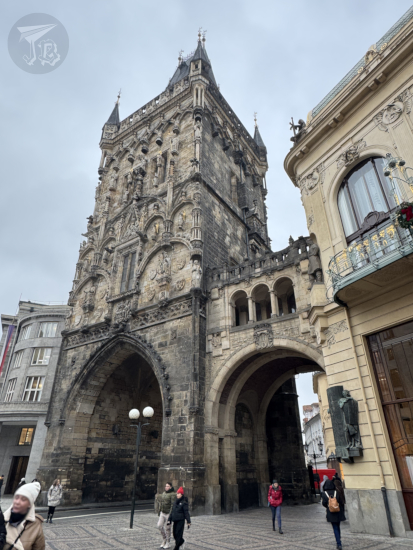
The hotel was a minute or so away from the square Náměstí Republiky, with tram stops, an underground entrance and a Christmas market. To the side stands the beautiful classical concert venue known as the Municipal house Obecní dům. Almost next to it we found the first gothic building we would see in the city – the Powder Tower Prašná brána. It is one of the original gates to the walled city, and construction dates back as far as 1475. Whether it was ever actually used to store gunpowder or not has been disputed. We crossed it and found ourselves in the main shopping street, named Celetná, flanked by traditional houses transformed into tourist shops and joints.

Powder Tower: A Goth defensive tower and Wall Gate.

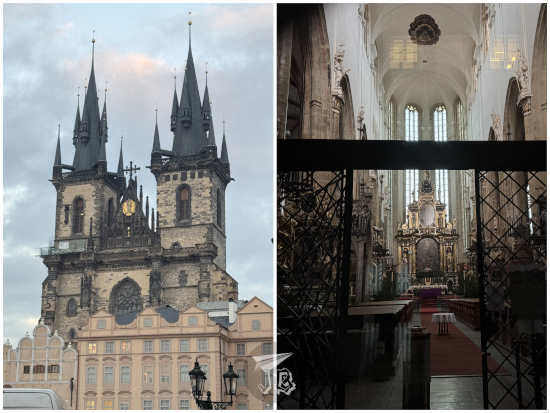
We reached Staroměstské náměstí, the Old Town Square, the neurological centre of the Old Town Staré Město pražské. There stands the Gothic Church of Our Lady before Týn Chrám Matky Boží před Týnem. I am used to churches having… squares in front, but this one is literally encased within other buildings, one of which is an art gallery. It was already too late to visit, unfortunately, but we could snoop through the glass doors. There has been a church in the square since the 11th century, though the present building, erected in Jagiellonian Gothic, was only finished around 1450. Its most striking characteristic is the design of the two towers on the west façade, which feature what I can only describe as pinnacles on pinnacles. I am fascinated by those pointy towers.

Our Lady Before Tyn, inside and outside. It is a two-towered church with spikey twers and a white interior with a baroque altarpiece.

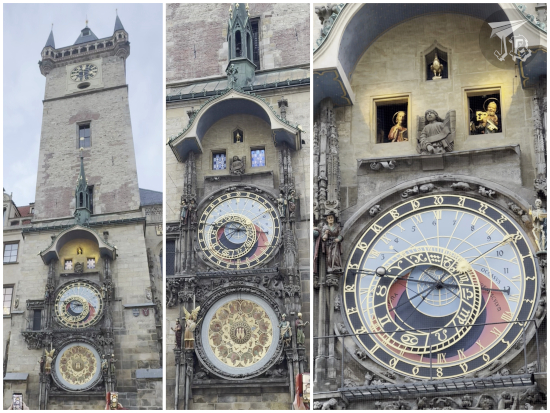
At this moment it was 15:55 so we hurried to the side of the Prague Old Town Hall Staroměstská radnice. There stands the bell tower, and on its wall, the famous Prague Astronomical Clock Pražský orloj, extremely hard to read and understand. Each hour, a Death figure rings a bell, the apostles walk around, and a bell strikes as many times as the 24-hour-clock’s hour.

Prague Astronomical Clock, a complex structure with two spheres.

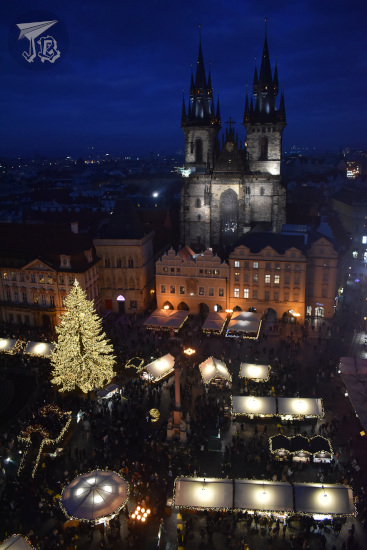
After the 16 tolls, we entered the Old Town Hall Staroměstská radnice, which was a bit underwhelming (it turns out that only the guided visit gives you access to the cool areas). There is a beautiful but tiny room full of frescoes, and the ascent to the clock tower – something that for a bit extra can be done on a lift. From the top of the tower we had a lovely view of the square below, the Christmas market and Our Lady before Týn against the night sky.

View from the clocl tower: Christmas Market and our Lady Before Tyn.

Back on the ground, we snooped the gift shop, then tried our luck at the church of Saint Nicholas in the Old Town Kostel svatého Mikuláše (this got confusing during the planning stage because there are actually two Saint Nicholas churches in town). Today, this Baroque monastery-and-church is used for worship and concerts. It was unfortunately closed.

We had a run at the Christmas market, which sold snacks, drinks, sweets, decorations, souvenirs and Christmas baubles. I actually got myself a beautiful one. My parents decided to head back to the hotel for a break then, but my sibling and I were still good to go. We resolved to snoop around the market some more. It was cold but not aggressively so – it was dry and there was no wind whatsoever, so it was not that bad.

Since I had not prepared anything beforehand, I had no idea where we could go or what we could do. We explored along Celetná, where we found a chocolate and candy shop that lead to the chocolate museum Choco-Story: Prague Chocolate Museum (at first I thought it was a branch from Chocolate Nation in Antwerp, but it is a different shop – though apparently a franchise?). I fell in love with some blueberry tartlets, but I had like zero stomach-room for them. There were also a couple of guys making candy from scratch.

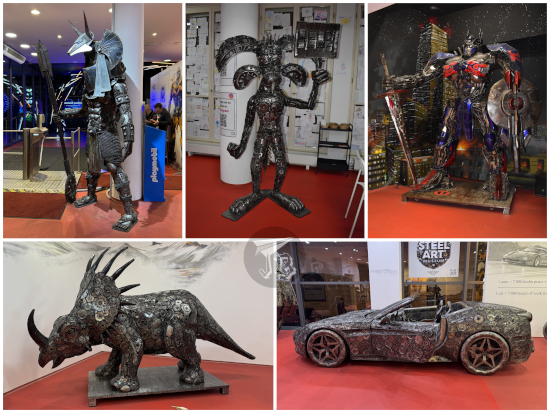
We looked at a couple of shops and then my eyes fell on a Horus Guard from Stargate. My sibling was game to go in and meet him – and that is how we ended up in the Steel Art Museum, which is apparently another franchise. And not only did they have a Horus Guard, there was also an Anubis Captain. The Steel Art Museum has two completely interactive floors, with different sections and 120 items. Everything in the museum is hand-sculpted using metal scraps. There are full cars from luxury lines which you can sit on, in, whatever you want. The only issue is that steel can be a bit slippery. There is a replica of the Throne of Swords from Game of Thrones, Optimus Prime and Bumblebee from Transformers, along the aforementioned Stargate soldiers on what I guess was the fantasy and sci-fi section. But then there were… dinosaurs, some more cartoonish, some more accurate, like a Ceratopsian (styracosaurus, probably). Unfortunately for me, steel is also heavy, so I could not take it home…

We proceeded to the upper floor, full of pop figures, Alien references, and even Marvel’s Avengers. We saw motorbikes, Ninja Turtles, Minions, and characters from films we did not recognise. Despite not knowing everything, we had a blast climbing – or trying to – on anything we could.

Steel Art Museum Prague: Stargate Anubis Warrior, Willy Coyote with a help sign, Transformer Optimus Prime, a quadruped dinosaur with a big frill, and a sportscar.

We headed back to the hotel, and looked around Náměstí Republiky and the Christmas market there. At first we thought it was just a few stands selling food and drinks. Later we would realise there was another part on the other side of the square. We also peeked into the shopping centre Palladium Prague, because it meant we could walk a few minutes in the warmth instead of the cold street.

We regrouped at my parents’ room, and after an hour or so, we headed out to find the restaurant we had booked for dinner – and that one of my parents wanted to try. Výtopna Railway Restaurant is located in Václavské nám or Wenceslas Square, which was currently half fenced off for renovation.

Wenceslaus I Václav I is known for the Christmas Carol Good King Wenceslas, but he was not actually a king. He was the son of the Duke of Bohemia, and lived in the 10th century. When he came to power, he used Christianity as a way to establish his position, which would eventually have him reach sainthood, and when he was later assassinated, martyrdom. The Christmas Carol tells the story of Wenceslas and his page witnessing a poor man gathering wood in winter, and going to his house to bring him a good dinner.

On the way to the square, we passed by Jindřišská věž, another gothic bell tower which has a restaurant and an observation deck. It would have been cool to eat there since the restaurant was at the top. I however did not propose it because it would probably be booked out and I did not want to cause any strife – good thing, too, because it turned out to be pretty expensive.

We found Výtopna Railway Restaurant to the side of the Václavské nám square, in a commercial gallery. Entrance was an absolute chaos. The restaurant is located on a first floor and the stairs were absolutely flooded. They did not take walk-ins as they were fully booked, so there was a queue of people waiting to see if something opened. However, the reservation-checking and seating system was slow, creating a jam. There was a group behind us who decided that, since they had a reservation (too), they could cut the whole line. We let them through, because the stairs were not a place to have a discussion and they were not open to reasoning.

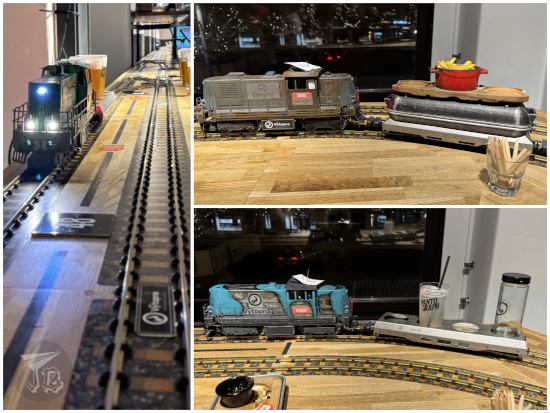
The whole point of Výtopna Railway Restaurant is that food comes to you riding on little trains. They have 900 metres of small tracks and twenty or so tiny trains that bring your order to you. It’s really cute. The “motto” of the restaurant is “meat & beer on rails”. I don’t drink beer, but I really wanted to try the goulash. Unfortunately, I was still very full from lunch. Instead, I opted for a salad with goat cheese (salát s kozím sýrem): green salad with grilled goat cheese, sour apples, walnuts, honey dressing and focaccia bread. It was all right, and the trains moved fast! You had 15 seconds to take your food from the wagons – and any pictures you wanted. So I let the family grab the food while I photographed everything.

Little trains and railways carrying food and drinks.

We undid our way from the restaurant to the hotel, where I took a very long shower and got into bed. I did not sleep much though.

1st – 4th December 2025: Prague (Czech Republic) {Prague, December 2025}

After last year the family went to Vienna, my parents came up with the idea of trying again. While the first idea was Lisbon, our first discussion happened around the time the local scenic funicular had a catastrophic accident. Somehow, the plans veered towards Prague [Praha], in the Czech Republic [Česká Republika], since my parents thought it was a “very doable” city for a couple of days. They also made clear that I was expected not to meddle with planning and just go along whatever. I had apparently unintentionally stepped on some toes in Austria, and I absolutely did not want to bruise anyone’s ego, so I took a huge I step back from preparation. I did not check out neither landmarks nor timetables, I did not look into exchange rates, and only offered opinions when they were explicitly asked of me.

My parents went to talk to our travel agent at Viajes El Corte Inglés to get an airplane-transfer-hotel pack. The original plan was travelling during the long weekend in December, but I was between projects and my sibling said they could get some time off easily. Choosing the alternative dates of 1st – 4th December brought the price down around 800 euro. Too good to let it pass.

Once the package was booked, my parents built an impossible itinerary, I made note of it, and left them to their own devices. They found a couple of restaurants they wanted to try, and the weekend before departure they enquired if I thought we should reserve. My take is that if you really want to check out a place, the best thing is booking, especially in this day and age when you can cancel the reservation with a click.

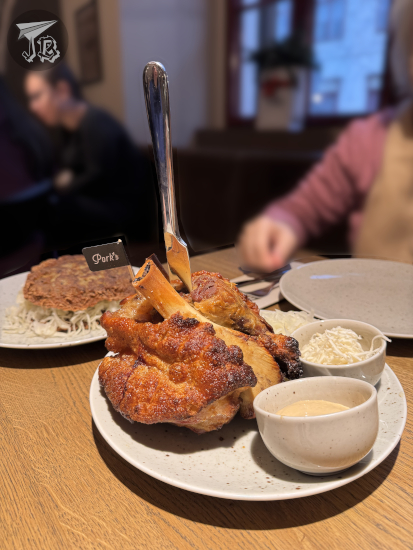
Unfortunately, if you find an instagrammable restaurant online, booking three days in advance is just not going to work, because 99% of the tourists will have also heard about it. The place, Pork’s Mostecká, books out a month in advance. Fortunately, it has a sister restaurant, Pork’s Vodičkova, less “traditional”, but with the same recipes. As one goes there to eat pork knuckles, it had to be booked for lunch (or risk a bad night of indigestion – my parents are firm believers in food-at-Spanish-times). The problem was that to book it for lunch on the day we were around there, we had to displace the other desired restaurant, Vytopna Railway Restaurant. Finally, we managed to find a dinner and a lunch to accommodate both visits.

A big issue was that our plane flew out at 8:45, which is a horrible time to brave the airport-area traffic jam. For my France / Monaco trip, I left at 6:30 and reached the parking a bit before 8:00 (theoretical driving time is 42 minutes), for a plane at 9:40. Thus, we had to leave before that time, so the jam had not formed yet – and, after discussing pros and cons, it was agreed we would drive off at 5:30 to pick my sibling up, and evaluate alternative routes on the way. My non-driving parent wanted the new route to avoid the traffic jam, but also did not want it because they were worried about getting lost.

After a lot of going back and forth, we bought some Czech crowns (Kr) from the bank, though my parent was unhappy with the rate – they got something around 21.5 Kr per euro while the official rate was on the vicinity of 24.5 Kr. Thus they got into their head that, once in Prague [Praha], we had to spend those crowns fast and then exchange more euros. I don’t get that logic, but again, I had promised to step back.

The one thing I was in put in charge of was checking in for the first flight. As it was early on a Monday, the travel agent would not be at work 24 hours earlier to do so. They expected me to do it on the computer, but I retrieved the booking data on my phone to add my frequent flier number. Before going to bed on Saturday night, I opened the app to see whether the free check-in was open, and since it was, I decided to go through it. Unfortunately, a message popped up – since we were in the last group to board, we either had to check in our luggage (for free) at the counter or pay for an upgrade. My sibling and I were travelling with backpacks, which would not take any overhead bin space. Queuing at the counter to check in two trolleys would mean an extra hour at least, hence leaving at 4:30, and lots of added stress. Therefore, I decided to unilaterally pay for the upgrades. I honestly think it is blatant extortion, and I was not happy to do it, but at that moment, it was the lesser evil. I did consider only upgrading two tickets, but then I would have gotten caught.

After the mini-flood in Monaco, I made sure to pack some boots and extra socks, along with sturdy winter clothes. I have to say we were really lucky with the weather, though. It was cold but not insanely so. Unfortunately, I forgot to use lip balm, and paid for it dearly.

I have not been this unprepared for a trip since I was a child, but I think that what my parents wanted was feeling in charge of the family again. I did my best not to step on any toes this time around (though I am not sure I managed). When I was asked what I wanted to visit in Prague [Praha], I went with the most famous sights in their schedule. The only action I took was downloading the map on all the phones. Well, and the plane upgrades, but you will keep my secret, won’t you?