11th December 2025: Underground and University London {United Kingdom, December 2025}

It was not too much of a chilly London morning. I popped into the underground to go leave my luggage at Liverpool Street station – where there is (you guessed it) a Costa Coffee. Then, I headed towards Baker Street Station, where I had booked guided visit with the Hidden London project, by the London Transport Museum. I arrived with some time, so first I explored the Wonderpass – which is a regular underground pedestrian tunnel which allows to cross the road, and has been “decorated” with facts and details about the history of the area, and turned into a small museum.

A few minutes were enough there, so I spent the rest of my time at The Regent’s Park, one of the Royal Parks in London. Between 1536 and 1541, Henry VIII, now head of the Anglican church, ordered the dissolution of the monasteries. Land that used to belong to Catholic orders went to the crown, and although much was sold to fund the King’s military campaigns, the area that comprises Regent’s Park today was retained as hunting grounds. In the 1810s, it was transformed into a pleasure garden with the blessing of the Prince Regent – who would go on to reign as George IV. Today, it is home to the London Zoo, a rose garden, a lake, several fountains, and even a whole university campus.

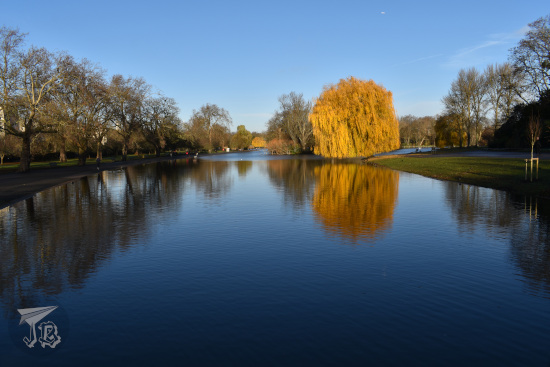
Regent's Park waterfront in the autumn. Trees on the left are bare, trees on the right are golden.

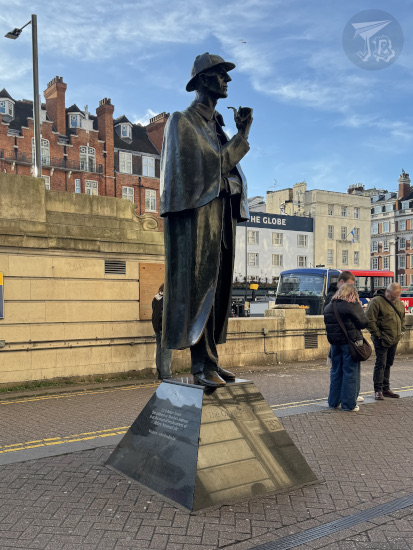
After a while, I headed towards Baker Street Station to await the beginning of my tour. The meeting point was the Sherlock Holmes Statue, which is, ironically, placed in Marylebone Road. The perpendicular road is indeed Baker Street, where the fictional address of the literary detective is – 221B, which today is a museum dedicated to Sir Arthur Conan Doyle’s books, recreating scenes from the stories. The statue was created by John Doubleday and installed in 1999. Arthur Conan Doyle (1859 – 1930) wrote four novels and over 50 short stories featuring the detective. Today the character – possibly the most famous fictional detective ever – is remembered for his uncanny logical deductions, while other personality traits – misogyny or drug addiction – tend to be tip-toed around.

Statue of Sherlock Holmes in front of Baker Street station.

Around 10:20, the people from the London Transport Museum came to check us in. This is one of those kinds of visits for which you need to bring a piece of ID, probably for insurance reasons. I had been wanting to try one of Hidden London tours for a while, despite them being expensive, and in the end I had chosen Baker Street: The World’s First Underground, as it promised to take you “behind the scenes” of the oldest underground station in the world.

Back in 1863, the Metropolitan Railway company had revolutionised transport by deciding to lay their tracks underground. At that time, London was one of the most populated cities in the world, and crossing it took an hour and a half. The project cut down time to 20 minutes. Unfortunately, we are talking about actual steam trains continouslymoving through tunnels, and the coal smoke was not… the healthiest to breathe, one could say.

The tour takes around 90 minutes, but it is set as more grandiose than it actually is. Most of the “hidden spots” are just service corridors full of trash cans and current working equipment. We had two guides and a security guard, and the information was interesting indeed, but there were few places to explore that felt really “hidden” and just like a conference in a couple of closed-off places.

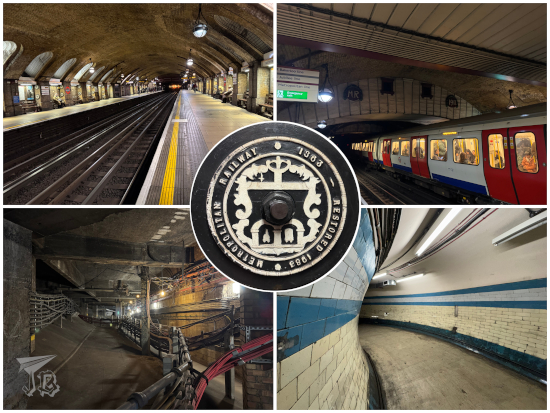
Baker Street Station hidden tour - platforms, and abandoned tunnels.

I did revisit a couple of the publicly-accessible areas after the tour was over to try and get a decent photograph, and then headed off towards Euston to visit a couple of museums belonging to the University College London (UCL), both of which I’ve wanted to see for a while now. However, the last few times I’ve been in town either one or the other was closed – or their opening times did not fit the plans. Today was the day. I first went to the Petrie Museum of Egyptian and Sudanese Archaeology. Though it is a tiny museum, it holds one of the largest archaeological collections in the world, with around 80,000 items.

The core of the collection was donated by writer Amelia Edwards (1831 – 1892), the “godmother of Egyptology”. Edwards toured Egypt in 1873 and 1874, and later, in 1882, she co-founded the Egypt Exploration Fund (now the Egypt Exploration Society), which aimed to support and promote Egyptian cultural heritage. Upon her death, all her Egyptian artefacts, and a hefty sum of money, were donated to the University.

I reached the museum and asked if I could snoop around. I was told no, but I was welcome to visit. Okay, I guess. No harm done. While I love old museums, this one feels way too crammed (and not even in the fascinating way the Sir John Soane’s Museum does). The space is small, so most objects are lounged together in large cases, some with their original labels from the Victorian times, even. It is run by volunteers and possibly all that they custody is in display, which explains why everything is so full.

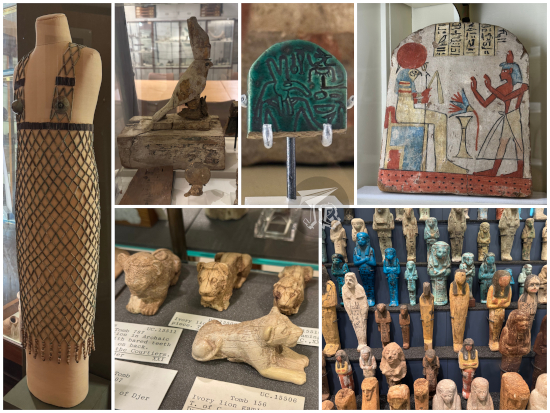
Exhibits at Petri Museum - Egyptian archaeological artefacts: a dress, animal and human statuettes, painted tiles.

Afterwards, I headed to the Grant Museum of Zoology and Comparative Anatomy, also part of the UCL. Established in 1828 by Robert Edmond Grant, it is one of the oldest natural history collections in the country, originally designed as a teaching collection. It comprises 100,000 specimens in total. There are incredible things on display here. Something that drew my attention was that there were a couple of tutoring sessions going on at the museum… about how to draw creatures and specimens. I did not eavesdrop, but what I overheard was fascinating…

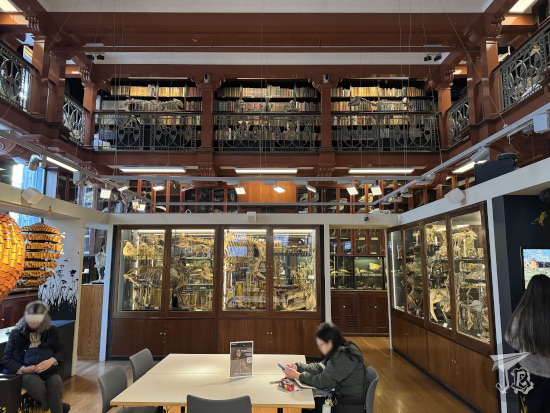
A general view of the Grant Museum of zoology. There are skeletons looking down from the second floor...

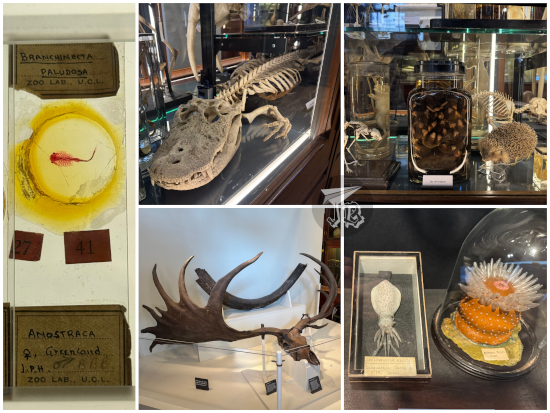
One of the highlights is the so-called Micrarium – almost 2,323 old microscope slides (a tiny fraction of the complete collection, which goes up to 20,000), designed in 2013. There is also a collection of invertebrate glass models that blew my mind away, fossils, skeletons and a wall full of disassembled mouse bones. The museum most infamous exhibit is a jar of moles (Talpa europaea), which hosts 18 of these tiny mammals, male and female, preserved in formaldehyde. When I asked why it was so popular, the volunteer explained that the jar was never catalogued and that it predates any worker of the museum – so no one knows where it came from, and what was it going to be used for. It might have been assembled for a zoology class, or maybe a researcher collected the critters. In any case, there is no record of it, the jar just… exists.

Grant museum of Zoology exhibits: a cocrodile skull, an old microscope slide, giant deer antlers, glass models of anemone and squid, and the (in)famous jar of moles.

Had I not received the email concerning security queue issues in London Stansted, I would have at that point headed for the Monument to the Great Fire of London. However, I have trust issues, so I decided to head to the airport instead. I took the underground to Liverpool Street, and was at the airport around four hours in advance instead of my usual two.

Stansted was packed. There was nowhere to sit, and I’m not talking about actual seats. It was almost impossible to find even a spot on the floor to plop down. I fortunately found a corner where I could stay for about an hour before things started clearing out. I felt a bit miffed because while security had taken a bit longer than usual, it was not the chaos I had feared, so I felt I had wasted my afternoon in London. However, better safe than sorry.

When finally my gate was called, I tried to get to sit down somewhere, but Ryanair made the decision to have the check point just at the end of the stairs, and I found myself stuck in the queue. Most of the waiting was done after check in, and the land crew person opened a cordoned thing to push us through so I ended up – somehow – in front of most of the Priority Queue. That meant I entered the aircraft much earlier than I normally would have. I made the trip back encased between two very tall people who… had trouble squeezing into the seats.

Once I landed, I beat most of my plane to passport control. It was cold when I stepped out and once in the car, the parking lot barrier didn’t want to let me through, and it took several tries to get out. Fortunately, going back and forth repeatedly solved the issue, and I did not have to go find a warden to get it done.

All in all, the trip was a success. I really wish I had stayed a day longer, I would have squeezed many other things in. However, now that my early-morning plane is back, and I have an ETA, I might feel compelled to fly to the UK a couple further times before London introduces a tourist tax. Maybe in summer if the Crystal Palace Trust has finished their renovations of the dinosaurs, or summer for the Jurassic Coast… Or, you know, the minute both the Natural History Museum’s Jurassic Oceans: Monsters of the Deep and the British Museum’s Bayeux Tapestry exhibitions are open.

10th December 2025: Oxford, trains and back to London {United Kingdom, December 2025}

I got up, used the kettle in the room to prepare a quick coffee… and one look at the radiator told me how it worked. I must have been much more tired than I realised the night before… I left my luggage at reception and went back to the streets of Oxford. I basically retraced my route from the previous evening in daylight.

I started off at the Claredon Building, the Bodleian Library and the Bridge of Sighs. Beyond that, I got back to the Radcliffe Camera, University Church of St Mary the Virgin, and the Old Bank Hotel. Down High Street, I walked by All Souls College, the Examination Schools, the Queen’s College, all the way down to Magdalen College.

Up the street again, I reached the Covered Market and turned at Carfax Tower, to St Aldates Church and Christ Church College. Though visiting it was my goal for the morning, I still had some time before the College opened. Thus, I decided to go to Costa Coffee for a proper breakfast, where I had a vanilla latte and a blueberry muffin.

I then headed back to Christ Church College. As it is the largest and most important structure – and also the one that holds the cathedral – it was the college I thought I needed to visit. The visitors’ centre is located in Christ Church Meadow, a floodable grassland open to the public during the day.

I purchased a self-guided visit ticket and went on to explore. Christ Church College (officially The Dean and Chapter of the Cathedral Church of Christ in Oxford of the Foundation of King Henry the Eighth) was founded in 1531 by King Henry VIII, as expected by the name. It was later refounded in 1532, and again in 1546. The second refoundation had a lot to do with the reorganisation of the Church of England, and since then it has been the home of Oxford’s cathedral. Christ Church is a huge complex, mostly in a stunning Gothic and Neo Gothic styles (with some Baroque and Neoclassical add-ons), and the audio guide kept insisting that one should not peer through the windows. Though I think it would have been doable to take the tour the previous day, the cathedral had been closed, and I wanted to see that.

I don’t really think I was ready for how grandiose – I can’t find any other word for it – the whole compound was. The Great Hall caught me by absolute surprise. The staircase which accesses it is magnificent, and the hall is just fascinating. There are fireplaces, pictures of Deans and Professors, long wooden tables and lead windows with different motifs, the most important one being the Alice in Wonderland Window.

The visit begins at Meadow Quad, a 19th-century Gothic Revival building, designed by TN Deane. The particular style is known as Venetian Gothic. During the Victorian period there were several efforts to redefine the significance of Classical ruins and medieval structures, along with a scorn of Baroque. In a typical with-me-or-against-me fashion, two thought currents emerged. On the one hand, Frenchman Eugène Viollet-Le-Duc, who wanted to be more Gothic than the Medievals themselves. His idea was to perfect Gothic buildings using more modern materials and techniques, often making up structures and even whole buildings. Amongst his notable efforts are the restoration of Notre Dame in Paris and the city of Carcassonne (and by his followers, the Olite castle).

On the other hand, Englishman John Ruskin claimed that construction had a life cycle and should be born (be built), then live (be used) and die (collapse). Being a Romantic in the artistic sense of the word, he also idealised Gothic, and his theories inspired more than one Gothic Revival attempt, but he considered them plagiarism and “faux”. Ruskin studied in Oxford, and some of the Neo Gothic buildings there tried to recreate his idealised visions of Gothic – Meadow Quad is one of them (the museum of natural history is another). While Ruskin originally (and vehemently) opposed restoration, to the point that at some point he wrote that it “shattered his soul”, by the end of his life he acknowledged that maybe it was not such a bad idea. Though this is of course a very summarised version of both theories, if I have to take a stand, I’m on Viollet-Le-Duc’s side.

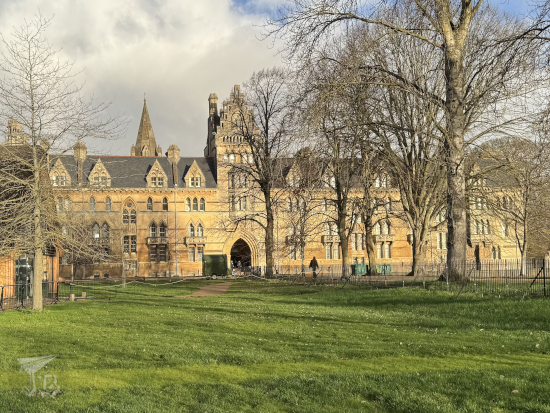
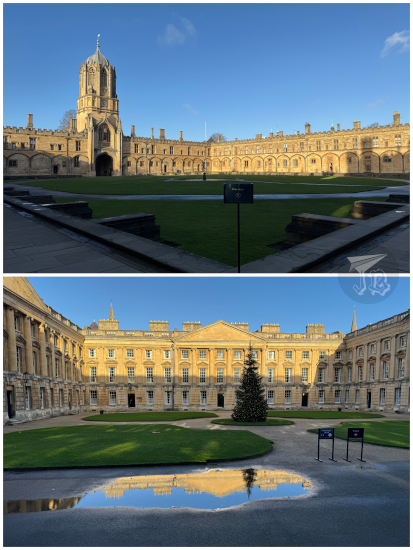
Outer façade of Christ Church College, Oxford, towards the end of the meadow.

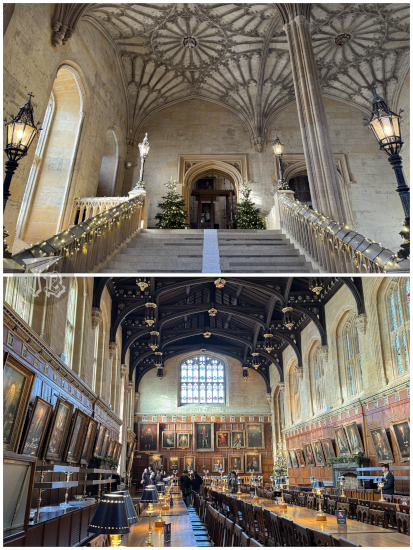
The first visit inside the college is Bodley Tower, which features a the monumental Hall Staircase, with an incredibly vaulted ceiling of Medieval design but carved in 17th century. It leads to the Great Hall, the Renaissance mesh room where students and teachers share their meals on long wooden tables (I’ve also learnt that during summer holidays Christ Church turns the students’ rooms into a B&B and you can have breakfast there. Yes, I’m having thoughts). Features of the room include the two chimneys, painted portraits, and stained glass windows.

There is a particularly famous window, called Alice’s window, which honours a former student of the college, one Charles Dodgson, who is more famous than you think. Dodgson’s pen name was Lewis Carroll, and Alice is the one who went to Wonderland and Through the Looking Glass. Carrol was born in 1832, and throughout his life he became a writer, photographer and mathematician. He was tall but scrawny, deaf in one ear, had weak lungs and suffered from a stammer. In 1851, he enrolled to study in Oxford’s Christ Church, where he would go on to work for the rest of his life. It is said, especially in this college, that the main character from Alice’s Adventures in Wonderland (1865) and its sequel Through the Looking-Glass (1871) was based on the Dean’s daughter, Alice Liddell. Another apocryphal story is that the Dodo that appears in the fist book is based on himself – apparently his stammer made it difficult for him to pronounce his own surname, Dodgson, so he referred to himself as a Dodo. It’s difficult to know if this was true…

Main Staircase and Main Hall, where food is served.

Leaving behind the tower, I ventured onto the main yard of the college, Tom Quad (officially the Great Quadrangle), home of the resident pet ducks Tom and Peck. It was originally designed to be a cloister, but the arcade was never finished. In the middle of the quad stood a firefighting water reservoir, now substituted by a decorative fountain with a flying Mercury in bronze. The street and the college are connected by a gate on top of which stands the bell tower known as Tom Tower, whose bell is known as Great Tom. Tom Tower was designed by Christopher Wren around 1680, and Great Tom rang for the first time in 1684. Today, it rings 101 times at 21:00 Oxford time, which is 21:05 GMT, signalling the original curfew time.

The other two quadrants open to visitors are Peck Quad and Canterbury Quad. The former is overlooked by the New Library built in the 18th century in the Renaissance style. The latter gives way to the Picture Gallery. Possibly though, the most impressive element in the complex is Christ Church Cathedral or Cathedral Church of Christ. The building was erected towards the end of the 12th century, but the interior was redesigned, in the Neo Gothic style by Sir George Gilbert Scott.

Quadrants at Christ Church College, Oxford. One is Gothic, the other is Baroque.

The cathedral was re-signified within the context of Henry VIII’s Reformation, which was sparked when the king wanted to have his first (out of six of them) marriage annulled. The original wife, Catherine of Aragon (Catalina de Aragón, daughter of Spain’s Catholic Monarchs) had already married Henry’s older brother, Arthur, who died soon after. Seven years later, she was wedded to Henry VIII, soon after his ascent to the throne, and although she become pregnant six times, only one child, future Queen Mary I, survived past infancy. In order to marry his brother’s widow, Henry needed a special dispensation from the Pope.

However, he was unhappy that Catherine had only reared one daughter, so by the time she was too old to have more children, he sought a personal favour from the Pope – the annulment of the marriage. He claimed to have realised that according to the Bible, said marriage was wrong and the lack of sons was a divine sign. It did not help that by this time, he had fallen in love (or in lust) with Anne Boleyn. The Pope rejected the request, which eventually yielded to Henry VIII’s breaking out with the Catholic Church and creating the Church of England. Henry banished Catherine, and married Anne Boleyn, who later ended up beheaded, accused of “treason” (read: infidelity), while Henry married again – four times.

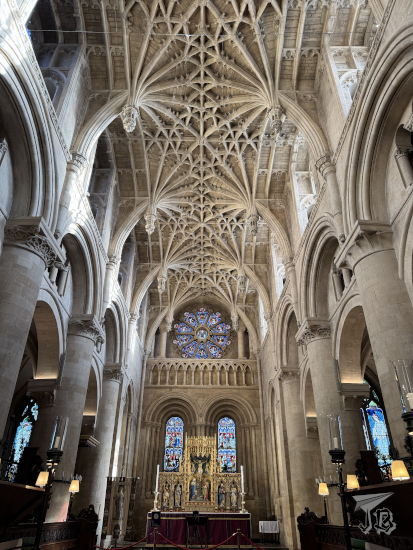
Christ Church Cathedral was originally Catholic, built in the Norman (Romanesque) style during the 11th and 12th centuries. After its conversion to the Anglican rite, the interior of the church was redesigned. It has large stained glass windows and an amazing Neo Gothic ceiling. During the audio guide explanation there was a salute from the Dean, Sarah Foot, welcomed visitors “of any faith, or none” into the cathedral. As the building had originally been designed as an Augustinian monastery during the Catholic period, it features a cloister and a chapter house, the last visitable elements in Christ Church. I turned back in the multimedia guide, bought a trinket at the gift shop, and left the premises.

Interior of the very gothic Christ Church cathedral.

Afterwards, I returned to the hotel to pick up my luggage and head to the station taking a small detour to see the outside of Oxford Castle and Prison and the Castle Mound. There’s no free exploring the castle, you must book a guided tour, so I had decided against it, heading back towards London instead. I wanted to leave on the 12:34 train, which gave me enough time to drop the luggage in my London room, and head out again. Unfortunately, the train was delayed by a “disruptive passenger” and reached Oxford 20 minutes late. I had a booking for the London Museum of Natural History, but I could get another one to guarantee entry if there was a queue, half an hour after the original.

I did not see everything that you can see in Oxford. However, I’ve learnt that day trips are cheaper, because a single and a return ticket have the same price. I did not get to see anything related to JRR Tolkien, nor the Headington Shark, so I might have to eventually come back. I do not regret my planning though, because I had priorities. Off to London I rode, munching on salt-and-vinegar crisps.

I reached Paddington, then changed to the underground to reach Victoria Station. I hate Victoria. I hate it almost as much as I hate Shinjuku Station. It’s bustling and chaotic and I never get my exit right. It was particularly crowded as they had a Christmas installation – a huge plastic “Christmas bauble” which people could enter to have their picture taken. I finally got my bearings and reached the hotel, a few minutes away. Though it was called the Grapevine Hotel, check-in was next door, in the Sheriff Hotel. I had booked a single en-suite with private toilet, and when I got to my second-floor room I found the faucet, the shower, the bed, and a note reading “the toilet is on the first floor”. As in… a whole floor down there was a toilet with a sign reading “Room 15 toilet”. It was incredible surreal, and I had a good laugh about it!

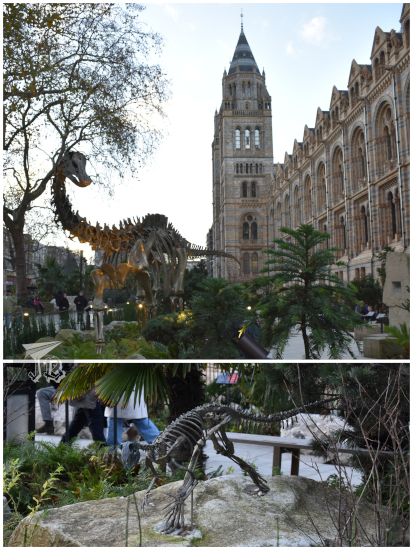
I headed back to Victoria Station (have I mentioned I really hate Victoria?), hopped onto the Tube, and reached South Kensington. It was not too crowded and I could take the tunnel towards London’s Natural History Museum. They have recently reopened their garden, after revamping the area and adding a bunch of details and attractions. Renamed Evolution Garden, its main feature – due to sheer size alone – is Fern the Diplodocus (Diplodocus carnegii). The life-sized specimen is made in bronze and based on Dippy, the Carnegy cast. Before Dippy went on tour in 2021 (again), each bone was scanned so further copies could be made. The museum wanted a new specimen in a lifelike pose and no external support, that would be placed outside, no less. That was why it was decided to build the new display in bronze. However, the resulting skeleton would be too heavy, so they needed to hollow the bones out and keep the skeleton up using internal wiring. The result is a 25-metre long, self-supporting giant that gently sways with wind and withstands both heat and rain.

It almost dwarfs the smaller Hypsilophodon, first discovered in the Isle of Wight – a typical “English dinosaur”. The species lived in the Early Cretaceous, and it was first discovered in 1849, and for a couple of decades it was thought to be a young Iguanodon, until Thomas Henry Huxely proved otherwise. The new species was officially named Hypsilophodon foxii in 1869. It was bipedal, had a beak and teeth, and it is thought to have been a natural runner. It measured up to 2 metres in length, weighed around 20 kilograms.

Outside garden if the Natural Science Museum London showing the diplodocus and Hypsilophodon fossil replicas.

The Garden of Evolution has vegetation in order of appearance – from ferns to other early plants to flowering plants and grasses as one walks through the garden and “advances” in time. There are more small sculptures and art pieces, rocks and ponds, all of them dedicated to recreate evolution and at the same time provide a little nature to the heart of London.

I walked into the building, and my bag was flagged for inspection… ish. It’s just big enough to hold my camera and my wallet, and when the security guard saw that it flopped – the camera was already around my neck – he waved me through. My first stop was the gift shop – there were two things I wanted so I got that out of the way. I was aiming for two Christmas ornaments, but I got a Fern commemorative coin too.

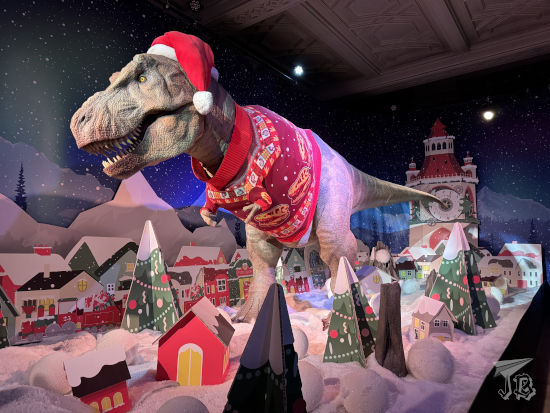
I headed to the dinosaur area. One museum’s traditions is dressing their T. Rex animatronic in a humongous Christmas jumper every year – this year it featured ammonite, theropod prints, stars and a T. Rex skull. It was hilarious. I almost bought myself the human-design version after seeing it.

T Rex animatronic dressed in an ugly Christmas sweater with T Rex skulls.

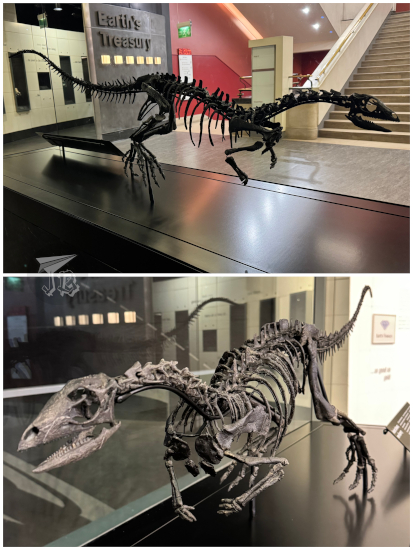
I then went to the birds area to find the museum’s dodo, because after Oxford, everything dodo had to be checked out, of course. Later, I found my way to Sophie, the most complete stegosaurus skeleton. Afterwards, I made my way up because in June, the Museum unveiled a new species, a small herbivore named Enigmacursor mollyborthwickae from the Morrison Formation in the US. It is considered the holotype for the species (the only specimen known, even). Enigmacursor means “mysterious runner” and mollyborthwickae references Molly Lowell Borthwick – she and her husband donated a small fortune so the museum could acquire the unique skeleton, filed NHMUK PV R 39000. It was named in 2025 by Professors Susannah Maidment and Paul Barrett, and put on display. I was very excited to see it for the first time.

Enigmacursor mollyborthwickae, the one and only skeleton of this small theropod dinosaur.

I wandered through other spaces of the museum, including seeing the Treasures in the Cadogan gallery, where the Archaeopteryx is kept, the mineral gallery and The Vault, with all the gems and precious minerals. I also popped into the newly-renovated Hall of Mammals. I left the museum a bit before closing and was a tad disappointed that I could not cross the gardens, as they had closed an hour before the museum itself. I had a couple of hours before the musical, which did not feel like much to go to the centre and snoop around something “Christmassy”. So I headed back towards Victoria, and stayed a little at the bauble decoration, which now had a few ballet dancers inside – characterised as the Nutcracker, but to the music of Swan Lake.

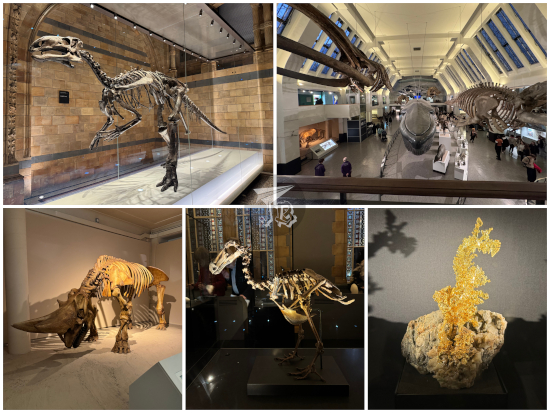
Natural History Museum London exhibits: Maiasaurus skeleton, mammal hall, rhino skeleton, dodo skeleton, gold ore in the shape of a dragon.

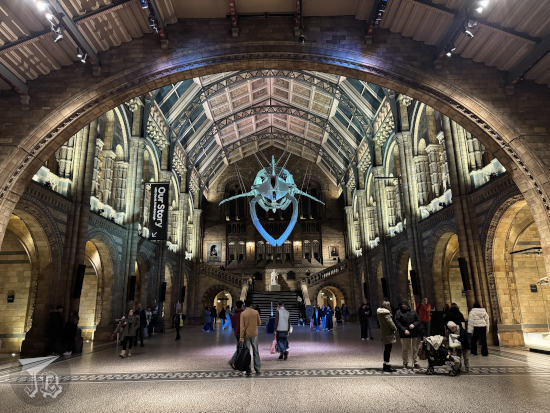
Hintze Hall and Hope the blue whale of the Natural History Museum London from the entrance.

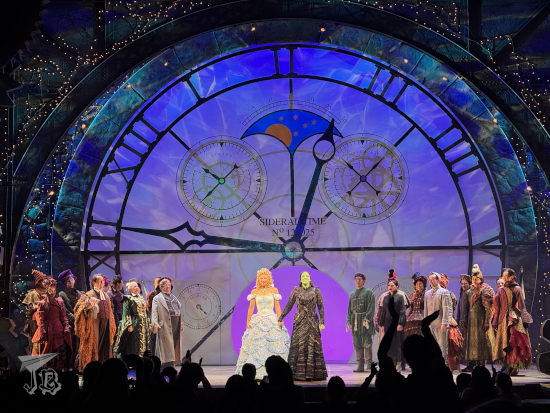
At 18:30 I strolled to Apollo Victoria Theatre. After watching the Spanish version and the first film, it felt right to go back to watch the original Wicked musical once more.

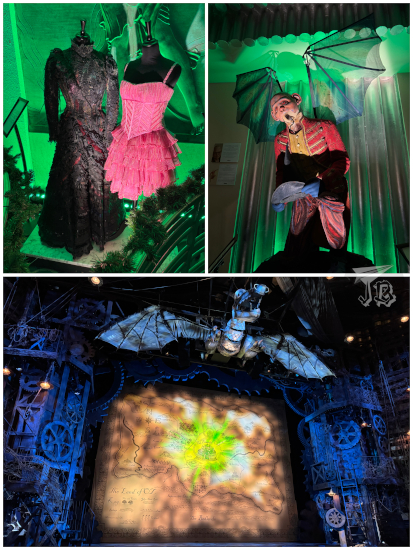
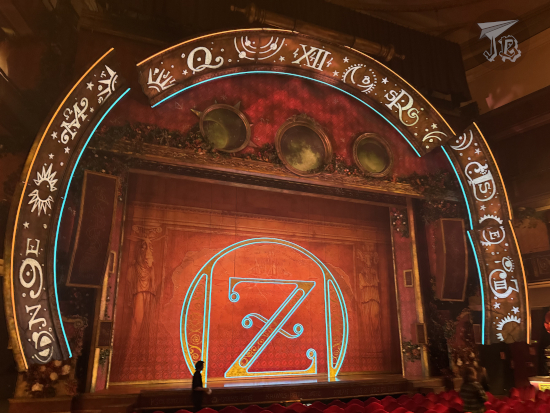
The theatre was displaying a couple of dresses and a sculpture of Chistery the flying monkey. I checked out the upper bar for a change, but everything was packed, so as soon as the sitting area opened, I went to find my seat. Since I was amongst the first people inside, I could take a few decent pictures of the stage. The theatre was rather empty in comparison to what I was expecting, but then I realised that it was the middle of the week, and I had only been to the Apollo Victoria at weekends before. I had booked a seat next to the aisle on row S, and honestly it was a perfect view – the person in front of me was also short, which was fantastic.

Dresses, figures and stage from Wicked in London.

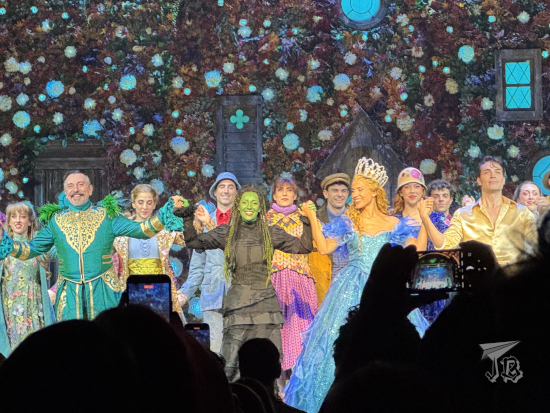
The three main characters were played by Emma Kingston as Elphaba, Zizi Strallen as Glinda and Carl Man as Fiyero. I think Kingston has become my favourite Elphaba to date. Points to Man for keeping the British Ts during his solos, too. However, he did not feel as powerful a character as 2022’s Ryan Reid. I saw a few of Jeff Goldblum’s mannerism on the Wizard (Michael Matus), which… honestly do not work if you’re not Goldblum. Though the cast claims that they have not been influenced by the film, there are times that it just… slips in. Not in a bad way, but… it’s there. I really enjoyed it though, much more than any of the other versions. It feels natural – and not as long as the film(s).

The Cast of London's Wicked after the show.

After the play was over, I stopped by the station so I could buy some dinner (and cut some walking in the cold), and I guess I was hungry because I had all but skipped lunch. Once back at the hotel, I checked in for my flight, and also received an email stating that there was a bit of a chaos at London Stansted airport due to operational issues. That made me decide to head to the airport a couple of hours before I would usually do the following afternoon. It meant sacrificing one of the stops, but it would have sucked to get stuck there due to a long security line. And it’s London. It’s not like I’m not planning to go back already.

The truth is that the hotel had been cheap, and it ended up being quite uncomfortable. On top of the toilet issue, there were no blinds on the window, and it was humid. At least, heating worked, I guess. I did not sleep much, but that gave me time to try and plan my following morning.

9th December 2025: Exploring Oxford {United Kingdom, December 2025}

Nothing ever seems to go right before 4:30 in the morning, right? It turned out that when I reached my usual parking lot at the airport, I had mistakenly booked for another one! Ho boy that was stressful for a few minutes! Fortunately, I could reach the correct parking lot within five more minutes, and found a good spot to drop off the car. Then I did not have to wait for the bus, but could directly walk into the terminal. I might change my usual parking lot to this one, honestly. I like that you can walk and not depend on the bus. The downside is that if you get in or out late, you have to look for one of the 24-hour accesses to the terminal, and those are far and few so you end up walking back and forth a bit.

This whole mishap put me 20 minutes behind schedule, and of course I got a secondary screening at security – random drug / explosive test. Also, can airports decide on policies? Or at least, you know… could the airport agree with itself? Shoes on, shoes off, liquids in, liquids out… In Madrid, it seems to depend on the terminal – and the equipment I guess, if I am being rational. But I really did not feel like waiting for the chemical test to show a negative result.

Passport control went smoothly. When I sat at the boarding gate, I received a reminder that I had to check in with some administrative nonsense (basically proving that I’m still alive) – fun thing to do at 5:00. But that was a fast thing, and soon we had boarded. I had an aisle seat, not exit row. I dozed for most of the flight. Once at London Stansted, getting out took a bit of time because I was really back in the plane, but since I know that airport pretty well, I was able to outrun most of the crowd and barely had to wait at immigration. No one asked about the ETA, but it’s supposed to be linked to the passport, so I guess the system recognises it.

Once in the United Kingdom, I made my customary stop at Costa Coffee, then hopped onto the Stansted Express to get to central London. I changed into the underground, reached Paddington Station… and missed my train by literally a minute, because I could not, for the life of me, figure out how to access the platform! It turns out that Paddington has only one entry point in the middle of all the platforms, but several points of exit. The next train was only 30 minutes later so I just hung around the station for that time.

The first London Paddington station was designed by Isambard Kingdom Brunel and opened in 1854. The original train shed features a glazed roof and wrought iron arches. There is a side shopping centre with a Paddington Bear shop, since the character was named after the area. Since Michaek Bond published the first book in 1958, this Peruvian spectacled bear has become a staple of British children’s literature – and of course, someone managed to heavily cash on that.

Once the train was announced, I got on, and roughly at 11:00, I was finally in the historical centre of Oxford, with the plan to visit the four museums that the local university created to showcase its collections. Since my hotel was on the way, I dropped my luggage off there, and headed out to the first stop – the Oxford University Museum of Natural History, a place that I had wanted to visit when I was a child, just like the Oceanographic Museum of Monaco. To get there, I walked by St Mary Magdalen, an Anglican church in Gothic and Gothic Revival styles, and the Martyrs’ Memorial, designed by Sir George Gilbert Scott to commemorate the burning at the stake of Protestant Bishops Hugh Latimer and Nicholas Ridley and Archbishop Thomas Cranmer.

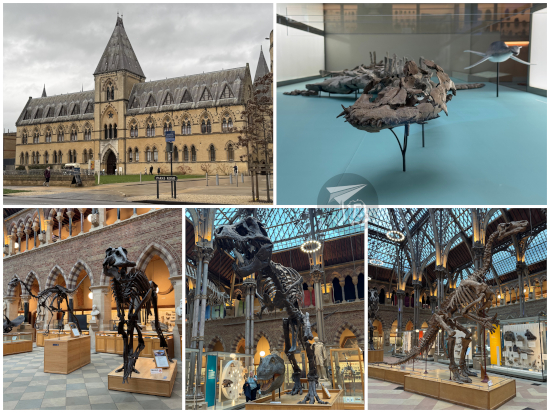
The Oxford University Museum of Natural History was built between 1855 and 1860, and gathered all the science collections that the university had amassed in different colleges and the Ashmolean Museum, with items that can be traced back to the Tradecant Collection from the 1600. The building itself was mainly designed by Irish architect Benjamin Woodward in a stunning Neo Gothic style. It was originally conceived as both museum and research centre, but as the collection grew, most of the research departments – except entomology – left to newer spaces. Once inside, the museum resembles a cloister, with a central court divided in five aisles by iron pillars that support the glass ceiling, decorated with wrought leaves to evoke trees and plants. Both floors have stone columns supporting pointed arches, and each one is representative of a different British stone, as if it were a research core.

Today, the museum has custody of seven million artefacts, divided in three main collections – Earth (comprising palaeontology and minerals), Life (covering zoology and entomology) and Archive (out of mere mortals’ reach). There are a few incredibly rare and valuable items in either collection. One of them is the only soft tissue of a dodo, an extinct bird.

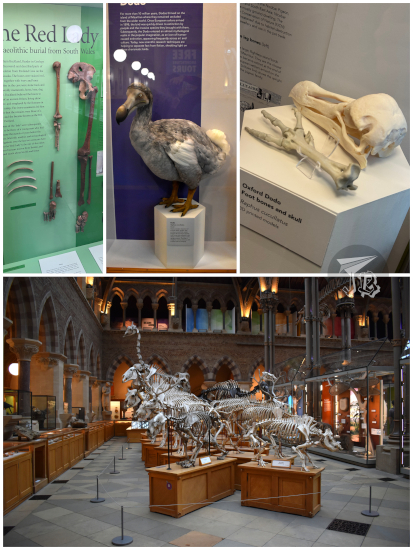
The dodo (Raphus cucullatus) was a flightless bird from the African island of Mauritius that disappeared in 1662. It was a roundish bird that could measure up to 75 centimetres, and when it was “discovered” in 1598, it had no fear of humans. That made it a very easy prey, which led to its annihilation in just 64 years. Nowadays, it has become a symbol of anthropic extinction, but it used to be just known due to its role in the book Alice’s Adventures in Wonderland by Lewis Carroll, one of the most important books in Victorian literature. Oxford is very proud that the book was written there.

Other elements in the zoology collection are skeletons of elephants and other mammals – the skeleton parade – and dozens of taxidermied birds. The dodo obviously belonged to the bird group, but the preserved tissue is too fragile to be displayed by now. The entomology collection is also impressive, but I’m a bit squirmy about those.

Another item in the Life collection is the so-called Red Lady of Paviland, a partial human skeleton dating back from the Upper Palaeolithic period. The bones were found along with shell beads and carved ivory in a cave known for mammoth remains. They were covered in red ochre, and were originally identified as belonging to a woman from the Roman period (hence the name). They turned out to be from a young man who could have lived as long as as 34,000 years ago, making them the oldest human remains in the United Kingdom, and one of the most ancient ceremonial burials in Europe.

Oxford Museum of Natural History exhibits: reddish human bones from the Red Lady (who turned out to be a man), reconstructed dodo, printouts from the dodo remains the miseum has, a collection of skeletons.

Besides local minerals, the Earth collection hosts over 200 rocks from outer space. One of them is the Nantan meteorite – 4.5 billion years old, and on display for you to touch. And as with every natural history museum, highlights are fossils and, of course, their reproductions. On display there are casts of a Tyrannosaur (Stan), one of the Bernissart iguanodons, an edmontosaur… The ground floor hosts plesiosaurs, ichthyosaurs, dunkleosteus… and a “Wall of Trilobites” with literally dozens of them.

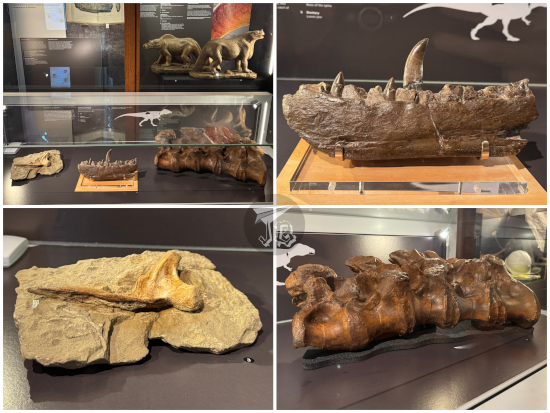
However, the key items in the collections is none of the almost-complete skeletons or fossils on display or archived, but a few dislodged pieces – a leg, a piece of spine and half a jaw. These belong to the species Megalosaurus bucklandii, named by Willian Buckland in 1824 as the holotype of a long-gone massive creature. Megalosaurus was the first dinosaur ever described and named, and it would later get its “interpretation” at London’s Crystal Palace. It was not an accurate one, but it kicked off the first “dinomania” in the Victorian times. Normally, only a cast of the jaw is displayed, but the temporary exhibition Breaking Ground, about the history of palaeontology, had brought them out to be enjoyed by yours truly… I mean everyone. Another fantastic item in this exhibition was an ichthyosaur fossil found by Mary Anning herself – one with remains of its last supper still in its stomach.

As I entered the museum, the first thing I saw were two preserved bears (one of them has since been retired), and the skeleton replicas of iguanodon and tyrannosaur. To the right, the marine reptiles that wrote the history of palaeontology in the UK, and some other dinosaur replicas (edmontosaur, triceratops…). I wanted everything in the gift shop, of course. I had planned to walk the museum in order, but I was unable to, because as soon as I found the stairs, I trotted up to the first floor to find the temporary exhibition Breaking Ground.

Oxford Museum of Natural History building from the outside, and exhibits: dinosaurs and other fossils.

I ran into a couple of school visits, and at some point I was almost ran over by an overeager tween. One of his classmates tried to excuse him saying “apologies, he’s a bit hyper”. I could understand… I only hide it better, but this was one of those other places that had been in my inner child’s bucket list forever and a day. I was extremely happy to be there, and I’m sure I stayed way longer than normal people do. Selfies with megalosaurus were taken.

Megalosaurus was a Middle Jurassic theropod carnivore which has only been found in the Oxfordshire area (Taynton Limestone Formation). The first remains known to science have been lost, but were described and illustrated at the time. There was a tooth recovered in 1699, and a partial femur. A new batch of bones were discovered in 1815, and they were acquired by Willian Buckland, a geology professor in the University of Oxford. He named the creature “megalosaurus” (large lizard) in 1822, and officially presented his findings in 1824, with illustrations by his wife Mary Ann Mantell. Though Sir Richard Owen would not coin the term “Dinosauria” until 1842, megalosaurus was the first non-avian dinosaur to be formally described and named (though Buckland’s reconstructions would not be accurate in the least). The species would eventually receive the binomial name Megalosaurus bucklandii to honour Buckland.

Oxford Museum of Natural History exhibits: pieces of the original megalosaurus fossil.

I went through the exhibition, and emerged on the other side, where I saw the mineral and gem gallery, and what they show you about the dodo – a 3D printed skull and some pictures. Back on the ground floor, I looked at the statues, the skeleton parade, the evolution area… Lots and lots of items.

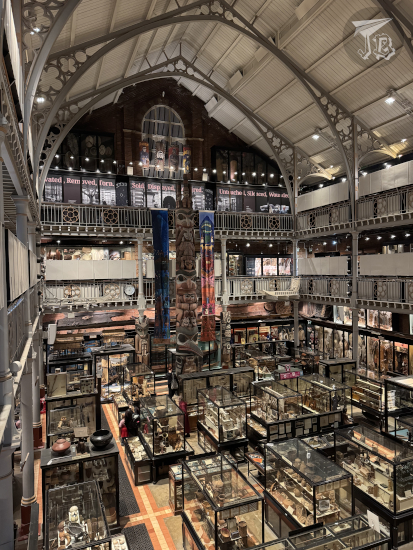
Towards the back, the Oxford University Museum of Natural History is connected to the Pitt Rivers Museum, the university’s collection of archaeology and anthropology. It was founded in 1884 when private collector August Pitt River exchanged his collection for a post as permanent lecturer in anthropology in the university. The premises reminded me a little of the Sir John Soane’s Museum (but way larger), there was so much stuff to see that my brain could not process everything.

Despite the information clutter, I was extremely impressed, especially by the self-awareness of the museum itself. Panels at the entrance explain the relation between colonialism and the collection itself. Apparently, the museum is carrying out a very serious attempt to get in touch with the cultures that spanned a good part of the items in display in order to return them, amend racist descriptions, remove them from view or challenge them. A notable example was its removal of a collection of shrunken heads, tsantsa, from the Shuar culture. Several cases pointed out how historical labels were offensive (outright calling the cultures inferior or savage) and asked how the viewer would feel if their relatives’ remains were exhibited in museums. I think it made me successfully uncomfortable.

Pitt Rivers museum general view.

However, the coolest thing happened on the third floor, when a random volunteer asked me if I knew what a prehistoric tool was. It was in the middle of a case of hand axes. I owned up that I had no idea, so he explained that it was the tool used to make all the other tools, a stone hammer – which made it the oldest item in the whole museum.

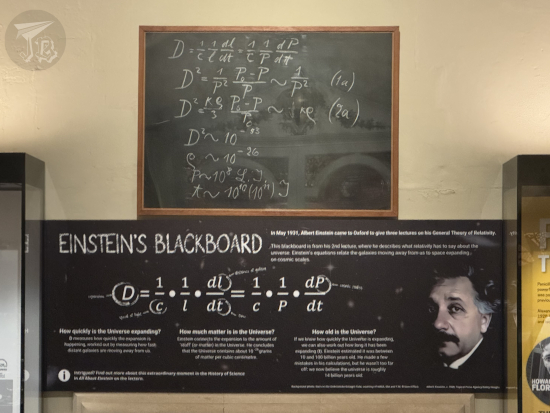
There were still things to do and see, and I had time. I had a second run around the Natural History Museum, just because I could, then I headed towards the History of Science Museum. It is one of the oldest museums in the world that was originally built as such. Unfortunately, most of it was closed due to conservation works. However, the lower floor hosts the highlights, one of them being a small blackboard which feature some equations scribbled in 1931 by no other than visiting professor Albert Einstein. Another of the items is the original penicillin culture that was applied to human clinical trials in 1941 by Howard Florey after Alexander Fleming discovered its antibiotic properties. And probably less dramatic, but utterly impressive, is a 1795 drawing of the moon by John Russell, which looks better than any photography I have ever been able to take.

Einstein's blackboard at the History of Science Museum.

I ran into a Christmas market – Christmas in Oxford, which I decided I would visit later on, and headed out to the last of the four museums, the Ashmolean Museum of art and archaeology. Its collections were started as far back as 1683. It is considered Britain’s first public museum, and hosts works spanning half a million years of human history.

On the way, I stopped to buy a drink at a supermarket, and I guess I needed it, because it was gone in… three minutes. I had been getting cramps on my toes, which is usually due to an electrolyte imbalance, so I bought a juice-like thing I like.

The Ashmolean Museum ended up being much larger than either of the other museums, outright huge. It felt similar to Victoria and Albert institution, with a lot of different collections from varying origins. It is much more modern-feeling than the other three, especially since a renovation in 2009.

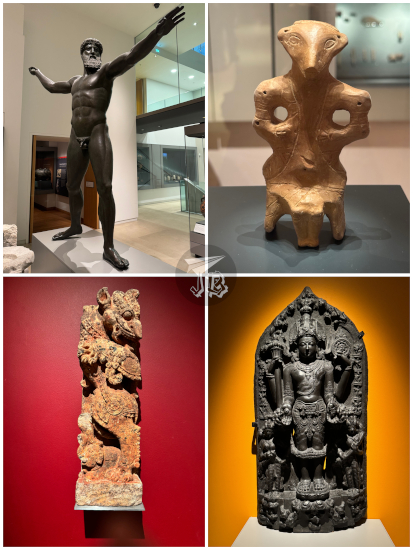
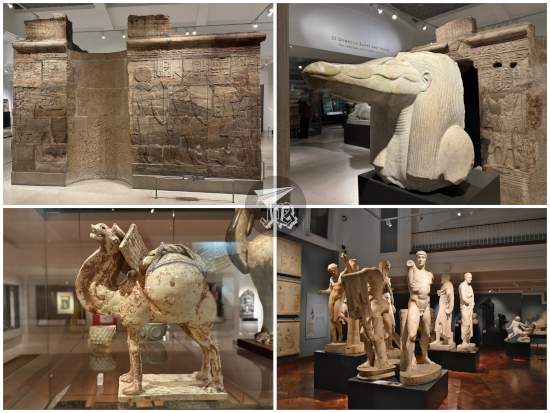
On the ground floor I found Ancient Egypt – I walked past Roman and Greek sculpture first – with a whole sarcophagus complete with mummy case, and even a small temple. I then proceeded to Greece and Cyprus. I came across a staircase and followed it to the area of Conservation, Textiles, Writing, Money and History – Present of the museum, which includes a cabinet of curiosities hosting some of the oldest pieces in the institution, along some which are just… interesting. One of them is an iron lantern from 1605, which is said (probably an urban legend though) to have been used by Guy Fawkes. Fawkes has historically been considered the head of the Gunpowder Plot, in which a number of English Catholics tried to blow up the English Parliament and assassinate King James VI by digging a tunnel underneath and filling it up with barrels of gunpowder. He would have used this lantern inside the dug-up tunnels.

Ashmolean Museum Exhibits -Greek god, vaguely human form, griffon, Hindu deity.

Ashmolean Museum Exhibits - Small Egyptian temple, Sobek the crocodile god, Arabian camel from a tomb, copies of Roman sculptures.

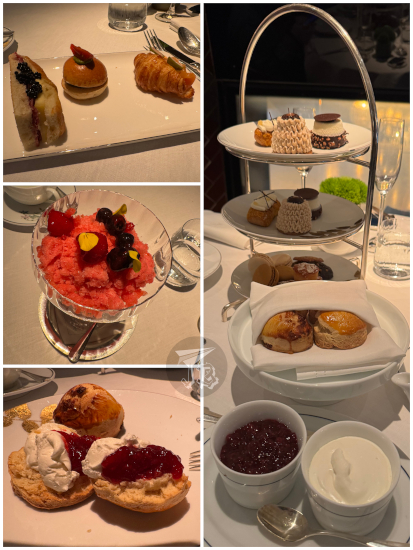
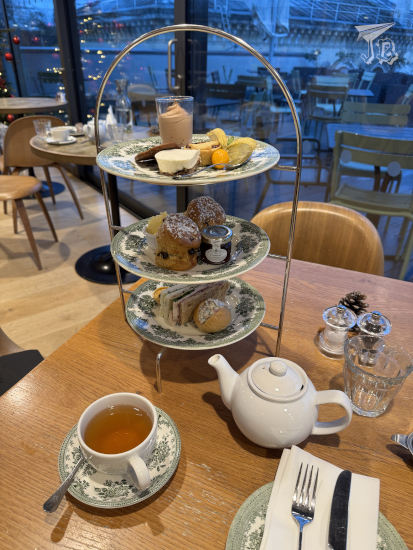
I popped into the shop, where I saw that the restaurant and terrace was open and they were serving “Festive Afternoon Tea”. I had not been able to book it for the Natural History Museum in London, but maybe I could get away with it here. I decided to try my luck, so I climbed to the fourth floor, where the Rooftop Restaurant is. I caused a bit of a ruckus since I popped in without a reservation and solo, but once the waiters got approval, everything went smoothly. I got a seat next to the window and ordered. Afternoon tea consisted on sandwiches, scones and sweets along with a pot of loose-leaf tea.

The mini-sandwiches were: Cucumber and dill cream cheese; Brie and cranberry shallot shell, shallot purée; Roast turkey, sage emulsion, cranberry sauce, rocket; Smoked salmon, dill and horseradish crème fraîche. The scones were homemade, not plain but with cranberry and mixed spice, accompanied by English clotted cream, and Tiptree jam; they were absolutely mind-blowing.

As for sweets, I got Mini Baileys mousse, Tia Maria syrup; a Father-Christmas-shaped gingerbread biscuit; a lovely Mince Pie; and Mini vanilla cheesecake, candied clementine segment. The sweets were extremely so and I did not finish all of them, particularly the mousse.

It was hard to decide which tea I wanted. In the end I went for the in-house Ashmolean Tea, mixed specifically for the museum by local business Team Tea: a malty second flush Assam, combined with single estate Darjeeling and Black Gunpowder from China. They claim that the “Gunpowder” is a call back to the lantern. It was a great choice, and required no sugar or milk – though I drank the milk after all the sweets.

Afternoon tea, on a three-storied tray, along with a cuppa.

Belly full (maybe a bit too full), I went back down to the second floor, where I visited China and Japan, and European and English art rooms, including jewellery. On the first floor I found the Mediterranean World, Islam and Near East, and India. Back on the ground floor there was more China, Rome, and a collection of Classical casts I had missed before. I missed a bit of the collection, displayed at the third floor, because there is no staircase access there – or I did not find those stairs. I left about ten minutes before closing time.

In front of the Ashmolean Museum stands the beautiful Randolph Hotel Oxford, a Hilton property that is way out of my league, but I can admire. Down Broad Street there were tons of small cafés and shops – collectibles, memorabilia, books… It started drizzling a little just as I walked by one of the largest bookshops, so it was a great idea to pop in and snoop. here are two writers that greatly define Oxford’s personality, and both had their dedicated areas – Lewis Carrol and JRR Tolkien, author of The Lord of the Rings, and father of the modern high fantasy genre, I guess. I wanted everything, but I was limited by luggage size. Good thing I can be reasonable at times. But only at times… T

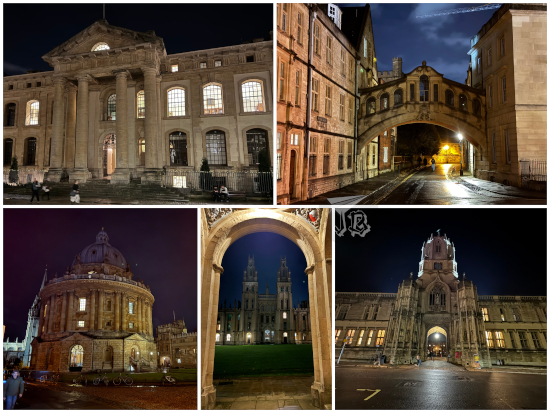
The drizzle cleared, and I was quite at the centre of Oxford. I explored the Christmas in Oxford market, and then the Claredon Building and courtyard, the Bodleian Library and the Bridge of Sighs. I checked whether I could get a ticket for the tours happening the following day, but they were sold out. It was a pity, but I could live with that – there were plenty of things to do.

The Clarendon Building is a Neoclassical structure, originally destined to be the University Press under the design of William Townesend. Today, it is part of the library, founded in 1602 by Sir Thomas Bodley, and it hosts 13 million items in print. Besides the Clarendon, the library is hosted in a number of buildings – I was snooping around the 15th century Duke Humfrey’s Library and the Radcliffe Camera (from the Latin “chamber”, not because there is any kind of camera around). The Bridge of Sighs is officially called Hetford Bridge. It is a sky walk between the new and old wards of Hetford College, actually a relatively new construction, dating from 1914.

I walked past the Radcliffe Camera and the Gothic University Church of St Mary the Virgin. I strolled into High Street with another of the high-class lodgings – the Old Bank Hotel. The sun had already set and it looked – and felt – like it was the middle of the night, but it was not even 17:30, as I had just left the Ashmolean Museum right before closing time at 17:00.

Oxford at night - Library, Bridge of Sighs, Radcliff Camera, Colleges.

I went all the way towards the end of High Street to see the colleges and other university and religious buildings. It’s difficult to actually explain the roles that Colleges have in Oxford. They are technically “residential colleges”, and become both housing and teaching institutions. All university students are members of one of the 36 colleges. The University describes them as “academic communities where students have their tutorials”. The colleges offer courses, and the students combine courses (year or semester-long subjects) until they lead to a degree. Classes are organised by the colleges, and the preferred teaching method is the aforementioned tutorial, a small group of people (one to four) discussing a topic of academic nature, usually related to the week’s work. Examinations and important lectures are conducted by the University as a whole.

The first building I came across along High Street was All Souls College (officially The College of All Souls of the Faithful Departed, of Oxford), established in 1438. From that corner, I saw one historical building after the other. All the students take the exams at the end of term in the Examination Schools, which also serves for lectures. It was erected between 1876 and 1882. A bit further down the road I saw the Queen’s College, which dates back to 1341, and it’s named after Queen Consort Philippa of Hainault, wife and political advisor to Edward III. I finally spotted Magdalen College, founded in 1458 and one of the most important colleges in town, with beautiful Gothic and Neo Gothic architecture.

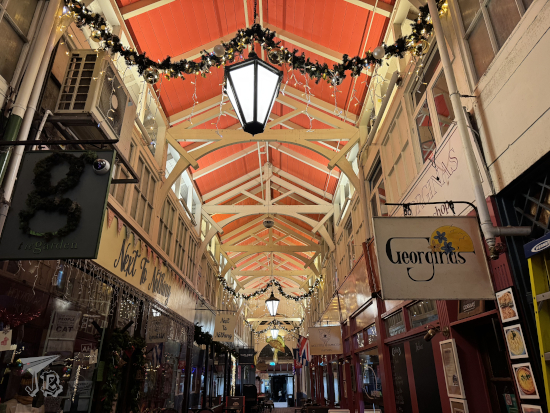
I backtracked towards the other end of High Street, walked past All Saints’ Church, Lincoln College Library, and found the Covered Market. The structure, designed by John Gwynn, has been in use since it opened in 1774. It has permanent stalls and wooden beams that give it a church-like vaulted ceiling, along with a cast iron ceiling. Most of the shops were closed though, and the market was almost empty.

Covered market, a wooden structure.

I reached Carfax Tower, or St Martin’s Tower. It used to belong to a long-gone church built in the 12th century, and technically no building in Oxford may be higher than it. From there, I turned into St Aldate’s street, where the Town Hall stands. Unfortunately, it was under renovation, and mostly covered by construction scaffolding.

I reached Christ Church College, which I planned to visit the following morning. In front of it stands the small Medieval St Aldates Church. I went out a little further until I reached Folly Bridge and Bacon’s Tower over River Thames. The tower is not the original 12th century one, but a sort of revival castle erected in 1849 as a folly – basically a decorative building (hence the name).

I tried to drop by the Christmas Market again to buy a cute bauble, but it turned out that it closed at 18:00, and it was 18:30 by then. I headed back to the hotel and got my room. After a shower, I settled down to make my plans for the following day and watch some TV (without even having to surf for a channel in a language I understood…). I even managed to stay awake long enough not to give myself jet-lag.

However, for the life of me, I could not figure out how to operate the radiator in the room…

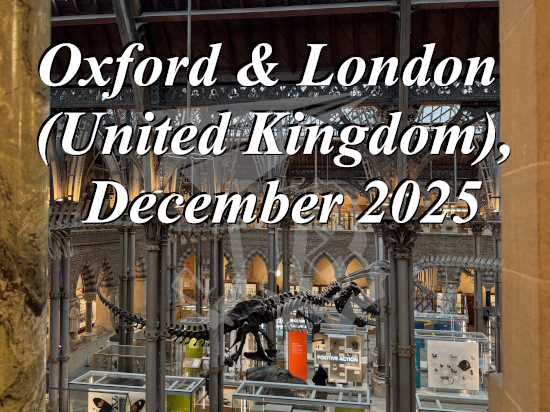
9th – 11th December 2025: Oxford & London {United Kingdom, December 2025}

This little trip was supposed to be to Seville, Spain. I had an unexpected and quite-harsh project in October-November and I decided to spend part of the income rewarding myself for going through it. Thus, I traced a good plan, I swear. Three-day trip, placed right after the Spanish December long weekend, destination accessible by public transport, not so cold… It was a perfect plan. And then I went on Ryanair page and saw that my early-morning flight to London-Stansted was back on the rooster. And furthermore… it was comparably cheap.

But I stuck to the plan. Until I saw that the Oxford University Museum of Natural History was running an exhibition and had pulled out some of its heavy-weight artefacts… But what really sealed the deal was that I found a flights + hotels combination that was actually cheaper than trains + hotel in Seville. It really seemed like the universe was coming together to tell me I could and should take this trip. Yes, it was quite close to the Prague trip, but I was quite literally facing four months of downtime afterwards due to a long project coming up.

So the plan became landing in London, heading to Oxford. Once there, I would see the four museums belonging to the University of Oxford. The next day, I would go back to London, because, in the end, it is one of my favourite cities. Spoiler alert though – I did not get to see much Christmas stuff there. Weird.

For London, I booked a time slot at the Natural History Museum, bought a ticket for Wicked and signed up for a tour with the London Museum of Transport. In Oxford, the museums are free, and I did not know how long I would take, so I would improvise after that.

Something that I have been wanting to do for a while was the Afternoon Tea at the Natural History Museum. You get to see the Mary Anning rooms, usually reserved for members, and there are dinosaur-print macarons. Unfortunately, when I tried to book that, it turned out it was for minimum two people, and since they charged up front, I could not trick the system – though I honestly considered booking it and just bring a take-out container and live off the second afternoon tea for the following day. Temptation, but in the end it was way too expensive for just a whim. Fate would give me a hand with that, too, even if the start of the trip was somewhat… bumpy.

Oxford And London Trip Dec'25 Intro.

One of the things I had to do to travel to the UK was getting an ETA (Electronic Travel Authorisation). I am pretty sure I don’t need one, because I have the right to work in the UK, but I decided to go through the process because it felt easier than drawing up all the paperwork and taking it along to prove it at entrance. On the 20th of November, I downloaded the app and followed the instructions – first, I got a security code on my email to start the application. I had to take a photo of my passport, then scan the chip (I did not even know my phone could do that!). Next, the system asked me to “scan my face”, I guess similarly to what the machines do when you enter the UK border, and I had to take a picture with a white background and no shadows – finding that background was the most difficult part. The last step was, obviously, paying for it, and of course the bank app and the ETA one had to be open at the same time on the phone and switching from one to the other was stressful because my banking app sucks.

After payment, the application was sent, and I received an email that it would be checked. This was 16:09. When I came out from work, I had a valid ETA – the email had arrived at 16:18. Yay, I’m not suspicious. The authorisation is valid for two years, and allows for multiple entries. I will have to make good use of that.

Plane tickets, hotel bookings, train schedules and ETA in hand, I was ready for a three-day getaway in England.

4th December 2025: The Old Town Reprise {Prague, December 2025}

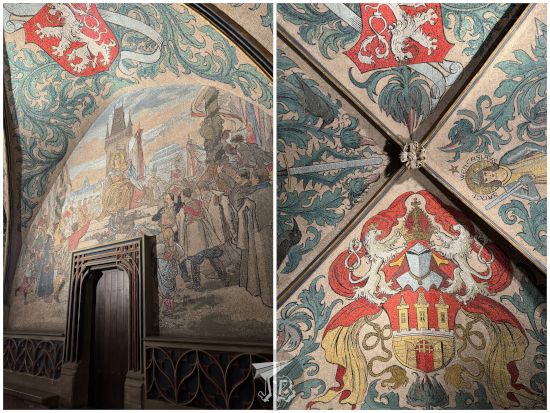
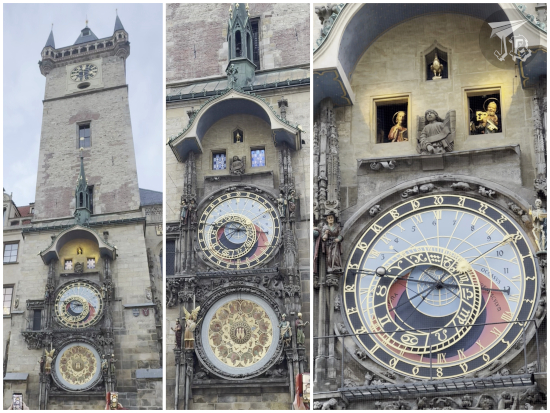
For our last half-day in Prague [Praha], it was decided that we were going to go back to the Old Town Hall Staroměstská radnice, in order to take a guided tour to see the machinery of the Prague Astronomical Clock Pražský orloj. I am not sure why we did not did the tour on Monday when we first visited, as we ended up paying for admission twice. However, a word to the wise: if you ever find yourself in Prague, do take the tour. The price is negligible in comparison to the ticket entrance and you will actually get to see something besides the view from the tower. We waited at the small frescoed hall for the tour to start.

Small hall in Prague town hall, decorated with frescoes on the ceiling and walls depicting historical scenes and herald motifs.

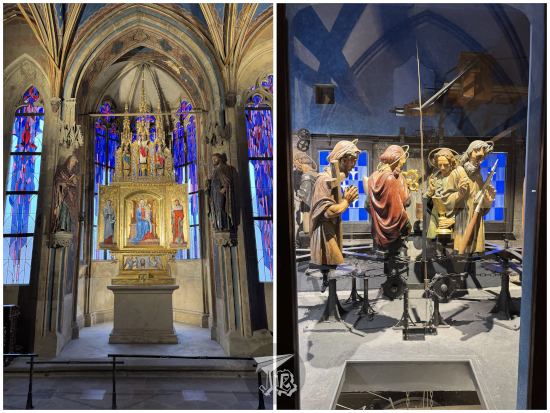
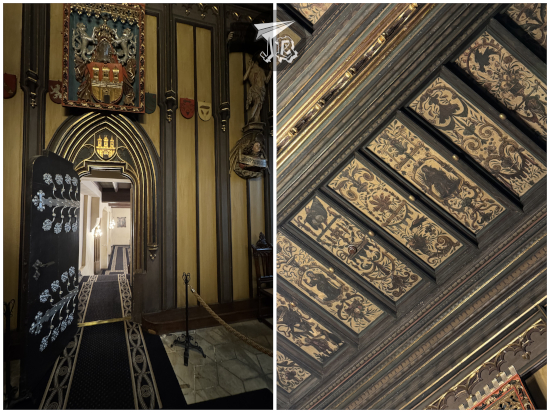
The guided tour was led by a very giddy lady who was extremely excted to describe all wars, murders, maiming and torture methods in full gory details. The visit started at the chapel, which is not the original one, but a reconstructed version. It is right behind the clock, so you can glimpse a bit into the mechanism. And glimpse means see a couple of gears and the sculptures. Then we continued into the only intact room of the area – the gothic Hall of Justice, which was honestly very impressive – and well maintained.

Prague town hall: reconstructed chapel and apostles inside the clock mechanism.

Gothic Justice room in the Prague town hall, with wooden decoration and ceiling.

We went on to visit a Baroque hall with paintings that depicted the Hussite war and the coronation of George of Poděbrady. The guide also explained that Good King Wenceslas, from the Christmas carol, had never been a king. We finally got to see some original frescos from before most of the Town Hall was destroyed – on the very last day of World War II.

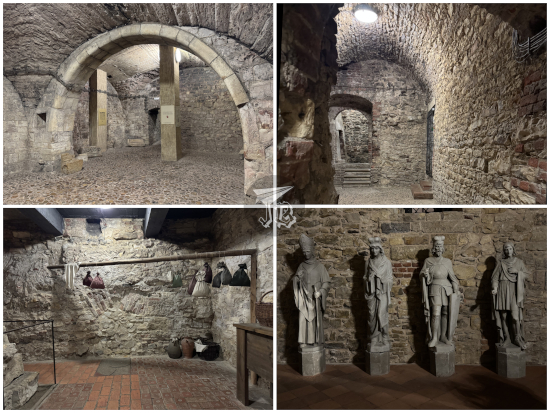
Afterwards, we moved underground, to see the surviving Romanesque and Gothic foundations of the Old Town Hall and the city itself, which used to be 6 metres lower than it is today. They are not the only cellars in Prague [Praha] that can be visited, but they were pretty impressive and preserved.

Underground Prague tunnels and arches.

We did not have time for anything else after the visit, but I ditched my family then to do a quick souvenir-shop run, and met them at the hotel 15 minutes before pick-up. The driver could not find a parking spot, so he was 10 minutes late anyway. We got to the airport, went through security and tried to find somewhere to eat. My parent seemed to be desperately looking for something, anything, that was not Costa Coffee for lunch, but unfortunately for them – fortunately for me – nothing else was found. Ergo, I got a vanilla latte! My other parent was astonished by my happy “Costa Grin”. We had seen a few Costas around Prague through the visit, but aside from saying I liked the chain, I did not push to go into any. I knew there would be enough of them in the UK in a few days.

It did not take long for our gate to be called, and boarding started before schedule. Since I had paid for the upgrade, we were amongst the first to board the plane, despite being on the literal last row. The flight was all right – there was some turbulence, but nothing too bad. And when we were landing, I was surprised about how clearly you could spot the Torrejón Christmas park (hello there, light pollution).

We landed, got to the shuttle, then to the parking lot, and finally home. As a balance… I don’t know. More than a trip, I thought about this as “spending time with family somewhere else”, but I was a bit confused about my role in it. I was expected to sit back, but I was also expected to plan and guide, it felt like being on thin ice a couple of times. I was not disappointed because I made a big effort not to do much research beforehand – beyond what my parents had prepared. I know we missed a few interesting things, and we had a couple of hiccups, but Prague [Praha] was pretty good for a three-day escapade, and I got to see actual central Europe Christmas Markets, which we missed in Vienna in 2024.
I liked Prague’s Gothic – I know, no one is surprised. If anything, I was taken aback at how packed it was, especially tourist families with kids during weekdays. I think the whole Christmas market tourist pull is way more important than I had given credit to. Yes, I had seen actual group trips aimed to see them but… Just wow. Talk about packed. And finally, on the topic of famous and populated Christmas Markets – I am not sure a couple of them actually closed for the night. At least they were still open way past 22:00… Which would cause even more contrast a few days later in Oxford. It was also not as cold as I had expected or feared, which was decent for pictures. Maybe next time we can do something warmer. Like the North of Africa…

3rd December 2025: Josefov, the National Museum, and a Light Show {Prague, December 2025}

The city of Prague [Praha] has a rich history, and some of it is dark. Nevertheless, it cannot be ignored just because it is uncomfortable.

The day did not start well. After breakfast, I checked the plane tickets for the following afternoon’s return, and ran into the same issue as before – a message saying “you must check your bags”. Seriously, it felt like extortion, but I decided to let it go and pay up. That put us behind schedule – my mistake, I misunderstood the time we wanted to be out. On our way, a guy helped us out with directions, and offered money exchange. He was standing at the door of a legit shop. I did not trust him, but a second later my parent was talking to him! Remember my parent’s obsession with the bad exchange rate they claimed they had received from the bank? In the end, they got scammed out of a couple hundred bucks, as the guy gave him Russian roubles instead of Czech crowns. That was not a nice experience, and the day was still going to get a bit more difficult.

Since my parent just pocketed the money, we did not realise it was not valid until they tried to use it to pay for our first spot of the day in Josefov, the Old Jewish Quarter. Today the quarter is luxurious and mostly full of 20th century buildings, after it was almost completely demolished at the end of the 19th century. However, it may have started with the arrival of the first Jews in the 10th century, and reached its peak in the late 1500s. Before the reconstruction, it was composed of narrow streets and brick houses.

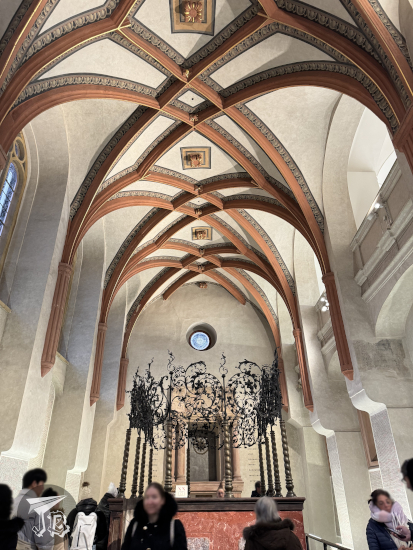
Amongst the few remaining historical buildings and structures there are a number of synagogues, the old town hall and the cemetery. Our first stop was Pinkas Synagogue Pinkasova synagoga. Built in the gothic style, it was completed in 1533, and during World War II, it became a repository of religious paraphernalia after the Nazis banned Jewish services. Today, it serves as a memorial to around 80,000 victims of the Holocaust. Their names are written on the walls, and there is a collection of drawings by children from between 1942 and 1944 – most of the children ended up murdered in Auschwitz. I had understood that the synagogue was working as a social centre, so I assumed the drawings were by local contemporary kids. When I realised what they were, it broke me inside. The wave of feelings – and tears – makes the whole experience a bit of a blur.

Interior of the Gothic Pinkas Synagogue, with the names of the victims of Holocaust written on the walls.

All the synagogues in the area are managed by the institution Jewish Museum in Prague Židovské muzeum v Praze, so there is one combined ticket for all of them. There was a small security check at each entryway, but the security guards were all extremely nice and kind. The Pinkas Synagogue was in the same controlled area as the Old Jewish Cemetery Starý židovský hřbitov.

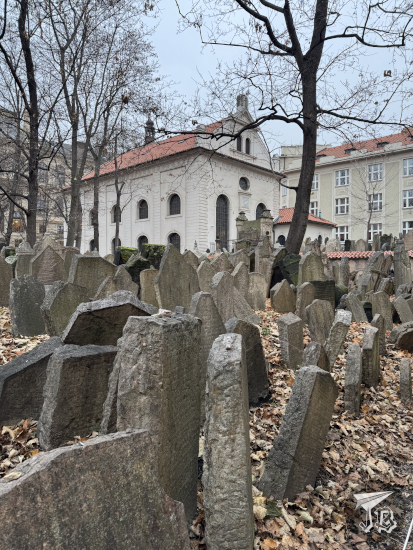
The cemetery is one of the largest of its kind in Europe, and it was used between the 15th and 18th centuries. Since space was scarce, there are layers upon layers of burials, and the headstones often refer to someone who is buried in the lower levels. This scheme has allowed for older graves to remain through time, as the layers were added on top of the existing ones. Despite my general liking of old cemeteries, I found the place oppressive – probably because of the recent shock to my system.

Old Jewish Cemetery, Prague.

We then walked a couple of minutes to Klausen Synagogue Klausová synagoga. It is the second synagogue built in the same place, erected in 1884 in the Baroque style. It was the only one in that style spared by the urban renewal in the early 20th century. It struck me then that, even if I was aware of architectural styles in churches, I had never thought that synagogues in Europe would go through the same architectural trends. Then again, up until today, I don’t reckon I’d ever been into a synagogue that could still be used as such.

Interior of the Baroque Klausen Synagogue, Prague.

I later learnt that there is no actual “right” way to build a synagogue, and that any group of believers can erect one. This is usually done in the architectural style of the time and place. Synagogues have a raised platform or pulpit, the bimah [בּימה], from where the Torah is read. The Torah [תורה] comprises the first five books of the Hebrew Bible [Tanakh, תַּנַ״ךְ], and, usually in scroll form, is read daily. When not in use, the Torah is kept in a chest or cabinet called the Ark [Aron Kodesh, ארון קודש‎], which dictates how the whole building is erected, as attendees are supposed to face Jerusalem for prayers. Many synagogues have an eternal light or flame, always lit somewhere in front of the Torah Ark.

Next, we visited the Old New Synagogue Staronová synagoga, the oldest active synagogue in the Czech Republic [Česká Republika], and one of the earliest examples of Gothic in the city of Prague [Praha]. It was originally the New Synagogue to an Old Synagogue, but when the latter was demolished, and even newer ones were built, hence the confusing name. It felt a bit closed off and claustrophobic, as it was accessed by a long corridor and packed with three tourist groups.

Interior of the Old New Synagogue, Prague, showing the curtain that covers the sacred texts.

We got a bit lost on our way out, so I was able to catch a glimpse of a bit of an oddity – the Prague Metronome Pražský metronom, a giant instrument that… swings. It holds no other function than moving along with time, it does not even click like a normal metronome would. It’s officially named the Time Machine and it was erected by artist Vratislav Novák. I saw it on the other side of the Vltava River, across the Czech Bridge Čechův most.

We finally reached the Spanish Synagogue Španělská synagoga. Built in the 19th century, it replaced the Old Synagogue, and its side, which used to be a hospital, is now the Museum. It was erected in a Moorish revival style, with two stories, several balconies and a lot of gold and golden. It hosts an exhibit about the history of Jews in the Czech Republic, but there is no tangible relation to Spain, the name seems to be a reference to the art style of Al-Andalus.

Golden interior of the Spanish Synagogue, Prague.

And for some reason (aside from him being Jewish, of course), there is a Statue of Franz Kafka Socha Franze Kafky standing next to the Spanish Synangogue. It is a bronze sculpture of the writer riding a hollow suit, based on the short story Description of a Struggle [Beschreibung eines Kampfes].

The last synagogue we visited was Maisel Synagogue Maiselova synagoga, currently a museum. It is Neo Gothic, after a previous building was destroyed. It has been restored recently, and hosts a very impressive display of menorah [מְנוֹרָה], a candelabrum with seven branches, symbol of Judaism since ancient times.

Gothic Maiselova Synagogue from the outside, Prague.

We set off then to try and find the nearby underground station, near the Jan Palach square and park Park u náměstí Jana Palacha. There are several buildings and views from the square. We did not stop for long there, and hopped onto the underground to get to Wenceslas Square Václavské nám. We had a bit of time before our lunch reservation, so we decided that the two-story souvenir shop at the corner was a perfect place to spend 20 minutes because it had heating. Afterwards, we walked down the square and crossed the Art Nouveau palace-turned-shopping-hub Lucerna Palace Pasáž Lucerna. Looking back, it could have been a cool place to explore with the idle time we had, but the pedestrian passage was not heated…

We finally got to the restaurant that my parent had wanted to try from the moment Prague [Praha] had been decided upon – Pork’s. As the name conveys, their menu is basically comprised of pork dishes, and reportedly they serve the best pork knuckle in town. The original restaurant, Pork’s Mostecká, is in Malá Strana, close to the Charles Bridge, and it was the one my parent had their heart set on… Unfortunately, it books out a month in advance. We had been able to find a spot in its sister restaurant Pork’s Vodičkova.

The place was full and bustling, but we had our table ready for us. We ordered two signatory dishes – pork knuckle with mustard, horseradish, crispy sauerkraut Vepřové koleno, hořčice, křen, křupavé zelí, a salad (Lettuce salad with grilled goat cheese, beetroot and marinated pear Listový salát s grilovaným kozím sýrem, řepou a marinovanou hruškou) and a weird potato thing I had seen and was extremely curious about – Potato pancake with sour cabbage, fried in pork fat from our knuckles (Bramborák s kysaným zelím smažený na výpeku z našich kolen), which turned out to be a sort of waffle sandwich (I loved it, because I’m weird like that). The knuckle was all right but I had to peel off some of the fat because it made the dish too heavy on the stomach. For dessert, we shared some apricot dumplings – Homemade fruit dumplings with cottage cheese, sugar and warm butter, Domácí ovocné knedlíky z tvarohového těsta, tvarohem a cukrem sypané, máslem přelité.

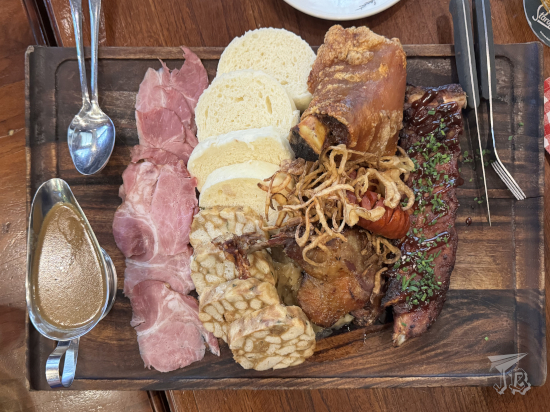
Pork knuckles portion with cabbage and mustard.

We left the restaurant around 15:00 and my parents, who were still a bit on the upset side, decided to go to the hotel, claiming they wanted a break before the light show at 19:30. Since my sibling was up to anything, I decided to head out to the main building of the National Museum Historická budova Národního muzea. We would not have time to do the whole thing, but at least we could wander for a couple of hours and snoop around.

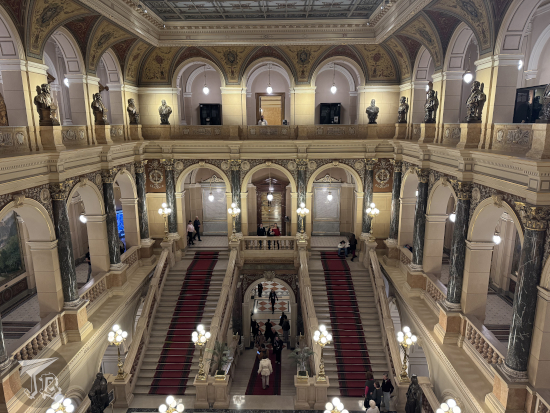
The main or historical building was designed by architect Josef Schulz and erected between 1885 and 1891, when it was inaugurated. It is a magnificent structure in the Neo Renaissance style, grandiose and decorated with gold and frescoes. It feels like a palace, and honestly, it does not look like a museum at all. The building was damaged during the succeeding conflicts in the 20th century, so it ended up closing between 2011 and 2018 for extensive renovations. At the moment, it hosts four permanent exhibitions: the Hall of Minerals, Miracles of Evolution, Windows into Prehistory, and (Czech) History, though the latter seems to only cover from the Middle Ages to the first half of the 20th century. Thus, I guess that it doubles as natural history and archaeology museum.

Prague National Museum building, huge constructiond ecorated with gold, white and marble.

We started at the Hall of Minerals, which is a traditional collection of minerals in vintage cases. The meteorite collection is pretty good, especially the moldavites. Moldavite vltavín is a mineral derived from a meteorite impact (a tektite), around 15 million years ago. It is a green gemstone, local to the area of Bohemia. It is not uncommon, but not widely available in the world (and unfortunately none was for sale in the gift shop).

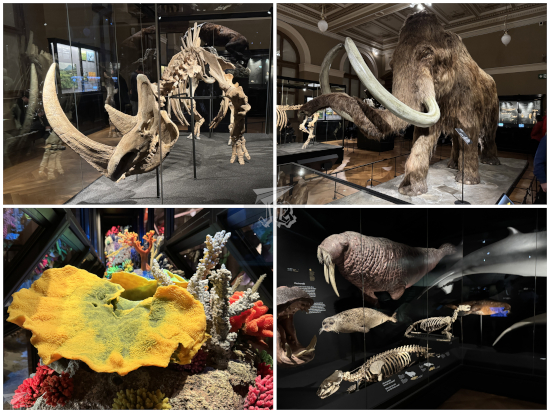
We got to the prehistory ward, and it was really fun. As far as huge diversity goes, the exhibit was not impressive, but what they lack in actual stuff, they make up for with models. We entered through the Paleocene room with a mammoth (technically there is a baby mammoth too but that had been moved to another exhibition) and the skeleton of a woolly rhinoceros, almost complete. The latter is either haunted and has tried to escape, or someone seriously mismeasured its case, because the horn had cracked the glass at some point. Some other models included a sabretooth cat and a scene of steppe wolves hunting.

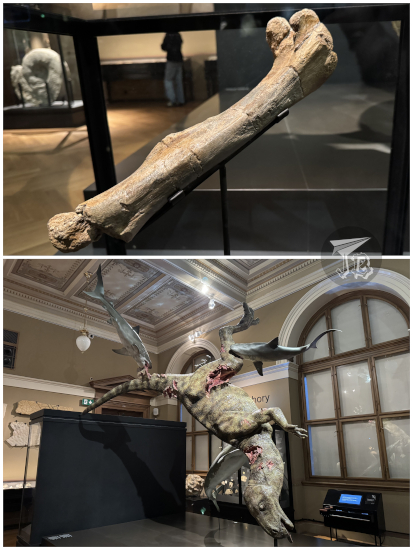
We went back in time towards older epochs. There was a mosasaur hunting an ammonite, along with a number of fossils from both invertebrates and vertebrates. We reached the Age of Dinosaurs. They have literally one bone, a femur, of an ornithopod dinosaur, similar to an iguanodon. From that, they managed to describe a whole species, Burianosaurus augustai (2017), similar to an Iguanodon. Upon studying the specimen, scientists also discovered that there were shark teeth marks on the bone, so someone recreated a whole scene of the poor beast dying and being torn apart by sharks. I’m not even kidding.

Further back in time, and deeper into the museum, we reached the wall of national fossils – trilobites. There were cases about the primitive oceans, with dioramas and replicas. From there, we entered the world of evolution and biodiversity, which again had great models but humble actual exhibits.

The History Exhibit starts in the 8th century and lasts until World War I. It held a lot of interesting artefacts that reflected how life was at the beginning of the 20th century, including some fascinating objects such as toys. The Prehistory area was a bit more strange, with lots of human remains in reproductions of burials (I really hope they were reproductions and nobody had relocated a whole necropolis…).

Prague National Museum: Bone and reconstruction of burianosaurus - the reconstruction is a dead dinosaur being eaten by sharks.

Prague National Museum: Skeleton of a Wooly rhino, reconstruction of a mammoth, colourful corals and marine mammal reconstructions (seal, walrus, sea lions).

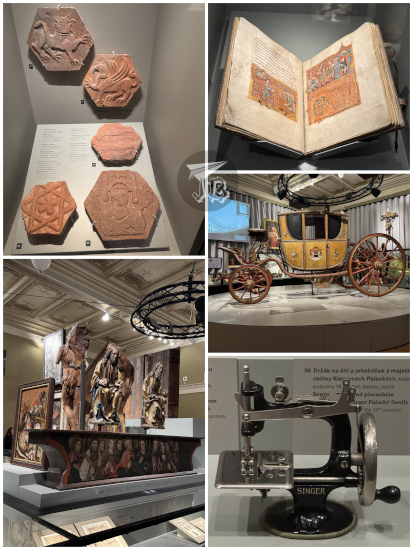
Prague National Museum Historical displays: old town clay tiles, Medieval book, religious sculptures, carriage and toy sewing machine.

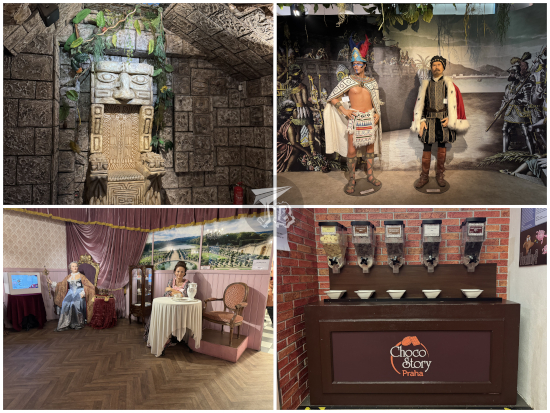
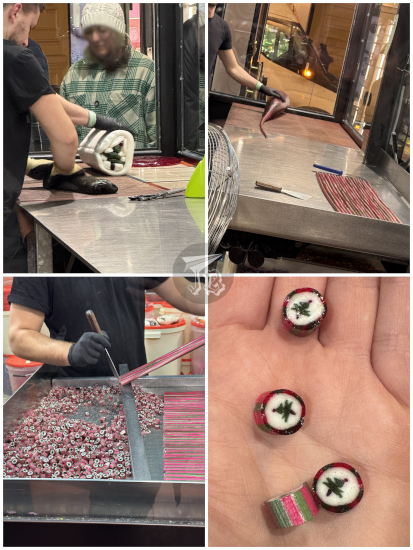
We left the museum to head back towards the hotel. There was a small Christmas Market at the end of Wenceslas Square Václavské nám, and we passed by yet another one: the regular market Havelské tržiště had been turned into a festive checkpoint, but most of the stalls had the same stuff at the same prices. It was still packed though. We made a stop at the Choco-Story shop to see if they had started selling the Christmas-tree sweets we had seen made the day before, but no such luck.

We went back the hotel to regroup and find out what time they were picking us up the following day. Later in the evening, we left once more to find Broadway Theatre so we could watch the WOW Show Black Light Theatre Prague. Notice the English name, it was clearly aimed at tourists, but the only one my parents found advertised at the hotel. Doors opened at 19:30, but placement was free, so we wanted to be there around 19:15. As we checked in, we were given some glow sticks. I don’t think my family had ever held glow sticks in their life…

We had to go down a couple of floors worth of stairs to get to the actual theatre and when we got to the stalls, we ended up getting pretty horrible seats for some reason or another. Soon the venue began to fill up. There was a huge group of young tourists who had obviously been raised in a barn. They yelled and burped and, when lights went off, they decided to start throwing the glow sticks. One got me in the back of the head, and damn, those things hurt.

Prague’s black light theatre (černé divadlo) works with black backgrounds, UV lights and fluorescent elements to create visual illusions. Basically, you only see brightly coloured bits, either props, face paint, or clothing. It was… weird. Not what I was expecting at all. The idea was that a guy came back from work, watched some TV, then went to sleep, and we got to see all his dreams, in dance version. At some point, the actors bounced some big balls at the audience for us to play with, and the rude macro-group decided to play dodge-ball with them. Some dancers also played spiders which had to move over the audience. All in all, it was an interesting experience, a bit ruined by the company, but I did not like it much. A bit too surreal for me.

Dinner was again at the shopping centre – not much choice, at the only open sandwich place. One of these days, my family will realise that buying snacks in advance is a good idea. That day was not today.

2nd December 2025: From the Pražský hrad Castle, downwards {Prague, December 2025}

It was a grey morning in Prague [Praha] when we headed down for breakfast. The buffet was packed and the coffee horrible, but I was able to find cranberry juice, hard-boiled eggs, bread and cheese. The goal of the day was visiting other areas within the UNESCO World Heritage Site Historic Centre of Prague, starting from the castle to make our way down. Thus, we jumped onto the public transport system – my parents could ride free due to their ages, and my sibling and I bought tickets. The ticketing system allows you to ride for a set period of time after validating, which is done at the gate. We rode the underground to the Malostranská stop, at the foot of the hill where the castle was built. This area of the city is called Malá Strana, the Lesser Town – it is a historical name, because there is nothing “lesser” about it.

Prague Castle Pražský hrad is the largest ancient fortress in the world – a huge complex of buildings delimited by a defensive wall. It hosts the official residence of the current President of the Republic, and in the past it was the place from where the kings of Bohemia and Holy Roman Emperors ruled. Construction began around 870, with the establishment of a walled church on top of a hill overlooking the area. The current palace was built under the reign of Charles IV (Karel IV), who also reinforced the fortifications. The enclosure hosts several notable areas and buildings, such as the Cathedral and the Golden Lane.

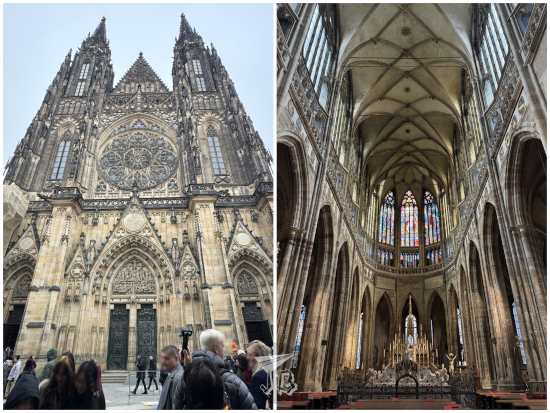
The first step was, however, climbing up from the underground stop to the castle itself – literally. This was done via stairs, which fortunately were not frosty. They were… steep, steeper than they looked, considering how wide each step was. I was a bit out of breath by the time we were up… and once at the gate there was still more uphill way to walk!! We reached the ticket office and decided on a “Prague Castle – Main circuit” (Pražský hrad – hlavní okruh) ticket, which included the four key sites: the Old Royal Palace, St. George’s Basilica, the Golden Lane, and St. Vitus Cathedral.

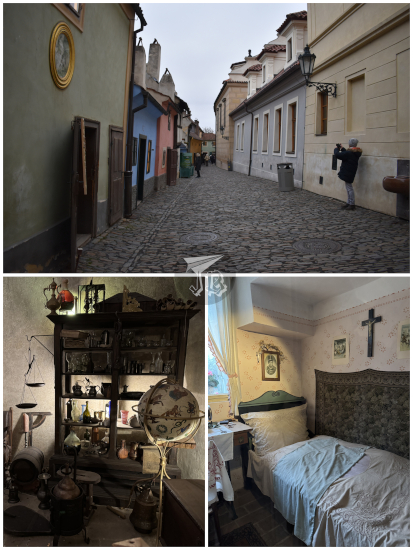
Right next to the ticket office there was the access to the Golden Lane Zlatá ulička. It was originally an area where the castle guards lived. Today, it is a narrow alley with coloured houses, many of which have been converted into souvenir shops or tiny ethnography museums, trying to show how people used to live there – the seamstress, the alchemist, the goldsmith, the fortune-teller… Some famous or important historical figures have dwelt there, most notably writers Franz Kafka – with a bookshop where he used to dwell – and Jaroslav Seifert (1984 Nobel Prize in Literature), and the fortune-teller Matylda Průšová. There is also a collection of weapons and armours.

Golden Alley and reconstructed dwellings: a bedroom and the alchemist's office.

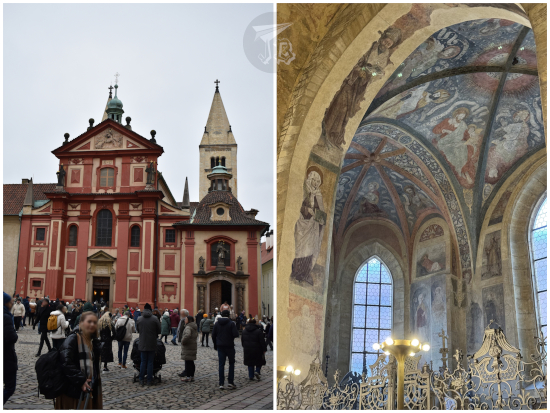
Our next stop was the Basilica of St George Bazilika svatého Jiří. Despite its Baroque façade from the late 17th century, the inside is purely Romanesque. The church is actually the oldest surviving building in the castle complex, consecrated in the year 921. Fortunately, the interior has been kept Baroque-free, and it displays a severe limestone appearance (though it had to be restored after World War II) with frescoes behind the altar.

Baroque exterior of the church of St George and Romanesque frescoes inside.

The crown jewel (in my not-so-humble gothic-loving opinion) of the castle is the Cathedral of St. Vitus – formally the Metropolitan Cathedral of Saints Vitus, Wenceslaus and Adalbert Katedrála svatého Víta, Václava a Vojtěcha. The current building is Gothic, and dates back from 1929. No, that’s not a typo. Although construction started in 1344, it did not end until the 20th century! The current building was erected over a previous Romanesque church when the latter became too small. It was sponsored by Charles IV (Karel IV) of Bohemia and originally designed by Matthias of Arras, who obviously did not live enough to see the work completed.

Gothic Cathedral of St Vitus.

Prague’s Medieval history was heavily influenced by the Hussite Wars. The Hussites were reformists, an early movement of what would later become Protestantism, founded by Jan Hus (who ended up burnt to death for his trouble). The Hussite Wars lasted between 1419 and 1434, and were rather complicated, with people changing sides, a civil war, foreign interventions actually called “crusades”… In the end, the “moderate” Hussites allied themselves with the Catholics to defeat the “radical” Hussites, and eventually rose to power as George (Jiří) of Poděbrady was crowned the first protestant King of Bohemia in 1458. While the king himself was a Hussite, he was a moderate and thus tolerant of the Catholics and their rites.

However, with the Hussite uprising, works of the cathedral came to a stop. It stood half-built until the 17th century. Finally, the early 20th century saw serious efforts to finish it in time for St. Wenceslaus’ Jubilee in 1929. Despite its 600 years of construction, the building is simply magnificent, even if there was no sun to shine through the coloured windows. The pointed arches are just perfect, and the stonework has that lovely patina that they’ve cleaned out from Notre Dame in Paris.

The final building included in our ticket / pass was the Old Royal Palace Starý královský palác, a magnificent Gothic – with some Renaissance touches – building dating back from the 12th century. The Vladislav Hall, built in the 14th century, is vaulted, with gothic nerves. There is a small room with a throne and replicas of some of the crown jewels. Upstairs, rooms with frescoes. To the side, there was a long queue to see the “Defenestration Window” – during the Hussite Wars, people developed a taste for throwing other people out of windows. In 1618, during one of the many Protestant-Catholic moments of tension, two regents and a secretary were pushed out of one of the windows in the palace. They survived. According to the side who tells the story, they were either saved by angels or by falling onto a pile of cow dung.

Interior of the former Bavarian Palace, with gothic vaults.

The family decided to get going. We passed by newer buildings, where the President lives, and headed down the hill. We found a restaurant that my parent seemed to like and we were lucky enough that they had room for us. The staff at U Dvou slunců was pretty nice, and despite me thinking I wanted some dumplings, I ended up ordering Smažený obalený sýr, fried breaded cheese with chips and homemade tartar sauce – just because I love cheese. It was delicious.

After lunch, we went to Malostranský chrám svatého Mikuláše, the church of St. Nicholas Church in Malá Strana. It is considered the most important Baroque church in town. There are frescoes all over the ceiling, and the decoration is not extremely over the top. The dome is 20 metres in diameter, and the columns are actually made of fake marble, but I would never have been able to tell. It hosts two organs, one of which was currently out of service for restoration.

Baroque interior of St Nicholas Malá Strana church, with frescoes on the ceiling.

Then, we headed to the Church of Our Lady Victorious and The Infant Jesus of Prague (mouthful) – Kostel Panny Marie Vítězné a Pražské Jezulátko. The church was founded in 1584, and it is also Baroque. It is famous because it hosts the statue of the Infant Jesus of Prague Pražské Jezulátko, a small wooden sculpture of Spanish origin from the 16th century, which somehow made its way to Bohemia through the House of Habsburg. The centre of one of the major pilgrimages in Europe, the figure is about half a metre high, and it is displayed wearing embroidered vestments. On the day of our visit, the clothes were purple, as it was Advent. The church also has a display of nativity scenes and a small museum with different garments for the Infant Jesus that have been donated by wealthy benefactors. I have to say though that the poor thing is… hideous.

Baoque interior of Our Lady Victorious and the Child Jesus sculpture.

The sun was setting and it was time to cross Charles Bridge Karlův most over the Vltava river. It is a Medieval stone bridge, built between 1357 and 1402, over 500 metres long! There is a tower on each side – Malá Strana Bridge Tower (Malostranská mostecká věž) and Old Town Bridge Tower (Staroměstská mostecká věž), both gothic, and 50 statues along the way. There are also gas streetlamps that are manually lit during Advent! Unfortunately though, since the lighting is a thing, the bridge was swarmed, and it was extremely difficult not to lose each other, so we did not get to see much.

Charles bridge, with an official lighting a gas streetlight.

Back in the Old Town Staré Město pražské we got to see the Klementinum, a Baroque astronomical tower and library that I would have loved to visit, but it was not in the schedule – I would have prioritised it over the churches, but as I mentioned, I had not done any of the planning. My parents decided they were done then, so my sibling and I stayed behind again, after arranging to meet at 19:30. We explored some candy shops, and eventually caught the Astronomical Clock Pražský orloj at 17:00.

After the 17 bell strokes, I proposed my sibling to go to the chocolate museum, Choco-Story: Prague Chocolate Museum. It is not big, and it features different stages in the history of chocolate – its use in Pre-Columbian cultures, how the Spanish introduced it to Europe, and how it became a popular treat amongst the higher classes, then it became democratised. The last room was explicitly about a Czech company that used to sell chocolate. In the second-to-last exhibit there was an unlimited chocolate tasting station. Yes, the person at the entrance used the word “unlimited”. We of course took pictures with all the available props. And ate chocolate.

Choco Story Prague scenes related to chocolate history - from the Mayans to the Victorian to the present day, with the tasting station.

We eventually left the museum, and that placed us in the right place-and-time to see how they made candy from scratch. The two guys started with blocks of different colours – green, white and reddish. They worked the material until it was almost viscous. First, they made three “triangles” with the green material, which they put on top of each other. Then, they filled up with white until they had a cylinder, and wrapped that in red and green – it was a Christmas tree in the middle of a snowy circle! They ended up with something that had around 20 centimetres in diameter. And then suddenly they started pulling and pulling and made sweets that were no bigger than 1 cm, with the Christmas tree in the middle. It was astonishing!! And even better… they shared samples!

Candy-making show. The sweets have little Christmas trees inside.

On the way out, we decided to be weak and bought the blueberry tartlets we had spotted the day before, along with some souvenirs. I got a silly Christmas bauble. We headed back to the room to eat the tartlets, and at 19:00 we dropped by our parents room to regroup. At first we considered having dinner in one of the Christmas Markets, but in the end, they decided that they did not want to eat standing up, and we went to a random sandwich shop the Palladium Prague shopping centre.

To end the day, however, we did go to the Christmas Market in Náměstí Republiky square, but not for food, just for a drink. A typical drink – traditional honey wine, which I didn’t know (because I don’t drink), but it is just another word for mead. So instead of gentle mulled wine, we got a kick out of Tradiční medovina. Boy, did we sleep well that night.

Honey Wine.

Before going to sleep though, I had been tasked with booking tickets for a light show the following evening, which was a bit of a challenge on the phone – no way I’m putting my credit card on public Wi-Fi – with a website that kept trying to change its language from English into Czech.

1st December 2025: Way too much food {Prague, December 2025}

I stayed over at my parents’ house so they could shave 15 minutes off driving, because 15 minutes of extra sleep at 5:00 matter. I gulped down a coffee and loaded my luggage in the car. We picked my sibling up and drove to the airport before the traffic jam even formed. We got on the shuttle a minute after parking, reached the terminal, and went through security without a hitch. There was really nothing noteworthy to the journey, really, once the check-in-your-hand-luggage extortion had been paid. We were picked up at the airport in Prague [Praha] and driven to the hotel, where we could not check in yet.

Thus, we headed to have lunch first. There was a restaurant in front of the hotel which served traditional Czech food, called La Republica, where my plenty and I shared a Staročeský talíř pro 2 osoby – Old Bohemian plate for two people, which comprised a duck leg (kachny), pork knuckle (vepřový kolena), pork ribs (vepřový žebra), smoked pork belly (uzený bůček), sausage (klobása), dumplings (karlovarský knedlík and houskové knedlík), white and red cabbage (zelí), with crispy onion liberally sprinkled on top. One kilo of food! Way too much!

Czech knedlík are somehow of a national staple – boiled dumplings, quite heavy on the dough, with optional fillings. Both houskové knedlík and karlovarský knedlík are considered “bread dumplings”, with a base of stale white bread, flour and eggs. They are supposed to be eaten dipped in the sauce that came along with the plate, and they were delicious. So were the pork ribs, and I’m not even a rib person!

Plate of meats and dumplins for two. Way too much food.

After lunch, we checked into the hotel, dropped our things at the room, and set off towards the Old Town Staré Město pražské, the preserved Medieval area of Prague [Praha], part of the Unesco World Heritage Site Historic Centre of Prague. The city is the capital of the Czech Republic [Česká republika], and formerly of the region of Bohemia. The origins of Prague can be traced back to the Palaeolithic, but it was around the 5th century BCE when a Celt tribe settle nearby and gave the historical region of Bohemia its name. During the 1st century BCE, Germanic tribes took their place, and in the 6th century CE, they too were replaced by Slavic tribes.

The city was a fortified settlement by the 9th century CE, when the castle construction started. After the turn of the first millennium, the city became an important trade point, and many Jews settled there. The first bridge over the river Vltava was erected in 1170 (though destroyed during a flood later) and building of the cathedral started in the 1340s. It was Charles IV (Karel IV), Holy Roman Emperor and King of Bohemia, who, between 1346 and 1378, brought the city its Medieval splendour.

After his death, his son Wenceslaus IV reigned, and though there were great achievements, such as the construction of the astronomical clock, it was a time of civil and religious unrest. This lead to a few centuries of wars, even while important artists and wise men lived in town – German astronomer Kepler comes to mind. When the 18th century arrived, things had calmed down, the city thrived, and its population increased. The area, which comprised different municipalities, eventually merged into one large city.

Prague served as the capital of the newly-formed country of Czechoslovakia after World War I. In 1939, it was occupied by Nazi Germany, which lead to the killing of most of the Jewish population. During allied bombings, many structures were damaged, including the Old Tow Hall, and Czechoslovakia as a whole rose against Nazism in 1945, shortly before the end of the war. The country became part of the Soviet Union until the Velvet Revolution in 1989, a moment in which peaceful protests ended up the Communist State. In 1992, the historical centre of Prague was declared World Heritage, and at the end of that same year, Czechoslovakia split in two countries (the Czech Republic and Slovakia) in a process called the Velvet Divorce, a stark contrast to the dissolution of Yugoslavia in the Balkan Wars, which seemed to peak at that time.

The hotel was a minute or so away from the square Náměstí Republiky, with tram stops, an underground entrance and a Christmas market. To the side stands the beautiful classical concert venue known as the Municipal house Obecní dům. Almost next to it we found the first gothic building we would see in the city – the Powder Tower Prašná brána. It is one of the original gates to the walled city, and construction dates back as far as 1475. Whether it was ever actually used to store gunpowder or not has been disputed. We crossed it and found ourselves in the main shopping street, named Celetná, flanked by traditional houses transformed into tourist shops and joints.

Powder Tower: A Goth defensive tower and Wall Gate.

We reached Staroměstské náměstí, the Old Town Square, the neurological centre of the Old Town Staré Město pražské. There stands the Gothic Church of Our Lady before Týn Chrám Matky Boží před Týnem. I am used to churches having… squares in front, but this one is literally encased within other buildings, one of which is an art gallery. It was already too late to visit, unfortunately, but we could snoop through the glass doors. There has been a church in the square since the 11th century, though the present building, erected in Jagiellonian Gothic, was only finished around 1450. Its most striking characteristic is the design of the two towers on the west façade, which feature what I can only describe as pinnacles on pinnacles. I am fascinated by those pointy towers.

Our Lady Before Tyn, inside and outside. It is a two-towered church with spikey twers and a white interior with a baroque altarpiece.

At this moment it was 15:55 so we hurried to the side of the Prague Old Town Hall Staroměstská radnice. There stands the bell tower, and on its wall, the famous Prague Astronomical Clock Pražský orloj, extremely hard to read and understand. Each hour, a Death figure rings a bell, the apostles walk around, and a bell strikes as many times as the 24-hour-clock’s hour.

Prague Astronomical Clock, a complex structure with two spheres.

After the 16 tolls, we entered the Old Town Hall Staroměstská radnice, which was a bit underwhelming (it turns out that only the guided visit gives you access to the cool areas). There is a beautiful but tiny room full of frescoes, and the ascent to the clock tower – something that for a bit extra can be done on a lift. From the top of the tower we had a lovely view of the square below, the Christmas market and Our Lady before Týn against the night sky.

View from the clocl tower: Christmas Market and our Lady Before Tyn.

Back on the ground, we snooped the gift shop, then tried our luck at the church of Saint Nicholas in the Old Town Kostel svatého Mikuláše (this got confusing during the planning stage because there are actually two Saint Nicholas churches in town). Today, this Baroque monastery-and-church is used for worship and concerts. It was unfortunately closed.

We had a run at the Christmas market, which sold snacks, drinks, sweets, decorations, souvenirs and Christmas baubles. I actually got myself a beautiful one. My parents decided to head back to the hotel for a break then, but my sibling and I were still good to go. We resolved to snoop around the market some more. It was cold but not aggressively so – it was dry and there was no wind whatsoever, so it was not that bad.

Since I had not prepared anything beforehand, I had no idea where we could go or what we could do. We explored along Celetná, where we found a chocolate and candy shop that lead to the chocolate museum Choco-Story: Prague Chocolate Museum (at first I thought it was a branch from Chocolate Nation in Antwerp, but it is a different shop – though apparently a franchise?). I fell in love with some blueberry tartlets, but I had like zero stomach-room for them. There were also a couple of guys making candy from scratch.

We looked at a couple of shops and then my eyes fell on a Horus Guard from Stargate. My sibling was game to go in and meet him – and that is how we ended up in the Steel Art Museum, which is apparently another franchise. And not only did they have a Horus Guard, there was also an Anubis Captain. The Steel Art Museum has two completely interactive floors, with different sections and 120 items. Everything in the museum is hand-sculpted using metal scraps. There are full cars from luxury lines which you can sit on, in, whatever you want. The only issue is that steel can be a bit slippery. There is a replica of the Throne of Swords from Game of Thrones, Optimus Prime and Bumblebee from Transformers, along the aforementioned Stargate soldiers on what I guess was the fantasy and sci-fi section. But then there were… dinosaurs, some more cartoonish, some more accurate, like a Ceratopsian (styracosaurus, probably). Unfortunately for me, steel is also heavy, so I could not take it home…

We proceeded to the upper floor, full of pop figures, Alien references, and even Marvel’s Avengers. We saw motorbikes, Ninja Turtles, Minions, and characters from films we did not recognise. Despite not knowing everything, we had a blast climbing – or trying to – on anything we could.

Steel Art Museum Prague: Stargate Anubis Warrior, Willy Coyote with a help sign, Transformer Optimus Prime, a quadruped dinosaur with a big frill, and a sportscar.

We headed back to the hotel, and looked around Náměstí Republiky and the Christmas market there. At first we thought it was just a few stands selling food and drinks. Later we would realise there was another part on the other side of the square. We also peeked into the shopping centre Palladium Prague, because it meant we could walk a few minutes in the warmth instead of the cold street.

We regrouped at my parents’ room, and after an hour or so, we headed out to find the restaurant we had booked for dinner – and that one of my parents wanted to try. Výtopna Railway Restaurant is located in Václavské nám or Wenceslas Square, which was currently half fenced off for renovation.

Wenceslaus I Václav I is known for the Christmas Carol Good King Wenceslas, but he was not actually a king. He was the son of the Duke of Bohemia, and lived in the 10th century. When he came to power, he used Christianity as a way to establish his position, which would eventually have him reach sainthood, and when he was later assassinated, martyrdom. The Christmas Carol tells the story of Wenceslas and his page witnessing a poor man gathering wood in winter, and going to his house to bring him a good dinner.

On the way to the square, we passed by Jindřišská věž, another gothic bell tower which has a restaurant and an observation deck. It would have been cool to eat there since the restaurant was at the top. I however did not propose it because it would probably be booked out and I did not want to cause any strife – good thing, too, because it turned out to be pretty expensive.

We found Výtopna Railway Restaurant to the side of the Václavské nám square, in a commercial gallery. Entrance was an absolute chaos. The restaurant is located on a first floor and the stairs were absolutely flooded. They did not take walk-ins as they were fully booked, so there was a queue of people waiting to see if something opened. However, the reservation-checking and seating system was slow, creating a jam. There was a group behind us who decided that, since they had a reservation (too), they could cut the whole line. We let them through, because the stairs were not a place to have a discussion and they were not open to reasoning.

The whole point of Výtopna Railway Restaurant is that food comes to you riding on little trains. They have 900 metres of small tracks and twenty or so tiny trains that bring your order to you. It’s really cute. The “motto” of the restaurant is “meat & beer on rails”. I don’t drink beer, but I really wanted to try the goulash. Unfortunately, I was still very full from lunch. Instead, I opted for a salad with goat cheese (salát s kozím sýrem): green salad with grilled goat cheese, sour apples, walnuts, honey dressing and focaccia bread. It was all right, and the trains moved fast! You had 15 seconds to take your food from the wagons – and any pictures you wanted. So I let the family grab the food while I photographed everything.

Little trains and railways carrying food and drinks.

We undid our way from the restaurant to the hotel, where I took a very long shower and got into bed. I did not sleep much though.

1st – 4th December 2025: Prague (Czech Republic) {Prague, December 2025}

After last year the family went to Vienna, my parents came up with the idea of trying again. While the first idea was Lisbon, our first discussion happened around the time the local scenic funicular had a catastrophic accident. Somehow, the plans veered towards Prague [Praha], in the Czech Republic [Česká Republika], since my parents thought it was a “very doable” city for a couple of days. They also made clear that I was expected not to meddle with planning and just go along whatever. I had apparently unintentionally stepped on some toes in Austria, and I absolutely did not want to bruise anyone’s ego, so I took a huge I step back from preparation. I did not check out neither landmarks nor timetables, I did not look into exchange rates, and only offered opinions when they were explicitly asked of me.

My parents went to talk to our travel agent at Viajes El Corte Inglés to get an airplane-transfer-hotel pack. The original plan was travelling during the long weekend in December, but I was between projects and my sibling said they could get some time off easily. Choosing the alternative dates of 1st – 4th December brought the price down around 800 euro. Too good to let it pass.

Once the package was booked, my parents built an impossible itinerary, I made note of it, and left them to their own devices. They found a couple of restaurants they wanted to try, and the weekend before departure they enquired if I thought we should reserve. My take is that if you really want to check out a place, the best thing is booking, especially in this day and age when you can cancel the reservation with a click.

Unfortunately, if you find an instagrammable restaurant online, booking three days in advance is just not going to work, because 99% of the tourists will have also heard about it. The place, Pork’s Mostecká, books out a month in advance. Fortunately, it has a sister restaurant, Pork’s Vodičkova, less “traditional”, but with the same recipes. As one goes there to eat pork knuckles, it had to be booked for lunch (or risk a bad night of indigestion – my parents are firm believers in food-at-Spanish-times). The problem was that to book it for lunch on the day we were around there, we had to displace the other desired restaurant, Vytopna Railway Restaurant. Finally, we managed to find a dinner and a lunch to accommodate both visits.

A big issue was that our plane flew out at 8:45, which is a horrible time to brave the airport-area traffic jam. For my France / Monaco trip, I left at 6:30 and reached the parking a bit before 8:00 (theoretical driving time is 42 minutes), for a plane at 9:40. Thus, we had to leave before that time, so the jam had not formed yet – and, after discussing pros and cons, it was agreed we would drive off at 5:30 to pick my sibling up, and evaluate alternative routes on the way. My non-driving parent wanted the new route to avoid the traffic jam, but also did not want it because they were worried about getting lost.

After a lot of going back and forth, we bought some Czech crowns (Kr) from the bank, though my parent was unhappy with the rate – they got something around 21.5 Kr per euro while the official rate was on the vicinity of 24.5 Kr. Thus they got into their head that, once in Prague [Praha], we had to spend those crowns fast and then exchange more euros. I don’t get that logic, but again, I had promised to step back.

The one thing I was in put in charge of was checking in for the first flight. As it was early on a Monday, the travel agent would not be at work 24 hours earlier to do so. They expected me to do it on the computer, but I retrieved the booking data on my phone to add my frequent flier number. Before going to bed on Saturday night, I opened the app to see whether the free check-in was open, and since it was, I decided to go through it. Unfortunately, a message popped up – since we were in the last group to board, we either had to check in our luggage (for free) at the counter or pay for an upgrade. My sibling and I were travelling with backpacks, which would not take any overhead bin space. Queuing at the counter to check in two trolleys would mean an extra hour at least, hence leaving at 4:30, and lots of added stress. Therefore, I decided to unilaterally pay for the upgrades. I honestly think it is blatant extortion, and I was not happy to do it, but at that moment, it was the lesser evil. I did consider only upgrading two tickets, but then I would have gotten caught.

After the mini-flood in Monaco, I made sure to pack some boots and extra socks, along with sturdy winter clothes. I have to say we were really lucky with the weather, though. It was cold but not insanely so. Unfortunately, I forgot to use lip balm, and paid for it dearly.

I have not been this unprepared for a trip since I was a child, but I think that what my parents wanted was feeling in charge of the family again. I did my best not to step on any toes this time around (though I am not sure I managed). When I was asked what I wanted to visit in Prague [Praha], I went with the most famous sights in their schedule. The only action I took was downloading the map on all the phones. Well, and the plane upgrades, but you will keep my secret, won’t you?

3rd & 4th October 2025: Wicked Madrid (Spain)

I am not a big fan of musicals – not because of the genre, but because in general the stories don’t seem to appeal to me. However, I like Wicked. Just before the first instalment of the movie duology was released, it was announced that the musical was getting a Spanish version. I was on the fence as to whether buy tickets or not, because I have often come across horrible translations into Spanish. After a lot of pondering, I decided to get an opening-day ticket, which I purchased in late November 2024. If in the end I backed up from attending, I could always give it to someone else, as it was sure to be a full house. Thus, I got a spot for Wicked: El Musical in Nuevo Teatro Alcalá in Madrid. However, once the film was released and I got to read the subtitles – I’m a visual person, I can’t ignore subtitles no matter how much I try – I became a bit more apprehensive.

In March 2025, I received an email advertising the option to get a VIP upgrade, Experiencia Premium Wicked, which included early entry, the booklet, a guided tour of the theatre, and what was de-facto dinner in the VIP lounge (which had its own private toilets). It was convenient, so I purchased it. Since I had originally bought the ticket on presale, some kind of discount was applied to it. I can’t be sure how much due to the anything-but-transparent Spanish ticket pricing. The nice seat on row 13 had a face value of 84.90 €, there was a fee of 6.79 € and a discount of 17.98 €, yielding to a final price of 74.71 € for the seat. The Premium upgrade was 29.90 €, value for money for the convenience only. Thus in total, I paid 104.61 €, without even being sure I was going to attend – I think my nibling was praying I would back out in the end and gave them the tickets…

I was not completely sure what to do with myself that day. I got a hotel because the 21:00 session would wrap up late, especially on opening day. The theatre Nuevo Teatro Alcalá was not in a convenient point to drive to. Trains would not be running any more when I reached any station, but the underground would. The only affordable but private room I found was 20 minutes away on said underground, but a big city would still have reasonably-full trains around midnight on a Friday in what is climatologically late-summer. The hotel was relatively close to the largest cemetery in Madrid, Cementerio de La Almudena, which reportedly holds some masterpieces of funerary architecture. I thought that it being October, it might be an appropriate visit, following a cultural itinerary provided.

On the day of, I set towards Madrid so I could reach the hotel a bit around check-in time, at 15:00. I dropped my luggage and set off towards the graveyard. Cementerio de La Almudena is the largest cemetery in Western Europe. It opened in 1884, though it was officially inaugurated in 1925. There were several architects involved in the design, but the current appearance is due to Francisco García Nava, who substituted previous styles with different Modernisme trends. Looking from above, the cemetery is designed as an adorned Greek cross, a design that eventually yielded to the creation of a secondary civil cemetery across the street.

I had wanted to visit for a while, but once there, I found Cementerio de La Almudena oppressive. Though there are green areas, it had nothing on the nature feeling northern Europe cemeteries give off. The niche walls felt overcrowded and cold, and the paved paths seemed designed just for vehicles and not people. I mean, the cemetery is big enough that it has its own bus stops inside, but there was something off about it. It was not a Victorian Garden, I guess. Since I was not enjoying myself, I decided to cut the visit short. I left after an hour, and headed towards the Central District.

La Almudena graveyard, with some neobyzantine decoration and traditional cross-decorated graves

When I reached my underground stop, I saw there was a matcha bar nearby, but upon reaching it, there was long a queue outside – it turns out that it belongs to a TikTok influencer – and I decided to just go to Starbucks instead. I had a vanilla drink sitting at a park, then headed out to one of the few buildings representative of Modernisme in Madrid, the manor Palacio de Longoria. It was running an exhibition on the history of Spanish comedy cinema. I am not a fan, but exhibitions are the only way to visit the manor. The building was designed by José Grases Riera and built in 1902. It features a central staircase with a colourful skylight which is always cordoned off, but it is incredibly beautiful.

Longoria Palace, a Modernisme building with a stunning skylight with a red stair in a sun and a blue stela. It is over a staircase with an intrincate railing.

My next stop was the national library Biblioteca Nacional de España for an exhibition I wanted to see in July, but it was not running. It turns out that the temperature control in the room had broken down, and the exhibits were removed for safety. The exhibition El papiro de Ezequiel. La historia del códice P967 (The Ezekiel Papyrus. History of Codex 967) displays part of the oldest surviving document preserved in the National Library of Spain, and discusses its history. The document is a Greek translation of some of the books of the Bible, copied on papyrus probably in the 3rd century CE. It was discovered in the necropolis of Meir (Egypt), probably in the 19th century, and sold by the page to different institutions and collectors around the world between 1930 and 1950. Its excellent conservation is probably due to it being sealed in a vase until it was dug up.

The Spanish National Library is depositary of several sheets, which were originally bought by private collector Pénélope Photiadès. Upone her death, her collection of around 350 papyri, now called Papyri Matritensis, was bequeathed to the cultural organisation Fundación Pastor de Estudios Clásicos. As for the rest of the original codex, 200 out of 236 pages are accounted for in different places around the world. The pages in deposit in Madrid contain the oldest version of Ezekiel’s prophecies

The Book of Ezequiel is part of the Hebrew Bible [Tanakh, תַּנַ״ךְ] and the Christian Old Testament. Ezequiel was an Israelite priest, considered one of the 46 prophets to Israel, who lived around the 600 BCE. His prophecies or visions revolve about the fall of Jerusalem and its eventual restoration. In-between, there are prophecies against other nations or rulers who had wronged the Israelites.

Regardless of the importance of their contents for the Abrahamic religions, it was really cool to see something that old. Especially considering that all those centuries ago, someone thought the writing was important enough to have it preserved and protected for the future. The exhibition is held in a round room, with photographies of all the known pages and their location. At the moment, there are five collections – Cologne, Princeton, Dublin, Madrid and Barcelona.

The exhibition displayed five sheets mounted over mirrors so both sides could be seen. Alongside, there are other translations of the Bible, and a small display on how to write on papyrus. The whole collection was displayed in a circular room, so it felt really immersive. It was really cool.

Ezequiel papyrus - two pieces of papyrus with ancient writing on it

The weather was nice and I still had time, so I headed out to the park Parque del Retiro. This large park in the centre of Madrid originates in a Royal possession in the 15th century, and it opened to the public in 1767 under the reign of Charles III (Carlos III). Today there are several buildings remaining, alongside the royal gardens, now the large green area. There are ponds, fountains, sculptures and extremely old trees – which end up being a potential hazard when it’s too hot, too cold or too windy. This yields to quite the controversy when the park closes during summer due to the risk of collapsing branches. Parque del Retiro is considered a historical garden and part of the Unesco Heritage Site Paseo del Prado and Buen Retiro, a landscape of Arts and Sciences.

I finally headed off towards the nearby theatre Nuevo Teatro Alcalá. I ended up joining a loose group of people waiting for the theatre to open, and I got shoved away by a group coming out from a taxi. Later, one of the ladies would claim that she was there before anyone else – everyone who had seen them pushing me knew she was lying, but obviously her group needed to go in first. Ironically, though they made it to the hall first, I ended up reaching the theatre and the VIP lounge way before them. The irony.

Teatro Nuevo Alcalá with the promo of Wicked for the musical.

Upon entrance to the hall, I received my VIP lanyard and booklet. I am not well-versed in Spanish musical theatre actors, but I’m told the cast is really popular. First, we were shown inside the hall, where we had an introduction to the building and the play. Wicked is the musical adaptation of the eponymous book by Gregory Maguire (1995). The novel is in turn based on the world created by L. Frank Baum, The Wonderful Wizard of Oz (1900). While the original book is aimed to children – I read somewhere that it was conceived as the first “US-based fairytale”, later adaptations would take a turn towards more mature audiences.

In The Wonderful Wizard of Oz, a normal child from Kansas, Dorothy (with her little dog too), ends up in the magical world of Oz after being flown away by a tornado. There she partners up with a Cowardly Lion, a Tin Woodman and a Brainless Scarecrow. Together they travel to meet the eponymous Wizard, who promises to help them if they kill the Wicked Witch of the West.

The book has been both praised and reviled throughout its history. While the original story gives no room to think that the Wicked Witch is anything but gratuitously evil, the very way the protagonist party is just sent to kill her may sound… strange. It did to me when I was young and read the story for the first time. Other versions just have the Wizard tell the party to bring him the Witch’s broom.

It might have also been like that for Maguire, whose novel focuses on the evil witch, whom he names Elphaba. In the novel, Elphaba is ostracised and radicalises as she grows up, which leads to her fall into evil. In the musical, she is not really evil, but the circumstances around her life and powerful people’s manipulations make her a scapegoat. She chooses her own path rather than either give in or become a victim.

The original musical features music and lyrics by Stephen Schwartz and book by Winnie Holzman. It first opened on Broadway (after a San Francisco try-out) in 2003 – and it has run since then, except during the Covid pandemics. In 2005, it went on tour in the US, staying on different cities for literally hundreds of performances. The London production opened in the Apollo Victoria Theatre in 2006 – I have seen that one twice, in 2018 and 2022. There have been two German productions (2007 – 2011 and 2021 – 2022). There have also been runs in Australia, New Zealand, Japan, South Korea and Brazil. Between 2013 and 2015, the first Spanish adaptation was staged in Mexico City, though I cannot be sure the translation is the same as the Mexican one. The Spain version is considered a “non-replica production” as the setting is different. For starters, there is no dragon hanging above the stage and no map of Oz on the curtain.

Wicked stage, surrounded by a circle of runes and a stylised Z in the middle

We did not hear any of this at the small explanation, but we learnt that they have 140 pairs of shoes. Then, we could go up the stage to get our picture taken with the giant Z on the curtain. I was amongst the first to get up there, so I also was lead to the VIP room quite early – remember the lady from before? I beat her every time, I did not even try, but it amused the hell out of me to realise it. To be honest, I had chosen the VIP experience not only because I’m a snob, but because it included what could be counted as dinner – cheese, ham and breadsticks with a drink before the play. And also the private bathroom, which was great. Ten minutes before curtain the waiters started telling us, along with taking orders for the drink during the break.

VIP package at Teatro Nuevo Alcalá - cheese, ham, breadsticks, soda, a commemorative grass, the program, and the menu.

I was at my seat at 20:55, and the theatre was not full yet. The play started a little late, and I was a bit apprehensive, to be honest, because as mentioned before Spain has a less than stellar record with translations, but adaptors David Serrano and Alejandro Serrano have done a general good job. Main singers included Cristina Picos as Elphaba; Cristina Llorente as Glinda (that must have been confusing during rehearsals); Guadalupe Lancho as Madame Morrible, Javier Ibarz as the Wizard and Xabier Nogales as Fiyero. The latter was, in my totally-non-expert opinion, the weakest performance. When trying to sing with both the witches, his voice was barely audible, and he just did not have the… charm nor the presence. There is more to Fiyero’s character than choosing a cute actor, I think. There is one line that defines Fiyero in Dancing through life, which hints that there is more to him than the deeply shallow character he plays. After babbling about being brainless and shallow, when the “Ozdust ballroom” is mentioned, he sings that in the end “dust is what we come to”.

The play was well carried by the main characters, despite a couple of wardrobe malfunctions with Glinda’s dress and Chistery’s wings. The translations of the songs and the jokes were mostly on point. An exception was “magic wands, are they pointless?” – that one either completely flew over the translators’ heads, or they tried to localise it – and failed. The lyrics were well-chosen, carrying as much parallel in form and meaning as the originals. Unfortunately, the song that suffered the most was Defying Gravity, which just… can’t be easily done. It was decent though. In general, I’d give the effort an 80%.

The main cast of the Spanish Wicked musical greeting after opening day

During the break, I returned to the VIP lounge to skip the bathroom lines, and have a snack (popcorn) and my second drink. I have to say that the VIP experience is much more value for money than the London one, even if it catered to way more people – maybe because it was opening day. After the event was over, I made it to the nearby underground station and… the trains were crowded. I’ve seen fewer people on the platforms on a random weekend morning. Maybe in the future, I can drive closer to Madrid and park somewhere with an underground station so I won’t need to book a hotel.

However, staying over had a few advantages. When I woke up in the morning, I headed towards a cosy café (as cosy as a franchise can be), Santa Gloria, to order a “glorious latte with vanilla” whipped cream and cinnamon, and a salmon-on-avocado toast, which was delicious. Afterwards, I took the underground to meet up with some family members (amongst them my very-disappointed nibling). Their house is actually quite near the Museo del Aire y del Espacio, Museum of Aeronautics and Astronautics and we headed there to spend the morning.

The Museum of Aeronautics and Astronautics is a space where the Spanish Air Force preserves historical aircraft. It is located in the neighbourhood of Cuatro Vientos (Four Winds), close to the military air base. Since it was established in 1975, the site has expanded its collection to 200 aircraft. There are seven hangars full of stuff and almost 70,000 square metres of exhibition. Along with all the actual preserved items, there are reproductions of important planes in history, models, engines, uniforms… I know next to nothing about the history of aeronautics, but it was really cool to see all the machinery and even go inside a couple of planes. There were even a few items from space exploration.

We were there from around 11:00 until closing time, 14:00, and it was barely enough to have a quick look at everything. There are guides who show you around, and it might be interesting to take a visit with one of them in the future.

Several aircraft at the Cuatro Vientos - helicopters and military planes, along with a historical biplane.

I had seen there was a big shopping centre nearby, but we got lost and then caught in a traffic jam, so we ended up having a very late lunch before everyone headed home for the day. Oh, but the mall had a Lego store where I could get stamps on my passport. When the salesperson asked me how many I wanted, he was somewhat surprised that I said I wanted all of them…

21st September 2025: Alarcos on the way back {Road Trip & Almadén, September 2025}

The lady in Almadén had recommended a pretty hermit-church-castle place in the nearby village of Chillón, but when I reached there, it turned out to be closed and expecting a bike race, so if I stayed… well, I would have to stay till the race was over. I left as fast as I could, so I was not able to see the church Ermita Virgen del Castillo and the Bronze-Age paintings nearby. I just stopped for a quick picture of the mining park Parque Minero de Almadén.

A general view of the town of Almadén. It shows that it is located on a hilltop. The main structures seen are the mining complex on the left (a grey mass on top of a black gorge) and the castle at the very top.

I stopped for fuel, then went onto the road. It took a couple of hours until I reached the village of Alarcos. Nearby stands the archaeological site Parque Arqueológico de Alarcos, which displays three historical periods – there are remains of an Iberian town, a ruined castle, and a Reconquista battlefield. The Iberian town was built around the 6th century BCE, located all over the hill. There are remains of a neighbourhood, a sanctuary, and further away, a necropolis.

Remains of house blocks in the Iberian village - foundations built in rock.

Remains of the Iberian sactuary with the Medieval wall in the background.

During the Middle Ages, there was a project to build a town and a castle. The town would have been protected by a wall, and the castle would have stood at the highest point. However, Alfonso VIII decided to fight a battle against the Almohad Caliphate there before the castle was finished. The battle of Alarcos happened in 1195, and the Christians lost miserably. The castle was then turned into an Almohad town until the battle of Las Navas de Tolosa recovered the whole area in 1212. However, nobody wanted to live in the town any more, so eventually its population would be moved to “The Royal Villa”, later the Royal Town – Ciudad Real, the current capital of the region.

Alarcos Battlefield with the sign that positions the troops.

Ruins - more like just the foundations, actually - of the 11th century Medieval castle. It would have been huge, perched atop a hill, but the most one sees is the intention of a tower, and it's not even the keep.

There is also a small hermit church, but that was locked away behind a fence. The castle is extremely derelict, though some of the Moorish houses can be guessed on the blueprint. Any archaeological findings have been taken to the museum in Ciudad Real – which I still have to visit, but timing was not on my side today. Fortunately, that is doable on public transport – if I ever decide to trust Spanish long-distance trains again.

On my way out, the nice person at reception gave me a bag of goodies – a booklet about the site, some brochures, a magnet and a Medieval music CD. She recommended my trying to reach a hermit church on the other side of the motorway to find the interpretation centre about the prehistoric volcanos in the area, but that is for another, focused trip.

I just hit the road to get home. There was an accident on the way and the subsequent traffic jam added an hour to the drive. The last 40 minutes or so, I felt very tired, so even if I had wanted to have lunch somewhere, I also had the feeling that if I stopped, it would be harder to keep driving. I made it home around 15:30 and had a very late lunch.
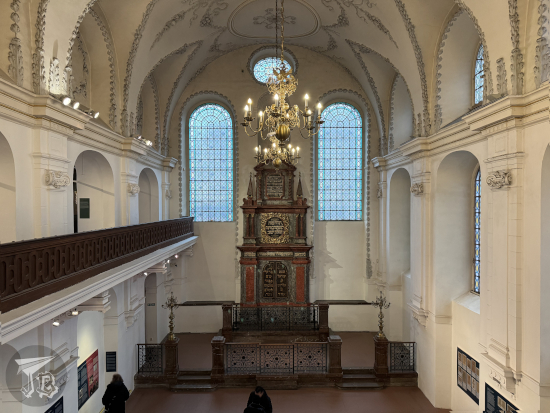
I consider the trip was a success. I saw the Mine, which is something I have been wanting for years. Food in Almadén was horrible, and maybe future road trips should be broken with a night in-between, so lessons were learnt. More supermarkets, more overnight stops. But I only had a long weekend, so I made the most of it. And splurged on a mercury vial for my mineral collection.

20th September 2025: The Mercury Mine in Almadén {Road Trip & Almadén, September 2025}

My lodging in Almadén included breakfast, so I had a coffee and a toast – better than dinner the previous night, but this time there was the hotel lady working the bar. Afterwards, I just grabbed my things and redid half of my tour from the previous night, and re-visit all the spots inscribed as World Heritage Heritage of Mercury. Almadén and Idrija.

The former mining school, the first one created in Spain, Antigua Escuela de Ingeniería de Minas was still closed – it is not open to visitors due to its poor conservation state. It is a Baroque building erected in the 1780s, with a sober façade and wooden interior with basements and semi-basements to deal with the steep street outside, the whole building designed around a master staircase.

I climbed up towards the castle Castillo de Retamar. Historically, the Romans were the first to intensively exploit the mines, as they used cinnabar for pigments. Later, the Moors started distilling mercury, which they used for decoration. There are testimonies of fountains of mercury running in Al-Andalus – let’s face it, quicksilver is a fascinating thing. As the Moors wanted to protect their dominion over the mine – and the whole territory, including the water sources – they erected the castle in the 12th century. The building was later reinforced by the Order of Calatrava, but today there are only a few remains: the brick foundations of what could have been the keep, topped with a 14th-century bell tower.

I finally headed out towards the mining complex Parque Minero de Almadén. When the mine closed down in 2003, it had been the largest producer of mercury in the world throughout the current era – it is calculated that one third of the mercury used in the world comes from Almadén. The catch? Several of them, actually. First of all, mercury is toxic. Second, the exploitation of the mine was less than stellar – at a point in history, digging in the mine was a punishment for capital crimes, considered worse than being sent to row in the navy, with workers being little more than slaves. Third, the mine is surrounded by underground water reservoirs that percolated slowly into the tunnels, which reach 700 metres deep, threatening to inundate them. If breaking down rock was hard, so was carrying the mineral, along with bags of never-ending water, up and out. Since the mines closed, the water has flooded most of the 19 under-levels of the mine, rising up until the third one.

With the mine closed, life in Almadén dwindled down. The area opened to visitors in 2008. When the Unesco Heritage Declaration came in 2012, it breathed a bit of a new air into the town, turning it into a tourist destination, but lack of management makes it, in the end, barely worth a day’s visit. Visits to the mine are only guaranteed at the weekends, when the museum located in the university is closed down. Reservation of activities is confusing, and unless you’re a whole group there is no way to book a complete visit. I had booked the guided visit to the mine at 10:30 in the morning and a visit to the museums in the afternoon. I was not sure that I could do both before Spanish lunch time, but figured out I would be able to talk my way into the museums early if both things could be combined in one go. It was actually the cashier’s idea to have me do so, even better. One of the museums was closed and there was no warning about it anywhere but Google Maps, which feels a bit like cheating.

The main entrance to the mining complex Parque Minero de Almadén is locked down. There is a side building with an open door and a sign reading “we don’t have any information about tourist visits”, which leads to the Visitors’ Centre. That was confusing. As I came in, there was a large group who had not booked in advance because they were afraid they’d feel claustrophobic, and now they had no tickets. The cashier managed to fit them into the afternoon visit. I talked to him about my bookings and he told me to go to the museums after my mine visit, and to wander around while the rest of the group came together.

The lift that reaches inside the mine (modern lift in old encasing)

Of course, there was a family with young children absolutely in the wrong mind frame to get into a poorly-lit underground tunnel for a couple of hours. Fortunately, there were two groups organised and I made sure to insert myself into the child-free one. I didn’t want a repeat of the Cueva del Viento, where a bunch of information was lost due to kids being kids. And I understand that kids are kids but… for me it’s hard enough to focus on the information from a guide without the added distractions.

The visit into the mine only goes down to the first floor and an upper sub-gallery, after which you ride out in the “mining train”. Before starting, you need to get your helmet, and some lanterns are dealt out to each group to improve visibility in the tunnels. The rules are simple: distribute the lanterns throughout the group, keep light pointed at the floor. Apparently, those pointers are too hard to follow – my group had three lights together in the middle of the group, pointed upwards all the time. Good thing phones have torches now.

The descent to the mine is done through a modern-times lift installed in a former shaft Pozo de San Teodoro, down 50 metres to the gallery. It did not feel claustrophobic to me, and surprisingly, I was more impressed about knowing about the water creeping up than the rock above my head. The visit took about two hours and a half. Along the walk we saw areas that were worked on from the 17th to the 19th centuries, along some of the machinery that came into play in the 20th.

Inside the Almadén mine - corridors and mining galleries and a well to extract the water.

Inside the Almadén mine - corridors sustained by brick. In one of the pictures there is a bat flying but you can't see it.

Don’t get me wrong, back in the day mining those tunnels must have been beyond horrible. It is impossible to describe the history of mine without considering the harsh conditions the workers had to endure, especially the prisoners that were all but enslaved there for decades. The most intense exploitation of the mine happened during the age of the Spanish Empire and its expansion to America. Mercury became a key ingredient in the production of gold and silver in the New World.

Inside the Almadén mine - corridors sustained either by brick (newer) or wood (older).

Inside the Almadén mine - corridors and an image of the Virgin Mary.

Throughout the works in the mine, various exploitation strategies were used, digging both horizontally and in angles. We saw different methods and tools, from plain old pickaxes to modern hydraulic hammers, and the room where the mules would work to help extract the cinnabar. We were shown corridors held up by wooden beams – which were discontinued after in the mid 1750s there was a fire that lasted two years – and later brick ones. We saw shafts that had water at the bottom, and in the end we rode a little mining train to come up to street level. The visit ended with a brief lookout and explanation of the furnaces used to purify the mercury.

A piece of cinnabar embedded in the rock within the Almadén mine.

The mining train that used to transport cinnabar and now transports tourists out of the mine.

Rusted distilling equipement, metres high, where mercury was produced from cinnabar when the mine was in operation.

Afterwards, I had my visit to the museums. One of them has an explanation of the mining procedures, the same thing we had heard within the mine itself. The second held the former workshops, which displayed machinery to keep up with the maintenance of all the apparatuses used within the mine. I was the only person who had booked those tickets, so it was a quiet visit. I was also allowed to amble around the outer part of the mining park, seeing all the heavy-duty machines.

I left the mining park and tried to find the historical gates. The entrance to the mines has always been walled off – historically to protect the valuable resources it held. I could see the restored Puerta de Carlos IV. This gate would have taken me to the Mercury Museum, currently closed. There was another gate, but the overgrown vegetation made it impossible to do more than glimpse it.

Mining equipment and buildings on the outer part of the mine in Almadén, including an excavator, the mechanical shop and the classic door, in red brick.

My next step was heading back downtown until I reached the bullfighting ring Plaza de Toros de Almadén. During thirty-month fire of the mine, which started in 1755, the miners had to work on anything, anywhere, to raise some money. One of their ways to get income was converting the communal garden into a bullfighting ring – at least that is one theory. Today, it is considered the second-oldest ring in the world, with the characteristic that the coso (the actual bullring) is not a circle but a hexagon. It is an important national monument and part of the Heritage Site.

Bullfighting ring in Almadén. The sand pit is hexagonal, which is its main characteristic.

In front of the entrance to the bullring stands the Monument to the Miner Monumento al Minero, which takes a new meaning after having visited the mine itself and heard about all the hardships and dangers within its galleries.

And then came the hard job to find a place to grab a bite. I wanted to try a typical dish from a restaurant with a typical name, but they had run out… For real. At least they let me have lunch at the bar… It made me decide to buy something from the local supermarket to have dinner later on. After lunch, I went back to the hotel to wait for 17:00, when the last monument would open.

This was the former hospital Real Hospital de Mineros de San Rafael. It was built between 1755 and 1775 – started during the fire – in order to treat miners who became ill or had an accident in the mine. The most common malady was hydrargyria – mercury poisoning – though of course there were physical accidents, especially loss of fingers after dynamite was introduced.

The visit has three parts of sorts. On the right there is a bit on the history of mining medicine and mercury poisoning. On the left, a very humble display of what is called “the archive” – documentation related to the mine and mining operations. Upstairs, a ward with some archaeological items and an exhibition about how the layman lived outside the mine, with a chilling panel explaining that the work in the mine was considered so dangerous that children would not be allowed to play when there was a relative in the galleries.

Mining hospital - a baroque building with some exhibits inside, amongst them cinnabar, mercury (sealed away) and a wagon

Afterwards, I moved towards the current university, which has been built around and over the former prison Real Cárcel de Forzados, but there was nothing to see from the outside, and the campus was closed as it was a weekend. However, I was on a small hill, so I decided to continue upwards and see if I could get a general view of the mining park. I ended up at a small forest-park, but did not get a great view.

A general view of the town of Almadén. It shows that it is located on a hilltop. The main structures seen are the mining complex on the left (a grey mass on top of a black gorge) and the castle at the very top.

I headed downtown again and I headed towards a tobacco shop I had seen in a small side street. They had souvenirs in the window, so I hoped that they would sell some mercury. Technically, you cannot buy mercury in Europe – both the Mining Park and the Hospital staff had told me so – but this little shop had a little for sale. So yay me, now I officially own some Almadén mercury.

I found the side entrance to the church Iglesia de Santa María de la Estrella, but no other shops open – I wanted to buy some local cheese. Not even the supermarket had anything that I would not find in my local one. I did buy some dinner and snacks though, and a thermally insulated bag because mine is old and is not working that well any more. It helped keep dinner fresh until I reached the hotel and could use the small fridge there. Pity about the cheese though.

Baroque church in Almadén, showing the exterior in and the main altar.

I turned in afterwards to decide what I would do on my way back, and study the routes.

19th September 2025: A knot of roads {Road Trip & Almadén, September 2025}

I woke up early – way before the alarm clock went off, so I decided to hit the road. I first topped up the fuel tank at the cheap petrol station near my place. Afterwards, I drove off to the motorway and the morning rush hour. As I was caught in the traffic jam, there was a pretty rainbow in front of me – no pictures, though, for obvious reasons. Traffic dwindled a lot when I left the A2 behind and merged onto M50. From there, I took a couple of hours to reach my first stop, the village of Consuegra. On the mountaintop of the so-called Cerro Calderico, in the outskirts of this ten-thousand inhabitant, stand some the best examples of restored traditional windmills.

During the Middle Ages, the area in central Spain known as La Mancha proved a challenging place for watermills, the dominant technology at the time. The rain regimes cause irregular river flow, with a lot of the currents drying up in summer. As demand for flour grew, windmills were built near but outside towns, on high ground. They provided clean flour, cheap enough to be affordable, without being subjected to draught or flood seasons changing. The windmills lived its golden age from the second half of the 16th century until almost the 20th. Towards the end of the 1800s, most of the cereal crops were exchanged for vines in order to supply wine to France, leading to the decay and progressive abandonment of wind-milling. The Industrial Revolution and the appearance of fossil fuels and electricity finished off whatever little remained in the early 20th century.

However, besides their practical function, there was something else about the La Mancha windmills. They had gone viral centuries before the Internet was a thing. In the year 1605, Miguel de Cervantes – considered the greatest writer in the Spanish language – wrote his masterpiece El Ingenioso Hidalgo Don Quijote de la Mancha, worldwide known as “Don Quixote”. The novel is amongst the most translated literary works in the world, and tells the tragic story of a minor nobleman, the title character, who goes crazy from reading too many chivalric romances. He decides to leave his home and become an errant knight, having great adventures in his mind, which are more misadventures in real life. He is accompanied by a farmer-turned-squire, Sancho Panza.

During one of his delusions, Don Quixote fights giants with long arms – which the reader knows, from Sancho’s warnings, that are in reality windmills. Of course, the madman is “defeated” by the blades, which shatter his spear on impact. It is one of the most famous passages of the book, even if it is barely a page or two in the eighth chapter. Throughout the novel, which starts “in a village of La Mancha, the name of which I have no desire to call to mind”, several locations are explicitly mentioned, others are implied, and some have completely imaginary names. Experts have placed this fictional encounter with windmills either in Consuegra or Campo de Criptana – which was not on my route.

Thirteen windmills were built in the 19th century on the Cerro Calderico, and twelve have been restored and turned into tourist attractions – one even works. They stand in a row alongside the ridge and next to the local castle Castillo de la Muela (or Castillo de Consuegra). After all, both castles and windmills need the higher ground to be effective, in a way. The castle already existed in the 13th century, with roots in a 10th century previous fortress.

I parked at the foot of the hill and walked up to see the castle and the windmills. The castle was closed as it was a local holiday, and the fortress is managed by the town hall. I stayed around for an hour or so, walking from one end of the hill to the other. I had a snack as I snooped around, then I moved on.

Consuegra - a line of windmills with a castle in the background

My next stop was the National Park Parque Nacional de las Tablas de Daimiel, a weird place. I call it weird because despite its status as a protected area, it has been on the brink of collapse for the last century or so. The wetlands have been drying out for decades.

The area is the literal last of its kind in Spain, a kind of wetland generated when rivers break their banks in their middle course on flat terrain. In the middle of the de facto Spanish Inner Plateau desert, it is formed by the rivers Guadiana (fresh water) and its tributary, the Cigüela (brackish water), and fed by a number of underwater aquifers. These have been exploited for farming, which seems to be the cause for the dessication. So out of what it should be, there is only one medium-sized pond, Laguna de Navaseca (usually referred to the “permanent pond” Laguna Permanente), where a number of birds, fish and amphibians live either seasonally or all year round. The area was designated a national park in 1973. Later, it received other protections, especially regarding the bird population.

I parked in the allocated space and had a sandwich before I went in. The visitors’ centre was manned by a very disgruntled employee who explained the dessication to me as if I were personally responsible for it. I really felt like apologising. The truth is that the first place I visited was the pier, which has not seen water for at least a decade. I could do two of the three walking routes, but in the end I only did one and a half, as the second I tried was way hot and dry and I gave it up three-quarters in, as there was no water any more.

In the end, I stayed around the main pond Laguna de Navaseca, where wooden walkways have been built. I felt horribly guilty whenever the wood cracked under my feet and I scared the ducks away, but the local guides could be heard from across the whole pond. On the banks, there are bushes of common reed (Phragmites) and rushes (Juncus). The only tree in the area is the tamarix (Tamarix gallica), small and brime-resistant.

In the pond – and flying over it – I found a flock of greater flamingoes (Phoenicopterus roseus) – which are for some reason not listed anywhere that explains the park. I also saw herons, ducks, geese and I swear ibises – the latter are not mentioned either, but my bird identification book suggest a glossy ibis (Plegadis falcinellus). I was hoping that autumn had modulated the temperatures a bit, but it was extremely hot. It was also… stupidly dry for wetlands… That is why I gave up on the second route halfway.

Doñana National Park - view of the main pond, surrounded by low bushes

Doñana National Park - view of the main pond with flying flamingoes

An ibis waddling for food

A flock of flamingoes flying

I went back to the car and drove to a small parking lot at the entrance of the park which allows you to see the watermill. It was closed, and again dry, but it was an interesting structure.

I continued on the road towards the archaeological site Yacimiento Visitable de Calatrava la Vieja in Carrión de Calatrava, which has a very nice and shaded parking area, where I had my second sandwich as I was there 30 minutes before schedule – read: they had not opened yet.

The archaeological site is considered one of the most important of Moorish origin in Spain – a city and a castle from that period, erected on older remains, probably Iberian. Back during the Arab vs Christian wars in Spain, the fortress was right in the middle on the way between Toledo and Córdoba, along with other important commercial routes, so it became a key defence point. It is known that the castle already existed before the 8th century, on the Guadiana riverbank. When it fell to the Christians around 1150, it became the first line of defence, and it was entrusted first to the Knights Templar and then to the Cistercians. It became the birthplace of the first Spanish military order, the Order of Calatrava Órden de Calatrava.

Calatrava castle from the outside - a ruined fortress with a roundish shape, built in clay-coloured rock, with no vegetation whatsoever around it

The castle was built on a plateau, defended by the river itself and the walling structure, which included at least 44 flanking towers. There were four fortified corridors (corachas) that protected access to the water. The entrances to the inner fortress had several turns to make them easier to protect. Between the inner core and the walls stood the medina, the Islamic city, and the alcázar rose as a sort of triangular keep, accessed through a triumphal arch. The inner castle itself is the best-preserved area, having even rebuilt furnaces to make clay. During the Templar times, part of the alcázar was repurposed into a budding church which was never finished. On one of the inside walls there are carved drawings of vessels.

Calatrava castle, collage: The inside of a room with a Templar cape as sole decoration, the inside of a pottery oven, a view of the mdina arched entrance and two inner archways.

As I climbed the walls, clouds had started gathering and the wind had picked up. I decided to get going, trying to outdrive the storm. At first I thought I had been lucky, but about 20 minutes away from Almadén, the skies opened and there was a torrential downpour. I was lucky enough to find a parking spot where I hoped, down the corner from the hotel, and I have an umbrella in the car. A few minutes after parking, the storm stopped though, albeit the rain did nothing to cool down the evening. I checked in, and the hotel lady gave me a map with all the spots that have been inscribed as World Heritage Heritage of Mercury. Almadén and Idrija.

Mercury (chemical symbol Hg) is a native metallic element, the only one which is liquid under normal temperature and pressure conditions. In nature, it is usually found as cinnabar (mercury sulphide, HgS), a bright scarlet mineral. Its formation is linked to volcanic activity and alkaline hot springs (the area of Ciudad Real comprises the extinct volcanic field called Campo de Calatrava, which I drove through, but found no way to stop anywhere to explore). Liquid mercury, also called quicksilver, is extracted from cinnabar by heating it, as sulphur evaporates with heat.

Mercury is toxic to the nervous system, dissolves gold and silver, and has long been associated with “mystical” powers and sites – the first emperor of China was buried in a tomb with rivers of mercury, there is mercury under one of the Teotihuacan pyramids in Mexico, and in the end it carries the name of the Roman God of Messengers and Travellers. It has fascinated humans throughout history.

The name of the five-thousand-inhabitant town, Almadén, comes from the Arabic Al-maʻdin [المعدن], which means “The Mine”. The site was already exploited in times of the Romans – the extracted bright-red cinnabar was used to create vermilion paint for the walls of Pompeii and Complutum. When I was a child, my history book had some information on Almadén, and the accompanying photograph showed someone who had thrown a cannonball into a mercury pool, but the cannonball was floating on it. I have wanted to see the mine since then, even knowing that there was no way I would ever see that one pool any more, due to the legislations that have deemed mercury as “too toxic for anything”.

I went to have a look around town. It was dusk and everything was closed – not that many things would open the next day anyway. I did a small circular walking tour which included the main church Iglesia de Santa María de la Estrella, and down the main street the central square with the town hall Ayuntamiento de Almadén and the church Iglesia de San Juan. I continued on and found the the old mining school Antigua Escuela de Ingeniería de Minas. To the side of the street stands the former castle point Castillo de Retamar, where only a turret remains. Up a little, I reached the third church, Iglesia de San Sebastian and the ruins of the manor house Casa de la Superintendencia.

Almadén Castle - a derelict tower in brick, with a stork nest on top

I undid my path and headed to the other side of town. In a secondary square there is a monument to miners Monumento al Minero, and across the street the bullfighting ring Plaza de Toros de Almadén. My final stop was the former hospital Real Hospital de Mineros de San Rafael. I had dinner at the hotel restaurant, which honestly was a little disappointing.

Almadén: monument to the miner at night; a huge sculpture in metal that represents miners. Two of them have picks and are breaking a rock, two others are pushing a wagon. The miners have helmets with actual lights.

I headed back to the room to have a shower and some rest, and get ready for the following day – and try to digest dinner.

19th – 21st September 2025: Windmills, Mercury and Castles Road trip {Road Trip & Almadén, September 2025}

Though work season had started once again, there was a four-day weekend, and I decided to spend three of them on a kind-of road trip. Plane-ticket prices were off the charts even weeks in advance, so I thought that if I had made it to Loarre and Zaragoza, I could just drive an extra 40 minutes and head to Almadén, a place with horrible public transit connections that I have wanted to visit for a long time.

I sketched the itinerary again and again, and due to weather concerns I ended up sticking to the first one I had drafted. The idea was to make a few stops on the way there, one or two on the way back, and spend a whole day in Almadén. I tried to book a “complete” visit to the main attraction in town, the mine, but I was not able to, because they only run it for eight people or more. When I wrote to the Mine to try and understand how that worked, their answer was all caps and felt rude – later I realised it was more of a lack of netiquette understanding. To be fair, it discouraged me a little, and I thought of giving up the whole thing. And honestly, up until the 15th, when the hotel became non-refundable, I was on the line as to whether I really wanted to do it. In the end, of course, I decided to go.

For the first day (Friday), I had drafted a bunch of itinerary options that I planned to decide upon depending on time and tiredness. The only clear thing was that I was to arrive in Almadén in the evening. Saturday would be entirely spent in town, and in the evening I would decided the return day’s stops.

I am always surprised when places that want to live off tourism won’t just… coordinate. Half of the stuff is only open at weekends, and the other half only on schooldays. Most of the restaurants in town were closed and food was pretty much awful in the couple of them I found open. But I saw most of what I wanted to see, so I count the weekend as a success.

19th – 21st September 2025: Road trip & Almadén

22nd – 26th May 2025: A taste of Malta {Malta, May 2025}

Last-minute trips are weird. You start looking at an Ireland itinerary, but for some reason hotels are 200€ a night. You check for alternatives and end up booking at a place you had never considered before. In my case, it was the tiny country of Malta, an archipelago with eight islands: Malta, Gozo | Għawdex, Comino | Kemmuna, Manoel Island | Il-Gżira Manoel, Cominotto | Kemmunett, Saint Paul’s Island | Il-Gżejjer ta’ San Pawl, Filfla and Filfoletta. It turns out that Malta is both the country and the main island. Only Malta, Gozo and Comino, that is inhabited – and there are just two people living in the latter.

Malta is located in the Mediterranean Sea, a handful of kilometres south of Sicily. It is one of the smallest, and most densely-populated countries in the world – actually, in the island of Malta you literally cannot tell where one city ends and the next begins. The inhabitants speak English and Maltese (I will use this order for bilingual references, English | Maltese, as I did above with the island names). Malta as an independent country was established in 1964, when it gained independence from the United Kingdom.

Humans first reached Malta during the Mesolithic, around the year 6500 BCE. Due to the island’s geostrategic location in the middle of the Mediterranean, it has been lusted after by many powers and alliances – from the Phoenicians, Greeks and Romans to the British Empire and everyone involved in WWII. The successive populations have heavily influenced the islands and its architecture.

My original plan was to stay in Valletta, a fortified city mostly from the 16th century and the capital of the country. However, I only found apartments in basements for a decent price. I finally found a hotel in Saint Julian’s | San Ġiljan. Once that was booked, I focused on what to do and see in Valletta, but the more I read about the island, the more intrigued I grew.

In the end, I decided to balance some landscape watching (22nd and 26th) with historical Valletta (23rd), prehistoric ruins (24th) and a guided tour through the smaller island of Gozo (25th). There were a few things that did not work out as intended, but all in all it was a good trip with lots of new experiences, but a tad of necessary improvisation made it less efficient than it could’ve been. Fortunately, everything that went wrong could be fixed.

31st March 2025: More Modernisme and the way back {FFVII Barcelona 2025}

For our final day in Barcelona, I had planned some more architectural visits. I had adjusted my planning considering the underground issues the previous day, but it turned out, it had been a Sunday-only thing. We had breakfast and on check-out, the manager asked how the stay had been. To his merit, when we told him about the issue with the air-conditioning, he apologised and offered us free breakfast in compensation. After we declined – timed entry visit – he advised us to write a complaint letter for a discount next time. I didn’t think it was necessary.

Since the station we had to change at was open, there was no issue with the underground, so we were half an hour early. I had booked a locker for the luggage in the centre of town, as the hotel is very convenient for attending a concert at CCIB, but quite far from… everything else, really. The locker system was convenient: you book online and get a code which opens both the place and your assigned locker. I found it more trustworthy than leaving the bags in a random shop which “looks after luggage”. However, about a month later, there was a complete outage in Spain, which made me second-guess the convenience of these things, as I heard about a lady who could not go home because her luggage was inside one of those lockers. We’ll see whether I dare use them again.

We were to continue on my Modernisme route, visiting one of the works of Antoni Gaudí (1852 – 1926), considered the peak representative of the style – to the point that some of his works have been declared Unesco Heritage by themselves as Works of Antoni Gaudí. Gaudí originally found inspiration in orientalism and Neo-Gothic, but as he became more and more established, he turned to nature forms – seeds, branches, bones, catenary shapes… The UNESCO work we wanted to see was Casa Milà, a building commissioned to Gaudí by lawyer Pere Milà in 1906. The building itself was erected between 1906 and 1910, and it was nicknamed “The Quarry” La Pedrera. It is an eight-floor apartment building with a self-supporting façade, electricity, running and hot water. The building was designed around a central patio, and it has a very particular roof-terrace. Some people claim that Casa Milà does not even fit into the Modernisme category, but it should be classified as “organic naturalism”, or even “expressionism” all by itself.

La Pedrera, exterior

I found the building… underwhelming. We had a combined ticket for Sant Pau and Casa Milà at 39 €, but the normal ticket price for the building is 40 €, and this is only for one of the floors with a “recreated apartment”, the attic, and the terrace. At least you get to see the patio as you have to walk past it so you reach the tiny lift in which they cram you to take you to the 7th floor. The experience felt… like… not enough. I was for sure expecting something more.

La Pedrera, Interior

Do not get me wrong, the house is extremely cool, but you get to see really little in comparison to how big the place is. So even if it is pretty, it feels crowded and small, with way too many gift shops crammed in. The terrace is fun, with chimneys that look like ancient warriors – some people say they represent chess pieces, others that they hide religious undertones – Gaudí was very spiritual. Reportedly, they also inspired the stormtroopers’ helmets in Star Wars.

La Pedrera, terrace

Afterwards, we walked to the music hall Palau de la Música Catalana part of the Unesco Heritage Site Palau de la Música Catalana and Hospital de Sant Pau, Barcelona. The so-called Palace of Music was designed by Lluís Domènech i Montaner a couple of years after projecting the hospital.

Palau de la Música Catalana

Everything that Casa Milá came short, the Palace passed with full marks. The building has an original entrance designed by Domènech, in dark brick with extensive decoration. The interior is laced with tiles and glass, and tinted-glass windows. The concert hall is amazing. At first, we could not access it, because there was an educative concert for children going on, but we were later allowed to sit at the paradise. There is a huge skylight / lamp in coloured glass, pegasus statues. The concert was incredible too, with four to six musicians playing classical music and… running around the stage too. Lady trotting up the stairs while playing the cello, you have my admiration. I loved everything about the palace, to be honest, except the creaky chairs.

Palau Música Catalana

Once we were done in the Palau, we walked to the market Mercat de Sant Josep (St. Joseph’s market), known as La Boquería (The Butcher’s). It used to be a regular marketplace, but now it has turned a touristic attraction. The main entrance is also part of the Modernisme route, designed by architect Antoni de Falguera, who also created the inner metal cover. Though I had half a mind about eating there, the prices were ridiculous, so we ended up at an Asian place a couple of streets down. On the way, I had been excited about the “Barcelona Aqueduct”, but it turns out it’s a modern construction with old ashlars, nothing historical in it at all.

Market La Boquería

After lunch, we had about an hour to kill, and we decided to try our luck in the hobby-shops area. The Norma Comics shop was open, and we spent a while looking at the books there. Then, we headed back to pick up our luggage and commute to the station.

We had to change trains, and there was an announcement that any passengers with a connection shorter than 30 minutes would be escorted to their train. Of course, that’s only PA, and you’re on your own – I asked a worker, who tried to divert us to the suburban trains, not our connection. From that conversation, I think that we were supposed to go out of the system and get our tickets scanned again, but we found our train before that. There was no one else to consult with, so I decided that we would get on it. My sibling was mortified, but we were not doing anything wrong. If anyone checked on us, we had a valid ticket. They had not lived up to their part of the agreement anyway – and I would have told them exactly that, had anyone even thought of scolding us.

But we made it, as I predicted nobody gave us any grief, and the drive from the train station was uneventful. All in all, it was an intense weekend – though I feel I could have squeezed in a monument or two more had we skipped the sit-down meals, but my sibling can’t handle that. All in all, I think everything worked out rather well.

30th March 2025: Sant Pau, Verne & a chocobo {FFVII Barcelona 2025}

The Barcelona hotel charged 20 € per day and person or breakfast, and I was not willing to pay for that, and so I told my sibling. They had no option but to accept since they had decided to delegate all planning and credit-card’ing on me. Instead of booking with breakfast, I brought cold latte bottles and snacks – good for taking headache medicine, which I did. After a quick breakfast, we set off. As we left, I asked at reception if they could do something about the air conditioning.

We headed towards the underground. It should have been an easy twenty-five-minute commute, but one of the stations was half-closed. We had to go outside and walk towards the other entrance to change lines, which was strange and consumed a ridiculous amount of time. We had to be at the ticket booth of our booked visit ten minutes before the allotted time, and we barely made it – though they did not seem to care. When I was looking at tickets, I found a combined ticket that saved us 10 € for two iconic buildings in town that I had not visited before. That however implied exchanging vouchers for tickets, thus the extra time.

We reached the former hospital of Saint Paul Sant Pau Recinte Modernista ten minutes after I had anticipated, right at the time we had to be there. Sant Pau is a huge hospital complex erected between 1901 and 1930 by architect Lluís Domènech i Montaner (1849 – 1923). Domènech favoured Modernisme, and is considered one of the most influential architects in shaping it. He designed buildings which balanced functionality and decoration, with lots of mosaics and polychrome. Though the precinct had been a hospital since the Middle Ages, it was completely redeveloped for the early 20th century project. Today, it is half of the Unesco Heritage Site Palau de la Música Catalana and Hospital de Sant Pau, Barcelona.
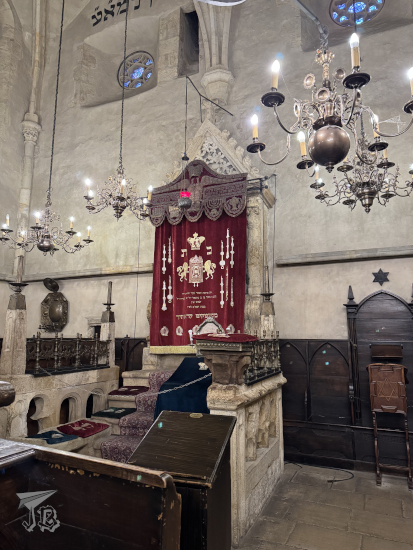
Hospital San Pau from the street

The hospital is considered one of the most important, and largest, complexes in the local Modernisme style. The complex was designed with 26 buildings, 12 of them pavilions for patients, separated by sexes and kind of disease. The pavilions were connected by underground tunnels, leaving space for gardens and open spaces between structures. It was originally conceived to be self-sufficient, closed off to protect the rest of the city.

Hospital San Pau, outside

The buildings are erected in brick, and decorated with ceramics both inside and outside, some of them forming complex mosaics on the roofs and ceilings. After a new hospital was built next to the original one in 2009, the complex was recovered as a museum in 2014. We could visit the pavilions, the tunnels, and the administrative building. The whole enclosure is magnificent, and incredibly large. It took over two hours to see everything we were allowed to visit and I loved every second of it. Well, except the pavilion with political propaganda.

Hospital San Pau, interior

Afterwards, we headed out towards a fun restaurant I had found online – Verne Barcelona, decorated simulating Captain Nemo’s Nautilus from the novel Twenty Thousand Leagues Under the Sea by French writer Jules Verne. We shared a cone of tempura vegetables and I ordered a “Submarine” – a sandwich made from toasted brioche bread – called Turtle, with battered squid, sauce and salsa (I just don’t understand how they are supposed to resemble a submarine…).

Verne Barcelona

We headed back towards the hotel, stopping at a Starbucks for a coffee – a matcha in my case – because I helped my sibling dress up for the concert. We had been carrying the cosplay after all, of course they were going to wear it!

We were in Barcelona to attend the Final Fantasy VII Rebirth Orchestra World Tour, to be held in the CCIB – Centre de Convencions Internacional de Barcelona. Final Fantasy is an expanded video game anthology which set off in 1987. Since then, it has spawned 16 main games and countless spin-offs, media, plushies, and remakes. One of the most famous games is the seventh instalment, Final Fantasy VII, released in 1997. The game is set in a cyberpunk dystopia where energy is obtained by draining the Planet’s life-force. Gameplay follows the adventures of a party which opposes the system, embodied by the electric company Shinra, while at the same time trying to stop the main antagonist – mad soldier Sephiroth – from destroying the Planet itself.

Since 2015, Final Fantasy VII has been under redevelopment into a trilogy using modern graphics. The first game was Final Fantasy VII Remake, released in 2020, whose music had its very own World Tour in 2021. The second instalment, Final Fantasy VII Rebirth came out in 2024, and its music event – Final Fantasy VII Rebirth Orchestra World Tour – began almost immediately, ending precisely with our concert.

We were at the queue already when doors opened, but not early enough, so we needed to line again for the merchandise booth, almost an hour. It was in that queue where something amazing happened. When we attended the previous concert Final Fantasy Distant Worlds 35th Anniversary – Coral –, we were stuck at the merchandise queue for about an hour too and by the time we reached the front, they had ran out of most of the items. That included what I wanted the most – the chocobo plushies. Chocobo are a recurring species in the Final Fantasy franchise, large birds that can be ridden in-game, and in real life be sewn into cutesy toys.

It turned out that in 2023 the last chocobo plush had been bought by the guy who was sitting behind me. I might have made some jokes about stealing it and running away, and he promised to get me one for the next concert. I of course filed that under “one encounter silliness” and forgot all about it.
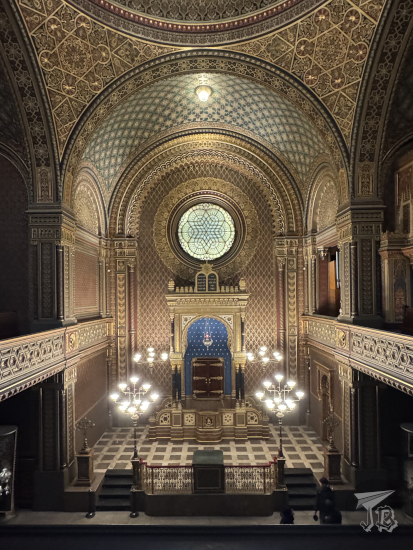
Well, he did not.

In that queue, two years later, he found me, and he gave me a chocobo plush. He actually found my sibling, who was easier to identify due to the cosplay. I was absolutely flabbergasted. Gobsmacked. Never in a million years would I have expected something like that to happen. Just… figure that everything that went on afterwards was coloured by a feeling of puzzlement and amazement at this stranger’s kindness over a silly plush I wasn’t able to buy two years before.
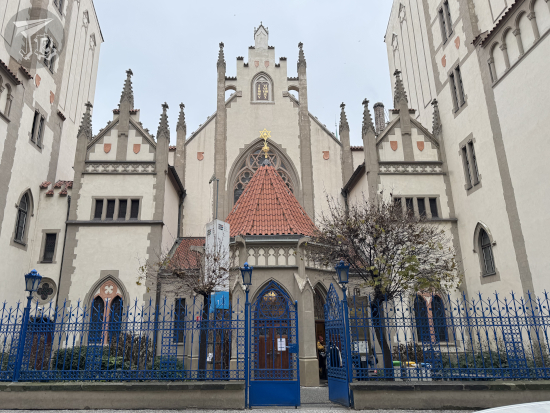
Chocobo!

We got to the front of the line over an hour later, almost at the time of start. I only wanted a programme, and we were seated around 20:50. I am good at choosing seats, by the way. We were dead centre at a great distance from the stage.
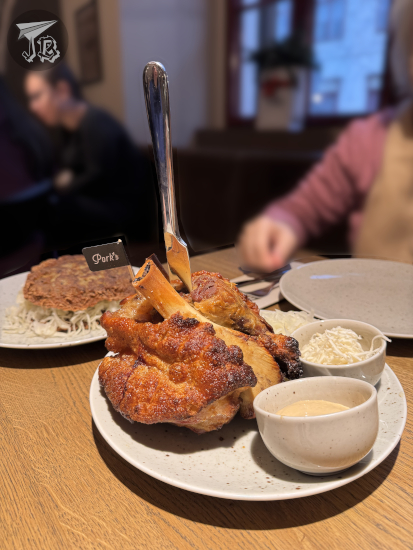
Setlist:
  First part:
  1. The Unknown Journey Continues
  2. FFVII Rebirth Opening
  3. Main Theme of FFVII – Battle Edit
  4. A New Journey Begins: Grasslands / Junon / Mt. Corel
  5. Crossing the Planet: Corel Desert / Gongaga / Nibel
  6. Queen’s Blood
  7. Stamp – Rebirth Medley
  8. Rufus’s Welcoming Ceremony – A New Leader
  9. Costa del Sol – Fun in the Sun
  10. Custom Valkyrie
  11. End of the World Medley
  12. Cosmo Canyon – Sanctum of Planetology
  13. Bare Your Soul
  14. Welcome to the Gold Saucer
  Second part:
  15. Loveless Symphonic Suite – Gift of the Goddess
  16. No Promises to Keep – Loveless Ver.
  17. Galian Beast
  18. J-E-N-O-V-A Lifeclinger
  19. Sephiroth Reborn Symphony
  Encore:
  20. One-Winged Angel – Rebirth Medley
  21. Aerith’s Theme – Return to the Planet Medley

Final Fantasy VII Rebirth orchestra playing

The orchestra was directed by Eric Roth. It was all right, I enjoyed it. However, I don’t think it was as powerful as the first one I saw, but that one was the first post-Covid event so it was emotional in other ways. Then again, I am not a gamer. I just watch gameplays on the Internet… I was a bit disappointed by the arrangement of One-Winged Angel, it felt… too elegant. What I love about the song is the pure chaos it represents, after all.

In attendance was composer Masashi Hamauzu [浜渦 正志 | Hamauzu Masashi]. He started working for Square Enix in 1996 under Nobuo Umematsu, the main composer of Final Fantasy VII music. Hamauzu’s first direct work related to the saga was the Chocobo’s Mysterious Dungeon soundtrack in 1997. He was in charge music for the Final Fantasy VII spin-off Dirge of Cerberus and alongside Mitsuto Suzuki, he has worked in both Final Fantasy VII Remake and Final Fantasy VII Rebirth.

After the concert, we joined the VIP queue for pictures and autographs. Though I had brought the CD from the time before – when I did not get the pamphlet – I was equipped this time. And I even managed the Spanish – English – Japanese cacophony without messing up either of them. That’s a first for me, I think. I got my programme autographed on the setlist page, and then my sibling and myself headed back to the hotel. For 179 €, I keep thinking the VIPs should at least get their own merch queue, or an item to get signed. I guess there are lots of people to get paid…

Eric Roth and Masashi Hamauzu signing autographs

Something that surprises me a lot about this area of Barcelona is that not even the McDonald’s at the shopping centre is open after 23:00, so I always make sure we buy something to snack after the concerts. The room was at least not freezing, though not particularly welcoming either. I had a hot shower, and that finally got rid of my headache, just in time for bed…

29th March 2025: Tibidabo & Friends {FFVII Barcelona 2025}

It sometimes feels like the alarm clock going off at 6:00 is actually worse than it going off at 3.00… Fortunately, after a hefty dose of coffee, I was able to get on my way, and we got to the station on time to do some reorganising of luggage. The situation with the trains was chaotic due to some projected works on the tracks. They announced that the train would be 12 minutes late, but it actually arrived and left a minute early. The train ride was uneventful, despite a large crowd of loud teenagers from a rugby team who had no idea where the were going, and really dirty toilets in the cars. The train reached Barcelona ten minutes before schedule. However, it did not go into the station until 15 minutes later for some reason – I really don’t understand what was going on with the whole railway system, or how construction in Madrid affected the time to enter Barcelona, but at least we were there.

The first step was dropping off the suitcase. Fortunately, Barcelona Sants has a luggage storage. I decided that for 10 € I could ditch my backpack and not haul it through the underground. Barcelona Sants station was under construction in 2021 and it’s still under renovation, so it took a bit to get to the correct place with the suitcase. Once we could drop the luggage off, we headed off to the underground.

There, we had to queue up to get our transportation cards from a machine – which apparently could not be used in any language except Catalonian. I had a code to input, and with that code the machine spat the tickets. They were convenient to use, and they worked on the underground and the buses without problem. The online discount made them better value for money: a single ticket is 2.65 €, and the 72-hour card Hola Barcelona is 26.30 €, which is reduced to 23.67 € if you order online (a 10% discount which is almost the price of one trip).

I had waited to book activities till the very same week because I wanted a relatively good prediction on the weather. It was not as nice as I had hoped due to the wind that morning, but oh well. Unfortunately though, the eclipse caught us in the underground. I had hoped we would be outside already, but we were over half an hour behind schedule due to the train and the construction in Sants.

I had bought tickets for the amusement park Parc d’Atraccions Tibidabo. A long time ago, from Park Güell, I was trying the zoom of my then-new camera and I was intrigued by its silhouette. I was curious and honestly, I thought it was an interesting place to see. Tibidabo is considered the oldest – or at least longest-running – amusement park in Spain. The first rides opened in 1905 under private initiative, though the park is now owned by the Barcelona city council.

I found a ticket which allowed to see the panoramic area and ride the “classical attractions”. It included the shuttle bus and the funicular Cuca de Llum, opened in 2021, which is not the original from the turn of the 20th century, but a recently renovated one. There’s no way I am getting on a funicular which older than 100 years old. To get there, we took the underground, and walked to the so-called Tibidabo Store, where we exchanged our tickets for bracelets so we could ride the bus to the funicular. The place is a bit out of town indeed.

We reached Parc d’Atraccions Tibidabo around 12:45, a good couple of hours after leaving Sants. Upon entering, it was colder than I had imagined, because it was windy, especially at the top of the mountain. There was no ticket control except for the attractions, so we were able to come and go as we pleased, and i found that was a regular mini-bus that went there. I felt a bit cheated, but I guess the funicular itself was an experience! Good thing that I am not too keen on rides and I decided to only get the basic ticket. It did not feel cheap either (21.50 €). The ticket Pase atracciones emblemáticas allowed us to wander around and ride the ‘emblematic’ rides – i.e. the classic one – and see the museum.

Barcelona from above

We first had a look at the city of Barcelona underneath. The view was not particularly different from the one in Parc Güell, except I’m more familiar with the layout by now. We then turned to snoop around the Temple of the Sacred Heart of Jesus Temple Expiatori del Sagrat Cor, a Christian church designed by Enric Sagnier i Vilavecchia (1858-1931) in a mix of Neo-styles, halfway between a Disney Castle and a classic cathedral. Construction was carried in two phases: 1903 – 1911, and 1915 – 1951. The upper towers were built later on, and work continued until 1961. The outer lower area is Neo-Romanesque, and the upper one Neo-Gothic; the inside is Neo-Byzantine, with mosaic walls. It has stairs a the sides to move from one level to another, and a lift inside. All in all, the whole building is… weird.

Sacred Heart Basilica

We ambled around for a while, and finally decided to have an early lunch, so we could avoid the family rush. My sibling wanted a proper sit-down, and we found the only option offering actual tables. The service was terrible – we never got glasses nor cutlery. We had to ask for napkins twice I think. Thrice for the bill after ordering two bottles of water and two burgers Hamburguesa de mejilla ibérica con pepinillo (Pulled pork and pickles burger). The service was so bad that the waiter decided to give us a complementary 15% discount on their own volition.

After lunch, we queued to ride the carousel and the Ferris wheel, and we saw the Automatons Museum, which was really interesting. The oldest piece dates back from 1880, and the newest from 2005. There used to be automatons sprinkled through the park for almost a century, but they were housed in their current home in 1982 to protect them from the weather.

Tibidabo Panorama

Automaton Museum

Around 15:00, we came down from Tibidabo. We had to share one ticket to get into the funicular, and the doors closed on me. I had to go to customer service to wait for someone to give me a replacement one. We undid all the way back to Sants to pick up our luggage, then we went back to the underground to meet with my friends E**** and P***o near their house to celebrate an important event in their family. We stayed with them for a few hours, then dropped by the supermarket to buy dinner for the next day, and took a bus towards our hotel.

We checked in, dropped our stuff in the room, cranked up the heating, and went to have dinner. We ended up at a Japanese franchise because the website said they had okonomiyaki, which they didn’t. At least they had dorayaki to compensate.

When we came back the room was at 19 ºC, and the air conditioning was blowing out cold air. I turned the thing off and went down to reception, where they told me they would call with a solution – either maintenance or a change of room. An hour later, without having heard from them, I went down again and a different receptionist told me the only thing that could be done was giving us extra blankets. I asked for three blankets and only got two. But I was too tired to fight – there was an extra towel I could use for added warmth. I defrosted in the shower and went to bed.

29th – 31st March 2025: Final Fantasy VII Rebirth Orchestra World Tour in Barcelona (Spain) {FFVII Barcelona 2025}

My sibling is an avid Final Fantasy fan, or at least of the concerts, and they usually ask me to prepare a trip when there is one in Spain. They tend to be in Barcelona, which has a love-to-hate relationships with tourism. Short-term letting apartments to tourists is more profitable than renting to residents, which is (allegedly) one of the causes of the current housing crisis. Finally, it has one of the highest criminality rates in Spain, and the epicentre of the secessionist movement. Thus, I’ve not planned much the last couple of times we were there, just enough to fill the days. It does not help that my sibling is a cosplayer and we have to haul a suitcase with the outfit.

This time, however, the Final Fantasy Rebirth Orchestra World Tour concert was on a Sunday. I have no faith in the public transport system any more, and Monday had to be requested off anyway, so we ended up looking at Saturday-morning to Monday-evening trip. Thus, I decided to fit in a bunch of Modernisme and other stuff that had been on my list for a while. Also, friends! Because friends are extremely important, especially when big changes are on the way!

I bought tickets for the concert in June 2024, when they went on sale. I booked the hotel in November, but I refused to pay for breakfast, because it was 20 € per person and day, and I was not going to pay 40 bucks for weak coffee and stuff I don’t even eat… And then I did not do much planning until February. However, I knew that at some point I needed to get things organised, else we would spend the weekend queueing to enter places. I’ve seen it happen before…

The train tickets only came out 90 days in advance, and I got them in early February. They were expensive – I had hoped to catch one of the new low-cost trains, but paying for the cosplay suitcase would push it to normal ticket prices. I found an outbound direct train, bit the return one that I wanted was not running, so we had to take a connection – which meant going to Madrid, then backwards on our way back. Oh, well. And on top of that, construction on the tracks triggered delay warnings – which did not come true in the end, good thing I insisted on being at the stations for the earlier time, whether it was the old or new one.

I put together a tentative itinerary waiting for the weather forecast, and the week of the trip itself, I booked tickets, including the transportation card – which was a nightmare. I really don’t understand how or why cities have decided to get rid of regular transport tickets. The ten-trip ticket has disappeared, and buying a one-way was prohibitive. Considering how many trips we would get, it made sense to get a 72-hour tourist ticket, since it was impossible to register to get a normal card… I also organised where to leave the luggage, since the hotel is next to the venue, and that is more than a bit out…

Spoiler alert though: we did not get pick-pocketed nor robbed, unless you count the insane tourist tax at the hotel, and we did not take forever to do the check-in.

15th & 16th March 2025: Canterbury (England, UK) for “The Shark Is Broken”

I’ve travelled for – or with the excuse of – concerts (take your pick) and documentaries (at least thrice, even twice for the same one), but this was my first time travelling for a theatre play. Don’t get me wrong, I like theatre – I’ve even squeezed Wicked into a London trip a couple of times – but it had never been a main driving force. Until I stumbled upon the information that The Shark is Broken was heading towards the UK and Ireland. There were no shows in London, and my connection to everywhere else – including Dublin – was not good, especially due to work schedules. However, there was one date which was, if not convenient, at least doableCanterbury, in the county of Kent. Unfortunately, neither the Gods of Trains nor the Gods of Buses were as willing to smile upon me as the Gods of Air Travel.

Once I secured a ticket for the play (£55.00, dead centre of the stalls), a hotel in Canterbury, and the plane ride, I checked out what to see in town. This was back in December 2024. I also booked my parking spot at the airport, and since it was so long out, I could reserve Terminal Parking for just a couple of quids more than long-distance parking. That’s an extra 20 minute snooze! However, as I’d been hearing about train disruptions in England, I decided to wait a little before buying the Stansted-London and London-Canterbury trains. And sure enough, when a couple of weeks before the trip I went to check on the trains, the Stansted Express was indeed not running. There were ticket sales, at normal prices, but the trip would be by bus – taking as long as a bus usually takes. Thus, I decided to buy a coach trip at coach prices instead. That added a couple of hours of travel / waiting to the whole journey. Then, I went on to the South Western Rail website, which claimed that purchasing tickets would be easy. My definition of easy is… different, but, I was able to secure tickets. I was supposed to download the app to use them – but the app cannot be downloaded outside the UK. Fortunately, I was able to download a copy of the tickets from the confirmation email and use those.

When the day came, I left home a bit after 3:00 for my 5:45 flight. It was extremely cold, but at least it was not raining. I had some time at the airport before take-off, but of course everything was closed. It felt a bit weird, knowing it was the last time I could fly to the UK “for free”, considering that all countries are implementing the stupid Visa fees everywhere. We landed in London’s Stansted Airport on time, so I made it to the 08:10 coach I had booked – despite the utter chaos that Stansted coach station has become. The nice 40 minutes by train to London Liverpool turned into an over-two-hour coach obstacle course through London’s construction work.

Since I had been forced to buy a bus ticket, I got a direct one to King’s Cross – St Pancras International, where my train to Canterbury was due to depart. I had calculated for a safe train at 10:40, and I reached the stop around 10:05, which gave me enough time to find the nearest Costa Coffee before I went to Platform 13 to board my train. I chose the carriage poorly, as I ended up in the midst of a boisterous hiking group, but the trip was less than an hour, and I reached Canterbury West at 11:34. This was a bit over an hour later than what I had originally hoped for, due to the train-bus adjustment. Looking back, maybe it had not been necessary to buy that ticket in advance.

The city of Canterbury is a Unesco World Heritage Site in the county of Kent, in the south-east of England. The area has been inhabited since the Lower Palaeolithic, through the Iron Age, and Roman times on. The town saw the first Christian conversions in the British Isles, and the foundations of the cathedral were set in 596. Canterbury survived the Viking raids around the year 1000, but it fell into William the Conqueror’s hands in 1066.

In 1170, Archbishop Thomas Becket was murdered in the cathedral, an event which triggered massive pilgrimages from all the Christian countries. Between 1387 and 1400, author Geoffrey Chaucer wrote The Canterbury Tales, one of the key works in English literature, a fictional compendium of stories told by pilgrims towards the cathedral. During the early Middle Ages, Canterbury became one of the most populated towns in England, until the Black Death decimated its people. In the 16th century, there was an influx of French protestants (Huguenots) who fled mainland Europe to resettle, revitalising the economy and introducing the silk-weaving industry that flourished for over a century.

After the 17th century, things changed. Canterbury became an agricultural hub spot, so the Industrial Revolution only affected it with the construction of railways. The historical centre was damaged during WWII bombings, after which the historical area was pedestrianised and a ring road built around it. Today, Canterbury lives off tourism, retail, and higher education, with a large floating population of university students.

And it was cold that weekend. A climate topsy-turvy seemed to have exchanged the Spanish winter anticyclone and the British rains, so it was storming in Spain and crispy in Britain those days. But at least, it was not raining, which allowed for freedom and seeing a lot of things. Upon leaving the station, my first contact with Medieval Canterbury were the Westgate Towers Museum & Viewpoint, the largest Medieval gateway surviving in the UK. It was erected around 1380 to substitute the Roman ones. Even before that, there were other hits like “the oldest brewer in Britain.”

Westgate tower, former gate to the Medieval city

I reached the pedestrian St. Peter Street, which merges into High Street, the town’s spine. My first real stop was the Cathedral and Metropolitical Church of Christ, Canterbury (Canterbury Cathedral for short). The cathedral is the seat of the Archbishop of Canterbury, the symbolic leader of the Anglican church, and the spiritual leader of the Church of England – whose official residence is actually in London though, for some reason. I wanted to get to the cathedral first just in case it closed at any time for a service, and so I did not pay much attention to the main street for the time being.

The cathedral precinct is accessed by the Christchurch Gate, completed around 1520 in the Tudor Gothic style. It features restored colours on the decoration, restored between 2018 and 2022. In the square in front of it stands the Canterbury War Memorial, to honour the victims of WWI, which was damaged during WWII, along with most the historic area, due to bombings.

The cathedral was established in the year 597 after the arrival of St Augustine to Kent. During its first period of existence, it was a Roman Catholic place of worship. The building burnt down and was completely re-erected towards the end of the 11th century, and a lot of construction and reconstruction went on until the end of the 16th century – around the time of the English Reformation, when the Catholic monasteries were disbanded and the cathedral turned Anglican. Most of it has remained in the 12th-century Gothic style, except the crypt, which is Romanesque. The west front – under conservation work – hosts statues of people who are considered influential in the life of the cathedral and the church of England, from Augustine of Canterbury to Kings and Queens including Elisabeth II. During the Roman Catholic period there was a Benedictine Abby attached to the cathedral. Today, only the cloister and the ruins of the infirmary remain from that time.
I bought my ticket and headed to the entrance of the cathedral. There was a trail, and I decided to follow it. That led me to see the West façade, with the statue of the Saints, Kings and Queens, and then down a corridor towards the cloister, which might have been the most beautiful one I’ve ever seen, with gothic arches and family crests painted on them. After the cloister, I found the herb garden and the water tower, and I got to see the ruins of the infirmary.

I went down to the crypt, and then up to the cathedral. The building already looks big from the outside, but the inside feels huge, with columns and pointed arches soaring up to the ceiling, and paned glass windows letting the light in. I first toured the quire (choir), where the Shrine to Thomas Becket used to be. Thomas Becket (Saint Thomas of Canterbury) was King Henry II’s friend and chancellor when he was appointed Archbishop of Canterbury in 1162. He clashed with the King regarding the rights of the crown and the church, and even if the Pope tried to mediate, in the end Becket was murdered in the atrium of the cathedral in December 1170, which propelled him to martyrdom first and sainthood a couple of years later. His body was hidden for decades until he was buried in a shrine under the quire in 1220. The shrine became a pilgrimage destination in the Middle Ages known as The Pilgrims’ Way, from either Winchester or Southwark Cathedral in London. During the Reformation, in 1538, King Henry VIII ordered the destruction of the shrine and Becket’s remains. Today, there is a candle burning where that shrine stood, and the Pilgrimage is still encouraged by the cathedral.

Canterbury cathedral - exterior

Canterbury cathedral - interior

I saw the place of the murder, called the martyrdom, on the way to the main nave, where a concert was being rehearsed. It sounded beautiful, but I could not stay forever, because there were many more things to see in town. Outside the cathedral itself there is a memorial garden and the six-metre sculpture War Horse (named Joey), in honour of all the animals that have died in war.

I had to move on, as it was windy and cold out in the open, and I still had more places to visit. I went on towards the Canterbury Roman Museum. The British are always extremely proud of their Roman ruins, though sometimes these are just a few objects. This time, however, the museum lives up to its hype. Even if the artefacts are not that impressive, it hosts the only in-situ Roman pavement mosaic in the UK. Unfortunately, nobody thought about building an overpass viewing platform…

Roman mosaic on the ground

I then headed back towards the main artery of the historical area, High Street and the local museum, The Beaney House of Art & Knowledge, which also doubles as Tourist Information Centre. I broke the worker’s brain when I asked for advice considering that I’d already seen the cathedral and the Roman Museum. What I actually wanted was an estimate of how long the trail around town would take, and confirmation of opening times. I was not too successful as they gave me some schedules which were not accurate. Anyway, I snooped around the place.

The Beaney House of Art & Knowledge was designed by A.H. Campbell in 1897 in the Tudor Revival style. It is named after James George Beaney, a Canterbury-born medical doctor who left money to the city to create a cultural hub. Today, the house hosts the Tourist Information Centre, an art gallery, an auction gallery, the local library, and a museum with collections about different aspects of the town’s history, including a lot of worldwide items that seemed brought by aristocrat’s Grand Tour.

The Beaney House of Art & Knowledge

I decided to do the walking trail around the town then. Now that I was not bee-lining any more, I could take in the statues, houses and buildings in High Street. The statues include Aphra Behn and Geoffrey Chaucer. Behn was a 17th century writer, one of the first English women to earn her living from her art, and possibly even a spy in the colonies and Antwerp. Along the street, I located my hotel, the Great Stour Canal, the theatre and the restaurant where I wanted to have lunch. I exited the centre through the Westgate Towers again, and ended up in the Westgate Gardens. I had started exploring, but then I got dizzy, and my legs shook a little. I had been on the go for almost 12 hours, on four hours of sleep, so it was time for a break. Thus, I backtracked to the Old Weavers Restaurant. I have to admit that I almost got sidetracked to have an authentic afternoon tea, but I had come across this place during my planning, and I was glad I went.

It is true that British food has a horrible reputation around the world. But honestly, it is not that bad – it’s just not such an important social event as it could be for example in Italy or Greece. Furthermore, there is a theory that most “traditional” recipes diluted away with industrialisation, when people worked too much to bother with cooking – the Industrial Revolution was something so new, nobody really knew how to deal with so many changes. Then, WWII food rationing and post war pre-made foods prevented a whole generation from learning how to cook. And thus, Chicken Tika Masala became the staple of English cuisine. In reality, however, this is not accurate. The British gave us scones, bangers n’ mash, roasts and pies, all of which are delicious.

Pies were what grabbed my attention from the Old Weavers Restaurant menu. The eatery is located next to the canal, in a house which dates from the 1500s, with foundations from the 1200s, and the original interior structure. The building was originally a weaving centre in the 16th century by the Huguenot refugees, which then became a weaving school – hence the name. When the school closed, the restaurant was established. moreover, almost all the “nice” restaurants in the area were offering a 15% discount with theatre tickets too.

The place was warm and a hot meal was a nice break to have. I was seated at a small table on the ground floor and ordered a Chicken, ham & leek pie in a hot skilled with a puff pastry lid, and a side of chips. I like British pies. Conversely, the first recipe of British pie on record was also written by Chaucer in 1381.

Pie and chips

Since I was quite literally outside my hotel, I decided to check in so I could drop my backpack and relieve the weight on my shoulders. I was not carrying much at all, but the hours were getting heavier, I guess. The hotel turned out to be an old refurbished house, with narrow stairs, and my room was on the upper floor. It turned out to be tiny, and weirdly distributed – I had to open the bathroom door in order to take off my coat. But it had a working bathroom, a radiator, and it was warm, so I was all right with it. The price was cheaper than anything I would have found in London and it would save me a lot of stress when I left the theatre. While taking the train back to London was doable, it’s not like I felt like one hour on the train, and then a commute in the Tube in the middle of the night.

I left again, and tried to pick up where I had stopped before lunch – this was my mistake. I should have done my walk clockwise, but I thought I had a bit of time. I had not counted on admission ending up an hour beforehand – but it was all right, and my plan ended at a local supermarket to buy snacks, dinner, and something I wanted to bring back with me. Thus, I went to the Westgate Gardens again, and I took a bit of time with the buildings and the ruins there.

Canterbury - Marlow theatre and Medieval buildings

Canterbury is located on the River Stour, usually known as Great Stour to distinguish it from its tributaries. There are at least three main waterways through town, and even businesses that give boat rides to tourists. The Westgate Gardens are built along the Stour. They host The Guildhall (town hall) and Tower House, a narrow Victorian house built around a bastion of the city walls. I strolled along the riverside, mindful of the mallards and the seagulls who owned the place, until I crossed the Rheims Way Underpass – Canterbury really likes its underpasses, and they’re all right when you get used to them – full of graffiti and contemporary art (graffiti). I eventually veered back towards town, towards an area called Tannery Field and I came across the Canterbury Bull Sculpture, by local artist Steven Portchmouth, an artwork which honours the agricultural and industrial history of the area.

Canterbury Great Stout & Westgate park

I found St. Mildred’s church, an 11th-century stone church with a small graveyard, and totally missed Canterbury Castle for a minute there. I knew it was closed, but it turned out it was completely covered in scaffolding. The castle dates back to 1066, when Canterbury surrendered go William the Conqueror, who proceeded to commission a motte-and-bailey structure, with the motte being what remains today, though underneath the protective scaffolding.

A few minutes away, I got distracted by something which had not been in my plans – Dane John Gardens. Dane John was not a person as I originally thought – the name comes from the corruption of the Norman word for “fortified mound”, donjon, and there is actually a theory that the mound that still stands in the middle of the park is a former defensive motte, though during the Roman times it might have also been a burial mound, on top of which stands the Simmons Memorial – Simmons was the local alderman who built the gardens between 1970 and 1803. The park ends at the reconstructed Roman wall, with rebuilt defensive towers, and it hosts small attractions like fountains, a giant sundial, a Band Stand…

I went along the Canterbury City Walls until I reached ground level again – and then I went underground to cross the wide roads. When I emerged, I finally made my way to St. Augustine’s Abbey. The abbey was originally dedicated to other saints, but it was repurposed after St. Augustine, who had established the cathedral, died. It was a Benedictine monastery from the year 598 on, until the English Reformation forced its dissolution in 1538. Afterwards, it became a royal residence, which was then rented out to noble families. Most of it was eventually dismantled to build new houses, until it was bought in 1844 by a religious Member of Parliament who established a missionary college. During the 20th century, the abbey ruins and the college were separated for classrooms and boarding houses. The British Government took charge of the ruins in 1940, and the abbey is part of the Unesco Heritage Site.

Dane John Gardens and Medieval walls of Canterbury

It was a little past 16:00, and I assume the ticket booth had just closed, though opening times were listed until 17:00 and there were people – a dogs – inside. I first saw the Fyndon Gate, the original gate to the abbey, built in the early 1300s, with two octagonal towers on the side, and a chamber above the entrance arch, which has an overlooking arcade. Though I could not enter the abbey, I was able see to the main ruins through a convenient lookout to the side of the locked-down area.

St Augustine Abbey Canterbury

I saw a signpost regarding the pilgrims’ route that lead me to both Rome and St. Martin’s church. Rome was a little far away to be back on time for the theatre, so I decided to settle for the church, which had been the plan all along anyway, as it was the third key point in the Unesco Heritage Site. The church recognised as the “oldest parish church in use” in the English-speaking world. It was used by Queen Bertha of Kent as her private chapel even before St. Augustine arrived from Rome in 597. Though her husband, Æthelberht of Kent, was originally a Pagan, he allowed her to continue practising her Christian Faith and he himself eventually converted. The building was erected reusing a lot of Roman bricks and tiles, along later stone. It has a small graveyard where many notable families have been laid to rest. The sun was setting, and the wind had calmed down, so it was nice. I did have a moment of slight worry when I glimpsed someone and I heard a bang – I thought maybe they had closed the gate and I would have to jump over the wall. Luckily, it was not.

Canterbury St Martin chuch

I headed back towards the centre. In front of the abbey’s Fyndon Gate I found the statues of King Æthelberht and Queen Bertha of Kent. King Æthelberht was eventually considered a saint for his role spreading Christianity among Anglo-Saxons, but his main contributions were more earthly. He created the earliest written Law code in any Germanic Language, and minted the first coins which circulated in Kent.

Still heading downtown, I walked by St. Paul’s church without the Walls, which could’ve been built in Roman times as a cemetery chapel. A bit further along, there was the St. Thomas of Canterbury Roman Catholic Church, the only Catholic church in town, built in the late 1800s in the Gothic Revival Style. Adjacent to the church stands the tower Tower of St. Mary Magdalene, which belonged to Medieval parish that was demolished to build St. Thomas. There is a memorial inside the tower, protected by glass.

Back in the High Street, most shops were closed or closing down, and I did not come across any bookshops, where I would have purchased a copy of Chaucer’s The Canterbury Tales just to have a copy from the town. What I did find was a Sainsbury’s Local supermarket. There, I bought a sandwich for a late supper after the theatre, some Cadbury Eggs, and a can of Bisto Gravy granules. Cadbury Eggs are a confection made of chocolate with a yellow-and-white sugary filling. Gravy is a cooking sauce I can’t recreate to save my life so I enjoy having the ready-to-make at hand, it’s just small granules that you dissolve in boiling water to create the sauce. Neither – I reasoned – should be a problem at the airport.

I went back to the hotel to have an hour or so of rest before I headed out to the theatre. Marlowe Theatre was obviously named after one of the most famous Canterbury locals: Christopher Marlowe, the 16th century playwright, poet, translator, alleged spy and reportedly atheist, whose work is reported to have influenced Shakespeare himself. His plays were extremely successful, and they include The Tragedy of Dido, Queen of Carthage, The Tragedy of Jew of Malta, and the first dramatised version of the Faust legend, The Tragical History of the Life and Death of Doctor Faustus. The Marlowe Memorial, depicting The Muse of Poetry (either Calliope or Erato, one guesses).

There have been at least three “Marlowe Theatres” in Canterbury. The current one was rebuilt from a previous one between 2009 and 2011, as a stainless steel and aluminium building with a colonnade, and at night it glows electric blue, pink and purple. It is not a pretty building on the outside, but the inside is all right. It seats 1,200 spectators, it has a bar and a tiny merchandise stall.

Canterbury cathedral and Marlowe Theatre at night

Before I went into the theatre, where I bought the programme, I headed towards the cathedral to take a few pictures the building at night. On the way back, I must have taken a wrong turn somewhere, because I was disoriented for a minute before I found the bluish glow of the theatre. Back in December, when I booked the tickets, I also got “ticket protection” (insurance, basically), but I was ecstatic that I did not need a refund. I had managed to get there, and I could finally enter the theatre. I did not feel even a bit tired, even if I had been on the go for over 16 hours.

The Shark is Broken is a ninety-five-minute play written by Ian Shaw and Joseph Nixon, based on actor’s Robert Shaw’s diary of filming the 1975 film Jaws, directed by a young Steven Spielberg in 1975. It follows three very different men who try to hunt down (fish down?) a great white shark which has found the perfect feeding ground off Amity Island, a small beach community in Long Island. Jaws is often credited as the first summertime blockbuster, and it went on to win three Academy Awards – Best Original Score for John William’s music, Best Film Editing and Best Sound.

Canterbury Marlowe Theatre - The Shark is Broken

It is a commonplace piece of trivia that working on Jaws was a nightmare for everyone involved, as the mechanical sharks used for filming kept breaking down, which caused delays and going over budget again and again and again. Main actors Roy Scheider (Chief Brody), Robert Shaw (Quint) and Richard Dreyfuss (Hooper) were stuck on the little ship set for days on end while the film crew worked on “Bruce”, the shark. On top of authoring the script, Shaw plays his father. Dan Fredenburgh plays Roy Scheider, and Ashley Margolis plays Richard Dreyfuss. The stage play was originally directed by Guy Masterson in its Broadway run, and Martha Geelan is acting touring director.

The play is a number of connected, sequential scenes depicting different conversations over several days, showing the rising tensions amongst the actors. There are plenty of rather uncensored references to Robert Shaw’s rampant alcoholism, which his son, Ian Shaw, has not tried to hide or dilute. The set is just the ship, and only the three actors are on stage, you only ‘hear’ about the shark off-scene.

Was it a comedy? No. Was it funny at points? Extremely. Did I enjoy it? Immensely. I’ve read reviews saying that it is not worth it unless you are a huge Jaws, which I am. It includes known trivia, obscure facts and several hilarious meta references, including “It’s a thriller, do you think people will be talking about it in 50 years?”, which delivered on the 50th anniversary of the film is hilarious. Another one, referring to how Spielberg bailed on the last day of filming fearing the crowd would dunk him in revenge for all the inconveniences, and his upcoming career, is “Sharks? Aliens? What’s next, dinosaurs?” The scenes were chronological towards the end of filming, until the last one. Another known piece of trivia is that Robert Shaw was extremely drunk trying to do one of his scenes, the so-called “Indianapolis Speech” – and he screwed it up every time until he sobered up and delivered it in one go. The speech is referred to a few times throughout the play, and the very last scene is its re-enactment. It was glorious.

The Marlow Theatre was just a minute away from my hotel, and I could use the back door to get back in. I climbed up to the room and took a shower to warm up. Unfortunately, the bathroom had one of those fixed nozzles and the shower screen was… way too short for it. I might have caused a teeny-tiny flooding – good thing that I had extra towels to contain it. Afterwards, I had my sandwich, and a Cadbury Egg, even if it should have been too late for chocolate. Predator was running on TV, so I watched that while I charged the phone. Finally, I set my alarm and went to sleep, thinking that maybe being able to be on the go for twenty-something hours straight is my superpower.

My train back to London was at 7:24 – I had to miss my breakfast at the hotel, which started at 7:30, but that’s life. Fortunately, there was a kettle with some instant coffee and creamers in the room, along with biscuits. I woke up around 6:15, got ready, and hurried to Canterbury West station not because I was late, but because it was extremely cold. The train was on time and I was back in London St Pancras International just before 8:20. The train ride was uneventful, and once there I crossed over to Kings’ Cross Station to get breakfast from Costa Coffee. Since I was there, I peered over at Harry Potter’s Platform 9⅓, and I discovered that they actually take out the cart when the “attraction” is closed. I knew they charged for pictures, but I did not know that the cart was detachable. Which… I guess makes sense… considering that people would take free pictures with it if it was there. I just thought there would be a screen or something…

Anyway, not my thing. I headed out to explore St Pancras International Station. The original station was constructed in the Gothic Revival style (or Victorian gothic) in the 19th century, opening in 1868. The exterior was made out of dark red bricks, while the interior displays a complex roof in wrought iron and glass. The overall station layout was commissioned to engineers William Henry Barlow and Rowland Mason Ordish, and the adjacent hotel was designed by architect George Gilbert Scott. It is a magnificent building only slightly defiled by the contemporary expansion tracks. St Pancras was all but abandoned around 1960 until the 1990s, with extensive reconstruction, renovation and restoration in the 2000s. In 2007, it became the “international” station as it became terminus for the Eurostar train which covers the route between London and Paris in 2h 16 mins.

St Pancras international train station

I had to sit down for a few minutes because I made a wrong movement and my back cramped, but it passed soon. I was able to do a little bit of shopping in the station. A lifetime ago, I bought an umbrella in a franchise called Boots, and they had the same style and brand in the shop at the station. Considering that said umbrella served me well between 2012 and 2024, I had decided to buy another one if I ever saw it. I also got a book, because books in the UK are comparatively very cheap.

I found the coach stop, where I had to be at 15 minutes in advance. It was cold and windy, and it felt long. Apparently, the bus before had not come either, so there were a lot of people waiting. However, my ticket and seat were guaranteed. The only problem was, again, that the traffic was horrible due to construction. We took 43 minutes to cover something that should have been done in 10. Despite it all, the coach arrived at London Stansted Airport on time and without issues.

I went straight to security. Stansted is implementing new security protocols, which is great if you don’t get stopped. I got through two times ago, but last time my keyring created a problem – I have since changed that. This time around, the security lady was opening playing-card boxes to check for chemicals (not even kidding) and had to swipe my gravy granules for drugs, or explosives or who-knows-what. When I said “I didn’t even realise that could be a problem” her – rather sheepish – answer was “it isn’t.” Then… why did it get flagged? I’ll never understand airport security.

After 20 minutes waiting at security, I had some sushi at the airport, and bought a Playmobil Royal Guard, because they have always drawn my attention, and I thought that today was the day. Then, it was just waiting. My plane back was at 14:10, landing before 18:00, because I needed to get to a hard week of work on Monday. Part of me wishes I could have stayed until a later flight, but I needed to be reasonable. I did not get emergency exit seats either flight, so there was no issue with the cabin crew. However, when I tried to get my car out of the parking lot, the plate-recognition system would not work, so I had go down all the way back to find a person to talk to – good thing, then, that my plane had not arrived at 23:00.

The truth is, everything would have been more efficient had the Stansted Express been running, but at least I waited to book tickets so I could make the most out of the commuting issues. I did not pay train prices for coach transit, and I did not have to wait much between transportation choices. Furthermore, I could fill the time I had with things to do – and stuff to buy. And the most important thing, I saw The Shark is Broken, along with getting to know a new city.