3rd December 2025: Josefov, the National Museum, and a Light Show {Prague, December 2025}

The city of Prague [Praha] has a rich history, and some of it is dark. Nevertheless, it cannot be ignored just because it is uncomfortable.

The day did not start well. After breakfast, I checked the plane tickets for the following afternoon’s return, and ran into the same issue as before – a message saying “you must check your bags”. Seriously, it felt like extortion, but I decided to let it go and pay up. That put us behind schedule – my mistake, I misunderstood the time we wanted to be out. On our way, a guy helped us out with directions, and offered money exchange. He was standing at the door of a legit shop. I did not trust him, but a second later my parent was talking to him! Remember my parent’s obsession with the bad exchange rate they claimed they had received from the bank? In the end, they got scammed out of a couple hundred bucks, as the guy gave him Russian roubles instead of Czech crowns. That was not a nice experience, and the day was still going to get a bit more difficult.

Since my parent just pocketed the money, we did not realise it was not valid until they tried to use it to pay for our first spot of the day in Josefov, the Old Jewish Quarter. Today the quarter is luxurious and mostly full of 20th century buildings, after it was almost completely demolished at the end of the 19th century. However, it may have started with the arrival of the first Jews in the 10th century, and reached its peak in the late 1500s. Before the reconstruction, it was composed of narrow streets and brick houses.

Amongst the few remaining historical buildings and structures there are a number of synagogues, the old town hall and the cemetery. Our first stop was Pinkas Synagogue Pinkasova synagoga. Built in the gothic style, it was completed in 1533, and during World War II, it became a repository of religious paraphernalia after the Nazis banned Jewish services. Today, it serves as a memorial to around 80,000 victims of the Holocaust. Their names are written on the walls, and there is a collection of drawings by children from between 1942 and 1944 – most of the children ended up murdered in Auschwitz. I had understood that the synagogue was working as a social centre, so I assumed the drawings were by local contemporary kids. When I realised what they were, it broke me inside. The wave of feelings – and tears – makes the whole experience a bit of a blur.
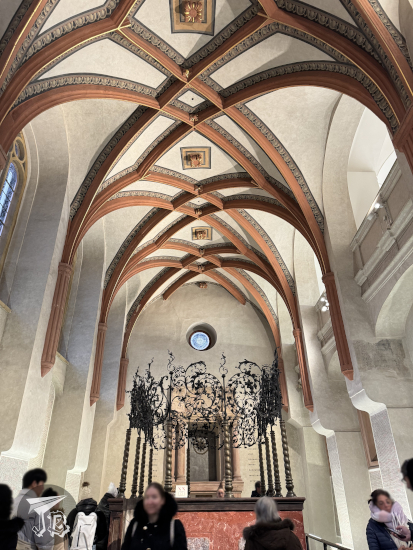
Interior of the Gothic Pinkas Synagogue, with the names of the victims of Holocaust written on the walls.

All the synagogues in the area are managed by the institution Jewish Museum in Prague Židovské muzeum v Praze, so there is one combined ticket for all of them. There was a small security check at each entryway, but the security guards were all extremely nice and kind. The Pinkas Synagogue was in the same controlled area as the Old Jewish Cemetery Starý židovský hřbitov.

The cemetery is one of the largest of its kind in Europe, and it was used between the 15th and 18th centuries. Since space was scarce, there are layers upon layers of burials, and the headstones often refer to someone who is buried in the lower levels. This scheme has allowed for older graves to remain through time, as the layers were added on top of the existing ones. Despite my general liking of old cemeteries, I found the place oppressive – probably because of the recent shock to my system.
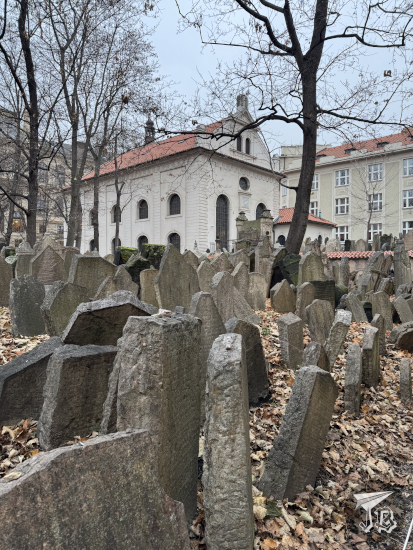
Old Jewish Cemetery, Prague.

We then walked a couple of minutes to Klausen Synagogue Klausová synagoga. It is the second synagogue built in the same place, erected in 1884 in the Baroque style. It was the only one in that style spared by the urban renewal in the early 20th century. It struck me then that, even if I was aware of architectural styles in churches, I had never thought that synagogues in Europe would go through the same architectural trends. Then again, up until today, I don’t reckon I’d ever been into a synagogue that could still be used as such.
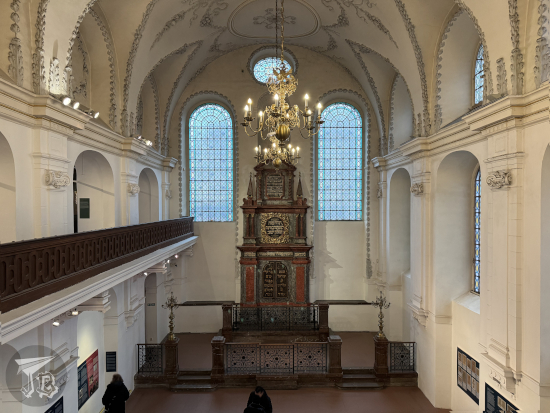
Interior of the Baroque Klausen Synagogue, Prague.

I later learnt that there is no actual “right” way to build a synagogue, and that any group of believers can erect one. This is usually done in the architectural style of the time and place. Synagogues have a raised platform or pulpit, the bimah [בּימה], from where the Torah is read. The Torah [תורה] comprises the first five books of the Hebrew Bible [Tanakh, תַּנַ״ךְ], and, usually in scroll form, is read daily. When not in use, the Torah is kept in a chest or cabinet called the Ark [Aron Kodesh, ארון קודש‎], which dictates how the whole building is erected, as attendees are supposed to face Jerusalem for prayers. Many synagogues have an eternal light or flame, always lit somewhere in front of the Torah Ark.

Next, we visited the Old New Synagogue Staronová synagoga, the oldest active synagogue in the Czech Republic [Česká Republika], and one of the earliest examples of Gothic in the city of Prague [Praha]. It was originally the New Synagogue to an Old Synagogue, but when the latter was demolished, and even newer ones were built, hence the confusing name. It felt a bit closed off and claustrophobic, as it was accessed by a long corridor and packed with three tourist groups.
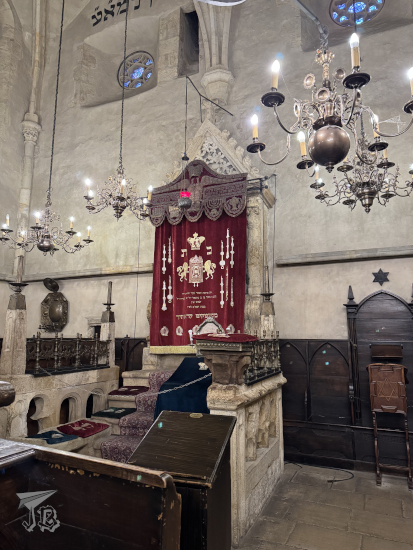
Interior of the Old New Synagogue, Prague, showing the curtain that covers the sacred texts.

We got a bit lost on our way out, so I was able to catch a glimpse of a bit of an oddity – the Prague Metronome Pražský metronom, a giant instrument that… swings. It holds no other function than moving along with time, it does not even click like a normal metronome would. It’s officially named the Time Machine and it was erected by artist Vratislav Novák. I saw it on the other side of the Vltava River, across the Czech Bridge Čechův most.

We finally reached the Spanish Synagogue Španělská synagoga. Built in the 19th century, it replaced the Old Synagogue, and its side, which used to be a hospital, is now the Museum. It was erected in a Moorish revival style, with two stories, several balconies and a lot of gold and golden. It hosts an exhibit about the history of Jews in the Czech Republic, but there is no tangible relation to Spain, the name seems to be a reference to the art style of Al-Andalus.
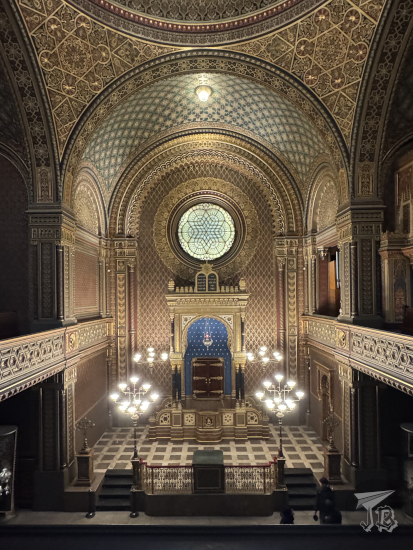
Golden interior of the Spanish Synagogue, Prague.

And for some reason (aside from him being Jewish, of course), there is a Statue of Franz Kafka Socha Franze Kafky standing next to the Spanish Synangogue. It is a bronze sculpture of the writer riding a hollow suit, based on the short story Description of a Struggle [Beschreibung eines Kampfes].

The last synagogue we visited was Maisel Synagogue Maiselova synagoga, currently a museum. It is Neo Gothic, after a previous building was destroyed. It has been restored recently, and hosts a very impressive display of menorah [מְנוֹרָה], a candelabrum with seven branches, symbol of Judaism since ancient times.
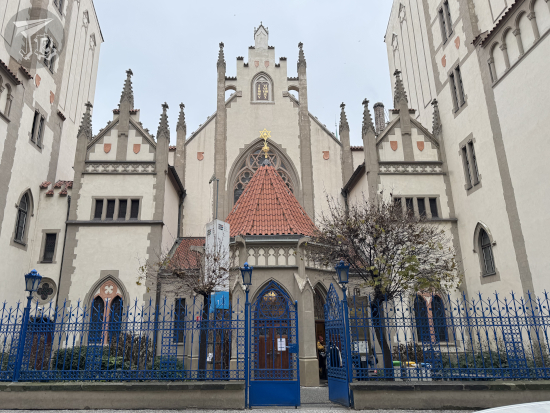
Gothic Maiselova Synagogue from the outside, Prague.

We set off then to try and find the nearby underground station, near the Jan Palach square and park Park u náměstí Jana Palacha. There are several buildings and views from the square. We did not stop for long there, and hopped onto the underground to get to Wenceslas Square Václavské nám. We had a bit of time before our lunch reservation, so we decided that the two-story souvenir shop at the corner was a perfect place to spend 20 minutes because it had heating. Afterwards, we walked down the square and crossed the Art Nouveau palace-turned-shopping-hub Lucerna Palace Pasáž Lucerna. Looking back, it could have been a cool place to explore with the idle time we had, but the pedestrian passage was not heated…

We finally got to the restaurant that my parent had wanted to try from the moment Prague [Praha] had been decided upon – Pork’s. As the name conveys, their menu is basically comprised of pork dishes, and reportedly they serve the best pork knuckle in town. The original restaurant, Pork’s Mostecká, is in Malá Strana, close to the Charles Bridge, and it was the one my parent had their heart set on… Unfortunately, it books out a month in advance. We had been able to find a spot in its sister restaurant Pork’s Vodičkova.

The place was full and bustling, but we had our table ready for us. We ordered two signatory dishes – pork knuckle with mustard, horseradish, crispy sauerkraut Vepřové koleno, hořčice, křen, křupavé zelí, a salad (Lettuce salad with grilled goat cheese, beetroot and marinated pear Listový salát s grilovaným kozím sýrem, řepou a marinovanou hruškou) and a weird potato thing I had seen and was extremely curious about – Potato pancake with sour cabbage, fried in pork fat from our knuckles (Bramborák s kysaným zelím smažený na výpeku z našich kolen), which turned out to be a sort of waffle sandwich (I loved it, because I’m weird like that). The knuckle was all right but I had to peel off some of the fat because it made the dish too heavy on the stomach. For dessert, we shared some apricot dumplings – Homemade fruit dumplings with cottage cheese, sugar and warm butter, Domácí ovocné knedlíky z tvarohového těsta, tvarohem a cukrem sypané, máslem přelité.
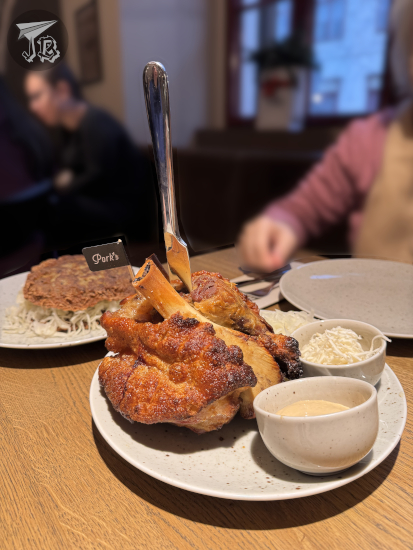
Pork knuckles portion with cabbage and mustard.

We left the restaurant around 15:00 and my parents, who were still a bit on the upset side, decided to go to the hotel, claiming they wanted a break before the light show at 19:30. Since my sibling was up to anything, I decided to head out to the main building of the National Museum Historická budova Národního muzea. We would not have time to do the whole thing, but at least we could wander for a couple of hours and snoop around.

The main or historical building was designed by architect Josef Schulz and erected between 1885 and 1891, when it was inaugurated. It is a magnificent structure in the Neo Renaissance style, grandiose and decorated with gold and frescoes. It feels like a palace, and honestly, it does not look like a museum at all. The building was damaged during the succeeding conflicts in the 20th century, so it ended up closing between 2011 and 2018 for extensive renovations. At the moment, it hosts four permanent exhibitions: the Hall of Minerals, Miracles of Evolution, Windows into Prehistory, and (Czech) History, though the latter seems to only cover from the Middle Ages to the first half of the 20th century. Thus, I guess that it doubles as natural history and archaeology museum.
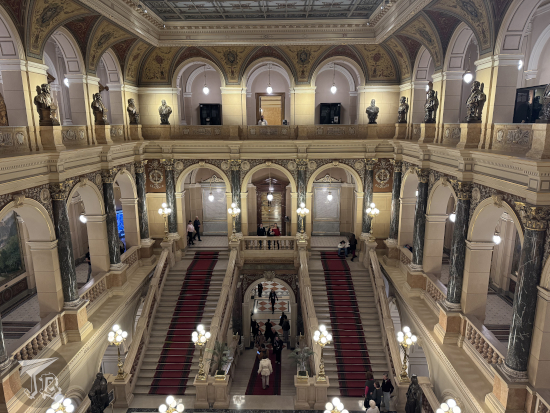
Prague National Museum building, huge constructiond ecorated with gold, white and marble.

We started at the Hall of Minerals, which is a traditional collection of minerals in vintage cases. The meteorite collection is pretty good, especially the moldavites. Moldavite vltavín is a mineral derived from a meteorite impact (a tektite), around 15 million years ago. It is a green gemstone, local to the area of Bohemia. It is not uncommon, but not widely available in the world (and unfortunately none was for sale in the gift shop).

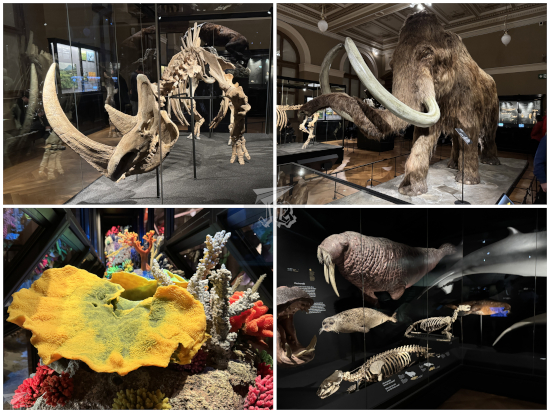
We got to the prehistory ward, and it was really fun. As far as huge diversity goes, the exhibit was not impressive, but what they lack in actual stuff, they make up for with models. We entered through the Paleocene room with a mammoth (technically there is a baby mammoth too but that had been moved to another exhibition) and the skeleton of a woolly rhinoceros, almost complete. The latter is either haunted and has tried to escape, or someone seriously mismeasured its case, because the horn had cracked the glass at some point. Some other models included a sabretooth cat and a scene of steppe wolves hunting.

We went back in time towards older epochs. There was a mosasaur hunting an ammonite, along with a number of fossils from both invertebrates and vertebrates. We reached the Age of Dinosaurs. They have literally one bone, a femur, of an ornithopod dinosaur, similar to an iguanodon. From that, they managed to describe a whole species, Burianosaurus augustai (2017), similar to an Iguanodon. Upon studying the specimen, scientists also discovered that there were shark teeth marks on the bone, so someone recreated a whole scene of the poor beast dying and being torn apart by sharks. I’m not even kidding.

Further back in time, and deeper into the museum, we reached the wall of national fossils – trilobites. There were cases about the primitive oceans, with dioramas and replicas. From there, we entered the world of evolution and biodiversity, which again had great models but humble actual exhibits.

The History Exhibit starts in the 8th century and lasts until World War I. It held a lot of interesting artefacts that reflected how life was at the beginning of the 20th century, including some fascinating objects such as toys. The Prehistory area was a bit more strange, with lots of human remains in reproductions of burials (I really hope they were reproductions and nobody had relocated a whole necropolis…).
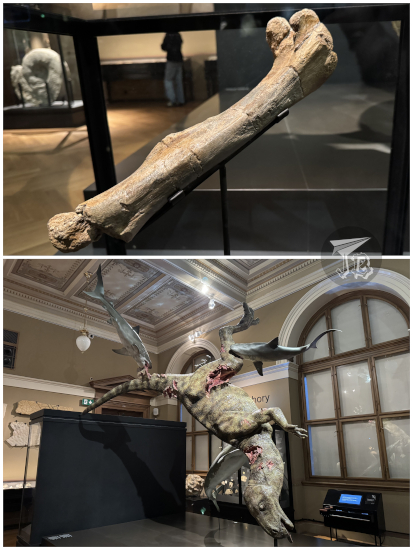
Prague National Museum: Bone and reconstruction of burianosaurus - the reconstruction is a dead dinosaur being eaten by sharks.

Prague National Museum: Skeleton of a Wooly rhino, reconstruction of a mammoth, colourful corals and marine mammal reconstructions (seal, walrus, sea lions).

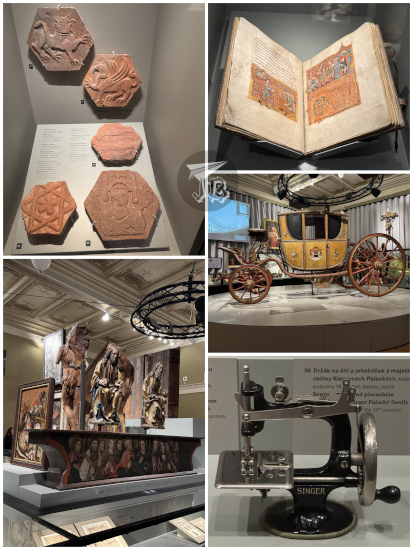
Prague National Museum Historical displays: old town clay tiles, Medieval book, religious sculptures, carriage and toy sewing machine.

We left the museum to head back towards the hotel. There was a small Christmas Market at the end of Wenceslas Square Václavské nám, and we passed by yet another one: the regular market Havelské tržiště had been turned into a festive checkpoint, but most of the stalls had the same stuff at the same prices. It was still packed though. We made a stop at the Choco-Story shop to see if they had started selling the Christmas-tree sweets we had seen made the day before, but no such luck.

We went back the hotel to regroup and find out what time they were picking us up the following day. Later in the evening, we left once more to find Broadway Theatre so we could watch the WOW Show Black Light Theatre Prague. Notice the English name, it was clearly aimed at tourists, but the only one my parents found advertised at the hotel. Doors opened at 19:30, but placement was free, so we wanted to be there around 19:15. As we checked in, we were given some glow sticks. I don’t think my family had ever held glow sticks in their life…

We had to go down a couple of floors worth of stairs to get to the actual theatre and when we got to the stalls, we ended up getting pretty horrible seats for some reason or another. Soon the venue began to fill up. There was a huge group of young tourists who had obviously been raised in a barn. They yelled and burped and, when lights went off, they decided to start throwing the glow sticks. One got me in the back of the head, and damn, those things hurt.

Prague’s black light theatre (černé divadlo) works with black backgrounds, UV lights and fluorescent elements to create visual illusions. Basically, you only see brightly coloured bits, either props, face paint, or clothing. It was… weird. Not what I was expecting at all. The idea was that a guy came back from work, watched some TV, then went to sleep, and we got to see all his dreams, in dance version. At some point, the actors bounced some big balls at the audience for us to play with, and the rude macro-group decided to play dodge-ball with them. Some dancers also played spiders which had to move over the audience. All in all, it was an interesting experience, a bit ruined by the company, but I did not like it much. A bit too surreal for me.

Dinner was again at the shopping centre – not much choice, at the only open sandwich place. One of these days, my family will realise that buying snacks in advance is a good idea. That day was not today.
2nd December 2025: From the Pražský hrad Castle, downwards {Prague, December 2025}

It was a grey morning in Prague [Praha] when we headed down for breakfast. The buffet was packed and the coffee horrible, but I was able to find cranberry juice, hard-boiled eggs, bread and cheese. The goal of the day was visiting other areas within the UNESCO World Heritage Site Historic Centre of Prague, starting from the castle to make our way down. Thus, we jumped onto the public transport system – my parents could ride free due to their ages, and my sibling and I bought tickets. The ticketing system allows you to ride for a set period of time after validating, which is done at the gate. We rode the underground to the Malostranská stop, at the foot of the hill where the castle was built. This area of the city is called Malá Strana, the Lesser Town – it is a historical name, because there is nothing “lesser” about it.

Prague Castle Pražský hrad is the largest ancient fortress in the world – a huge complex of buildings delimited by a defensive wall. It hosts the official residence of the current President of the Republic, and in the past it was the place from where the kings of Bohemia and Holy Roman Emperors ruled. Construction began around 870, with the establishment of a walled church on top of a hill overlooking the area. The current palace was built under the reign of Charles IV (Karel IV), who also reinforced the fortifications. The enclosure hosts several notable areas and buildings, such as the Cathedral and the Golden Lane.

The first step was, however, climbing up from the underground stop to the castle itself – literally. This was done via stairs, which fortunately were not frosty. They were… steep, steeper than they looked, considering how wide each step was. I was a bit out of breath by the time we were up… and once at the gate there was still more uphill way to walk!! We reached the ticket office and decided on a “Prague Castle – Main circuit” (Pražský hrad – hlavní okruh) ticket, which included the four key sites: the Old Royal Palace, St. George’s Basilica, the Golden Lane, and St. Vitus Cathedral.

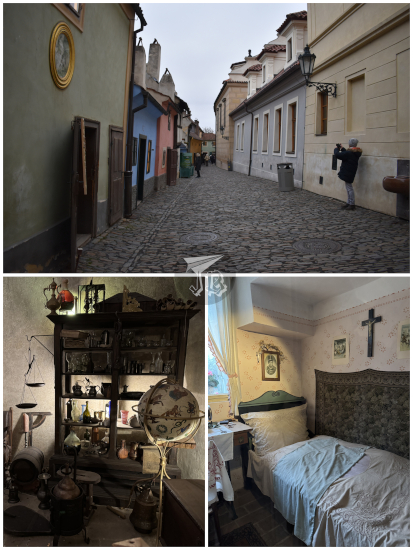
Right next to the ticket office there was the access to the Golden Lane Zlatá ulička. It was originally an area where the castle guards lived. Today, it is a narrow alley with coloured houses, many of which have been converted into souvenir shops or tiny ethnography museums, trying to show how people used to live there – the seamstress, the alchemist, the goldsmith, the fortune-teller… Some famous or important historical figures have dwelt there, most notably writers Franz Kafka – with a bookshop where he used to dwell – and Jaroslav Seifert (1984 Nobel Prize in Literature), and the fortune-teller Matylda Průšová. There is also a collection of weapons and armours.

Golden Alley and reconstructed dwellings: a bedroom and the alchemist's office.

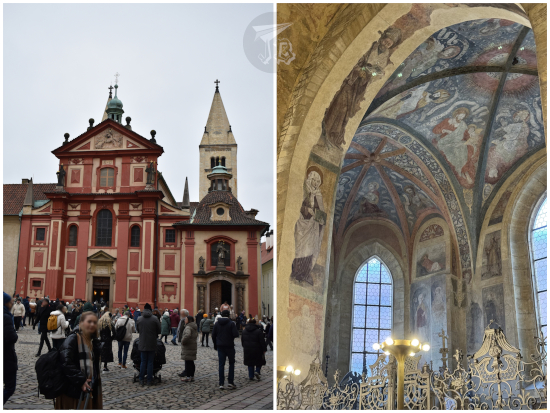
Our next stop was the Basilica of St George Bazilika svatého Jiří. Despite its Baroque façade from the late 17th century, the inside is purely Romanesque. The church is actually the oldest surviving building in the castle complex, consecrated in the year 921. Fortunately, the interior has been kept Baroque-free, and it displays a severe limestone appearance (though it had to be restored after World War II) with frescoes behind the altar.

Baroque exterior of the church of St George and Romanesque frescoes inside.

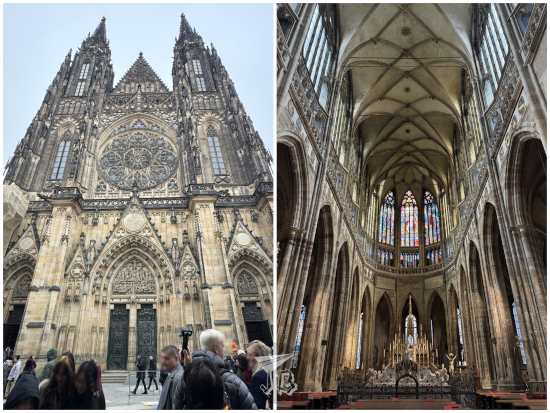
The crown jewel (in my not-so-humble gothic-loving opinion) of the castle is the Cathedral of St. Vitus – formally the Metropolitan Cathedral of Saints Vitus, Wenceslaus and Adalbert Katedrála svatého Víta, Václava a Vojtěcha. The current building is Gothic, and dates back from 1929. No, that’s not a typo. Although construction started in 1344, it did not end until the 20th century! The current building was erected over a previous Romanesque church when the latter became too small. It was sponsored by Charles IV (Karel IV) of Bohemia and originally designed by Matthias of Arras, who obviously did not live enough to see the work completed.

Gothic Cathedral of St Vitus.

Prague’s Medieval history was heavily influenced by the Hussite Wars. The Hussites were reformists, an early movement of what would later become Protestantism, founded by Jan Hus (who ended up burnt to death for his trouble). The Hussite Wars lasted between 1419 and 1434, and were rather complicated, with people changing sides, a civil war, foreign interventions actually called “crusades”… In the end, the “moderate” Hussites allied themselves with the Catholics to defeat the “radical” Hussites, and eventually rose to power as George (Jiří) of Poděbrady was crowned the first protestant King of Bohemia in 1458. While the king himself was a Hussite, he was a moderate and thus tolerant of the Catholics and their rites.

However, with the Hussite uprising, works of the cathedral came to a stop. It stood half-built until the 17th century. Finally, the early 20th century saw serious efforts to finish it in time for St. Wenceslaus’ Jubilee in 1929. Despite its 600 years of construction, the building is simply magnificent, even if there was no sun to shine through the coloured windows. The pointed arches are just perfect, and the stonework has that lovely patina that they’ve cleaned out from Notre Dame in Paris.

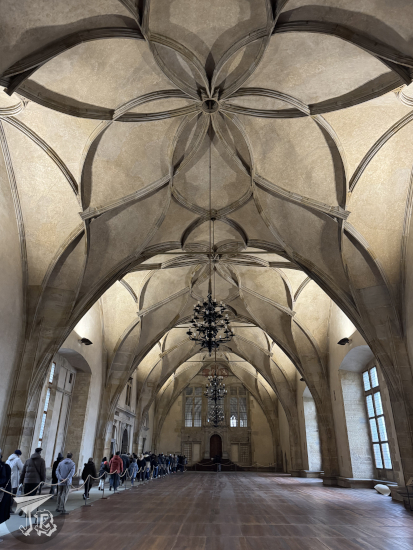
The final building included in our ticket / pass was the Old Royal Palace Starý královský palác, a magnificent Gothic – with some Renaissance touches – building dating back from the 12th century. The Vladislav Hall, built in the 14th century, is vaulted, with gothic nerves. There is a small room with a throne and replicas of some of the crown jewels. Upstairs, rooms with frescoes. To the side, there was a long queue to see the “Defenestration Window” – during the Hussite Wars, people developed a taste for throwing other people out of windows. In 1618, during one of the many Protestant-Catholic moments of tension, two regents and a secretary were pushed out of one of the windows in the palace. They survived. According to the side who tells the story, they were either saved by angels or by falling onto a pile of cow dung.

Interior of the former Bavarian Palace, with gothic vaults.

The family decided to get going. We passed by newer buildings, where the President lives, and headed down the hill. We found a restaurant that my parent seemed to like and we were lucky enough that they had room for us. The staff at U Dvou slunců was pretty nice, and despite me thinking I wanted some dumplings, I ended up ordering Smažený obalený sýr, fried breaded cheese with chips and homemade tartar sauce – just because I love cheese. It was delicious.

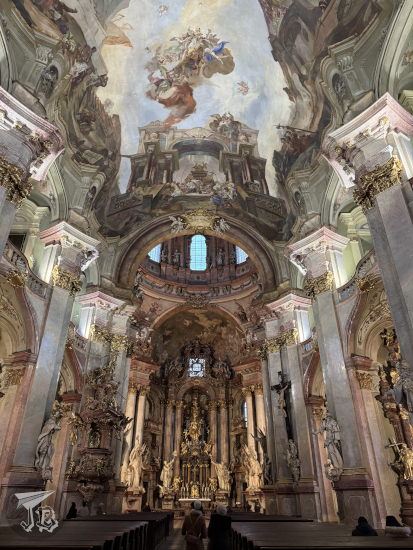
After lunch, we went to Malostranský chrám svatého Mikuláše, the church of St. Nicholas Church in Malá Strana. It is considered the most important Baroque church in town. There are frescoes all over the ceiling, and the decoration is not extremely over the top. The dome is 20 metres in diameter, and the columns are actually made of fake marble, but I would never have been able to tell. It hosts two organs, one of which was currently out of service for restoration.

Baroque interior of St Nicholas Malá Strana church, with frescoes on the ceiling.

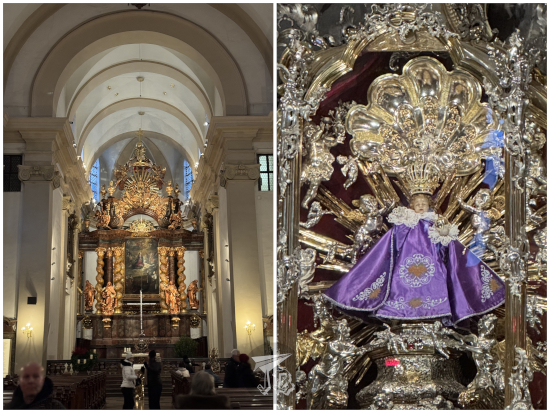
Then, we headed to the Church of Our Lady Victorious and The Infant Jesus of Prague (mouthful) – Kostel Panny Marie Vítězné a Pražské Jezulátko. The church was founded in 1584, and it is also Baroque. It is famous because it hosts the statue of the Infant Jesus of Prague Pražské Jezulátko, a small wooden sculpture of Spanish origin from the 16th century, which somehow made its way to Bohemia through the House of Habsburg. The centre of one of the major pilgrimages in Europe, the figure is about half a metre high, and it is displayed wearing embroidered vestments. On the day of our visit, the clothes were purple, as it was Advent. The church also has a display of nativity scenes and a small museum with different garments for the Infant Jesus that have been donated by wealthy benefactors. I have to say though that the poor thing is… hideous.

Baoque interior of Our Lady Victorious and the Child Jesus sculpture.

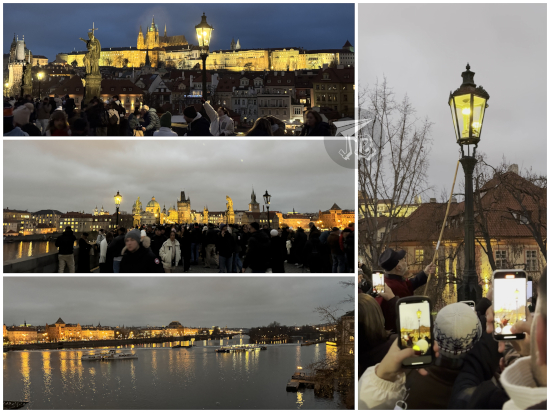
The sun was setting and it was time to cross Charles Bridge Karlův most over the Vltava river. It is a Medieval stone bridge, built between 1357 and 1402, over 500 metres long! There is a tower on each side – Malá Strana Bridge Tower (Malostranská mostecká věž) and Old Town Bridge Tower (Staroměstská mostecká věž), both gothic, and 50 statues along the way. There are also gas streetlamps that are manually lit during Advent! Unfortunately though, since the lighting is a thing, the bridge was swarmed, and it was extremely difficult not to lose each other, so we did not get to see much.

Charles bridge, with an official lighting a gas streetlight.

Back in the Old Town Staré Město pražské we got to see the Klementinum, a Baroque astronomical tower and library that I would have loved to visit, but it was not in the schedule – I would have prioritised it over the churches, but as I mentioned, I had not done any of the planning. My parents decided they were done then, so my sibling and I stayed behind again, after arranging to meet at 19:30. We explored some candy shops, and eventually caught the Astronomical Clock Pražský orloj at 17:00.

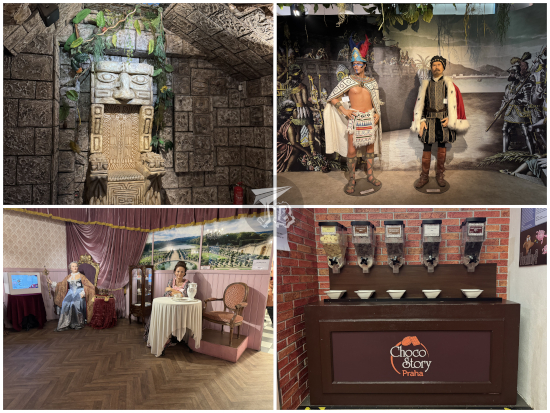
After the 17 bell strokes, I proposed my sibling to go to the chocolate museum, Choco-Story: Prague Chocolate Museum. It is not big, and it features different stages in the history of chocolate – its use in Pre-Columbian cultures, how the Spanish introduced it to Europe, and how it became a popular treat amongst the higher classes, then it became democratised. The last room was explicitly about a Czech company that used to sell chocolate. In the second-to-last exhibit there was an unlimited chocolate tasting station. Yes, the person at the entrance used the word “unlimited”. We of course took pictures with all the available props. And ate chocolate.

Choco Story Prague scenes related to chocolate history - from the Mayans to the Victorian to the present day, with the tasting station.

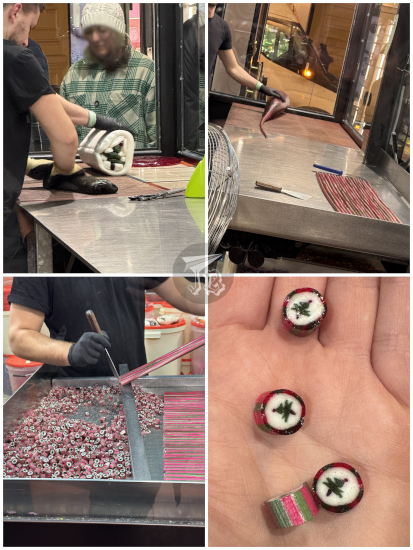
We eventually left the museum, and that placed us in the right place-and-time to see how they made candy from scratch. The two guys started with blocks of different colours – green, white and reddish. They worked the material until it was almost viscous. First, they made three “triangles” with the green material, which they put on top of each other. Then, they filled up with white until they had a cylinder, and wrapped that in red and green – it was a Christmas tree in the middle of a snowy circle! They ended up with something that had around 20 centimetres in diameter. And then suddenly they started pulling and pulling and made sweets that were no bigger than 1 cm, with the Christmas tree in the middle. It was astonishing!! And even better… they shared samples!

Candy-making show. The sweets have little Christmas trees inside.

On the way out, we decided to be weak and bought the blueberry tartlets we had spotted the day before, along with some souvenirs. I got a silly Christmas bauble. We headed back to the room to eat the tartlets, and at 19:00 we dropped by our parents room to regroup. At first we considered having dinner in one of the Christmas Markets, but in the end, they decided that they did not want to eat standing up, and we went to a random sandwich shop the Palladium Prague shopping centre.

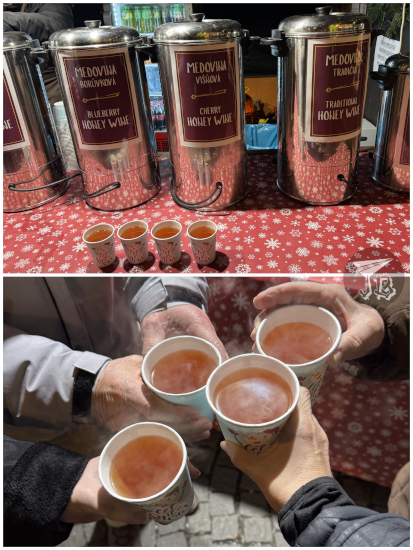
To end the day, however, we did go to the Christmas Market in Náměstí Republiky square, but not for food, just for a drink. A typical drink – traditional honey wine, which I didn’t know (because I don’t drink), but it is just another word for mead. So instead of gentle mulled wine, we got a kick out of Tradiční medovina. Boy, did we sleep well that night.

Honey Wine.

Before going to sleep though, I had been tasked with booking tickets for a light show the following evening, which was a bit of a challenge on the phone – no way I’m putting my credit card on public Wi-Fi – with a website that kept trying to change its language from English into Czech.

1st December 2025: Way too much food {Prague, December 2025}

I stayed over at my parents’ house so they could shave 15 minutes off driving, because 15 minutes of extra sleep at 5:00 matter. I gulped down a coffee and loaded my luggage in the car. We picked my sibling up and drove to the airport before the traffic jam even formed. We got on the shuttle a minute after parking, reached the terminal, and went through security without a hitch. There was really nothing noteworthy to the journey, really, once the check-in-your-hand-luggage extortion had been paid. We were picked up at the airport in Prague [Praha] and driven to the hotel, where we could not check in yet.

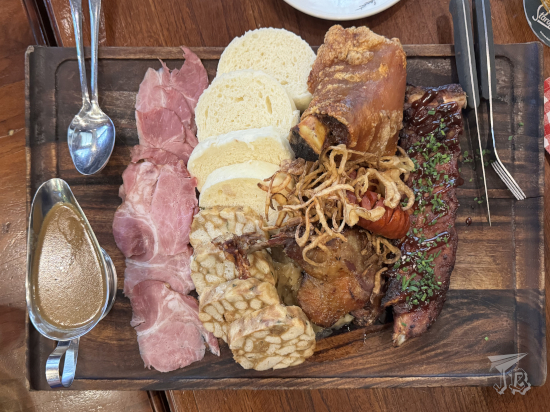
Thus, we headed to have lunch first. There was a restaurant in front of the hotel which served traditional Czech food, called La Republica, where my plenty and I shared a Staročeský talíř pro 2 osoby – Old Bohemian plate for two people, which comprised a duck leg (kachny), pork knuckle (vepřový kolena), pork ribs (vepřový žebra), smoked pork belly (uzený bůček), sausage (klobása), dumplings (karlovarský knedlík and houskové knedlík), white and red cabbage (zelí), with crispy onion liberally sprinkled on top. One kilo of food! Way too much!

Czech knedlík are somehow of a national staple – boiled dumplings, quite heavy on the dough, with optional fillings. Both houskové knedlík and karlovarský knedlík are considered “bread dumplings”, with a base of stale white bread, flour and eggs. They are supposed to be eaten dipped in the sauce that came along with the plate, and they were delicious. So were the pork ribs, and I’m not even a rib person!

Plate of meats and dumplins for two. Way too much food.

After lunch, we checked into the hotel, dropped our things at the room, and set off towards the Old Town Staré Město pražské, the preserved Medieval area of Prague [Praha], part of the Unesco World Heritage Site Historic Centre of Prague. The city is the capital of the Czech Republic [Česká republika], and formerly of the region of Bohemia. The origins of Prague can be traced back to the Palaeolithic, but it was around the 5th century BCE when a Celt tribe settle nearby and gave the historical region of Bohemia its name. During the 1st century BCE, Germanic tribes took their place, and in the 6th century CE, they too were replaced by Slavic tribes.

The city was a fortified settlement by the 9th century CE, when the castle construction started. After the turn of the first millennium, the city became an important trade point, and many Jews settled there. The first bridge over the river Vltava was erected in 1170 (though destroyed during a flood later) and building of the cathedral started in the 1340s. It was Charles IV (Karel IV), Holy Roman Emperor and King of Bohemia, who, between 1346 and 1378, brought the city its Medieval splendour.

After his death, his son Wenceslaus IV reigned, and though there were great achievements, such as the construction of the astronomical clock, it was a time of civil and religious unrest. This lead to a few centuries of wars, even while important artists and wise men lived in town – German astronomer Kepler comes to mind. When the 18th century arrived, things had calmed down, the city thrived, and its population increased. The area, which comprised different municipalities, eventually merged into one large city.

Prague served as the capital of the newly-formed country of Czechoslovakia after World War I. In 1939, it was occupied by Nazi Germany, which lead to the killing of most of the Jewish population. During allied bombings, many structures were damaged, including the Old Tow Hall, and Czechoslovakia as a whole rose against Nazism in 1945, shortly before the end of the war. The country became part of the Soviet Union until the Velvet Revolution in 1989, a moment in which peaceful protests ended up the Communist State. In 1992, the historical centre of Prague was declared World Heritage, and at the end of that same year, Czechoslovakia split in two countries (the Czech Republic and Slovakia) in a process called the Velvet Divorce, a stark contrast to the dissolution of Yugoslavia in the Balkan Wars, which seemed to peak at that time.

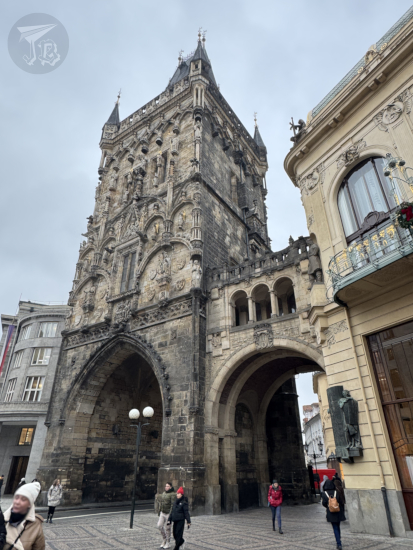
The hotel was a minute or so away from the square Náměstí Republiky, with tram stops, an underground entrance and a Christmas market. To the side stands the beautiful classical concert venue known as the Municipal house Obecní dům. Almost next to it we found the first gothic building we would see in the city – the Powder Tower Prašná brána. It is one of the original gates to the walled city, and construction dates back as far as 1475. Whether it was ever actually used to store gunpowder or not has been disputed. We crossed it and found ourselves in the main shopping street, named Celetná, flanked by traditional houses transformed into tourist shops and joints.

Powder Tower: A Goth defensive tower and Wall Gate.

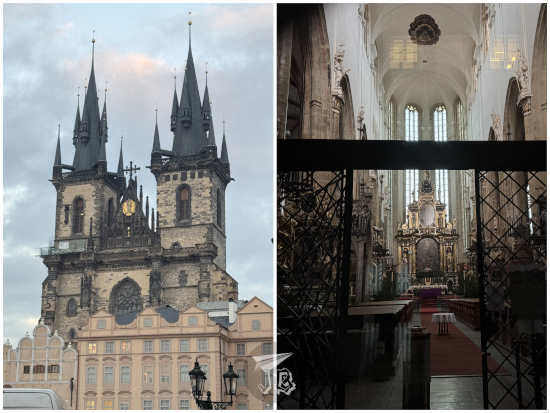
We reached Staroměstské náměstí, the Old Town Square, the neurological centre of the Old Town Staré Město pražské. There stands the Gothic Church of Our Lady before Týn Chrám Matky Boží před Týnem. I am used to churches having… squares in front, but this one is literally encased within other buildings, one of which is an art gallery. It was already too late to visit, unfortunately, but we could snoop through the glass doors. There has been a church in the square since the 11th century, though the present building, erected in Jagiellonian Gothic, was only finished around 1450. Its most striking characteristic is the design of the two towers on the west façade, which feature what I can only describe as pinnacles on pinnacles. I am fascinated by those pointy towers.

Our Lady Before Tyn, inside and outside. It is a two-towered church with spikey twers and a white interior with a baroque altarpiece.

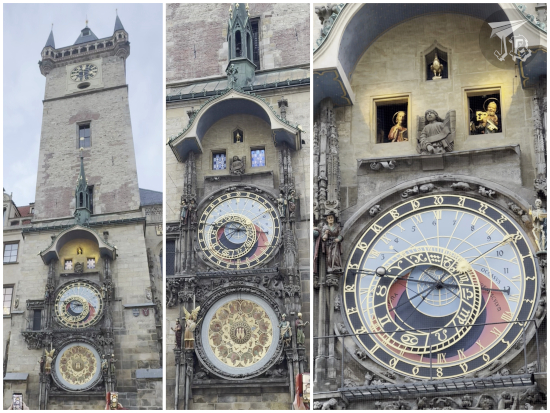
At this moment it was 15:55 so we hurried to the side of the Prague Old Town Hall Staroměstská radnice. There stands the bell tower, and on its wall, the famous Prague Astronomical Clock Pražský orloj, extremely hard to read and understand. Each hour, a Death figure rings a bell, the apostles walk around, and a bell strikes as many times as the 24-hour-clock’s hour.

Prague Astronomical Clock, a complex structure with two spheres.

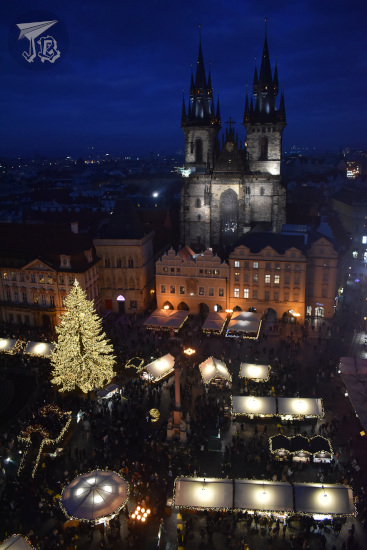
After the 16 tolls, we entered the Old Town Hall Staroměstská radnice, which was a bit underwhelming (it turns out that only the guided visit gives you access to the cool areas). There is a beautiful but tiny room full of frescoes, and the ascent to the clock tower – something that for a bit extra can be done on a lift. From the top of the tower we had a lovely view of the square below, the Christmas market and Our Lady before Týn against the night sky.

View from the clocl tower: Christmas Market and our Lady Before Tyn.

Back on the ground, we snooped the gift shop, then tried our luck at the church of Saint Nicholas in the Old Town Kostel svatého Mikuláše (this got confusing during the planning stage because there are actually two Saint Nicholas churches in town). Today, this Baroque monastery-and-church is used for worship and concerts. It was unfortunately closed.

We had a run at the Christmas market, which sold snacks, drinks, sweets, decorations, souvenirs and Christmas baubles. I actually got myself a beautiful one. My parents decided to head back to the hotel for a break then, but my sibling and I were still good to go. We resolved to snoop around the market some more. It was cold but not aggressively so – it was dry and there was no wind whatsoever, so it was not that bad.

Since I had not prepared anything beforehand, I had no idea where we could go or what we could do. We explored along Celetná, where we found a chocolate and candy shop that lead to the chocolate museum Choco-Story: Prague Chocolate Museum (at first I thought it was a branch from Chocolate Nation in Antwerp, but it is a different shop – though apparently a franchise?). I fell in love with some blueberry tartlets, but I had like zero stomach-room for them. There were also a couple of guys making candy from scratch.

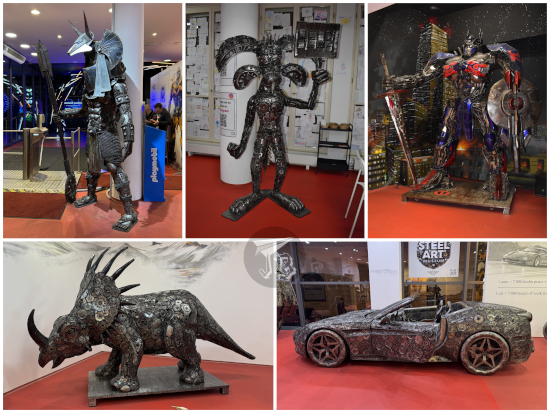
We looked at a couple of shops and then my eyes fell on a Horus Guard from Stargate. My sibling was game to go in and meet him – and that is how we ended up in the Steel Art Museum, which is apparently another franchise. And not only did they have a Horus Guard, there was also an Anubis Captain. The Steel Art Museum has two completely interactive floors, with different sections and 120 items. Everything in the museum is hand-sculpted using metal scraps. There are full cars from luxury lines which you can sit on, in, whatever you want. The only issue is that steel can be a bit slippery. There is a replica of the Throne of Swords from Game of Thrones, Optimus Prime and Bumblebee from Transformers, along the aforementioned Stargate soldiers on what I guess was the fantasy and sci-fi section. But then there were… dinosaurs, some more cartoonish, some more accurate, like a Ceratopsian (styracosaurus, probably). Unfortunately for me, steel is also heavy, so I could not take it home…

We proceeded to the upper floor, full of pop figures, Alien references, and even Marvel’s Avengers. We saw motorbikes, Ninja Turtles, Minions, and characters from films we did not recognise. Despite not knowing everything, we had a blast climbing – or trying to – on anything we could.

Steel Art Museum Prague: Stargate Anubis Warrior, Willy Coyote with a help sign, Transformer Optimus Prime, a quadruped dinosaur with a big frill, and a sportscar.

We headed back to the hotel, and looked around Náměstí Republiky and the Christmas market there. At first we thought it was just a few stands selling food and drinks. Later we would realise there was another part on the other side of the square. We also peeked into the shopping centre Palladium Prague, because it meant we could walk a few minutes in the warmth instead of the cold street.

We regrouped at my parents’ room, and after an hour or so, we headed out to find the restaurant we had booked for dinner – and that one of my parents wanted to try. Výtopna Railway Restaurant is located in Václavské nám or Wenceslas Square, which was currently half fenced off for renovation.

Wenceslaus I Václav I is known for the Christmas Carol Good King Wenceslas, but he was not actually a king. He was the son of the Duke of Bohemia, and lived in the 10th century. When he came to power, he used Christianity as a way to establish his position, which would eventually have him reach sainthood, and when he was later assassinated, martyrdom. The Christmas Carol tells the story of Wenceslas and his page witnessing a poor man gathering wood in winter, and going to his house to bring him a good dinner.

On the way to the square, we passed by Jindřišská věž, another gothic bell tower which has a restaurant and an observation deck. It would have been cool to eat there since the restaurant was at the top. I however did not propose it because it would probably be booked out and I did not want to cause any strife – good thing, too, because it turned out to be pretty expensive.

We found Výtopna Railway Restaurant to the side of the Václavské nám square, in a commercial gallery. Entrance was an absolute chaos. The restaurant is located on a first floor and the stairs were absolutely flooded. They did not take walk-ins as they were fully booked, so there was a queue of people waiting to see if something opened. However, the reservation-checking and seating system was slow, creating a jam. There was a group behind us who decided that, since they had a reservation (too), they could cut the whole line. We let them through, because the stairs were not a place to have a discussion and they were not open to reasoning.

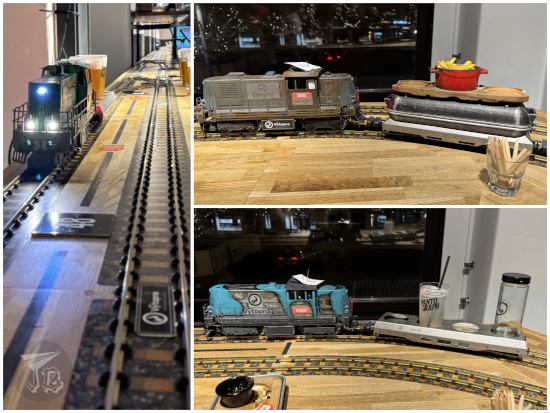
The whole point of Výtopna Railway Restaurant is that food comes to you riding on little trains. They have 900 metres of small tracks and twenty or so tiny trains that bring your order to you. It’s really cute. The “motto” of the restaurant is “meat & beer on rails”. I don’t drink beer, but I really wanted to try the goulash. Unfortunately, I was still very full from lunch. Instead, I opted for a salad with goat cheese (salát s kozím sýrem): green salad with grilled goat cheese, sour apples, walnuts, honey dressing and focaccia bread. It was all right, and the trains moved fast! You had 15 seconds to take your food from the wagons – and any pictures you wanted. So I let the family grab the food while I photographed everything.

Little trains and railways carrying food and drinks.

We undid our way from the restaurant to the hotel, where I took a very long shower and got into bed. I did not sleep much though.