24th July 2019: Morning in Kyoto, afternoon in Nagoya {Japan, summer 2019}

After waking up early again (what can be done? Early night → early morning) I walked out the hotel and took another stroll in Maruyama Kouen. Only this time, instead of heading towards Yasaka Jinja and Gion, I continued straight and I found Daiunin [大雲院].

The roof of a pagoda, in oxidized green colour

I continued on to Nene no Michi [ねねの道], which has temples left and right. These temples have little statues that you have to touch for luck, wealth and so on. As I have been feeling so lousy this last year, I decided to find the health one.

Statuettes of the Buddha and local gods

On my way I climbed up the Daidokoro-zaka [台所坂], a bunch of gentle stairs that lead up to Kōdaiji [高台寺], a fun temple with a lot of yokai folklore. It also held some healing sutras, so I took the liberty to make them spin.

Temple with funny-looking lanterns decorated with yokai and ghost faces

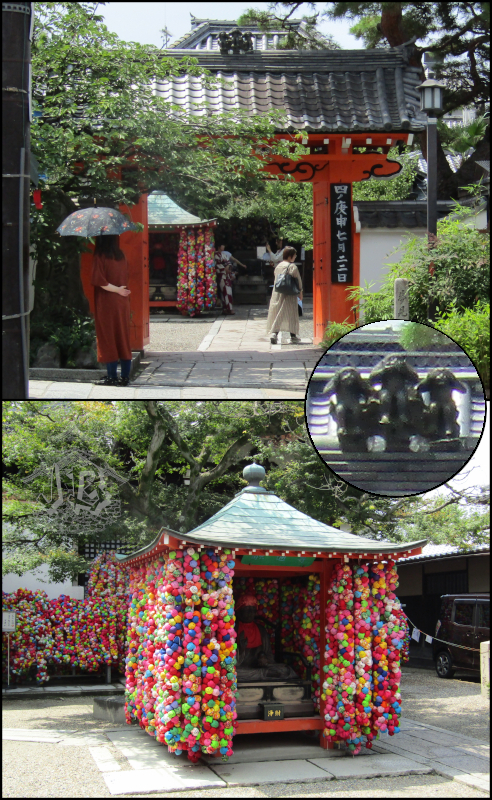
From there, I went to Kongoji (Yasaka Kōshindō) [金剛寺(八坂庚申堂)], which is a temple with… colourful balls where people write their wishes. They are supposed to entertain the ‘good faith monkeys’ (Hear no evil, speak no evil, see no evil) that guard the temple, I guess.

Buddhist temple with a decoration of thousands of brightly coloured pompoms

After that, I walked towards the Hōkanji (Yasaka no Tou) [法観寺 (八坂の塔)], a five-story pagoda.

Five story pagoda

A bit farther, I also found Rokuharamitsuji [六波羅蜜寺].

Buddhist temple exterior

I went down towards the river Kamogawa [鴨川], where I saw some more wildlife – ducks, cormorants, herons (cranes? Have I told you I can’t tell cranes and herons apart?).

Black cormorant standing in the river

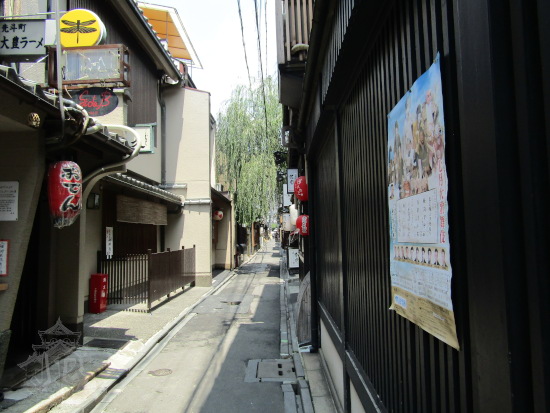
Finally – for my Kyoto trip – I walked down the Pontocho [先斗町] Alley before I headed for the station. It is renown for its restaurants, but everything was too expensive for my budget.

Narrow alley with restaurant lanterns and signs

Then I took a Shinkansen to Nagoya [名古屋] as I was going to attend HYDE’s 2019 tour that afternoon. As I arrived too early for 15:00 check in, I headed off to Zepp Nagoya to see whether the goods were out. They were. A girl passed out at the queue a bit behind me due to heatstroke, and that was a bit creepy, but the staff took good cafe of her.

After buying goods, I went to leave my stuff and have a shower at the hotel, then I met up with several friends and even new friends. I enjoyed HYDE Live 2019 much better than the 2018 shows, which felt… somewhat disappointing at the time, almost clumsy and disarranged. Since then, HYDE put out the album Anti in May 2019, so he has found his grounds again. Last year he seemed to be rehearsing / perfecting a few of the songs, and combining them with the echoes of L’Arc~en~Ciel and VAMPS, which only emphasised what we did not have any more – I am still not too happy with the covers of VAMPS songs, especially Ahead, where I miss KAZ’s guitar. And honestly? Not a fan of Duran Duran’s Ordinary World.

Setlist:
    1. Who’s gonna save us
    2. After light
    3. Inside of me
    4. Underworld
    5. Fake Divine
    6. Two face
    7. Set in Stone
    8. Zipang (Japanese version)
    9. Out
    10. Mad Qualia
    11. Sick
    12. Don’t hold back
    13. Lion
    14. Another moment
    15. Midnight Celebration II
– break –
    16. Duality (Slipknot cover)
    17. Devil Side
    18. Ahead
    19. Ordinary World (Duran Duran cover)

As his solo goals, HYDE has set his heart in in the US. Thus, his new music is heavily influenced by American producers and musicians, and completely in English. Though he is mainly a vocalist, HYDE started off as a guitarist, so there is a heavy reliance on powerful strings. To emphasise the fact that he is solo now, he has given his support musicians masks to cover their faces. Or maybe he’s just decided he likes masks as he himself wears a half-mask for the first few songs. He was very active and engaging with the audience, which always makes lives more fun. In general, I enjoyed the act, it was powerful and engaging.

Zepp Nagoya logo

When the concert was over I met up with Sr-san for dinner. We had misokatsu [味噌カツ] in a famous shop, and had a long conversation about the concert and HYDE’s new songs.

Dinner: breaded pork on rice and shredded cabbage

Walked distance: 23305 steps / 16.6 km.

23rd July 2019: Arashiyama honours its name {Japan, summer 2019}

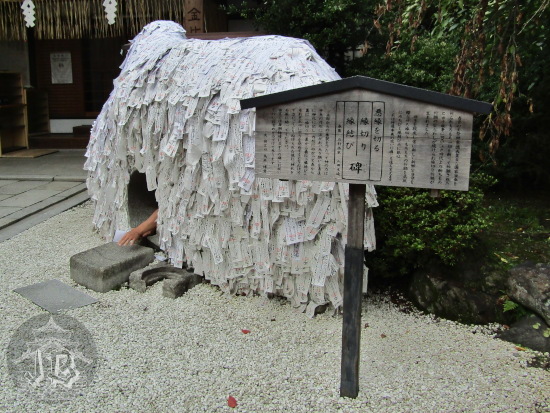
I started off the day at Yasui-Konpira-gu [安井金比羅宮], a shrine with a huge ema-like “mound” called Kushi-zuka [久志塚] with a hole in the middle. It is thought that if you write your wish on a paper, glue it on the mound and then crawl through the hole and back, your wish comes true. In case you’re wondering, no, I didn’t go through.

Then I walked all past Gion again to return to Gion Shirakawa [祇園白川] and Tatsumi Bashi [祇園 巽橋] to see the area by light. I saw Tatsumidaimyojin [辰巳大明神], the Kanikakuni monument, Kanikakuni Ishibumi (Koma-satsu) [かにかくに碑(駒札)], and a very cool heron (or crane?) who totally owned the place.

After this little stroll, it was still early so I headed off to the reconstructed castle Fushimi-Momoyama-jo [伏見桃山城]. It was a very cool castle, but it was not open to the public (this trip was not castle-lucky, now that I think about it).

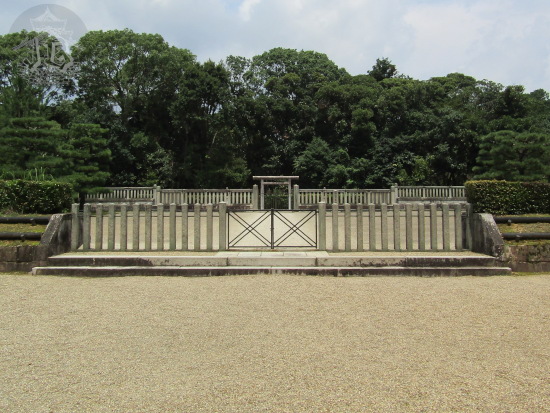
Underneath the castle, I found the Mausoleum of Emperor Kanmu Kanmu Ten’nō Kashiharanomisasagi [桓武天皇 柏原陵].

And then I walked off to the opposite part of the hill. On my way I found some of the original rocks that had conformed the Ninomaru [二ノ丸跡] of Momoyama-Jo.

I kept ascending until I reached Meiji Ten’nō Fushimi Momoyama no Misasagi [明治天皇 伏見桃山陵], Emperor Meiji’s Tomb at Fushimi Momoyama, which was… somehow very sober and somewhat humble for such an important figure in Japanese history (then again I’ve recently visited the Spanish Royal Family Pantheon so… hm… yeah. Anything is more sober than that.)

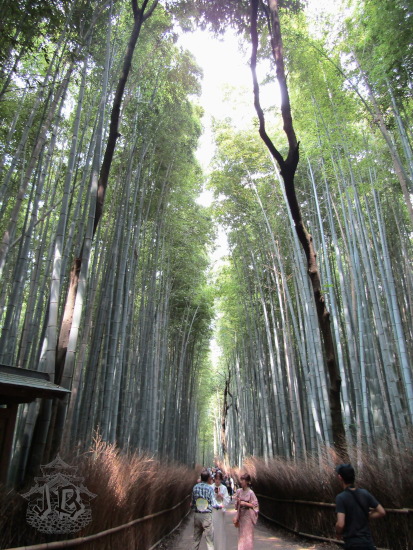
After that I was tired and hot, so I needed a break – and the best way to have a break is a train ride. I rode back to Kyoto Station and from there I headed off towards the Arashiyama area. I wandered around the Bamboo Grove Arashiyama Chikurin no Shōkei [嵐山 竹林の小径] for a while. It was packed so I kept diverting towards other areas.

I walked into Rakushisha [落柿舎], a poet’s house, where I got a shuuin.

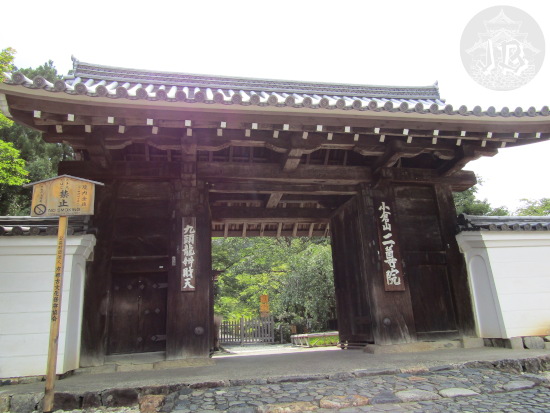
Then I went up the road to Nison-in [二尊院].

On my way back I stopped to admire the lotus flowers, which were in full bloom.

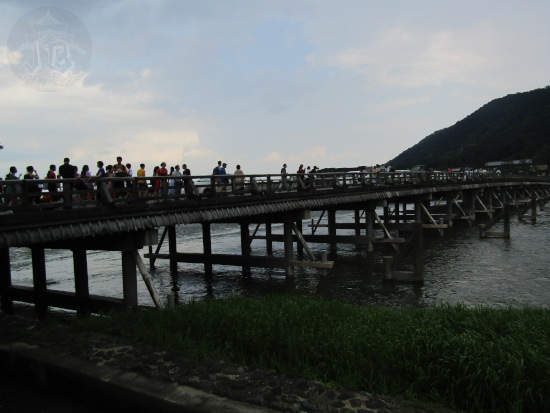
I considered going into the Museum of Korean arts, but as it was closed, my decision was irrelevant, so I decided to head back towards the Arashiyama Koen Nakanoshima Chiku [嵐山公園 中之島地区], the Nakanoshima area of Arashiyama Park. I saw the Kadono Ooi [葛野大堰], the small damn in the river, and crossed the Togetsu-kyō Bashi [渡月橋] bridge.

There I climbed up to Ichitani-Munakata-Jinja [櫟谷宗像神社].

I decided against climbing to the Monkey Park, and I was halfway back through the bridge, when the skies opened and a huge thunderstorm hit – so indeed, Arashiyama became the mountain of storms! I waited half of it under the canopy of a shop, and after twenty minutes I braved running across the street to the Lawson to get myself a sandwich and ate it as the rain dwindled enough for the streets to be walkable again.

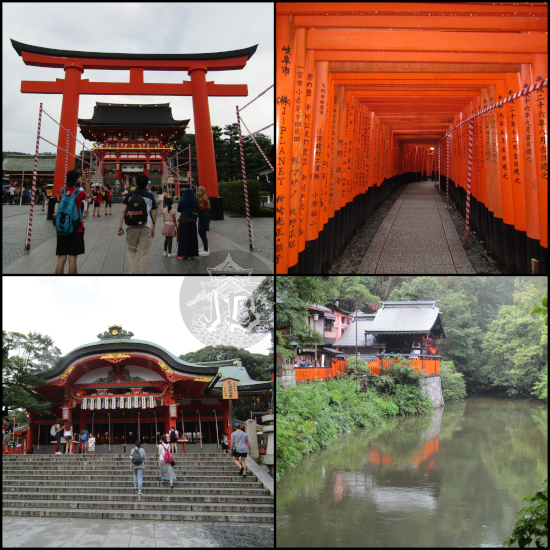
Once that happened, I walked to the station and took a train back to Kyoto and then to Fushimi Inari Taisha [伏見稲荷大社]. I did two sweeps – one with light and once when the sun was setting. Of course I did not climb the whole mountain, I just stayed to see the main buildings and the Senbontorii [千本鳥居] (the loooong torii line) lit.

And finally I headed off back to have some food and rest.

Walked distance: 27897 steps, 19.9 km (so glad I took my cane today!)

22nd July 2019: Tokyo Shinagawa → Higashimaya Kyoto {Japan, summer 2019}

My Shinawaga hotel was very close to Sengakuji [泉岳寺], the temple that honours the forty-seven ronin so I paid them a visit before I moved on.

The reason why I was in Shinagawa was being close to the station as I was heading off to Kyoto. I took a shinkansen around 9 am and was in Kyoto just before 11, maybe. From Kyoto station I walked to Nishi-Hongwan-ji [西本願寺], which was about 10 /15 minutes away. It had been on my list since I went to Higashi-Hongwan-ji last year, but I had to go get some rest afterwards because I had a migraine.

As I was heading back towards the station I came across a building that really grabbed my attention. A little research yielded to finding out that it is a temple: Dendou-In [伝道院], which apparently belongs to Nishi-Hongwan-ji and is a research building. It was designed by a famous architect called Itō Chūta in 1912 in a style called “Evangelical”, and built shortly after. It’s not open to the public though, but it sure as hell is interesting.

After that I took the underground to my hotel. It was raining like crazy when I got there, and to make things more difficult, my bloody credit card decided to stop working. This made me slightly late to my 13:00 appointment at Studio Esperanto Oiran Taiken [studio-esperanto 花魁體驗]. Things were a little different this time. First of all, because I was just in time for appointment, I was directly ushered to the make-up room. Fortunately I had quite a clear idea of what I wanted, so it sort of worked in the end. The make-up artist was nice but she was a bit intimidated, and the photographer was difficult to communicate with, which hampered the experience a little. In the end, however, I got really cool pictures out of the experience, so I am not going to complain.

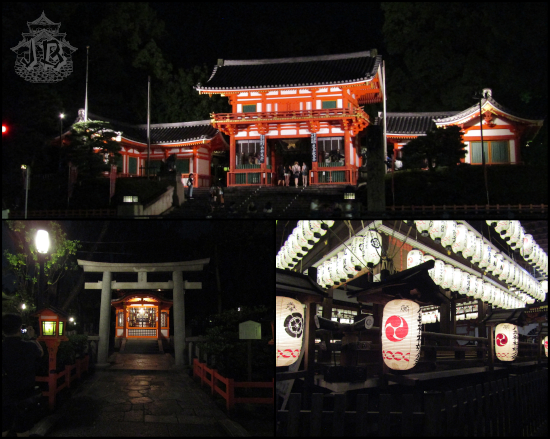
By the time I got out, there was a deluge outside. I was in the hotel, which was close to the photography studio, for a little, and after checking the maps that they had given me at reception, I realised that I was much closer to the Gion area than I – and Google Maps – had actually thought. There was one big park / shrine complex I could walk. At least part of it is called Maruyama Koen [円山公園] and it has a cool pond. I walked from the north entrance to the western exit, which belongs to Yasaka Jinja [八坂神社], the Yasaka Jinja Minami-romon [八坂神社 南楼門], the Tower Gate. I passed Gyokkō Inari Yashiro [玉光稲荷社] on the way.

I walked off to Gion, [祇園] which was almost empty due to the storm. Whenever I get to Gion in the evening, I always check whether there is a long queue at Gion Corner, which is a theatre that performs “traditional arts”:

  • Tea Ceremony [茶道]
  • Flower Arrangement / Ikebana [華道]
  • Koto [箏]
  • Gagaku [雅楽] Court Music and dance
  • Kyogen Theatre [狂言] (comic play)
  • Kyo-mai [京舞] (maiko dance)
  • Bunraku [文楽] Puppet Theatre

I was lucky this time, as the rain had scared most tourists away, so I could come in. It was a fun thing to do once, especially with “foreigner discount” it becoming half-price, but the audience kept talking and moving around the floor to take pictures and videos. Thai and Chinese people are loud (and a few of them rather disrespectful)! But all in all, I’m happy I got it out of my system, particularly the Kyo-mai dance.

After that, as it was not raining any more, I strolled down an almost-empty Gion.

Then I walked off towards an area that I had never been able to find before – Gion Shirakawa [祇園白川] and Tatsumi Bashi [祇園 巽橋]. Fortunately this time I had checked for the Tatsumi Bridge location fist, so it was not even that hard! I just had to know where to look for it! (≧▽≦).

I decided to take the way back through the park, so I could see all of Yasaka Jinja [八坂神社] lit up, which was very pretty.

As the hotel was also next to Heian Jingu [平安神宮], but as it was not lit up, I did not walk in.

Then I bought some conbini food and I went to the hotel to have dinner and a bath – the hotel had a hot spring public bath (and it was empty! Just for me!). I was lucky enough to get one of the traditional rooms, and the sand-puffs-like thingies were super-comfortable… until I had to stand up. It was so comfy I could barely stand up! And then I went off to sleep like at 10pm cause I was beat (∪。∪)。。。zzz.

Walked distance: 18517 steps / 13.2 km

17th August 2018: Gold & Oiran {Japan, summer 2018}

Last year I decided to take a maiko photoshoot and it was fun, so when this year I found something similar, I decided to take the plunge. In this case, it was not a maiko, but an oiran [花魁], high-ranking courtesans with flashier clothes and more expensive kimono and accessories. I timed this to be the day after the Gozan no Okuribi, and my appointment was at 1 pm, although the website advised you to be around half an hour earlier.

I woke up feeling much better than the previous day, and after leaving the hotel the first thing I did was visit Mikane Jinja [御金神社], a small temple that had at some point come under my radar because it has a golden torii. This was, again by luck, very close to my hotel.

Torii gate painted in glittery golden paint

After that I took the underground to go to the Higashiyama / Keage area, where my photo studio was. There are also a few things to see around there, so I got off at Keage Station and the first thing I saw was Nejirimanpo [ねじりまんぽ], a Spiral Brick Tunnel, also called “Twisted tunnel”. I walked across, of course.

Entrance to a tunnel made of bricks. The bricks seem to be built in a spiral, and not straight

Afterwards I found myself at the complex formed by Tosho-gu [東照宮] and Konchi-in [金地院]. Tosho-gu is dedicated to Shogun Tokugawa Ieyasu.

A Buddhist temple with lots of bonsai pines in front of it

I continued into the temple complex and saw Nanzen-ji [南禅寺], a grand temple.

The main building of a Buddhist temple with an incese brazier in front of it

And then I stumbled onto Suirokaku [水路閣], which is, of all things, an aqueduct! Furthermore, it is still in use.

Aqueduct made out of brick

My next stop was Saisho-in [最勝院].

A Shinto purifying fountain

Then it was almost time for my appointment, so I headed towards Studio Esperanto Oiran Taiken [studio-esperanto 花魁體驗], which was pretty much amazing.

Studio Esperanto front shop

While considerably more expensive than the maiko photo shoot, but the truth is, it seems less standardised and way more professional in a way, relaxed in the other… maybe it is the fact that you get to choose more is what makes it unique to you – also I am happy to report that I could do it with my contacts in, so that was way more enjoyable. The whole thing was like a dream – it reminded me a little of the experience you get when you go to Swallowtails, a lot of people are trying their best to make you feel welcome. In this case you choose a kimono and two different covers, called uchikake, which are super heavy because they are embroidered with metal thread.

The first thing I did was to take off my clothes and put on a white “underwear” robe. I could choose a lot of things – make up style, colours, wig, nails, hairstyle to a point, eyelashes… it is very participative. After make-up, you choose the kimono and the obi – which is the real thing, a long one that they tie around you. For the photo shoot itself, you feel like a rock star for real. They put the uchikake on you, they help you with the poses, and they take a lot of pictures for you to choose which ones you want printed into a book -For the plan I bought, 25,000 ¥ you get five printed pictures in a book and can buy the rest of them on a CD (which was 10,000 extra, but in my case, way worth it, as I got 50 pictures) – one day I would love to do the VIP experience, that’d be cool, but I guess I’ll just settle for entertaining repeating a similar plan with the blue background.

Collage of a person in oiran outfit. The kimono is decorated with pine needles embroidered in gold, and cranes. The person is wearing wig with long red hair.

While I was waiting for the pictures to be done, I decided to have a walk around the area. I saw the Biwako Sosui Kinenkan [琵琶湖疏水記念館 ], the Lake Biwa Canal Museum, from the outside.

Fountain with a crane inbetween the flow

I thought I might check out the zoo, but the price made me decide against it, and after turning a corner I found myself, surprisingly, at Heian Jingu [平安神宮 ].

Bridge leading up to a huge torii gate painted vermillion

I remembered there was a conbini next to the daitorii, so I went there to have some lunch, and then walked back to the Keage area, to have another look at the temple complex and Jishi-in [慈氏院] (probably. There was some construction going on and this might have been a smaller temple).

A Buddhist temple through the wooden gate

After I had my pictures (and still not quite believing it), I decided to walk down to Gion, as the path would take me down the river.

A shot of the Kyoto canal, with weeping willows hanging over it

I ended up at Yasaka Jinja [八坂神社].

Vermillion gate that marks the entrance to a shrine up a flight of stairs

Then I walked into the actual Gion [祇園] area. It was more than crowded, which killed the exploring drive.

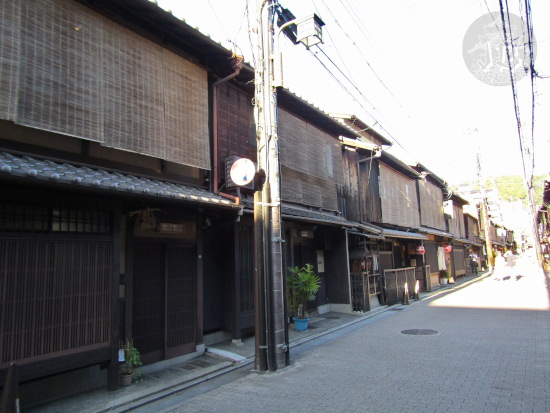
Wooden houses in the sun, the wood is dark

And here is when I totally forgot that I wanted to go see Fushimi Inari Taisha by night and went back to the hotel 。゚(゚´Д`゚)゚。. I guess I was a bit more tired than I had previously thought, because I did not remember that until I was getting on a train the following there.

16th August 2018: 五山送り火 (Gozan no Okuribi) {Japan, summer 2018}

Remember when I mentioned I overdid it on the 15th? I was feeling it today. My head was bugging me and it grew worse along the morning. The weather, showery, was not really helping, even when I took my meds.

Never the less, I left the hotel in the morning, got some breakfast and walked to Kyoto’s old castle, Nijō-jō [二条城], which was literally two blocks over. This was not planned, as when I booked the hotel I looked for something reasonably-priced reasonably-close to a JR or an underground station – I really, really hate Japan buses, trains for the win.

Anyway, the castle was close, so I decided to drop by as the first time I had been around it was being renovated.

After the castle I walked towards the JR station where I had come from the previous day to stop by Shinsen-en [神泉苑], the remains of a Heian Era garden, which holds a sub-temple to To-ji.

Also I snooped into Nijo Jinja [二条神社], just because there was an indication sending me there.

Then I headed off to Kyoto JR station as there is a tourist information centre. There I wanted to ask where to watch the upcoming Gozan no Okuribi [五山送り火], which is a festivity that closes the Obon festival in Kyoto. The Obon festival honours the deaths of the deceased, which come back to the world and are sent away by the five fires started in four mountains around Kyoto. I wanted to see as many fires as possible, and I had been doing some research online. I wanted to find a good place, which in the end turned out to the rooftop of a local Aeon supermarket, the Aeon Mall Gojo.

After getting the info, I went to Higashi Honganji [東本願寺], a temple close to the station.

I wanted to go find its twin, Nishi Honganji, but I was not feeling well and I really wanted to be fine for the evening’s fires – which were after all the reason why my trip was planned like this, so I could go to see the fires. My headache was growing worse, I think part of the reason was that I was stressing that the mall might not be a good place to watch the fires and whether I could go somewhere else. Thus I got something to eat, and headed back to the hotel for a shower, a nap, and some dinner before I left for the mall.

The nap proved to be a good idea. The fires would be lit at 8 pm, so I stayed in the hotel until a little after 5 pm, when I left so I could be at the mall at 6 pm. This gave me time to relocate to another of the viewing spots if my first choice did not work.

But it did. You know you’re on the right track when you find all the locals all ready a picnic, and the Aeon was just like that. There were hotel employees pointing to the areas where we would see the fires. Out of the five fires we would see three, and part of the other two.

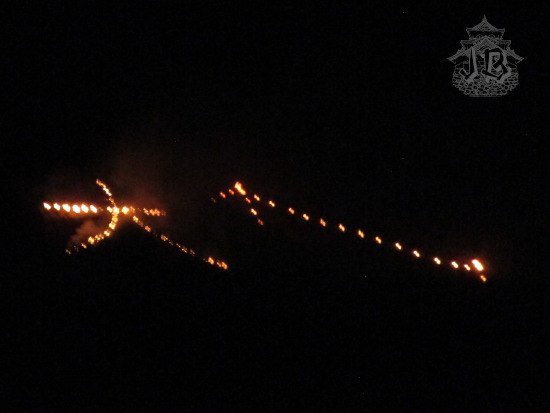
There are five fires in the Gozan no Okuribi [五山送り火], and they are lit from right to left. The first one is shaped 大, it is called Migi Daimonji or just Daimonji [大文字]. It is lit at 8pm. The second one is Myojo [妙法], a Buddhist prayer. Next comes the ship that is supposed to take the souls back to the underworld, called Funagata [舟形]. The fourth is the Hidari Daimonji [左大文字], another 大, and the final one is the Toriigata [鳥居形], shaped like a torii.

Everything was good. I could relax and my headache did not come back, even if we had a mini deluge that had everybody going inside for a few minutes.

When it was done and we went all back outside, we had a great sunset.

Finally everything went dark and the fires started. We saw the Migi Daimonji lit first to our right.

Then the sparks of what could have been the Myojo or the Funagata, nobody was too clear on that. Later we saw the Hidari Daimonji lit, just in front of us.

Finally, we got to see the Toriigata after changing sides of the roof.

All in all, it was a great success!! I was really glad I got to go and see it, especially the first and last fire, because it gave everything a sense of beginning and ending, even if I was quite exhausted to make it back to the station and the hotel.

15th August 2018: Hikone is small and at noon it turns into a pumpkin? Hikone → Kyoto {Japan, summer 2018}

As I had learnt the way to the castle entrance the previous day, first thing in the morning I headed off to Hikone Castle. The walk to the castle is flanked by the Irohamatsu [いろは松], which is a row of special pine trees that were planted there as their roots grow downwards but not sideways.

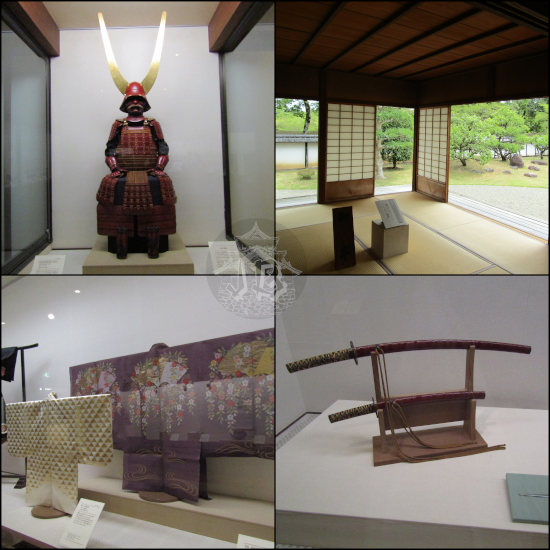
Hikone castle, Hikone-jō [彦根城], is one of the twelve castles that retain the original keep and one of the five to be a national treasure. The ticket included the castle, the museum, and the Gardens. I was there when they opened so the affluence of people was not to big yet.

Being one of the important ones made two things happen – one, that you have to take your shoes off, and two, that the stairs are crazy. Good thing I was not carrying my backpack – I had left it at the hotel but they told me they could only keep it till noon for whatever reason, so it was a good thing that Hikone is not as big of a town as others. The interior structure of the castle is naked wood, and it feels quite severe.

After the castle I went to the Hikone-jō Hakubutsukan [彦根城博物館], the Castle Museum, as it started drizzling. Normally the castles have the museum inside, but this one was in a nearby tower next to the main gate.

My next destination were the Genkyuen [玄宮園], a traditional garden from where you can spot the castle.

Also within castle grounds was the Kaikoku kinen-kan [開国記念館] (officially translated as Hikone City Museum of History, but it is more as “Memorial Hall”) – unfortunately pics were not allowed except for this Lego Castle.

Finally I checked out Shigakengokoku Jinja [滋賀縣護國神社] under daylight.

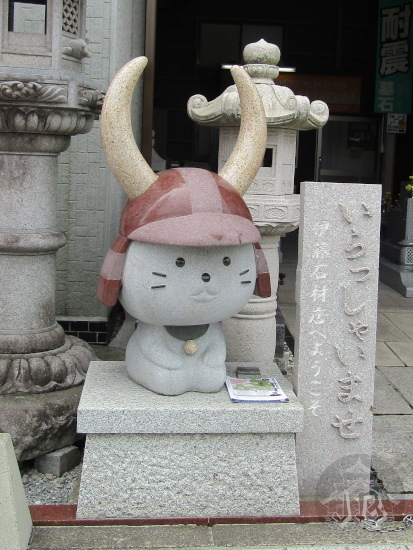
I walked back to the hotel through the main street, where I saw many stone statue shops displaying their work - including the city mascot, Hikonyan [ひこにゃん].

Finally, after picking up my luggage from the hotel I stopped by the Ii Naomasa Ritsuzō [井伊直政立像], the Statue / Monument to Ii Naomasa, who was the original builder of the castle.

I jumped on the Hikone Rapid Express, which was packed, and headed off to my next destination, Kyoto [京都]. As I was earlier than expected, I got a jump-start on sightseeing. This would later proof to be not too much of a good idea – originally I only wanted to do one temple so I did not put my luggage into a coin locker. Looking back, I should have.

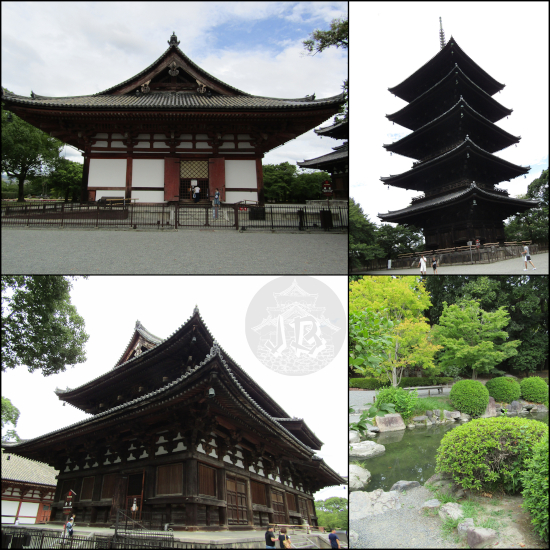
I went to To-ji [東寺], a Buddhist temple whose pagoda had drawn my attention every time I had been in Kyoto before.

Then, as it was quite close, I decided to check out the aquarium, Kyoto Suizokukan [京都水族館].

Finally, I went to Daishōgun Shōten Machi Ichi-jō Yōkai Street [大将軍商店街 一条妖怪ストリート], a shopping area with a lot of yokai and yokai-like mascots. Unfortunately, most everything was closed due to the Obon festivities, which in the end made for an unrewarded extra effort. Here I was trying to pace myself and not doing a good job out of it.

On my way to Yokai street and back I saw Jinja Kitano-Jinja Otabisho [北野神社 御旅所],

Jizo-in [地蔵院 ],

and finally Daishogun Hachi Jinja [大将軍八神社].

Finally I backtracked to the station and headed off to the hotel for some rest. I made a mental list of things that were incredibly close to the hotel and I could do the following day.

27th July 2017: Osaka → Kyoto → Tokyo {Japan, summer 2017}

It’s not the first time I’ve done this, but this time it was sane-ish. I left Osaka [大阪] maybe at 8.30 in the morning and took the Shinkansen to Kyoto [京都]. Once there, I found myself a coin locker at the station and went on to the bus area. I was heading to Jonan-gu [城南宮] which was my last shrine of the Kyoto Gosha Meguri ~Shi shin Sou Ou No Miyako~ [京都五社めぐり~四神四神相応の京~] and… under repairs too. But I had finished the Meguri. I had to wait about an hour for the bus. Then 40 minutes ride, about 10 minutes in the shrine, 30 minutes waiting for the bus back and 40 minutes ride again.

After I had some lunch at the station, I headed back to Tokyo [東京], where I met up with D****e in order to hit Nakano Broadway [中野ブロードウェイ] to rummage through TRIO (Yay TRIO for getting me what I needed ♥… and some more stuff I did not need but hey, who cares about those details?). Afterwards we had some kushikatsu dinner.

26th July 2017: Kyoto buses *eyeroll* {Japan, summer 2017}

Someone told me that using Kansai public transport made her appreciate Tokyo trains, and I whole-heartedly agree. I am thankful to the Kyoto [京都] Tourist Office Lady told me the two shrines I had left in the Kyoto Gosha Meguri ~Shi shin Sou Ou No Miyako~ [京都五社めぐり~四神四神相応の京~] would take me a long time, because it allowed me to plan accordingly. Good thing that with a JR Pass you can travel between Osaka and Kyoto in barely half an hour for free.

I went to Matsuno Taisha [松尾大社], but I did not try the famous sake they had because not a drinker here. The shrine was being restored, too, so that took away some of the impressiveness.

Collage of a Shinto shrine: a vermillion torii, ceremonial sake, and the main buildings in dark wood

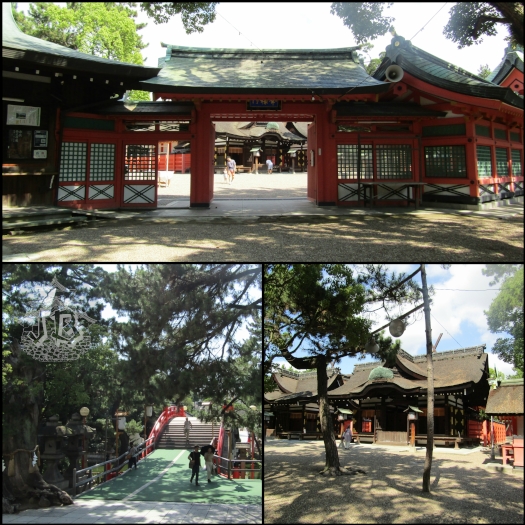
After I was back at the station, I travelled back to Osaka [大阪] to get the shuuin at Sumiyoshi Taisha [住吉神社] there.

A vermillion gate that gives way into a Shinto Shrine.

Then I headed out to Zepp Osaka Bayside for the last of my VAMPS concerts for the time being. There had been no surprises this time, so it was just a “normal” concert without extra adrenaline, which was good for a chance, honestly. I was too sore to jump after the previous day though (≧▽≦).

Zepp Osaka Bayside logo in blue neon

23rd July 2017: Kyoto: plans long made and plans unexpectedly changed – Maiko Henshin and Gyosha Meguri {Japan, summer 2017}

It was an early and cloudy Kyoto [京都] morning when I woke up to walk to Heian Jingu [平安神宮], a shrine built in 1895 to celebrate that Kyoto had existed for 1100 years already. It was supposed to be just another trip to a shrine, I did not expect anything special to come from it.

Heian shrine - main building and secondary buildings that stand on the sides, symmetrically to the left and right. The buildings are vermilion and white with a green-grey roof, and the ground leading to them is sand.

However, as I was snooping around the shrine shop I saw that they had come up with a stamp rally, shrine version – the Kyoto Gosha Meguri ~Shi shin Sou Ou No Miyako~ [京都五社めぐり~四神四神相応の京~] (The tour of four gods of Kyoto). According to legend, Kyoto was anciently guarded by four god-like spirits: the Azure Dragon of the east Seryu, the White Tiger of the west Byakko, the Red Bird of the south, Suzaku and the Black Tortoise of the north Genbu. Heian Jingu stands in the middle “the heart” of Kyoto, and each guardian is supposed to dwell in one shrine in each cardinal point. I bought a small cardboard tablet with the four sacred guardians of Kyoto , with the Heian Jingu stamp in the middle. With that tablet, you had to visit four more temples on the four cardinal points and get their stamps. It is The rally unexpectedly trumped all my Kyoto-visiting plans. I had to absolutely do this! I was so pumped that I did not even take pictures of the tablet until the peregrination was completed.

A cardboard card with the drawings of the four mystical guardians of Kyoto, the white tiger, the black tortoise, the blue dragon, and the red fire bird. They are aligned with their cardinal points, east, north, west, south. Between the animals and in the centre, five stamps in red ink.

After leaving Heian Jingu, I walked alongside the Kamo River Kamogawa [鴨川] towards Gion [祇園], stopping to get the second stamp at Yasaka Jinja [八坂神社]. Here is where the “easy” stamps were over. I still had three shrines to get to, and they would not be as easy as a literal walk down the river.

The vermilion entrance to a Shinto shrine on top of stone stairs. There are rows of lanterns hanging from the gate.

I was to meet D****e at 10.15, as she was coming from Osaka, where she was for a concert. She wanted to tag along to what I was going to do next, basically to… share the pictures with everyone. Last year, my friend B**** had told me about something she had done that she thought I might like, a photo shoot in maiko [舞妓] clothes – maiko being Kyoto geisha-in-training. Following her recommendation, I chose a place called Maiko-Henshin Studio Shiki [舞妓体験・変身スタジオ「四季」], which is where B**** had done hers.

This is something that had been in the back of my mind for the longest time, but I had never got around to doing it because of the price tag. I was a bit put off by paying over 10,000 ¥ for what would in essence be pictures of myself. However, I eventually realised that it is not just the photographs you are paying for, it is the whole three-hour experience. I booked a Studio Shoot plan for 11,900 ¥ (plus tax), which included:

  • White make-up cover.
  • Renting and getting dressed into a formal kimono.
  • A pair of tabi (Japanese socks) that you get to keep.
  • Fake eyelashes applied on you.
  • Natural wig (half-wig) fitted and fixed.
  • Eight studio photographs including a Fushimi Inari Taisha background.
  • A book with the best eight pictures.
  • CD-R with all the pictures taken.
  • Five postcards.
  • Ten minutes of free time to take your own pictures outside the studio.
  • Possibility of paying to get some extras, including extra pictures.

The shop was easy to walk up to. It was set out as a traditional house with a sliding door, and they offered two kind of services – kimono rental to walk around Kyoto, and Studio transformations along the subsequent pictures – maiko, samurai, and couple or family options.

This was a 98% great experience. 1% fell because I had a coughing fit (I have had issues with my lungs, but they are slowly getting better) and the other 1% due to a communication failure with the studio upon reservation. However, that 2% is negligible and it was all in all great. D****e had a blast in turned, and she decided that she needed to share the pictures with everyone she knew who knew me.

I had made my reservation online a month in advance. I chose a time, which was rescheduled for an hour later. When I asked if I could have a sword for the photo shoot, the answer was to inform my photographer.

When I arrived, the receptionist checked my plan with me. Then they asked about the optional or “less crucial” items – whether I actually wanted the white make-up, fake eyelashes, and type of wig – I have absolutely no idea about wigs. They asked if I wanted any extra photographs (each one for 1000 ¥) on top of the eight included in the shoot. They also checked who came with me so they could call D****e to come in when she was allowed to be with me.

D****e and I had arrived early for my 11:00 appointment, and they called me around 11.15. I was given a little basket, a gown, the keys to a locker, and a pair of tabi [足袋] – Japanese socks, with a separation for the big toe and the small ones. The little basket also contains a brochure to give you instructions of what you are to do in all the steps of the experience. This was helpful, especially when they recommended using the toilet beforehand.

I walked up to the third floor to change into the gown and tabi and put all my belongings into the locker. I took with me the key on an elastic band around my wrist. The little basket was for the instructions, and my mobile phone for pictures during free time later. At this point I was still wearing my glasses, but I had to take them at the next step, and they would also go into the basket.

I walked down to the make-up room on the second floor. At this point I had to take off the glasses (and decided that I wanted to get myself some contact lenses). Here I had the white make-up applied, and I was amused by the process. I had not built any kind of expectation about how they would do it, but I guess I was not expecting a thick brush – much thicker than a normal make-up brush. It was an interesting feeling – the white paste was cool and the brush also felt very different from a regular one. The make-up reached up to my hair line, but the artist left a little bit of unpainted skin for the wig. They also painted much lower down my back than I would have expected – it was explained to me that the neck and the wide collar of the kimono are “sexy”.

Afterwards, they contoured my face a little, added the blush, and airbrushed my lips bright red. Finally, they did my eyelids and eyebrows, also in tones of red. The staff gave me instructions in “fluent” (read: broken) English, but we both tried, and communicated successfully. I was told where to look at each point, or to close my eyes and finally I was offered the fake eyelashes again – I accepted because I was going to be without my glasses anyway. I unfortunately inhaled a bit of powder or something, and had a coughing fit that almost gave my poor make-up artist a heart attack…

After the whole make-up had been applied, it was time to get the wig fitted. I was shown to another room with a big closet full of lockers, and each locker held one wig. They checked three or four against my head until they decided on one to put on me. It was a “half-wig”, which means that they painted the hairline and part of your own hair in order to stick it down. Afterwards, they put some traditional decoration, kanzashi [簪], in the wig.

Then it was time to choose the kimono. At this point, D****e was called onto the floor to “help me choose”. There were literally hundreds of options, but I actually found the one I really wanted even before she was there. It was black with cherry blossoms on it, and when D****e arrived she said “that one is really you”. The staff grabbed it for me and took it to the next room – and my poor friend was sent away once me.

Before they started getting me dressed, the first thing was padding my front so the kimono fell flat. At this point I was wearing the under-gown, and on top of that they put an undercoat called nagajuban [長襦袢] over it – this is done to protect the kimono. The nagajuban was tied closed with a cord called datejime [伊達締め]. Then they put the actual kimono on me – and boy was it heavy. I had not expected that it would be that heavy. They offered me a choice of three obi [帯], the wide belt, somewhat of a rigid sash that holds the kimono together. They tied it down and placed a pre-made ornate bow on the back – it was a bit of a bummer that they did not do the whole knot on the spot. They finished putting hair accessories into the wig, and I was ready to head off to the studio. They tucked the long sleeves and the lower part of the kimono into a string that they tied around the obi. The big problem came when I had to go down the stairs to the studio on the first floor, without the glasses – yes, I need to get myself some contact lenses.

Down there, I had to wait for maybe 10 – 15 minutes, which felt very long. I am a tremendously visual person, so I felt very vulnerable without my glasses, just catching some shadows in the background. I saw something that I thought was a cat in a little garden, probably for the outside shoots (the garden, not the cat). When the “cat” jumped into a small pond, I realised that it was a duck.

Once I was admitted into the studio, the photographer was a very nice young woman. However, it was now when I learnt that the eight pictures that you get with the package are pre-planned shoots, you do not get to choose anything. The photos are pre-planned and “staged”, so they are the same for everyone, whether it is “your angle” or not. But at this point, the 1,000 ¥ were not that much of a price increase, so I decided to get it anyway. I was not upset, I just thought it was a translation issue from Japanese to English or a miscommunication. My photographer was friendly and explained about the extra photograph. As it was not included in the maiko set, I had to get it in the samurai room. I agreed, because I really wanted that picture with the katana. As she was finishing explaining, D****e was shown in. She helped with the “look at X” instructions. She also helped make the photographer understand the kind of picture I wanted, since she had trouble digesting the idea that I wanted the samurai sword kind photo with the pretty maiko set-up.

The photo shoot has eight pictures, and I don’t think I look particularly well in any of them – but it was fun. For the first seven photographs I was only wearing the tabi, and for the last one I was given a set of okobo [おこぼ] – high platform sandals for you to walk on, named onomatopoeically for the sound they make on the pavement. The photos included in the photo shoot are:

  1. Full body, slightly backwards, with a fan and the kimono extended at your feet,
  2. Upper body, front, with the fan,
  3. Upper body, front, with some kind of ball / jewellery box,
  4. Full body, front, with a red paper parasol, and kimono extended,
  5. Upper body, front, looking straight at the camera with the parasol,
  6. Full body, front, looking “nice”, kimono extended at your feet,
  7. Upper body, front, with some kind of bento box,
  8. Full body, lower part of the kimono pulled up, with the okobo and a Fushimi Inari Taisha background.

After my official shoot, I was taken to the samurai room for my extra photograph so I could get the picture with the sword. Then, D****e and I were lead outside, the back part of the studio, to play around with the phone and take selfies and stuff. She made sure to take a hundred thousand photos of me during the following 10 minutes. Just for the LOLs, my last couple of pictures were back with the glasses on – which surprisingly did not even flake the white make-up.

Once back inside, the magic seemed to die down, and everything became efficient and a bit cold. My kimono was undone, my wig taken away, and I was given instructions on how to remove the make-up. It did not take too long to do so and go back to my normal, boring self. Then I had to pay and we waited for a little while before I was given my pictures. In total, the whole thing took about two hours and a quarter.

It was a fun experience, probably not a must in Japan. Communication at times was a bit weird, because they work in a sort of “line”, and each person is very specialised on one thing. They are very set on what they do, and don’t always explain in detail because after all “they know,” it is what they always do, even if the customer is lost or not aware of what is going on. Then again, I had a blast and I really liked it, never mind all the inconveniences and issues. Not that I feel I need to repeat it, especially costing this much. However, I might consider something similar thing at a cheaper price, or with a different kind of character.
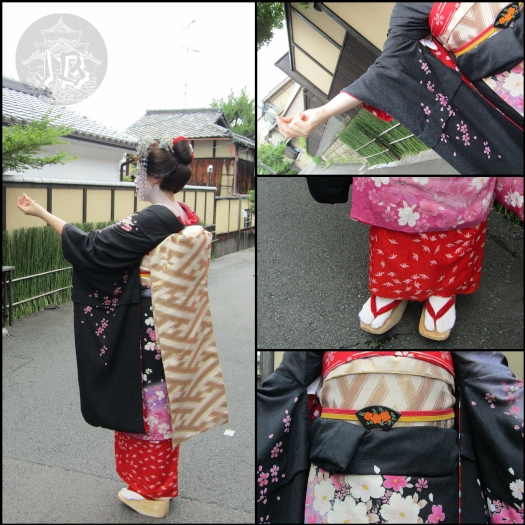
Person dressed as a maiko, with a long robe in black with pink cherry flowers

I walked D****e to her station, waved her away, and headed off towards the third shrine of the stamp rally, which I thought at the time would be the furthest-away shrine, Kamigamo Jinja [上賀茂神社], in the outskirts. There was some kind of art / craft fair there by university students, so it was very lively. Unfortunately too, a lot of it was under renovation, but I explored a little (and wasted a lot of time waiting for and riding the bus). Anyway, I received shrine-stamp number three.
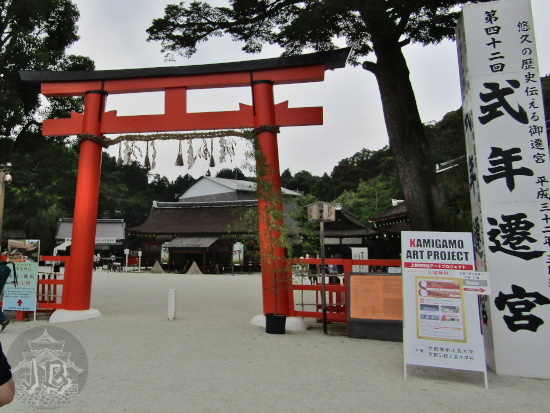
A vermilion torii gate

After the stamp success, I headed off back to the hotel to retrieve my luggage and undid my way to the station by subway. I had a while at the station, so I explored the building a little. Designed by Hiroshi Hara, it is one of the most “out of place” buildings in the city. It can be considered “futurist”, with an irregular glass-and-steal façade and illuminated stairs.
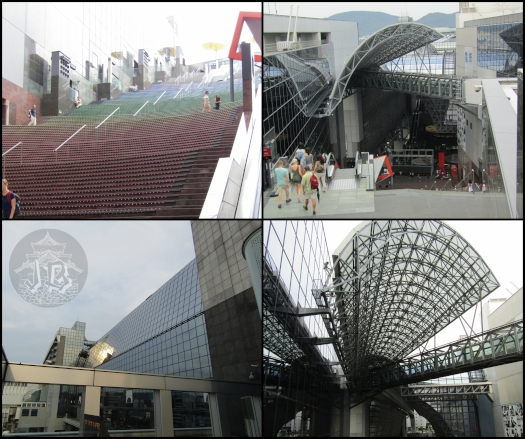
The stairs and wavy roof of Kyoto station

Finally, I jumped on a train to backtrack to Himeji [姫路], which is south of Kyoto. I timed the visit to Maiko Henshin so D****e could tag along, even if it meant going back and forth a little – travel was covered by the JR Pass though. Once in Himeji, I found my hotel and then went to walk around the castle. Actually, I should have been having some dinner but apparently I’m castle-distracted. I walked around the park and took a lot of pictures – and spotted some koi carps in the castle moats that were huge.
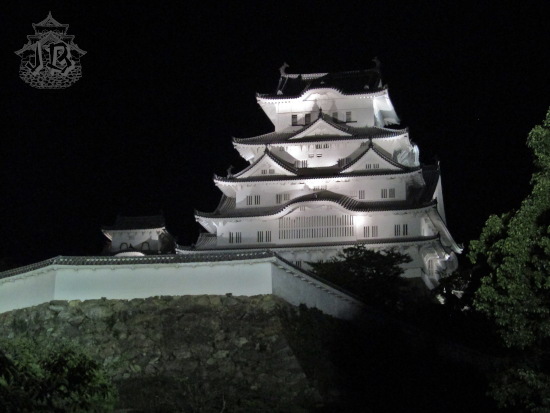
A Japanese castle lit up white at night.

22nd July 2017: Kokura → Okayama – castle day {Japan, summer 2017}

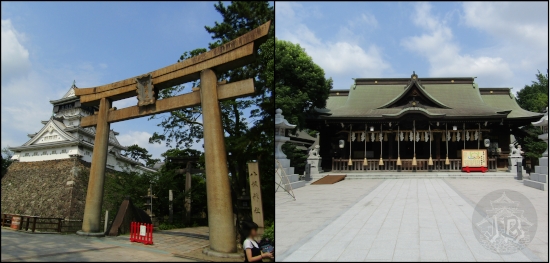
I started the day in Kytakyuushu [北九州], heading out to Kokura-jo [小倉城] again, this time by light.

After the castle I went to Yasaka Jinja [八坂神社], next to the castle.

Then I backtracked to the station to head to Okayama [岡山]. Unfortunately the train I wanted to take was full, so I had to wait for an hour and take a slower train. In hindsight (when everything is clearer) I should have stopped at Fukuyama to see that castle, but I was worried I would not have time to see Okayama castle. On the way I was talking to the nice ojii-san who was going to Nara to pick up the car his wife had bought in yahoo auction.

Upon arrival in Okayama and failure to find appropriate coin lockers I headed out to Okayama-jo [岡山城].

As I was good for time I bought a combined ticket for the castle and Korakuen [岡後楽園] a huge Japanese garden which hosts a couple of small shrines – Jizo-do [地蔵堂] and Jigen-do [慈眼堂].


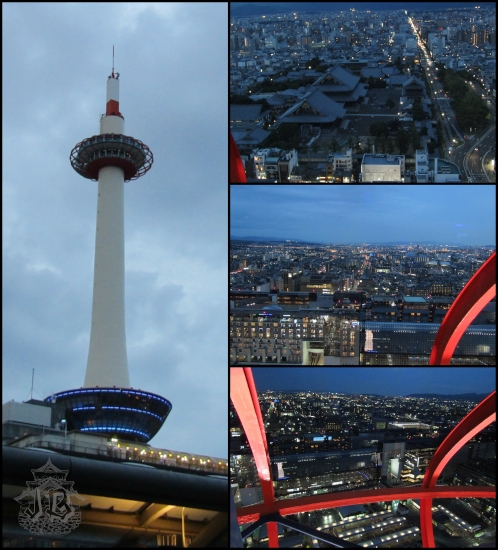
Afterwards I backtracked towards the train station and took a train towards Kyoto [京都], where I climbed up Kyoto Tower [京都タワー], because I had not been up even if I had been to Kyoto before.

Afterwards, I just wanted to get some sleep, so I went to the hotel, had dinner and collapsed in bed.

24th August 2015: Up and down Fushimi Inari Taisha (Kyoto) {Japan, summer 2015}

Still sore and a little sunburnt from the Beast Party, I woke up early-ish on Monday to make use of my JR Pass and head off to Kansai, namely Kyoto [京都]. It was as always both a short and long ride and for the first time I did it with a reserved seat, as I gave myself the exercise of trying to talk to the reservation people. It did not go too well, but I managed my reservation.

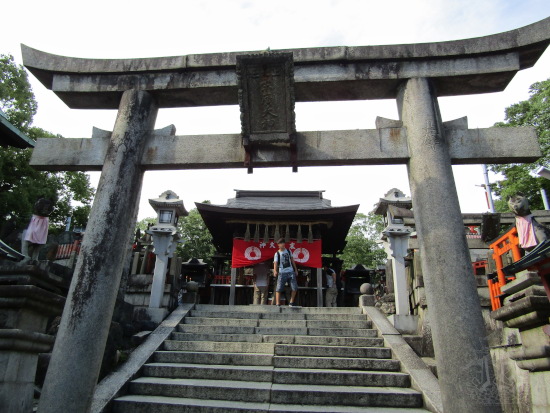
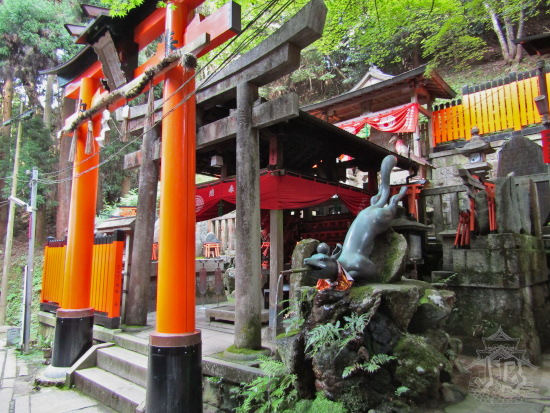
Upon arrival in Kyoto I changed my original plans – again – due to – again – rain forecast. So instead of what I had planned, I changed into shorts, put on my cap, and armed with onigiri and coke, I set up to top Inari-san [稲荷山], Mount Inari. You see, I have been to Fushimi Inari Taisha [伏見稲荷大社] before, twice, and both times I had to give up halfway because heat. Both times I tried to stick with healthy stuff – isotonic drinks and so, rest, and do things correctly. This time, I bought water, coke, snacks and onigiri, allowed myself to rest, but not to sit down and finally managed to do the whole thing, snacking on onigiri and crisps as necessary and pushing forward. I am quite surprised my clothing survived, too.

I started down at the big torii and the honden.

This is the pond where I usually kinda collapse XD but this time I made it through.

Kyoto view from Yotsu-tsuji, halfway up.

Itchinomine (First Summit)

Proof, in case you doubted me…

Fox temizuya (purifying fountain):

Down the other side:

By the time I was done, I may have been able to head off to another shrine, as I took less time than I had expected, but I decided that I’d better get some rest and get ready for the next day. After all, this was supposed to be ‘relaxing vacation’.

… Yeah, I don’t believe that either.

19th August 2014: Change of plans {Japan, summer 2014}

My day in Kansai was yet another carefully laid out plan, only darkened by a 90% chance of rain in Nara, where I was going to head out in the afternoon. Morning in Fushimi Inari Taisha, afternoon in Nara, maybe heading to Osaka in the evening to eat takoyaki in Namba. However, just before heading off I checked my emails only to find one by D****e telling me about an even which was going to happen in Tokyo that evening – a VAMPS’ secret live.

Hyde had been mentioning a ‘secret’ with a number code which turned out to be the event that was being organised, timing up with the release of VAMPS’ latest single. Having discarded trying for their interviews in Osaka on the 21st. It was a tough decision, because it meant losing one hotel night – coming back to Kyoto would be a rough 5 hours the day before, and that night would be impossible.

In the end, knowing that whatever I chose I would be missing out on something I really wanted to do, I decided to go with what could not be repeated – the VAMPS concert.

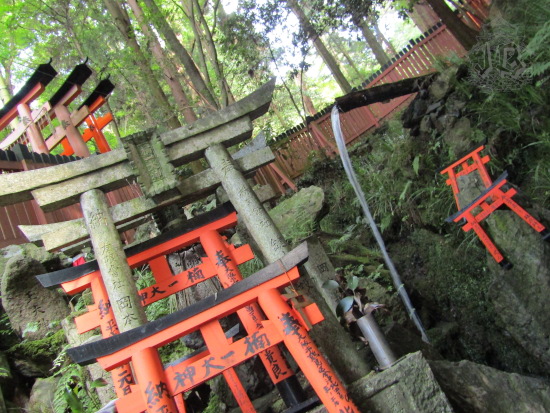
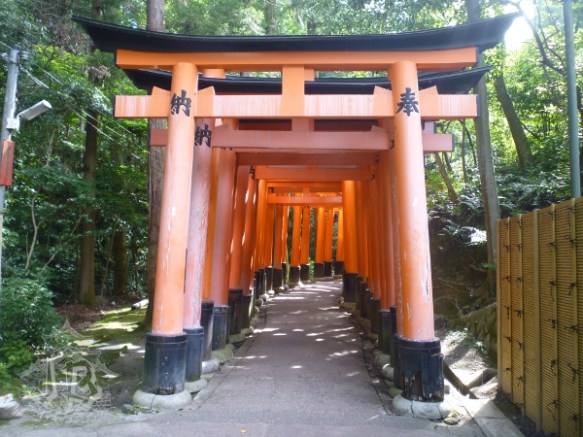
That still left me morning and eawrly afternoon in Kyoto [京都], so I dashed towards Fushimi Inari Taisha [伏見稲荷大社]. I was rather amused to find that some torii were under repair. I spent two hours in the Inari Forest and Mountain, but once again I did not make it to the top – it was just too hot. I did walk along some forgotten paths and was alone for a good 40 minutes or so, which was amazing. One day I have to try this either at dawn or in winter.

The Senbontorii - a row of hundreds of torii one after the other creating a sort of tunnel. Also, the main building of Fushimi Inari behind the giant vermillion torii

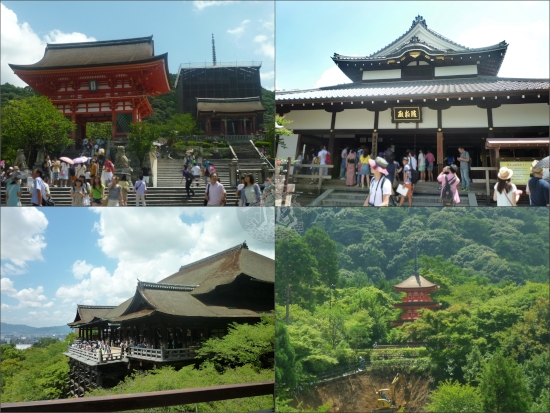
Before heading back to Tokyo I wanted to do something else, so I headed up to Kiyomizudera [清水寺], the Temple of Pure water, which was sadly being renovated. Never the less, I could come in and see most of the gardens and Pagoda and stand on the balcony. There were dozens of wind-bells and despite the rumble of people it was magical.

The main entrance to the temple, and a view of the main building from the side, where you can see that it hangs from the mountain.

After that I went back to the hotel, showered, changed and headed off to Odaiba [お台場] to the VAMPS Mezamashi Secret live, an event that the band had organised to introduce two new songs. It turned out to be a seven-song mini concert, and the first time I ever listened to what became one of my favourite VAMPS’ songs, The Jolly Roger.

The Mezamashi secret live stage. It shows the band's promo picture and the time, 19:40. The stage is lit in red, and there are flags with the band's logo, a Jolly Roger.

11th July 2012: Kyoto in 9.5 hours: Mission Impossible {Japan, summer 2012}

My express visit to Kyoto [京都] on the 11th was fueled by a jump into a rabbit hole – the first time I drank canned coffee. It would not be the last, definitely.
A can of Georgia Café au Lait

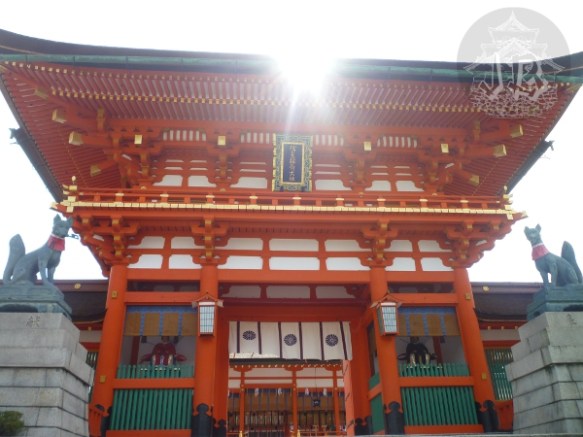
I started off with Fushimi Inari Taisha [伏見稲荷大社] and is dedicated to Inari, the God of Rice, whose messengers are considered to be the foxes or kitsune [狐]. It is a temple with a gazillion plus one torii, since in early Japan Inari was seen as the patron of business. Thus each of the torii is donated by a Japanese business. Sorry for the sun reflection, this was the best picture of the main building I could take:

A shrine building, in powerful orange. The sun is shining at the rim of the roof, and there are two sculptures of foxes sitting on the sides.

A line of torii (have I mentioned that I looove torii?) the Senbon Torii [千本鳥居], or line of a thousand torii:

A torii in the foreground. Beyond it, so many others that you cannot tell them apart. All of them are orange, but the outermost ones have been burnt by the sun and are less bright

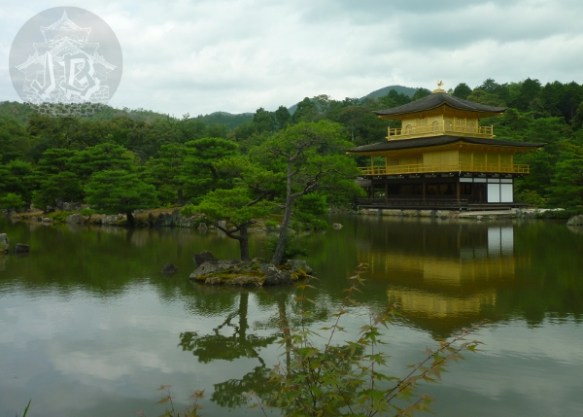
After Inari, I crossed the whole of Kyoto via bus and train and visited the Kinkaku-ji [金閣寺], the Temple of the Golden Pavilion. While I went to visit it because it was a must-see I found it amazing, and liked it more than I wanted to admit.

A pond with a pine tree at the centre. To the side, a three-story pavillion that looks similar to a pagoda. The first floor is built in wood and plaster, the upper ones have been covered in gold
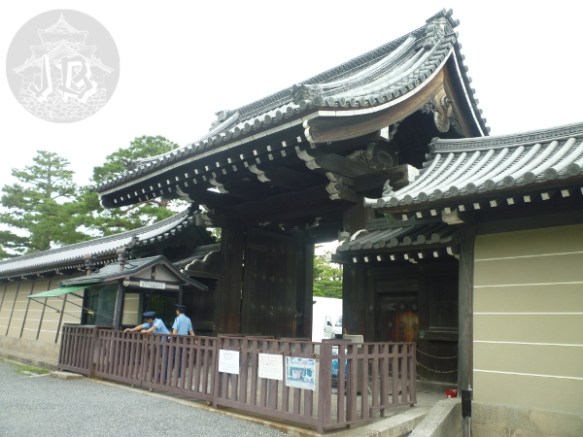
Bus again, towards the Imperial Palace, Kyōto-gosho [京都御所], of which you see… the outer wall and the cops that guard the door XD

The entrance to the Imperial palace - a gate through the walls. Two police officers in blue are chatting at the fence

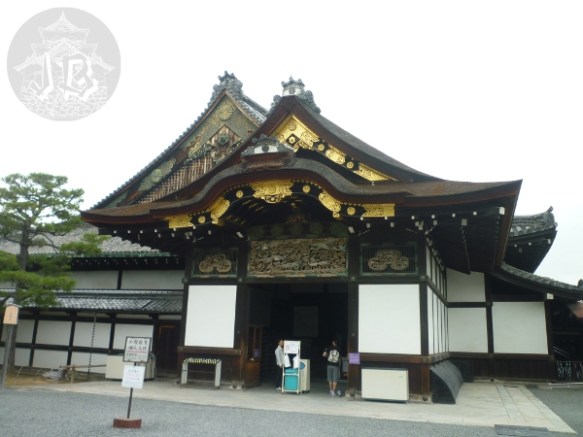
And a thirty-minute walk after that, I found myself entering the castle Nijō Jō [二条城]. Can you feel the rush? XD

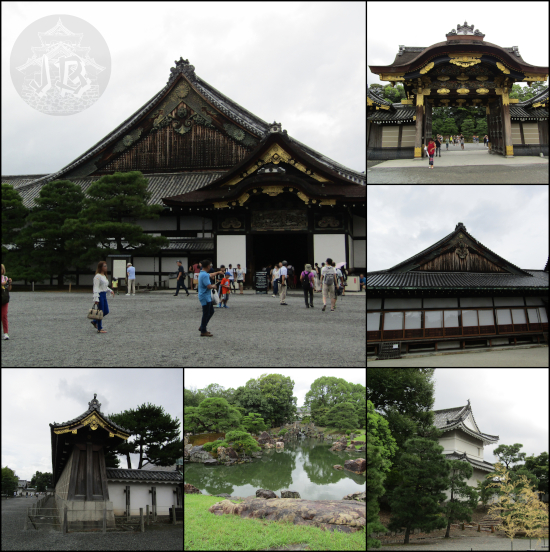
The main building to the old castle. Is is built in dark wood with gold ornaments and carved details showing animals and plants, painted in bright colours

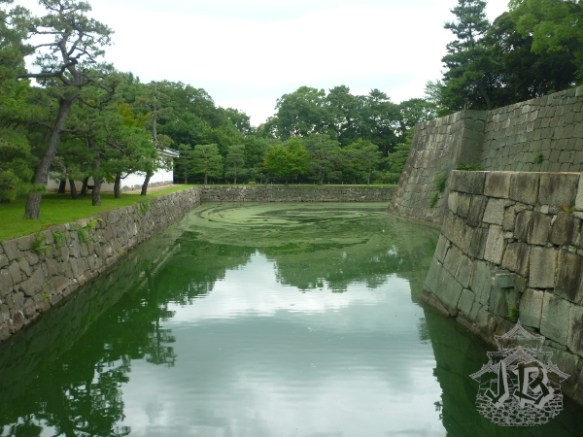
A view of the moat. The water is green.

Two buses later I was in Chion-in [知恩院] which was being repaired, so you can only see park entrance gate, which technically might belong to a nearby temple. I mean… there are too many temples to keep track of them! (Edit: after a bit of processing, that’s actually the entrance to the Yasaka Jinja [八坂神社] complex.)

A bright orange and white building at the top of some some stone stairs.

And going down those stairs to the left there was… Gion [祇園], the traditional geisha district. Found no geisha though D:

Traditional Japanese houses in dark wood, burnt by the sun. The entrance has a paper lanter and a menu

Finally, after another temple or twenty, or among them, I managed to sneak into Kennin-ji [建仁寺] just before it closed to see the twin dragons:

A ceiling painting of two dragons. The background is dark and the dragons are coloured in light shades, gold, white and red

By then I was so dead that I headed back to the station and was catatonic for the Shinkansen ride to Tokyo. This is not by far all I saw, but I lost track of the names for a bit. By the end of the day I was exhausted, but this is the gist of what I did that day. I would need more time to sort out the pictures, and I am trying to keep you guys generally updated, not write a thesis on ancient Japan XD (ETA 2017: Wow, that frame of mind changed a lot)