20th July 2023: Herculaneum and the Naples National Archaeological Museum {Southern Italy, July 2023}

Knowing my way to the station of Napoli Porta Nolana, this time I only had to buy the ticket and wait for the 8:14 Circumvesuviana Line 4 to Poggiomarino, which was supposed to reach Ercolano Scavi in the town of Herculaneum [Ercolano] by 8:33. It took longer than that because there were a lot of stops. Then again, my strategy of the first station in order to travel sitting down was successful once more.

Unlike the modern city of Pompeii, the modern Ercolano was built before the ancient town was discovered. It was originally called Resina, but the name was changed in 1969. Despite the legend saying that the Greek hero Heracles (Hercules in Latin) founded the original Herculaneum, the early history of this city is parallel to that of Pompeii. It was first an Oscan settlement, then Etruscan, then Greek, and it eventually became a Roman municipium in the first century BCE. It was a small vacationing town for people from the north, apparently.

Much like Pompeii, the ancient city of Herculaneum – what today is the Parco Archeologico di Ercolano or Herculaneum Archaeological Park – was buried by the 79 CE eruption of Mount Vesuvius, and it belongs to the Archaeological Areas of Pompei, Herculaneum and Torre Annunziata Unesco World Heritage Site. However, the different location of the town changed how it fared during the eruption.

The 79 eruption lasted two days (thought to be 24th and 25th October 79 CE). The citizens of Pompeii and Herculaneum who fled and survived were the ones who escaped during the first 12 hours – during these, heavy pumice and ash came down on Pompeii, destroying buildings. At this time, Pliny the Elder was commander of the Roman fleet at a nearby town, and he sent galleys to help the evacuation of the coast. We know this because his nephew, Pliny the Younger – a teenager at the time who would grow into a lawyer and magistrate – left in writing what he had seen in two letters. Those letters are now lost, but Medieval copies of them survived.

At the time of the eruption, Herculaneum stood right by the shore. Most of the bodies found were at the coastline, probably trying to escape by sea or reach Pliny’s ships. A boat was actually found carbonised in the vicinity. As wind blew pyroclastic flows towards Pompeii, burying it in volcanic ash and pumice, only a few centimetres of ash fell onto Herculaneum. These, however, rightfully freaked people out, and caused most of the population to flee during the first day.

As Herculaneum lies closer to the volcano, when the cloud of volcanic material (called a “volcanic surge”, composed by gas, ashes and pumice) collapsed in the middle of the night, it hit the town at over 400 ºC. Everyone who had stayed behind was instantly killed by the heat, leaving behind the skeletons of around 330 people. There were no casts made of them – unlike the thousand unfortunate Pompeiians.

Pliny the Elder died in the early morning of the second day. During the second day, the second pyroclastic cloud collapsed on top of Pompeii, but at this time, not a soul remained alive in Herculaneum. Subsequent volcanic clouds and pyroclastic surges (not lava) buried the towns until excavations started in the 18th century – barring some grave robbers, apparently.

About one fourth of Herculaneum has been unburied, even if it was the first city to be discovered. There is a bit of a paradox here – although it is in better condition and it suffered less structural damage, it is worse preserved. It still holds a lot of mosaics in situ, despite many frescoes taken to the Archaeological Museum. Unfortunately, its current condition has deteriorated terribly.

Herculaneum is less famous than Pompeii. A much smaller area can be visited, and the unexcavated part is underneath the modern cities of Ercolano and Portici. There are many buildings closed and a lot of scaffolding is needed due to a period or abandonment at the end of the 1990s. One of the telltales that it expects fewer tourists is that the webpage is only in Italian.

I reached the station Ercolano Scavi around 8:45, and ten minutes later I was at the entrance of Parco Archeologico di Ercolano. The park was already open and there was a line to buy tickets, and people struggling with their phone passes. I had printed mine out, so it was stupidly easy to wave it, get it scanned, and go through. Most people who went in before me decided to stay at the museums because that is the first thing you reach, but I reasoned that the earliest I went into the archaeological area, the less time I’d be under the sun when it became scorching. Again, this helped to be alone in a couple of houses.

Herculaneum general view

Restoration is a race against time in Herculaneum and as you walk you can see the scaffoldings and workers going on their daily lives – archaeologists, restorers, gardeners. Here, the effect of the volcanic activity are seen extremely clearly, on the floors and the walls – bulging mosaics and cracked frescoes and tiles. There is no doubt, however, that the damage was less. There are columns that still stand, covered in their original paint, and the bathhouses could just be used today with some refurbishing – and of course running water.

Another phenomenon that happened in Herculaneum was that a lot of wood became instantly charcoal when the pyroclastic surge collapsed onto the town. That means that some of the beams that are still in the buildings are the original ones, which is unbelievable. There are even surviving stairs and furniture. I wandered the streets for a few hours, going into anything that was open and in general feeling in awe at the mosaics and the frescoes. I was also astonished as how people felt comfortable poking the slabs and the paint – as there were fewer caretakers than in Pompeii.

Some highlights included:

Terme Maschili or Male Baths, where you can see the wavy mosaic on the floors.
Herculaneum mosaic - Merfolk

– The mosaics in Casa di Nettuno e Anfitrite or House of Neptune and Amphitrite.
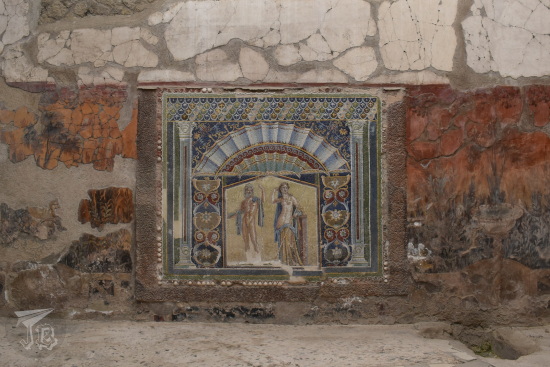
Mosaic covering a foutnain in Herculaneum

Casa del Rilievo di Telefo or House of the Relief of Telephus, one of the best preserved structures with a lot of paintings, even on the columns.
Herculaneum: House of the Relief of Telephus

Terrazza, statua e altare di Marco Nonio Balbo or Terrace, statue and altar of Marcus Nonius Balbus.
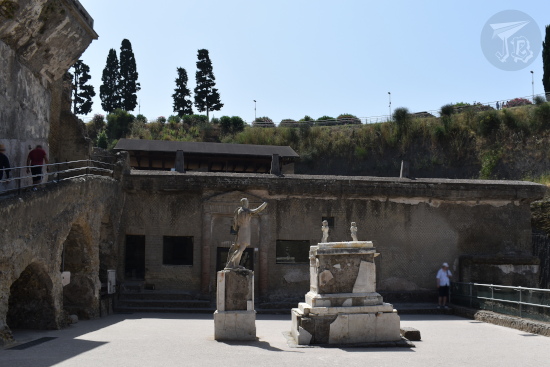
Terrace, statue and altar of Marcus Nonius Balbus

It was noon when I decided to retreat towards the museums, which hold only small trinkets and some jewellery. Just as I was thinking that the Herculaneum inhabitants could rest in peace instead of being on display, I reached the Boat Pavilion Padiglione della Barca, which holds a carbonised boat where some of the residents tried to escape. There are panels which explain that they are planning to make copies of the three hundred something skeletons they found at the coastline and place them in the same spot they were found. So much for resting in peace.

I went back towards the station and took a train back to Napoli, where I transferred to the underground and headed off to the National Archaeological Museum – Museo Archeologico Nazionale di Napoli (MANN). I had read online that the ticket was valid for two days, so the plan was to grab a leisure lunch there, wander around for a while in the air-conditioned areas of the museum, then come back the following day. Unfortunately, the ticket read that it was only valid for one admission that day. I had to reconsider my plan then. It was barely 13:30, so I decided to go right into it. Also… there was no air-con.

The roots of the MANN are the so-called Collezione Farnese, or Farnese Collection, one of the first collections of the Greco-Roman Antiquity. The original collector was Pope Paul III when he was still Cardinal Alessandro Farnese (1568 – 1549). In the 18th century, the marbles were inherited by Elizabeth Farnese. Her son Charles would become King of Naples, Sicily and Spain, and was the great sponsor of the excavations in Herculaneum and Pompeii. The mosaics and frescoes taken from these two cities are the second core conforming the museum.

The Farnese Marbles are fantastic. It’s been a while since a work of art took my breath away, but some of these did. The collection preserved a lot of Roman copies of Greek original sculptures, and although a lot of them were restored during the Renaissance, I enjoyed the gallery a lot. Some favourites were the Resting Hercules, Atlas, Apollo playing the lire, and of course the Farnese Bull.

Farnese Marbles: Farnese Hercules, Farnese Bull, Farnese Apollo, and Eros with a fish

The Hercules sculpture shows the hero leaning on his club after having finished the last of his tasks – the apples of the Hesperides garden, which he holds behind his back. Atlas kneels, holding the world. The Farnese Bull is the biggest surviving sculptural group from antiquity – the twin brothers who founded Thebes, Zethus and Amphion, tie their stepmother Dirce to the horns of a wild bull as revenge for how she tormented their mother. The original is attributed to Appollonius of Tralles. Apollo playing the lire is sculpted in two marbles, one darker for the tunic and a white one for skin and the lire – and one of the few sculptures I can share on social media as he is totally clothed…

After the Farnese marbles, I explored the rest of the classical sculptures. Then I moved onto the second floor to the collection of mosaics from Pompeii and Herculaneum. When I was little I saw a mosaic of fish in my history book, and I had always wanted to see it. I finally did, along with one that implies “beware of the dog”. I did not get to see the Alexander the Great mosaic because it was being restored (though I did see the in-situ reproduction in the Casa del Fauno / House of the Faun). There was even a whole fountain with columns that were almost completely covered in mosaics.

Mosaics from Pompeii and Herculaneum

At the end of this area stands the “Secret Cabinet”, which holds the images and sculptures from Pompeii and Herculaneum that were over the centuries considered “too pornographic to be seen” – including penis amulets and a sculpture of “Pan making love to a goat”.

I continued on to the second floor, to “Archaeological Naples”. In this area there also were sculptures, a lot of bronzes too – including a beautiful Athena and a Drunk Faun. The central hall of this floor held an exhibit about Alexander the Great and his influence in the Mediterranean. It hosted the Farnese Atlas and the Artemis of Ephesus. Afterwards, I went to the Protohistory and Prehistory area – which did not hold many attention-grabbing artefacts, especially consider how spectacular everything else was.

Sculptures in the Napoli Archaeological Museum

By this time, I needed a break. It was a bit later than 15:00 so the café was practicable. I got myself a lemon sorbet and… fried pasta pasta frittata, a typical street food bite. Which is basically a croquette made out of pasta. It was surprisingly good, actually.

Pasta fritatta

I went back upstairs – I was tired by now, and if I had had the chance to do the museum in two days, I would have left now. But I did not, so I continued towards the exhibitions of “everyday life” and frescoes of Pompeii and Herculaneum. These include dishware, glassware, decoration, mirrors, jewellery… and of course the frescoes, including the Portrait of Terentius Neo and his Wife, that were taken down from the walls of the houses during the 18th century in order to preserve them. They feel weird as they hang on the blank walls – framed, far away from the place they used to be. I know it can’t be, but it would be cool to see them all on site. While I could really imagine how some of the houses would have looked 2,000 years ago when I was in Pompeii, I could not imagine the perfectly-framed frescoes on the walls. It was a bit unsettling.

Pompeii and Herculaneum frescoes

I bought the extra ticket to see the Magna Graecia Collection. At first I was not convinced because after a while all the Greek pottery starts looking the same to me. You get to wear shoe coverings in order to walk in there, at first I thought it was not to upset the marble floors, but then I walked onto the mosaics and wow. Just wow. I mean… after a bit you don’t even realise that you’re supposed to be looking at pottery and just keep staring at the floors…

Magna Graecia Mosaic

I ended the visit with the Egyptian collection, where – on top of it being the only area of the museum with air conditioning – I saw one of the crocodile mummies that I might have seen at Kom Ombo.Finally, after basically snooping round the whole museum including the gardens, I headed back to the station area to buy some food and go get some rest in the hotel.


For the sake of completion, here is a relation of all the spots I visited in Parco Archeologico di Ercolano or Archaeological Park of Herculaneum:
Boathouse and shoreline
Access bridge
Casa dello Scheletro or House of the Skeleton
Casa dei Galba or House of Galba
Terme Maschili or Male Baths
Casa dei Due Atri or House of the two atriums
Sede degli Augustali or Hall of the Augustales
Casa dei Salone Nero or House of the black salon
Bottega del Plumbarius or Shop of a plumbarius (metal worker, welder or blacksmith)
Casa del Bel Cortile or House of the Beautiful Courtyard
Casa di Nettuno e Anfitrite or House of Neptune and Amphitrite
Terme Femminili or Female Baths
Casa Sannitica or Samnite House
Casa del Tramezzo di Legno or House of the Wooden Screen
Casa del Papiro Dipinto or House with the painted papyrus roll
Casa dell’Alcova or House of the Alcove
Casa dell’Erma di Bronzo or House of the Bronze Herm
Casa dell’Ara Laterizia or House of the Brick Altar
Casa dell’Atrio a Mosaico or House of Mosaic atrium
Casa dell’Albergo or House of the Inn
Casa del Telaio or House of the Tailor
Casa del Mobilio Carbonizato or House of the Wooden Furniture
Casa dell’Apollo Citaredo or House of Apollo the Lyre-player
Casa del Bicentenario or House of the Bicentenary
Pistrinum di Sextus Patulcius Felix or Bakery of Sextus Patulcius Felix
Taberna di Priapo or Bar of Priapus
Casa della Stoffa or House of the Cloth
Casa dei Cervi or House of the Deer
Palaestra
Casa del Rilievo di Telefo or House of the Relief of Telephus
Terrazza, statua e altare di Marco Nonio Balbo or Terrace, statue and altar of Marcus Nonius Balbus
Terme Suburbane or Suburban baths
Area Sacra or Holy Area
Sacello di Venere or Shrine of Venus
Grande Taberna or Large bar
Casa del Gran Portale or House of Large Portal
Thermopolium (food shop)
Casa di Aristide or House of Aristides
Antiquarium (museum)
Padiglione della Barca or Boat Pavillion
19th July 2023: Pompeii {Southern Italy, July 2023}

Pompeii [Pompei] is a town belonging to the greater Napoli Metropolitan Area. There is not much there “except” for the ruins of the ancient city that names the area. Pompeii Scavi (ruins of Pompei) or Parco Archeologico di Pompei (Archaeological Park of Pompeii) is the name given to the ruins nowadays, which belongs to the Unesco Heritage Site Archaeological Areas of Pompei, Herculaneum and Torre Annunziata.

The ancient city of Pompeii dates (dated?) back to an Oscan settlement in the 8th century BCE. The Etruscans arrived around 524 BCE, and the Greeks in 450 BCE. From the year 340 BCE, Pompeii was controlled by the Romans, first tacitly, then as a confederate, with its own administration and language. After it tried to rebel, it was forcefully conquered and made a colony in the first century BCE. The different civilisations expanded the city according to their own tastes.

The preservation of Pompeii makes it possible to appreciate the different styles in decoration, in mosaics, but chiefly on the frescoes in the houses. The first decoration style was called “incrustation” and it made the wall look like it was composed of actual marble bricks when it was in reality flat. The second style was the “architectural” one – areas of the wall were painted to look in relief, with or without decoration, such as a brick with a still life decoration on top, an open door, a window or a garden. The third style was the “ornamental” – there was a central element and all around it, linear separations and smaller motifs occupying whole walls and even rooms. The fourth and final style was called “Intricate” because it just fills the walls with ‘main’ motifs – the more the merrier, with as many colours and decoration as possible.

In the year 62 CE, there was an earthquake that heavily damaged the city. The citizens were not too worried, because quakes were common in the area. Reconstruction started. By the year 79 CE, the city had thousands of inhabitants. In October, Il Vesuvio, the volcano known as Mount Vesuvius, erupted. The eruption happened in the early afternoon, which caused most of the population to flee during the first hours. The ones that stayed behind were killed instantly when a cloud of volcanic gas with a temperature higher than 300 ºC collapsed onto the city. By the end of the eruption, Pompeii had been buried by 20 m of volcanic ash, whose weight caused most roofs to collapse.

Romans never came back to Pompeii, though after the eruption some valuables were salvaged, some excavations were made and building materials were taken. Subsequent eruptions covered the city completely, until the first walls were excavated in 1693. When Herculaneum was discovered in 1738 while building the Royal palace for the King of Naples (later Spain’s Charles III), the king was greatly interested and he sponsored excavations, which continue even today. The archaeological importance of Pompeii resides on the fact that this was not a fancy town, but an everyday one, which can teach us a lot about how Romans really lived.

Nowadays, about two thirds of the city have been uncovered and most areas that are not being actively worked on can be visited. Scientists and experts say that the primary goal at the moment is conservation rather than uncovering the rest of the site. Pompeii was not destroyed by lava, it was only covered in pumice and ash – lava would have disintegrated the whole city. As it became buried, time stopped. Unfortunately, as soon as anything is unearthed, the clock starts again. Furthermore, there are problems with conservation, bad restoration techniques, vandalism, theft and overtourism.

Another thing that makes Pompeii special was that “remains” of the victims were found – skeletons encased in a “hollow” where the body decomposed. Giuseppe Fiorelli came up with the idea of making casts out of those moulds in 1863 – though many of these casts were destroyed or damaged during WWII bombings. Some of them, or their copies are displayed through the site. I personally find it a bit morbid, but they are useful for archaeologists, apparently. It is calculated that around a thousand people perished in the eruption, but 90% of the population survived.

I woke up early to take the train to Pompeii – the modern town next to the ruins has taken the name of the ancient city. While most people take the train at Napoli Garibaldi (the easiest train station to reach on public transport), I was coming on foot. The terminus, Napoli Porta Nolana, was just three minutes further and the ticket price was the same, so I went there to hopefully be able to sit. I was successful and I rode the Circumvesuviana Line 1 8:09 train to Sorrento, which reached the station Pompei Scavi-Villa dei Misteri a bit after 8:30. After a couple of minutes, I was in line to get into Pompeii Scavi. As I had an entry ticket booked (and printed), once gates were open at 9:00 I was inside the archaeological park in a couple of minutes (my first picture is timestamped at 9:04).

I spent in Pompeii from 9:00 to 15:30, most of it walking, though I made a stop around noon for a snack, and I also had multiple breaks to apply sun lotion. The strada (streets) have little shade, and the few trees are planted on recreated orchards and gardens, and you can not sit under them. Also, there is a system of rotation on houses – not all of them are open, and none are open all the time. A few are the “house of the day”, which in my case (Wednesday) was the Terme del Foro (Forum Baths). There are also a lot of fountains throughout the site, and the water is drinkable.

A typical Roman house – where most people lived – were called insulae. They were “apartment blocks” with up to seven floors. The ground floor usually had a shop, and the owners lived right above, with windows and balconies. The higher the floor, the worse the apartment was – smaller and with fewer to no windows.

Rich people, in contrast, lived in a type of house called domus (villa for extremely wealthy individuals). A domus was a single-storey house built around an wide area, the atrium which had an opening in the celling with a small pool underneath to gather rainwater. This was the most important place of the house and it hosted a place to worship the ancestors or the household gods. Most of the rooms in the house led to the central atrium – the bedrooms (cubicula), dining room (triclinium), the study (tablinum) and the kitchen (culina). At the rear of the house there was an orchard or garden (hortus) and at the front, the shops (tabernae ). The domus was accessed through the fauces, a small decorated corridor. Bigger houses had a second building with a sort of patio (peristylum) similar to a cloister, with columns, plants, and a pond in the middle (piscina). At the very end there was a resting area (exedra).

The walls were decorated with frescoes, and the floors with mosaics. In Pompeii, both are damaged in most houses due to the earthquakes and the weight of volcanic ash and pumice, but they are still the best examples we have of Roman domestic frescoes. A lot of them have been removed and are in the Naples Archaeological Museum – only the most recently-unearthed ones are still at their original place. It is an interesting debate though – should they have been removed? If they had not, they might have got destroyed by decay and insufficient protection. But now they hang in the museum, devoid of all context, and it is weird.

A problem with Pompeii is the sheer amount of people that visit it – another paradox: maybe fewer visitors should be allowed, but it is visitor revenue is what keeps the place working and pays for conservation, research and further excavations. The best was the first 30 to 40 minutes, when I even had the Santuario di Apollo and the Casa dei Mosaici Geometrici all for myself.

All in all, the city is awe-inspiring. It’s not only that it has a huge architectural and archaeological value. It also shows the will of humanity to learn and discover, and at the same time, how small we are in comparison to nature – some of the originally-flat mosaics are now wavy due to the volcanic earthquakes, and the mosaics are cracked.

The streets are wide and the pavements are raised. There are raised crossings that would have slowed down the chariots and allowed people to cross without getting wet when it rained, or hm… when people… dumped… stuff there. Today, aside from tourists, there are lizards – absolutely indifferent to tourists – and cats – absolutely adored by tourists.

Some highlights of the visit included:

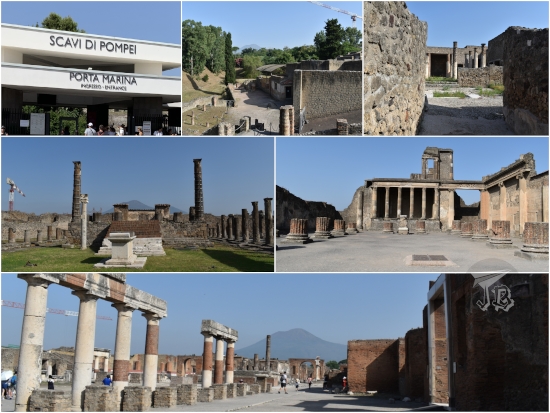
Casa di Romolo e Remo or House of Romulus & Remus; Santuario di Apollo or Temple of Apollo; Basilica (building where politics were discussed); Foro or Forum. Some sights even have Il Vesuvio looming about.
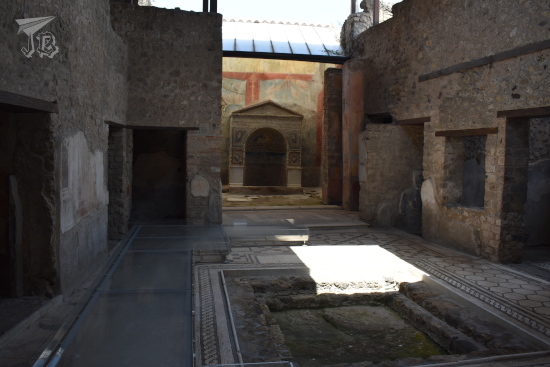
Collage showing some buildings of Pompeii

Casa del Menandro or House of Menander, with an almost completed atrium and peristylum, with great frescoes in situ.
Pompeii Casa del Menandro - hall and garden

Casa dell’Orso Ferito or House of the Wounded Bear, with incredible mosaics (closed, unfortunately)
Pompeii House of the Wounded Bear

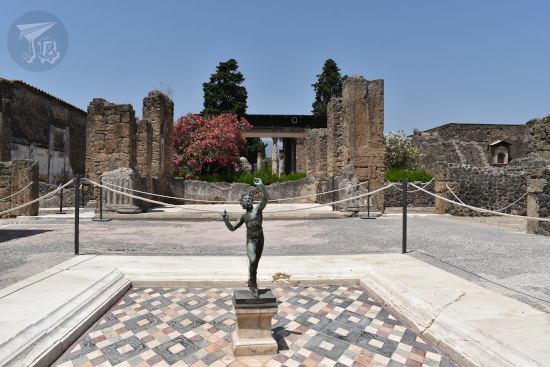
Casa del Fauno or House of the Faun, one of the most famous houses, and original home to a mosaic depicting Alexander the Great in battle.
Pompeii House of the Faun

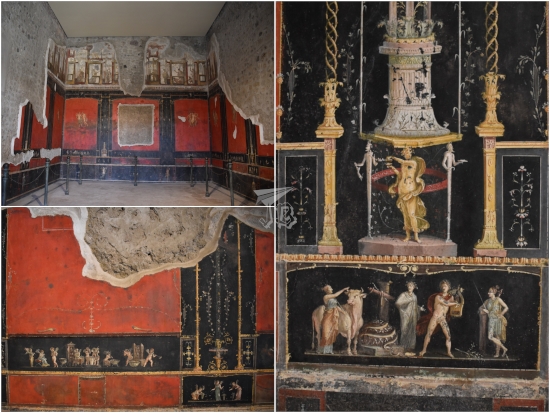
Casa delle Nozze d’Argento or House of the Silver Wedding, with fantastic frescoes, and tiny details, extremely detailed.
Pompeii House of the Silver Wedding

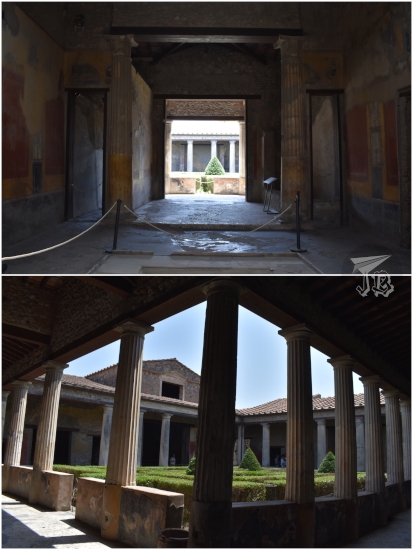
Casa dei Dioscuri or House of Castor & Pollux, in which the columns still keep some of the painting.
Pompeii House of Caxtor and Pollux

I visited around 75 buildings, and entered as many as I could. Towards 15:00, I again had a few buildings for myself, or with fewer people, and I wish I had had the energy to continue on. Unfortunately, the inner restaurant was super-full whenever I checked – which I did repeatedly between 12:00 and 15:00. However, by 14:00 I knew that I was overdoing it, so I started my retreat. I still had to see the Antiquarium or Pompeii Museum.

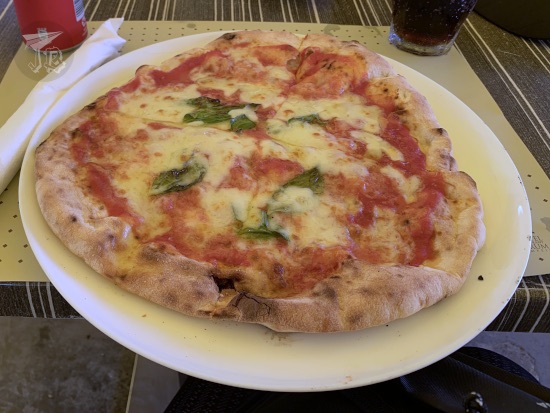
After I left the site, I stopped for a very late lunch (or a very early dinner) at a restaurant just outside the ruins. One of the waiters did not want to give me a table – or actually acknowledge me at all, I think this is the first time that I have actually felt the whole “solo travellers not welcome” echo, However, another one sat me, and I ordered the famous pizza Margherita, which is the big pizza in the Naples area. Not the Napoletana one, go figure.

A whole pizza Margherita

I took the train back, and I was in Naples with time to do something else. I had eaten and I was feeling better, but I thought that I had overdone it, and was worried about crashing the following day if I was not careful. Thus, I took a trip to another supermarket and went back to the hotel for a shower.


For the sake of completion, here is a relation of all the spots I visited in Parco Archeologico di Pompei or Archaeological Park of Pompeii:
Casa di Romolo e Remo or House of Romulus & Remus
Santuario di Venere or Temple of Venus
Casa di Trittolemo or House of Tryptolemus
Basilica (building where politics were discussed)
Santuario di Apollo or Temple of Apollo
Comitium ed Edifici Municipali or Hall of the Elections and Municipal buildings
Foro or Forum
Casa dei Mosaici Geometrici or House of the Geometric Mosaics
Palestra Degli Iuvenes or Gymnasium of the Iuvenes
Casa dei Cinghiale or House of Vesbinus
Terme Repubblicane or Republican Baths
Foro Triangolare or Triangular Forum
Santuario di Atena ed Eracle or Temple of Athena and Heracles (Greek Doric Temple)
Teatro Grande or Large Theatre
Quadriportico dei teatri / Caserma dei Gladiator or Quadriporticus of the theatre / Gladiator Barracks
Ingesso al Teatro Piccolo od Odeon or Entrance to Little Theatre or Odeon
Domus Cornelia or House of Cornelius Rufus
Tempio di Asclepio or Temple of Aesculapius
Casa degli Epidii or Casa de Marco Epidio Rufo or House of Epidio Rufo
Casa del Citarista or House of the Citharist
Casa de Casca Longus or House of Casca Longus
Fullonica di Stephanus or Fullery of Stephanus
Casa del Larario di Achille or House of the Lararium of Achilles
Casa del Criptoportico or House of Cryptoporticus
Casa di Paquius Proculus or House of Cuspius Pansa
Casa di Fabius Amandio or House of Fabius Amandus
Casa del Sacerdos Amandus or House of the Priest Amandus
Casa dei Casti Amanti or House of the Chaste Lovers
Casa e Thermopolium di Vetutius Placidus or House and Thermopolium of Vetutius Placidus
Casa di Giulio Polibio or House of Julius Polybius
Casa del Frutteto or House of the Orchard
Casa di Trebio Valente or House of Trebius Valens
Taberna di Sotericus or Tavern of Sotericus
Casa di Octavius Quartio or House of Octavius Quartio
Casa della Venere in conchiglia or House of Venus in the Shell
Anfiteatro or Amphitheatre
Palestra grande (Exhibition: “Arte e Sensualità nelle case di Pompei” Art / Sensuality in the Houses of Pompeii)
Pradeia di Guiulia Felice or Farms of Julia Felix
Casa del Triclinio all’aperto or House of Summer Triclinium
Casa del Larario Fiorito or House of the Floral Lararium
Osteria del Gladiatore or Inn of the Gladiators
Porta Nocera (gate)
Necropoli di Porta Nocera or Necropolis of Nocera Gate
Casa del Menandro or House of Menander
Casa dell’Efebo or House of the Ephebus
Casa del Criptoportico or House of Cryptoporticus (again)
Casa dei Ceii or House of Fabia and Tyrannus
Casa di Sirico or House of Siricus
Casa di Marte e Venere or House of Mars and Venus
Casa dell’Orso Ferito or House of the Wounded Bear
Casa dei Cornelii or House of the Cornelii
Terme Stabiane or Stabian Baths
Lupanare or Brothel
Arco di Nerone or Arch of Nero
Portico Della Concordia Augusta (Edificio di Eumachia) or Portico of Concordia Augusta (Building of Eumachia)
Tempio del Genio di Augusto or Temple of the Genius of Augustus
Arco di Caligola or Arch of Caligula
Terme del Foro or Forum Baths (this was the “house of the day”).
Casa del Fauno or House of the Faun
Casa della Caccia Antica or House of the Ancient Hunt
Casa di Arianna or House of Arianna
Casa della Fontana Grande or House of the Large Fountain
Casa della Fontana Piccola or House of the Small Fountain
Casa dei Vettii or House of the Vettii
Casa delle Nozze d’Argento or House of the Silver Wedding
Thermopolium (food shop)
Casa di Paquius Proculus or House of Cuspius Pansa.
Porta Ercolano (gate)
Necropoli di Porta Ercolano or Necropolis of the Ercolano Gate
Casa del Poeta Tragico or House of the Tragic Poet
Casa dell’Ancora or House of the Anchor
Casa di C.N. Caetroni Eutychi or House of C.N. Caetroni Eutychi
Torre di Mercurio XI or Tower of Mercury XI
Casa dei Dioscuri or House of Castor & Pollux
Tempio di Giove or Temple of Jupiter
Macellum (food market)
Antiquarium (museum)