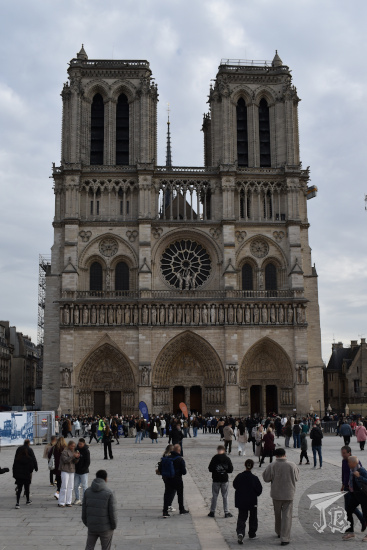
I left the house a little earlier than 6:30, and I reached the parking lot at 7:50, though the theory is a 38-minute drive – the joys of mid-week rush-hour traffic. But I made it, and it was only a few minutes’ wait for the shuttle-bus, so I got to the terminal pretty quickly after that. Security was smooth, boarding went well, and I got to snooze on my 9:45 plane. Pretty good jump, all things considered. We landed at Charles de Gaulle airport a few minutes early, and I was at the train station relatively fast. It was a short walk away, and it looked familiar – I had done it to get to my first-night hotel for the Saint Seiya Symphonic Adventure Weekend. I needed to buy a Navigo transport card too, on top of the price of the ticket, but after wrestling the machine, I just took the RER, and was downtown Paris around 13:00. I stepped out of the underground stop right in front of Cathédrale Notre-Dame de Paris.
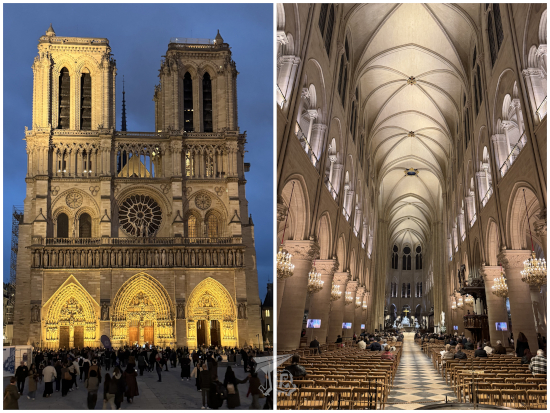
Notre-Dame (Our Lady) is the Catholic cathedral of Paris. It was founded in 1163, and its construction spanned about a century. It was repeatedly modified afterwards, with some reconstruction. The building is considered one of the most important examples of the French Gothic architecture, including innovations such as the flying buttresses, rib vault, and the rose window above the gate.
The cathedral was damaged during the French Revolution (1789 – 1799), and converted into a secular “temple of reason” – the Cult of Reason tried to take over Christianity during the period. In 1831, Victor Hugo’s novel The Hunchback of Notre-Dame (original title: Notre-Dame de Paris) was published, and it sparked renewed interest in the building. Around this time, architect Eugène Viollet-le-Duc was promoting gothic as the purest form of architecture, so he took up the refurbishing of the cathedral. He had a vision of restoration which implied “doing what the Medieval Builders would do with modern technology”, an approach that has earned contempt with time. He placed a spire on the roof of the cathedral, despite the original having been lost centuries before.
This spire was later destroyed during a fire in 2019. While the cause of the blaze has not been disclosed, flames ravaged the structure during 15 hours, destroying most of the wooden parts of the cathedral, and damaging the upper walls. The fire broke out around 18:20, and due to problems or mistakes, the firefighting brigade was not notified until almost 19:00. Paris firefighters had trained extensively to prevent a disaster in the building, but the old wood had been burning for 40 minutes when they arrived. Most of the extinction work was carried out within the walls of the building itself – I clearly remember that there were fears that a tower would collapse on the brigade.
Fortunately, the stone structure of the ceiling and walls withstood the blaze, and the building did not cave in. The cathedral holds relics important to Christianity, including the purported Crown of Thrones, and those were taken out for safekeeping. Furthermore, a number of artworks had been removed because there was restoration going on. When I was in the area in February 2020, just before the Covid lockdowns, I was shocked that the site still reeked of smoke.
Though the Catholic church as exclusive and perpetual right to use the building, Notre-Dame belongs to the French Government. It was declared historical monument in 1862, and it has been part of the Unesco Heritage Site Paris, Banks of the Seine since 1991. All these characteristics protected it from “daring” post-fire projects such as modernist windows or alternative spires. The first phase of reconstruction were consolidation projects, to make sure the water had not damaged the stone, building scaffolds which have not been completely taken down yet. Then the debris was taken out, and finally rebuilding work would start in 2021. Though some experts predicted decades of reconstruction, the cathedral safely opened for Advent in 2024, though there are still works going on.
Despite having a timed ticket for peace of mind, I did not need it. There were barriers to optimise a queue, but I only had to walk through. I went to show my backpack to the security guards, and they were extremely nice and laid-back. When I said I was coming from the airport, they waved me through after a quick visual inspection.
My feeling when I got inside was “woah, white”. The walls were treated with a special solution that not only removed the soot, also did away with centuries’ worth of patina. The building was packed, so it was hard to wander around and enjoy, but Notre-Dame is one of my favourite pieces of architecture, and I loved being able to walk inside once more. Nevertheless, I preferred the old, greyish interior. To collaborate with the cathedral’s maintenance – or so I tell myself – I bought a commemorative coin. Then I decided I needed the second one (do keep score, this whole thing with the coins was to become a pattern in this trip).
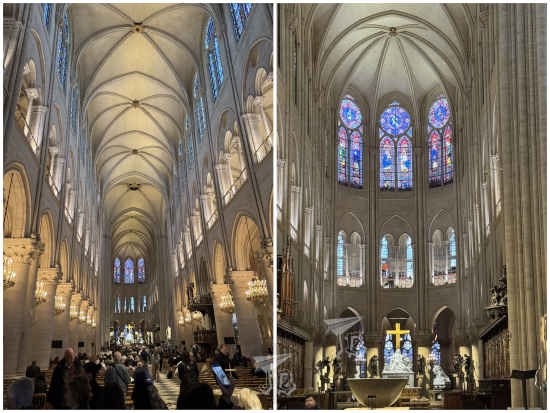
I could see people working on the second floor behind the altar, it was a bit surreal. After I had walked the inside, I went around the building to check out the construction, then moved on along the Seine towards another of my favourite places in Paris, the Gallery of Palaeontology and Comparative Anatomy, Galerie de Paléontologie et d’Anatomie comparée, part of the French National Museum of Natural History, Muséum national d’Histoire naturelle. The gallery is going to be “closed for refurbishing”, which I fear will make it lose its charm, so I really had to visit this time around.
The French National Museum of Natural History was established in 1793. However, the project that would eventually lead to this gallery did not start until the Gallery of Zoology had been inaugurated, in 1889. The building was designed by architect Ferdinand Dutert, with two floors and three levels, alongside a few balconies. It was erected between 1893 and 1898, when it was inaugurated. The structure is stupidly impressive and beautiful – the outside is made of brick and the interior has mainly metal and wood. Most of the second floor is actually a mezzanine, which originally held the collection of anthropology, and now the plant fossils. The first floor holds the palaeontology specimens, and at ground level stands the compared anatomy collection. It is a museum of its time, with that charm that contemporary ones do not hold.
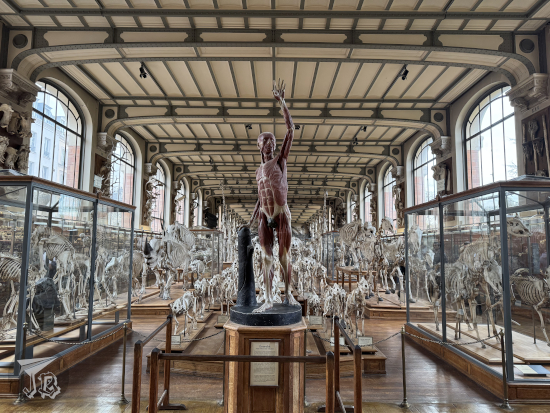
Upon entering, my backpack was thoroughly checked – the guard even made me use my phone to give him light as he went through my stuff before he let me in. I paid my fee and stepped into the ground floor, with its cavalcade of skeletons. As you enter, a human figure greets you, and behind him stand hundreds of mounted skeletons, the Gallery of Comparative Anatomy, following a very specific order – and one day I hope to know enough French to understand. First there are the pinnipeds and land carnivores, then herbivores and after a small separation, the cetacean group. On the cases along the walls, birds and smaller mammals are protected. The the far right corner, there is a small (but creepy) collection of “aberrations”.
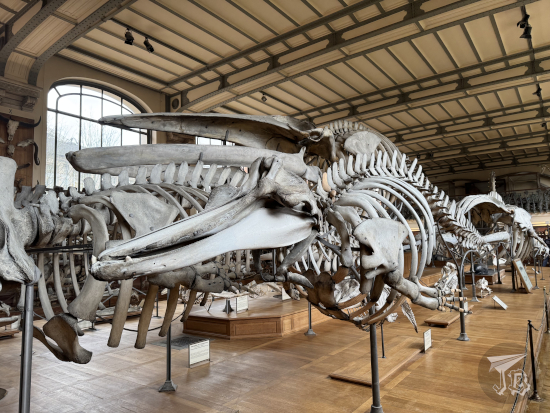
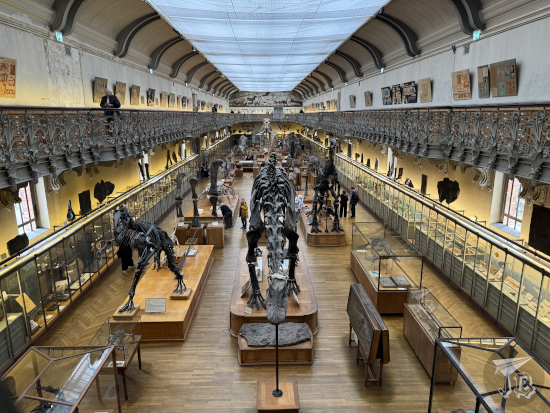
The first floor, which is accessed through a stone staircase, holds the Palaeontology Gallery, with casts of the specimen of diplodocus, a T-Rex, allosaurus, a replica of one of the Bernissart iguanodons, allosaurus, pterosaur, sarcosuchus… On the other side of the ward stands an impressive mammoth, known as Le mammoth de Durfort (the Durfort Mammoth). Discovered in 1869, it is one of the largest of its kind (Mammuthus meridionalis) ever assembled. It has been recently restored, too, so it looks rather impressive. To its side stands the only authentic skeleton of the only woolly mammoth (Mammuthus primigenius) preserved outside Russia.
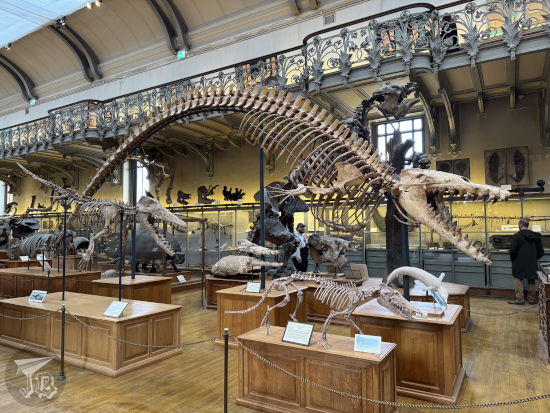
There is also a skeleton of a Cynthiacetus peruvianus, a toothed whale, one of the oldest cetaceans ever discovered. This creature lived around 37 million years ago, in the Late Eocene. The whole gallery is fascinating, if also a bit unsettling, especially the ground floor. I could’ve stayed there for hours, but my friend D****e’s plane had landed a little early and I had promised to meet her at the station.
I then ran into a problem in the underground. It turns out that you cannot put a ticket in a Navigo pass that you have used for the airport (at least on the same day), so I had to purchase yet another pass! We managed to meet and headed to the hotel, where we only got one room card because it was strictly not taking it out. They were very upset with me for not speaking French – I can speak a bit of it, and I read it pretty well when it’s simple (so no detailed anatomy explanations) and I’ve got time, but I can’t understand much beyond the super-basics to save my life.
D****e suggested going out for a walk, and we headed off. The street where Le Bataclan was closed off as there was a remembrance ceremony for the victims of the terrorist attacks. We then headed further towards Cathédrale Notre-Dame de Paris (yes, again. No, I did not complain). We were shocked about the number of police officers that were around, but later we learnt that there was another ceremony at the nearby town hall, which was lit in the colours of the French flag, like the Palais de la Cité opposite Notre-Dame. There was again no queue to enter the cathedral, and the building was open late, so we took another tour inside, as it was artificially lit. On top it being Thursday, there was a mass, maybe for the victims of the attack too. The night felt pretty heavy, to be honest.
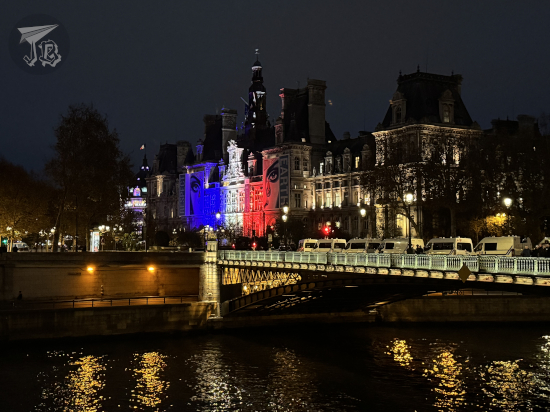
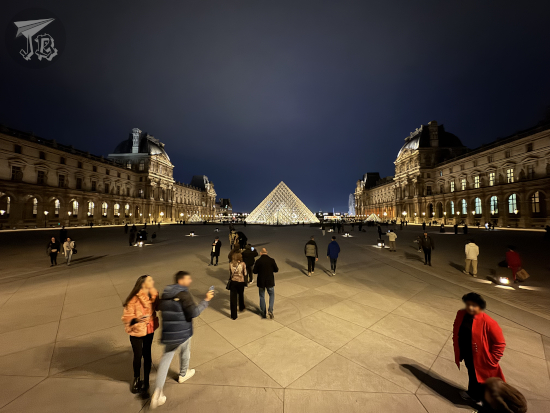
We walked a bit further, strolling along the Seine. We passed by the church Saint-Germain-l’Auxerrois on our way to take silly pictures with the Louvre Pyramid Pyramide du Louvre, the polemic skylight entrance designed by architect I. M. Pei and installed in 1989. Back then, it was incredibly controversial, especially due to how it clashed with the French Renaissance style of the square and buildings around it. I personally think the structure is ugly, but it has been there for most of my life, I can’t remember the Louvre without it.
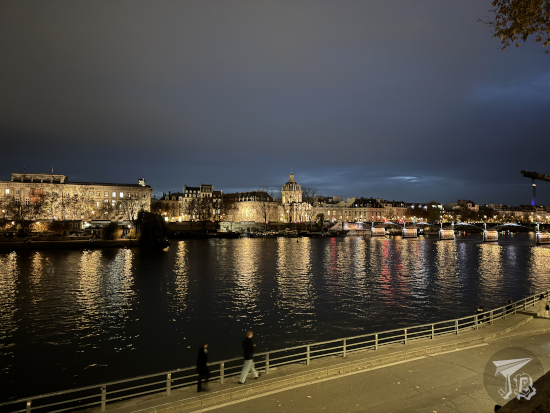
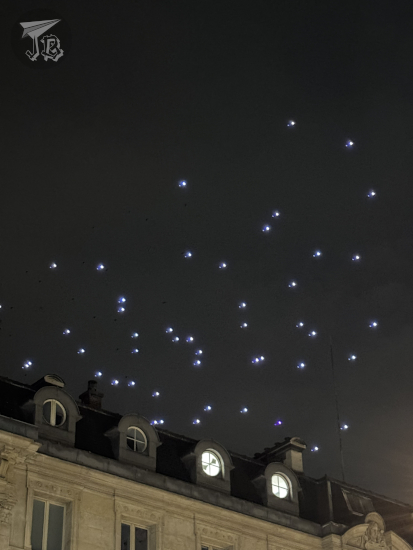
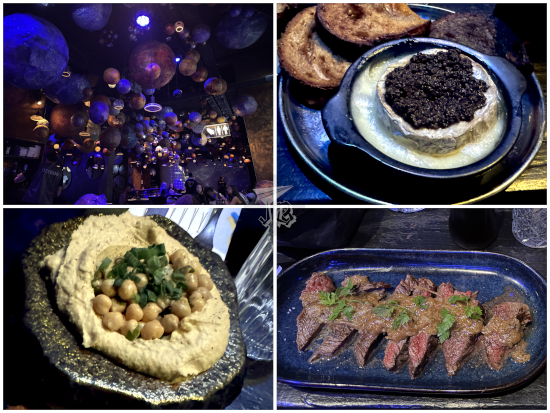
We then headed back towards the hotel area. We walked back by the memorial service at the town hall, they had launched drones up to the sky. For dinner, I had found a fun place called Stellar which reminded me of the rock band Starset, and booked it. I figured that if she was too jet-lagged, we could always cancel, but that way we had a secured spot. Stellar is managed by the group Ephemera, which creates “immersive restaurants”, and this particular place is “set in space”. The light is low, there are planets and stars hanging from the ceiling, and the solar system slowly slides around you in giant screens. It was really cool, and they were happy to help us in English.
Stellar makes a point of telling you where their dishes, recipes and ingredients come from. We chose three items to share: Truffle baked Camembert (from France), Galactic houmous (from the Middle East, but with a Mediterranean twist – olives), and Shallot flank steak (medium-rare, also from France, though the actual meat was Irish) with fries. The houmous was a bit too heavy, but everything was delicious. The decoration was amazing too, and we had a great time as planets and moons floated around us. Once you book, you have a table for 75 minutes, and they were so efficient that it did not even feel short – we were waiting for food for a very short time. We forewent desserts because we were full – even if I had somehow managed to skip lunch. That was not a great idea… I think I’ll try to chase a couple more of the immersive restaurants if / when I come back to Paris.
We headed back to the hotel for an early night, though I did not sleep that much, if at all, and the night was very short.
 JBinnacle – A Travel Logbook