
I was determined to cross as many things on my bucket list as I could in this trip as I could, and that involved some crazy travelling – in this case, two hundred eighty-something kilometres, four trains, and a bit over five hours. In order to make it work, I needed to leave Osaka around 7:00. From the hotel I took the Midosuji underground line from Doubutsuen-Mae Station to Shin-Osaka station, where I took the Tokaido-Sanyo Shinkansen to Okayama – the first 2.5 hours. There, I took the Yakumo Limited express to Yonago [米子市] (a bit over an hour). There, I had to change to, the JR Sakai Line which would finally take me to Sakaiminato [境港市] in Tottori prefecture – it took 45 minutes to travel the last 18 km.
Sakaiminato is “The City of Kitarō and Fish” – Fish is quite self-explanatory. Kitarō is the main character in the manga Ge Ge Ge no Kitarō [ゲゲゲの鬼太郎], often quoted as the reason why yōkai and other elements of Japanese folklore and mythology became popular in the 20th century. Yōkai [妖怪], literally “strange apparition”, are mythological creatures unique to the Japanese islands. They tend to represent nature or societal phenomena, some of them have animal features or are part-human part-animal, or anthropomorphised animals. Many others are rooted on the Japanese idea that inanimate objects have or can develop a spirit. Some yōkai are benevolent, others are evil.
The creator of the manga was Mizuki Shigeru [水木 しげる] (1922 – 2015). He was born in Osaka, but his family moved to Sakaiminato when he was young, and he grew up there. After being drafted to fight in World War II, he became interested in travelling and mythology. Back in Japan, he started the manga in the 1960s. Aside from writing and drawing Ge Ge Ge no Kitarō [ゲゲゲの鬼太郎] (Ge Ge Ge being an onomatopoeia of creepy grave yard noises), he was also a great connoisseur of Japanese folklore, especially monsters, ghosts, and yōkai.
Ge Ge Ge no Kitarō went through a few names and formats to its final form – and there have been anime adaptations as recent as 2018. Kitarō, the main character, is a young yōkai boy who lives between the worlds of humans and yōkai. His usual adventures involve protecting people from both evil yōkai and monsters of western origin. Other characters appear through the story, such as Medama-Oyaji, the “ghost” of Kitarō’s father, incarnated in his eyeball, the Rat-Man (Nezumi Otoko) or the Cat Girl (Neko-Musume).
Most of Kitarō’s adventures happen in or around Sakaiminato, and the town has decided to honour Mizuki’s yōkai legacy – or turn it into a tourist attraction. The inhabitants embraced its yōkai fictional legacy with glee… and stamps. Sakaiminato is all and everything about yōkai.
The magic started when I reached Yonago [米子市] Station: there, the platform is decorated with sculptures and statues, a prelude of what one finds when arriving in Sakaiminato. The train in the JR Sakai line [境港線] was also decorated with some of the characters of the manga. Furthermore, a lot of stops of the Sakai Line, aside from their actual name, are nicknamed after a yōkai.

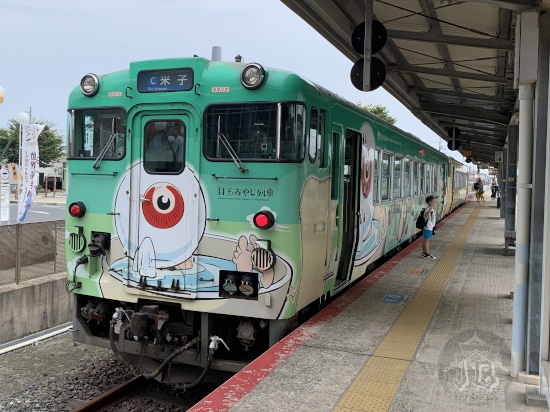
I finally reached the Sakaiminato station, Sakaiminato-eki [境港駅]. Upon exiting the train, the first thing I saw was a mural with all the recurrent characters in the manga. The second, that the street lights were shaped like Medama-Oyaji, Kitarō’s eyeball-shaped father.

As I came out of the station, I was greeted by a bronze statue of Mizuki Shigeru writing among his characters, and a themed postbox. At the end of the block there was a mall-like building (actually, a cultural centre) which holds the Tourist Information Office. There, I got a copy of the yōkai booklet to carry out the Yōkai Stamp Rally [妖怪スタンプラリー]. The booklet was 120 ¥, of course I could not let it go – there are 35 stamps to collect, and if you get all the stamps of the main rally, you get a small certificate. There are extra stamps for day trips, too. I wish I had known beforehand, I would have planned two days out there to try and complete it.
In order to complete the stamp rally, you have to go down the main street and stop at the many shops which have a small stand out front with a stamp and an ink pad. It was stupidly fun to do, even if there were a few parents who thought nobody but their kids should get stamps and a certificate. Some of the stamps were “hidden” away from the main street and the documentation is in Japanese, so some effort is required – or just use the convenient interactive map.
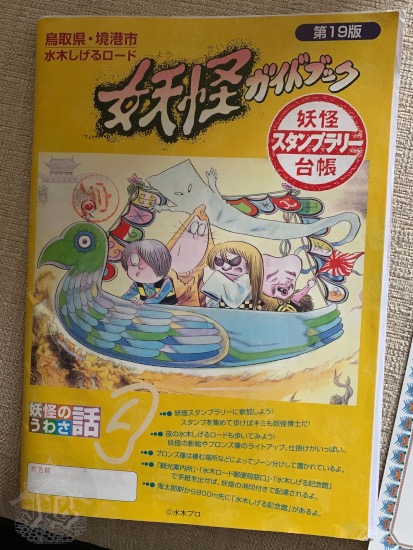
Booklet acquired, I could go forth and explore (and stamp). I backtracked towards the bronze statue of Mizuki Shigeru writing among his characters Mizuki Shigeru-sensei Shippitsu-chū no Zō [水木しげる先生執筆中の像], and the Kitaro postbox [鬼太郎ポスト].


And as you follow the road and turn the corner you directly go into Mizuki Shigeru Road. However, when have you read me going into something directly without getting distracted? First I had to see the Yōkai World Summit, Sekai Yōkai Kaigi [世界妖怪会議].
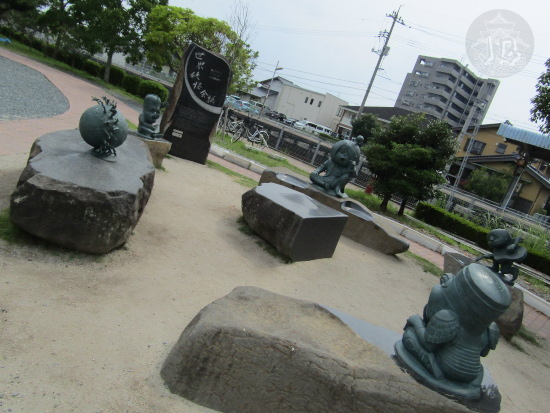
Finally I got down to Mizuki Shigeru Road [水木しげるロード], which features dozens of small and not-so-small bronze statues representing yōkai as they appear in the manga, alongside the characters designed for the story itself. The Tourist Information claims that there are 177 statues in total. I honestly did not count. Shops line to the sides, and a bunch of them have the stamps that you ink on your booklet – and it was hard to get to them, it was so crowded!
I walked the right side to the end, then I decided to come back to check into the hotel, which was close to the station, and drop the luggage. Why didn’t I do that from the beginning? Either it was too early for check-in, or I was eager to get started with the stamps, or maybe both. I reached my hotel and it was gorgeous! It was actually the most expensive hotel in the whole trip, but it was amazing! Outside, it was just a brick building. Inside, it was full of wood and tatami, and so was the room. There was an onsen (artificial hot spring) on the uppermost floor, which I decided I would visit later.
I actually felt a bit bummed that I only had a night there, because I would have really stayed in that room for hours just lounging around – and there were more stamps to collect… But as soon as I thought about the stamps I realised I just had to go out again to continue my adventure. There were lots of things to see and do! Thus, I headed out again, and realised I needed to find myself some food as it was close to 15:00 and I had only had a coffee and a cracker at around 8:00. Then, I set off to walk the left side of the Mizuki Shigeru Road. Of course, every time I went up and down the street I took photographs…

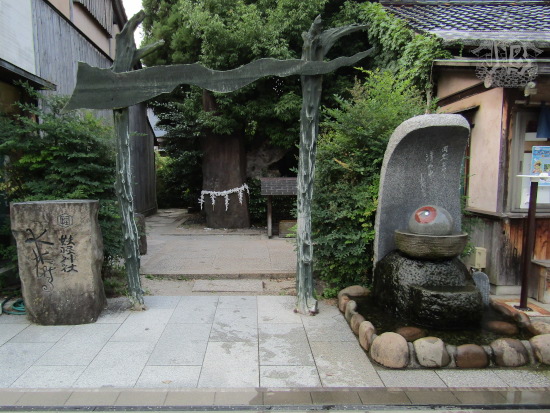
Of course, I also had to visit Yōkai Jinja [妖怪神社] on the way (the amount of time and times I had to wait till I was able to take a picture of this without anybody in it was ridiculous (≧▽≦)).
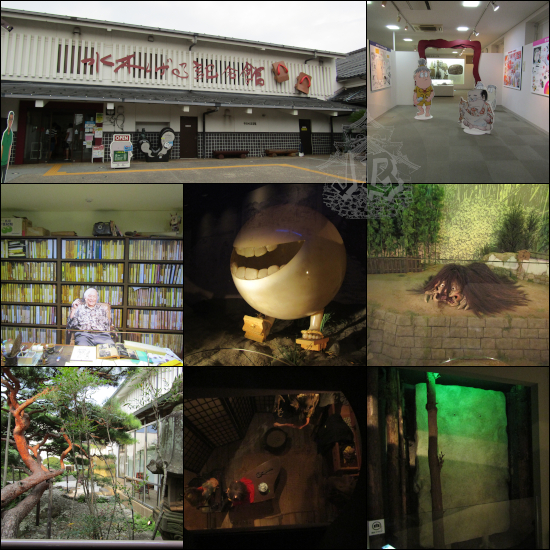
At the end of the road, I had seen the Mizuki Shigeru Museum, Mizuki Shigeru Kinen-kan [水木しげる記念館] and I knew that it was open (on a Monday!) until late (in Japan!). I actually had put Sakaiminato on the schedule like this so I could make the most out of the Monday. I decided to enter before I had finished the stamp rally, because I keep getting distracted by shiny new things. The Museum features some of the original manga strips, a replica of Mizuki’s office, some items of his mythology-artefact collection and personal library. You can peek at haunted house and see a lot of “domestic” yōkai that that may lurk in a traditional home. There are also replicas of different yōkai – big, moving, and trying to be creepy but only managing to be awfully cute: Nurikabe, Shirouneri, Otoroshi, Azukihakari, Betobetosan, Suiko, Akaname, Miagenyudou. There are also photo spots to compensate that more than a few items cannot be photographed. The museum also had a nice garden for the “wild” yōkai.
I still had a few stamps to go, so after I left the museum, I diverted towards the harbour to find them. That is how I ended up at Ominato Jinja [大港神社], a much more traditional shrine, not for tourist but actual practising.

It was time to look for the “hidden” stamp spots. The very last one I found was at the Sakaiminato Ekimae Police Box, Sakaiminato Ekimae Kōban [境港駅前交番]. I had completed the booklet in one afternoon! However, it was just around 18:00, so the tourist office was already closed. I saw something called “Kitarō Haunted House”, but I did not enter – it seemed to be for kids, and I did not want to brave too many hyper-protective fathers.

Instead, I went to the harbour to have a look at the setting sun. This was my first time in the west of Japan, so I thought I could see the sun going under the maritime horizon. I had not counted on the bay, but it was overall pretty.

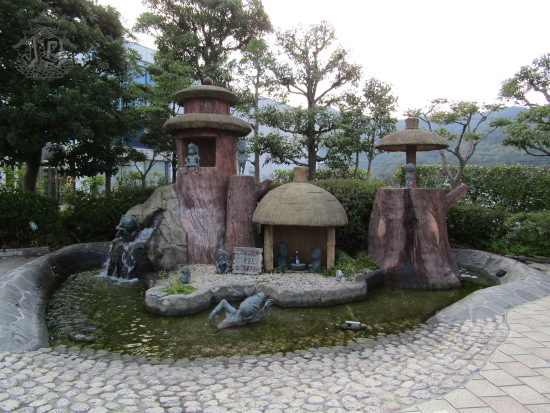
As it was “after hours”, I went to look at the fountain Kappa no Izumi [河童の泉]. That day, the city employees had been cleaning it, and I did not want to take pictures with the workers in them, or disturb their work and power-washing. The fountain was still not running, but the city officials had left.
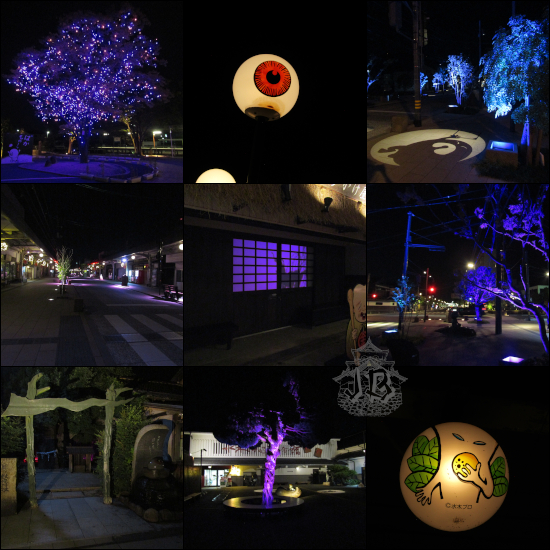
Afterwards, I tried to grab a bite to eat, but most places had either shut down or were not taking customers any more by 18:00. Thus, I found myself some conbini food, and headed back to the hotel. I had a nice traditional bedroom and a fantastic shower, but honestly, I ignored it in favour of the onsen. I went there to enjoy a long soak. As night falls and the shops close down, it looks like this small Japanese town would go quiet. Nothing further from reality! The Mizuki Shigeru Road displays a creepy illumination complete with sound effects. This is probably an incentive for people to stay overnight. I had read about it on the brochure, so of course I walked out again to see the town at night.
The whole Mizuki Shigeru Road had been completely overtaken by the wannabe creepy atmosphere – at least. There was music, and some of the shop windows had shadows. The Medama-Oyaji street lights flickered. Suddenly, as I was walking down the road, there was a thunderclap sound and all the lights went out at the same time. I jumped! They got me good! Well, me and everyone who was just experiencing it for the first time. Part of the fun became identifying when the lights would go out and watching out for people getting as startled as you had been. I plead guilty of doing it.
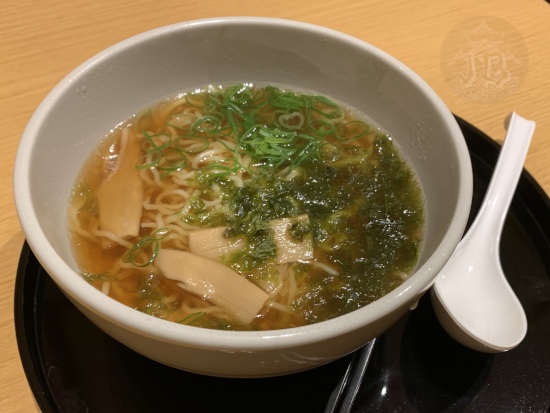
I went back to the hotel around 21:00. However, as part of the stay-in-town incentive, my hotel also offered a free bowl of ramen between 22:00 and 23:00. I wondered if it would be greedy to go and have it, but I decided to take full advantage of the offer. Thus, to finish the day, I got free ramen at the hotel for dinner! Indeed, I could have stayed in that hotel for days on end!
I went to bed soon after. But remember, Sakaiminato is “The City of Kitarō and Fish”. I had done the Kitarō part. The following day, I needed to focus on the fish.
Walked distance: 13641 steps, 9.76 km in one afternoon/evening. It was bloody amazing and I had a blast!
 JBinnacle – A Travel Logbook