
Due to poor planning on my side – that happens sometimes – Friday was a weird day. Part of me keeps thinking that I should have taken a train or a boat somewhere, but I actually managed to do most of the key sights in Naples. Acting on a recommendation, I had booked a 10:00 visit to the Catacombs of San Gennaro Catacombe di San Gennaro, part of the Catacombe di Napoli (Catacombs of Naples) network.
I bought a multiple-trip public transit ticket and I set off around 8:00. The underground-bus commute was to take 45 minutes, but the underground alone took that long. Thus, I decided to do the second leg of the trip on foot, up the hill Collina di Capodimonte. The bus trip was to take 20 minutes, and the walk 22 – I took less than 20 and I did not even see any bus going where I wanted to be… then again I was stupidly early in the end…
The cult to San Gennaro (Saint Januarius) is deeply felt in Naples – the miracle of his blood turning liquid three times a year is just one of the signs. They buried, exhumed, and reburied the man up to seven times if I understand correctly, and he is not even in the catacombs any more, but in the cathedral. The catacombs are excavated into the volcanic tuff that conforms the hill, and they date back to the 2nd century CE. They were located outside the city walls, as were all the graveyards at the time. The original tomb was expanded to accommodate palaeo-Christian burials. The first patron of Naples, Saint Agrippinus, was buried here and a basilica was constructed in his honour. After his burial in the 4th century CE, the catacombs became… popular. Eventually, San Gennaro was buried there in the 5th century and the place became a pilgrimage site until his body was moved to Benevento.
The catacombs have two levels, and can only be visited in a guided tour. They were restored in 2006, and are currently managed, by a cooperative which tries to promote Naples heritage and improve the city, providing working opportunities for young people. They tackled the restoration of the catacombs in 2006. Our guide asked if anyone had visited any catacombs before, I said that I had visited the Catacombs of Paris, but she did not make any… further comment about anything. There are no bodies in the Catacombs of San Gennaro, which is almost weird considering how morbid Neapolitans are.
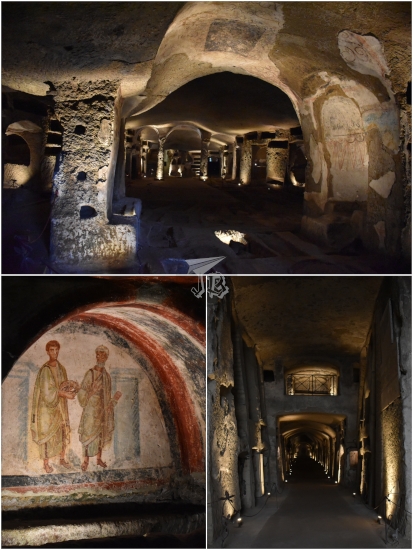
What you can find in the catacombs is a powerful example of underground architecture. Everything is directly carved into the rock, except for a few bricks here and there (and some scaffolding). There are three types of tombs: fossa (ground burial, vaguely body-shaped), loculo (stacked tombs built against the walls) and arcosolium (a carved tomb carved into the wall and a protective arch surrounding it). Some of the walls and tombs still have frescoes, a few of them with recycled symbolism from the pagan times, such as the god of wine Bacus’ vines being reinterpreted as a Christian theme of Jesus as the ‘true vine’, God as the husbandman, and the disciples as the branches.
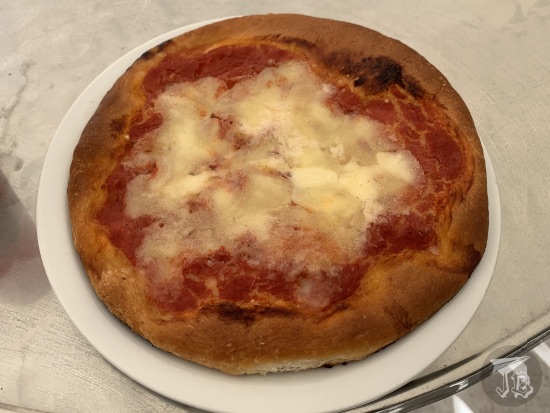
The visit ended at the basilica San Gennaro Extra Moenia or St Januarius Beyond the Wall – due to it being outside the city’s protective walls, even if these walls are long gone. As the reception area had a small cafeteria, I headed there for a late breakfast (second breakfast? super early lunch?). It was around 11:00 and I ordered a mini-pizza and got myself a cold coke. I felt much more alive after that.
I went uphill for Museo e Real Bosco di Capodimonte, one of the former royal palaces Reggia di Capodimonte, and the forest that surround it. The palace was built in the Italian Baroque and Neoclassical styles between 1738 and 1840. A cohort of architects worked on it, the most credited being Giovanni Antonio Medrano. Although today the palace is technically a museum, the ‘good’ paintings have been moved for restoration, so I decided not to go in. But I might have got sunburnt on the walk.

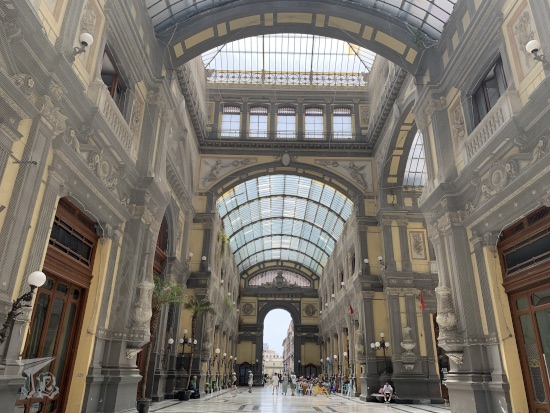
I went back down Capodimonte Hill towards Central Naples, and I made a stop at Galleria Principe di Napoli, a commercial gallery dating back from the 19th century. It was originally built in brick, with a cover of iron and glass. Today it is almost unused as most of the shops have closed or moved, and there have been recent mini-collapses which worry local authorities.
I walked into the underground system – which does not have air-con and was crowded. I stopped at Stazione Toledo, one of the stations belonging to the project Stazioni dell’Arte (Art Stations), a city project to beautify Naples’ transport hubs. Óscar Tusquets designed Stazione Toledo, and it has earned the reputation of being the most beautiful underground station in Europe.

Afterwards I went back to the platform to wait for a train to head to the harbour – the frequency is 15 minutes, but at least I was sitting down. I should have eaten something , but it was too hot – I bought a bottle of water and an ice cream (which was not even actual Italian ice cream) and continued off. I saw the outward of Castel Nuovo, a medieval castle dating back from 1279, commissioned by Charles I of Anjou. Had it had an open ticket office, I would have come in, but you could only book online and I really did not want to go around entering my bank data in the middle of Napoli.

Thus I walked past the theatre Teatro di San Carlo and headed off towards the square Piazza del Plebiscito. On one side stands the church Basilica Reale Pontificia San Francesco da Paola, which was getting prepared for a wedding. On the other side, the other Naples Royal Palace Palazzo Reale di Napoli. The palace was one of the Bourbon residences during the time of the Kingdom of Naples and the Kingdom of Two Sicilies. Like the Capodimonte one, it is built in a mixture of Italian Baroque and Neoclassical styles, and it is attributed to Domenico Fontana. I snooped around the free areas of the palace.


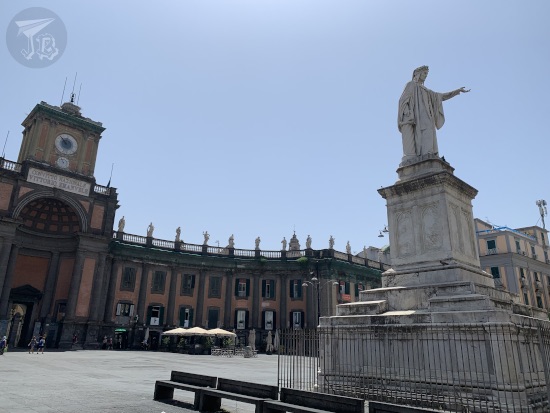
There is another shopping gallery next to the palace, the Galleria Umberto I, a little more alive than the Prince of Naples if only because there were tourists groups using it as a meeting point. I crossed it on my way to the underground stop. I took the train again and alighted at the square Piazza Dante, with the monument to the famous poet Monumento a Dante Alighieri and the school Convitto Nazionale Vittorio Emanuele II, whose tower is called the Equation of Time Orologio Equazione Del Tempo, with a double clock to reflect both solar hours (apparent solar time vs mean solar time) simultaneously.
I headed out to the chapel-museum Museo Cappella Sansevero, which is reported to always have long lines. I wanted to check if there were advanced tickets. Upon arrival around 15:15, I managed to get a slot for 15:30, and I was admitted a bit after 15:20. Pictures are not allowed and the guards patrol like eagles, so I could not even a sneak one. The chapel is home to a number of incredible Baroque and Rococo sculptures. The most important one is the masterpiece known as the Veiled Christ Cristo velato by Neapolitan sculptor Giuseppe Sanmartino (1720 – 1793). The sculpture was commissioned by Raimondo di Sangro and completed in 1753. It is so impressive that a legend says that an alchemist transformed the veil from a real one into marble.
Other incredible sculptures are Release from Deception and the veiled Modesty. When you go out, you are forced to cross a small cabinet which holds something called Le Macchine Anatomiche “Anatomical Machines” (Giuseppe Salerno) which are real-life skeletons with a reproduction of the vascular and circulatory system.
My final stop for the the day was Complesso Monumentale di Santa Chiara, a monumental complex comprising a church Chiesa di Gesù Redentore e San Ludovico d’Angiò, a cloister Chiostro maiolicato, a museum Museo Di Santa Chiara and a Roman archaeological excavation Scavi archeologici Santa Chiara.
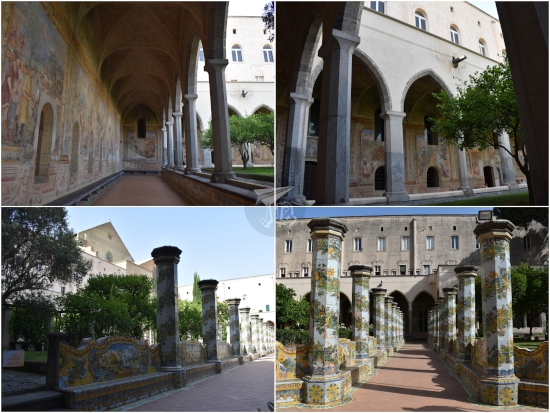
This religious complex started off as a Clarisse monastery built between 1313 and 1340. The cloister is square, and the arcades are covered in frescoes. The cloister itself is considered unique, as in 1742, Domenico Antonio Vaccaro built two avenues of octagonal columns. These pillars, along with the benches that join them, are decorated in the Rococo style, covered with majolica tiles in floral and everyday-life themes. A bit too fancy for a Poor Clares convent… though I really liked the columns and the cloister.
The library contains codexes. The Roman ruins are from a Roman bath, but with Pompeii and Herculaneum so recent in my mind, they were not that impressive, I guess. The museum holds pieces from the baths, religious artefacts from the church before it was burnt, and other religious paraphernalia.

The church was originally erected in the Angevin Gothic style, with some original Romanesque left, and it was redecorated in Baroque style in the 17th century. After being damaged during the WWII bombings, it was restored “in style” – meaning, how it was supposed to have been before the Baroque decorations.
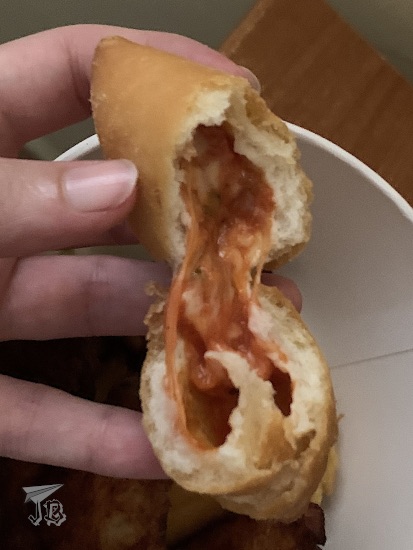
After the church, I went back to the hotel and I decided to try one of the McDonald’s item that is typically Italian – not found anywhere else, a Tasty Basket: McNuggets (found everywhere), chicken wings (found in more places), and panzerotti con pomodoro (typical Italian, a panzerotto is a small calzone with the same dough and seasoned tomato as pizza). It was either strangely good or I was hungry.
 JBinnacle – A Travel Logbook