23rd May 2025: Valletta {Malta, May 2025}

Around 5:00, I was woken up by a group of guys singing, and I thought they were outside, drunk and going back to their hotel. It turns out that Saint Julian’s | San Ġiljan is a party area. I had absolutely no idea – I would like to chalk that up to the improvisation again, but to be honest the concept of a “party town” is one that had not even crossed my mind till then. I did not sleep much afterwards, so a bit after 7:30, when breakfast opened, I headed there, then I took the bus towards the capital, Valletta.

My first stop was a compulsory one – the City Gate | Bieb il-Belt which I had to cross to walk into the city. The capital of Malta was declared a Unesco World Heritage in 1980 under the name City of Valletta because with 320 monuments in 55 hectares, it is one of the most concentrated historic areas in the world. The city was erected by the Knights Hospitaller around a watch tower that was demolished to create a large defensive fort. After said fort fell during the Great Siege of 1565, the Grand Master of the Knights Hospitaller Jean de Valette decided to build a grand fortified city with plans by Francesco Laparelli. Neither Valette nor Laparelli saw the city complete, which happened in the 1570s, when it became the capital. The Gate is the entrance to the fortification itself, separating Valletta from the city of Floriana. Protected by its the walls, Valletta thrived and though 17th the century it became filled with manors and palaces, some of which have now been repurposed as hotels or museums.

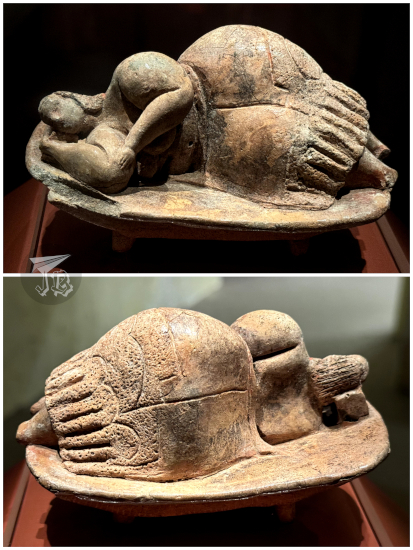
One of such buildings is the National Museum of Archaeology, which hosts artefacts from the Neolithic (around 5900 BCE) to the Phoenician period (circa the 6th century CE). On the ground floor they have all the items that have been removed from the Neolithic temples for protection, including some of the carvings from Ħal Tarxien Prehistoric Complex. A tiny clay figuring called The Sleeping Lady captured my attention. It was a lovely detailed little representation from the so called Temple Period of Maltese history (4000 – 2500 BCE), which was recovered from the Ħal Saflieni Hypogeum. There are also headless bodies and bodiless heads found at other temples.

Archaeological Museum Valletta: pieces taken from the Temples in order to protect them: carved rocks, statues (most of them of bodies without heads), trilithons...

Archaeological Museum Valletta: Sleeping lady. A small figurine of a woman sleeping made in clay

I proceeded upstairs, where there is a small exhibit on “cart ruts”, a network of tracks in the rock. The analysis seems to show that they were made by carts with wooden wheels eroding the limestone. However, there are no… traces of whatever pulled on them – no tracks, no trails, nothing but the wheels. There is another room displaying Phoenician civilisation, and one showing some amphorae from a shipwreck off Xlendi Bay in the island of Gozo, at a depth of 110 m. The ship sank in 700 BC, it was discovered in 2007 and it was finally excavated between 2018 and 2021.

The final room I saw hosts a few skulls from the Ħal Saflieni Hypogeum. I might have to return to Malta just to finish exploring all the prehistoric sites – aside from that, there is sea, the food is delicious and when you open the tap, the water is warm. I felt right at home, really. Anyway, some of these skulls are described as “elongated” and for a while there was even a conspiracy theory about them being alien… They are not. The elongation was not artificially created, like in some Mesoamerican cultures. They belonged to a few individuals who had… long heads. Which is a bit anticlimactic, but only a few remains have been recovered from the calculated thousands, so there is very little that can be inferred from whomever was interred in the burial chamber.

Archaeological Museum Valletta: Phoenician pottery, skulls from the Hypogeum, anforae from the shipwreck

There was actually a last-last area, a ball room from the Baroque palace, but that was under construction and I could barely have a bit of a look. Afterwards, I walked towards the St. John’s Co-Cathedral | Kon-Katidral ta’ San Ġwan. The Catholic co-cathedral shares responsibilities with the one in Mdina, and was built between 1573 and 1578 in a Mannerist style. The interior was redecorated in the 17th century in a very Baroque style and lots – and I mean lots – of gold and golden decoration. Downstairs, there is a crypt where some Grand Masters of the Knights Hospitaller are buried. On the main floor, the nave is surrounded by nine chapels, eight of which are dedicated to the different chapters of the Order and their patron Saint, and the last one is dedicated to and one to the Virgin Mary. .

Though you can get tickets online, there is no chance to buy same-day tickets but on site. I queued for a while, maybe 20 minutes or so, before I was scanned for… guns and explosives… then I was allowed in. There were small restoration works being carried out. Not a Baroque person in general, but I have to admit it was impressive. I declined climbing to the dome because the fun views are from across the harbour, not from inside the city itself.

The co-cathedral holds two pieces of art by Caravaggio – The Beheading of Saint John the Baptist and Saint Jerome Writing, both in the chiaroscuro style – with high contrasts of light and dark. Michelangelo Merisi da Caravaggio (1571 – 1610) was one of the maximum representatives of chiaroscuro, with usually violent and gruesome topics, usually disguised as hagiography.

Baroque interior of the cathedral, with dark walls decorated with frescoes and golden wood

After I exited the cathedral, I headed down a small alley opposite for something that is not a monument but… made me happy anyway. Malta has Costa Coffee – something which, unlike the plugs, I had thought of checking beforehand. I actually had a shop near my hotel. Had I known that, I might have skipped booking breakfast. What I did worked really well though, so no big deal. I managed to balance breakfast and dinner, which made my moving around more convenient, not needing to find a place for lunch. Of course, a medium vanilla latte from Costa does not count…

My next stop was the Grand Master’s Palace | Il-Palazz tal-Granmastru. It was the first building erected by the Knights Hospitaller around 1574, and it is considered the seed of both Valletta and the country of Malta itself. The building was first the residence of the eponymous Grand Master of the Knights of Malta until the 18th century, then the residence of British Governors, the Seat of the Parliament, and it currently houses the Office of the President of Malta. That explains why the security is tight enough you’re not even allowed a bottle of water in.

The building was designed by Gerolamo Cassar. The exterior is Mannerist, severe and simple, but the interior is richly decorated with paintings and frescoes. Some of the rooms have coffered ceilings and tapestries on the walls. There is a huge armoury, organised chronologically, and a throne room, which felt a bit out of place for a republic. The building has two courtyards – the so-called Prince Alfred’s Courtyard has a clock tower which is claimed to date from the 1530s. Oh, and apparently, it’s haunted? I did not feel anything out of the ordinary, not even a temperature drop. That would have been handy.

Grand Master's Palace - clock tower, throne room and corridors decorated with frescoes

After the Palace, I walked down Valletta’s narrow streets and until I reached St Paul’s Pro-Cathedral | Il-Pro-Katridral ta’ San Pawl, the Anglican “temporary” cathedral, established in 1839 – and still in use. It is a Neoclassical building with a very characteristic steeple and an organ imported from England.

Interior of the cathedral, with corinth columns and a small altar.

I then took a walk towards what is called Lower Valletta, at sea level. I walked around Elmo Bay and reached Fort Saint Elmo | Forti Sant’Iermu. The origin of the star-shaped fort was defence against the Ottoman Empire (which would eventually yield to Türkiye), and it is a large structure in limestone. It was key in the 1565 Great Siege of Malta and the Maltese victory. However, the interior is a War Museum, and I did not quite feel like that. Instead, I walked around and went down to the beach to enjoy the waves and the views of Fort Ricasoli | Forti Rikażli across the bay.

Fort St Elmo - a sea-side fortification made in golden limestone

Later, I found the Lower Barrakka Gardens | Il-Barrakka t’Isfel, a green terraced with trees, monuments and fountains, along with a nice view. I was heading upwards again, towards Upper Valletta.

Lower Barrrakka Park: Mediterranean plants, a temple-like building and a pond.

I thought I ought to get some food as I passed by the Valletta Food Market | Is-Suq Tal-Belt, but I did not find anything I fancied. I bought a soda in a small market in the basement, where I was charged 10 cents for the “reusable cap” (fair) and 10 extra cents for buying a chilled drink (LOL). The soda gave me calories and hydration enough to continue on, so I found the Upper Barrakka Gardens | Il-Barrakka ta’ Fuq. Aside from a nice mixture of architecture and nature, the gardens are linked to the Saluting Battery | Batterija tas-Salut, which stands under the terraced area of the gardens as part of the St. Peter & Paul Bastion. It was constructed in the 16th century for ceremonial gun salutes. Today it hosts cannon replicas that are fired at 12:00 and 16:00. I was there for the Evening Salute, with the firm plan to watch from above.

Then a nice gentleman in a nifty uniform said something akin to “for just 3 € be the closest to a firing cannon you can be in Europe” and there went all my restraint. I mean it was only 3 € and being the closest to a firing cannon you can be in Europe. Yes, I’m easily distracted. Yes, I paid the 3 €.

Entry included a brief explanation, including what a “smooth-bore breech loading 32-pounder gun” is: basically, a cannon designed in the 1880s with a smooth barrel, which can be loaded from the breech end of the barrel and… can fire shells weighing 55 pounds (24.95 kg). They were made modifying guns that could only shoot 32-pound shells though. The soldier-actor explained about cannons, how to load them, what the process was and the security protocols. Oh, and that the weapons were anything but accurate in real life. That was cooler than I thought it would be, so I was happy I had decided to get the ticket.

Saluting Battery: cannons and still of the shooting

 
When the demonstration was over, I left the gardens. I walked past the Tower Port and The Lascaris War Rooms, another war museum, on my way to the Herbert Ganado Gardens and the Kalkara Steps. Doing this, I temporarily left Valletta and stepped into Floriana, then walked back into Valletta until I found The Valletta Waterfront, a group harbour warehouses from the 1700s which have been converted into restaurants, bars and souvenir shops. Since it was that silly time when the restaurants have closed after lunch time and are not yet open for dinner, it was almost empty, so it was nice to see all the buildings.
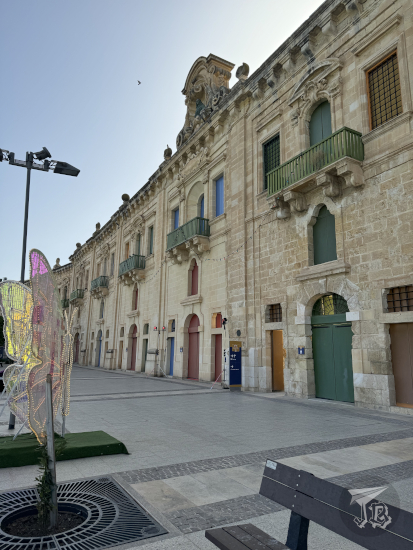
Valletta Waterfront: a line of neoclassical warehouses and buildings turned into shops and eateries

I had two options then – one was walking back towards the city centre to see two churches that I had missed, or head back to Saint Julian’s | San Ġiljan. Since I was quite closer to the bus station than to any of the churches (Shrine of Our Lady of Mount Carmel | Bażilika Santwarju tal-Madonna tal-Karmnu and The Collegiate Matrix Parish church of Saint Paul | Il-Knisja Kolleġġjata Arċipretali u Matriċi ta’ San Pawl), I decided to return.

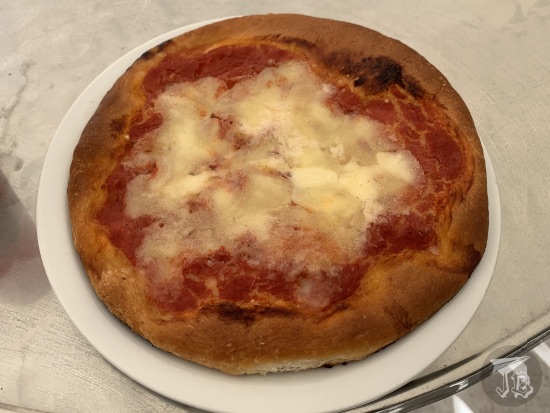
Once in Saint Julian’s | San Ġiljan, I had the largest pizza I’ve ever had the pleasure or disgrace to be served. I mean, good thing that I ordered a plain Margherita (in all honesty, it was the house special with extra cheese) because I would not have been able to eat anything with toppings, even after having basically skipped lunch. I somehow made space for ice-cream afterwards…
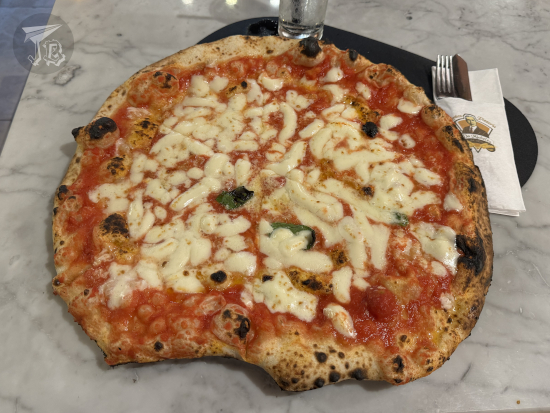
Huge Margheritta pizza

21st July 2023: Naples, from the hills to the port {Southern Italy, July 2023}

Due to poor planning on my side – that happens sometimes – Friday was a weird day. Part of me keeps thinking that I should have taken a train or a boat somewhere, but I actually managed to do most of the key sights in Naples. Acting on a recommendation, I had booked a 10:00 visit to the Catacombs of San Gennaro Catacombe di San Gennaro, part of the Catacombe di Napoli (Catacombs of Naples) network.

I bought a multiple-trip public transit ticket and I set off around 8:00. The underground-bus commute was to take 45 minutes, but the underground alone took that long. Thus, I decided to do the second leg of the trip on foot, up the hill Collina di Capodimonte. The bus trip was to take 20 minutes, and the walk 22 – I took less than 20 and I did not even see any bus going where I wanted to be… then again I was stupidly early in the end…

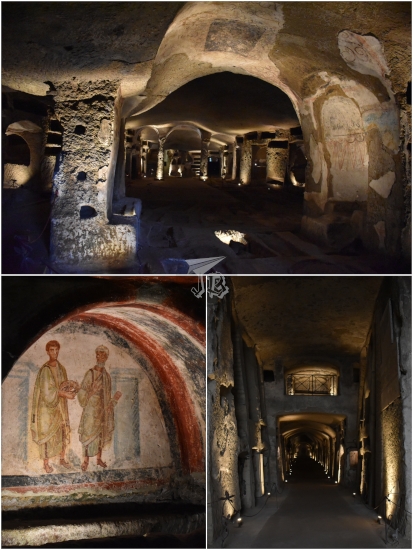
The cult to San Gennaro (Saint Januarius) is deeply felt in Naples – the miracle of his blood turning liquid three times a year is just one of the signs. They buried, exhumed, and reburied the man up to seven times if I understand correctly, and he is not even in the catacombs any more, but in the cathedral. The catacombs are excavated into the volcanic tuff that conforms the hill, and they date back to the 2nd century CE. They were located outside the city walls, as were all the graveyards at the time. The original tomb was expanded to accommodate palaeo-Christian burials. The first patron of Naples, Saint Agrippinus, was buried here and a basilica was constructed in his honour. After his burial in the 4th century CE, the catacombs became… popular. Eventually, San Gennaro was buried there in the 5th century and the place became a pilgrimage site until his body was moved to Benevento.

The catacombs have two levels, and can only be visited in a guided tour. They were restored in 2006, and are currently managed, by a cooperative which tries to promote Naples heritage and improve the city, providing working opportunities for young people. They tackled the restoration of the catacombs in 2006. Our guide asked if anyone had visited any catacombs before, I said that I had visited the Catacombs of Paris, but she did not make any… further comment about anything. There are no bodies in the Catacombs of San Gennaro, which is almost weird considering how morbid Neapolitans are.

Catacombs of San Gennaro

What you can find in the catacombs is a powerful example of underground architecture. Everything is directly carved into the rock, except for a few bricks here and there (and some scaffolding). There are three types of tombs: fossa (ground burial, vaguely body-shaped), loculo (stacked tombs built against the walls) and arcosolium (a carved tomb carved into the wall and a protective arch surrounding it). Some of the walls and tombs still have frescoes, a few of them with recycled symbolism from the pagan times, such as the god of wine Bacus’ vines being reinterpreted as a Christian theme of Jesus as the ‘true vine’, God as the husbandman, and the disciples as the branches.

The visit ended at the basilica San Gennaro Extra Moenia or St Januarius Beyond the Wall – due to it being outside the city’s protective walls, even if these walls are long gone. As the reception area had a small cafeteria, I headed there for a late breakfast (second breakfast? super early lunch?). It was around 11:00 and I ordered a mini-pizza and got myself a cold coke. I felt much more alive after that.

Neapolitan mini pizza

I went uphill for Museo e Real Bosco di Capodimonte, one of the former royal palaces Reggia di Capodimonte, and the forest that surround it. The palace was built in the Italian Baroque and Neoclassical styles between 1738 and 1840. A cohort of architects worked on it, the most credited being Giovanni Antonio Medrano. Although today the palace is technically a museum, the ‘good’ paintings have been moved for restoration, so I decided not to go in. But I might have got sunburnt on the walk.

Royal Palace of Capodimonti

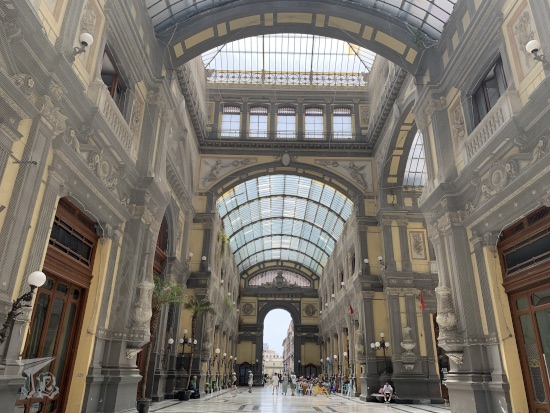
I went back down Capodimonte Hill towards Central Naples, and I made a stop at Galleria Principe di Napoli, a commercial gallery dating back from the 19th century. It was originally built in brick, with a cover of iron and glass. Today it is almost unused as most of the shops have closed or moved, and there have been recent mini-collapses which worry local authorities.

Commercial gallery in Naples

I walked into the underground system – which does not have air-con and was crowded. I stopped at Stazione Toledo, one of the stations belonging to the project Stazioni dell’Arte (Art Stations), a city project to beautify Naples’ transport hubs. Óscar Tusquets designed Stazione Toledo, and it has earned the reputation of being the most beautiful underground station in Europe.

Escalator in Toledo underground station Naples

Afterwards I went back to the platform to wait for a train to head to the harbour – the frequency is 15 minutes, but at least I was sitting down. I should have eaten something , but it was too hot – I bought a bottle of water and an ice cream (which was not even actual Italian ice cream) and continued off. I saw the outward of Castel Nuovo, a medieval castle dating back from 1279, commissioned by Charles I of Anjou. Had it had an open ticket office, I would have come in, but you could only book online and I really did not want to go around entering my bank data in the middle of Napoli.

Outside of Castle Nuovo, Naples

Thus I walked past the theatre Teatro di San Carlo and headed off towards the square Piazza del Plebiscito. On one side stands the church Basilica Reale Pontificia San Francesco da Paola, which was getting prepared for a wedding. On the other side, the other Naples Royal Palace Palazzo Reale di Napoli. The palace was one of the Bourbon residences during the time of the Kingdom of Naples and the Kingdom of Two Sicilies. Like the Capodimonte one, it is built in a mixture of Italian Baroque and Neoclassical styles, and it is attributed to Domenico Fontana. I snooped around the free areas of the palace.

Basilica of San Francisco de Padua, Naples

Royal Palace, Naples

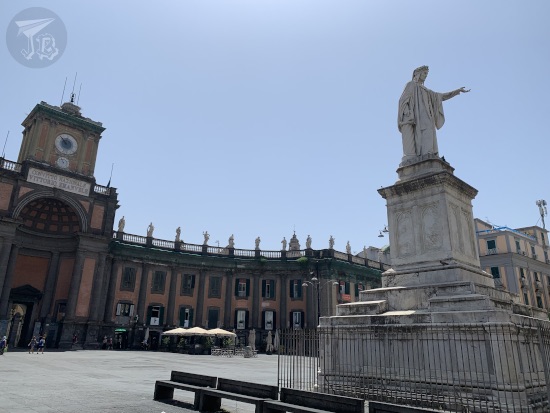
There is another shopping gallery next to the palace, the Galleria Umberto I, a little more alive than the Prince of Naples if only because there were tourists groups using it as a meeting point. I crossed it on my way to the underground stop. I took the train again and alighted at the square Piazza Dante, with the monument to the famous poet Monumento a Dante Alighieri and the school Convitto Nazionale Vittorio Emanuele II, whose tower is called the Equation of Time Orologio Equazione Del Tempo, with a double clock to reflect both solar hours (apparent solar time vs mean solar time) simultaneously.

Dante Square, Naples

I headed out to the chapel-museum Museo Cappella Sansevero, which is reported to always have long lines. I wanted to check if there were advanced tickets. Upon arrival around 15:15, I managed to get a slot for 15:30, and I was admitted a bit after 15:20. Pictures are not allowed and the guards patrol like eagles, so I could not even a sneak one. The chapel is home to a number of incredible Baroque and Rococo sculptures. The most important one is the masterpiece known as the Veiled Christ Cristo velato by Neapolitan sculptor Giuseppe Sanmartino (1720 – 1793). The sculpture was commissioned by Raimondo di Sangro and completed in 1753. It is so impressive that a legend says that an alchemist transformed the veil from a real one into marble.

Other incredible sculptures are Release from Deception and the veiled Modesty. When you go out, you are forced to cross a small cabinet which holds something called Le Macchine AnatomicheAnatomical Machines” (Giuseppe Salerno) which are real-life skeletons with a reproduction of the vascular and circulatory system.

My final stop for the the day was Complesso Monumentale di Santa Chiara, a monumental complex comprising a church Chiesa di Gesù Redentore e San Ludovico d’Angiò, a cloister Chiostro maiolicato, a museum Museo Di Santa Chiara and a Roman archaeological excavation Scavi archeologici Santa Chiara.

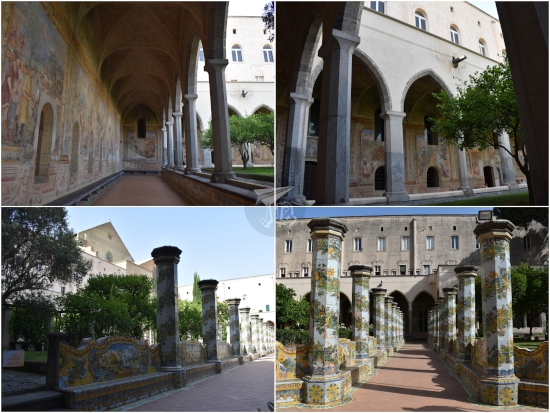
This religious complex started off as a Clarisse monastery built between 1313 and 1340. The cloister is square, and the arcades are covered in frescoes. The cloister itself is considered unique, as in 1742, Domenico Antonio Vaccaro built two avenues of octagonal columns. These pillars, along with the benches that join them, are decorated in the Rococo style, covered with majolica tiles in floral and everyday-life themes. A bit too fancy for a Poor Clares convent… though I really liked the columns and the cloister.

20230721 Santa Chiara Cloister Naples

The library contains codexes. The Roman ruins are from a Roman bath, but with Pompeii and Herculaneum so recent in my mind, they were not that impressive, I guess. The museum holds pieces from the baths, religious artefacts from the church before it was burnt, and other religious paraphernalia.

Altar. Santa Chiara, Naples

The church was originally erected in the Angevin Gothic style, with some original Romanesque left, and it was redecorated in Baroque style in the 17th century. After being damaged during the WWII bombings, it was restored “in style” – meaning, how it was supposed to have been before the Baroque decorations.

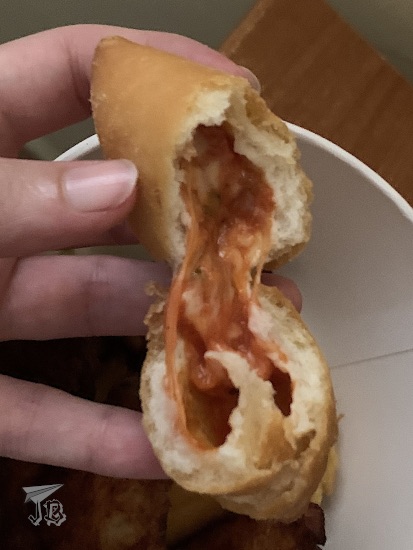
After the church, I went back to the hotel and I decided to try one of the McDonald’s item that is typically Italian – not found anywhere else, a Tasty Basket: McNuggets (found everywhere), chicken wings (found in more places), and panzerotti con pomodoro (typical Italian, a panzerotto is a small calzone with the same dough and seasoned tomato as pizza). It was either strangely good or I was hungry.

panzerotti con pomodoro

19th July 2023: Pompeii {Southern Italy, July 2023}

Pompeii [Pompei] is a town belonging to the greater Napoli Metropolitan Area. There is not much there “except” for the ruins of the ancient city that names the area. Pompeii Scavi (ruins of Pompei) or Parco Archeologico di Pompei (Archaeological Park of Pompeii) is the name given to the ruins nowadays, which belongs to the Unesco Heritage Site Archaeological Areas of Pompei, Herculaneum and Torre Annunziata.

The ancient city of Pompeii dates (dated?) back to an Oscan settlement in the 8th century BCE. The Etruscans arrived around 524 BCE, and the Greeks in 450 BCE. From the year 340 BCE, Pompeii was controlled by the Romans, first tacitly, then as a confederate, with its own administration and language. After it tried to rebel, it was forcefully conquered and made a colony in the first century BCE. The different civilisations expanded the city according to their own tastes.

The preservation of Pompeii makes it possible to appreciate the different styles in decoration, in mosaics, but chiefly on the frescoes in the houses. The first decoration style was called “incrustation” and it made the wall look like it was composed of actual marble bricks when it was in reality flat. The second style was the “architectural” one – areas of the wall were painted to look in relief, with or without decoration, such as a brick with a still life decoration on top, an open door, a window or a garden. The third style was the “ornamental” – there was a central element and all around it, linear separations and smaller motifs occupying whole walls and even rooms. The fourth and final style was called “Intricate” because it just fills the walls with ‘main’ motifs – the more the merrier, with as many colours and decoration as possible.

In the year 62 CE, there was an earthquake that heavily damaged the city. The citizens were not too worried, because quakes were common in the area. Reconstruction started. By the year 79 CE, the city had thousands of inhabitants. In October, Il Vesuvio, the volcano known as Mount Vesuvius, erupted. The eruption happened in the early afternoon, which caused most of the population to flee during the first hours. The ones that stayed behind were killed instantly when a cloud of volcanic gas with a temperature higher than 300 ºC collapsed onto the city. By the end of the eruption, Pompeii had been buried by 20 m of volcanic ash, whose weight caused most roofs to collapse.

Romans never came back to Pompeii, though after the eruption some valuables were salvaged, some excavations were made and building materials were taken. Subsequent eruptions covered the city completely, until the first walls were excavated in 1693. When Herculaneum was discovered in 1738 while building the Royal palace for the King of Naples (later Spain’s Charles III), the king was greatly interested and he sponsored excavations, which continue even today. The archaeological importance of Pompeii resides on the fact that this was not a fancy town, but an everyday one, which can teach us a lot about how Romans really lived.

Nowadays, about two thirds of the city have been uncovered and most areas that are not being actively worked on can be visited. Scientists and experts say that the primary goal at the moment is conservation rather than uncovering the rest of the site. Pompeii was not destroyed by lava, it was only covered in pumice and ash – lava would have disintegrated the whole city. As it became buried, time stopped. Unfortunately, as soon as anything is unearthed, the clock starts again. Furthermore, there are problems with conservation, bad restoration techniques, vandalism, theft and overtourism.

Another thing that makes Pompeii special was that “remains” of the victims were found – skeletons encased in a “hollow” where the body decomposed. Giuseppe Fiorelli came up with the idea of making casts out of those moulds in 1863 – though many of these casts were destroyed or damaged during WWII bombings. Some of them, or their copies are displayed through the site. I personally find it a bit morbid, but they are useful for archaeologists, apparently. It is calculated that around a thousand people perished in the eruption, but 90% of the population survived.

I woke up early to take the train to Pompeii – the modern town next to the ruins has taken the name of the ancient city. While most people take the train at Napoli Garibaldi (the easiest train station to reach on public transport), I was coming on foot. The terminus, Napoli Porta Nolana, was just three minutes further and the ticket price was the same, so I went there to hopefully be able to sit. I was successful and I rode the Circumvesuviana Line 1 8:09 train to Sorrento, which reached the station Pompei Scavi-Villa dei Misteri a bit after 8:30. After a couple of minutes, I was in line to get into Pompeii Scavi. As I had an entry ticket booked (and printed), once gates were open at 9:00 I was inside the archaeological park in a couple of minutes (my first picture is timestamped at 9:04).

I spent in Pompeii from 9:00 to 15:30, most of it walking, though I made a stop around noon for a snack, and I also had multiple breaks to apply sun lotion. The strada (streets) have little shade, and the few trees are planted on recreated orchards and gardens, and you can not sit under them. Also, there is a system of rotation on houses – not all of them are open, and none are open all the time. A few are the “house of the day”, which in my case (Wednesday) was the Terme del Foro (Forum Baths). There are also a lot of fountains throughout the site, and the water is drinkable.

A typical Roman house – where most people lived – were called insulae. They were “apartment blocks” with up to seven floors. The ground floor usually had a shop, and the owners lived right above, with windows and balconies. The higher the floor, the worse the apartment was – smaller and with fewer to no windows.

Rich people, in contrast, lived in a type of house called domus (villa for extremely wealthy individuals). A domus was a single-storey house built around an wide area, the atrium which had an opening in the celling with a small pool underneath to gather rainwater. This was the most important place of the house and it hosted a place to worship the ancestors or the household gods. Most of the rooms in the house led to the central atrium – the bedrooms (cubicula), dining room (triclinium), the study (tablinum) and the kitchen (culina). At the rear of the house there was an orchard or garden (hortus) and at the front, the shops (tabernae ). The domus was accessed through the fauces, a small decorated corridor. Bigger houses had a second building with a sort of patio (peristylum) similar to a cloister, with columns, plants, and a pond in the middle (piscina). At the very end there was a resting area (exedra).

The walls were decorated with frescoes, and the floors with mosaics. In Pompeii, both are damaged in most houses due to the earthquakes and the weight of volcanic ash and pumice, but they are still the best examples we have of Roman domestic frescoes. A lot of them have been removed and are in the Naples Archaeological Museum – only the most recently-unearthed ones are still at their original place. It is an interesting debate though – should they have been removed? If they had not, they might have got destroyed by decay and insufficient protection. But now they hang in the museum, devoid of all context, and it is weird.

A problem with Pompeii is the sheer amount of people that visit it – another paradox: maybe fewer visitors should be allowed, but it is visitor revenue is what keeps the place working and pays for conservation, research and further excavations. The best was the first 30 to 40 minutes, when I even had the Santuario di Apollo and the Casa dei Mosaici Geometrici all for myself.

All in all, the city is awe-inspiring. It’s not only that it has a huge architectural and archaeological value. It also shows the will of humanity to learn and discover, and at the same time, how small we are in comparison to nature – some of the originally-flat mosaics are now wavy due to the volcanic earthquakes, and the mosaics are cracked.

The streets are wide and the pavements are raised. There are raised crossings that would have slowed down the chariots and allowed people to cross without getting wet when it rained, or hm… when people… dumped… stuff there. Today, aside from tourists, there are lizards – absolutely indifferent to tourists – and cats – absolutely adored by tourists.

Some highlights of the visit included:

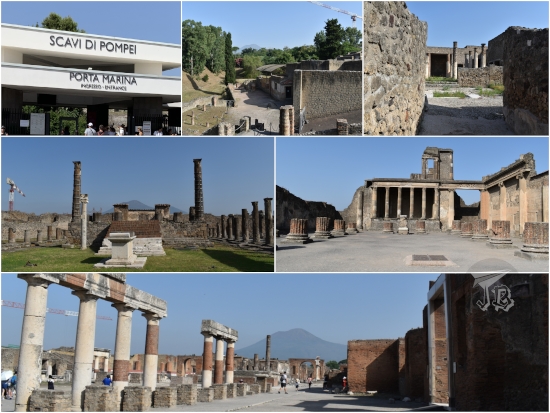
Casa di Romolo e Remo or House of Romulus & Remus; Santuario di Apollo or Temple of Apollo; Basilica (building where politics were discussed); Foro or Forum. Some sights even have Il Vesuvio looming about.
Collage showing some buildings of Pompeii

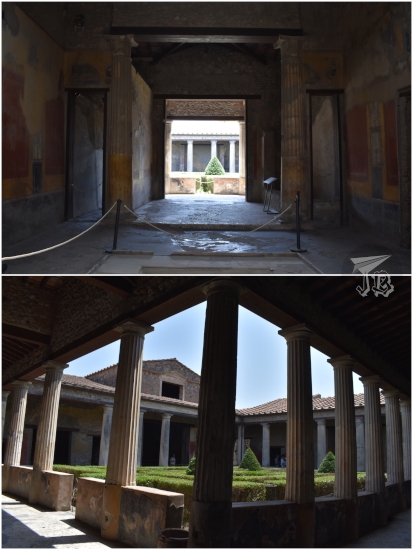
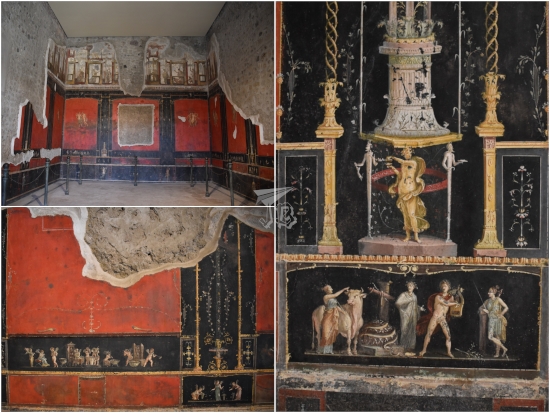
Casa del Menandro or House of Menander, with an almost completed atrium and peristylum, with great frescoes in situ.
Pompeii Casa del Menandro - hall and garden

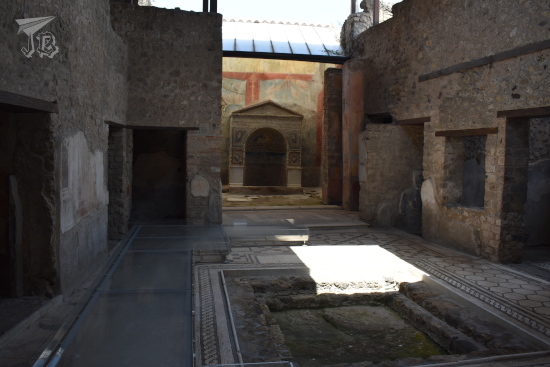
Casa dell’Orso Ferito or House of the Wounded Bear, with incredible mosaics (closed, unfortunately)
Pompeii House of the Wounded Bear

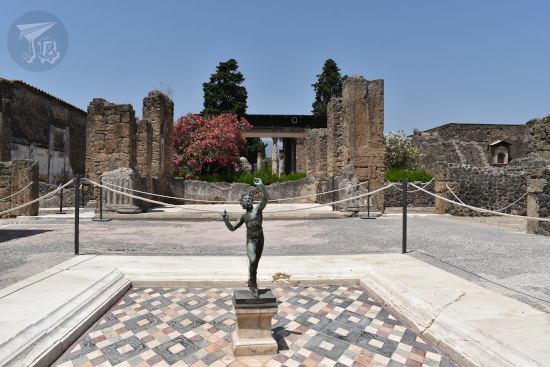
Casa del Fauno or House of the Faun, one of the most famous houses, and original home to a mosaic depicting Alexander the Great in battle.
Pompeii House of the Faun

Casa delle Nozze d’Argento or House of the Silver Wedding, with fantastic frescoes, and tiny details, extremely detailed.
Pompeii House of the Silver Wedding

Casa dei Dioscuri or House of Castor & Pollux, in which the columns still keep some of the painting.
Pompeii House of Caxtor and Pollux

I visited around 75 buildings, and entered as many as I could. Towards 15:00, I again had a few buildings for myself, or with fewer people, and I wish I had had the energy to continue on. Unfortunately, the inner restaurant was super-full whenever I checked – which I did repeatedly between 12:00 and 15:00. However, by 14:00 I knew that I was overdoing it, so I started my retreat. I still had to see the Antiquarium or Pompeii Museum.

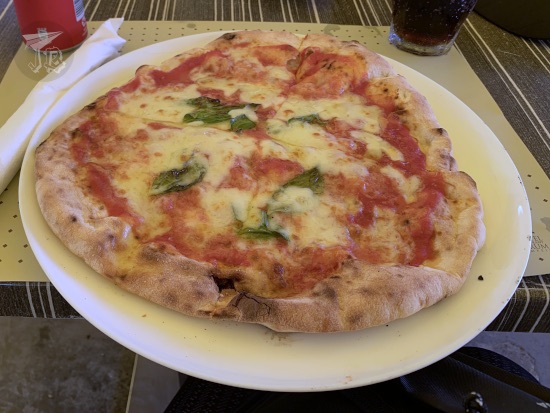
After I left the site, I stopped for a very late lunch (or a very early dinner) at a restaurant just outside the ruins. One of the waiters did not want to give me a table – or actually acknowledge me at all, I think this is the first time that I have actually felt the whole “solo travellers not welcome” echo, However, another one sat me, and I ordered the famous pizza Margherita, which is the big pizza in the Naples area. Not the Napoletana one, go figure.

A whole pizza Margherita

I took the train back, and I was in Naples with time to do something else. I had eaten and I was feeling better, but I thought that I had overdone it, and was worried about crashing the following day if I was not careful. Thus, I took a trip to another supermarket and went back to the hotel for a shower.


For the sake of completion, here is a relation of all the spots I visited in Parco Archeologico di Pompei or Archaeological Park of Pompeii:
Casa di Romolo e Remo or House of Romulus & Remus
Santuario di Venere or Temple of Venus
Casa di Trittolemo or House of Tryptolemus
Basilica (building where politics were discussed)
Santuario di Apollo or Temple of Apollo
Comitium ed Edifici Municipali or Hall of the Elections and Municipal buildings
Foro or Forum
Casa dei Mosaici Geometrici or House of the Geometric Mosaics
Palestra Degli Iuvenes or Gymnasium of the Iuvenes
Casa dei Cinghiale or House of Vesbinus
Terme Repubblicane or Republican Baths
Foro Triangolare or Triangular Forum
Santuario di Atena ed Eracle or Temple of Athena and Heracles (Greek Doric Temple)
Teatro Grande or Large Theatre
Quadriportico dei teatri / Caserma dei Gladiator or Quadriporticus of the theatre / Gladiator Barracks
Ingesso al Teatro Piccolo od Odeon or Entrance to Little Theatre or Odeon
Domus Cornelia or House of Cornelius Rufus
Tempio di Asclepio or Temple of Aesculapius
Casa degli Epidii or Casa de Marco Epidio Rufo or House of Epidio Rufo
Casa del Citarista or House of the Citharist
Casa de Casca Longus or House of Casca Longus
Fullonica di Stephanus or Fullery of Stephanus
Casa del Larario di Achille or House of the Lararium of Achilles
Casa del Criptoportico or House of Cryptoporticus
Casa di Paquius Proculus or House of Cuspius Pansa
Casa di Fabius Amandio or House of Fabius Amandus
Casa del Sacerdos Amandus or House of the Priest Amandus
Casa dei Casti Amanti or House of the Chaste Lovers
Casa e Thermopolium di Vetutius Placidus or House and Thermopolium of Vetutius Placidus
Casa di Giulio Polibio or House of Julius Polybius
Casa del Frutteto or House of the Orchard
Casa di Trebio Valente or House of Trebius Valens
Taberna di Sotericus or Tavern of Sotericus
Casa di Octavius Quartio or House of Octavius Quartio
Casa della Venere in conchiglia or House of Venus in the Shell
Anfiteatro or Amphitheatre
Palestra grande (Exhibition: “Arte e Sensualità nelle case di Pompei” Art / Sensuality in the Houses of Pompeii)
Pradeia di Guiulia Felice or Farms of Julia Felix
Casa del Triclinio all’aperto or House of Summer Triclinium
Casa del Larario Fiorito or House of the Floral Lararium
Osteria del Gladiatore or Inn of the Gladiators
Porta Nocera (gate)
Necropoli di Porta Nocera or Necropolis of Nocera Gate
Casa del Menandro or House of Menander
Casa dell’Efebo or House of the Ephebus
Casa del Criptoportico or House of Cryptoporticus (again)
Casa dei Ceii or House of Fabia and Tyrannus
Casa di Sirico or House of Siricus
Casa di Marte e Venere or House of Mars and Venus
Casa dell’Orso Ferito or House of the Wounded Bear
Casa dei Cornelii or House of the Cornelii
Terme Stabiane or Stabian Baths
Lupanare or Brothel
Arco di Nerone or Arch of Nero
Portico Della Concordia Augusta (Edificio di Eumachia) or Portico of Concordia Augusta (Building of Eumachia)
Tempio del Genio di Augusto or Temple of the Genius of Augustus
Arco di Caligola or Arch of Caligula
Terme del Foro or Forum Baths (this was the “house of the day”).
Casa del Fauno or House of the Faun
Casa della Caccia Antica or House of the Ancient Hunt
Casa di Arianna or House of Arianna
Casa della Fontana Grande or House of the Large Fountain
Casa della Fontana Piccola or House of the Small Fountain
Casa dei Vettii or House of the Vettii
Casa delle Nozze d’Argento or House of the Silver Wedding
Thermopolium (food shop)
Casa di Paquius Proculus or House of Cuspius Pansa.
Porta Ercolano (gate)
Necropoli di Porta Ercolano or Necropolis of the Ercolano Gate
Casa del Poeta Tragico or House of the Tragic Poet
Casa dell’Ancora or House of the Anchor
Casa di C.N. Caetroni Eutychi or House of C.N. Caetroni Eutychi
Torre di Mercurio XI or Tower of Mercury XI
Casa dei Dioscuri or House of Castor & Pollux
Tempio di Giove or Temple of Jupiter
Macellum (food market)
Antiquarium (museum)