For my last escapade of the year 2025, I chose a nearby low-effort one – Alcalá de Henares. I was checking out dates for upcoming events in Madrid when I saw that the palaeontology and archaeology museum Museo Arqueológico y Paleontológico de la Comunidad de Madrid (MARPA) had opened a special exhibition on sabre-toothed cats called Dientes de Sable.
I drove to Alcalá de Henares and parked a bit farther away from the centre, then walked. I really don’t enjoy driving there, especially now that they’re having construction in the main arteries of the city. On my way in, I followed the music to find one of the traditional parades displaying giant puppets – Pasacalles de los gigantes y cabezudos, which happens around Christmas.
I arrived at the MARPA just behind a family, who were told that the sabre-tooth cat exhibit was “good for kids”. I jokingly asked if it wasn’t good for adults and I was told that “kids enjoyed it more”. When I got to the temporal exhibition room to see Dientes de Sable (Sabretooth), I have to say that… no, it was not good for kids. The panels were interesting but… extremely technical. I have some knowledge of science, zoology and palaeontology, and way too much information flew over my head.
When I was in primary school, everything was either an animal, a plant or a rock, and nobody knew what to do about mushrooms. It turns out that biology is slightly more complicated than education in the 1980s tried to convey. Let’s start with what an animal is: an organism comprised by more than one cell, and these cells have a nucleus (which holds DNA) enclosed by a membrane. Having more than one cell allows animals to get pretty big.
Some organisms look more alike than others, which in general (though sometimes it is a fluke) means they are in a way “related”. These relations are scientifically called “taxonomy”, and the groups are bigger or smaller according to the shared characteristics. From more general to more specific they are: domain, kingdom (animals comprise one of these), phylum (for animals) or division (for plants), class, order, family, genus, and finally species. There are “clades” in-between which refer to groups of organisms composed of an identifiable common ancestor and all its descendants, and sub- and super- prefixes for many of the categories.
Mammals – which are animals with milk-producing glands, for feeding the young, among other characteristics – are a class (Mammalia). An order of mammals are Carnivora, creatures which specialise in eating flesh (hence the idea of a “carnivore”, literally meat-eater). Most of them are land-dwelling predators. Within them, we find two suborders – Feliformia (cat-like) and Caniformia (dog-like). For what is worth, seals belong in the dog-like category and hyenas in the cat-like one… so this is a bit more complicated and I am summarising.
Within Feliformia we find the family Felidae, which appeared around 25 million years ago, at the end of the Oligocene. Five million years later, there were two large types of felid groups – some had conical teeth and others developed sabre-shaped teeth – hence being collectively known as sabre-toothed cats. Conical-toothed cats are divided in Felinae or “small cats”, which includes anything smaller than a cheetah, including the domestic cat, and Pantherinae or “big cats”, which comprises leopards, tigers, lions and so on. The subfamily Machairodontinae held all the sabre-toothed cats, with three main subgroups or tribes, all extinct nowadays: Metailurini, Smilodontini and Homotherini or Machairodontini. I hope that was not too confusing, I made a schematic life tree chart to try and help…
The most famous genus of sabre-toothed cat is Smilodon, which jumped to fame hand-in-hand (paw-in-paw) with Diego, from the 2002 animated film Ice Age (also, the squirrel-character Scrat, from that same movie, might have sabre-shaped teeth, but it is a fictional animal, not a Machairodont). Smilodon is a very well-studied genus in science since the species Smilodon fatalis has been found in abundance (over two thousand individuals) in the Los Angeles palaeontological site of La Brea Tar Pits. For millennia, tar has been seeping from the underground, creating a pit so deep that it could (can) swallow an animal whole. However, this was not a fast process. When an animal wandered onto the pits, which were covered with leaves or dust, it became stuck and sank slowly. The dying animal attracted predators, which would also get stuck and end up sinking along after starving to death. This process generates what is known in palaeontology as a “predator trap”.
Spain did not have Smilodon or Tar Pits, but the palaeontological site known as Cerro de los Batallones has turned out to be another predator trap which yielded to many remains of Machairodonts, out of which apparently Machairodus aphanistus is the one getting better PR. The trap was different than the tar – the site was an underground structure or cave with round walls, opened at ground level. Animals fell into the hole and starved, and the stench attracted carnivores, which jumped in, but could not get out again, eventually dying themselves. The cave ended up filled with sediment, maybe in a mudslide or something similar that buried the skeletons. Some of them have even been found articulated, despite the geological phenomena that have affected the area – one of the skulls in the exhibits shows shearing, even.
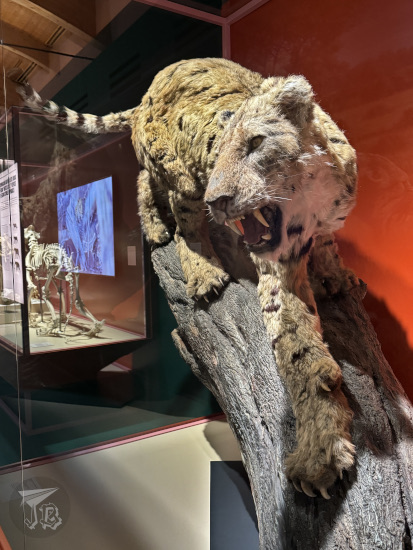
Confusing still? Try to condense all this informational dump in a few panels with drawings and schematics… I would not call this exhibition child-friendly at all. There is a lot of writing on the walls, along with life-like illustrations about how the animals and their environment would have looked. Regarding the actual items, there were a few replicas of skeletons, and several real pieces, mostly Machairodus from Cerro de los Batallones, as any palaeontological item recovered would be deposited in this museum. Actually, the first skeletal reconstruction you see on display is the one from MARPA’s permanent collection. I really wish they had taken that one out of a glass case, because I can never seem to take a good photography of it.
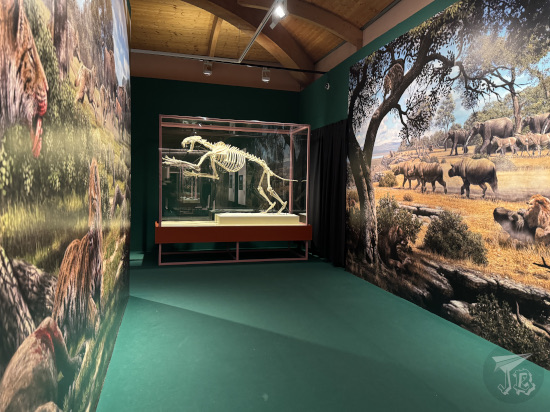
Dientes de Sable (Sabretooth) exhibition is divided in several sections – taxonomy, environment, palaeoecology, illness, restoration and reconstruction. There are a lot of explanatory panels and artists’ reinterpretation of the animals and their environment. There are three or four complete reconstructions of skeletons, a few skulls – real and casts – and a handful of actual fossils. One of the skeleton casts shows a healed fracture in the hind leg, which seems to imply that the animal lived in a pride and it was relatively taken care for by other members – as it did not starve to death.
There is also a reconstruction of a mummified cub that was found in Siberia in 2020, and a guess of how it would have looked in real life. Having an actual piece of fur helps cement the image of how any of the animals would have looked alive. However, most of it is speculative.
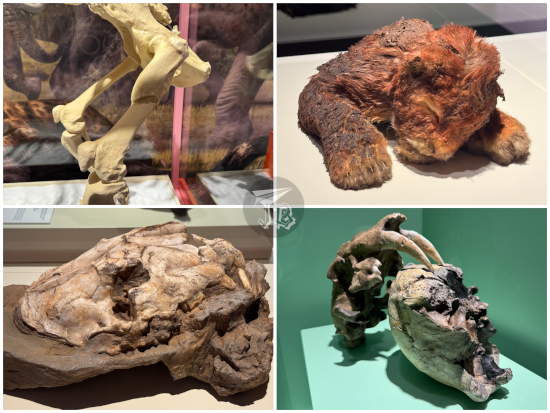
Sabre-toothed cats coexisted with humans, or at least early Hominini, and maybe the two species even hunted each other. Dmanisi Hominini lived in the modern-day Georgia (country) area of the same name around 1.80 million years ago, so they are amongst the earliest Hominini fossilised in Eurasia. They created simple stone tools, but did not use fire yet, and probably lived in social groups. The scientific consensus is that they belong to the Homo genus, maybe Homo habilis or Homo erectus. One of the skulls found at the site presented unhealed wounds that are consistent with the fangs of a Machairodont animal of the genus Megantereon.
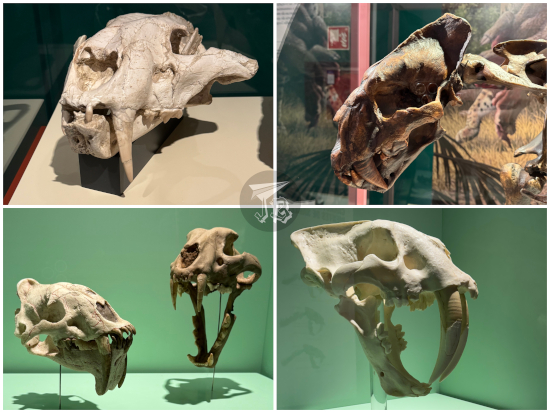
In order to flesh out the exhibition, there are comparisons with modern-day big-cat skeletons, such a tiger or a lion, but one needs to know way more comparative anatomy than myself in order to appreciate much more than the clear difference in the skulls and fangs.
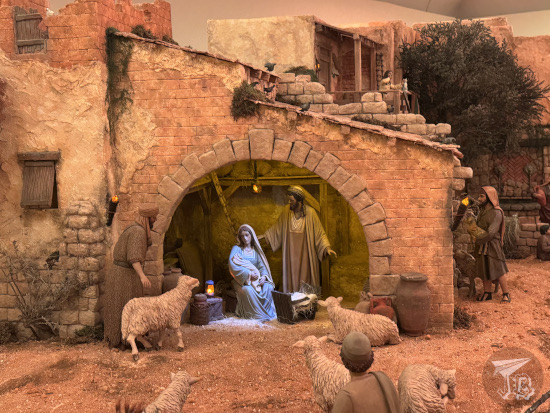
After I left the museum, my plan was to see a couple of the nativities in town, as Alcalá de Henares has a large association dedicated to the dioramas. I went to the exhibition hall and former hospital Antiguo Hospital de Santa María la Rica, where they had set up one of the nativity scenes, Gran Belén Tradicional, along with a few collections and miniatures they were displaying. Nativity scenes are a huge tradition around Christmastime in Spain, with hundreds of displays across town and cities, one in every church, and usually one from every government level.
Spanish nativity displays tend to be structured in scenes, which are not always concurrent. They represent the birth of Jesus according to the Bible (Gospels of Luke and Matthew). There is an area with Mary and Joseph, baby Jesus, a mule, and an ox – usually a cave-like structure to represent the stable. Shepherds are represented heading towards the portal, starting from the Annunciation scene. The Three Wise Men approach, often riding dromedaries (usually referred to as camels though) from a different direction. Many scenes feature a village to show daily life, and usually a snapshot of Mary and Joseph running away to Egypt. Other snippets that might be represented are King Herod – either meeting the Magi or ordering the massacre of the Innocents – or Mary learning she is pregnant.
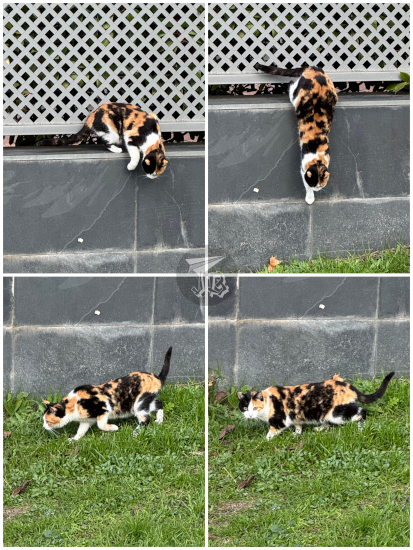
Since I was in town, I thought I’d check out the other famous nativity scene set up Gran Belén Monumental. I came across a modern felid on a hunt, too – a domestic cat prowling around a hotel garden. When finally I reached my destination, there was a long queue. I was not going to wait for 40 to 60 minutes to see a nativity scene, even if the day was not extremely cold – I was just there out of curiosity. Ergo, I turned on my heels and left. I did not feel like eating out, so I just headed home to munch on some Christmas leftovers.