22nd July 2023: Half a morning in Naples {Southern Italy, July 2023}

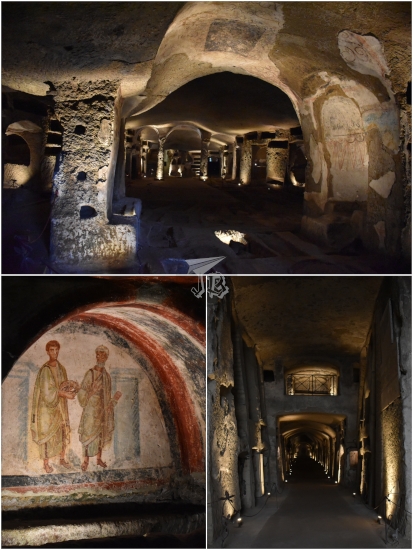
For my last half-day in Naples, I had free entrance to the catacombs Catacombe di San Gaudioso, one of the monuments in the Catacombe di Napoli (Catacombs of Naples) network. These are in a really bad part of town that the cooperative is trying to revive – and they say they’re being successful. San Gaudioso – Saint Gaudiosus of Napoli – was a North African Christian bishop who fled persecution into Naples. His relics were buried in the Catacombs of San Gennaro and then transferred to his own around the 6th century. The Catacombs of San Gaudioso were “popular” at first, but they became abandoned, until eventually they were rediscovered and entrusted to the Dominicans in the 17th century. The Dominicans took over and developed a rather morbid interment tradition for the nobles and clergy. The body was drained, then buried. A wall would be built in front of the tomb, and the deceased person’s skull placed on it, with the frontal bones facing forwards. The body was fresco-painted as a skeleton underneath, with symbols and writings around it. Today you can see those frescoes, but the front part of the skull has been smashed away. There is also the actual tomb of Saint Gaudiosus and other 17th century paintings left. If you ask me, the guide went a bit into… excessive graphic detail about the body preparation.

Catacombs of San Gaudioso

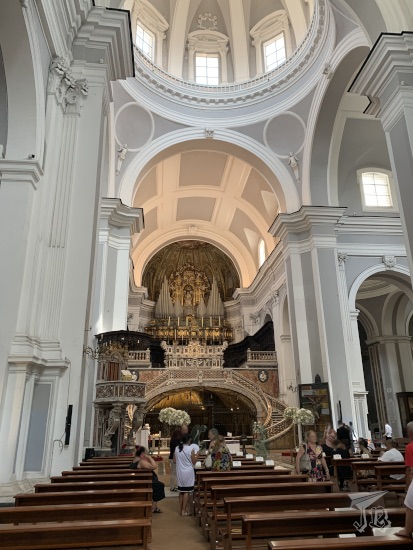
The catacombs were restored and open to the public in 2017. They are accessible though Basilica di Santa Maria della Sanità (Basilica of Saint Mary of Healthcare), the Baroque church that was built by the Dominicans once they were entrusted the catacombs – with the money they had from the noble family’s interments. The church connected directly with the catacombs through a hole under the back area of the altar. There was a wedding, so we could not snoop around much. In the sacristy, there is a presepe which, aside from the standard Nativity scene, has scenes from everyday life, legends of Napoli and mythology touches.

Baroque church Santa Maria de la Sanita

I walked back towards the Historic Centre of Naples Centro storico di Napoli thinking that maybe I could get an early lunch, but the nice places were not open yet, and the smell was a bit on the overwhelming side. I went into Via San Gregorio Armeno – the Christmas alley – again. It was Saturday morning so the “good” shops had brought out what they offered and I finally got to see what makes the area famous.

Neapolitan nativiy figures

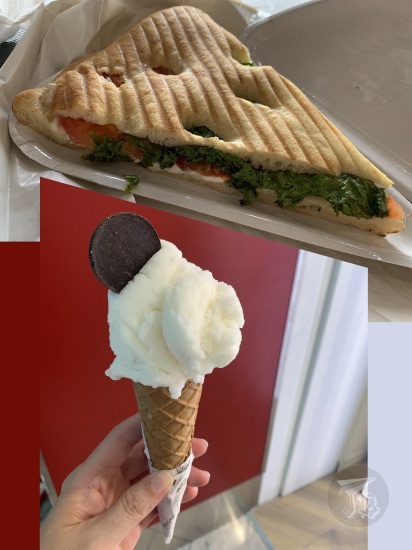
I finally decided to go towards the station, grab a bite to eat there, and head off to the airport. I had seen a huge bookshop near the food court, and I found something to entertain myself. I tried another piece of typical Italian food – a focaccia stuffed with cheese and greens. And then I realised that I had not had any real Italian ice cream! That was easily solved though…

focaccia and ice cream

The flight back was uneventful except I got emergency exit seat again, so I had to negotiate an exchange seat. The flight attendant this time was not as efficient as the one I had last time this happened. He had me wait until boarding was complete to find me another seat, which almost ended up with him having a riot in his hands. And here I had tried to board a bit earlier than usual to help the crew out… I will go back to boarding late-ish from now on.

Balance: Pompeii and Herculaneum are fantastic. Some people need to learn some respect and be civil – “no smoking” includes marijuana, don’t prance around with your shirt off in what is basically a ghost town, and for the love of that is holy, don’t poke the buildings. At least I did not run into anyone writing their name anywhere. Naples is not the best city, but it’s not as dangerous as I had worried about beforehand. However, maybe I should have done my planning a bit more carefully. Then again, not being too efficient allowed for downtime and resting, which I might have needed. I recently read that you should relax when you go on holiday?

21st July 2023: Naples, from the hills to the port {Southern Italy, July 2023}

Due to poor planning on my side – that happens sometimes – Friday was a weird day. Part of me keeps thinking that I should have taken a train or a boat somewhere, but I actually managed to do most of the key sights in Naples. Acting on a recommendation, I had booked a 10:00 visit to the Catacombs of San Gennaro Catacombe di San Gennaro, part of the Catacombe di Napoli (Catacombs of Naples) network.

I bought a multiple-trip public transit ticket and I set off around 8:00. The underground-bus commute was to take 45 minutes, but the underground alone took that long. Thus, I decided to do the second leg of the trip on foot, up the hill Collina di Capodimonte. The bus trip was to take 20 minutes, and the walk 22 – I took less than 20 and I did not even see any bus going where I wanted to be… then again I was stupidly early in the end…

The cult to San Gennaro (Saint Januarius) is deeply felt in Naples – the miracle of his blood turning liquid three times a year is just one of the signs. They buried, exhumed, and reburied the man up to seven times if I understand correctly, and he is not even in the catacombs any more, but in the cathedral. The catacombs are excavated into the volcanic tuff that conforms the hill, and they date back to the 2nd century CE. They were located outside the city walls, as were all the graveyards at the time. The original tomb was expanded to accommodate palaeo-Christian burials. The first patron of Naples, Saint Agrippinus, was buried here and a basilica was constructed in his honour. After his burial in the 4th century CE, the catacombs became… popular. Eventually, San Gennaro was buried there in the 5th century and the place became a pilgrimage site until his body was moved to Benevento.

The catacombs have two levels, and can only be visited in a guided tour. They were restored in 2006, and are currently managed, by a cooperative which tries to promote Naples heritage and improve the city, providing working opportunities for young people. They tackled the restoration of the catacombs in 2006. Our guide asked if anyone had visited any catacombs before, I said that I had visited the Catacombs of Paris, but she did not make any… further comment about anything. There are no bodies in the Catacombs of San Gennaro, which is almost weird considering how morbid Neapolitans are.

Catacombs of San Gennaro

What you can find in the catacombs is a powerful example of underground architecture. Everything is directly carved into the rock, except for a few bricks here and there (and some scaffolding). There are three types of tombs: fossa (ground burial, vaguely body-shaped), loculo (stacked tombs built against the walls) and arcosolium (a carved tomb carved into the wall and a protective arch surrounding it). Some of the walls and tombs still have frescoes, a few of them with recycled symbolism from the pagan times, such as the god of wine Bacus’ vines being reinterpreted as a Christian theme of Jesus as the ‘true vine’, God as the husbandman, and the disciples as the branches.

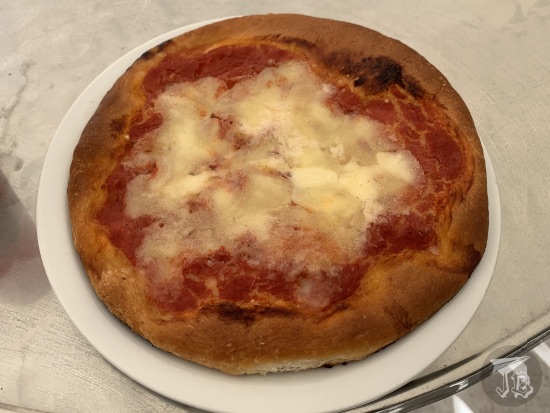
The visit ended at the basilica San Gennaro Extra Moenia or St Januarius Beyond the Wall – due to it being outside the city’s protective walls, even if these walls are long gone. As the reception area had a small cafeteria, I headed there for a late breakfast (second breakfast? super early lunch?). It was around 11:00 and I ordered a mini-pizza and got myself a cold coke. I felt much more alive after that.

Neapolitan mini pizza

I went uphill for Museo e Real Bosco di Capodimonte, one of the former royal palaces Reggia di Capodimonte, and the forest that surround it. The palace was built in the Italian Baroque and Neoclassical styles between 1738 and 1840. A cohort of architects worked on it, the most credited being Giovanni Antonio Medrano. Although today the palace is technically a museum, the ‘good’ paintings have been moved for restoration, so I decided not to go in. But I might have got sunburnt on the walk.

Royal Palace of Capodimonti

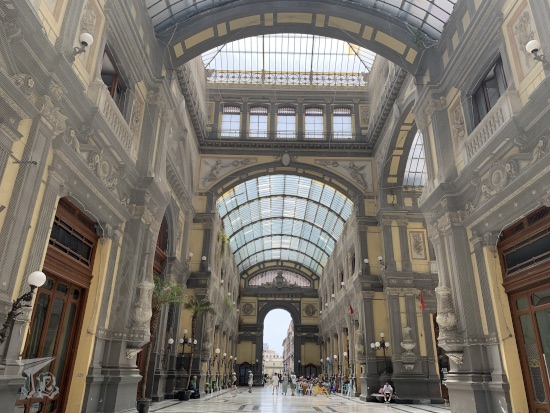
I went back down Capodimonte Hill towards Central Naples, and I made a stop at Galleria Principe di Napoli, a commercial gallery dating back from the 19th century. It was originally built in brick, with a cover of iron and glass. Today it is almost unused as most of the shops have closed or moved, and there have been recent mini-collapses which worry local authorities.

Commercial gallery in Naples

I walked into the underground system – which does not have air-con and was crowded. I stopped at Stazione Toledo, one of the stations belonging to the project Stazioni dell’Arte (Art Stations), a city project to beautify Naples’ transport hubs. Óscar Tusquets designed Stazione Toledo, and it has earned the reputation of being the most beautiful underground station in Europe.

Escalator in Toledo underground station Naples

Afterwards I went back to the platform to wait for a train to head to the harbour – the frequency is 15 minutes, but at least I was sitting down. I should have eaten something , but it was too hot – I bought a bottle of water and an ice cream (which was not even actual Italian ice cream) and continued off. I saw the outward of Castel Nuovo, a medieval castle dating back from 1279, commissioned by Charles I of Anjou. Had it had an open ticket office, I would have come in, but you could only book online and I really did not want to go around entering my bank data in the middle of Napoli.

Outside of Castle Nuovo, Naples

Thus I walked past the theatre Teatro di San Carlo and headed off towards the square Piazza del Plebiscito. On one side stands the church Basilica Reale Pontificia San Francesco da Paola, which was getting prepared for a wedding. On the other side, the other Naples Royal Palace Palazzo Reale di Napoli. The palace was one of the Bourbon residences during the time of the Kingdom of Naples and the Kingdom of Two Sicilies. Like the Capodimonte one, it is built in a mixture of Italian Baroque and Neoclassical styles, and it is attributed to Domenico Fontana. I snooped around the free areas of the palace.

Basilica of San Francisco de Padua, Naples

Royal Palace, Naples

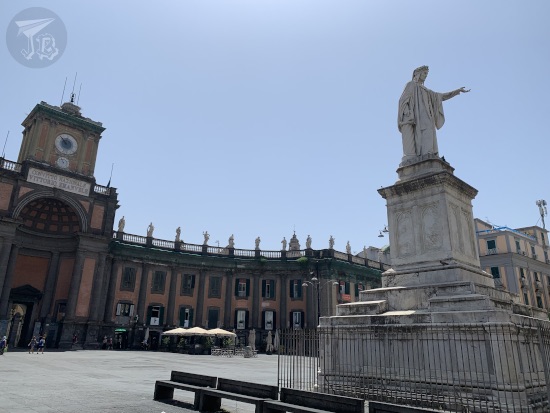
There is another shopping gallery next to the palace, the Galleria Umberto I, a little more alive than the Prince of Naples if only because there were tourists groups using it as a meeting point. I crossed it on my way to the underground stop. I took the train again and alighted at the square Piazza Dante, with the monument to the famous poet Monumento a Dante Alighieri and the school Convitto Nazionale Vittorio Emanuele II, whose tower is called the Equation of Time Orologio Equazione Del Tempo, with a double clock to reflect both solar hours (apparent solar time vs mean solar time) simultaneously.

Dante Square, Naples

I headed out to the chapel-museum Museo Cappella Sansevero, which is reported to always have long lines. I wanted to check if there were advanced tickets. Upon arrival around 15:15, I managed to get a slot for 15:30, and I was admitted a bit after 15:20. Pictures are not allowed and the guards patrol like eagles, so I could not even a sneak one. The chapel is home to a number of incredible Baroque and Rococo sculptures. The most important one is the masterpiece known as the Veiled Christ Cristo velato by Neapolitan sculptor Giuseppe Sanmartino (1720 – 1793). The sculpture was commissioned by Raimondo di Sangro and completed in 1753. It is so impressive that a legend says that an alchemist transformed the veil from a real one into marble.

Other incredible sculptures are Release from Deception and the veiled Modesty. When you go out, you are forced to cross a small cabinet which holds something called Le Macchine AnatomicheAnatomical Machines” (Giuseppe Salerno) which are real-life skeletons with a reproduction of the vascular and circulatory system.

My final stop for the the day was Complesso Monumentale di Santa Chiara, a monumental complex comprising a church Chiesa di Gesù Redentore e San Ludovico d’Angiò, a cloister Chiostro maiolicato, a museum Museo Di Santa Chiara and a Roman archaeological excavation Scavi archeologici Santa Chiara.

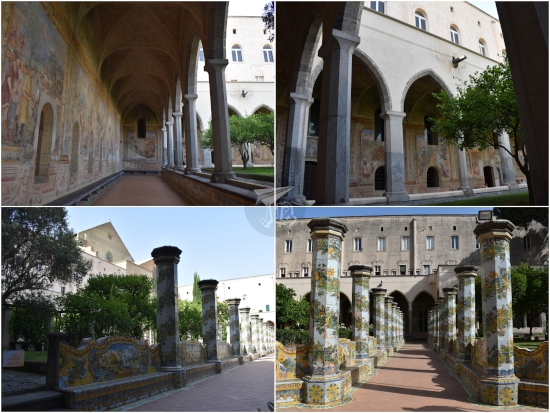
This religious complex started off as a Clarisse monastery built between 1313 and 1340. The cloister is square, and the arcades are covered in frescoes. The cloister itself is considered unique, as in 1742, Domenico Antonio Vaccaro built two avenues of octagonal columns. These pillars, along with the benches that join them, are decorated in the Rococo style, covered with majolica tiles in floral and everyday-life themes. A bit too fancy for a Poor Clares convent… though I really liked the columns and the cloister.

20230721 Santa Chiara Cloister Naples

The library contains codexes. The Roman ruins are from a Roman bath, but with Pompeii and Herculaneum so recent in my mind, they were not that impressive, I guess. The museum holds pieces from the baths, religious artefacts from the church before it was burnt, and other religious paraphernalia.

Altar. Santa Chiara, Naples

The church was originally erected in the Angevin Gothic style, with some original Romanesque left, and it was redecorated in Baroque style in the 17th century. After being damaged during the WWII bombings, it was restored “in style” – meaning, how it was supposed to have been before the Baroque decorations.

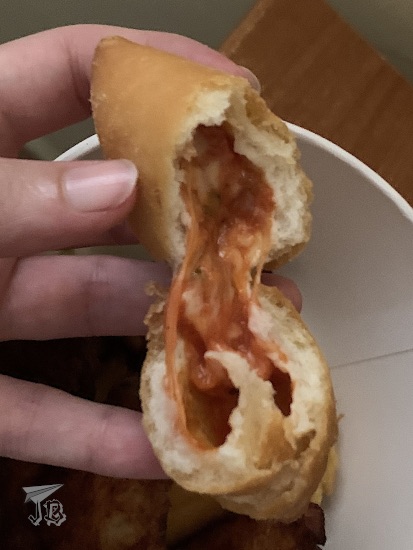
After the church, I went back to the hotel and I decided to try one of the McDonald’s item that is typically Italian – not found anywhere else, a Tasty Basket: McNuggets (found everywhere), chicken wings (found in more places), and panzerotti con pomodoro (typical Italian, a panzerotto is a small calzone with the same dough and seasoned tomato as pizza). It was either strangely good or I was hungry.

panzerotti con pomodoro

20th July 2023: Herculaneum and the Naples National Archaeological Museum {Southern Italy, July 2023}

Knowing my way to the station of Napoli Porta Nolana, this time I only had to buy the ticket and wait for the 8:14 Circumvesuviana Line 4 to Poggiomarino, which was supposed to reach Ercolano Scavi in the town of Herculaneum [Ercolano] by 8:33. It took longer than that because there were a lot of stops. Then again, my strategy of the first station in order to travel sitting down was successful once more.

Unlike the modern city of Pompeii, the modern Ercolano was built before the ancient town was discovered. It was originally called Resina, but the name was changed in 1969. Despite the legend saying that the Greek hero Heracles (Hercules in Latin) founded the original Herculaneum, the early history of this city is parallel to that of Pompeii. It was first an Oscan settlement, then Etruscan, then Greek, and it eventually became a Roman municipium in the first century BCE. It was a small vacationing town for people from the north, apparently.

Much like Pompeii, the ancient city of Herculaneum – what today is the Parco Archeologico di Ercolano or Herculaneum Archaeological Park – was buried by the 79 CE eruption of Mount Vesuvius, and it belongs to the Archaeological Areas of Pompei, Herculaneum and Torre Annunziata Unesco World Heritage Site. However, the different location of the town changed how it fared during the eruption.

The 79 eruption lasted two days (thought to be 24th and 25th October 79 CE). The citizens of Pompeii and Herculaneum who fled and survived were the ones who escaped during the first 12 hours – during these, heavy pumice and ash came down on Pompeii, destroying buildings. At this time, Pliny the Elder was commander of the Roman fleet at a nearby town, and he sent galleys to help the evacuation of the coast. We know this because his nephew, Pliny the Younger – a teenager at the time who would grow into a lawyer and magistrate – left in writing what he had seen in two letters. Those letters are now lost, but Medieval copies of them survived.

At the time of the eruption, Herculaneum stood right by the shore. Most of the bodies found were at the coastline, probably trying to escape by sea or reach Pliny’s ships. A boat was actually found carbonised in the vicinity. As wind blew pyroclastic flows towards Pompeii, burying it in volcanic ash and pumice, only a few centimetres of ash fell onto Herculaneum. These, however, rightfully freaked people out, and caused most of the population to flee during the first day.

As Herculaneum lies closer to the volcano, when the cloud of volcanic material (called a “volcanic surge”, composed by gas, ashes and pumice) collapsed in the middle of the night, it hit the town at over 400 ºC. Everyone who had stayed behind was instantly killed by the heat, leaving behind the skeletons of around 330 people. There were no casts made of them – unlike the thousand unfortunate Pompeiians.

Pliny the Elder died in the early morning of the second day. During the second day, the second pyroclastic cloud collapsed on top of Pompeii, but at this time, not a soul remained alive in Herculaneum. Subsequent volcanic clouds and pyroclastic surges (not lava) buried the towns until excavations started in the 18th century – barring some grave robbers, apparently.

About one fourth of Herculaneum has been unburied, even if it was the first city to be discovered. There is a bit of a paradox here – although it is in better condition and it suffered less structural damage, it is worse preserved. It still holds a lot of mosaics in situ, despite many frescoes taken to the Archaeological Museum. Unfortunately, its current condition has deteriorated terribly.

Herculaneum is less famous than Pompeii. A much smaller area can be visited, and the unexcavated part is underneath the modern cities of Ercolano and Portici. There are many buildings closed and a lot of scaffolding is needed due to a period or abandonment at the end of the 1990s. One of the telltales that it expects fewer tourists is that the webpage is only in Italian.

I reached the station Ercolano Scavi around 8:45, and ten minutes later I was at the entrance of Parco Archeologico di Ercolano. The park was already open and there was a line to buy tickets, and people struggling with their phone passes. I had printed mine out, so it was stupidly easy to wave it, get it scanned, and go through. Most people who went in before me decided to stay at the museums because that is the first thing you reach, but I reasoned that the earliest I went into the archaeological area, the less time I’d be under the sun when it became scorching. Again, this helped to be alone in a couple of houses.

Herculaneum general view

Restoration is a race against time in Herculaneum and as you walk you can see the scaffoldings and workers going on their daily lives – archaeologists, restorers, gardeners. Here, the effect of the volcanic activity are seen extremely clearly, on the floors and the walls – bulging mosaics and cracked frescoes and tiles. There is no doubt, however, that the damage was less. There are columns that still stand, covered in their original paint, and the bathhouses could just be used today with some refurbishing – and of course running water.

Another phenomenon that happened in Herculaneum was that a lot of wood became instantly charcoal when the pyroclastic surge collapsed onto the town. That means that some of the beams that are still in the buildings are the original ones, which is unbelievable. There are even surviving stairs and furniture. I wandered the streets for a few hours, going into anything that was open and in general feeling in awe at the mosaics and the frescoes. I was also astonished as how people felt comfortable poking the slabs and the paint – as there were fewer caretakers than in Pompeii.

Some highlights included:

Terme Maschili or Male Baths, where you can see the wavy mosaic on the floors.
Herculaneum mosaic - Merfolk

– The mosaics in Casa di Nettuno e Anfitrite or House of Neptune and Amphitrite.
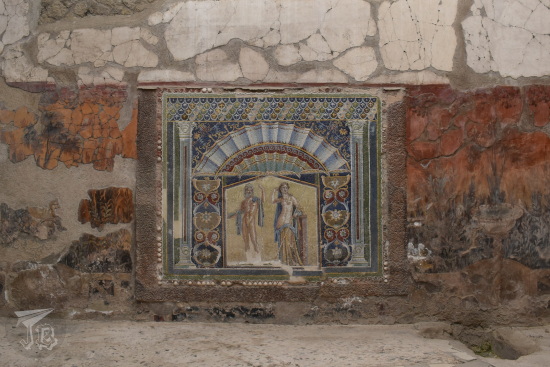
Mosaic covering a foutnain in Herculaneum

Casa del Rilievo di Telefo or House of the Relief of Telephus, one of the best preserved structures with a lot of paintings, even on the columns.
Herculaneum: House of the Relief of Telephus

Terrazza, statua e altare di Marco Nonio Balbo or Terrace, statue and altar of Marcus Nonius Balbus.
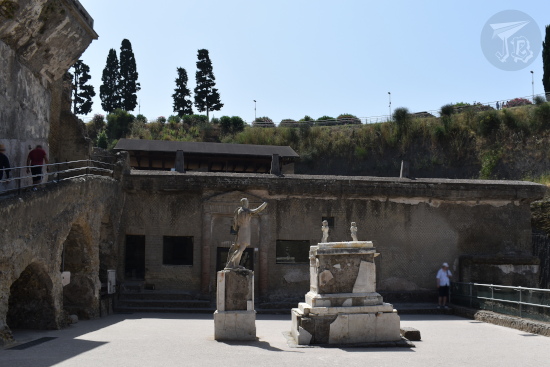
Terrace, statue and altar of Marcus Nonius Balbus

It was noon when I decided to retreat towards the museums, which hold only small trinkets and some jewellery. Just as I was thinking that the Herculaneum inhabitants could rest in peace instead of being on display, I reached the Boat Pavilion Padiglione della Barca, which holds a carbonised boat where some of the residents tried to escape. There are panels which explain that they are planning to make copies of the three hundred something skeletons they found at the coastline and place them in the same spot they were found. So much for resting in peace.

I went back towards the station and took a train back to Napoli, where I transferred to the underground and headed off to the National Archaeological Museum – Museo Archeologico Nazionale di Napoli (MANN). I had read online that the ticket was valid for two days, so the plan was to grab a leisure lunch there, wander around for a while in the air-conditioned areas of the museum, then come back the following day. Unfortunately, the ticket read that it was only valid for one admission that day. I had to reconsider my plan then. It was barely 13:30, so I decided to go right into it. Also… there was no air-con.

The roots of the MANN are the so-called Collezione Farnese, or Farnese Collection, one of the first collections of the Greco-Roman Antiquity. The original collector was Pope Paul III when he was still Cardinal Alessandro Farnese (1568 – 1549). In the 18th century, the marbles were inherited by Elizabeth Farnese. Her son Charles would become King of Naples, Sicily and Spain, and was the great sponsor of the excavations in Herculaneum and Pompeii. The mosaics and frescoes taken from these two cities are the second core conforming the museum.

The Farnese Marbles are fantastic. It’s been a while since a work of art took my breath away, but some of these did. The collection preserved a lot of Roman copies of Greek original sculptures, and although a lot of them were restored during the Renaissance, I enjoyed the gallery a lot. Some favourites were the Resting Hercules, Atlas, Apollo playing the lire, and of course the Farnese Bull.

Farnese Marbles: Farnese Hercules, Farnese Bull, Farnese Apollo, and Eros with a fish

The Hercules sculpture shows the hero leaning on his club after having finished the last of his tasks – the apples of the Hesperides garden, which he holds behind his back. Atlas kneels, holding the world. The Farnese Bull is the biggest surviving sculptural group from antiquity – the twin brothers who founded Thebes, Zethus and Amphion, tie their stepmother Dirce to the horns of a wild bull as revenge for how she tormented their mother. The original is attributed to Appollonius of Tralles. Apollo playing the lire is sculpted in two marbles, one darker for the tunic and a white one for skin and the lire – and one of the few sculptures I can share on social media as he is totally clothed…

After the Farnese marbles, I explored the rest of the classical sculptures. Then I moved onto the second floor to the collection of mosaics from Pompeii and Herculaneum. When I was little I saw a mosaic of fish in my history book, and I had always wanted to see it. I finally did, along with one that implies “beware of the dog”. I did not get to see the Alexander the Great mosaic because it was being restored (though I did see the in-situ reproduction in the Casa del Fauno / House of the Faun). There was even a whole fountain with columns that were almost completely covered in mosaics.

Mosaics from Pompeii and Herculaneum

At the end of this area stands the “Secret Cabinet”, which holds the images and sculptures from Pompeii and Herculaneum that were over the centuries considered “too pornographic to be seen” – including penis amulets and a sculpture of “Pan making love to a goat”.

I continued on to the second floor, to “Archaeological Naples”. In this area there also were sculptures, a lot of bronzes too – including a beautiful Athena and a Drunk Faun. The central hall of this floor held an exhibit about Alexander the Great and his influence in the Mediterranean. It hosted the Farnese Atlas and the Artemis of Ephesus. Afterwards, I went to the Protohistory and Prehistory area – which did not hold many attention-grabbing artefacts, especially consider how spectacular everything else was.

Sculptures in the Napoli Archaeological Museum

By this time, I needed a break. It was a bit later than 15:00 so the café was practicable. I got myself a lemon sorbet and… fried pasta pasta frittata, a typical street food bite. Which is basically a croquette made out of pasta. It was surprisingly good, actually.

Pasta fritatta

I went back upstairs – I was tired by now, and if I had had the chance to do the museum in two days, I would have left now. But I did not, so I continued towards the exhibitions of “everyday life” and frescoes of Pompeii and Herculaneum. These include dishware, glassware, decoration, mirrors, jewellery… and of course the frescoes, including the Portrait of Terentius Neo and his Wife, that were taken down from the walls of the houses during the 18th century in order to preserve them. They feel weird as they hang on the blank walls – framed, far away from the place they used to be. I know it can’t be, but it would be cool to see them all on site. While I could really imagine how some of the houses would have looked 2,000 years ago when I was in Pompeii, I could not imagine the perfectly-framed frescoes on the walls. It was a bit unsettling.

Pompeii and Herculaneum frescoes

I bought the extra ticket to see the Magna Graecia Collection. At first I was not convinced because after a while all the Greek pottery starts looking the same to me. You get to wear shoe coverings in order to walk in there, at first I thought it was not to upset the marble floors, but then I walked onto the mosaics and wow. Just wow. I mean… after a bit you don’t even realise that you’re supposed to be looking at pottery and just keep staring at the floors…

Magna Graecia Mosaic

I ended the visit with the Egyptian collection, where – on top of it being the only area of the museum with air conditioning – I saw one of the crocodile mummies that I might have seen at Kom Ombo.Finally, after basically snooping round the whole museum including the gardens, I headed back to the station area to buy some food and go get some rest in the hotel.


For the sake of completion, here is a relation of all the spots I visited in Parco Archeologico di Ercolano or Archaeological Park of Herculaneum:
Boathouse and shoreline
Access bridge
Casa dello Scheletro or House of the Skeleton
Casa dei Galba or House of Galba
Terme Maschili or Male Baths
Casa dei Due Atri or House of the two atriums
Sede degli Augustali or Hall of the Augustales
Casa dei Salone Nero or House of the black salon
Bottega del Plumbarius or Shop of a plumbarius (metal worker, welder or blacksmith)
Casa del Bel Cortile or House of the Beautiful Courtyard
Casa di Nettuno e Anfitrite or House of Neptune and Amphitrite
Terme Femminili or Female Baths
Casa Sannitica or Samnite House
Casa del Tramezzo di Legno or House of the Wooden Screen
Casa del Papiro Dipinto or House with the painted papyrus roll
Casa dell’Alcova or House of the Alcove
Casa dell’Erma di Bronzo or House of the Bronze Herm
Casa dell’Ara Laterizia or House of the Brick Altar
Casa dell’Atrio a Mosaico or House of Mosaic atrium
Casa dell’Albergo or House of the Inn
Casa del Telaio or House of the Tailor
Casa del Mobilio Carbonizato or House of the Wooden Furniture
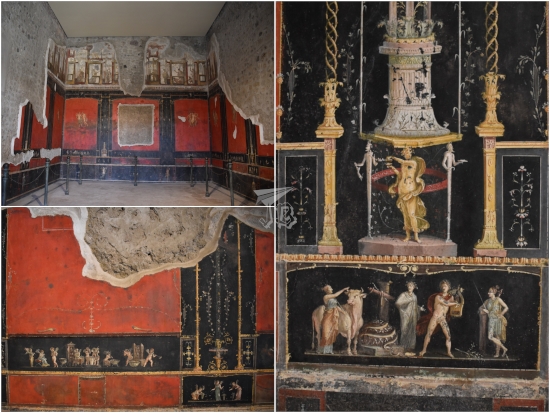
Casa dell’Apollo Citaredo or House of Apollo the Lyre-player
Casa del Bicentenario or House of the Bicentenary
Pistrinum di Sextus Patulcius Felix or Bakery of Sextus Patulcius Felix
Taberna di Priapo or Bar of Priapus
Casa della Stoffa or House of the Cloth
Casa dei Cervi or House of the Deer
Palaestra
Casa del Rilievo di Telefo or House of the Relief of Telephus
Terrazza, statua e altare di Marco Nonio Balbo or Terrace, statue and altar of Marcus Nonius Balbus
Terme Suburbane or Suburban baths
Area Sacra or Holy Area
Sacello di Venere or Shrine of Venus
Grande Taberna or Large bar
Casa del Gran Portale or House of Large Portal
Thermopolium (food shop)
Casa di Aristide or House of Aristides
Antiquarium (museum)
Padiglione della Barca or Boat Pavillion

19th July 2023: Pompeii {Southern Italy, July 2023}

Pompeii [Pompei] is a town belonging to the greater Napoli Metropolitan Area. There is not much there “except” for the ruins of the ancient city that names the area. Pompeii Scavi (ruins of Pompei) or Parco Archeologico di Pompei (Archaeological Park of Pompeii) is the name given to the ruins nowadays, which belongs to the Unesco Heritage Site Archaeological Areas of Pompei, Herculaneum and Torre Annunziata.

The ancient city of Pompeii dates (dated?) back to an Oscan settlement in the 8th century BCE. The Etruscans arrived around 524 BCE, and the Greeks in 450 BCE. From the year 340 BCE, Pompeii was controlled by the Romans, first tacitly, then as a confederate, with its own administration and language. After it tried to rebel, it was forcefully conquered and made a colony in the first century BCE. The different civilisations expanded the city according to their own tastes.

The preservation of Pompeii makes it possible to appreciate the different styles in decoration, in mosaics, but chiefly on the frescoes in the houses. The first decoration style was called “incrustation” and it made the wall look like it was composed of actual marble bricks when it was in reality flat. The second style was the “architectural” one – areas of the wall were painted to look in relief, with or without decoration, such as a brick with a still life decoration on top, an open door, a window or a garden. The third style was the “ornamental” – there was a central element and all around it, linear separations and smaller motifs occupying whole walls and even rooms. The fourth and final style was called “Intricate” because it just fills the walls with ‘main’ motifs – the more the merrier, with as many colours and decoration as possible.

In the year 62 CE, there was an earthquake that heavily damaged the city. The citizens were not too worried, because quakes were common in the area. Reconstruction started. By the year 79 CE, the city had thousands of inhabitants. In October, Il Vesuvio, the volcano known as Mount Vesuvius, erupted. The eruption happened in the early afternoon, which caused most of the population to flee during the first hours. The ones that stayed behind were killed instantly when a cloud of volcanic gas with a temperature higher than 300 ºC collapsed onto the city. By the end of the eruption, Pompeii had been buried by 20 m of volcanic ash, whose weight caused most roofs to collapse.

Romans never came back to Pompeii, though after the eruption some valuables were salvaged, some excavations were made and building materials were taken. Subsequent eruptions covered the city completely, until the first walls were excavated in 1693. When Herculaneum was discovered in 1738 while building the Royal palace for the King of Naples (later Spain’s Charles III), the king was greatly interested and he sponsored excavations, which continue even today. The archaeological importance of Pompeii resides on the fact that this was not a fancy town, but an everyday one, which can teach us a lot about how Romans really lived.

Nowadays, about two thirds of the city have been uncovered and most areas that are not being actively worked on can be visited. Scientists and experts say that the primary goal at the moment is conservation rather than uncovering the rest of the site. Pompeii was not destroyed by lava, it was only covered in pumice and ash – lava would have disintegrated the whole city. As it became buried, time stopped. Unfortunately, as soon as anything is unearthed, the clock starts again. Furthermore, there are problems with conservation, bad restoration techniques, vandalism, theft and overtourism.

Another thing that makes Pompeii special was that “remains” of the victims were found – skeletons encased in a “hollow” where the body decomposed. Giuseppe Fiorelli came up with the idea of making casts out of those moulds in 1863 – though many of these casts were destroyed or damaged during WWII bombings. Some of them, or their copies are displayed through the site. I personally find it a bit morbid, but they are useful for archaeologists, apparently. It is calculated that around a thousand people perished in the eruption, but 90% of the population survived.

I woke up early to take the train to Pompeii – the modern town next to the ruins has taken the name of the ancient city. While most people take the train at Napoli Garibaldi (the easiest train station to reach on public transport), I was coming on foot. The terminus, Napoli Porta Nolana, was just three minutes further and the ticket price was the same, so I went there to hopefully be able to sit. I was successful and I rode the Circumvesuviana Line 1 8:09 train to Sorrento, which reached the station Pompei Scavi-Villa dei Misteri a bit after 8:30. After a couple of minutes, I was in line to get into Pompeii Scavi. As I had an entry ticket booked (and printed), once gates were open at 9:00 I was inside the archaeological park in a couple of minutes (my first picture is timestamped at 9:04).

I spent in Pompeii from 9:00 to 15:30, most of it walking, though I made a stop around noon for a snack, and I also had multiple breaks to apply sun lotion. The strada (streets) have little shade, and the few trees are planted on recreated orchards and gardens, and you can not sit under them. Also, there is a system of rotation on houses – not all of them are open, and none are open all the time. A few are the “house of the day”, which in my case (Wednesday) was the Terme del Foro (Forum Baths). There are also a lot of fountains throughout the site, and the water is drinkable.

A typical Roman house – where most people lived – were called insulae. They were “apartment blocks” with up to seven floors. The ground floor usually had a shop, and the owners lived right above, with windows and balconies. The higher the floor, the worse the apartment was – smaller and with fewer to no windows.

Rich people, in contrast, lived in a type of house called domus (villa for extremely wealthy individuals). A domus was a single-storey house built around an wide area, the atrium which had an opening in the celling with a small pool underneath to gather rainwater. This was the most important place of the house and it hosted a place to worship the ancestors or the household gods. Most of the rooms in the house led to the central atrium – the bedrooms (cubicula), dining room (triclinium), the study (tablinum) and the kitchen (culina). At the rear of the house there was an orchard or garden (hortus) and at the front, the shops (tabernae ). The domus was accessed through the fauces, a small decorated corridor. Bigger houses had a second building with a sort of patio (peristylum) similar to a cloister, with columns, plants, and a pond in the middle (piscina). At the very end there was a resting area (exedra).

The walls were decorated with frescoes, and the floors with mosaics. In Pompeii, both are damaged in most houses due to the earthquakes and the weight of volcanic ash and pumice, but they are still the best examples we have of Roman domestic frescoes. A lot of them have been removed and are in the Naples Archaeological Museum – only the most recently-unearthed ones are still at their original place. It is an interesting debate though – should they have been removed? If they had not, they might have got destroyed by decay and insufficient protection. But now they hang in the museum, devoid of all context, and it is weird.

A problem with Pompeii is the sheer amount of people that visit it – another paradox: maybe fewer visitors should be allowed, but it is visitor revenue is what keeps the place working and pays for conservation, research and further excavations. The best was the first 30 to 40 minutes, when I even had the Santuario di Apollo and the Casa dei Mosaici Geometrici all for myself.

All in all, the city is awe-inspiring. It’s not only that it has a huge architectural and archaeological value. It also shows the will of humanity to learn and discover, and at the same time, how small we are in comparison to nature – some of the originally-flat mosaics are now wavy due to the volcanic earthquakes, and the mosaics are cracked.

The streets are wide and the pavements are raised. There are raised crossings that would have slowed down the chariots and allowed people to cross without getting wet when it rained, or hm… when people… dumped… stuff there. Today, aside from tourists, there are lizards – absolutely indifferent to tourists – and cats – absolutely adored by tourists.

Some highlights of the visit included:

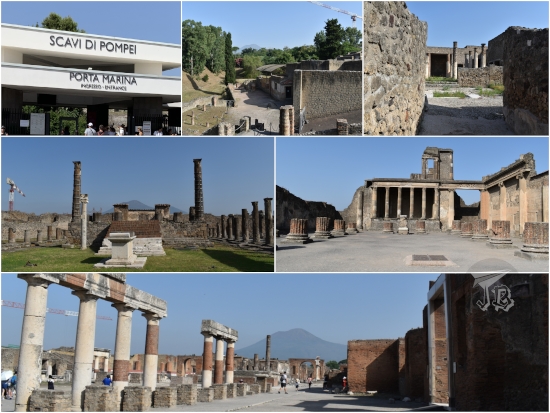
Casa di Romolo e Remo or House of Romulus & Remus; Santuario di Apollo or Temple of Apollo; Basilica (building where politics were discussed); Foro or Forum. Some sights even have Il Vesuvio looming about.
Collage showing some buildings of Pompeii

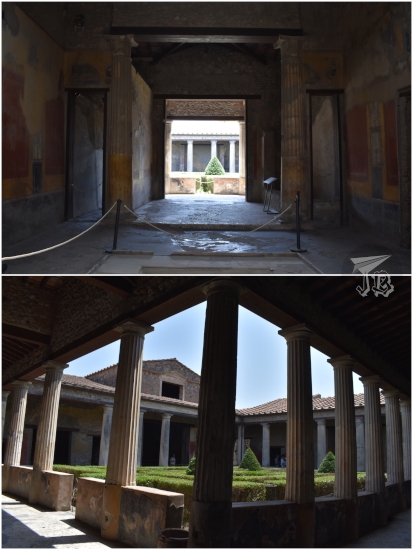
Casa del Menandro or House of Menander, with an almost completed atrium and peristylum, with great frescoes in situ.
Pompeii Casa del Menandro - hall and garden

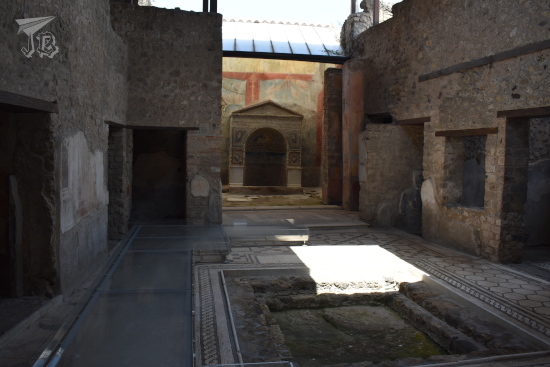
Casa dell’Orso Ferito or House of the Wounded Bear, with incredible mosaics (closed, unfortunately)
Pompeii House of the Wounded Bear

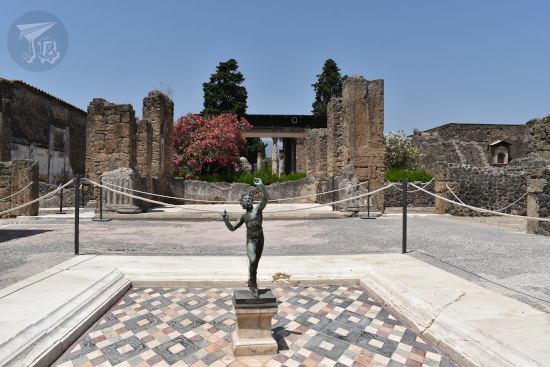
Casa del Fauno or House of the Faun, one of the most famous houses, and original home to a mosaic depicting Alexander the Great in battle.
Pompeii House of the Faun

Casa delle Nozze d’Argento or House of the Silver Wedding, with fantastic frescoes, and tiny details, extremely detailed.
Pompeii House of the Silver Wedding

Casa dei Dioscuri or House of Castor & Pollux, in which the columns still keep some of the painting.
Pompeii House of Caxtor and Pollux

I visited around 75 buildings, and entered as many as I could. Towards 15:00, I again had a few buildings for myself, or with fewer people, and I wish I had had the energy to continue on. Unfortunately, the inner restaurant was super-full whenever I checked – which I did repeatedly between 12:00 and 15:00. However, by 14:00 I knew that I was overdoing it, so I started my retreat. I still had to see the Antiquarium or Pompeii Museum.

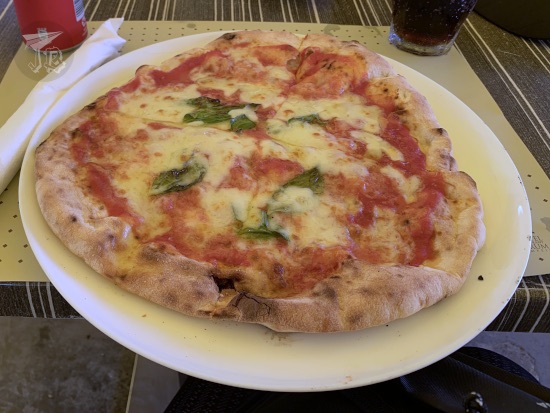
After I left the site, I stopped for a very late lunch (or a very early dinner) at a restaurant just outside the ruins. One of the waiters did not want to give me a table – or actually acknowledge me at all, I think this is the first time that I have actually felt the whole “solo travellers not welcome” echo, However, another one sat me, and I ordered the famous pizza Margherita, which is the big pizza in the Naples area. Not the Napoletana one, go figure.

A whole pizza Margherita

I took the train back, and I was in Naples with time to do something else. I had eaten and I was feeling better, but I thought that I had overdone it, and was worried about crashing the following day if I was not careful. Thus, I took a trip to another supermarket and went back to the hotel for a shower.


For the sake of completion, here is a relation of all the spots I visited in Parco Archeologico di Pompei or Archaeological Park of Pompeii:
Casa di Romolo e Remo or House of Romulus & Remus
Santuario di Venere or Temple of Venus
Casa di Trittolemo or House of Tryptolemus
Basilica (building where politics were discussed)
Santuario di Apollo or Temple of Apollo
Comitium ed Edifici Municipali or Hall of the Elections and Municipal buildings
Foro or Forum
Casa dei Mosaici Geometrici or House of the Geometric Mosaics
Palestra Degli Iuvenes or Gymnasium of the Iuvenes
Casa dei Cinghiale or House of Vesbinus
Terme Repubblicane or Republican Baths
Foro Triangolare or Triangular Forum
Santuario di Atena ed Eracle or Temple of Athena and Heracles (Greek Doric Temple)
Teatro Grande or Large Theatre
Quadriportico dei teatri / Caserma dei Gladiator or Quadriporticus of the theatre / Gladiator Barracks
Ingesso al Teatro Piccolo od Odeon or Entrance to Little Theatre or Odeon
Domus Cornelia or House of Cornelius Rufus
Tempio di Asclepio or Temple of Aesculapius
Casa degli Epidii or Casa de Marco Epidio Rufo or House of Epidio Rufo
Casa del Citarista or House of the Citharist
Casa de Casca Longus or House of Casca Longus
Fullonica di Stephanus or Fullery of Stephanus
Casa del Larario di Achille or House of the Lararium of Achilles
Casa del Criptoportico or House of Cryptoporticus
Casa di Paquius Proculus or House of Cuspius Pansa
Casa di Fabius Amandio or House of Fabius Amandus
Casa del Sacerdos Amandus or House of the Priest Amandus
Casa dei Casti Amanti or House of the Chaste Lovers
Casa e Thermopolium di Vetutius Placidus or House and Thermopolium of Vetutius Placidus
Casa di Giulio Polibio or House of Julius Polybius
Casa del Frutteto or House of the Orchard
Casa di Trebio Valente or House of Trebius Valens
Taberna di Sotericus or Tavern of Sotericus
Casa di Octavius Quartio or House of Octavius Quartio
Casa della Venere in conchiglia or House of Venus in the Shell
Anfiteatro or Amphitheatre
Palestra grande (Exhibition: “Arte e Sensualità nelle case di Pompei” Art / Sensuality in the Houses of Pompeii)
Pradeia di Guiulia Felice or Farms of Julia Felix
Casa del Triclinio all’aperto or House of Summer Triclinium
Casa del Larario Fiorito or House of the Floral Lararium
Osteria del Gladiatore or Inn of the Gladiators
Porta Nocera (gate)
Necropoli di Porta Nocera or Necropolis of Nocera Gate
Casa del Menandro or House of Menander
Casa dell’Efebo or House of the Ephebus
Casa del Criptoportico or House of Cryptoporticus (again)
Casa dei Ceii or House of Fabia and Tyrannus
Casa di Sirico or House of Siricus
Casa di Marte e Venere or House of Mars and Venus
Casa dell’Orso Ferito or House of the Wounded Bear
Casa dei Cornelii or House of the Cornelii
Terme Stabiane or Stabian Baths
Lupanare or Brothel
Arco di Nerone or Arch of Nero
Portico Della Concordia Augusta (Edificio di Eumachia) or Portico of Concordia Augusta (Building of Eumachia)
Tempio del Genio di Augusto or Temple of the Genius of Augustus
Arco di Caligola or Arch of Caligula
Terme del Foro or Forum Baths (this was the “house of the day”).
Casa del Fauno or House of the Faun
Casa della Caccia Antica or House of the Ancient Hunt
Casa di Arianna or House of Arianna
Casa della Fontana Grande or House of the Large Fountain
Casa della Fontana Piccola or House of the Small Fountain
Casa dei Vettii or House of the Vettii
Casa delle Nozze d’Argento or House of the Silver Wedding
Thermopolium (food shop)
Casa di Paquius Proculus or House of Cuspius Pansa.
Porta Ercolano (gate)
Necropoli di Porta Ercolano or Necropolis of the Ercolano Gate
Casa del Poeta Tragico or House of the Tragic Poet
Casa dell’Ancora or House of the Anchor
Casa di C.N. Caetroni Eutychi or House of C.N. Caetroni Eutychi
Torre di Mercurio XI or Tower of Mercury XI
Casa dei Dioscuri or House of Castor & Pollux
Tempio di Giove or Temple of Jupiter
Macellum (food market)
Antiquarium (museum)

18th July 2023: Naples from below and above {Southern Italy, July 2023}

Naples [Napoli] was waking up when I walked out into the heat. It was a bit after 8:00 because I was… not really planning, just expecting to get lost. My hotel was right next to the Porta Capuana and Castel Capuano, remains of the Medieval times and ancient walls. There is where I took my first wrong turn – the nice receptionist at the hotel had tried to explain to me how to get there, and I tried to follow his instructions – which meant I did not follow my original route and I got disoriented. Fortunately, phone GPS came to my aid and I eventually made my way to the Historic Centre of Naples Centro storico di Napoli. While on principle I understand the protection of a Unesco Heritage Site, it did not feel like one, mostly due to the smell – a mixture of human urine, cooked flour and raw fish – and the crazy traffic. I don’t think “pedestrian” means the same thing in Italian as in any language I speak.

I was around the area I wanted to be about 9:30 for my 10:00 visit, and I took the time to wander up and down Via del Tribunali. Off to one side stands the metal sculpture Busto de Pulcinella – a character of the early theatre school called Commedia dell’arte, where different characters wear masks to be identified as an archetype. Pulcinella is an opportunistic anti-hero from the lowest social strata recognised by the black mask. Italians like rubbing body parts of different statues for luck, that’s why his nose is polished off.

Napoli Storico - the centre of Naples

I had a booked guided tour at 10:00 for a place called Napoli Sotterranea – Underground Naples. It is just one of the companies that give tours through the hundred of kilometres of tunnels that cross the Historic Centre. The city of Naples was built on and out of tuff, a volcanic rock made out of compacted ash, with a yellowish colour in this area. Tuff is easy to dig and excavate, and the Greeks used it to build an aqueduct to serve the city – that later the Romans expanded – 40 metres under the ground. When I arrived at the gate, there was a crowd – and even if I had a “skip the line” reservation, my English tour did not start till 10:20. The whole thing was a bit chaotic, and I later realised that as convenient as online pre-booking is, it is not covered by the Naples Tourist Card, so a lot of people had no option but to call at the attractions to get their discounted tickets – I decided not to get the card because I had booked or planned to book most things in advance so it was not value for money for me.

Napoli Sotterranea starts off going down over 150 steps into the excavated tuff to visit the aqueduct. There are a number of galleries where the water used to run, and at some points you can even glimpse the original paint to help prevent the water filtering into the rock. Then the guide explains that during the WWII bombings, the tunnels were used as air raid shelters and you are shown the “showers” and “latrines”, followed by a morbid recall of the stench and the conditions, and some art exhibits and objects from the time. It was at this point I started thinking that the Neapolitans had a thing for the macabre.

Fortunately, we moved over soon, to a tiny garden that is not watered nor lit by sun, and yet it thrives in the tunnels due to humidity and artificial lamps. Then we went further into the earth – you have to walk along a very narrow tunnel, sometimes only practicable sideways. They used to give you a candle for it, but now they tell you to use your phone torch. It was a bit claustrophobic, but at least you did not need to crouch like in the pyramids. At the end of the tunnels there are several underwater ponds and fountains.

Napoli Sotterranea: tunnels and underground water reservoir

As you come out from the tunnels, there is a small “museum of war” with some uniforms and so on, and then they take you to see “the Roman Theatre”. Here’s the thing – the theatre is kind of there. Throughout the centuries, it has been incorporated into the rest of the architecture of the city, so only bits and pieces are visible, mostly those that remain underground, like the actors’ tunnels, and a hall which holds a collection of Neapolitan nativity scenes or presepe.

After the guide set us loose, I walked towards the Montesanto funicolare cable car station. Naples’ rope way is a tourist attraction in its on right, some people say. I’m not a fan, but I really did not want to climb up Vomero Hill Collina del Vomero in the sun and heat. The ride did not take longer than a few minutes, and after a short stroll I reached one of the city’s castles – Castel Sant’Elmo.

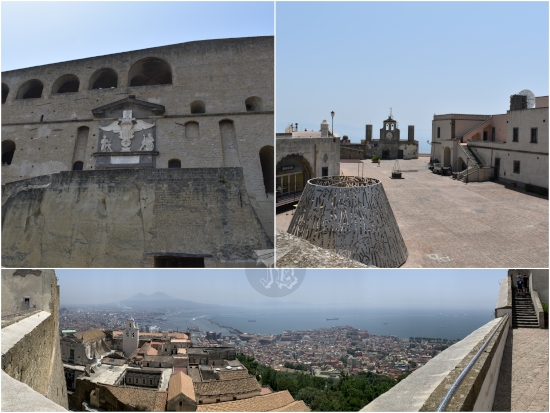
This fortress and former prison dates from the late 13th century. It was built in volcanic tuff, and the structure was mostly developed throughout the 14th century, though it was severely damaged in an earthquake in 1456. Construction continued, and then in 1587 lightning struck the ammunition depot and the explosion destroyed several parts of the castle, including the church. Throughout Naples’ convoluted history, Castel Sant’Elmo has been a stronghold for war, and a prison. Today, it’s a monument, a museum, and a viewpoint of the port and Mount Vesuvius Il Vesuvio in the distance.

Naples Castel San Telmo

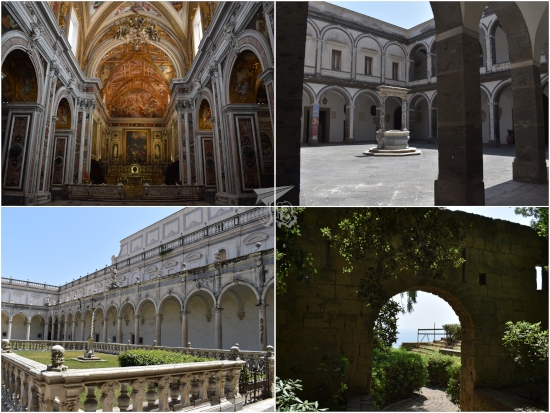
Next to the the castle stands the monastery-museum Certosa e Museo di San Martino. It originally was a Carthusian monastery inaugurated in 1368 and dedicated to St. Martin of Tours. The monks were expelled by French soldiers in 1799, and they were never allowed back. In 1866, it was taken over by the state. The monastery has a Baroque church – Naples is after all the birthplace of the style, but in a different way from the Spanish one, so I don’t dislike it as much. The monastery also has two cloisters – one of which with a cemetery in the middle. There are also hanging gardens and orchards and the different rooms of the building host religious artefacts, items from the Bourbon times, and one of the best presepe in the world.

Naples Monastery of San Martino, showing the church, the cloisters, and the entrance to the hanging gardens

Then I went back downhill, again using the funiculare. My next spot was Naples Cathedral, dedicated to the Assumption of Mary, known as Cattedrale di Santa Maria Assunta, Cattedrale di San Gennaro in honour of Saint Januarius, the patron saint of Naples. However, the most common name it receives is simple Duomo di Napoli. The current building was built in the Angevin Gothic style (gotico angioino) back in the 13th century, over palaeo-Christian buildings. The interior is strongly Baroque, though there are still some 14th century frescoes.

Collage. Duomo the Napoli: façade and main nave

For reference, Italian churches claim that walking into them showing shoulders or knees is disrespectful – so they encourage visitors to show “decorum and modesty” because “it demonstrates respect in the house of god”. I think their obsession with joints is exaggerated (especially considering the heat), and there was a certain event that highlighted the hypocrisy of it all. I visited the palaeo-Christian baptistery, one of the parts of the cathedral that you need to pay in order to access – and all tickets in Italy have been increased 1 € as part of the recovery plan of the area of Emilia Romagna, affected by heavy floods in May 2023.

The Baptistery of San Giovanni Battistero di San Giovanni in Fonte is a basic round pool on the ground, but the mosaic above it is super-detailed. It dates back from probably the late 4th century. The centre has the Chi-Rho symbol, and it is surrounded by scenes from the Bible, animals and plants, and allegories. Well, while I was admiring the art, the guy from the ticket booth came over, pulled his zipper down and urinated into the remains of the original wall. Talk about Catholics and respect in the house of God…

Next I went to the side chapel Reale cappella del Tesoro di San Gennaro (Royal Chapel of the Treasure of St. Januarius) and the Museo del Tesoro di San Gennaro (Museum of the Treasure of St. Januarius). San Gennaro / Saint Januarius is the patron saint of Naples. He was a Catholic martyr in the 3rd century, who died during the persecution of Christians by Emperor Diocletian. After his beheading, his blood was saved and it is said that the blood liquefies three times a year. The chapel holds a reliquary, and the museum some religious artefacts, including the “treasure” – reliquaries, jewels and other religious paraphernalia in noble metals and gems.

Collage: Baptistery of San Giovanni and Royal Chapel of the Treasure of St. Januarius

After the cathedral, I found Via San Gregorio Armeno, an alley that is famous because it concentrates the sells of handmade figurines for the nativity scenes presepe. However, as I walked I could only find cheaply-made expensively-sold figures of politicians, footballers and so on. I have to say that I know or understand nothing about football, but apparently Naples’ city team has won the national championship, and that’s a big thing? Everything was full of football references, posters, banners… and the alleyway was not an exception. It felt a bit… disappointing as I had heard so much about it, and I saw very few things that were “classical” there – I would come back another day and found the real thing though.

I made a visit to a local supermarket to find something to drink, dinner, breakfast and snacking the following day – because I had packed some, but I had forgotten that I had. Italian people don’t believe in either sandwiches or refrigerated coffee, which was a bit of a bummer. They have a lot of stands to grab something on the go, and they are keen on cafés, but I really did not feel comfortable sitting around in the city.

I went back to the hotel with my “groceries” because I did not want to be walking around after sunset, and I spent the rest of the evening watching British Museum’s documentaries about Pompeii and Ercolano to get ready for the following day. One of the things that drew my attention was how the documentaries kept emphasising the “importance” of the archaeological sites, and that it was important to respect them. I did not understand why, as I felt that is quite obvious. I would later discover… yes, people need to understand their importance.

17th – 22nd July 2023: Southern Italy

Back in May, I booked myself a small trip to the south of Italy. A long time ago, I was in the ancient city of Pompeii (and climbed Mount Vesuvius), and for a few years now, I’ve wanted to come back. I had not really looked seriously into it because affordable flights felt either too short (two nights) or too long (five nights). In the end, I made the calculation that maybe one day for Pompeii, one for Ercolano (Herculaneum) and two and a half for Napoli (Naples) might work out – arriving Monday evening and leaving Saturday late afternoon. I found an reasonably-priced hotel close to the station for the five nights, and then life happened as it usually does. This meant that I ended up without a definite plan – just a few basic bookings – and I seriously miscalculated how rough around the edges Naples really is. Despite it being an area with a “bad rep”, I wanted a hotel near the station to facilitate getting to both Pompeii and Ercolano by train, and because I did not want to connect to a second means of transport when I arrived in town at night.

My flight was due on the 17th of July at 18:30, but it was delayed. Right as I was boarding around 18:45, I got an email stating that my credit card had been denied at the hotel, so unless I provided another one within two hours, the booking would be cancelled. I would be in the air, so I needed to do it on the plane itself. Truth be told, my credit card is due to expire in August, so I don’t know if the error was on the hotel or my bank’s part. Fortunately, upon landing there were no further messages, and as I waited to disembark I tried to access my banking app – to no avail. That made me a tad bit stressed – even if I had cash, I wouldn’t want to get stuck abroad without a working credit card again. My bank has this thing for making all my cards stop working at the same time.

I had booked a ticket for the airport bus, that took merely 15 minutes to get to town. The line, however, was stupidly long. As we waited, taxis and gypsy cabs offered rides, but I did not trust those. The first bus left, and the second one arrived shortly after. It filled up, and there were two groups in front of me. The driver claimed that he only had space for one, so I gleefully claimed “one!” and went ahead. People on board called me lucky, people off board probably hated me.

As we drove off into the road, the first thing I saw was a rat, and that should have been a hint. We stopped off at Plaza Garibaldi in Naples around 22:20, and I did not take 10 minutes to get to the hotel – but boy, they felt long. The city smelt like urine and fishmonger ice, and there were lots of people hanging out who looked up to no good. I finally reached the hotel, the debit card worked, and I had bought a sandwich at the airport so I could have a snack. The air-con worked, and I managed to get the shower working. Things were looking up.

I’ve seen Naples described as charming and chaotic. In principle, I agree with the chaotic part. It has nice things, but it did not feel like a nice “welcoming” city – I would not really call it dangerous, but maybe dodgy or sketchy, and always on the lookout for a naïve tourist to scam or pickpocket. I was not really scared, but uncomfortable more than a few times, which made the whole trip a bit tiring. I decided not to wear headphones to pay more attention to my surroundings. In general, the plan was to start off early in the mornings and be back at the hotel with dinner and drinks in the late afternoon, which turned out to be a good idea. The hotel was small and noisy, but clean, with nice staff, and it became a little refuge, because this is not a town I wanted to go out to take pictures at night of.

Side note – on top of everything, I got caught in the middle of a heat wave – so just assume that from the beginning to the end, it was hot, and I was dripping sweat, unless I was underground. I mean, not even the Archaeological Museum has air conditioning in all the wards… but it does in the basement, which holds… the Egyptian collection. Go figure.

The city of Naples – Napoli in Italian – dates back to a settlement-port established in the 8th century BCE. It was refounded by Greek settlers in 470 BCE and it has been continuously inhabited since then, despite the constant threat of looming volcano Il Vesuvio – Mount Vesuvius – and its temperamental eruptions. There are records of about 50 eruptions, the most famous being the one that buried down Pompeii in 79 CE, though the volcano has been quiet since 1944.

Originally part of Magna Graecia (a network of Greek colonies in in Italy), Naples quickly became one of its most important cities. It became an ally of the Roman Republic against Carthage and it eventually became a Roman colony and part of the empire. Emperor Nero performed in its theatre in 64 CE, it is said that an earthquake hit as he did – he explained that it was the gods clapping at his act – it was in reality a precursor of the year 79 eruption.

After the fall of Roman Empire, the city was captured by the Ostrogoths, and later by the Byzantine Empire. In the year 661, the Byzantine Emperor granted Naples the right to be self-governed by a local Duke, which yielded to the Duchy of Naples and its eventual independence. In the year 1137, the Duchy was annexed to the Kingdom of Sicily, of which it became capital in 1266. In 1282, the Kingdom of Naples was created, though at that time there was a dependency of the Kingdom or Aragón and the city eventually became a part of the Spanish Empire. In the 17th century, Naples was the second-largest city in Europe, and it became the epicentre of the Baroque style.

In 1714, the Spanish “lost” Naples, and for a while it was ruled by Austria. After the French Revolution and the Napoleonic wars, Naples and Sicily combined to become the Kingdom of the Two Sicilies. After 1861, Naples became part of the Kingdom of Italy as part of the Italian unification. This marked the beginning of the decline of the city. Naples was the most bombed city in Italy during WWII, and the first to rise against German occupation. In recent years, it has had issues with waste management, Camorra organised crime, corruption, poverty and high unemployment.

In 1995, the Historic Centre of Naples was declared Unesco World Heritage Site, due to the great number of historical monuments of standing importance – archaeological sites, churches, palaces, castles… Naples has turned to tourism as a source of income, both legit and not so much. Different attractions are managed by cooperatives that employ local people at the same time they open historical sites for visits – which is of course good, but the downside is a lot of guided visits and places you can’t see on your own.

I arrived late on Monday, and I had decided not to book Pompeii for my first day, just in case there were delays. I decided to dedicate Tuesday 18th to Naples (which lead to discover that the Archaeological Museum closed on Tuesdays), Wednesday 19th to Pompeii, Thursday 20th for a half-day trip to Ercolano, and the rest of the time to Naples itself. If I had done a bit more research and timed things better, I could have fit another half-day trip. However, on the bright side, this meant I did not become too tired.