19th August 2021: A Monastery and a Castle {Spain, summer 2021}

We packed up and in the morning, we continued out trip, heading generally westward towards our next destination, which was about an hour and twenty minutes away. Unfortunately, we got on a slight disagreement with the Sat-Nav again – it sent us through the secondary road and in the end we took two hours going through the curves. Thus, around 10 am we managed to get our tickets to the “royal” monastery Real Monasterio de San Juan de la Peña – which is in the middle of nowhere but technically belongs to Jaca.

The monastery is actually two (or three, depending on how you look at it). The old monastery, Monasterio Viejo de San Juan de la Peña was built in the Romanesque style, and dates back from the tenth century. Its origins, however, seem to be more obscure, related to Iberian and pagan rituals. It is excavated into / built onto the vertical wall of a natural cove occurring in a bare-rock hill or crag in the middle of the forest. It held a convent, a church, and a cloister on the first floor. From the time it was built till the time it was confiscated by the government in the 19th century, it became one of the burial points for the monarchs of the old Kingdom of Aragón and Navarra, thus the “royal” eponym.
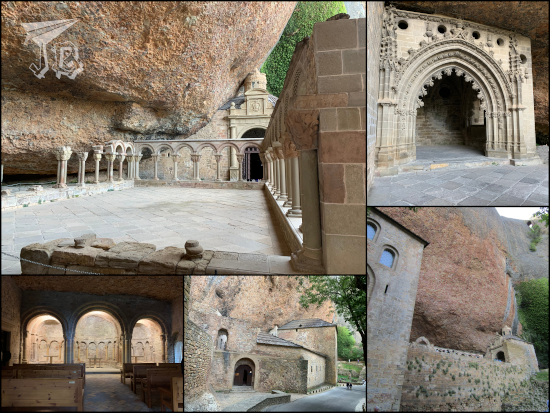
One of the many legends regarding the monastery is that it was home to the Holy Grail between the 11th and the 14th century. Later, in the 17th century, there was a fire, and it was decided to build a new monastery. Here is what is weird – there is a building there now, the so-called new monastery Monasterio Nuevo de San Juan de la Peña. Some of the buildings have survived, but most of it is an archaeological museum / excavation of what was there, again until the liberal confiscation.

Issues: You can only visit the old monastery after buying your tickets at the new monastery. And to get from one monastery to the other, you need to take the shuttle, again, awesome during Covid times. Furthermore, there was no control of the number of people there, which resulted in an overcrowding that would have been uncomfortable in normal times, much more during the pandemic. While the bus makes sense due to the fact that there is literally no way to park around the old monastery, some crowd managing would have been necessary.

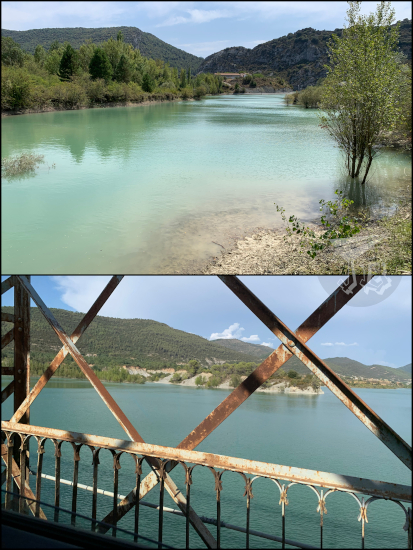
After visiting both monasteries, we went back to the awful road. I don’t know if it was the curves, the heat, that I had overdone it the day before, or all of the above but I was not feeling well. Thankfully after some food and a stop at the water reservoir Embalse de la Peña, I felt better.
We continued our way and made a stop to look at an interesting geological feature called Mallos de Riglos, which are several almost-detached vertical walls of conglomerate rock left behind by erosive processes that dragged away what used to be around them. They stand up to 275 metres high over the river Río Gállego.

This was a short stop from a viewpoint, but we soon drove on towards the next destination – after one of the most important buildings in religious Romanesque architecture, we were going to see a civil counterpart, the (self-reportedly) best-preserved Romanesque castle in the world: Castillo de Loarre. The truth is that, from afar it looks awesomely cool, though once you are inside, it loses a bit of its appeal as there is no perspective. Besides, it was too hot to hike down the hill for good views.

The keep is built on a rocky hill, and the surrounding buildings are connected to it by a number of doors and haphazard stairs and arcs. Both the main towers and the fortified wall were erected around 1287, in a strategic point between the Muslim and the Christian kingdoms battling over the place. As the Christians expanded their influence, the Muslim tribes retreated towards the Mediterranean, leaving the castle “jobless” in a way, and the castle decayed until it was restored (twice) in the 20th century.

After the castle, we went back to the car, and from there I fought the Sat-Nav (I was not the driver). When I saw that it wanted to send us through another god-forsaken secondary road full of curves for over a hundred kilometres, I advocated for 123 km of main roads and highways. I won (^◇^)y, and around half past seven we arrived in our next destination Sos del Rey Católico, where we would be staying at the Parador for two nights (of course, I got my stamp there). A great improvement from the hotel in Torla-Ordesa, and a welcome one, with awesome sunset views to go with it.

Total driven distance: 272 km. Maybe around five hours and a bit? Some of the roads felt eternal.
Total walked distance: 5.23 km.

17th August 2021: Towards the Pyrenees, via the cathedrals {Spain, summer 2021}

The total driven distance today was around 450 km, but we did that in three legs with with two visits in-between.

The first stop was Huesca, in the province of the same name, in Aragón. After ditching the car (and having our first Sat-nav disagreement for the trip), we walked towards the city centre. The first thing we peered into was a little grocer’s shop Ultramarinos La Confianza, which dates back to 1871 and is reported to be the longest-running grocer’s in Spain. Unfortunately, due to Covid restrictions there was a queue outside and we could only see it from the outside.

We proceeded to the cathedral of the Lord’s Transfiguration Catedral de la Transfiguración del Señor, a Gothic-style building that stands in the centre of the town, just in front of the council hall. The cathedral has only one tower which used to be crowned by a spire, but that was lost during the civil war. The main gate is decorated with carvings of the Apostles.

However, we did not enter through the main gate, but the lateral one which gave us access to the religious museum of the cathedral Museo Diocesano de Huesca. The museum has several art pieces from different periods, and gives access to the Gothic cloister of the cathedral, and to older structures, among them, a peek into the original Romanesque cloister.

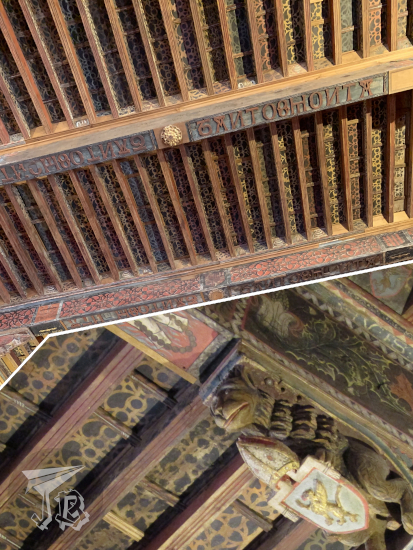
Adjacent to the cathedral stands the Bishop’s palace, also part of the museum. The most impressive part is the hall called Salón del Tanto Monta , which sports a Mudejar wooden ceiling carved and polychrome in 1478, restored twice since then. The wording “Tanto Monta” refer to the Catholic King Fernando, indicating that he had as much importance in his wife’s kingdom as she did – I’ll get into that history titbit another day though.

We finally walked into the cathedral itself, which is presided by the high altar made from alabaster and sculpted in the 16th century by Damián Forment, the most important sculptor at the time.

Again due to Covid, we could not visit the council hall and see the painting that illustrates a rather sordid legend – the king Ramiro II called upon some treacherous noblemen under the excuse to show them “the greatest bell in the kingdom” and beheaded all of them. Some of the legends add that he used one of the severed heads as a clapper. The town hall hosts a painting by José Casado del Alisal depicting this side of the legend, even though it has been long debunked. What was open was the little church in the convent Monasterio de Nuestra Señora de la Asunción, though the most interesting part of the monastery is the building itself, in a very characteristic style using bricks that reminds of the Mudejar style.

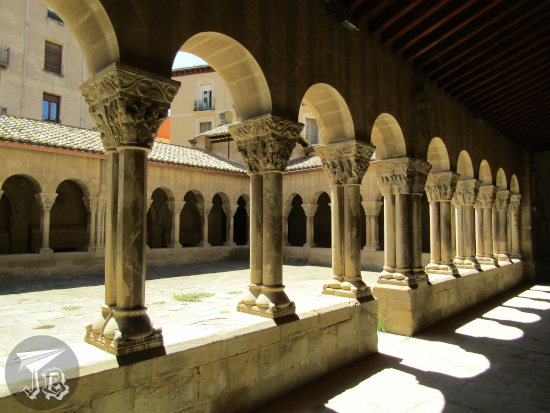
The next stop was another monastery San Pedro el Viejo, one of the oldest Romanesque buildings in Spain. The church was used as Royal Pantheon and some of the old Monarchs of the former Kingdom of Aragón are buried there. Though it has been completed and renovated in different styles, the cloister dates back to 1140 – albeit some of the capitals have been “cloned” in restoration.

The inside of the church has been populated by Baroque chapels (urgh). However, some of the original polychromy can still be seen.

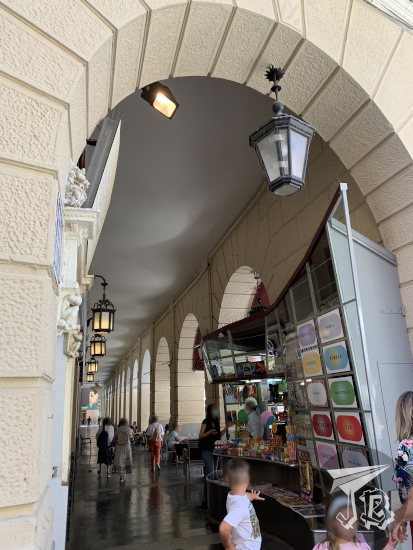
These are the main sights for the town of Huesca, so we decided to go on. We tried to find a place to have lunch, but most places were closed as the local festival had just finished. Searching, we ended up passing by and underneath the Porches de Galicia, a covered street considered a historical landmark, but there is no actual information on it that I could find.

On our way out, we walked past the fountain Fuente de las Musas, representing the Greek Muses.

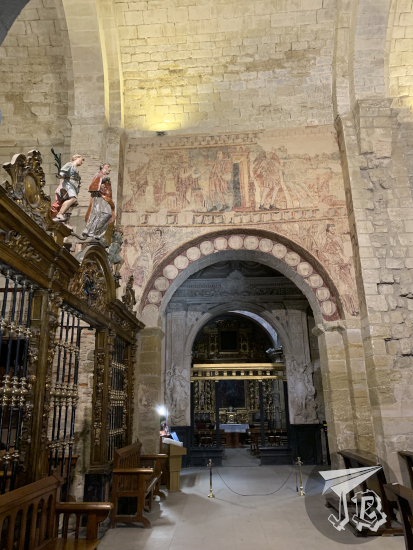
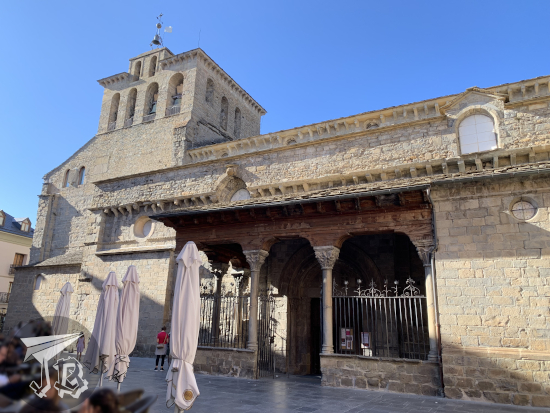
The second leg of the journey took us to Jaca, where we visited the cathedral and the Diocesan museum. The cathedral of St. Peter Catedral de San Pedro Apóstol, a predominantly Romanesque building (with, of course, Baroque decoration), although the wooden ceilings have been replaced. The building itself was completed around the year 1130. The altar holds the organ and is richly decorated with frescoes.

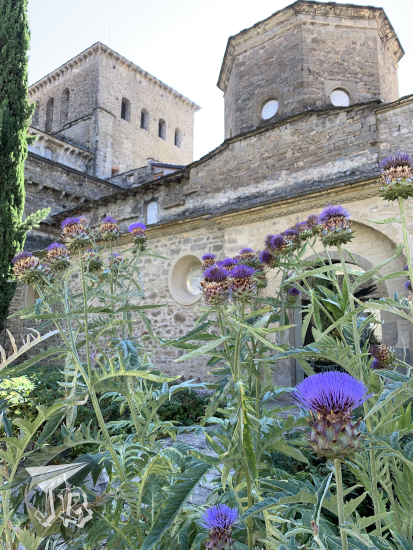
The adjacent museum Museo Diocesano de Huesca, also called the Romanesque Museum, which contains a large number of Romanesque paintings that have been collected from the different churches around the area, and sculptures from the period. It also yields entrance to the cloister, which has a small garden populated with roses, bright purple thistles, and tiny shy lizards that ran away as I peered in.

It was a little too late to enter and walk around the old fortress Ciudadela de Jaca, the military museum, so I just walked around it. Unfortunately, the star shape is not appreciated from the ground, so take my word for it – it is star-shaped. Due to droughts, however, the moat is devoid of water, and it has been turned into a… deer park.

So after this we drove off to the final destination of the day, the small village of Torla-Ordesa, which is the entryway to the Pyrenees area on the Huesca province, particularly the nearby national park Parque Nacional de Ordesa y Monte Perdido.

We had a bit of an organisation issue here. Because the park is a National one, there is zero reliable information from the administration itself – it turns out that to reach the park you need to take the bus from the visitor’s centre in Torla-Ordesa, you cannot get there on your own (lovely for Covid times, don’t you think?). Furthermore, the park has top capacity which is measured by the buses that depart from the centre – around 30 buses, which is usually reached around 10 am in summer. This made us change all our plans. So we set the alarm for 6:30 am to get an early start, and went to bed.

As mentioned before, driven distance was around 450 km. Total walking distance: 7.5 km.