19th July 2025: Highway → Murero → Highway → Home {Dinosaur Eggs Loarre & Zaragoza, July 2025}

While Zaragoza (Saragossa) is not a super-busy city, the noise from the large avenue the hotel was in woke me up early enough to be amongst the first customers at Pannitelli Original Bakery. I had a toast, orange juice, and a coffee, then set off to the not-so-easy task of retrieving my car, driving back to the hotel, getting my deposit returned, and going on my merry way. It took a while, but once that was taken care of I could drive off. Getting out of Zaragoza was easier than getting in had been, and there were few cars on the road. One of them was the traffic police, so every driver seemed on their best behaviour…

Once in the speedway, the first stop of the day was a petrol station, as there was no way I made it home with one quarter of a tank. Unfortunately, there were no low-cost fuelling points on my way, so I had to use a big-name one. Thirty euro don’t take you as far with branded fuel…

To be fair, I could have driven home the previous day, but I thought that after such a week, an extra night of sleep could only be beneficial. Staying also allowed me to see the Asian treasure exhibits in the Lonja and make a stop on the way. My first idea had been going downtown to see the Natural History Museum, but it closes at the weekend. That was why I asked about the visit during the course, and it turned out it was doable. Thus, in the end, I decided to make a stop in a small palaeontological site that I would not travel to otherwise. Furthermore, the site popped up during the course twice – the signage had been handled by Paleoymas and the Natural Science Museum had quite a few specimens from there.

View of a valley with a sign that reads 'Plaeontological site' in Spanish

The Yacimiento Paleontológico de Murero palaeontological site holds remains from the Cambrian Period, extremely important because there are around eight million years’ worth of fossils (511 to 503 million years ago) preserved in the strata. Palaeontologists have found about eighty species of trilobites, along with echinoderms which had not yet developed five-way symmetry, brachiopods, worms… It is mainly composed of shales which allow for soft-bodied organisms to be fossilised along the hard bits like shells or exoskeletons. The site is famous because it allowed researchers to identify sexual dimorphism in trilobites – they were able to describe two distinct types of animals within a same species, which are interpreted as male and female. What they don’t know is which animal is which sex.

I left Zaragoza using the A23, then turned to a national, smaller road (N234) that crossed over to the A2. The site and the municipality it technically belongs to, Murero, lie halfway through this road. As mentioned before, not somewhere I would purposely travel to, but since I was literally in the area, it was a convenient stop. The regional road was all right, but the local one was narrow and the curves were very sharp and steep. I was thankful that all of the cars I saw passed while I was hiking or taking photos of the site, and none while I was driving. I decided to only stop at the area which had a small parking lot so it was safe for me and any potential driver.

To be honest, I expected to see more in the palaeontological site. The signage has either weathered out or been vandalised and nothing is readable. It is a short walk up and down a hill where you can’t really see anything except for a box at the top where people leave what they find, but there was not a chance to see anything in situ. I guess the palaeontologists and the amateurs have taken out everything that is worth anything already – or left it well buried so it can’t be pillaged. I wouldn’t even consider it a nice hike because broken pieces of slates made the path extremely slippery (I forgot my hiking boots in the car…).

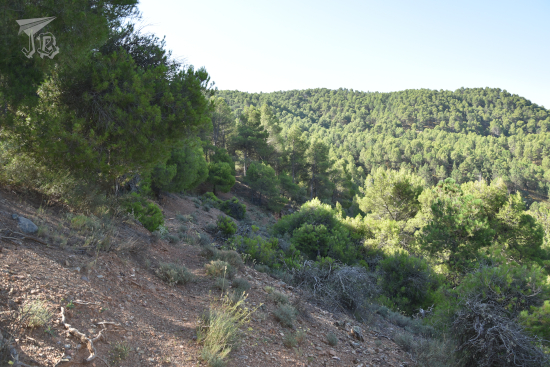
Walking upward to the site, among the pines. On the lft there is a rock with the number 6 painted on it with yellow paint.

Side of the mountain with pine trees

And oh, the temptation to steal a trilobite from the display box was strong! I resisted it though, and headed back to the car after an hour or so. I undid the path towards the N234 road and continued onto the A2. I made a stop in-between for some caffeine and a snack, but I was home for Spanish lunchtime. I have to admit I had pondered stopping somewhere along the way, maybe Daroca, Belchite or Calatayud, but considering that I still had to drive back, I decided to leave it for another time.
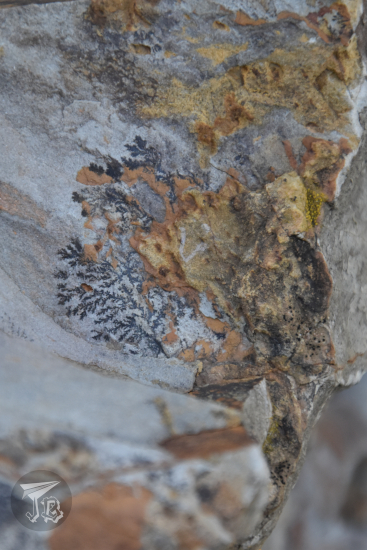
Cool crystal dendrite, which is not a fossil but still neat

Fossil equinoderms on a stone

Fossil trilobite, deformed by pressure and the pass of time

On my first solo road trip, I was surprised by the sheer amount of people who like driving at the same speed all the time. A bunch of drivers in the regional road, with limits of 90 kph, did 70 kph even when they drove through 50 kph towns. The same happened in the speedway – some people drove at 110 kph, both at the 120 kph or the 100 kph stretches. There were also those who liked aligning their cars with the markings that separate the lanes, effectively occupying both. The lorries were more manageable on the way back than towards Loarre, as it was a Saturday morning, and because the speedway feels more “downwards”.

Once home, it hit me how tired I was, so I guess it was a good thing that I had not made another stop. Checking Murero out was a good idea as it broke the trip in half and was a small hike that helped me keep alert, but more would have been overdoing it.

As a recap of my experience with the course Técnicas de restauración en paleontología a través de la preparación de los huevos de dinosaurio de Loarre: Palaeontological Restoration Techniques through the preparation of Loarre dinosaur eggs, I can say that all in all, it was amazing. The professors were extremely knowledgeable, they made learning effortless and entertaining, and the group was fun and easy-going. The course was way more hands-on than I had expected, literally covering everything from geological analysis to the fate of a dug-up piece, either in display or in storage within the museum, including working with the fossils themselves. It was not cheap, mostly due accommodation choices, but booking in advance probably made it better – and honestly, decent hotels were a must. As Loarre is a small village, food options were limited. Though there was a bakery / shop, we were out doing stuff while it was open. However, I made do with crisps or nuts for dinner, as I had a good breakfast. Probably lunch in Ayerbe was the weakest, and most awkward since it involved getting to know each other (and ten bucks for a frozen pizza was daytime robbery).

The whole trip involved driving around almost 700 km. It did show me that I (and my coffee-maker of a car) can manage the long drives better than I had expected, even during a “peak” time such as a holiday-period opening date. I am more comfortable on the road than in towns, though, even when caught in a jam. Was it the smartest idea to head to Loarre directly after work? Probably not, but if I had to do it all over again, I probably would – it was the only actually available option. And knowing that not all the course openings were filled, I would not have stressed as much over the University’s lack of efficient sign-up.

The only downside I can find is the lack of mental reset – I was constantly learning new facts, and I did not get much me-time. It was extremely fun, but not really a holiday where I could plan and do stuff at my own pace. Would I do it again? Well, the University of Teruel runs a similar summer course using Dinópolis resources, and sign ups open in February…

Stay tuned.

14th – 19th July 2025: Loarre & Zaragoza Summer University (Spain) {Dinosaur Eggs Loarre & Zaragoza, July 2025}

Sometimes I get weird ideas stuck in my head. I usually let common sense override them, but this time the temptation was too great, so I allowed myself to do something slightly insane. I don’t regret it one bit.

Until a few years ago, my work projects rarely extended past June. Lately however, I’ve had to work well into July, which means I have not been able to sign up for any summer university course. Especially, one summer university course from the university of Saragossa Universidad de Zaragoza called Técnicas de restauración en paleontología a través de la preparación de los huevos de dinosaurio de Loarre: Palaeontological Restoration Techniques through the preparation of Loarre dinosaur eggs. Until now, I had been working through both editions of the course – usually until the very same day the four-day course finished. However, this year my last day of work was the day before the course started.

I started mulling… what if? What if I signed up? What if I directly drove from work to the site of the course? What if I did something crazy and went to Loarre? It would mean driving for a about four hours through the late afternoon / early evening of the 14th of July, the day before lots of holiday periods kicked off… right after a whole work session. It was not the best of ideas. It was not the most reasonable thing to do. What if I did it anyway?

I made up my mind – I would do it, sanity be damned. My family also offered to subsidise part of the course and accommodation as my birthday present, too (thanks!). I found out all the information and decided to try for the course on the 27th of April. Now, I just had to wait for admission to open, sign up, be accepted, and pay. It seemed to be a simple process, like any other course I’ve taken before.

Palaeontological Restoration Techniques through the preparation of Loarre dinosaur eggs

Except, it was anything but simple.

Sign-up for the Saragossa Summer University, Cursos de Verano UNIZAR usually opens the first Monday of May. That did not happen this year – because 2025 is special? Once I located the correct website, I checked every day – like keeping tabs on concert-ticket information – until a tiny banner reading “sing-ups will open on the 12th May” appeared. Since enrolment did not open a midnight, I deduced that slots would open at 9:00, so I was ready at the computer at that time. The online forms opened indeed around 9:20, but there were only five courses listed on the website, and none of them was mine. The rest opened gradually, but only as numbers… I kept refreshing the webpage until I finally saw my course just after 9:40. I filled in the information, and the webpage said that I would receive an email with confirmation and further instructions.

That email never arrived.

I gave the university a couple of hours, then phoned them up around 13:00. I was told there was a problem with the system and to call the following day if the email had not arrived. Thus, I called around 9:15 on the 13th of May, when I was informed that they had forgotten to activate sending the confirmation emails but not to worry.

On the 15th of May there was a webpage update, saying that the email that had never arrived held confirmation and paying instructions, so I rang the University again. They told me that they would send the information “manually” and “later”. Maybe. The conversation was not really reassuring in tone. I explained that I needed to book accommodation, and they checked again – I was number seven in the list, which meant I was in. They also informed me that there was a partner accommodation on the website – not really, there was a coding error and it did not display. I told the lady so, and she said she would update the webpage. I asked again if she was sure my enrolment had gone through, she insisted that I was in, and the email would come later. Definitely maybe.

I went on Google Maps to check for accommodation in town. Loarre is a 350-inhabitant village famous for its castle and since 2019, its palaeontological sites, where around a hundred sauropod eggs have been found. These eggs were the star of the course Técnicas de restauración en paleontología a través de la preparación de los huevos de dinosaurio de Loarre: Palaeontological Restoration Techniques through the preparation of Loarre dinosaur eggs, from the 15th to the 19th of July 2025. If everything worked in the end…

The accommodation recommended by the University was the campsite, but that was a bit out – it meant driving to the village every day, or a 35-minute walk each way. And that would be nice in the morning, but not after the whole day out. I sent an email to a nice rural cottage which never replied. Then I realised that the course actually was held in Loarre only for three of the four days, the last one would be in Zaragoza (Saragossa) itself. I tried to book at the recommended accommodation, but when they had not confirmed within 48 hours, I just went on a third-party site. I booked a place to stay in the heart of Loarre and a hotel near the university in Saragossa. Of course, a few hours later, the recommended accommodation replied, so I had to cancel. I still reserved everything with full cancellation, just in case. Can you tell I had little confidence in the whole process?

Of course, in between, work tried to change my schedule (already chaotic), because someone needed one of my days in exchange for the 15th of July, which I had to regretfully decline. I hope they don’t hold that against me, but after all the planning and the stress, I did not want to give up the chance to take this course to do someone a favour. On the 13th of June (Friday), the sign-up email arrived, with a payment deadline on the 23rd (Monday) – the course fee was 190 € (160 € discounted). I transferred the money right away, since the following day there would be a bank outage. I also sent proof of payment and a copy of the documentation that entitled me to the discounted price. A few minutes later, someone wrote to me to ask for the discount paperwork. I sent it again.

On Friday the 20th of June, I got a phone call from a long number at work. I rang back. It turned out to be an admin from the summer university asking me if I was still interested because I had not paid yet! I said I had transferred the money, sent the receipt, and the documentation. The person on the other side of the line was surprised for a second, then updated bank data or something, and it turned out that my payment had indeed gone through. Magic! Guess who emailed the University again to have confirmation on writing… It should not be so difficult to… enrol in a course from an establishment that has been offering them for literally almost a century.

To be honest, I was not 100% confident I was really enrolled until I saw my name in the roster the morning of the first day. But it was. Actually, that is a bit dramatic, as on the 7th of July 2025 I received an email from one of the course coordinators, Lope Ezquerro Ruiz with some information. In that email, he explained that some people had contacted them to try and organise transportation, so they were offering to drive people from Saragossa or Huesca on the first day, and back to Saragossa for the last session.

The truth is that public transport to Loarre was a nightmare. That is why I had decided to drive, even if I don’t like it that much, especially in the middle of the holiday rush. Had I known transport from and to Saragossa was a possibility beforehand, I would have planned accordingly. I might have considered taking a railway round trip to Saragossa instead of driving, but by then it was too late to rearrange and change the whole accommodation planning. Furthermore, it allowed me to pack for all kinds of eventualities (yay boot space). In the end, it was way more convenient to have the car, so I don’t regret it.

As the day approached, the weather predictions were al over the place. I decided to pack a bag for Loarre, and a different one for Zaragoza (Saragossa) that I would swap, I also prepared an isothermal bag with frozen water bottles, drinks and snacks – of course, the ice would eventually melt, but I had to leave the car outside while I was at work (and when I came back at 15:00, the the temperature it marked was usually 43 ºC), and I wanted to make sure no fizzy drink exploded. I finally readied an extra bag for “maybes” – extreme cold, extreme heat, rain, extra headwear…

Both the village of Loarre and the city of Zaragoza are located in the area of Aragón, a region of Spain which has gained a lot of traction in the palaeontological world due to the impact of Dinópolis and their exploitation of anything that can be even vaguely related to dinosaurs.

One of the things that surprised me, however, was how Loarre wants to attract tourists but does not seem to be willing to carter to them. I packed snacks for dinner because I was not sure I’d find a place to eat or a shop, and I was right. On Wednesday, we were too late for lunch and had to find alternative plans, and the Hospedería decided that they would not offer food in the evening because the cook had hurt her foot.


If you are interested in the “hard science” of what I learnt and will summarise here, I recommend these sources (in Spanish) by part of the course professors:

  • Moreno-Azanza, Miguel; Ezquerro, Lope; Pérez-Pueyo, Manuel & Gasca, José. (2021). Huevos de dinosaurio en las Sierras Exteriores de Huesca. You can read it here.
  • Díaz Berenguer, Ester & Canudo, José. (2024) El Museo de Ciencias Naturales de la Universidad de Zaragoza. Revista PH. 10.33349/2024.113.5663. Available here.
  • Pérez-Pueyo, Manuel; de Jorge, Laura; Ezquerro, Lope; Laita, Elisa; Moreno-Azanza, Miguel; Díaz Berenguer, Ester; Núñez-Lahuerta, Carmen; Barco, José; Cuenca-Bescós, Gloria & Canudo, José. (2023). Paleontología de proximidad: cómo fijar el patrimonio en el medio rural. Found here.
  • The museum-lab Laboratorio Paleontológico de Loarre website.
  • The company that manages the private side, Paleoymas website.
  • The Saragossa University Natural Science Museum Youtube channel.