
Sos del Rey Católico, formerly just Sos, is a small town still in the province of Zaragoza in Aragón. Its historical centre is so historical that it has been around since the 1400s. In 1452, the infante Fernando, who would go on to become the Catholic King, was born there. Back in the Middle Ages, the Kingdoms of Aragón and Castille became intertwined when Queen Isabel I of Castille and Fernando II of Aragón got married, earning the moniker of Catholic Monarchs due to their relentless fight against the Muslim Caliphates that had conquered the country long before. The trick of their marriage was that both of them remained the king / queen of their own kingdom in a very delicate equilibrium that sometimes was referred to as tanto monta.
A walk through the town yields to viewing a lot of Medieval buildings and palaces – too many to keep tack of. The wall is still standing in several places, built around the natural rock in order to make the most of the natural defences. There are a number of palaces that have been repurposed with new functions – the town hall, a school, and so on, and you can see them all in a short stroll, which we of course took. We left the hotel at around 9 in the morning because our breakfast turn was from 8:00 to 8:30 and there was not much else to do anyway.
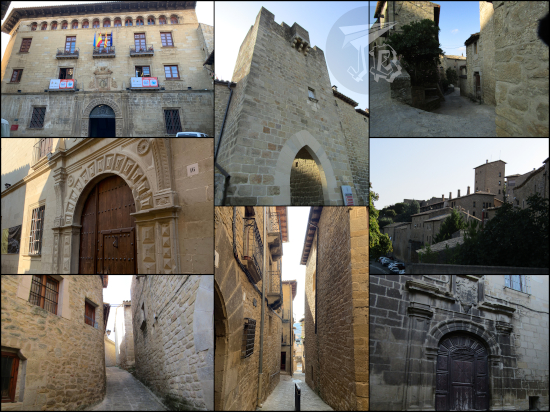
The second reason why Sos del Rey Católico became known was the filming of an absurd Spanish comedy back in 1985. Thus, the village erected a sculpture to the director, Luis García Berlanga, Estatua a Berlanga.

The sculpture lies at the feet of the church of Saint Stephen Parroquia de San Esteban, which we could not enter, unfortunately, due to a scheduling conflict. The church has a Romanesque-style entrance carved in the 12th century, but protected from the elements by an outer portico from the 16th century. The church has an interesting shape, which tunnels and stairs, owning to the actual relief of the area.

Beyond the church stands the remains of the castle Castillo de Sos del Rey Católico, out of which the keep and a little turret still stand, albeit heavily restored. The old town was a frontier fortified area between the kingdoms of Navarra and Aragón, and it was a strategic point in Medieval times. This is why Fernando II’s mother fled there when the war started and why Fernando was born there.
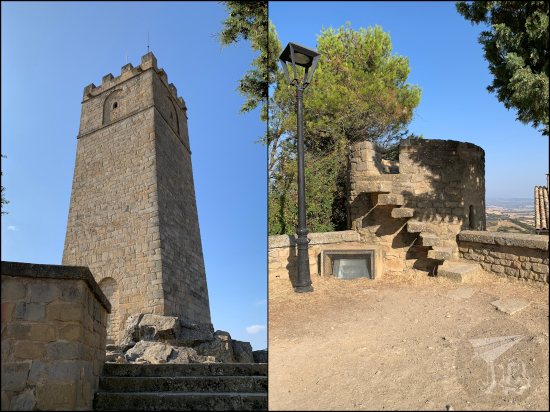
The short climb yields to being able to survey the surroundings.

The whole “Fernando the Catholic King” was born here reaches its peak in the old palace called Palacio de Sada, where the King was born. Today they have turned it into an “interpretation museum” and holds some panels, an audiovisual, and reproductions of both the Catholic Monarch’s Last Will and Testament. The highlight of the palace is the Romanesque chapel and former Church of Saint Martin, Iglesia de San Martín de Tours, which still shows the painting and polychrome on the altar walls.

Shortly after 11 we went back to the car to drive to the other side of the Aragón – Navarra border, both the old kingdoms and the current areas. We had a booking for the monastery of Leyre Monasterio de Leyre at 12:30 and considering how much our Sat-Nav was trolling us we wanted to give ourself an hour of leeway. The device behaved itself and we arrived there at the right time.
Leyre is a still-active Benedictine monastery has been rebuilt and renovated, but at its core stands the church of Leyre. Standing in the middle of the mountains, it used to be a fortified monastery.
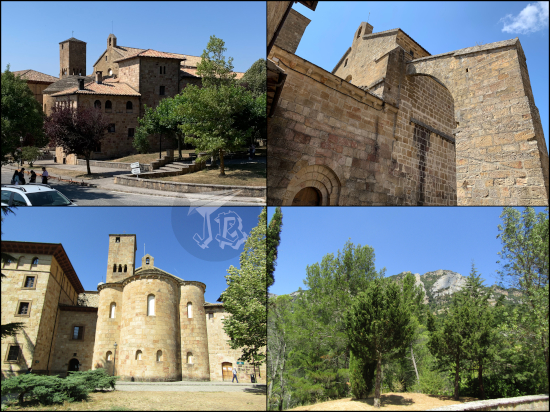
The church is based on an early Romanesque “crypt” whose goal was to flatten the terrain in order for the church to be built above it. It is an amazing engineering work, and not at all usual.
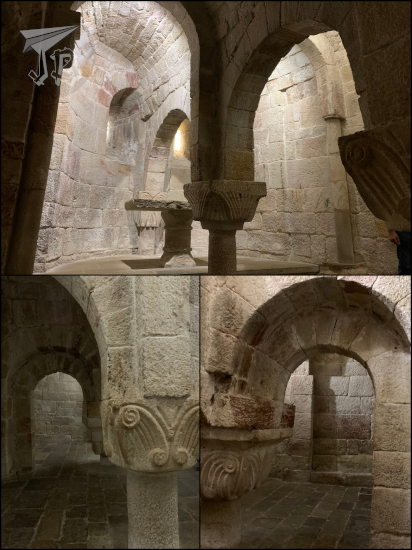
The original Romanesque church was consecrated in 1057, and it is one of the most impressive and highest Romanesque buildings I’ve ever seen. The main nave is also Romanesque, but the dome is already Gothic. There is a beautiful sculpture of the Virgin of Leyre. The entrance of the church is magnificent, carved in the 12th century with dozens of carving in stone.
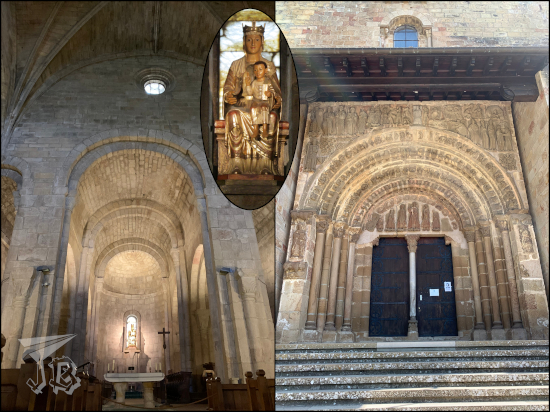
We were lucky enough to have timed the visit with the monks’ Sext prayer, in Latin and Spanish, and mostly sung in the Gregorian style. Ah, and this was also a burial point for the Monarchs, but this time of Navarra… then again, eventually the Kingdoms of Navarra and Aragón became one so…
After Leyre, we got onto the car again and crossed over to the other side of the highway to the Castle of Xavier Castillo de Javier. We had lunch around the castle before we even approached the building, under Saint Francis Xavier’s glance.
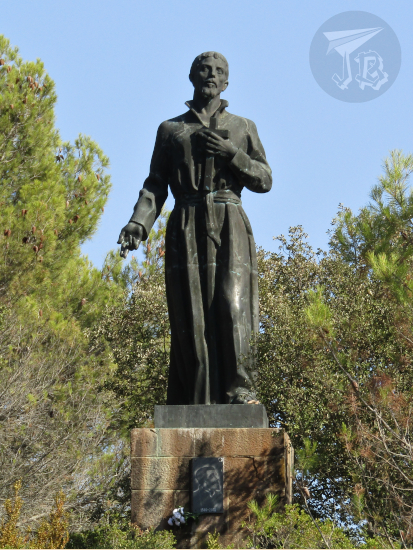
The castle was the birthplace and childhood home of this Catholic saint (born 1506), famous for trying to spread Christianity in India, South-East Asia and Japan. He was a co-founder of the Jesuit order, which owns the castle now. The building has been turned into a museum about the saint.
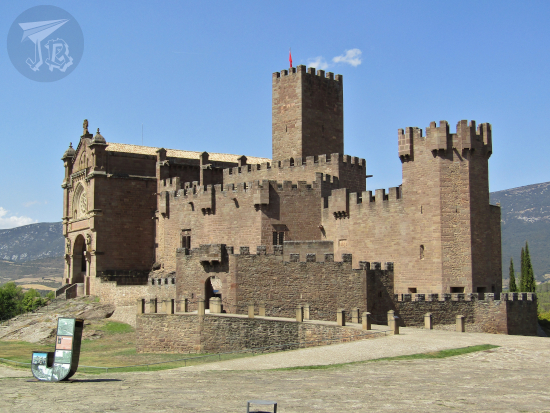
The origins of the castle date from the 10th century, though most of its current appearance can be traced to the 11th and 13th century. Later the towers were destroyed, and in the 19th century they were re-erected, and the adjacent basilica was built. There is also a reconstructed little church were the saint was christened.

The inside of the castle holds some items from Francis Xavier’s times – real or not – some Japanese paintings and scrolls, trinkets that were brought from Asia during the preaching missions, and a bunch of dioramas. You can climb up to the keep and look at the surrounding area. Unfortunately, the guide was horrid and he just regurgitated facts that were dubious or plain wrong – for example, he claimed that a diorama that looks like a Hindu temple represented the Emperor of Japan.
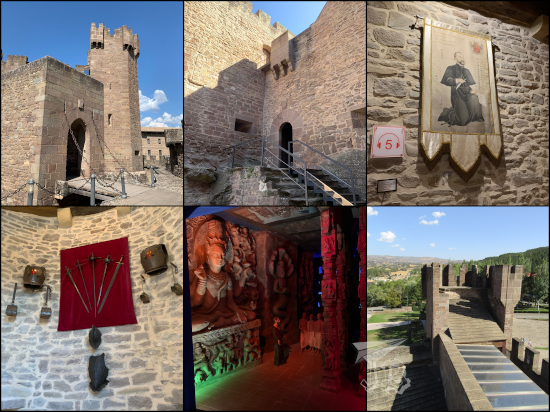
One of the most interesting artefacts in the castle is a late-Gothic oak carving of Christ on the cross, which sports a faint smile. The piece is located in a tiny chapel decorated with dancing skeletons referring to the Latin expression “Carpe Diem” (seize the day).

After the castle we drove over the “border” back to Sos del Rey Católico, and after a shower and a drink, I decided to explore de historical building of our hotel, Parador de Sos del Rey Católico, and the gardens.

Driven distance: 56 km. Walking distance: 6.17 km.



 JBinnacle – A Travel Logbook