In 2022, some relatives who spend the weekends there talked me into visiting the Medieval fair in Tendilla – Feria de las Mercaderías de San Matías. It recovers the tradition of the cattle fair around St. Matthew’s day, and today it is one of the yearly highlights of the village. The historical roots of the municipality as an important villa in Medieval times can be traced to the Second Count of Tendilla, Don Íñigo López de Mendoza (1442 – 1515). He accompanied the Catholic Monarchs in their conquest of Andalusia and was later named “governor” (of sorts) of Granada once it was won for the Kingdom of Castile.
I once more arranged to attend the fair in 2023, and I drove off early in order to secure a decent parking spot as the core of the village gets closed off to traffic. Tendilla is laid out along a former main road, which used to work as a separating axis. Today, traffic has been diverted and circumvents the whole village, and the axis has been renamed as two streets: Calle del General Muñoz y Muñoz from the beginning of the village to the town hall square, Plaza de la Constitución, and Calle del Alférez Agudo to the end of the village and the “former fair square”, today the square Plaza de Vicente Mariño. Along this axis, rows of stands on both sides of the street, selling crafts, trinkets, traditional products and foods, and so on. Tendilla is known for its torreznos, processed pork lard snacks, so there are many of them on offer.
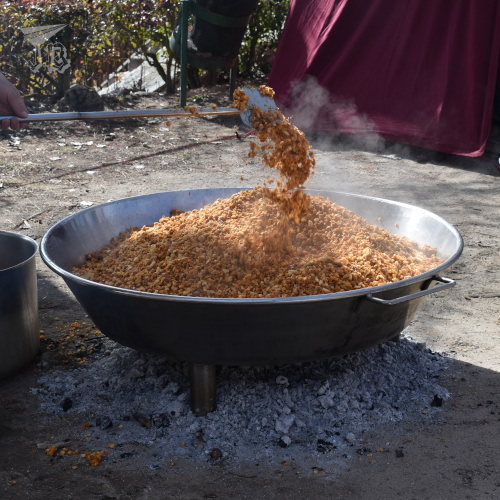
The typical food at the fair is migas, a dish made out of toasted breadcrumbs and several toppings. Traditionally, migas were made from stale bread by semi-nomadic shepherds back when it was common to move livestocks from one area of Spain to the other according to the season (transhumance). The town hall organises a collective cook-out of a simplified version for the attendants, just the fried breadcrumbs with paprika and garlic, topped with the famous torreznos. Though there are endless variations of the dish, the local tradition calls for breadcrumbs, paprika, garlic, and minced pork, topped with a fried egg, and sometimes some fruit.
We were going to prepare our own complete version of the migas, so the first goal was securing some minced chorizo, called picadillo from the butcher’s. We also bought some torreznos for later. Then, we started wandering the village – literally up and down from one square to the other – to see the stands and catch all the events. Although it was rather cold, it was sunny and not windy, quite pleasant once you were wearing enough layers – I had actually brought some extra ones that I did not end up needing.
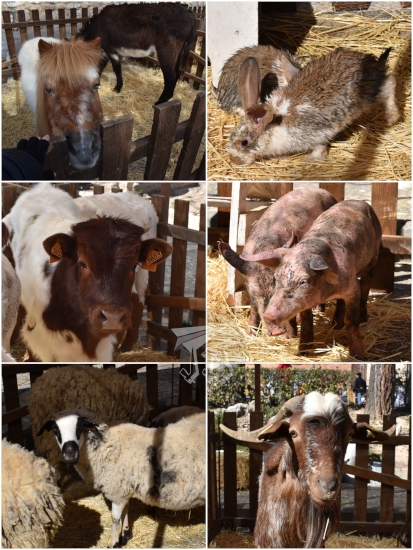
At 11:00 the “farm” opened at Plaza de Vicente Mariño – this is the closest activity related to the origin of the fair, a cattle trade event. There were horses, ponies, donkeys, cows, goats, sheep, piglets, and fowls… I might have remembered a little too late that hay causes an allergic reaction these days. Across the street from the farm stood a huge BBQ grill and some watering holes – I guess that to place the roasting pork just in front of the living piglets is part of the village’s twisted sense of humour. Desensitising kids, or what? One of the funniest things around this area is hearing people squealing at the animals, especially at the piglets – there are a lot of “urban people” in the fairs wanting to “experience country life”, who have never really seen a farm animal in their life and are thoroughly impressed – and end up saying hilarious things.
At 11:10, we caught the Opening Parade took place, described as musicians, jugglers and knights walking along the streets. It featured a dancer, a small group of musicians, and the members of the horse riding school Caballeros del Alarde.

After the parade ended at Plaza de Vicente Mariño, we went to check on the communal migas, and say hi to the guys preparing them. They had prepared a bonfire and a huge pot to toast the breadcrumbs, and fought off the cold with beer and wine.
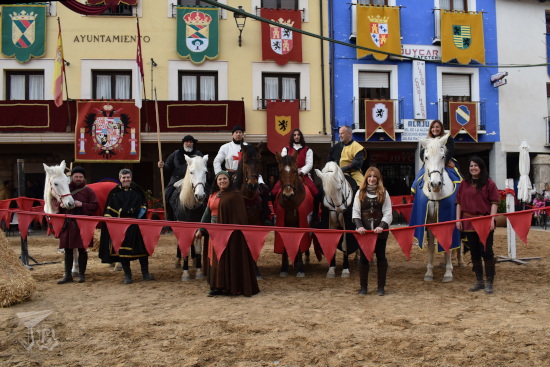
There was a second parade at 12:10, this time the official inauguration one. Aside from the musicians, dancers and horse riders, walkers included the authorities, ladies in Medieval clothing, and giants. They walked from the town hall square Plaza de la Constitución to the migas cook-out. With this, the festival officially kicked off.

I followed the horse riders Caballeros del Alarde back to Plaza de la Constitución where they started practising for their later show. They are part of a horse riding school which carries out several activities, Medieval riding is one of them, along with horse training, archery, and shows in Medieval fairs and markets. For this event in particular, there were six riders – five men and one woman – with two bay and two white horses. One of the bay horses was not in the mood to cooperate though, and got easily spooked.
The show happened from 13:30 to 14:30. It was an exhibition of Medieval horse-riding – while horses galloped through, different different tests carried out – spearing a bale of hay, hitting a metal shield, catching a metal loop with the sword, then cutting off a carrot… There was also a bit of a staged scuffle, swashbuckler-style. The emcee made it sound like the whole show was an exhibit to train for an upcoming jousting contest (in the evening) and the riders would later compete for a pouch full of gold maravedis – Medieval Spanish coins. The show itself was pretty fun and impressive to be honest – the riders had to control the horse in a crowded and small area, full of bystanders and noise, and do the activities with a very high level of success.

After the horse show, we went home to prepare the traditional version of migas – we fried some minced chorizo, garlic and paprika, then worked the bread on the stove. Finally, we fried the eggs (sunny side up) and the food was ready! Not that we stayed down for long, soon after finishing our late lunch we went out again to find a good spot to watch the jousting at Plaza de la Constitución.

We walked around the square and realised that there was not really a good spot though because the square was too small and set in a way that anything the riders did, their right hand would be towards the inner area of the square. So whatever they did, the view would be obstructed by flags and décor. And the best viewpoint was actually taken by the sound equipment – which ended up malfunctioning anyway…
Before the tournament started, a sword was brought in as a present to the village. Because the sound was so horrible, I did not completely get the significance of it – it was supposed to have been donated by Queen Isabel of Castile to the village. The program said that there was going to be a forged sword at some point, so I thought it was that one.

This time there were only five riders, apparently one of them had been hurt at a previous exhibition and was not ready for the whole competition. The show itself was all right though – the emcee presented the best rider as a bit (or a lot) of a cheater, and he hyped a lot of “girl power” vibe around the female rider. The riders competed on tests in pairs, again spearing, loop catching and carrot-cutting. The “cheater” won in the end and the maravedis were distributed among attending children, as apparently the coins were not legal Medieval currency but plain old chocolate. They tried to do an archery exhibition too, but the square was too small.

There were much fewer people for this exhibition since it was later in the evening (17:00) and because the evil-looking storm cloud just above our heads. Thus, this time, when the riders offered if someone wanted to take a picture on one of the horses, I got myself up a white Pure Spanish Breed warhorse, which was really cool. Then, the group asked if someone would take a picture of them, and I offered to do so.
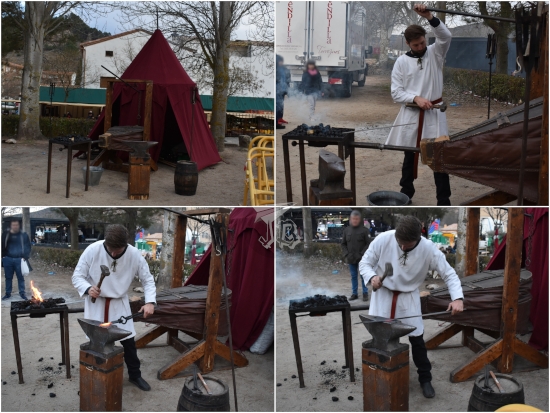
We went to see the campsite afterwards, with different things that could have existed in Medieval times. One of the most interesting things was the forge, with the blacksmith at the ready. I hung out around the smithy for a while and as night fell, the sword started to take shape. I realised later that this was the sword that was going to be forged for the village, and not the one I had seen before the jousting.
I don’t know whatever happened to it, because I eventually moved away to find the final parade, in which a group of villagers dressed up as Moors from Granada, either friends or foes of the Count. The parade was lit with torches, and ended at main square Plaza de la Constitución again. There were also jugglers, fire-dancers, and some more swashbuckling. They also made a queimada, a distilled spirit with “magical powers” flavoured with herbs, cinnamon, sugar, herbs and coffee beans. A spell is usually requires an extra spell as it is prepared. While I would have wanted to try it, I did not dare do so before driving…

A bit after 21:00, after roughly 12 hours of “fairing”, I got back on the car to drive home with a basketful of food and good memories to drive home before the temperature went below zero again. Only when I was home I realised I had not even taken my scarf off, and that it still had straw on it from the farm – which quite probably did not help with the allergies.





 JBinnacle – A Travel Logbook