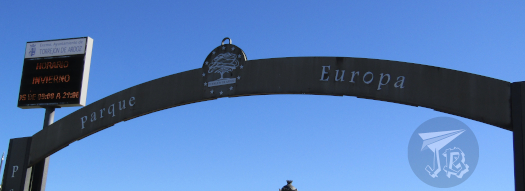
No matter how much some people demonise it, one true thing is that a great chunk of the Spanish general income is dependent on tourism. That’s why when the 2008 recession hit the country, many areas or municipalities tried to fabricate tourist attractions where there used to be none. Torrejón de Ardoz is one of these places – despite shouldering a huge debt, it gambled a couple of tourist lure. One is a huge winter lights (Christmas) display, which runs from November through January. The other is a huge park in a former slum, called Parque Europa, Europe Park.
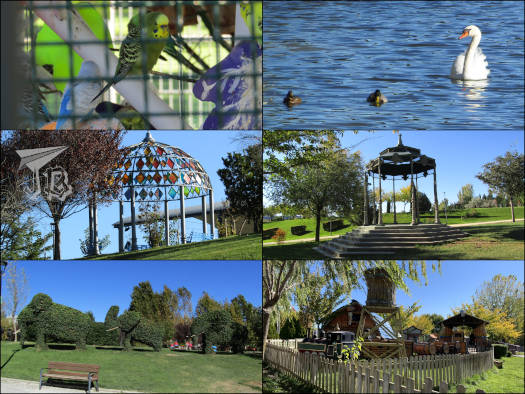
Parque Europa was described as “Pharaonic” upon its inauguration in 2010. It covers a whooping 23 hectares of trees, bushes, ponds, rides for kids and replicas of different European monuments and landmarks, both real and art depictions. I can’t be sure if in the end the park managed to break a profit, but the reviews online do sound like it did.
In winter, the park opens at 9.00 am, and I thought that if I managed to get there relatively early in the morning, I might find a free parking spot around the area. Online reviews do talk about limited parking space aimed to fill the pay-per-car parking lot close to the entrances, so I thought I’d try to leave the park in the streets of the industrial complex nearby. After a couple of Sat-Nav mishaps – human-caused aka I forgot the adapter for it to work in the car (≧▽≦) – I was on my way and I reached the neighbourhood a bit before 10.00 am. As I was driving towards my intended parking spot I caught a glimpse of the Eiffel Tower, so when I turned and found a random parking spot, I decided to just ditch the car. There were many double-parked cars ahead so I thought the rest of the street would be packed. At that time in the morning, I could have just parked in front of one of the access gates without problems, apparently. So I had to walk two whole extra minutes!! In the end though, that parking spot was even closer than the ones I planned to look for – so it was all good.
I wanted something to do in the morning outside the house so I did not have a plan per se (to be honest, I had long made the afternoon plans and I wanted something to do in the morning to make the most out of the disposable contacts). However, as the fountains were turned on at noon, I wanted to leave them for last. Fortunately, most of them are in the same area of the park – which is shaped like a ham of sorts. At that time most of the children rides were closed, and I was mostly alone except for people jogging or walking their dogs, and it was rather chilly. But I wanted to see the replicas, so that was all right.
These are the monument replicas that are hosted in the park, in the order I saw them, turning clockwise from the entrance I used:
- Puerta de Alcalá (Gate to Alcalá), Madrid, Spain. Neoclassical gate to the former walls in Madrid. Today it is considered World Heritage as part of the “Paisaje de la Luz”.
- Torre de Belém (Belém Tower), Lisbon, Portugal. Officially named Torre de São Vicente (Tower of Saint Vincent), a 16th-century port fortification for Portuguese explorers, with high symbolism and ceremony.
- Tower Bridge, London, United Kingdom. Crossing the River Thames, it is one of the most iconic London landmarks.
- Kinderdijkse molens, the Windmills of Kinderdijk, Netherlands. The original windmills were designed as part of water drainage to drain the excess water in the Alblasserwaard polder.
- Brandenburger Tor (Brandenburg Gate), Berlin, Germany. It is one of the most characteristic landmarks in the country, a monument built in the place of a former wall gate in the 18th century.
- Den lille Havfrue (The Little Mermaid), Copenhagen, Denmark. This small sculpture is displayed on a rock in the a promenade in Copenhagen, and depicts the mermaid in Hans Christian Andersen’s tale becoming human.
- La tour Eiffel (The Eiffel Tower), Paris, France, built for the entrance to the 1889 World’s fair and one of the most visited monuments of the world.
- Michelangelo’s David, Florence, Italy. One of the masterpieces of the Renaissance sculpture, standing 5.17 m of white marble. This replica I didn’t get to see because it had been either stolen or taken away for restoration.
- Fontana di Trevi (Trevi Fountain), Rome, Italy. Dating back from 1762, the fountain is a “more dramatic” version of a previous one at the end of one of the Roman aqueducts. The fountain was turned on at noon and it had just a little water.
- Manneken Pis (“Little Pissing Man”), Brussels, Belgium. It is a bronze fountain sculpture depicting a naked little boy peeing into the basin, dating back from the 17th century.
- Atomium, Brussels, Belgium. This stainless steel building was constructed for the 1958 Brussels World’s Fair, and renovated between 2004 – 2006. It stands 102 metres high and some of the spheres are open to the public and hosts exhibitions.


There are also “adaptations” or monuments that you can “sort of” identify but have been more freely reproduced.
- Greek Theatre, based on the Athens one, with the Winged Victory of Samothrace watching over in a bit of an artistic license move I guess, considering it was a ship figurehead. The actual one is in the Louvre Museum in Paris. The theatre is built into the slope of the central pond of the park so visitors can see the light and sound show in said pond when they are held.
- Plaza de España (Square of Spain). The centre of the square is the famous “Puerta del Sol” in Madrid and the older Post office. Its back represents the Main Square of the city. Other houses represent different regional buildings throughout Spain that I was unable to recognise.
- Viking Ship fountain. There is not much I can say about this. It was one of the fountains, and this one was turned before any of the others.

Inspired by paintings, there are two other monuments.
- The Three Graces. While the park’s webpage claims that the sculpture is a copy of the one that Antonio Canova created, it looks like it was sculptured using Ruben’s painting as inspiration. This one was the first monument I saw.
- “Van Gogh’s bridge”, a wooden bridge inspired by Vincent van Gogh’s painting “The Langlois Bridge at Arles”. I missed it at first so I had to backtrack and I did not find a good angle to see it from the side.

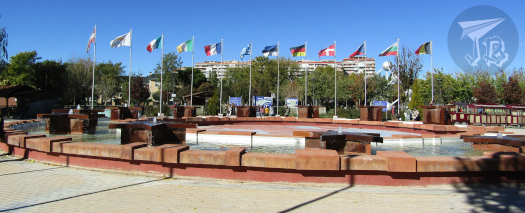
An original piece is the fountain called Plaza de Europa, Europe Square, a circular square with stars forming little fountains. This was one of the fountains I had to wait till noon to see and to be honest, I was… underwhelmed, expecting way more by the pictures on the website. I’m not sure if it was just “winter fountain” or whether the sprouts were set on low because it was a bit windy.
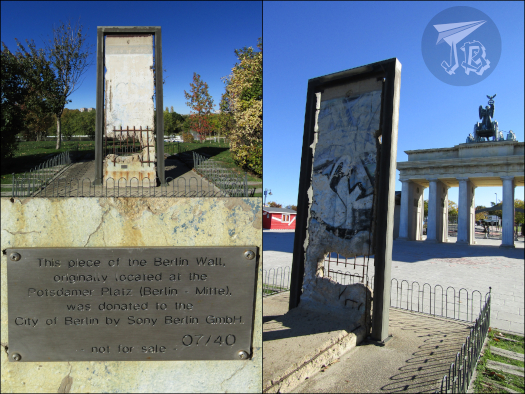
What was interestingly impressive was the original piece of the Berliner Mauer, the Berlin Wall. During the Cold War, after WWII, Berlin was partitioned into West Germany and East Germany with the erection of the wall in 1961 (in what was called the Berlin Crisis of 1961). It was all built within the eastern border as it was the USSR who decided to put it up. The Wall separated the city halves for decades, there were even deaths as people from the east tried to defect to the west. The wall officially but metaphorically fell in November 1989 as the political powers who had driven its building agonised. The piece that stands in Parque Europa originally stood in Postdamer Platz and was ceded to Torrejón by the city of Berlin and it stands behind the Brandenburg Gate.
There are many other areas and activities for kids. A number of them were already opening up by the time I left, others seemed to be on hold due to pandemic concerns. The park has different things to draw attention too, such a giant bird cage (mostly full of parakeets), three life-sized elephants made out of bush, gardens, or an artificial waterfall – which did not get turned on. I saw a lot of birds too – magpies, swans, mallards and some very territorial Egyptian geese (I think that they were Egyptian geese. I’m absolutely sure they were territorial).
I left Torrejón at around 12:30, I think. I took care of some errands on the way, had lunch, and then I headed off to the second part of my self-imposed day off. A late-Halloween activity that ran throughout the month of November: Arquitectura y escultura funeraria in Guadalajara: a walking tour with a focus on the funerary architecture and sculpture in town. Well, at least with a stop at those places that are directly controlled by the town hall, missing those that are not. Yes, I voluntarily signed up for a guided visit! Unfortunately, information on Guadalajara is rather difficult to find, so I thought there might be interesting knowledge to be gathered (Narrator’s voice: there wasn’t).
The tour started at the local cemetery Cementerio Municipal Virgen De La Antigua, where we saw several tombs and pantheons dating from the 19th century and the early 20th century. These included:
- Panteón de la Tropa, the “Troop mausoleum”, a communal grave for soldiers who died in the African campaigns, where supposedly some of the Civil Wars victims were buried. It actually is not the place, but legends are legends, I guess.
- Panteón de los Marqueses de Villamejor – a neoclassical mausoleum where a noble family was interred.
- Monumento funerario de la Familia Cuesta Sanz, a creepy obelisk-looking tomb.
- Some smaller mausoleums (or big graves) Panteón de María Luisa García Gamboa, Panteón de la Familia Chavarri, Panteón de Josefa Corrido de Gaona, and Panteón de la familia de Ripollés Calvo. All these are stone tombs with a rounded roof that drains off rainwater.
- Panteón de los Condes de Romanones, the place of eternal rest of another noble family, whose head was the son of the previous one.
Kittens

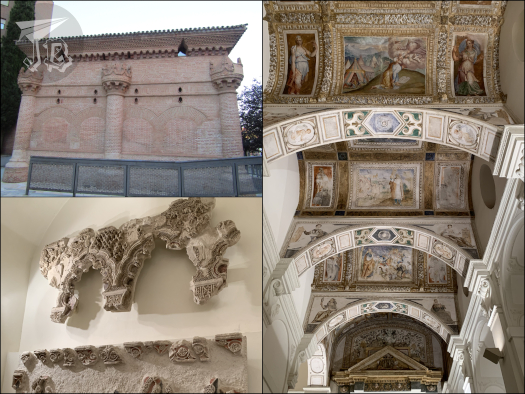
We then walked off towards the chapel Capilla de Luis de Lucena. Luis de Lucena was a doctor and a priest who was born in the 15th century. He died in Rome as he worked as a doctor for the Pope, but he expected to be buried in this chapel, adjacent to a now-disappeared church. The outer area is built in brick, and the inner ceilings have several frescoes, even if they are rather deteriorated as the town had no money to take care of the art during the 90s and the early 2000s. The chapel was never used as a burial place, and now it is a tiny museum that keeps rests of other disappeared churches in town, especially the funerary sculptures.
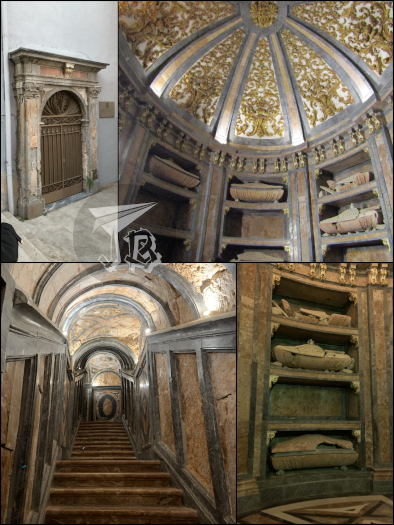
The final spot was the crypt of the church of St. Francis – Cripta de la Iglesia de San Francisco, built in dark marble and similar to the one in El Escorial. This is where the Mendoza duchy family members were buried, but the area was ransacked by the French during the Napoleonic wars and the remains were taken to Pastrana afterwards, so the crypt is currently empty. Which is good considering the way some of the tombs are shattered…
This concluded the tour so I was free to go. I saved up the entry fee on the chapel and the crypt as the tour was free. Most of the tour was just crawling from one point to the other and there was not that much new information to be learnt. Maybe there is jut not enough information to be found…
Driven distance: around 83 km.
Walking distance: 13.14 km












 JBinnacle – A Travel Logbook