
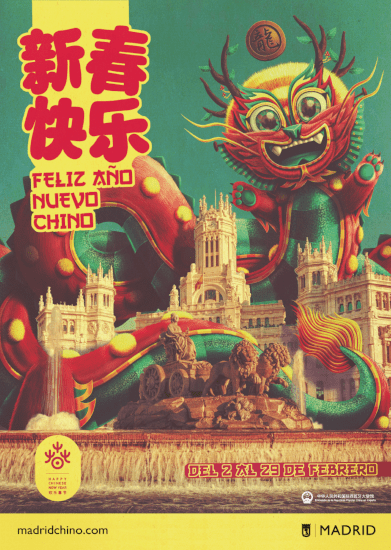
Chinese New Year started on the 10th of February of the Gregorian (solar) calendar. Many East Asian countries follow a lunisolar calendar, in which the New Year falls on the second new moon after the winter solstice. In China, it is usually referred to as the Spring Festival, and outside it as Lunar New Year. For a while now, the Chinese diaspora in Madrid has been celebrating with a parade in the District of Usera, the so-called “Madrid Chinatown”, which will eventually have traditional gates and panda decorations in order to try to be developed as a tourist area. Since the parade was on a Sunday, I decided that I would attend.
The equivalent to 2024 is the Year of the Wood Dragon. The Chinese calendar uses a combination of twelve animals that conform the Zodiac (rat, ox, tiger, rabbit, dragon, snake, horse, goat, monkey, rooster, dog and pig) and the five elements of Feng Shui (wood, fire, earth, metal and water) to name the years. The dragon represents prosperity, authority and good fortune. The Wood Dragon brings abundance and improvident, so it seems to be a promising year!
After keeping an eye on the ever-changing weather and rain predictions, I decided to bite the bullet and go, whatever happened. The parade was due to start at noon, and rain was to come a couple of hours later. I packed an umbrella, a waterproof bag inside my backpack, and my all-you-can-travel train pass. I picked up my sibling on the way.
We reached the district of Usera a bit after 11:00, with plenty of time until the start of the parade at noon. We found a street barrier and set positions, ready to wait out the cold until the parade started. I had read that it would last about three hours, but I thought that meant in total – since the first person went out at the beginning of the parade until the last person reached the end. I had never been to Usera before so I had no idea how long the streets were. In the end, the parade took about an hour and forty-five minutes to pass in front of the point where we were. There are a lot of Chinese associations! I do not really know if they were all based in Madrid, or if the Chinese diaspora of all of Spain had congregated for the occasion. And not only Chinese people marched – a lot of Spanish and Latin Americans did to.
The event was called Great Parade of the Chinese New Year of the Dragon Gran Pasacalle “Año Nuevo Chino Del Dragón”. It opened with a locomotive which “pulled” everyone behind it. There were people dressed as lions, others moving huge dragon puppets, dancers, musicians, martial artists, people in traditional clothing, acrobats, walkers on stilts… women, children, men, everyone seemed to be invited to the party. Each group got their introduction with a red banner, and lots of people carried either Chinese or Spanish flags. Some people handed out “dragon masks” for kids, and quite literally ignoring all the adults wanting one (I might have rescued one from the floor at the end of the parade). People in the parade waved and cheered Xīn nián kuài lè and Feliz Año Nuevo, “happy new year” in Chinese and Spanish. There were some drummers too, but most of the music came from portable little devices. An older lady kept telling everyone to hurry up.
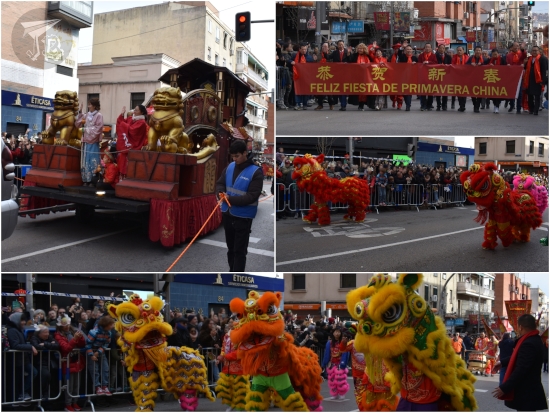
About half an hour in, my memory card ran out of space. I had been aware of that being a risk for a while, so I was carrying an extra one, which unfortunately was not compatible – I have no idea why. Luckily, I could use the phone for more pictures. The worst thing about the event was the presence of the “media” – I can understand the ones who were working / recording / interviewing. However, there were also a bunch of accredited people who were just in the way, chatting on their phones or doing nothing in the way of the parade – and of pictures.

All in all, it was spectacular. I loved the lions and the dragons, and I had to wonder how many dragons come out on a non-dragon year parade. Furthermore, everyone seemed to have such a good time!

At the end of the parade there were a few South American organisations who also participated, probably because even if Usera seems to have many Chinese businesses, there are a few Peruvian and Bolivian restaurants. They seemed more Carnival-like anyway.

After the parade had finished walking in front of us, we went to try to check the food trucks and the market at the end point of the parade. Unfortunately, everyone seemed to have had the same idea, and it was packed.
Instead, we found our way back to the underground and went off towards the centre. There we had a snack at one of the big malls, where I also bought a new SD card. I asked the assistant if the card would be compatible with my camera, he had to get another assistant, who had a bit of a waiting list. This second assistant said that my camera would not take a 128 GB card. I showed her the 128 GB card I had been using. She then asked to see the card which was not compatible. I showed her that one too. She said that it was not compatible because of the adaptors, but I pointed out that the cards had the same shape. Then she said that it was not compatible because “TDKs are too slow”. The card is a Philips. Anyway, she offered to let me try the new card to check it was compatible before buying it, which guarantees it works. I bought two, just in case.
Afterwards, we headed off to the shopping gallery Galería Canalejas. This is the new luxury shopping hub in town. The complex occupies almost a whole block, having joined as many as seven historical buildings into the same project – a Four Seasons hotel (the first in Spain), a parking lot, some private residences and the shopping gallery.
The original central building was commissioned by an American insurance company and built in 1887 by the architect José Grases Riera, who designed it in. The construction homed the Insurer’s headquarters, private residences, the former casino, and small shops on the street front. It was called Palacio de la Equitativa, uniting the word “Palace” with an approximate translation of the name of the insurer. In the 20th century, the building was bought by a bank company – and Spanish banks merged, re-merged, disappeared, until finally the building was sold to a private investor in 2012. The Neo-Renaissance and Neo-Baroque façade was carefully restored, along with the Art Decó stained-glass window on the ceiling. Also, under the direction of the architectural firm Estudio Lamela, some of the bank safes were recovered for decoration. The first shop in the gallery opened in 2020, and it seems that the Madrid tourism board started promoting the complex in 2023, following a strategy to drag “luxury vacation-makers” into town.
The gallery has three floors. The basement has been used for the food court. The ground and second floor hold a lot of security guards, since there are shops like Cartier, Louis Vuitton or Valentino… There is a café on the ground floor, amongst all the luxury shops. Behind it there is a staircase that connects all three floors (aside from the escalators on the sides).
The café Galería Canalejas Café offered afternoon tea, and I was even willing to try it despite the lack of scones. But it was cold and drizzling, and I had just discovered that they had afternoon tea the day before. We sat down and ordered.

The set included:
- Café o té Coffee or tea. I chose a Japanese sencha, which was brought quite earlier than the snacks. It was really good, albeit a bit weak. I own up I had finished it almost completely by the time the food came out. I really think they should add some water to the mix.
- Savoury snacks:
- Mini sándwich chicken coronation. Coronation Chicken mini-sandwich in a salty waffer, made with a salty waffer.
- Mini sándwich de mortadela trufada y queso Coloummier. Coloummier cheese and truffled sausage mini-sandwich, also in a salty waffer. I think they forgot the cheese in mine…
- Quiché de espinacas y salmón. Salmon and spinach quiche with wasabi mayonnaise. This was the best, in my opinion.
- Crep de hummus con vegetales. Hummus and vegetables crêpe. They actually forgot to bring this one out and did so later on.
- Sweet snacks:
- Bizcocho Valentía. A quite-heavy brioche with honey and lemon. It was nice, but I could have used a smaller size.
- Mini churros con vainilla y chocolate. Tiny churros with vanilla and chocolate. The vanilla was actually whipped cream, but the powdered-sugar on the churros and the bitter chocolate made it a good combination.
- Petit fours: We got three of these, but I have no idea which ones. According to the publicity, you chose them yourself, but they brought them on their own. They were tiny biscuits that felt really nice to finish off the tea.
- Bombón Canalejas
- Diamant Madagascar
- Florentin aux amandes
- Noisettine
- Trufa de turrón
All in all, it felt a little wannabe pretentious, but the staff was extra nice, and allowed us to stay there for as long as we wanted. We left when I noticed that the turn over was slow and a queue had started forming. We snooped up and down the gallery for a while before we headed off. And of course, I totally missed my train connection – what else is new?
 JBinnacle – A Travel Logbook