Because yes, we’re in rainy season, and in rainy season, it rains, lots. Especially when I want to go to certain places. I hoped that the rain would not be too much, and headed off to Kawasaki [川崎] (yes, like the motorbikes) to check out a temple called Kawasaki Daishi (川崎大師) or Heiken-ji (平間寺, Heiken-ji)

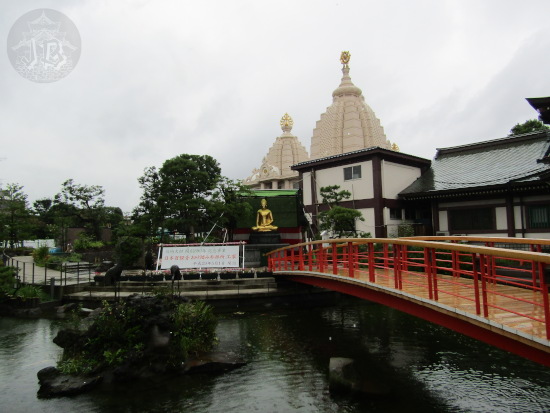
It was wet. There was some kind of child ceremony because there were a bunch of parents with very young babies braving the storm rain, while the kids (and occasionally their siblings) looked unimpressed or plain zonked out.
The only other thing for me to check out in Kawasaki were the Chinese gardens, but I decided that it was raining too much for that, so I came back to Tokyo [東京], and headed off to a shrine called Hie Jinja [日枝神社], in Chūō [中央], which I wanted to check out.
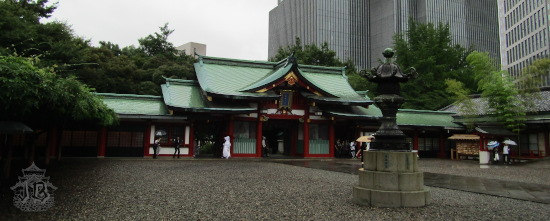
One of the most interesting thing of Hie Jinja is the way the torii is designed, with a sort of triangle on its top. It might be to deter wayward otoroshii, a creature from the Japanese mythology. Yes, this is important. As it was that it was raining. To get to Hie Jinja you have to climb a hill, as it could not be otherwise. In the rain, with my broken umbrella – because my awesome umbrella decided to stop being overdone and break, thankfully it was fixable, but not before I got home.
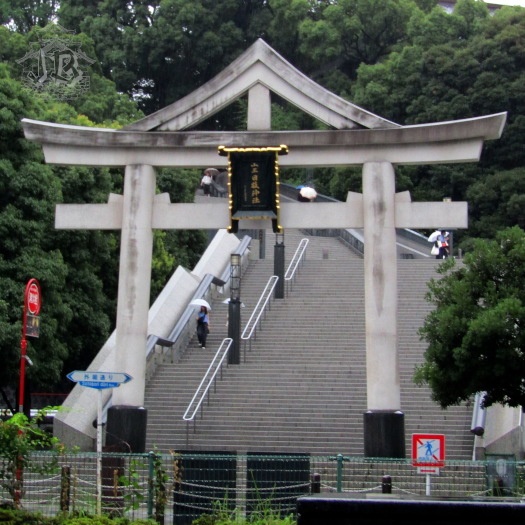
There was a marriage photo shoot in the shrine, and I was torn for the poor bride, having to walk in those clothes through the rain. I tried to be out of their way as much as I could, too. But kudos to the photographer for bringing a traditional umbrella which made the couple look awesome.
Tired of being wet, I decided to head out to a museum. I had two exhibitions I wanted to see, one of them in the Edo-Tokyo Museum, and the other one in the Museum of History and Science. I decided that I really wanted to se the former, just because I was feeling like it. It was an exhibition called ‘From Eerie to Endearing: Yokai in the Arts of Japan’ [大妖怪展 土偶から妖怪ウォッチまで], held in the Edo-Tokyo Hakubutsukan [江戸東京博物館], the Edo-Tokyo Museum, in Ryōgoku [両国]
This was the scenery of the first almost panic attack I caused. If you’re a visible foreigner in Japan, some people don’t want you around and they don’t want to speak to you, especially because you may require them to speak in English. This is a bit on the ridiculous side in the tourist industry, where you can be met with actual hostility at times. Japan, sorry to tell you this but you’re not ready for 2020. Point and case, the lady selling tickets in the Edo-Tokyo museum. She was literally paralysed for a moment, then she pulled back. Keep in mind, my Japanese is not the best thing in the world, but I said a grand total of six words, five if you count ‘onegaishimasu’ (please) as one “special exhibition, one ticket, please”. Straight forward. She was so much in a panic that she did not even hear me at first, it took her half a minute to realise I had asked in Japanese. When she asked me to repeat I just gave her the “yokai, one” and showed her one finger (to count!). She was so freaked out that I did not even get a brochure.
The exhibition has three main parts. The first one runs through the historical representation of yokai as supernatural beings, explaining old questions that humanity had (for example, what is the echo) or forming part of legends. It exhibits part of the Parade of the One Hundred Demons classic paints and scrolls, and a bunch of key ukyo-e in mythology, which I was very excited to see. Apparently, an huge bunch of Japanese people had decided that the museum was a perfect place to spend a rainy afternoon, too, and the exhibition was packed.
The second part dealt with the representation of the different worlds, especially the Buddhist ideas of heaven and hell, and the concept of ‘spirit’ or ghost (yurei) as opposed to a yokai. Out of these, my favourites were the umibozu and the Peony Lantern representations.
The final part was dedicated to ‘Yokai watch’, a contemporary anime series that explores the concept of cute yokai causing mischief in present days.
On my way back I dropped by Shinjuku [新宿] and the Book Off there. The number of acquired items was slowly climbing up, and I was still on budget!
Then I did my homework because I might fail at Japanese all my life but I will still try not to.






 JBinnacle – A Travel Logbook