31st March 2026: Euphoria, Shanghai Mama, and 103 Years of Magic (Madrid, Spain)

I was on break for Easter, and my sibling, who works in Madrid, proposed to “have lunch and whatever”. That usually means that they want me to find a good place for lunch, and a plan for “whatever” afterwards. The original plan was Monday, but way too many things were closed on that day, hence we rescheduled for Tuesday. I organised two “whatevers” – one for myself, one to do with them.

I took the train towards Casa de Campo, and I actually made an earlier train than I had calculated. I was at the final underground stop around 9:15, so I had 45 minutes to explore around before my 10:00 ticket. The park known as Casa de Campo was established as royal hunting grounds in 1561, under the reign of Felipe II (Philip II). It was at the time designed by Juan Bautista de Toledo, who divided the area in three parts – orchards, gardens and the actual hunting grounds. In 1656, engineer Pietre Jansen established the large pond in the centre, Lago de la Casa de Campo. Later royals would add modifications for their own enjoyment until the area was open as a public park in 1931, during the Second Republic. In 1997, it was declared historical park (Parque histórico). Today, the Madrid Zoo and the Amusement Park are located within its grounds. It also hosts an area for travelling exhibitions, Escenario Puerta del Ángel.

I’ve always wanted to explore the park a little, and this was my chance. There are several constructions of historical importance there. Beside the lake, which was already teeming with sportspeople, the first one I found was the aqueduct Acueducto de la Partida, a former waterway that carried water from the lake to one of the orchards. I also saw the former house to breed pheasants in, and the forest around it – La Faisanera and Bosque de la Faisanera – but mostly, I wandered around, scaring a bunny or two.

Eventually, I headed towards Escenario Puerta del Ángel where Euphoria, a new exhibit by the Balloon Museum had just opened. The first time I had been to one of their exhibits I had not known what to expect, but this time around I was ready. The Balloon Museum specialises in immersive artworks (each of them can take up a whole room), most of them created with inflatables and light. You can touch and play and be silly with a lot of them too.

The artworks displayed, and a bit about them, are:

  • One Hundred and Twenty by Nils Völker. A short corridor flanked with garbage bags that inflate and deflate as if they were breathing. A bit unsettling, so I am glad that was the first one and I could leave it behind.
  • My Room Is Another Fish Bowl by Philippe Parreno. A room full of helium balloons in the shape of fish and seahorses that you could play with as they floated gently along the room. This was very cute – but I guess I like fish.
  • Follow Me, I Think I Know the Way by Camille Walala. It was like a kid’s monkey jungle but made of inflatables. I wish I were younger and could climb on them.
  • Invisible Ballet by Hyperstudio. A room full of balloons that floated around at the centre. You could stand amongst them as they move and turn and the wind messes with your head (and the balloons hit you on the face, of course). This had a very pretty, but mostly hilarious, effect.
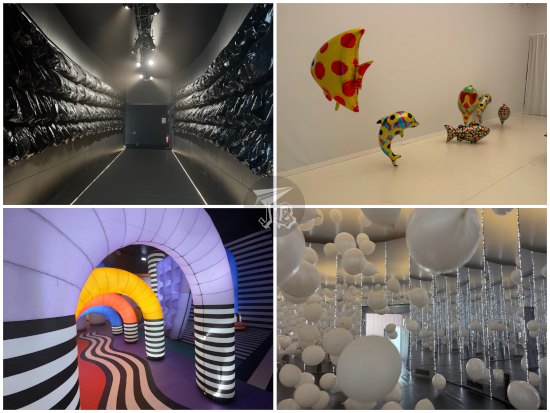
Collage - balloons in different shapes, including a bridge-like structure

  • Ovoids by SpY. A bunch of egg-like giant… things that gently swayed from the ceiling, making it a bit (actually very)… creepy.
  • Work No. 3883: Half the air in a given space by Martin Creed. A greenhouse full of huge blue balloons that you had to cross, it was like an adventure. Of course I went in, who do you think I am?
  • Our Floating by Alex Schweder. A round bed-like structure you could sit and lie on as it inflated and deflated randomly so you kept falling and rising. A welcome break, and giddy fun to flop down on.
  • ADA by Karina Smigla-Bobinski. A big… bouncy ball with charcoal pencils attached to it. You could push it or let it float around, and as it hit the walls it drew random lines on them. This was stupidly fun, but it did stain your hands – and whatever else it came in contact with, if you were not careful.
  • Crazy Love for Polygons by Cyril Lancelin. Hexahedral balloons that you could stack to make shapes with – unfortunately this was hijacked by toddlers who did not want to share with the rest of the attendees.
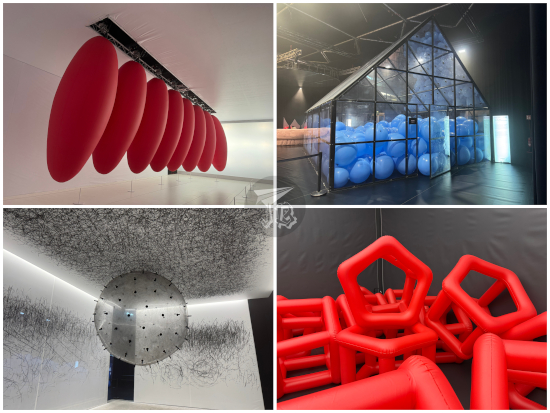
Collage - hanging balloons in different shapes

  • Pulse Topology by Rafael Lozano-Hemmer. A lot of lightbulbs hung from the ceiling in some sort of wave shape. You could put your hand under a sensor and the bulbs pulsated along your heartbeat. When you took your hand off, one of the bulbs remembered the rhythm and kept pulsing. It was a pretty intense feeling, to be honest, though I am not even sure why.
  • New Spring by A.A. Murakami. The installation resembled a cherry tree, but instead of cherry blossoms, it shed bubbles of pinkish mist that popped into scented vapour if poked or when they hit the ground. The scent was rather beautiful, too.
  • Hyperstellar by Hyperstudio with Quiet Ensemble and Roman Hill. A huge ball pit with a light and sound show. This is pretty similar to the Hyperstudio artwork I had seen the first time around, so I guess it is a signature kind of work.
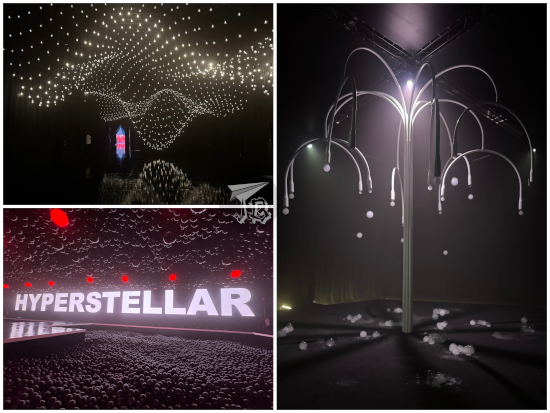
Collage - Waves made out of light; tree with bubbles; ball pool

  • Kaleidoscope by Karina Smigla-Bobinski. There were three tables in the middle of the room, and when you touched them, the liquid on top moved around, changing colour. That reflected or was projected on the walls… I didn’t quite get the idea.
  • 10 Agosto (10th of August) by Hyperstudio. A circle of swings looking at big round lightbulbs that turned on and off, and moved along the rhythm. It was quite relaxing even if the music was not designed for it.
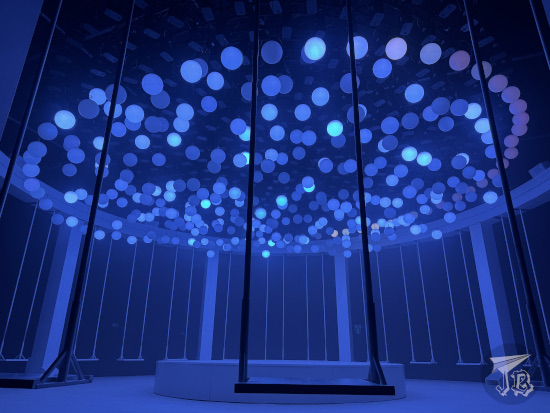
Slings amongst bulbs of light

At the end of the tour there was a gift shop, where I got myself a sweatshirt, because at some point, I had a wardrobe malfunction and the zipper of my sweater had dislodged. I thought that was a sign. It was all good because the weather was weird – the wind was cold, but it was nice out in the sun.

I left the museum and walked out of the park and into a wide avenue. There, I found a “trail” of trees in bloom, until I reached the edge of the park, which takes the name of Huerta de la Partida, strolled by the Madrid Sign and crossed over the river Río Manzanares. I headed into the former station, now shopping centre Estación de Príncipe Pío, where I tried the seasonal Starbucks drink – I did not like it too much – before I reached the royal gardens Campo del Moro. There, the Spanish Heritage management, has restored and sort of opened the historical Túnel de Bonaparte.
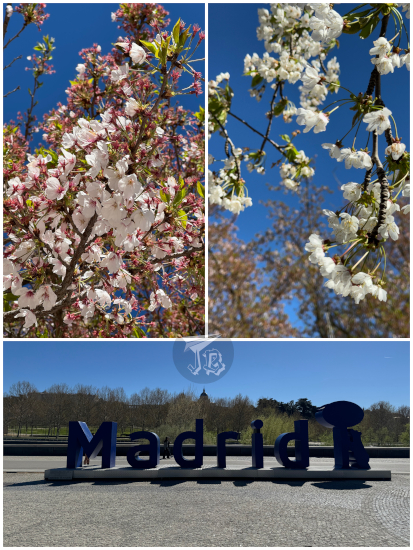
Spring blossoms and the Madrid sign

I feel the need to keep “opened” in quotation marks because I was expecting to be able to walk from one side to the other – but it turns out that no, only the first few metres are accessible – the rest are locked down (and the closed-off area is not even the historical part, but a reconstructed concrete bunker of sorts). The tunnel was conceived to be an underground connection the two parks – Campo del Moro and Casa de Campo. It was designed by Juan de Villanueva under orders from Napoleon’s brother, Joseph Bonaparte. Only the first few metres are the restored original, built in brick and open to visitors. It was a bit anticlimactic, because it would have been a nifty way to cross the busy avenue overhead.

An artificial tunnel structure within a park

I walked across Campo del Moro, emerged near Plaza de España and found Casa Gallardo, one of the few true Art Nouveau buildings in town. A restaurant has opened there, and there’s a part of me tempted to go for lunch some day so I can see the interior, but I don’t really think it would really be worth it. The house / palace was built between 1911 and 1914, and its architect, Federico Arias Rey, was awarded the “best house of 1915” recognition for it. The roofs are black slate, and the white façade features rounded balconies are uncommon in Madrid. Today, everything is private or residential, so no snooping around.

After wandering around for a bit, I finally walked into the underground to meet my sibling at the Tetuán stop, for our lunch reservation at Shanghai Mama (Infanta Mercedes), part of the group China Crown, whose first eatery tackled trying to tear down the Spanish idea that Chinese food was all cheap and greasy, or fried rice (and yet, our waiter was very surprised that we did not order any rice). We shared Crunchy duck bundles with plum sauce (Paquetitos de pato crujiente con salsa de ciruela | 缤纷鸭卷), Xiaolongbao filled with Iberian pork secreto (a shoulder blade cut, one of the best parts of the animal, apparently), mushroom and foie (Xiaolongbao relleno de secreto ibérico, setas y foie | 鹅肝鲜肉小笼包), Prawn chop suey (Chop suey de langostinos | 什锦炒大虾) and Lacquered duck magret with orange sauce (Magret de pato laqueado en salsa de naranja | 香橙酥鸭胸肉). Everything was delicious, but especially the chop suey. I had not had chop suey in years, so I was really happy it was so good. The duck was incredible too.

We did not have dessert, because I wanted to try the nearby Muua Bubble Tea. Spain came into the bubble tea fad a bit late, and while the place was pretty, the tea was extremely sweet. They were extremely generous with the tapioca, too, and very friendly.

Chinese food and bobba tea

Afterwards, we walked up towards Sala Castellana 214, one of the exhibition halls that Fundación Canal manages. They were running an exhibit by the Walt Disney Company’s Archives – Disney: The Exhibition – 100 Años de Magia (Disney: The Exhibition – 100 Years of Magic), which was half price for Easter. While I’m not a big Disney person, my sibling is.

The displays claim to honour 100 years of Disney’s creativity (103, actually, as the century-mark was 2023, when the original exhibit was held in the USA). I have a couple of problems with the way it was presented. I was honestly expecting that they would focus on the actual “Disney” work, as we were greeted by a lady from the “Disney Archives”, not stuff created by other people than Disney later bought. So in my opinion, Indiana Jones, Star Wars and all the Marvel stuff were an add-on.

The first room was an introductory video, and the second had a bit of an introduction to the company and the first films, including the birth of Mickey Mouse. In the upcoming areas, there were props like Cinderella’s shoe (from the live action film), one of the carousel horses from Mary Poppins (my sibling is rather sure it’s Bert’s), an original Winnnie the Pooh puppet (quite creepy, if you ask me)… I really liked a reproduction of the book from Sleeping Beauty, which projected the scenes on a screen. Other “not Disney in my head” props included an Indiana Jones outfit, Star Wars paraphernalia (a BB8, a prog, a lightsaber handle), Marvel’s suits and accessories (Captain America’s shield, one of Black Widow’s outfits, Avengers’ helmets…). There were also items from live action films such as The Little Mermaid and Cruella.

Another room focused on music, with a big screen projecting iconic songs, Mickey dressed as an orchestra conductor, or the outfit of the actor who played Mufasa in the Broadway version of The Lion King. There were also examples of how to create different sound effects. Further, there were items used in parks and films and an interactive Rocket Racoon that was not working.

Finally, there were references to the Disney Parks, a collaboration with National Geographic, and some more projections and a kids’ activity zone. Oh, and of course the shop. You can’t go wrong with a shop, especially when a good part of the attendees are going to be under the age of nine.
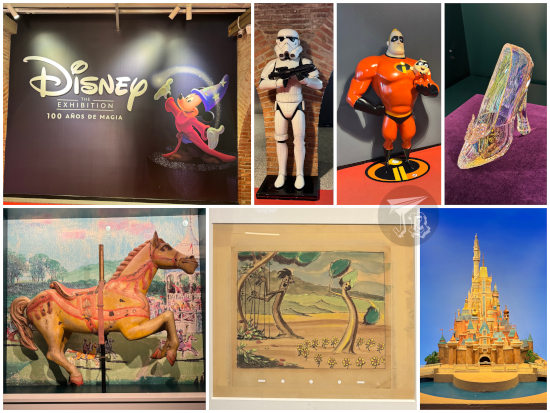
Exhibits at the Disney exhibition - stoorm trooper, Mr Incredible, a glass shoe, a merry-go-round horse, sketch from an old animaton, a reproduction of the Disney castle

We had a bit of a bad connection as Metro has closed down a few stops on Line 10, but we were lucky enough to catch the courtesy bus service that took us right to our station – for free, even. The train ride back was okay, there were issues with the carriage filling up and almost catching someone at the doors, but in the end everything worked out.
27th January 2026: The calm in-between the storms (Madrid, Spain)

I had arranged to meet my sibling in Madrid for a late lunch when they got off work. Before that, I had a free morning that I could invest in checking out an interesting-sounding exhibition, and as it seemed that the weather was going to give us a small reprieve, I headed out on the train. Upon reaching town, I stepped out of the station and walked towards a former brewery, now turned cultural centre – Complejo Cultural El Águila.

The original brewery was established around 1900 under the commercial name “El Águila” (The Eagle), aiming to become one of the first large-scale beer producers Spain. The location was chosen due to the nearby Delicias station – then an important transportation hub, and the high quality of the water in Madrid – as apparently water is the key ingredient in the making of beer, even more important than the malt. The building was designed by Eugenio Jiménez Corera, in the Neomudejar style. It was expanded between 1915 and 1935 as El Águila managed to take over a quarter of the beer market during the 20th century. In the mid 1980s, production was moved to more modern facilities, when the brand was overtaken by Heineken. At the turn of the century, the factory buildings were repurposed into the Regional Archive, a library, and an exhibition hall.

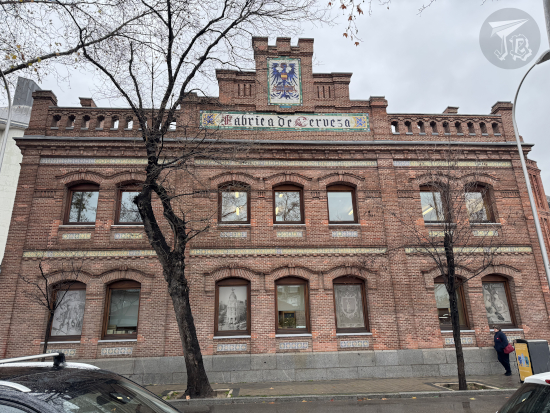
Old brewery built in brick with an eagle mosaic as logo

It was raining when I walked in, and the security guard came towards me, looking annoyed. I said I was there for the toys exhibition and he directed me to the – very visible – signage. I thanked him even though I had seen the information. He came at me. I would have found my way on my own.

The exhibition ¡Me lo pido! Juguetes en el Madrid de nuestra infancia (I’ll ask for it for myself! Toys in our childhood’s Madrid) is a collection of classic toys, from the beginning of the 20th century to the late 1980s or early 1990s. While during the years after the Civil War toys were an absolute luxury, the 1960s saw Spanish urban society thrive. It became common amongst children to write their letters to the Three Wise Men (or the Three Magi, in Spanish the Wizard-Kings, Reyes Magos) with their gift requests – no Father Christmas then. Kids would also voice (still do) those wishes out loud using the expression ¡Me lo pido!. It’s difficult to translate it, but maybe it could be “I’ll ask for it for myself”. The “myself” is actually key, because it sets some sort of “claim” over the item somehow. It is a sort of spell that seems to ban all the other kids in the friends group from wanting it, or something. I guess that makes sense if you are five…

The Magi are actually figures in the Bible who present offerings to Infant Jesus in Jerusalem. In the Spanish folklore, each has a distinct personality and appearance – they are called Melchor, Gaspar and Baltazar. Melchor is usually characterised as Northern European with a long white beard, bringing gold to Jesus as King – he sort of resembles Santa Claus. Gaspar is supposed to be Persian and sports a gold-brown beard, he presents Baby Jesus with frankincense, symbolising his Godhood. Finally, Baltazar, the dark-skinned Magus, brings myrrh to the mortal man. For a decades, before the black population in Spain grew after the dictatorship, it was an honour for men to paint their faces black in order to portray Baltazar, who is the most popular of the Magi! Nowadays, Baltazar is usually portrayed by an actual black man.

All the items in I’ll ask for it for myself! Toys in our childhood’s Madrid belong to the private collection Colección Quiroga-Montes. They range from extremely high-end, such as the doll Mariquita Pérez and metal reproductions of vehicles, to the more popular like marbles or spinning tops. In the middle, the most famous toys throughout the century – the Meccano, Nancy, Disney stuff – and my absolute favourite, the Lego before Lego, Exin Castillos (which I still use to build castles when I am stressed out). There were also photographs, some chronicling the children outside their houses – staring at toy shop windows – some intimate, after the Magi had done their yearly job.

The whole thing was endearing and I loved every bit, especially the toys dating from my childhood. It was extremely interesting to see how toys changed from metal and wood to plastic all around. However, it was also a bit unsettling to see the rigid divide between “girl presents” and “boy presents” for so long, even more than “inside presents” and “outdoors presents” any more.

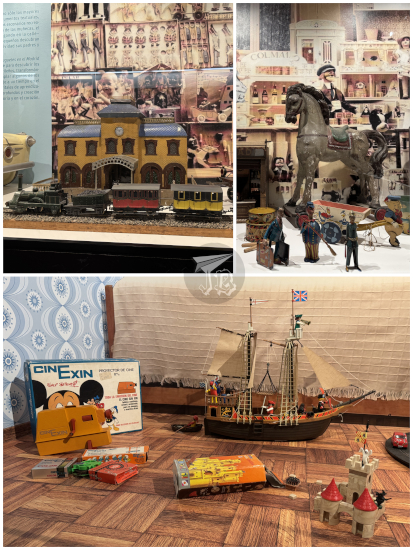
Old toys - tin train station and horse, a plastic castle and a plastic pirate ship

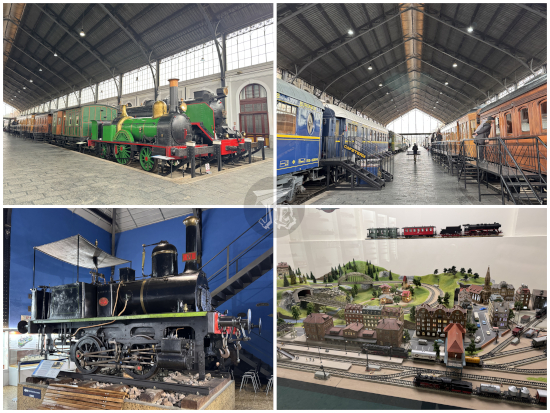
When I finished, I walked outside again. It had been raining hard while I was inside, but now it was cloudy but dry. I mentioned before that the brewery was near Delicias station. Today, the original station is no longer in service, but it has become the railway museum Museo del Ferrocarril, a project that was created to salvage the building. Madrid-Delicias was the first monumental station built in the city. It was however short-lived: inaugurated in 1880, it closed down less than a century later, in 1969. There is a widely-believed rumour that it was designed by Gustave Eiffel, but it was actually Émile Cachelièvre who drew the blueprints. The building was erected in iron, glass, and red and black bricks, maybe trying to echo some Neomudejar touches. During its prime, it was the terminus of trains that went to the west, including Lisbon, Portugal.

In 1984, Delicias became the Railway Museum, and it hosts a number of artefacts including whole tractors – steam, diesel and electrical – and cars, along with smaller rooms dedicated to specific pieces. The main ward, which would have made up the platforms, is occupied by real trains that have long gone out of service. The side rooms host smaller collections, either historical or thematic – such as the clock room, the infrastructure room or the model room. On the upper floors, the largest train model in the country is kept running when there are visitors to snoop around. There were many things to see that were closed off when I was in the museum for the flea market Mercado de Motores (despite no running mini-trains).

Collage of the train museum, showing old trains and models

I had planned to stay for longer, but it was cold – the gates were open and the wind came through, so in the end, I decided to go wait for my sibling at their underground stop, which would be much warmer. I was lucky enough that I skipped the two downpours of the day though, as I was inside when the heavy rain came – twice.

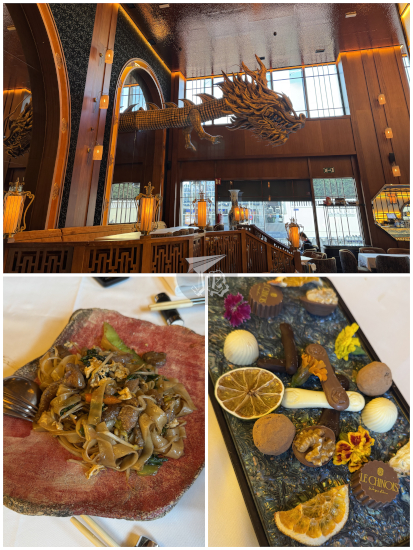
Once my sibling was done with work, we rode the underground towards Le Chinois. This high-end Chinese restaurant advertises itself with a different name in Chinese [梦香楼 | Mengxianglou]. It claims, in Spanish, to offer a mystic experience that transports patrons to Ancient China. In Chinese, it asserts to seek authenticity before beauty in food, using the best ingredients. Either text sounds a bit pretentious, honestly, quite on par with the decoration. Everything is wooden and there is an actual dragon model running above the dining area.

We ordered a few dishes to share. We started with some dim sum – an assortment of small one-bite dishes, aptly called “Dim Sum Assortment” [点心拼盘]: Sum Siu Mai (猪烧卖; steamed, handmade dumplings with spring onion, charsiu sauce, and quail egg), Xiao Long Bao (黑猪肉灌汤小笼包; bao stuffed with Iberian pork and chicken consommé), Ha Kao (大海水晶虾饺; Steamed dumplings stuffed with tiger prawns and dehydrated bamboo) and Jiao Zi (牛肉饺子; Chinese garlic, sautéed with fresh ginger, carrots, and chives). We also ordered some Soft Shell Crab [椒盐软壳蟹] (crispy, battered, and sautéed with salt and pepper) and Rice Noodles (干炒牛河; Stir-fried noodles with black soy-marinated beef, roasted ginger, wok-fried free-range egg, and seasonal vegetables). I think – I swear none of the noodles description matches the dish we got. For dessert, we shared an selection of chocolates and tea.

Chinese food at a restaurant with a giant wooden dragon decorating the ceiling

While the food was all right, none of it actually blew my mind. Furthermore, the experience itself did not feel up to par with the pricing, especially considering that the service was not that great. A beer slammed on the ground just next to us and splattered my coat – the staff only noticed when I cleaned it up. We ordered water, but they kept the bottle away and did not refill it as needed. We had to ask for it every time. All in all, way overpriced for “just okay” dishes, so I don’t think I will come back.

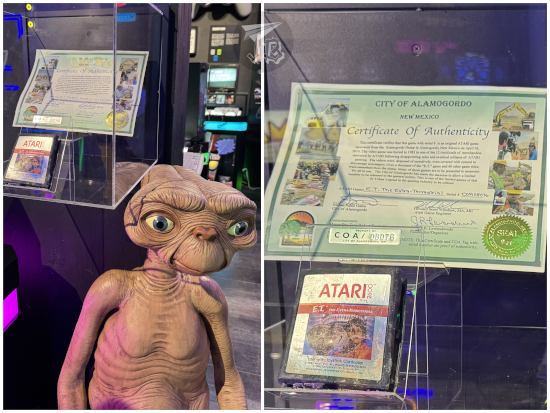
After the restaurant, I had booked a ticket at OXO Museo, the museum of video games. It features old-time games, arcade machines, and even a copy of the Atari ET video game. The game, released in 1982, was a massive failure. Urban legend had it that Atari buried all the unsold copies in the middle of the desert in New Mexico – and for once, the urban legend turned out true! A stash of games was found in Alamogordo, and a bunch of them (not only ET, also Pacman, Space Invaders…) and dug out in 2013. Around 1,300 cartridges were recovered, and one of then is exhibited in the museum.

An Atari video game cartridge and a figure of ET, along a certificate of authenticity

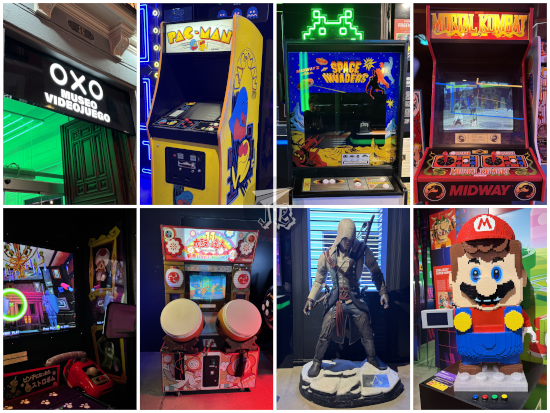
The museum is set up as 100% interactive – you can basically play with any video game in display – form the classics on arcade machines to the more modern Play Stations. There was even a taiko game. Decoration features sculptures and holographic displays. On the upper floor, there is a Lego and Video Games exhibition, where you can participate in creating a huge Sonic mural. It’s a pity that one can only stay in the museum for two hours at a time, there are a lot of things to do! The museum is so much “for all ages and skill levels” that even I managed to win a game or two.

Old arcade games at OXO

We made the most out of our time there, and then headed off to the train to try to head back home. There were delays, so we took forever, but eventually we made it. And again, I did not get rained on!

11th December 2024: CBA, hotpot and lights (Madrid, Spain)

Since I was meeting my sibling for the yearly event of Naturaleza Encendida in Madrid in the evening, I decided get there early and make the most out of the day. As I arrived, I headed to the Círculo de Bellas Artes (literally “Fine Arts Circle”). The CBA is a sort of NGO dedicated to culture and the arts. Its headquarters host many activities such as exhibitions, theatre plays, concerts, lectures… The building was designed by Antonio Palacios, one of my favourite architects. It has seven floors, some of them used for events, others for offices. There is even a small theatre.

The CBA was running an exhibition called “Messenger Species” Especies Mensajeras, by artist Álvaro Soler-Arpa. It is a collection of pieces created from animal bones and items found in dumps. Born in Gerona in 1974, Soler-Arpa is a multifaceted artist who does publicity illustration and creates distressing sculptures using animal bones as its medium to make the viewer to think about waste and pollution. This exhibition of modern art is described as “ecological art for reflection”. I thought that it could be either really good or a holier-than-thou approach, but my curiosity was piqued.

The exhibit collects selected pieces from four series of sculptures: “Toxic Evolution” (Evolución tóxica), “Devastated Nature” (Naturaleza devastada), “Design-methastasis” (Diseño-metástasis) and “Sculptures from the End of the World” (Esculturas del fin del mundo). It was… disturbing, but in a good way. It did not feel preachy. The idea is that nature is affected by the consumerism in current society, but not dying – adapting to it. The imagined futuristic animals are a warning sent through time – nature is resilient and it will survive. Us humans? Maybe not if we do not get any better.

Álvaro Soler-Arpa's Especies Mensajeras

There was another exhibition in the building about the consequences of war, but I decided I could not stomach that one. However, I had the access ticket, so I could take the glass lift to the famous terrace of the building – the one that kicked off a trend of opening terraces in Madrid to watch the skyline while having a drink. It was too cold and too closed to have anything, but I did get a nice view, especially of the Palacio de Telecomunicaciones and the Spanish language Institute Instituto Cervantes, both designed by Antonio Palacios too. The terrace is mostly flat, with a bar and an impressive sculpture of Minerva made in bronze by Juan Luis Vassallo. Minerva – Roman goddess of wisdom and art – is the symbol of the CBA. There is also a smaller and higher structure that looks like it could hold an even better view, but that was closed off.

Skyline from Azotea Círculo Bellas Artes

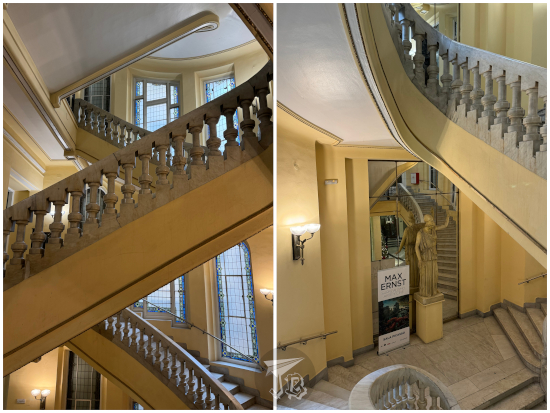
The CBA building has many cool spaces, such as the ball room (Salón de Baile) or the colonnade room (Sala de Columnas). However, my favourite part of the building are.. the stairs. They are designed as a double staircase with mirrors at the landings, and coloured windows alongside the steps. One of the sides is less bright now, because a building was erected and blocks the sun. I still find the staircase superb, so I hung around there for a while until the security guard gave me a weird look.

Stairs Círculo Bellas Artes

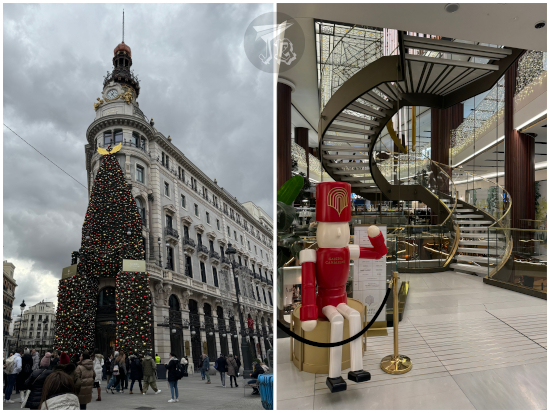
I left the CBA and walked down the street Calle Alcalá and stopped at Galerías Canalejas just to see what kind of decorations they had. It turned out to nutcrackers and elves inside and a huge Christmas tree outside. I still cannot afford anything they sell there.

Chrismas at Galerías Canalejas

I continued down towards the square Plaza de Oriente, where there was a classic merry-go-round – empty and ready to be ridden. Thus, since I have no shame, I went on it. The salesperson was incredibly kind, since I was the only rider – and an adult at that – and yet they directed me to a horse which moved up and down and showed me how to climb on it.

Then, I backtracked to the shop Turrones Casa 1880 in the street Calle Arenal, which hosts a small Museo del Turrón. Turrón is a typical Spanish confectionery eaten mostly at Christmas. It is mainly made out of processed almonds, and 1880 is probably the most famous brand – and it prides itself on the most expensive one. I am not a fan of turrón, to be honest, but it was almost Christmas, and if I was ever going to do it, that was the right time frame. The museum is mostly an audiovisual in a decorated cellar, with a photo-op, but the staff was really nice.

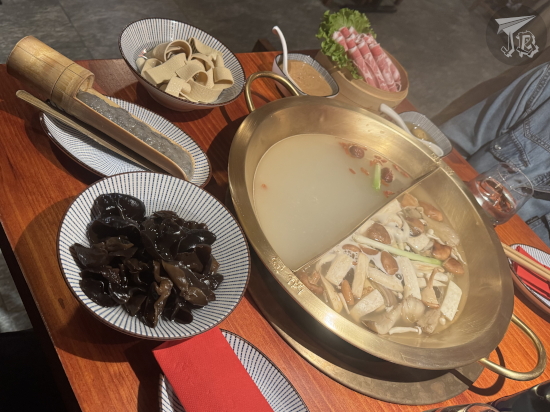
At 14:30 sharp, I met up with my sibling for a restaurant that I’ve been wanting to try for a while 壹锅火锅 Hotpot de Sichuan. Hotpot [火锅, huǒguō] is a Chinese type of stew based on a stock or soup that is kept simmering in the table itself, and you just grab the raw ingredients and dip them in the broth to cook them – imagine a fondue with broth instead of cheese. We ordered a menu for two, a pot with two broths, one mushroom-based and one meat-based. The dips were spring onion, coriander (which was not used, because I hid it), shrimp mince, thin beef slices, tofu stripes, Chinese black mushrooms, cabbage, and rice noodles, along with two sauces – one slightly spicy, and my beloved sesame and peanut sauce. The food was great, but at 15:40, the waiters popped up to tell us that they wanted to close the restaurant, and then stood up next to us until we finished and left. It was more than a bit awkward, so we hurried up to do so. While the food was great, the situation spoilt our experience a little, I think. We were still eating, not slouching around. I am not sure I would want to go back…

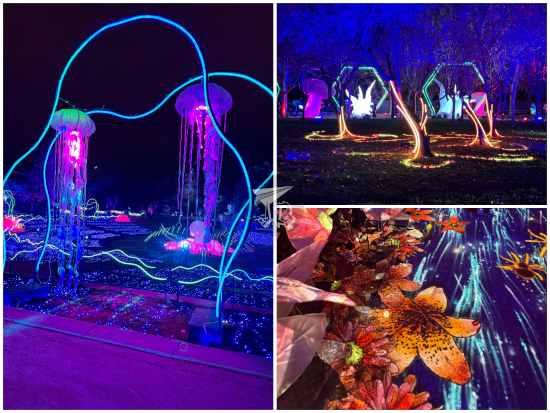
Afterwards, my sibling had to do some shopping, so we spent a while going up and down some shops and a department store, before we headed out to Naturaleza Encendida in the park Parque Enrique Tierno Galván. This is a yearly light show organised in Madrid parks – it used to take place in the Botanical Gardens, before it was moved to a larger area. The 2024 edition is titled Naturaleza Encendida: Life.

Naturaleza Encendida Life

To be fair, I was a little bit disappointed, as “Life” turned out to have mostly figures reused from the last few events. Though the organisers tried to build a narrative of water, land and air topics, the novelty had worn off. It was not bad, but the show keeps getting more and more expensive every year, with fewer and fewer perks for the VIP tiers. Furthermore, the new larger location does not imply more light sculptures – they’re just spread farther apart so they can fit more people without it feeling crowded, so it simply takes longer to walk it through. This has its advantages and disadvantages – it was good last year when we had to go on a weekend but this time around it just felt… colder. They also tried to give the whole thing an ecologist spin, and this time it did come out preachy… I mean, it is a show of lights, which technically could count as light pollution, without any actual… purpose… but charging you to watch pretty lights.

Naturaleza Encendida Life

Naturaleza Encendida Life

That was the end of the day, and we just headed home afterwards, but aside having to wait for the train for over half an hour, nothing to report on that end.

30th June 2024: Engines, illusions, history and tea (Madrid, Spain)

Since finding about my tea time outings, my sibling had been wanting to tag along to one. I was asked to organise something for the weekend that involved either Chinese hotpot or afternoon tea in Madrid. The hotpot place was booked out both days, but I found an afternoon tea opening on Sunday the 30th. I am too lazy to move out just for tea, so I organised a bit of a day out.
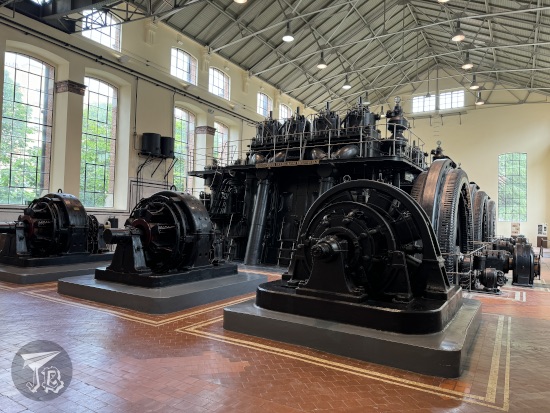
After an uneventful train ride, our first stop was at noon: Nave de Motores de Pacífico, the former energy centre that fed electricity to the original underground lines. Today, it is not in use and it has become part of the network of museums Museos Metro de Madrid. The warehouse was built by Antonio Palacios between 1922 and 1923 to home the diesel engines, transformers and fuel that single-handedly powered the underground system before the Spanish Civil War. The system was actually in place until 1972.

Warehouse containing the old underground engines

The building was erected in red brick, with white tiles inside, decorated with Palacio’s typical metallic green. The floors are ceramic tiles, and the engines are three monstrous vessel-powering pieces of engineering. These diesel engines created electricity, which then entered the transformers, and was sent to the power lines to feed the trains. At night, the excess was sold to the local street-light network.

Since we were going for afternoon tea to El Jardín de Orfila, where I have been before, I knew lunch was out of the question. However, we needed a snack. I planned that at Yatai Market, an… Asian food court of sorts. A number of stands come together to offer different cuisines and snacks, even full-sized meals. We tried a Chinese bao each and a couple of dim sums. I ordered a hoisin duck bao which was extremely yummy. I will definitely come back to try other stuff.

HotBao Yatai Market Cortezo

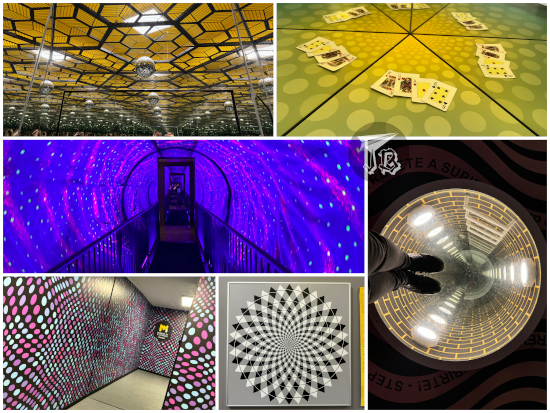
Afterwards, we headed off to the so-called Museum of Illusions. This museum is a compendium of optical illusion and installations designed to fool the brain into believing things that are either wrong or just not there: a distorted room so you look big in one corner but small in the other (Ames room), a vortex where you seem unable to walk straight, a rotated room, a room full of mirrors – there were a lot of illusions with mirrors actually – stereograms with hidden images, turntables, holograms…

We had a reservation for 14:00, and I was surprised at how chaotic entry was. I mean, they’ve been running the thing for a while now, someone should have figured out how to do crowd management, but no. Then, there were kids running and screeching all around, but it calmed down after a while. I had really hoped that the museum would be calm and half-empty at lunch time, but it was not so, not by a long shot. It was interesting though, and pretty fun.
Museum of Illusions Madrid

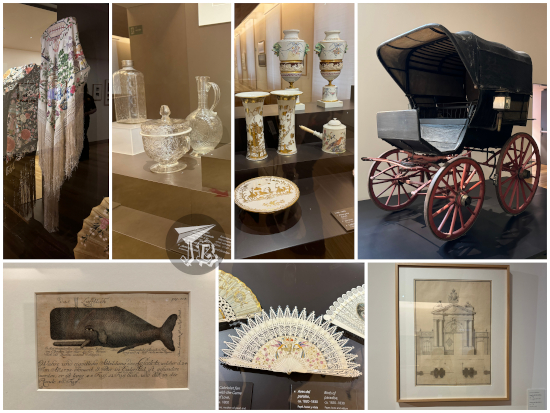
However, the experience was shorter than I had calculated, so I had to improvise an extra stop. Thus, we entered the local history museum Museo de Historia de Madrid, which tells the city’s history since Madrid became the capital of Spain. There are paintings, models, typical costumes, plans, maps, and Playmobil sets depicting of the uprising against the French in 1808. The museum is hosted in a former palace-like building which was actually built as a hospice. To the side stands the original Baroque chapel. It also has a lovely garden with a monumental fountain, which was relocated from its original place for conservation.

Museo de Madrid exhibits

Museo de Madrid - chapel and fountain

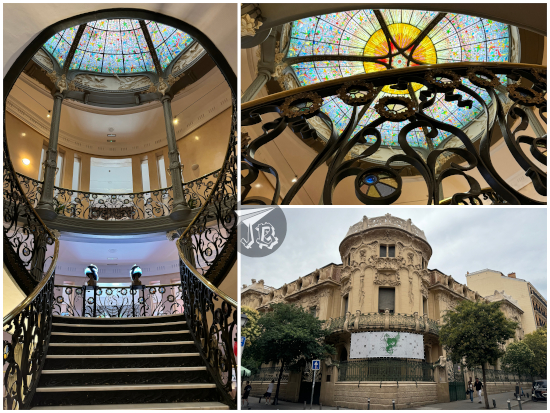
We spent some time there and then headed off to the building that now holds the office of the Copyright Owners’ association, a manor known as Palacio de Longoria. It was designed by José Grases Riera and built between 1902 and 1904. It is one of the few actual Art Nouveau buildings in Madrid, possibly the most important one. The façades were made in artificial stone, with sculptures and shapes resembling vegetation. I’ve wanted to visit it for a long time, but it is only open when there is an exhibition, and the stars had never aligned – until this time. There was an exhibition about urban music, and I was not going to let go of the chance to see the monumental staircase and the skylight.

Longoria Palace

We finally set off for afternoon tea at El Jardín de Orfila. Out of the several places I’ve tried afternoon tea in Madrid, this has been my favourite to date. The outside garden is lovely, but mostly, their scones are the best around.

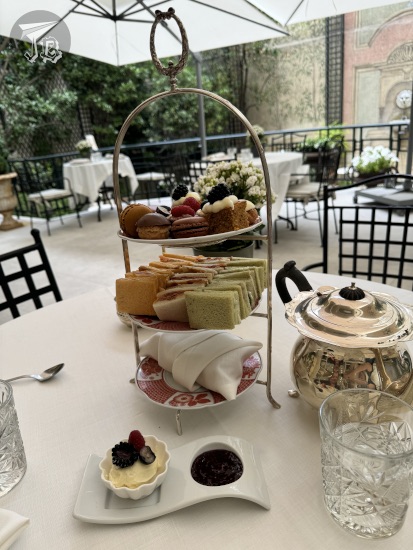
We ordered green tea, and the snacks were finger sandwiches – smoked salmon and cheese cream, classic cucumber and cheese, pastrami – pastries – carrot cake, macarons, lemon curd – and the scones. This time round, I decided to eat the scones after the sandwiches in order not to be full when it was their time. The afternoon was pleasant, but we shared the terrace with another table, and later a loud lady who wanted a smoke. That broke the magic a little, but the tea was fantastic and the scones were great.

El Jardínde Orfila: tea serving for two

Afterwards, we just headed for the train station to get back to our places. Of course we missed the correct one since they run whenever they like. What else is new? But the fun part was being able to pull a fun day out from my sleeve, and it was not stupidly expensive either, so good fun, all in all!

9th & 10th June 2018: Wicked London (England, Great Britain)

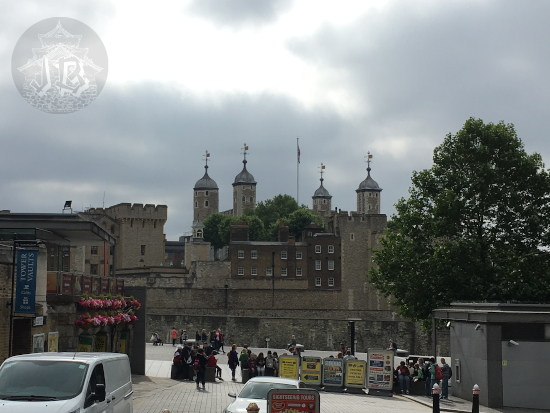
This will be the last work-trip, at least for a while. I might change my mind later, but for now I’m done with them (although there’s an upcoming family trip rather soon…). Again, we flew in early Saturday morning, and we went to walk around the Tower of London and the Tower Bridge.

Then we went to the British Museum. I left them for a couple of hours there and I went to visit some of the lesser-seen galleries.

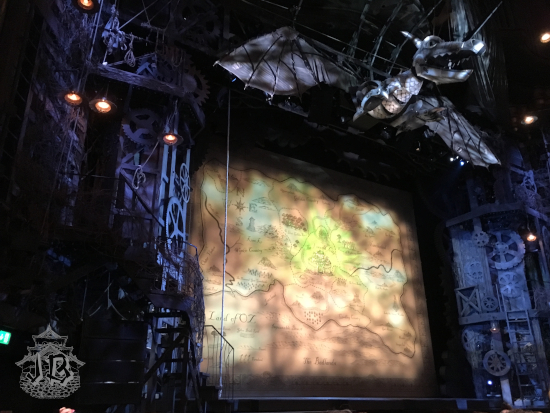
We had booked tickets for the musical “Wicked” in the Apollo Victoria Theatre at 14:30, so we headed over there. Wicked is a parallel story to “The Wizard of Oz”, focusing on the story of the Wicked Witch of the West, who becomes a social outcast due to her tendency to speak her mind and the strength of her magic. I had really wanted to watch this for a long time, so I used this chance and convinced the group to get there. I absolutely loved it ♥.

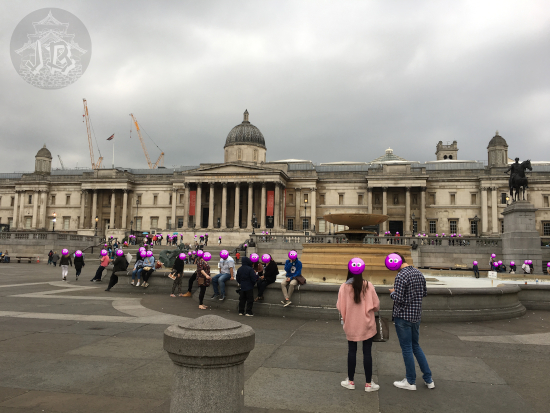
After the show, we dropped our things at the hotel. The group wanted to get some rest, so we stayed there for a while, then got out again. We took the underground towards London central and we were in Trafalgar Square for a while.

Then, we went to Chinatown for dinner.

Later, we walked around Piccadilly Circus, checking out some shops and so. We even stopped for cake.

On Sunday morning we went to Saint James’s Park, where we got to meet the local fauna, especially a very adventurous squirrel.

Then we dropped by Buckingham Palace. Although we did not watch the Guard Change, we did see one of the relief marches.

We walked from there to Westminster, saw the Houses of Parliament and the Big Ben, along the outside of Westminster Abby.

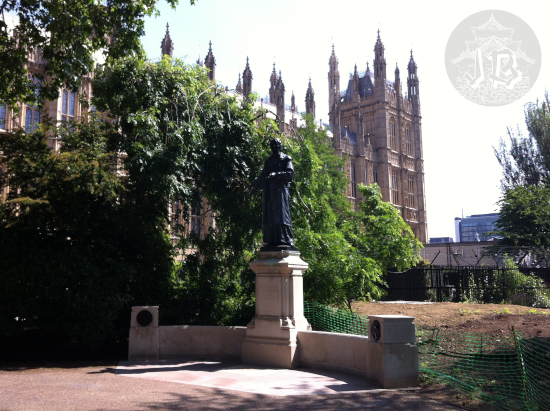
We visited the Monument to Emmeline Pankhurst and stayed for a while in the Victoria Tower Gardens.

As a final visit, we went to the Natural History Museum.

Finally, we headed off to the airport, and the icing of the cake was that we got caught in a controllers’ strike, so we had like a three-hour delay on our flight and it took forever to get home (;¬_¬). All in all, this was a very… strange trip, and without a doubt the highlight was going to see Wicked, which is something I had wanted to do for a long time, and gave me a couple of hours of enjoyment to myself.

30th July 2017: Tokyo → Yokosuka → Sarushima → Yokosuka → Yokohama → Tokyo {Japan, summer 2017}

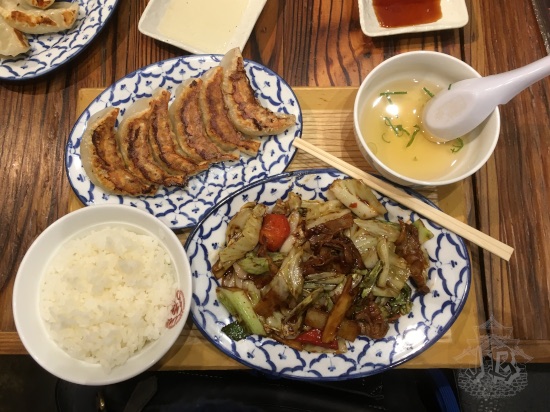
We ended up in Yokosuka [横須賀] because D****e wanted to go to a music and book shop called Yajima Record Honten [ヤジマレコード本店], which was sadly closing the following day. The first thing that we did when we arrived, however, was lunch (because we had not gotten up early and we had spent a couple of hours on trains). Yokosuka is known for being an American army base, so it prides itself on being “Americanised”, and the typical dish seems to be hamburgers. This is the avocado burger I ordered.

After this we walked a block north and found Yajima. The key aspect of this shop was that it had a bunch of posters and signatures from old promos from a bunch of J-rockers. It was a bit of a magical place and it is very sad that it is closed now. I took the chance to buy an unopened, brand new copy of Hyde’s Shallow Sleep single, and we took pictures of a bunch of the promos that were still up, some of them twenty or thirty years old.

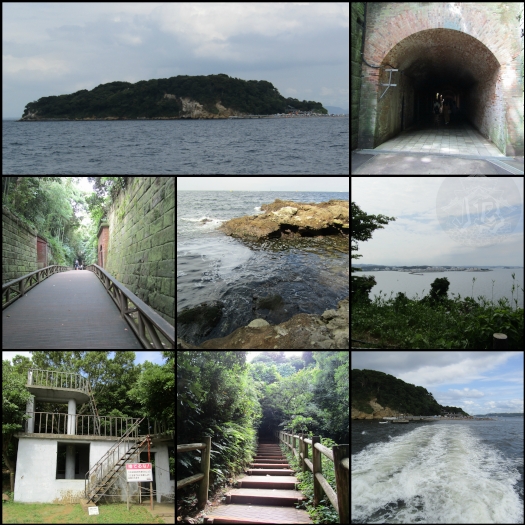
Afterwards we walked to the pier to catch a ferry to see Sarushima [猿島], which hosts a few old timer army bases and wartime ruins, aside from some very nice ocean views. It would have been nice if we had managed fewer people around, but alas, we all came by ferry so we all arrived at the same time. Sarushima is the only natural island in Tokyo Bay, and geologically it seems to be a continuation of Futtsu cape on the opposite side of the Bay. Although the name means “Monkey Island” there is no monkey there except in a legend that says that a white monkey guided Saint Nichiren through the fog in Tokyo Bay to the safety of the Island. Sarushima is a World Heritage National Historic Site.

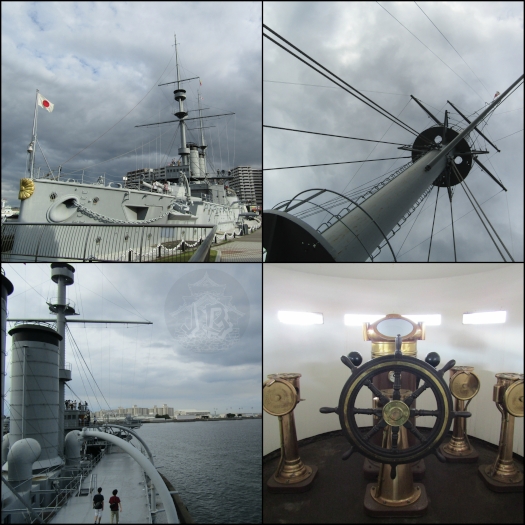
Afterwards we went back to Yokosuka Pier and boarded the Mikasa [三笠] warship which was used as flagship in the Russo-Japanese war (and sank after the war because she blew up. Figures). It is now a naval museum where you can VR the battle. I got VR-obliterated. There is a reason why I did not pursue a military career.

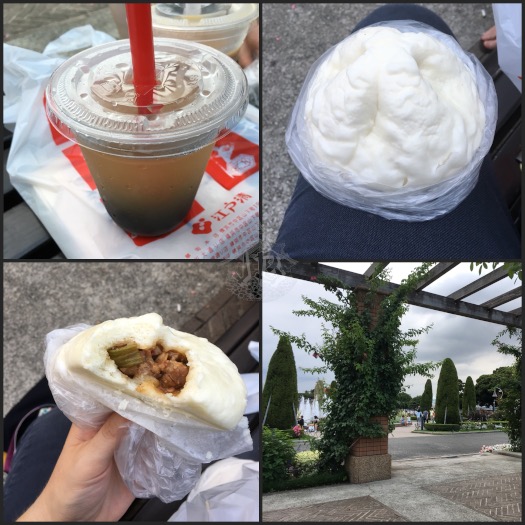
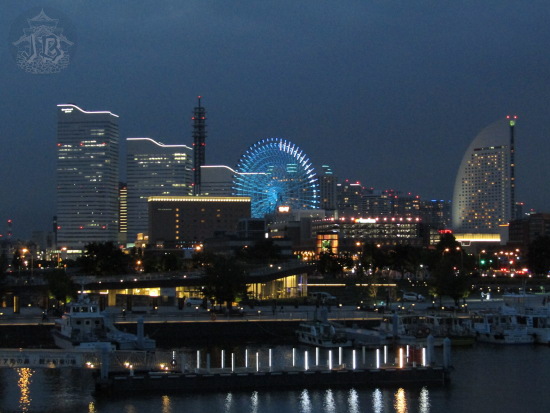
Afterwards we diverted our way to go to Yokohama [横浜] and get nikuman for dinner in Chinatown. We sat on a park bench and ate nikuman and drank bubble tea. Afterwards we walked down by the harbour and through Yamashita Koen [山下公園] and looked at the sunset/night skyline. Finally we caught a train back home.

29th July 2017: Shinjuku, Shibuya & Blended Fam {Japan, summer 2017}

D****e and I were going to have a relaxing weekend, not leaving Tokyo [東京] and stuff, but she wanted to do some shopping. We started off in Shinjuku [新宿], at the Tokyo Metropolitan Government Building Tōkyō Tochō [東京都庁], which was as always great and on her subway line anyway.

Collage showing Tokyo from above - thousands of buildings that disappear in the background, and some forlone green parks

Afterwards, I wanted to check something in one of the Shinjuku fandom shops (it said to ask the shop assistant, and I can ask, but I was not sure I would have understood the answer, thus she offered to tag along with me). Unfortunately the item I wanted was already gone, life is tough.

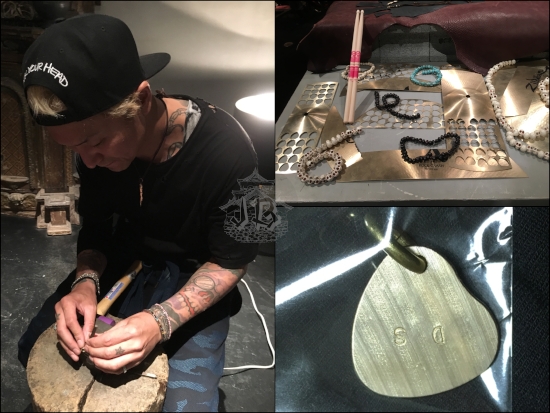
Then we went to Shibuya [渋谷] for lunch, Tokyu Hands and Mandarake. Afterwards we walked in the rain towards Royal Flash to check Arly’s Jewellery Line – Blended Fam. Arimatsu, or Arly, is the drummer for Oblivion Dust, and used to play for VAMPS too. He also designs jewellery, and he makes very pretty stuff – unfortunately quite expensive. We chose to drop by this day because he was going to be in the shop greeting fans, and engraving his most affordable piece of jewellery, a pendant made from his used cymbals. Furthermore, if you got one while he was there, he would engrave your initials on it! Fun. I decided to get one, and he was mortified when “SD” was engraved upside-down, yielding to “DS”. He was mortified. Then I joked about it and I gave it a naughty meaning… making him choke with laughter. So… it was a win, I guess?

The artist engraving the pendant, and the material - old cymbals cut out in a heart-shape.

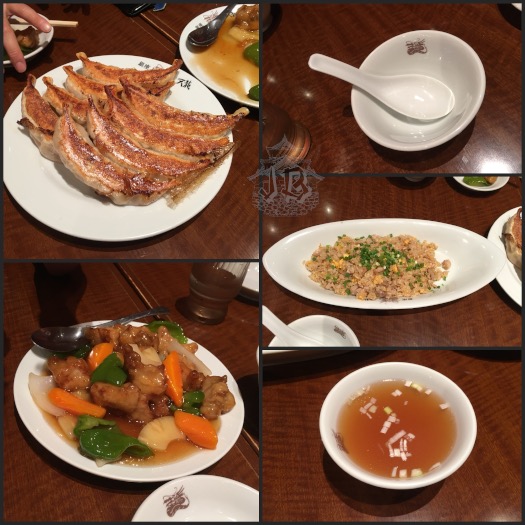
After the event, we headed off to the Tokyo SkyTree [東京スカイツリー]. We were going to see the nearby fireworks with a friend from there, and have dinner later, or have dinner with her if the rain did not stop. In the end only we had dinner – as it was raining very hard and we thought the fireworks would be cancelled, so we headed off to a nice Chinese restaurant at the SkyTree which had extra long gyoza.

Chinese food - dumplings, rice, sweet and sour pork, soup

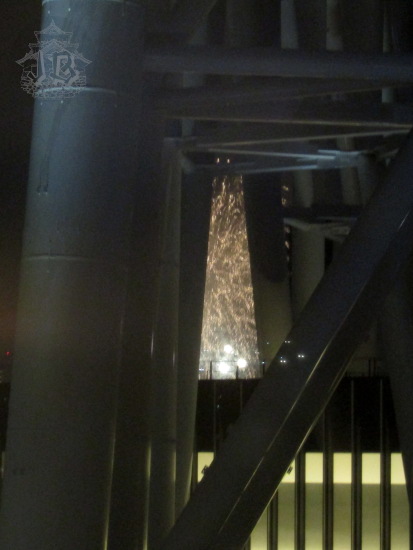
When we were coming out we saw one last firework, as the show was not cancelled in the end. Live and learn.

Firework sparks behind the structure of the Tokyo Skytree

11th & 12th June 2017: Highlights of London (England, Great Britain)

As part of my day job, I took a group of customers on a trip to London. Not the best decision in my life, but one that I would repeat a couple of times before I had enough. This was a short getaway – we took off on a red-eye flight on Saturday and we came back on Sunday evening.

Our first stop was The Tower of London, officially called “Her Majesty’s Royal Palace and Fortress of the Tower of London”. The main Tower, “White Tower”, was built in the 11th century, and additions to it were made up to the 1400s. It was designated Unesco World Heritage Site in 1998. The Tower holds an armoury, some treasure, documentation offices, a few shops and the Crown Jewels of England. And, according to the legend, quite a few ghosts.

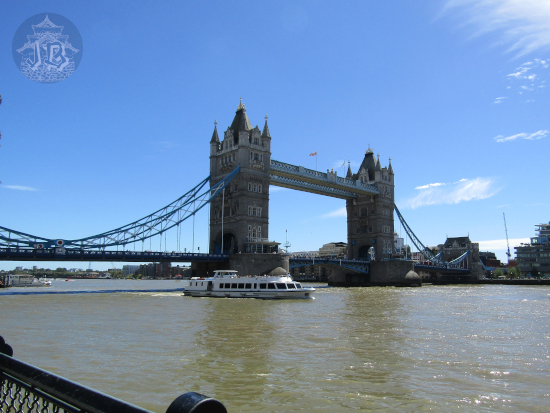
After the Tower, we took a moment to see the Tower Bridge.

We had a hotel basically at the end of the world, and we decided to go to drop our things off before we continued on the visit. We saw the Wellington Arc in Hyde Park on the way to the royal palace.

Then we fooled around Buckingham Palace.

Finally we went to Chinatown to have dinner…

… and rounded up the day at Piccadilly Circus.

The next morning we headed off to the British Museum. We had breakfast outside because of course it was one of those times when it’s all warm in London. Waffles = ♥

The British Museum was established in 1753, and opened to the public, in its current location, in 1759. It focuses on human history and art, having branched the natural history items to the Museum of Natural History and all the documentation to the British Library. The museum holds the awe-inducing number of 150 million of artefacts from dozens of cultures of the world, both ancient and modern, with amazing Grecian and Egyptian collections (albeit having disputed ownership…)

Inside the British Museum we separated. I left them to have a walk around the most important areas and I walked into my favourite spots (although the Japanese galleries were still closed. I also got a ticket to see the Hokusai – beyond the Great Wave exhibition, which presents a number of Hokusai’s works organised in series or topics. One is waves, and it shows how Hokusai experimented with textures, shapes, swirls and foam until he found the “perfect” wave – his most famous work, the Great Wave. There is a series on people, another one on mythology, and another one on himself and his family.

After I was done and we had met up again, I helped them found some stuff that they had not seen but still wanted to. Then, we headed off to the Westminster area to see the Big Ben, and although there was some scaffolding already visible, we managed to see the whole thing.

Finally, we headed off to the airport to get back home.

8th (and 9th) January 2017: The jump back to Tokyo… and then completely back… {Japan, winter 16/17}

At an insane hour in the morning, umbrella-less and in the middle of the rain, I got myself back to the point where buses were finally running to the airport. I dozed away the trip, because else I would have kept tying to read quizzes in Hiroshima-ben, the local dialect, that they were displaying on the bus screen.

I made it to Hiroshima airport and pulled a bunch of things off my backpack to conceal them before I got my boarding pass in case my carry on got checked, but once again the ‘I am a scary gaijin’ thing worked and I was free to go.

I was allowed to get my water bottle in, even with it being half-full, and I had a Calbee crisps breakfast because I could not find a sandwich inside, although in retrospective, maybe I should have gone out and back again as I had time. Then again, I would have had to explain that to security… never mind. So I had coffee and crisps. Not the best option, but what I had available.

When I landed and got back to downtown Tokyo [東京], I met B**** at Shibuya [渋谷] for gyoza, and boy did we eat gyoza. And afterwards she walked me to Shinjuku [新宿]to buy some stuff, and then we went to a cafeteria for cake… well, she had cake, I had a coffee jelly with vanilla which was my new favourite thing in the world. I seriously need to learn to make that.

After that there was a visit to Swallowtail in Ikebukuro [池袋], the butler café, which is as always very fun. We had a bit of a lost butler – he felt kind of new – and not the prettiest one. I noticed that they have uniformed the butlers, too, so now they are all wearing the same thing. After that we dropped by the shop and I got myself a bracelet I can’t wear because my wrist is too thin… and here I thought that I would get away with stuff prepared for Japanese girls… nope.

After that there were goodbyes and thank yous and tears because the only thing that I did the next day was going to the airport, more goodbyes, more tears. Very sad. As always.

Until next time, I guess.

Maybe.

Hopefully.

1st January 2017: Hatsumode {Japan, winter 16/17}

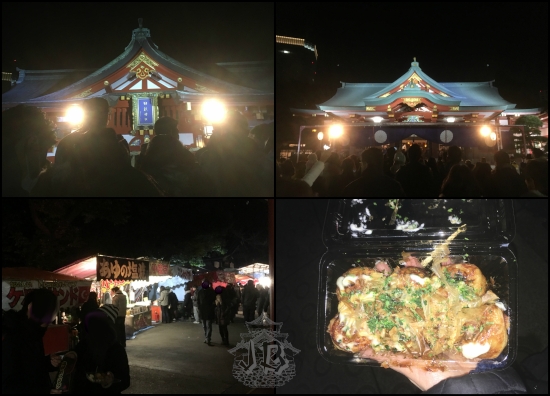
Hatsumode [初詣] is the Japanese custom of visiting a shrine or temple within the first three days of the year. Some people – like we did – actually wait the New Year to roll in the temple grounds. After the 108 (fast!) gongs that signal the entrance of the New Year, you are allowed into the shrine grounds to say the first prayer of the year in Hie Jinja [日枝神社].

After the prayer you can buy good luck charms, arrows which are ammunition for the kami to protect you (or something alike), enjoy some sacred sake, get your shuin, and once you’re outside, buy food and drinks. In my case I got some fresh takoyaki and ate them alone because apparently they’re stinky 。゚( ゚^∀^゚)゚。

Then we headed off home, and I got up at 8 am to have 12 grapes with Spanish TV as it has been my custom all my life. Then I went back to bed.

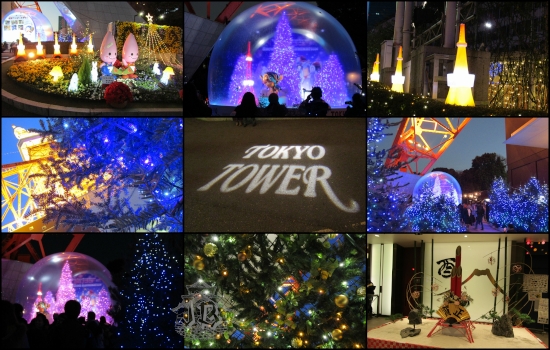
In the evening I headed off to Minato [港] to see Tokyo Tower [東京タワー]. Zojo-ji [増上寺] and Shiba Kōen [芝公園] were packed with Hatsumode parishioners and I had never seen such a line to go up Tokyo Tower. Thus I did not climb up, but I did take pictures of all the illumination around.

Afterwards I met with D****e and K***n. to go to Yokohama [横浜], to have dinner in Yokohama Chinatown, as Chinese people have their own New Year, they would be open to business as usual. It was my first time in Chinatown at night, too, so it was interesting seeing places like Kanteibyō / Kuan Ti Miao Temple [関帝廟 / 中華会館] in a new light.

On our way back we tried to see Shiodome [汐留]’s Winter Illuminations but they were off. We’re not completely sure of why…

19th July 2016: Oopsies {Japan, summer 2016}

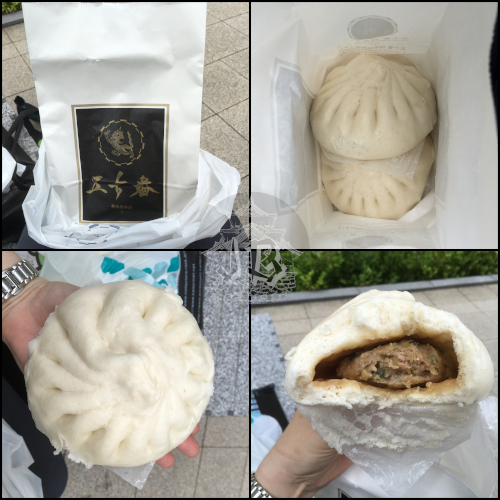
After doing some studying in the morning, I was to meet B**** for dinner. I went to Iidabahi [飯田橋] early and bought some meat buns (nikuman) for lunch – the most delicious nikkuman I’ve ever eaten are sold in a small Chinese shop there.

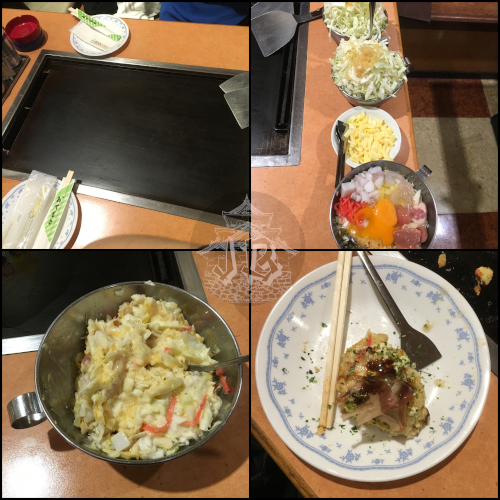
Unfortunately B**** and my carefully-laid out plans were forced to change because she had a gas inspection in her new apartment also known as the apatosaurus. However, we were able to go for some okonomiyaki and monjayaki .

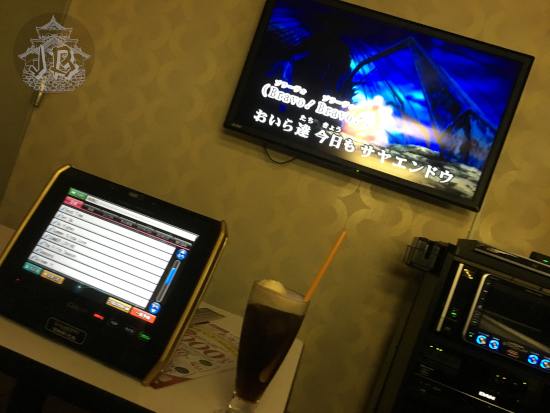
After lunch, we headed off to karaoke. All in all it was fun and plans were remade.

14th July 2016: Liar, liar, pants on fire (and Komagome II) {Japan, summer 2016}

The weather report had been announcing clouds all day. It lied. A lot. Seriously, both the JMA and whatever data an iPhone uses, they were way out of the way. See, I used these reports to plan an outdoors day visiting some parks, temples and shrines close to my area. This meant walking for a couple of hours, but there I went.

The first problem was that the weather decided that clouds were overrated. I did not think much of it at first, but it would be relevant later. The second was that GoogleMaps decided to join forces with the weather report and troll me.

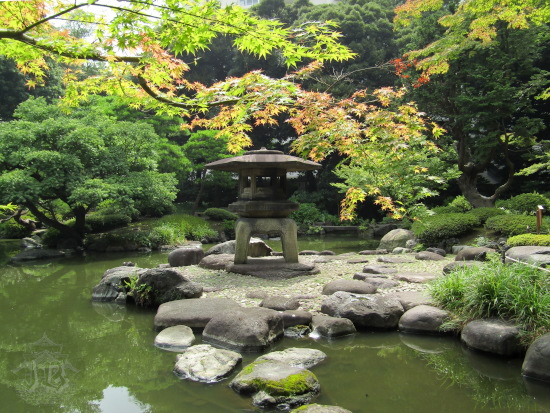
But let’s start form the beginning, and the beginning was the Kyu Furukawa Teien [旧古河庭園], a garden apparently famous for their rose festivals. No roses in July, but a very neat Japanese garden. I’ve never been much of an English Garden fan unless there are flowers, so I did not pay much attention to that part.

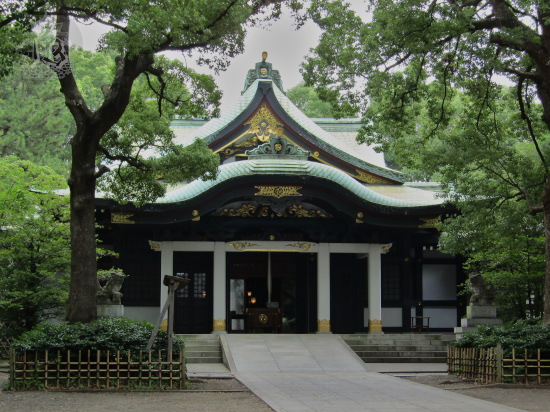
After the gardens I headed off towards the Oji [王子] area, checking out Hiratsuka Jinja, Takinogawa Park and Nanasha Shrine until I made it to the park called Asukayama Koen [飛鳥山公園], where for the first time this year I heard the cicadas singing like crazy. It’s officially summer in Japan, bugs dixit! It’s not a matter of the heat, the rain, or anything like that. In the end, the cicadas mark the time.

The park holds a few museums and In one of the corners Oji Jinja [王子神社] can be found. If Google agrees that it even exists. But alas, success in the end.

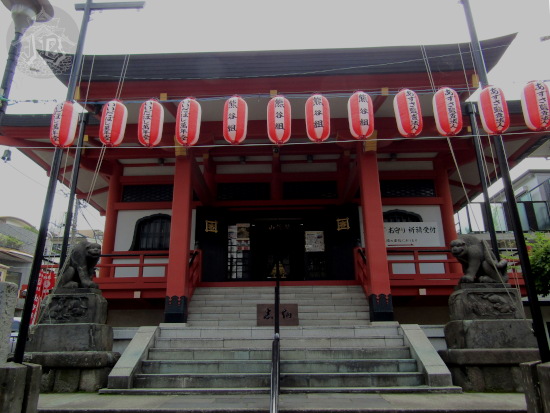
After an odyssey to find the Shrine and once again fight Google regarding yes, the Oji Inari Jinja [王子稲荷神社] exists, I managed to find the latter. Close to one of the crossroads I had been to before. Twice. Thanks, Google (-_-;)

Then I decided to head off to where my academy is, Iidabashi [飯田橋]. My destination there was Zenkoku-ji [善國寺], which was surrounded for some reason by no less than four Spanish restaurants. I am not brave enough to try those but there was a nikuman shop that did catch my attention. I also made a short stop at the local Book Off in order to check it out and get OFF THE SUN for a few minutes. At this point I had just realise that I had been indeed walking around in the sun for three and a half hours and I was… Burnt. Quite so. Damn it.

But it did not end there. Nooo, why would it end there? Then it RAINED 雨雨雨. When I had to do my laundry and get it dry, of course, because the next day I was over to Nagoya and wanted to make sure I had clothes to wear. And I studied because I had an exam the next day, and the previous one had been disastrous.

16th July 2012: Umi no Hi! {Japan, summer 2012}

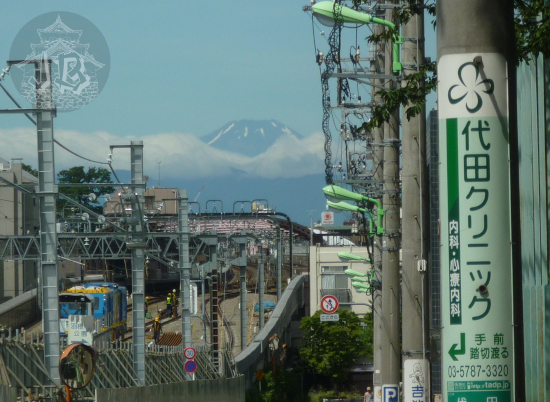
Monday 16th was the third Monday of June, and thus Umi no Hi [海の日], The Day of the Ocean, and it started great – the sky was super clear. That means we were able to see Mount Fuji, Fuji-san [富士山]! I had not seen him since I was here, not even on my way to Osaka because it was cloudy. It is difficult to see Fuji in Summer, so I was really happy to catch him.

The summit of Mount Fuji peering up through the clouds at the end of a downhill street under construction

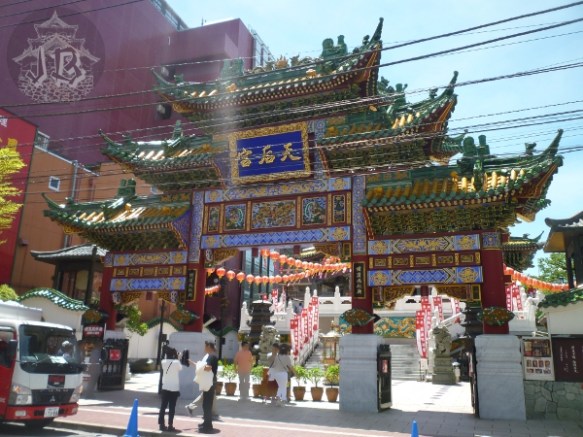
The morning, however, was to be spent in Yokohama [横浜]. The first stop was Chinatown, where I got to meet an old ‘friend’ of mine, whom I had been craving to see for a long time, in one of the temples. But that is its own story. (Basically: I got to see a dragon sculpture I loved).

The entrance to Chinatown - an ellaborate gate with Chinese characters, decorated in bright colours - red, blue, gold, green...

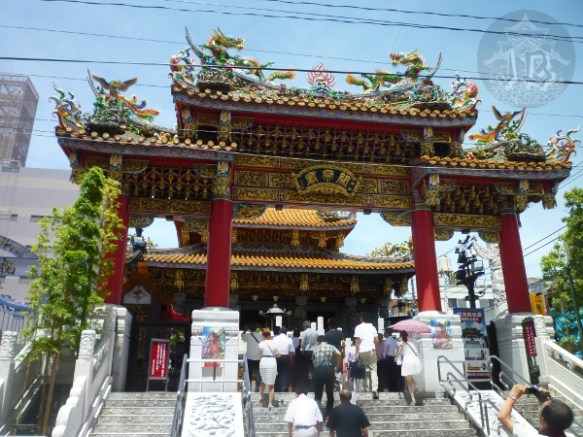
In Chinatown we visited Kwan Tai Temple [関帝廟]

An ellaborate temple with guarding dragons on top, over a flight of stairs. The colours are very bright, but the stairs are white.

And Kanteibyō / Kuan Ti Miao Temple [関帝廟 / 中華会館].

An ellaborate temple entrance, with lots of peaks and lanterns behind it

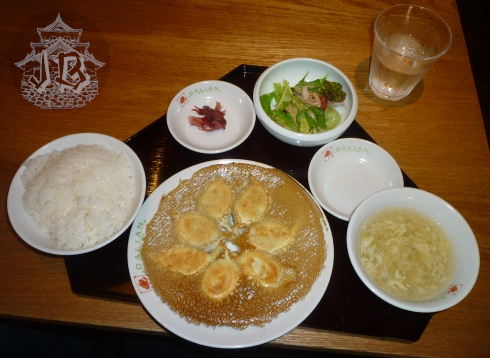
We had lunch in one of the many Chinese restaurants in the area.

Chinese food - rice, dumplings, soup, pickles

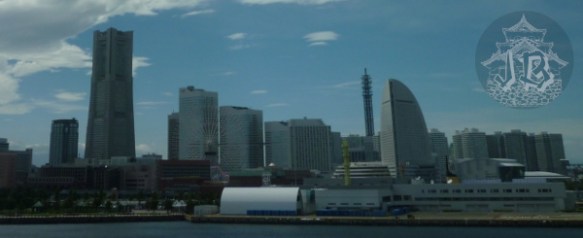
Afterwards we moved to the Port of Yokohama to see waves!! the famous skyline and the Yokohama Bay Bridge, along with lots of pretty ships which were open to visit in celebration of Umi no Hi.

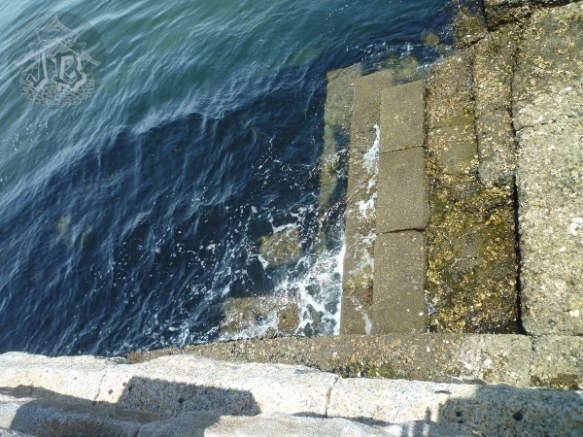
Stairs that disappear into the ocean

Yokohama skyline

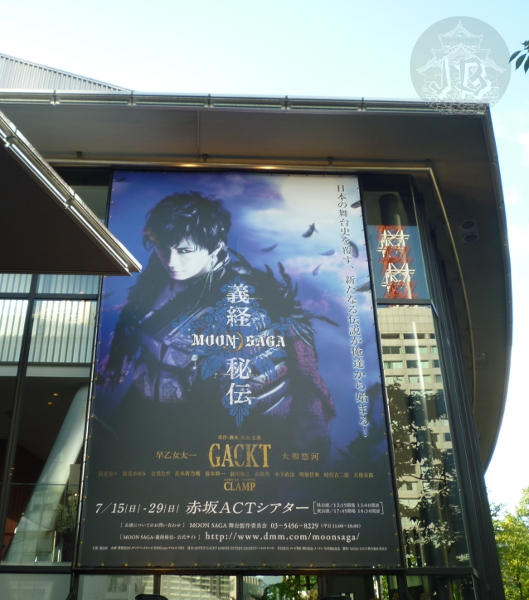
By 5pm, however, we were back in Tokyo because we had tickets to the theatre, more particularly GACKT’s Butai “MOON SAGA ~Yoshitsune Hiden~” at the Akasaka ACT Theater.

Being guionised by CLAMP, I expected a high body count [Spoilers from here] but I was surprised. The play is prepared as part of the whole Moon Saga project, so it does not focus in GACKT, who has surprisingly little stage time playing Yoshitsune. The play has all the elements of a CLAMP story – tragic love, honour debt, child with preternatural power, a few deaths, a character who randomly changes sides but in his heart he still belongs to the original side, main character forced to kill a friend, lots of angst… The butai tells the story of a group of fighters as they embark themselves in a war against the evil mononoke who are destroying Japan. Yoshitsune’s character himself is a half-oni or has an oni inside him, something along.

As I said, GACKT did not have much screen time, and to be completely honest, his spotlight was completely stolen by Saotome Taichi, a barely legal actor who plays Kage (Shadow), one of the good mononoke and who has a beautiful CLAMPian on-stage death.

Yoshinaga, one of the original companions, loses the love of his life, changes sides and tries to kill Yoshitsune, awakening the demon in him. GACKT flies through the stage during the fight and in the end Demon-Yoshitsune kills his old friend. The curtains fall soon after GACKT desperately cries over Yoshinaga’s body. Very sad. Very CLAMP.

The actors come back onstage, they are ovationed. The curtains fall again, the lights remain off. The curtains are drawn, and we are back to the beginning, the companions are alive and well, has it all been a dream? A foreshadow? Is this the companions’ destiny? But no, they are not companions… they are family…

Moon Saga board, showing singer and actor Gackt staring upwards, his eyes are red

[End Spoilers] It seems that when GACKT talks of the Moon Saga project, it means that you need to know all the pieces of the puzzle to understand the story. Each of the pieces seems to be part of a great jigsaw that will come together to form something absolutely amazing.

Well played, GACKT, well played. Now shut up and take my money, because this is going to be EPIC.

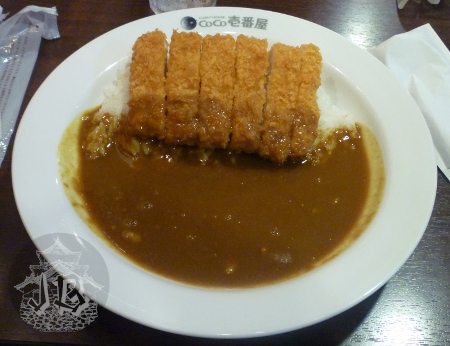
After the play, we had some curry at CocoCurry House.

A pork cutlet, breaded, with curry sauce and rice around it