
I was talking to an acquaintance whose child likes superheroes – so does the acquaintance, actually – about Comic Planet. After exchanging experiences, they mentioned that their spouse also enjoyed another thematic restaurant, and I decided that it could be a fun thing to do – and since they don’t take reservations for one, I roped my sibling into tagging along. And of course, since we were braving the horribly-working trains, I felt we should fill the day out. We could not leave early in the morning as I would have liked because I had this stupid bureaucracy appointment I had to get out of the way first.
We arrived in Madrid around 12:30, and our first stop was the Casa de Correos, an iconic building in the middle of the square Puerta del Sol. I did not even know you could just visit that building, nor that they ran exhibitions. It was a cool opportunity to check it out. Furthermore, the exhibition was actually something that I was quite keen on – the architect Antonio Palacios, commemorating the 150th anniversary of his birth. The exhibition, called “the Metro architect” Antonio Palacios, el arquitecto de Metro, is part of the network of museums managed by the underground company Metro. It consists mostly of photographs, a few of them by photographer Luis Lladó, an original model of Palacio’s project to renovate Puerta del Sol, and a modern model of a now-lost station, including lifts. It was a bit underwhelming, but still worth it – and free, so it was good either way.

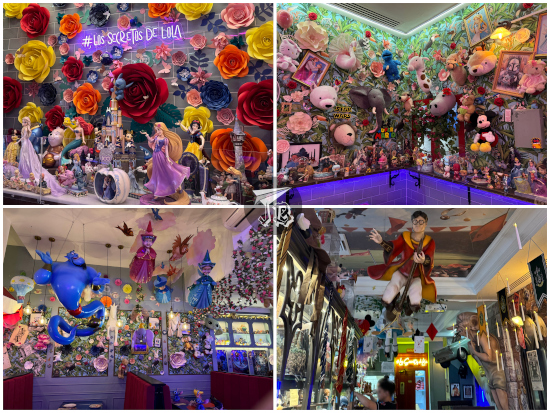
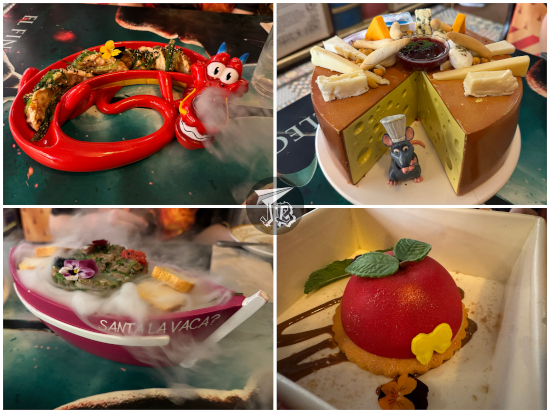
Afterwards, we headed out to the restaurant for our 13:30 reservation. The place is called Los Secretos de Lola (Lola’s Secrets ). It used to be just another bistro-grill in a street full of them, but some time after the pandemic, it reinvented itself. The restaurant has slowly turned into a Mecca of childhood mementos – Disney princesses, teddy bears, Harry Potter, Funko Pops… and crazy fun references like a Möet&Chandon spray to clean the tables. A lot of the food comes in a special piece of dishware – most of it Disney, but I can’t tell whether it’s actually licenced or a bunch of knock-offs. It was hilarious anyway. Though I am not much of a Disney person (my sibling is), my favourite film of theirs would be Mulan, and I just about lost it laughing when I checked the menu beforehand – I saw that they served gyoza in a Mushu-like dish, and decided we needed to order that. I was open to negotiation about anything else, really, but not the gyoza. The pasta in the Lady and the Tramp dish was also hysterical, but I could do without.
We reached the restaurant on point, and the owner directed us inside. We got a really cute Stitch table, but my sibling was not comfortable on high chairs, so we were accommodated at a Harry Potter one. We shared the non-negotiable teriyaki prawn-and-vegetable gyoza with wakame and bean sprouts, served on a Mushu-plate: Gyozas de gambas y vegetables al teriyaki, a plate of cheese Tabla de quesos variados (Blue cheese, Havarti, Mimolette, Emmental, Basilio, butter and breadsticks, on a Ratatouille’s Remy plate, which I had also found adorable) and a bluefin tuna tartar Tartar De Atún Rojo (on a little boat – I asked for no mango, and it was honoured; this was probably the weakest dish though). Finally, I tricked my sibling into a dessert called “Snowhite magic apple” Manzana Encantada Blanca Nieves: red chocolate capsule with white Kinder and a heart of caramel sauce, which came in an adorable “present box”.
The food was good, and I really like themed restaurants, I guess, even if they are not “my” theme. We did not stay for the two hours, I think we were on our way after an hour and a half – and when we asked for the check, it came in a Frozen music box. Then, we left towards Palacio de Cibeles, the old “communication palace” of Madrid, designed by Antonio Palacios and Joaquín Otamendi, and erected between 1907 and 1919. It is considered one of the first and most important Modernist buildings in Spain, constructed in biocalcarenite, with three stained-glass skylights, catwalks on the third floor, and a magnificent lookout on the rooftop. Part of the building is being used by the town hall, the other by the public entity CentroCentro, which runs cultural activities in the open spaces – mostly conferences and exhibitions.

We arrived a bit before 16:00. Since we had a ticket for one of the exhibitions at 17:30, we checked whether we could find a ticket for the rooftop. We found available slots at 16:30, which was great. Before the viewpoint access, we had time to wander around. Most of the free exhibitions were of modern art, and not that interesting, and I was more focused on the building itself. There is one dedicated to the World Heritage site Paisaje de la Luz, explaining why the area deserves its UNESCO place.
We found the staircase to one of the towers and we used it to move it through the different floors. It is a spiral staircase around the lift, with Palacios’ typical green tiles similar to the ones he used at Maudes hospital and Chamberí station. The catwalks were paved with glass tiles, and it was quite impressive above all. I loved the building, but after all, Palacios is one of my favourite architects, so it was to be expected.
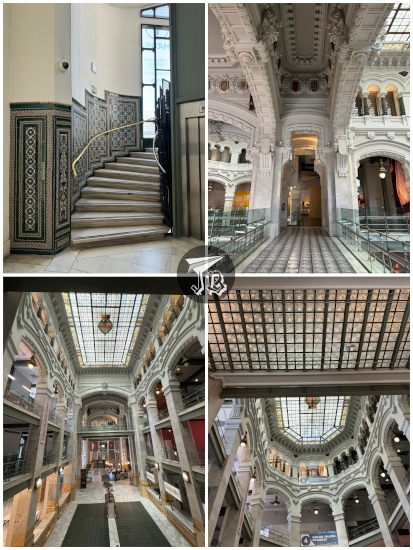
Then, we went up to the rooftop, where we could have a view of all of Madrid around us, most interestingly one of the main arteries of the city – Gran Vía. The weather was great, maybe a bit too bright. The turns were 30 minutes, but we were done in about half the time, after taking two walks around the middle tower.

We went down and sat for a little before we headed down to the basement to see “Notre-Dame of Paris: The Augmented Exhibition” Notre-Dame de Paris: l’Exposition Augmentée. It was only 3€, so I was not expecting much, but it actually blew my mind.
The experience was created by the company Histovery, which specialises in “virtual exhibitions” through an interactive tablet called “HistoPad”. The Public Entity in Charge of the Conservation and Restoration of Notre-Dame de Paris cooperates with the event, and the beauty company l’Oreal is a sponsor. The exhibition (which is simultaneously running in several parts of the world) follows the history of the Parisian cathedral Notre-Dame de Paris – it starts with the 2019 fire, which is a bit heart-wrenching, and then it covers a few key moments in the history of the cathedral, using a mixture of written information, videographs and a “treasure hunt” where you have to find pieces of a puzzle hidden within the virtual information. This is done using the tablet to scan 21 “time portals” that take you to a particular point in history.
Around 1160. The Dream of a Builder. At that time, Bishop Maurice de Sully came up with the idea to build a new, better, cathedral in Paris. The previous one was a smaller, Romanesque building, but the goal was a larger, architecturally impressive building. In this room (the second, actually, but the first chronologically), you find out about the “treasure hunt” – you need to find a number of hidden “light spots” to build a “stained glass window”.
Around 1180. The Gothic choir. This makes a small overview of the kinds of workers that helped in the construction, the kinds of stones, building materials – quarries, forests. I was extremely disappointed at this point when I came across a dog in the virtual quarry, but the program did not let you pet it.
1241. The Holy Relics: Louis IX, the future Saint Louis, bought the Crown of Thrones in Jerusalem and brought it to Paris. There was a great procession into Notre-Dame, where the relics were to be kept. Here there’s a spectacular recreation of the gates with the original polychrome sculptures and decoration.
1645. The Royal Promise: Widowed Queen of France explained to her son, future Louis XIV, that he was to renovate the choir of the cathedral and build a new altar, dedicated to the virgin Mary. This was the original splendour of Notre-Dame, before the French revolution broke out – the church was one of the targets of the revolutionaries, and a lot of the art was damaged and / or destroyed.
1804. The Imperial Coronation. After the French Revolution, Napoleon crowned himself “Emperor”, but a very “equal and revolutionary” Emperor. He held a ceremony for himself in Notre-Dame, with the presence of the Pope and everyone who was anyone in the totally equal new society.
1857. The Spire. Enter Viollet-Le-Duc, a major architect and restorer in France’s 19th century, whose theories influenced countless others. He revalorised gothic style in the country, managing to turn it into a “national style”. The man had the goal to restore and create buildings in “the gothic style that would have been if the Medieval workers had had the technology he had access to”. Historians have not been kind to him, accusing him of “inventing” stuff instead of “restoring” but kudos to him, he managed to make a lot of buildings survive to our time. In Notre-Dame, he is responsible for putting back a lot of the sculptures that were destroyed during the French Revolution. He also built the spire that famously collapsed in the 2019 fire.
2019-2021 (first and last rooms). A description of the restoration works that have been happening in and outside the cathedral since the fire, with special attention to the Paris firefighters who worked the incident. There is a very interesting part about safely removing debris and the original scaffolding, and the fact that there was a lot of lead in the cathedral that the workers had to be safe around. They also homage the “vertical workers” who had to remove collapsed pieces from the ground… hanging from ropes.
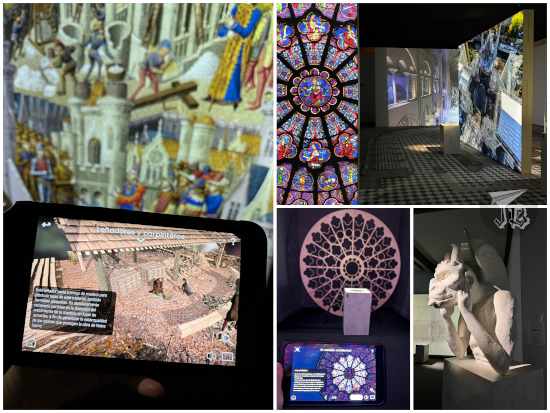
We completed the stained-glass window and signed up to get a diploma. The fun part is that most of the exhibition was not really… even physical. There were a few posters, a reproduction of one of the chimaeras, some small models… Nevertheless, it was extremely interesting – possibly the best “virtual exhibition” I’ve seen to date. The length of the experience is said to be 60-90 minutes… we stayed from 17:30 to 19:45, much longer than I had anticipated! Thus, we had to forfeit the last plan of the day to go back to the train system – which of course was experimenting delays. It took forever to get home. Because what else is new?

 JBinnacle – A Travel Logbook