17th July 2025: Hands on in the lab! {Dinosaur Eggs Loarre & Zaragoza, July 2025}

I got up around 7:30 and got dressed. I finished packing and before breakfast I took my luggage to the car, as I was leaving Loarre in the evening and I had to clear the room. Since I was outside, and the sky was clear, I went to explore the village a little more. There were some fountains and older farmhouses – one of them had been transformed into the rural hotel which never replied to my query. Some buildings had decorated their windows with cute homemade mascots.

Old Loarre Townhall, turned hotel (this is where I stayed)

Walk around Loarre: rhino mural, fountain, old house, wash house

At 8:30 I went back to the Hospedería de Loarre for breakfast. Since there was nobody at reception, I asked the lady at the restaurant what to do with the key when I left the room. I had my coffee(s) and toast, grabbed what I needed for the day, dropped off the key, and headed to the museum-lab for the third day of the course Técnicas de restauración en paleontología a través de la preparación de los huevos de dinosaurio de Loarre: Palaeontological Restoration Techniques through the preparation of Loarre dinosaur eggs. Today was the day when we would work hard at the laboratory.

The Restoration Lab in Loarre

Once again we got divided in three groups. One group opened a cast jacket using a radial saw – no way I was going to try and operate heavy machinery. Opening the jacket is the first step to study what it has been protecting, now that it is safe in the lab. The cast is removed in layers, and the rock is processed so the matrix (everything which is not actual fossil) is removed from around the eggs. Afterwards, there are two jobs. One is going through the discarded matrix / sediment for any and every interesting thing that can be found. The second is cleaning up the fossilised egg or eggs from any extra sediment to reveal their actual shape and colour.

I started with the cleaning crew (again). Under Ester Díaz Berenguer’s guidance, we worked on chemically removing sediment from a fossilised egg using alcohol diluted in water and brushes. It was a slow but very Zen work – wax-on-wax-off kind of thing. The others in my group sounded a bit frustrated with the task, but I guess it’s because they were younger people and more impatient? I know that I did not finish cleaning one shell fragment after an hour, but I was just… aware that fossil prep was a slow process?
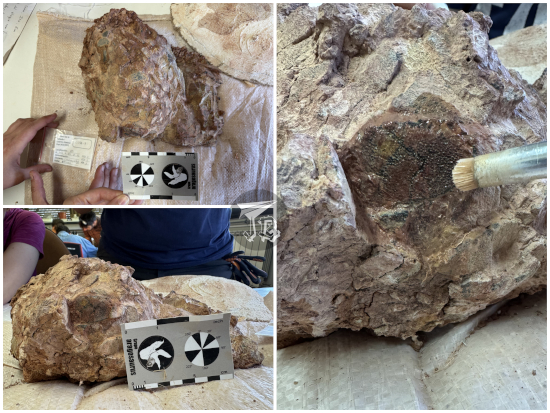
Chemical clean up of fossil egg using a brush

My second activity was also cleaning, but this time mechanically, using an air pen to remove as much of the remaining matrix as possible without damaging the general structure. This step would actually happen before chemical clean-up. The air pencil is a pneumatic tool so you really don’t have to press against the rock, to see the sediment peel away. It’s even more Zen than the chemical clean up – unless you’re working on a fragile bit. The important thing is to always clean away from the shells. I worked on that for another hour or so, and I even got to use some gluing materials to make sure a crack did not cause a problem – that was the bit that was more stressful, worrying I might damage the fossil.
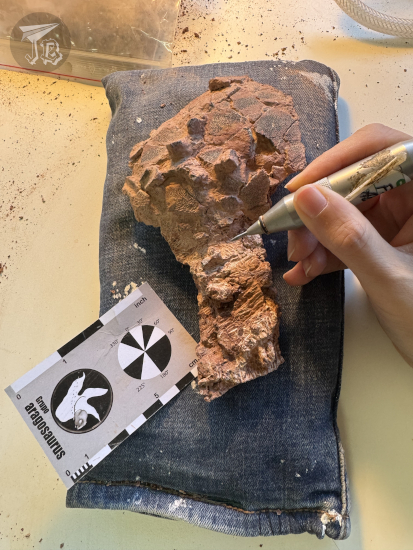
Mechanical cleaning of fossils using an air pen

We had a short break which I used to go to the car to organise the car boot – I had thrown all my things there, but a classmate had asked me to drive him to Saragossa, and I had to adjust for his luggage to fit too. Then my group moved onto studying the removed matrix from a jacket, under the direction of Manuel Pérez Pueyo. This consists on checking bags upon bags of broken rock bits to find anything that could be an eggshell. Though the main find of the Santa Marina site are the sauropod eggs, there are eggs belonging to other species – crocodilians and theropods. You weigh some sediment, spread it on a tray and move it around until you’ve taken out anything that can be useful to science. You have a microscope handy in case you need it. I am proud to report that during my three rounds, I did not miss anything key (before you discard your sediments, you call an expert to recheck). I did not find anything out of the ordinary, but I pulled out a couple dozen egg shell fragments.

Sediment being checked for loose egg shells

At the end of the morning, I snooped around what they were doing on the opened cast jacket, and someone was using the air pen on it, trying to locate the eggs. The jackets are opened upside down, so there’s a bit of detective work to find the fossils again. In order to protect the eggs, the casts are made big enough to protect them from any saw, so casts may be huge (and of course heavy). Thus, a lot of cleaning work is required at the lab, which translates in an insane amount of time. The palaeontologists must find an equilibrium amongst protection, weight, and lab-work when deciding on the size of the cast.

Upside down cast jacket that has just been opened. The job is cleaning out all the sediment around the eggs.

For lunch, all of us went to Casa Lobarre, the village restaurant, I think a concession from the town hall, as it is in the same building. The inside is decorated with reproductions of Romanesque frescoes and painted to look like a castle, as it was used as the set in a film some time ago (Kingdom of Heaven, 2005 I think. Don’t quote me on it). They offered a set menu with the choice of a (hearty) starter, a main course, and a dessert, drinks included. It was a big lunch! I ordered stuffed courgette and assorted grilled meats. The food was quite all right, especially for the price, and the desserts were handmade.

Afterwards, we had two lectures. One was given by Manuel Pérez Pueyo, who explained to us the hard science data of the Garum facies, which could be the key to understanding the last dinosaurs surviving in Europe. He also talked about the K-Pg limit and dinosaur extinction. He also made a comparison between the little Santa Marina site with the American Hell Creek formation – as the presentation said… size matters. That’s why there have been so many dinosaurs found there, compared to the more humble sites in Spain.

The final lecturer was José Ignacio Canudo Sanagustín, the director of the University of Saragossa’s Natural Science Museum Museo de Ciencias Naturales de la Universidad de Zaragoza. He explained how a museum works (I was reminded me of the visit to the inner works of the geomineralogical museum in Madrid), and the museum-lab status. The Saragossa Museum, as an institution, is the custodian of the Loarre fossilised eggs, even if they stay in the Laboratorio Paleontológico de Loarre. This is not unique to this village, as there are several similar schemes in place all throughout Aragón, known as “satellite sites” or “remote halls”.

Canudo also talked about counterfeit fossils – a reason why I only buy my fossils during Expominerales or Expogema, I don’t trust random vendors. Then, he moved onto the topic of the Museum itself – how it works, what kind of items they hold, how they came into the museum, and a little pride-flex, that they are home to a whooping 319 holotypes (the specimen that is used to describe a species), mostly from the Aragón region. The museum only exhibits a tiny proportion of the treasures that are deposited there for their protection and research.

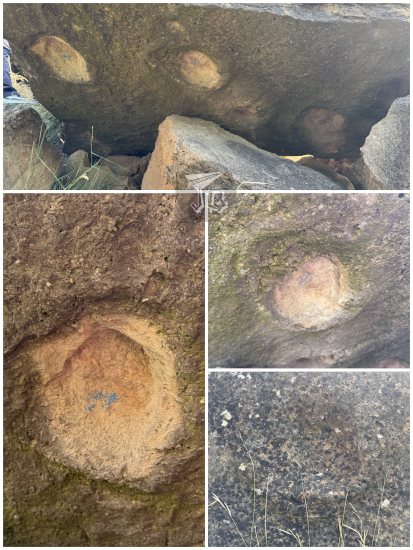
Towards the end of the evening, we hopped onto the vans yet again to head to the middle of nowhere for some amazing views of the castle. No, really. We were headed to another “palaeontological site”. It turns out that a few years ago, a farmer was ploughing his land and found a few slabs of rock which he discarded to the side. These slabs held footprints from hornless rhinoceros from maybe 15 – 10 million years ago. The slabs are haphazardly stacked with the footsteps on the underside, which is great for conservation. Also, the way is so unkempt that nobody would get there to damage them for kicks and giggles, which is good too. We had to waddle through thistles and dry plants about hip-height to get there, then climb up the rocks so all of us could get a look. Afterwards, we found a shaded spot to talk – and the professors brought cold drinks (and chocolate) again for the hike. They were crazy prepared.

Loarre castle

Here’s the thing with the rhino footsteps – scientifically, they’re out of place, so they have lost a good part of their intrinsic / purely scientific value. But legally, they must be protected and conserved. So, what to do with them? It would be expensive to move them, and once they were transported, where would they end up? Neither the lab nor the museum were willing to take them on… Each of the coordinators told us about pros and cons of different actions. In the end, what we were brought to realise was the big discrepancy between what must be done (considering the law), what should be done (considering the science) and what can be done (considering the money). The museum-lab has an idea or two about what to do with them, and I wish they succeed. I really hope the rhino footsteps become well-known some day. That way I can boast I knew them before they became famous…
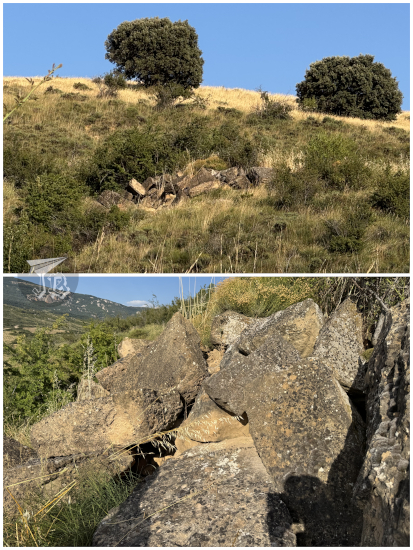
Slabs of rock in the middle of a hill.

Ancient rhinoceros footsteps

Technically, the day was over then, but the coordinators asked for our help with some stuff – getting the jacket we had extracted from Santa Marina into the lab, and moving one of the display cases to change the exhibit inside. We happily complied with both, being the first to see the new display in the museum. Are we special or what?

New exhibit in Loarre, which has exchanged a jacket for two prepared eggs

Afterwards, my classmate and I set off towards Saragossa Zaragoza. We arranged that I would drive him to my hotel and he would get a taxi from there. The drive from Loarre to outer Zaragoza takes about an hour, but once you get into the city itself, all bets are off. Furthermore, Google Maps had given me some strange instructions to enter Saragossa, but fortunately, traffic was light, as I had predicted / hoped. The hardest part getting to the hotel parking lot – I had to go to the hotel first (and find a parking spot for that) to check in, and get the key to the parking lot, then drive there. Of course, the only place I could drop off the car near the hotel was a one-way street in the opposite direction from what I needed, with no convenient turns allowed. In the end, it took 20 minutes to be able to leave the car, but it was really the most convenient option. Zaragoza is really not made for visitors to park in the streets, even if the hotel was far from the centre. It was the closest to the university as I had been able to find so the next day was nice and easy.

It was insanely hot, sticky hot, and I needed some dinner. I found a nearby fast food place and headed back to the hotel room with take-out. I finally had a long shower – this was a bit of a theme during this trip, wasn’t it? The room was small and a bit claustrophobic (honestly, it reminded me a little of a prison cell), and the air-conditioning machine was right above the bed, so it was a bit tricky to find the correct temperature / fan combination. I was tired, but stupidly alert, so it took a while to fall asleep.
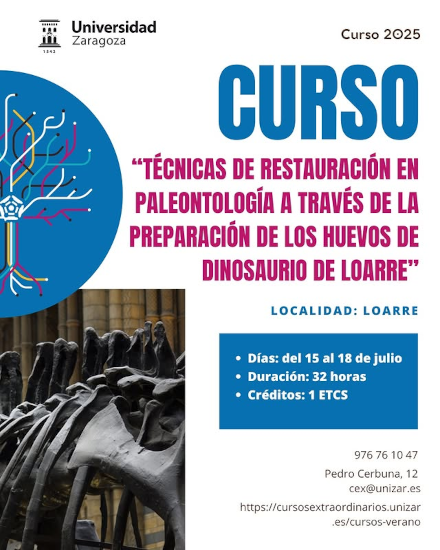
Palaeontological Restoration Techniques through the preparation of Loarre dinosaur eggs

16th July 2025: Santa Marina Palaeontological Site {Dinosaur Eggs Loarre & Zaragoza, July 2025}

In our second morning in the Loarre course Técnicas de restauración en paleontología a través de la preparación de los huevos de dinosaurio de Loarre: Palaeontological Restoration Techniques through the preparation of Loarre dinosaur eggs, we met at 9:00 in the museum-lab Laboratorio Paleontológico de Loarre. The first thing we did was pick up our PPE – glasses, earplugs, facemask and work gloves. For the day we would be cared for by Miguel Moreno Azanza, Lope Ezquerro Ruiz, Ester Díaz Berenguer, Manuel Pérez Pueyo and Laura De Jorge i Aranda.

Miguel Moreno Azanza and Lope Ezquerro Ruiz are the course coordinators. The former is holds a PhD in Geology and is a Postdoctoral fellow in the Saragossa university Universidad de Zaragoza. He is the egg expert and the leader of the works in Loarre. Ezquerro Ruiz is now a Lecturer at another University, Universidad Complutense (Madrid), but he has not lost contact with the dino-egg world. He is the expert sedimentologist, described as an “all-terrain geologist”. Ester Díaz Berenguer did her doctorate about ancient manatees, once dug a sauropod skeleton all by herself, and is the Natural History collection curator in the Natural Science Museum of the University in Saragossa. Manuel Pérez Pueyo holds a postdoctoral position in the university Universidad del País Vasco and is currently away in Romania, studying the same kinds of sediments the Loarre eggs are found in – he is the K-Pg Limit expert. And finally, Laura De Jorge i Aranda is the de facto boss – she is the main restorer and conservation expert in the lab, so what she says, goes. If she ever stays still for long enough to finish saying it, because she must be related to the Duracell bunny…

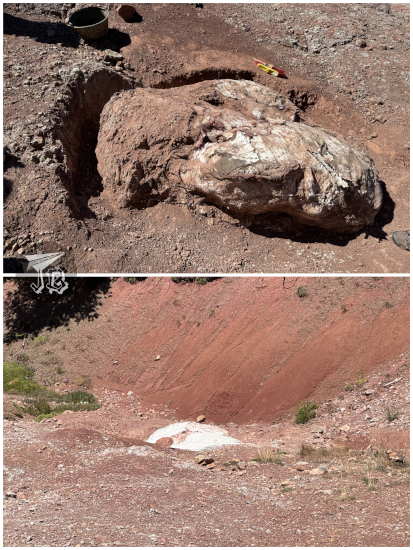
We hopped onto the vans, and drove / bounced off towards the actual palaeontological site: Yacimiento de Santa Marina, the outcrop where the eggs were first found. Around 6 km away from the village, the area of the site is around 500 square metres, and eggs could be found from the surface (originally, those have been excavated now) to almost 2 m deep. It is mainly comprised of red clays hardened into actual rock, whose age is disputed between around 70 and 66 million years ago. Fragments of egg shells can be found on the surface, easy to tell apart. While the clays are mainly reddish, the egg shells are dark grey / blue, three millimetres wide, clearly rounded and with clearly-visible pores on the outer surface. And no, finding one of the dozens of them that we saw never got old. They have found six or seven groups of eggs there, so the upcoming steps are extracting them and working out if the groups are actual nests or just casual accumulations due to transport or other causes.

Yacimiento de Santa Marina - red hard unforgiving rock full of dinosaur eggs if you dig hard enough

There were three jobs to do around the site – cleaning up an area where eggs had already been found to check for more, repairing a cast jacket which had been damaged, and extracting a cast jacket which was ready to be transported to the laboratory. I started with the clean-up team. There, we used the “small” equipment (cleaning brushes, paintbrushes, and screwdrivers) to remove sediment and small rocks trying to see if there were more eggs around or underneath the one that had been removed. It was a definite maybe.

A spot in the ground where an egg was found. It has to be cleaned (swept) to check if there are more eggs or eggshells

The professors had brought Coke, Aquarius and pastries for breakfast at the mountain hut next to the hermit church Ermita de Santa Marina, which lends its name to the site, and thus we had a break around noon – the museum-lab team had brought us snacks and drinks. Afterwards, my group moved onto recasting a jacket which protects what could be a whole nest inside. The whole thing is massive and thus heavy, so difficult to move. While the logistics for that are being taken care of, the cast jacket protects the fossils inside, and the whole thing is kept buried to prevent weathering.

In Spanish, the cast jackets are called momias, mummies, as they are wrapped in gauze or similar before. Unfortunately, that degrades with time and weather. In order to protect the fossils, three of us applied a layer of cellulose (read: wet toilet paper) first, while the other two made burlap stripes that would go between the cellulose and the plaster. Later, another group would make and apply the new cast, and the following day the professors came back the next day to rebury it for extra protection.

Giant cast protecting fossil eggs before and after getting some TLC and new plaster

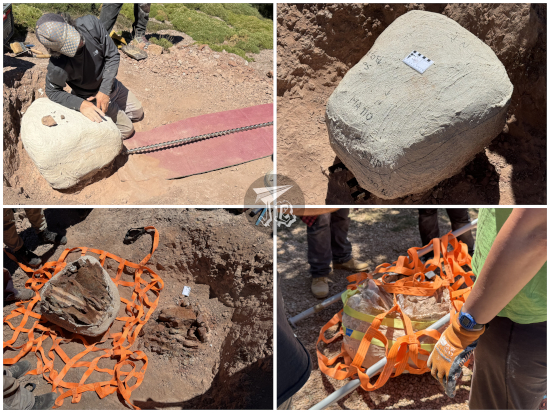
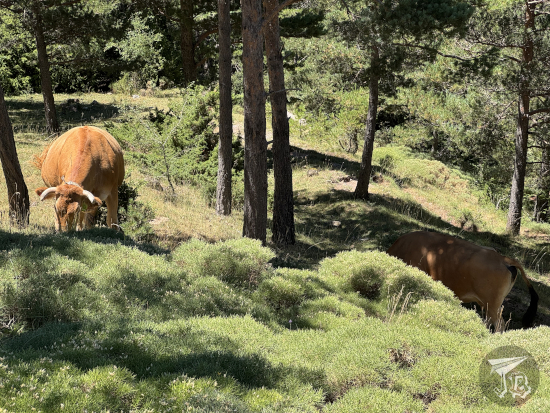
My group’s final job was breaking a plaster cast off the ground. As we worked on the other two spots, the other groups had taken a hydraulic hammer and a giant drill to the rock surrounding the cast to get it ready for extraction.. I got to work on the drill – while one of my peers pushed the tool into the rock, I was in charge of keeping the drill bit steady. Afterwards, I could hammer one of the stone-splitting wedges into the holes we had drilled, and a group-mate hammered in the other two. The cast was labelled and extra information was written on it: level, north, which side was up. After that, the whole thing was torn off the stand (by sheer blunt force, aka someone pushing it) and rolled onto a net that had to be hauled up the outcrop and then into the van, all that under the incredulous look of a herd of free-range cows which grazed nearby.

Jacket cast of a fossil being broken off the ground with a giant drill, and then transported using a net.

Two cows grazing

The strongest people around loaded the cast and carried it out, then put it in the van. They needed someone to take pictures of the process and I volunteered for that. By then, it was way past 14:30, which meant we were too late to have lunch in Loarre, where apparently it is only served between 14:00 and 15:00. Calls were (sort of desperately) made to find somewhere which would feed our large group lunch. We ended up in the restaurant at the campsite Camping de Loarre, which happily let us have some food there. They offered stuff to share, but we preferred to have individual plates. I think we all wanted something we really… wanted, so we just chose from the main dish options.

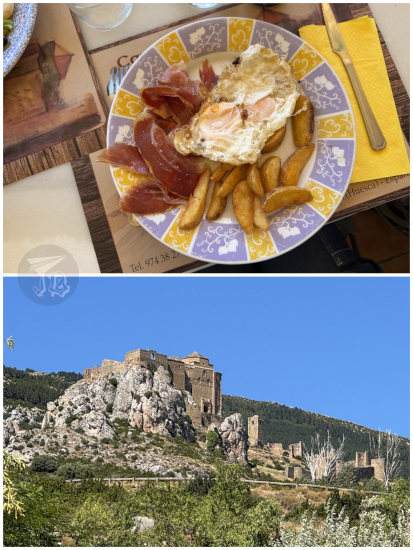
I ordered fried eggs with ham and chips. While I prefer my eggs runny, they were adequate. Since I had drunk a Coke for breakfast, I had an isotonic drink instead, and some of the communal water. As I was finishing, I overheard that they had ice cream inside… watermelon ice cream. It was exactly what I needed for dessert. While I was paying, the waiter asked something about whom to charge for the water, so I took care of that. It was still cheaper than buying all the soda and snacks the professors ended up providing.

Camping de Loarre: eggs with ham and a view of the castle

After lunch, we headed back towards the village, where we had a lecture by Laura De Jorge i Aranda on the theory of fossil restoration, conservation and preservation. One of the most important things she mentioned was documentation – as we had seen with the cast we had broken off. Once in the laboratory, the plaster is opened, the sediment classified for later study, the eggs cleaned mechanically and chemically, and any crack sealed with special glue. Every step of the way is documented. Finally, the fossils have to be packed for transport or preservation, and the sediment must be combed for anything of interest it might be hosting, such as loose egg shells (from either titanosaurs, crocodilians or theropods).

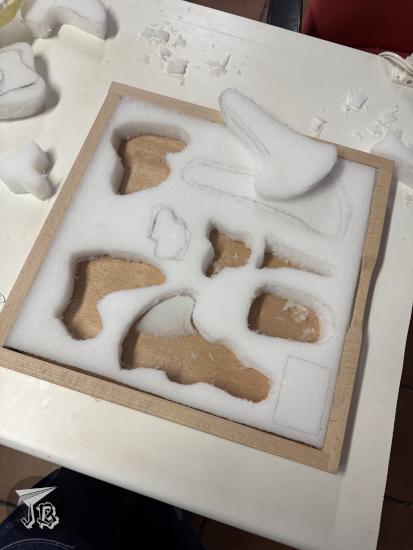
We moved then to the museum-lab to apply what we had just learnt in our first hands-on visit to the restoration laboratory. We were provided with a bunch of fossils (newly-discovered spinosaurid bones, so new that they are unpublished and thus cannot be shown) and Ester Díaz Berenguer guided us to make fossil beds with polyethylene covered with tissue. These were to go into fireproof drawers for conservation in the Natural Science Museum in Saragossa. The fossils are laid out on the polyethylene, traced, and the bed is carved for them with scalpels and cutters – remembering to also carve spaces for fingertips, so picking up the item is easier in the future.

A tray with cuts to fit the different fossil bones that we cannot show for scientific reasons, so it just looks like we cut a bunch of holes with weird shapes

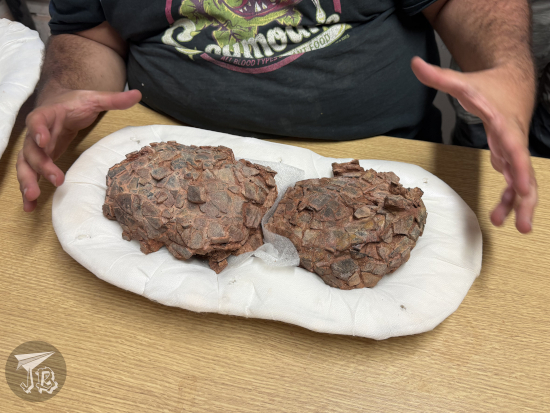
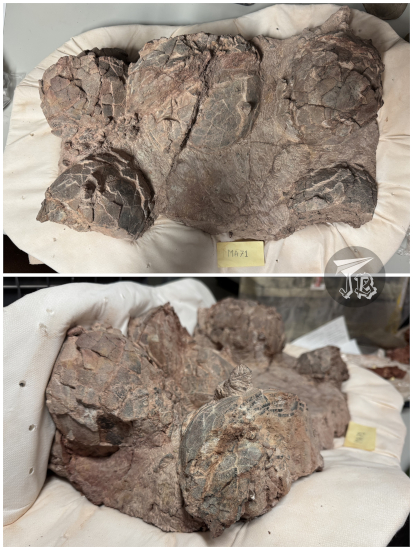
After that, Miguel Moreno Azanza showed us some of the prepared eggs. One of the specimens was a couple of eggs stored together (one of them might have a baby inside!). These were found in another site, Collado de la Tallada, which apparently is “easier to dig in”, but we were playing level pro in Santa Marina. Another was a group of five eggs together, which could have been a nest. They are criss-crossed by mini-faults. We were able to snoop around other eggs, as the professors chuckled something like “Don’t worry, you’ll work on them tomorrow”.

Two titanosaur sauropod eggs in a case. They look about as big as the palaeontologist's hands each. They are deformed and broken but have a vague egg shape.

When I signed up for the course, I expected that the “practice” would be standing there while an expert did something. Maybe we would all get one egg shell to touch and share amongst us. That would have been really cool already. But by now I had dug, protected, drilled, pushed, and held fossils. I was ecstatic. The course had blown up my mind already, and there were still two and a half days left.

A titanosaur sauropod egg nest with five or six eggs, deformed and cracked by the passing of time.

I went back to the hotel Hospedería de Loarre to shower, have a snack, and pack all my things as I had to clear the room the following morning. I also studied off the route to get to Saragossa in the evening after the course. During the planning stage, I had considered whether I wanted to go to Saragossa on Friday morning before the lessons or Thursday evening after them, and in the end I decided to drive on Thursday.

On the one hand, it meant driving after the whole day of class, probably tired, and around dusk. On the other hand, it allowed me to do the drive without a time limit constraint, park directly at the hotel, and it might mean less traffic. Furthermore, sunset was at 21:00, and it should be bright enough for a bit still after class. In the end, I decided in the end that it would be less stressful. Thus, Wednesday was my last night in Loarre.

Palaeontological Restoration Techniques through the preparation of Loarre dinosaur eggs

15th July 2025: The Egg Museum & the Mallos {Dinosaur Eggs Loarre & Zaragoza, July 2025}

I woke up around 7:30. After I had stressed out so much about reaching there, I almost could not believe I was really in Loarre, at the feet of the Pyrenees mountain range. I lounged around until breakfast started at 8:30. I went down and the choice was limited but adequate – fresh bread (still warm, the bakery was literally under my window, and it had been making me hungry for an hour), tomato spread, Spanish omelette, cheese, sausages, pastries, coffee, milk, and an assortment of jams and butter. The coffee was weak, so I had a couple of cups, but the orange juice was freshly squeezed and awesome. I made myself toast with cheese and omelette, loaded up on the caffeine and went on my way. At 8:58 I was at the museum-lab Laboratorio Paleontológico de Loarre (Oodinolab). And there was my name, on the attendance sheet for the course Técnicas de restauración en paleontología a través de la preparación de los huevos de dinosaurio de Loarre: Palaeontological Restoration Techniques through the preparation of Loarre dinosaur eggs. Everything was going to be all right. I have to admit I was 100% ready to show all my emails and confirmation should any problem have arisen… but it was all right (which… I should have known due to the email received previously… but I am an overthinker by nature).

After signing attendance and checking details for the certificate, we received a tote bag with postcards, notebooks and pens. The course started with a welcome and introduction by Miguel Moreno Azanza, who is the Universidad de Zaragoza researcher in charge of the lab. The most important goal of the course, he transmitted, was empowering us with knowledge about every step involved in fossil-handling: from digging to commercial exploitation, including geology, conservation, restoration, study and museumification.

The course kicked off with the guided visit of the museum-lab that is usually done for kids and families, including pulling out crates for our backpacks. Thus we learnt about the story of the discovery of the eggs – a fellow researcher of Moreno Azanza’s, José Manuel Gasca, a geologist, runs mountain trail. In 2019, he was training with a few colleagues when during a break he looked at the ground and saw what it looked like a fossilised dinosaur egg. And that is how one of the largest egg-dinosaur sites in Europe was discovered.

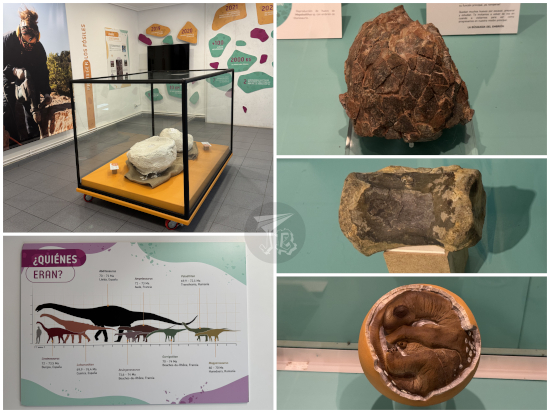
From the science standpoint, we also heard about how hardshell eggs played a key part in the evolution of animals coming out of the sea, as they allowed reproduction on land, without having to return to water. There were (are) different strategies to take care of eggs, and spherical eggs mean that they were (are) buried. From fossil tracks, we know that the dinosaur females that laid their eggs in the area buried them for protection using their back legs. We saw two cast jackets too, ready for research, on display.

Collage showing several exhibits of the museum: two cast jackets (with fossils inside), the first sauropod egg excavated (of course, in broken pieces of shell pressed together), a dinosaur vertebra and a reproduction of a sauropod embryo in an egg.

Fossil eggs are categorised as oospecies, unless or until it can be proven which animal laid them. The Loarre dinosaur eggs are tentatively classified as Megaloolithus siruguei (sometimes spelt Megaloolithus sirugei), laid by a species of titanosaurian sauropod – some candidates are Garrigatitan, Ampelosaurus and Lohuecotitan. Sauropods were plant-eating dinosaurs that moved on four straight legs, and had long necks and tails, such as Dippy, the Diplodocus (and other copies, such as the one in Madrid or Paris). During the Cretaceous period, the dominant group of sauropods were the Titanosaurs, the last surviving long-necked dinosaurs until the extinction of dinosaurs – in South America there was Patagotitan; another example is Qunkasaura pintiquiniestra, which I saw in MUPA and MARPA exhibits.

The first dinosaur eggs ever registered were found in the Pyrenees – on the French side though – by Pierre Philippe Émile Matheron in 1846, and described in 1859 by Jean-Jacques Pouech. In 1967, Pierre Souquet documented dinosaur eggshells around the reservoir La Peña, some ten-ish kilometres from Loarre (had I known in 2021…). These were the same oospecies as the ones in Loarre – since the fossil layer is the same, it makes sense.

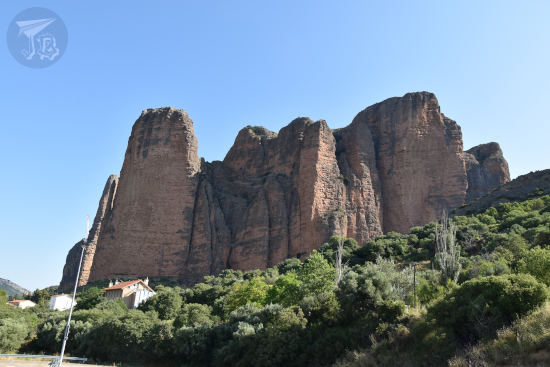
We were supposed to have a video-conference inauguration with someone from the university, but she decided to come in person, and that was moved to 19:00. So instead we hopped onto the vans that the organisation had provided and drove towards the geological formation called Mallos de Riglos, in the village of Riglos (hence the obvious name). The Mallos are a number of vertical domes conformed by reddish conglomerates. I had actually seen these geological structures before, from the other side of the River Río Gállego – not up close. The wording of the email “a slight ascent” had not made me suspect at first we were going to climb all the way up in the heat. Looking back, it was not that bad but a) I was not mentally prepared for it, and b) I have a new backpack, and it’s comfortable but… differently-shaped, so my centre of gravity was all off. There, Lope Ezquerro Ruiz (honourable mention to Manuel Pérez Pueyo, who cracked jokes and held the whiteboard) gave us a few good pointers on geology which made me wonder where he was when I was first studying geology at university.

Looking up at the Mallos de Riglos, vertical structures made from reddis conglomerates

Simply put, if one assumes that the natural laws have not changed with time (Uniformitarianism), then three things happen that define geology: strata deposits are horizontal, deeper strata are always older, and if they are not, it is because something new has eroded or deformed them. Of course, the Pyrenees mountain range is anything but flat.

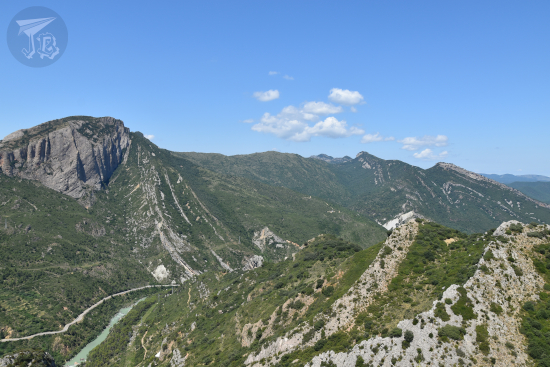
Pyrenees geological structures on the side of the mountain, from the mountain opposite the river - erosive walls, faults and folds

On site, we learnt about the Garum facies, the result of the sedimentation of fluvial and marshy red clays. The layer started forming during the Maastrichtian (the latest age of the Upper Cretaceous, 72.2 to 66 million years ago. Both the Maastrichtian and the Cretaceous ended with a literal bang – the Cretaceous–Palaeogene extinction event, when non-avian dinosaurs went extinct, marked by the K-Pg boundary (formerly K-T boundary), a layer of sediment rich in iridium which probably came from a meteorite impact. The deposit of Garum facies continued through the first age of the Paleocene, the Danian. This means that the K-Pg boundary is somewhere inside the layer, which is pretty cool. And even cooler? There are dinosaur eggs there, obviously from before the mass extinction.

We learnt about this literally standing on the Garum itself. We talked about the time when the a lot of the Iberian Peninsula was a shallow sea with scattered islands, and then sat to try and “see” the processes of folding, faulting and erosion that created the Pyrenees mountain range as the African tectonic plate pushed against the Eurasian plate.

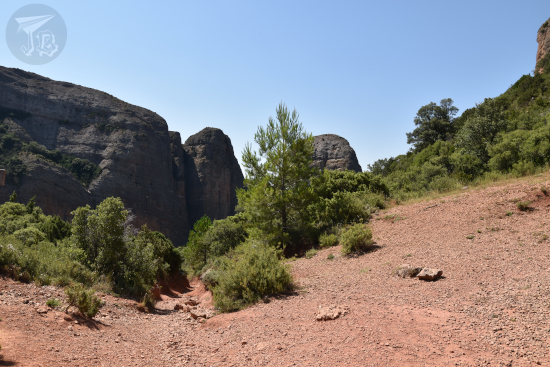
Reddish rock on the ground, called the garum facies

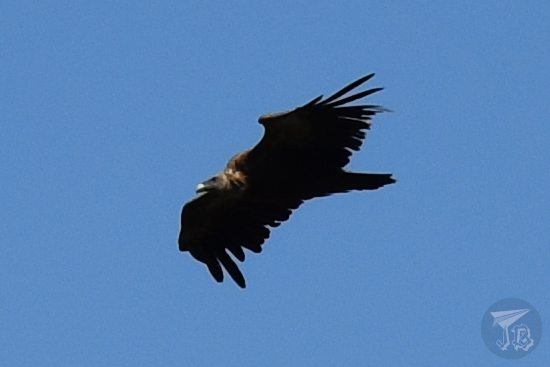
Every now and then, a vulture flew above us, in wide circles. We were apparently not appetising, because it flew away every time. Once we tackled the descent, we headed towards Ayerbe, where we split up for lunch. At 16:00 we met up again so professor Lope Ezquerro Ruiz could demonstrate how strata bend and break using a model and sand. Afterwards, we drove back to Loarre.

Griffon Vulture mid-flight

Walking down the Mallos de Riglos, with two vertical walls at the sides and a river-valley in the background

Simulation of how folding ocurs in rocks using sand

In the modern town hall, we had the first lecture of the afternoon, by José Luis Barco, Manager of the business Paleoymas, a company specialised in protection, development, management and use of cultural and environmental assets, with a strong emphasis on palaeontology and geology. One of their work lines is monetising projects related to palaeontology, as opposed to the “research-focused” stereotype. Between a palaeontological discovery and its communication or exploitation for the general public, there is a gap that can last over a decade.

Paleoymas is responsible for the project Paleolocal, which created the museum-lab in town, with the idea of studying the fossil eggs almost in situ, which would develop a touristic resource and help the village profit from it. The museum-lab is technically part of the Natural Science Museum Museo de Ciencias Naturales de Zaragoza, which has custody of the fossils according to the regional law. However, keeping the eggs in Loarre is a way to involve the community into protecting the palaeontological site, as well as to create a tourist flow to the village itself. See: yours truly, who spent 240 € in lodging there.

The second lecture was given by Miguel Moreno Azanza, who talked about the Theory of Excavating a Palaeontological Site, as one of the activities in the course was working on the field. The summary could be: “forget Alan Grant with a paintbrush, think hydraulic hammer”, but the important lesson is “do not dig up anything you cannot take with you, and register any and everything you see / do / touch”. Also, regarding egg shells, it’s important to write down whether you find them concave up or concave down. This can help decipher whether the egg has rolled or not (for example, if several eggs are found together, were they in a nest, or where they moved there somehow? Did a baby dinosaur break the eggshell?).

Around 19:30, we had the official inauguration of the course, with a representative from the university, Begoña Pérez, and the mayor of Loarre, Roberto Orós, who was nice enough to buy us all a drink afterwards. Not one to turn down a free Coke, I tagged along for a while, and when people started taking their leaves, I returned to my room. I had some crisps in lieu of dinner, took a long (and I mean long) shower, scribbled down some notes and lay down till it was time to sleep.

Palaeontological Restoration Techniques through the preparation of Loarre dinosaur eggs