29th July 2025: Birds with great PR (Madrid, Spain)

The National Museum of Natural Science Museo Nacional de Ciencias Naturales in Madrid announced that they were having an exhibit called Dinosaurios entre Nosotros / Dinosaurs among us, a collaboration with the American Museum of Natural History (though the original exhibition was apparently called Dinosaurs among us: The ancestry of birds, which feels slightly more accurate).

When I was young, it was believed that dinosaurs came from birds. With the new definition of what a dinosaur is, it turns out that birds are dinosaurs. The key features used to define a dinosaur is that the animal belongs to the clade (natural group) archosauria, and it has hind limbs which are erect underneath the body – as opposed to growing sideways and bent. Currently, two groups of archosauria exist: crocodilians (with bent legs) and birds (with straight legs). I think if you ever look into an emu or a cassowary’s eyes, you’ll understand what a deinonychus’ (the real species of the Jurassic Park velociraptor) prey might have seen.
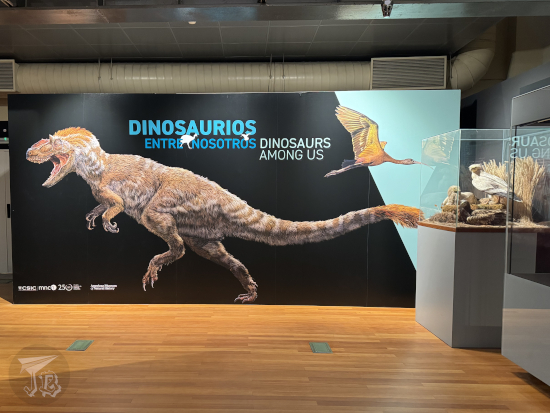
Dinosaurs among us sign, showing a feathered T-rex

The characteristic that originally defined archosauria was the hinge-like ankle structure. As time went on, protofeathers developed and some animals adopted a straight-legged stance, which is the start of the real dinosaurs – first the ornithischians (triceratops), then the sauropods (patagotitan or diplodocus), and the theropods (tyrannosaurus), the first with a wish bone. Then the forelimb became wing-like (deinonychus), yielding to the Avialae clade, which developed flapping flight. Some scientists declare that all Avialae are already birds. Others claim that birds are the subgroup Aves.

I took the train to Madrid and walked to the museum Museo Nacional de Ciencias Naturales. It took a second to be admitted because their computer system was down, but I was carrying cash, so I could was able to purchase my ticket (I had not bought it in advance because entry is timed, and I did not trust public transport delays). It was around 10:30, still early enough so that the museum was not crowded even during the school holidays. I headed directly to the exhibition, which, mostly through panels, taxidermy, and mounted birds, summarised how dinosaurs behaved similarly to today’s birds – laying eggs, brooding those eggs, protecting the nests… The biology and anatomy of birds and dinosaurs, especially theropods, are very similar.
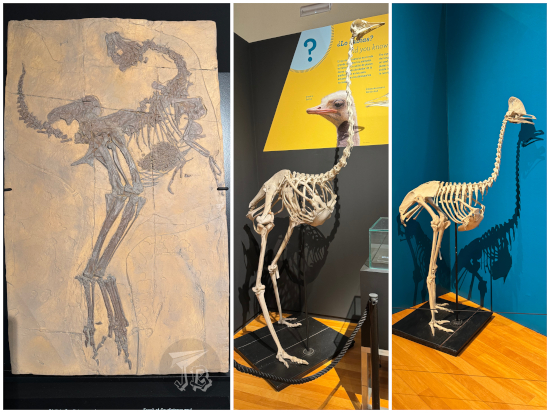
Fossil of Caudipteryx zoui (replica) and skeletons of a cassowary and an ostrich. They all share uncanny similarities, except the fossil is about one metre long and the current birds are larger

There was a very special exhibit – and no, it was not the Tyrannosaurus rex skull they’ve got. It was the original (and only) fossil of Iberomesornis romerali, a holotype from the MUPA, which you cannot photograph at its home, but you can here (just like my photography spree with the Concavenator at MARPA). Iberomesornis was the sparrow of the Early Cretaceous. There was a reconstruction of how it would look in real life (though I’ve read some texts that say it’s an outdated view?).

Iberomesornis romerali fossil and recreation. It was a crossing between a sparrow and a crocodile.

Similarly, there was a model of Archaeopteryx, the first ever-discovered feathered bird-like dinosaur. With only 13 specimens ever found, it was key in palaeontological studies before more avialans were discovered. This one was a replica, I’ve only seen one real slab ever in the London Museum of Natural History (I hope I can see the Berlin one at some point). The model was so ugly, the poor thing, but somewhat endearing.
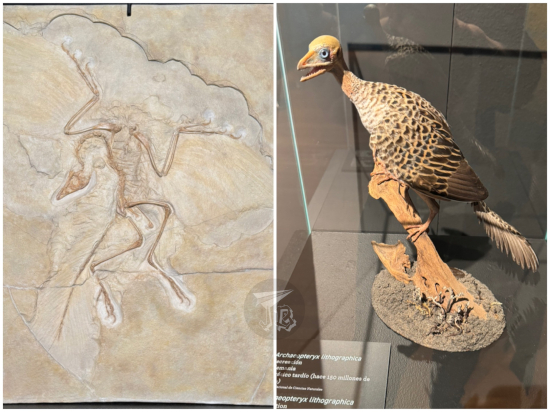
Archaeopteryx fossil (replica) and life-sized recreation. It looks like a bald nightmare with a beak and teeth.

There was also a model of Anchiornis Huxleyi, discovered in China and named after Thomas Henry Huxley, the biologist who in 1869 suggested that maybe birds were related to dinosaurs. He did this comparing the hip of a Megalosaurus and an ostrich (for a while, dinosaurs were classified using “bird hip” and “reptile hip” criteria) amongst other similarities, and of course he used Archaeopteryx as evidence. Unfortunately, the poor guy is more often remembered for being a Darwin fanboy – he was even nicknamed “Darwin’s bulldog”. Palaeontologist Xu Xing described the species in 2009, and chose to call it “Huxley’s almost bird”. It has allowed to rebuild almost completely the colours of dinosaur feathers.
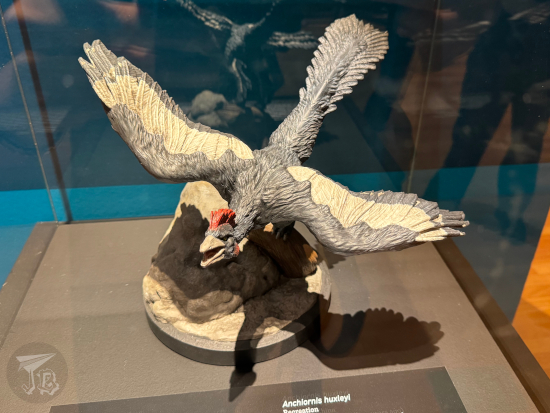
Anchiornis Huxleyi, proof that dinosaurs evolved into birds. Something between a rooster and a lizard

The rest of the exhibition was most… modern birds, sprinkled with children’s disappointed “Where are the dinosaurs?” wonderings. Truth be told, at the end of the exhibit there was a life-sized reconstruction of Velociraptor mongoliensis, the “real” one, not the presented in Jurassic Park, along with the explanation that Michael Crichton found the name cooler than Deinonychus, which is the animal he described in his book.

Taxidermy bird collection

Reconstruction of a Velociraptor mongoliensis, with a crocodilian face, long arms with proto-feathers and powerful claws.

So in the end, the exhibit was a lot of information about birds, hyped up with the buzzword “dinosaur”. Interesting enough but… not really what it was pumped to be. That’s what good PR does, I guess. And erasing half of the exhibition’s original title…

Back to Darwin though, the museum has a bit on him in its gallery of biodiversity – which is just a way to… continue exhibiting the old taxidermy specimens that they already had, some of them… made with more success than others – while some of the works they’ve got are extremely realistic, some others are… horror shows – such as the famous giant panda that the Zoo Aquarium first hosted.

One of the most interesting parts of this museum is the science cabinet Gabinete Científico, which recreates Carlos III’s scientific collection. It shows a glimpse of how science was understood at the time (though the human skeletons it used to host have been quietly removed).
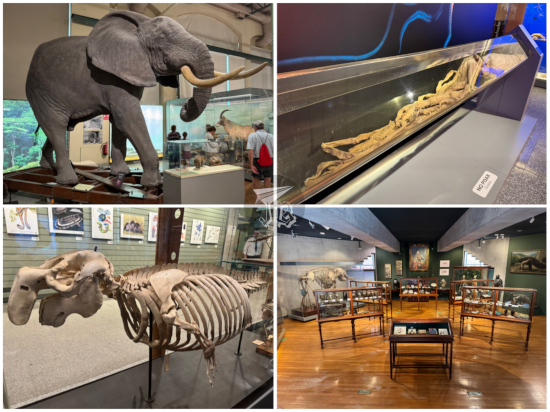
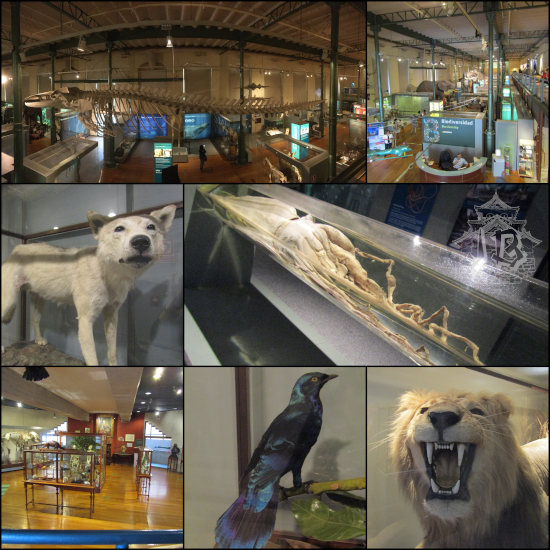
Natural Science Museum Madrid - Diversity collection: elephant, giant squid, manatee skeleton, 19th century cabinet

Recently, the museum became the custodian of Santiago Ramón y Cajal’s legacy, including his Nobel Prize certificate and medals. Ramón y Cajal was a Spanish doctor considered the father of modern neuroscience. In 1888, he discovered how nervous cells work, even before they were called neurons, and that they were separate entities that created the nerves and the brain, explaining how impulses are transmitted through the nervous system. He described characteristics that could only be observed in real life almost a century after he wrote abut them. In 1906, amongst many other awards, he received the Medicine Nobel Prize alongside Camillo Golgi, who designed the methodology to colour cells, a process that allowed many of Ramón y Cajal’s discoveries. The museum exhibits microscopes, drawings, and his original office and library. For some reason, next to the ocean display and the giant squid.

Santiago Ramón y Cajal legacy: reconstruction of his office and Nobel Prize

This was all in the first ward of the museum. The second one is on the other side of the building that it shares with the Industrial Engineering School. To get there, you have to follow the dinosaur footprints, but I took a couple of detours. First, I got a bit distracted trying to figure out the “Mediterranean Forest” garden, but honestly it was too hot to stay there for long. Maybe some other time with better weather.

My other stop was at the Engineering School, Escuela Técnica Superior de Ingenieros Industriales (UPM). I had recently discovered that its main hall hosts an 1832 steam engine, built by the company David Napier & Son Limited. The machine was designed to power coin minting, and it was one of the first machines to arrive in Spain, purchased by the Royal Mint. It is not clear in the description if it was designed by James Watt, or just similar to his models, but it seemed a piece of history worth seeing – and the janitor was distracted while I snooped around. The engine was donated to the Engineering School in 1914, when the Mint replaced it.

Watts Machine

I reached the second building of the science museum Museo Nacional de Ciencias Naturales, which is the palaeontology, geology and anthropology ward. Nothing had changed there that much since my last visit. Here’s a funny story though – they have a replica of a Diplodocus carnegii, of Dippy, exactly the same one that the London Museum of Natural history has – albeit on tour. Why am I so obsessed with the London one, having another replica so close? I think it’s because the “care” the NHM gave it, while in Spain it has just been set against a wall, mixed with all the other dinosaurs from whichever age. It actually took me a while to realise they were the same cast…

The original Dippy fossil was unearthed in 1898, and soon Andrew Carnegie bought it for his new museum in Pittsburgh, hence the name of the species. In 1902, King Edward VII convinced Carnegie to donate the original cast to the NHM while the skeleton was still unmounted (there was no museum to house it yet). In later year, Carnegie would donate a few more casts to other museums in the world, including Madrid, Paris and Vienna.

This time around (call it selective perception, or plain looking out for them) I spotted the trilobites from the Murero palaeontological site, one of whose characteristics are how deformed they are, due to the earth’s internal forces and movement. The museum has a large mineral collection too, but I think it lacks something. Maybe it’s me mentally comparing to other natural history museums in Europe, or even other incredible museums in Madrid itself, such as the Geomineralogical museum nearby. It is missing… loving, in a way. I think the Natural History Museum is a bit of an ugly duckling in the cultural system, because even if it’s considered a “national museum”, it is not part of the national network, so there is something weird going on there.
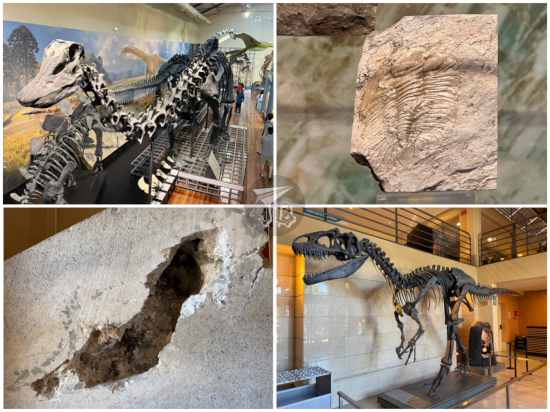
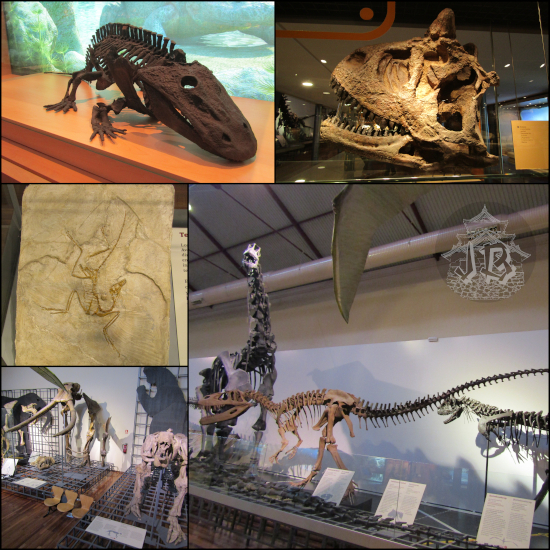
Natural Science museum Madrid - diplodocus, deformed trilobite from Murero, allosaurus, geode

As I left the museum, it was incredibly hot. It was early for Spanish lunch, but some places had already started opening. I had been looking at an “Asian Market” called Oiko, but then I read that you have to order through a machine (okay) and input your phone number so they call you on WhatsApp when your order is ready, and I get too many spam calls already. I was not planning on giving out my phone number to anyone who does not need it. Even if they had taiyaki desserts.

Instead, I found a burger joint called Steakburger, which self-describes as a gourmet burger restaurant, trying to become a franchise. I later realised that they are not 100% upfront with their prices, as the online menu lists one price, but the details shows another – and the desserts don’t even come with prices. It might also be a coding issue, since once you’ve checked the details, the correct price shows everywhere. Also, the machine translation is awful. Anyway, I had seen that they carried a burger with matured Angus and a topping of raclette – red cheddar, Gouda and mozzarella which were poured onto the burger, alongside Batavia lettuce and tomato, La melting cheese madurada. Honestly? It was good but not worth the price. The desserts looked decadent, but the burger was enough for me.
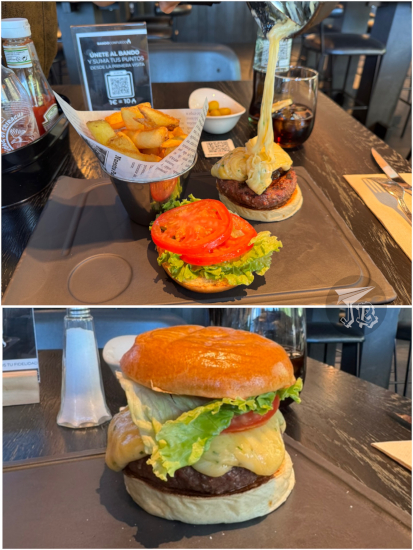
Hamburger being bathed over with melted cheese.

Afterwards, I just headed off to the station to take a train back, and for once I was there when a train was about to arrive. It was just too hot to look for something else to do, and during August a lot of things close at 15:00.

15th April 2023: Madrid for Sweet Space Museum (Spain)

My friend D****e and I met for a fast day packed with activities. We reached Madrid at 10:40 and had tickets to visit an interactive museum called Sweet Space. It markets itself as a “colourful experience which mixes sweets and modern art”. I just thought it would be a fun thing to do with a friend that would give into quirky pictures and a couple of hours of giggles. It actually fulfilled both. If you take the place seriously, it’s plainly not worth the visit – modern art in general is questionable at best, and this could be seen like a bit on the childish side – and regular tickets are 18 €. The place’s best-selling point is “get cool pics for your social media”, and we had decided to just be silly about it and enjoy ourselves.

The “museum”, located in the ABC Serrano shopping centre, gives the vibes of an oversized (maybe overpriced) playground, and just like Monasterio de Piedra, the number of people you encounter weighs a hugely in your experience. Although we had an 11:30 ticket, we were lucky enough to be admitted at 11:15 with a family that lost us on the third room, so we had quite a lot of time on our own, until the group that came afterwards caught up. We did take a lot of pictures, to be honest, and missed no opportunity to fool around – which was the mindset we had.

Since the museum’s flagship idea is mixing sweets and modern art, when you enter some of the rooms you are given a treat – a gummy or a piece of chocolate or a tiny bit of ice-cream. You cannot backtrack, so the route gets a bit weird at points – you go up to the second floor on stairs, but down using a slide… The museum has nine different rooms and a few of them are refurbished over time. Unfortunately, I forgot to track down the artists because it was stupidly fun – I mean, at one point I got to ride a carousel-style flamingo. Back in the day in the day, I would have never dared do such a thing, but I guess I’ve changed a little in the last ten years.

  • Room 1: Palm trees with marshmallow trunks (Antonyo Marest). This was a fun way to start the whole thing and set the mood. It is literally a room with tree trunks that look like colourful marshmallows, with leaves on top.
  •  
  • Room 2 (corridor): Flowers in the dark – a dark room with bright plastic flowers. It was pretty, but probably the less surprising room.
  •  
  • Room 3: Mirrors and hanging pink balloons, inspired by Tokyo’s TeamLab. It was hard to take a good picture that did not catch anyone’s reflection!
  •  
  • Room 4 (corridor): Mirrors and neon graffiti (Álvaro Linares) with Star Wars inspired references. This was one of the coolest areas (though I’m not sure how… legal that Darth Vader painting would be). One of the sides had a throne-like chair you could sit on and feel like an evil mastermind.

Collage. Sweet Space museum. Palm trees whose trunks resemble marshmellows, neon-coloured flowers and grafitti, pink balloon-like lamps hanging in a mirror-wall room

  • Room 5: Ice-cream parlour “Töto Ice Cream”, including little kart and refrigerator you can step into, giving off a strong 1950’s aura. A lot of pink, I’d say – I did not dare walk into the fridge (for some reason it gave me the creeps), but D****e did; I “drove” the little kart instead. We took silly pictures there with the installed iPad camera, just for the hell of it.
  •  
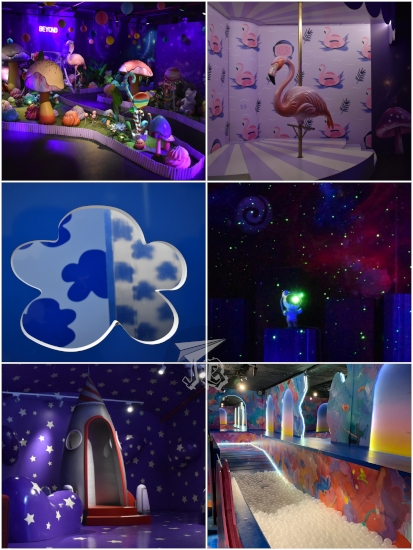
  • Room 6: Fairytale landscape (Christian Escribá and Patricia Schmidt), a-la Hansel and Gretel or Alice in Wonderland (though it was officially inspired by Wizard of Oz), with a swing and flamingo that you can ride. When I saw that one online, I really, really hoped that it was not only one of those things that only influencers get to do. I got to ride the flamingo. I don’t know why it drew me so much, maybe it was the pure surrealism of it all, but it made me giddy. The rest of the room was fun too – oversized mushrooms, teddy-bears, and colourful decoration.
  •  
  • Room 7 (upstairs): Sky with clouds (Agatha Ruiz de la Prada) painted and carved into sliding doors, a starry rocket (Ivanna Gautier), a bouncing area, a mural where you could take a 3D video for TikTok, and a “planetarium”, with tiny lamp-robots and tons of stars made from light dots. I liked this last one a lot, too. In order to leave the floor and go back to the lower floor, you have to go down a spiral slide, which I was not a fan of – it was difficult to get into it without putting weight on my bad wrist. However, I managed to go down unscathed.
  •  
  • Room 8 (Misterpiro): It held a ball pit with a “staircase to heaven” (or to nowhere). We did not go into the pit, but we climbed the stairs for pictures too.

Collage - fantasy worlds from Sweet Space museum. Overgrown mushrooms, a flamingo, a cloud, a universe made out of green neon dots with a little robot peering out, a cartoonish rocket in front of a starry background, a colourful ballpit full of white balls.

Finally, we reached the shop, where we purchased the pictures we had taken at the ice parlour (8 € for two magnets with four photographs, the downloadable version, and a gif). We were supposed to get a sweet in each room, and we ended up with three or four gummies, a chocolate, and a tiny scoop of ice cream. My favourite was the skull-shaped sweet&sour gummy we got upstairs, but they did not have it at the shop (though it is advertised online). The whole experience was a bit on the expensive side, but I had a discount that helped knock 10 € off the official price. The recommended time I had seen recommended for the museum was an hour and a half, but even if we took a long time, we were done in about an hour.

I had reserved lunch at 14:30 based on the time I expected us to be in the museum (and the availability of the restaurant), so we had some time to kill. We walked by the open-air museum of modern sculpture Museo de Escultura al Aire Libre de La Castellana, but it did not catch our fancy. Too much modern art in one day?

The place we would invest most of that extra time was the museum of Natural History Museo Nacional de Ciencias Naturales to see some dinosaurs and the gabinete de curiosidades, the 18th and 19th century collection of taxidermy specimens. I’d been there before, and it mostly has replicas (and holy molly, prices have gone up). This time there was an exhibit on the Moon landing, and the gardens had been open. The taxidermy collection is not as good as other museums, but at least it got us out of the heat.

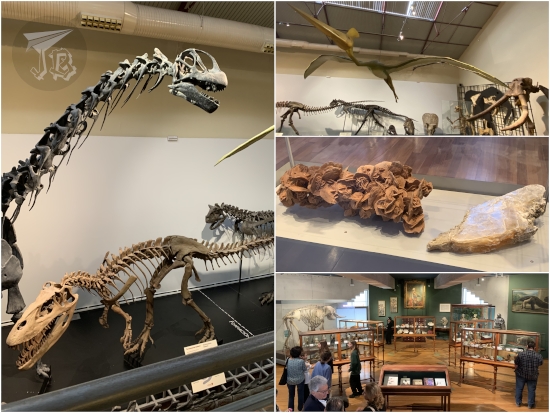
Collage. Dinosaur fossil casts and reconstructions, both carnivores and long-neck herbivores. A flying reptile with some mammooth fossils in the background. Rocks. The old collection dating from the 19th century - a number of glass cases with people looking at them and a painting of king Carlos III overlooking the place.

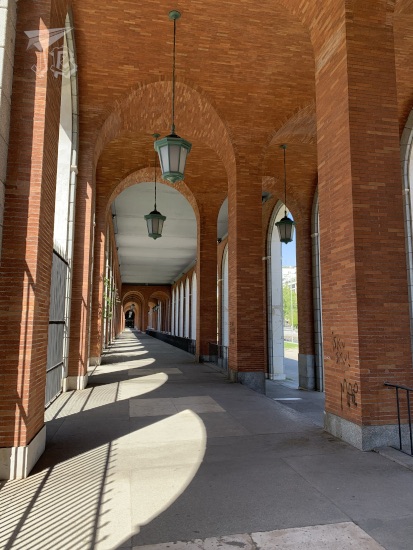
We left the museum and headed for lunch at one of the franchised establishments of New York Burger, which markets itself as a “gourmet burger” place. It was all right, and the servings were huge. After lunch, we hung around the area known as Nuevos Ministerios, a complex originally designed by Secundino Zuazo Ugalde around 1930. We hung out under the eastern archway for a while.

The archway in Nuevos Ministerios, built in reddish brick and white plaster

Afterwards, we took the train to Alcalá de Henares. We stopped at one of the shopping centres just outside town, Quadernillos, where the comic event Krunch! 2023 was taking place. We did not stay for long as most stands sold bootleg and plagiarised stuff, and I did not find any legit shop, but we had ice cream and D****e did take the chance to do some shopping in the mall before we headed home for the evening.

16th September 2016: Some Madrid (Spain) Museums

I woke up one morning, a silly weekday that I did not have to work for some reason and I decided to wander off and take a day trip to Madrid to see some museums, just because I could.

My first stop was the Museo Nacional de Ciencias Naturales, the museum of natural science. The museum is divided into several buildings. The first building holds the “Biodiversity” collection. This includes preserved specimens – in better or worse shape, mostly stuffed, and some skeletons.

Then I walked over to the palaeontology and mineral museum, where at the moment most of the collection is composed of replica, sometimes it feels that you see the same diplodocus or arsinoitherium (two-horned rhino) skull everywhere. Of course, however, I hunted down every megalodon tooth on site and sight.

After this, I walked around the mineral collection and walked down Castellana Avenue until Colón Square, where I had lunch somewhere before I walked around to see the Museo Arqueológico Nacional – National Archaeological Museum. There were a few things that interested me there.

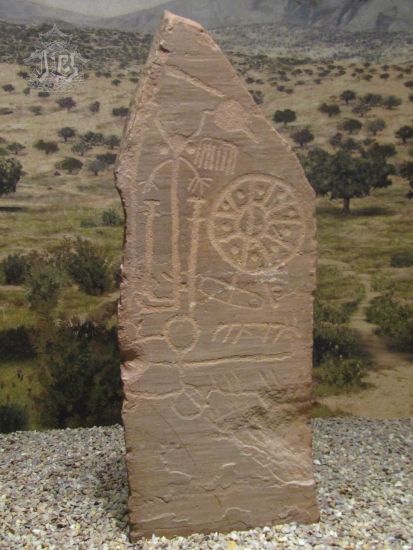
My first goal was to study the Iberian stelæ . Nobody really knows what they are or what their meaning is, but it is thought that they were funerary monuments, maybe of fallen warriors.

An interesting thing to see in this museum is the sculpture of La Dama de Elche, the Lady of Elche, the limestone bust of an Iberian lady dated back to the 4th century BC. It is supposed to be a woman who belonged to the aristocracy that was later revered as a goddess, or maybe a reinterpretation of the Goddess Tanit of Cathage. The back part has an opening, which suggests that it could have been a funerary urn. It was originally polychromated, but it has lost its colours. I really like her expression, and probably due to the Hellenistic influence. I have a thing for Greek sculpture, after all.

A second “lady”, the Dama de Baza (Lady of Baza), stands next to the first. This one still keeps some of its colours. This one is full-body, also carved out of limestone, and it traces back to the fourth century too. This lady seems to have been designed in pure Iberian style, without Hellenistic influences.

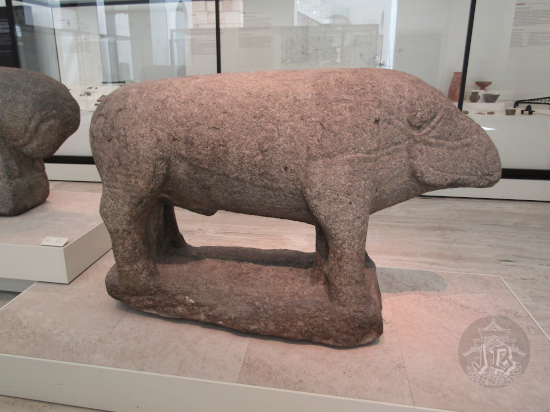
The last key pieces of Iberian sculpture in this museum are the verracos – sort-of headless boars, pigs or bulls (depending on the interpretation), but it is commonly accepted that they are symbols of protection of cattle routes. Most of them are… visibly male.

Once I had seen what I really wanted to see I wandered over the rest of the museum, stumbling upon the currency exhibition, which was strangely interesting.

I walked past the Medieval rooms and then I found the Egyptian area, which is humble, but has some interesting things like the X-rays of a mummified falcon. Finally, I checked out the classical Greek area before calling it a day and making it back home.