24th September 2022: Manzanares el Real & Alcalá de Henares (Spain)

My friend, whom I had not seen since January 2020 as the pandemic kept us apart, dropped by for a visit as she was in the area. Since the weather forecasting had not been promising, I had not booked anything, but given her a bunch of options to do. She was particularly taken by the castle in Manzanares El Real, a town in the Madrid area, so we drove there.

The palace-castle Castillo Nuevo de Manzanares El Real was built in the late 15th century as a replacement of the previous one by the House of Mendoza. The noble family was given control over the area the previous century, and after a hundred years living in the older castle, the new one was commissioned to Juan Guas, who designed the building in a on a Romanesque-Mudejar style. It was built in granite stone, with Isabelline Gothic decoration, mixing defensive / military, palatial and religious architecture. It was inhabited for about a century before it was abandoned. The castle was declared a Cultural Monument in 1931, and it has undergone several restorations. In 1961, it was used as shooting location for Charlton Heston and Sophia Loren’s “El Cid” film.

Considered one of the best-preserved castles in the Madrid area, the building it has four towers, six floors, and a central patio. It holds a collection of tapestries, and most of it can be walked. Unfortunately, the towers cannot be climbed, but you can walk around the walls, both in the terraced gallery and outside. It was a bit overpriced, but well-worth the visit.

Collage showing the castle. It is reddish with hard corners and rounded towers. The decoration is white and ornate.

We made a pause for lunch and tried the best wild asparagus (Asparagus acutifolius) that I have had in ages – just grilled with salt and lemon. We had some croquettes too.
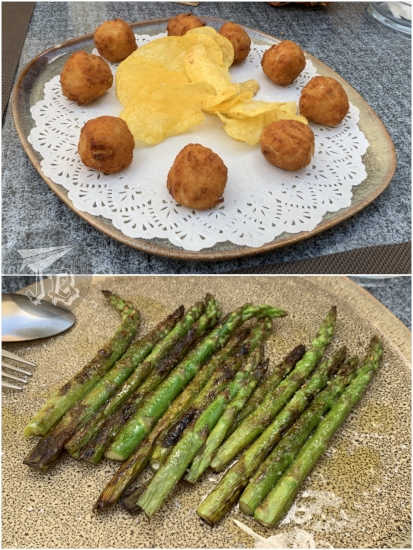
Plate of perfectly-round croquettes and some crisps in the middle + plate of roasted green wild asparagus

As we had walked into the village for lunch, we only had to walk a little further to find the ruins of the original castle Castillo Viejo de Manzanares el Real. At the moment, only the foundations can be seen, though it is similar to the new one. The archaeological excavation started in the year 2022, but nothing much is known of it, except this one was an actual military fortress that predates the new castle. From there, the views of the new castle and the local church make a nice skyline of sorts.

Foundations of the old castle. Not much is seen, there is a sign reading "Old Castle Archaeological Excavation"

View of Manzanares el Real, showing modern roofs, the church tower, and the castle in the furthest background

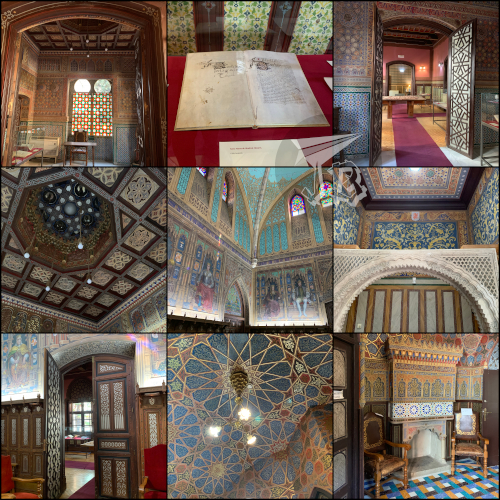
It was still early in the afternoon, so I suggested stopping by Alcalá de Henares. I wanted to make a stop at a shop to check for something, but after a quick visit to the shopping centre, we moved on to what is, in my opinion, one of the most interesting buildings in town – the small palace house Palacete Laredo. Built in the Neo-Mudejar style, it is a bizarre combination of mosaics, moorish-like decorations, and vibrantly-coloured windows that somehow work, somehow. Though only about half of the building can be visited, I just find it bizarrely alluring. My friend loved it. Furthermore, the building has a few Complutensian Polyglot Bibles in display – the first polyglot edition of the Christian Holy book, published in the 16th century under the patronage of the Cardinal Cisneros, a key figure in local history.
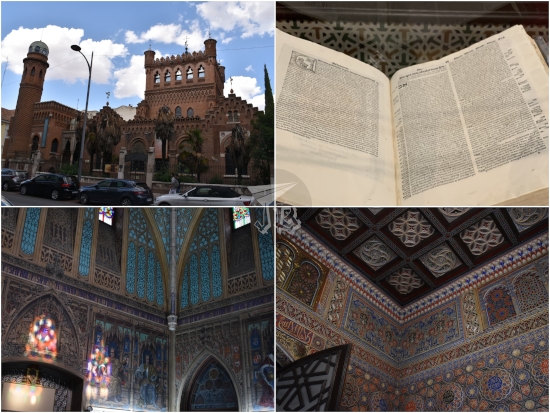
Palacete Laredo: exterior and interior decorations + close up of the open bible, in Latin and Hebrew

We continued on, and walked round the city. We saw two back-to-back weddings at the cathedral Santa e Insigne Catedral-Magistral de los Santos Justo y Pastor – that meant we could not snoop into the cathedral, but we did see one of the brides arrive in a Rolls Royce.

Finally, we dropped by the archaeological museum Museo Arqueológico Regional, which has opened a very interesting new palaeontology ward – holding reproductions and real fossils of animals that used to live in the Madrid area, with a few coming from the palaeontological site of Cerro de los Batallones – most interestingly a Tetralophodon longirostris and a Machairodus aphanistus sabretooth cat.

Skeletons and skulls: mastodon, giant prehistoric giraffe that looks similar to a humongous goat, and sabretooth cat

We did a little more shopping afterwards, and eventually we drove off into the sunset… and the traffic. We ended up walking for 12.47 km (19078 steps), and driving for a good three hours, though M40 was so busy it actually felt like much much longer.

4th September 2020: Alcalá de Henares (Spain)

After looking for a place to park the car for 12 minutes, I left the car and I went off on foot towards the centre with a relative who is living in Alcalá de Henares. The town centre has been a Unesco World Heritage Site since 1998.

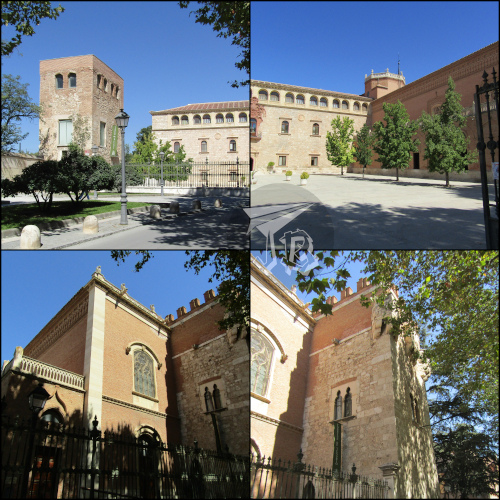
Our first stop, at 10:30 almost sharp was the Palacete Laredo, a small palace built in the Neo-Mudéjar style, a type of Moorish Revival architecture. It was designed and built between 1880 and 1884 by the Spanish artist Manuel José de Laredo y Ordoño. After a century in private hands, it passed to the town hall, which allows the university to use it as a museum, showing a collection of ancient documents.

The palace is built in brick, it has two floors and a minaret-like tower. The inside is decorated with coloured-glass window, tiles and paintings. The visible ceilings on the first floor are wooden artesonado (decorative beams joined together). There is also a garden, but it was closed.

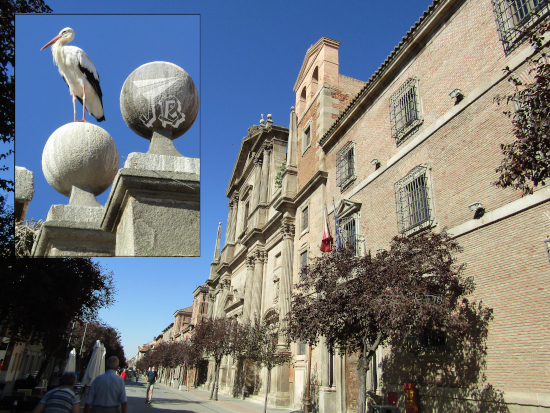
Afterwards, we headed off towards the centre. We walked by the church Parroquia de Santa María la Mayor and is inhabitant the stork on photo duty.

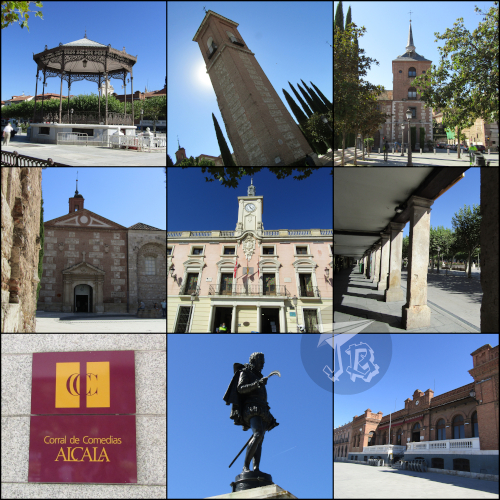
We had tickets to see the Corral de Comedias, a theatre built in the site of an ancient “theatrical courtyard”. These were open-air theatres that were common during the late middle ages and exploded in popularity in the 16th century. The Corral in Alcalá de Henares was built in 1601 by Francisco Sánchez, member of the Carpenters Guild. It suffered several changes – the ceiling was built in the 18th century, then it became a cinema, and eventually was “lost” in the 1970s. In the 1980s, it was rediscovered, restored, and finally opened as working theatre in 2003.

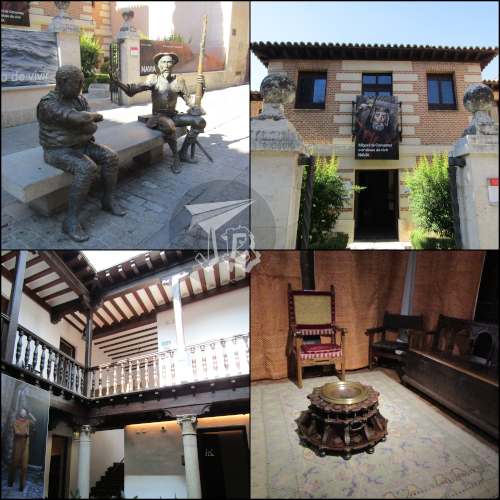
Alas, we were too late for the 12:00 visit to the university, so we wandered around the town’s main square Plaza de Cervantes – Alcalá de Henares was Cervantes’ birthplace. Miguel de Cervantes was a 16th century Spanish writer, most renown for his novel “The Ingenious Gentleman Don Quixote of La Mancha”, which many authors consider “the first modern novel” and “the best literary work ever written” (though… I disagree). The square features a bandstand, the statue of Cervantes, and is surrounded by several buildings of importance – the ruins of the church Iglesia de Santa María, the Town Hall and the Círculo de Contribuyentes, former casino, and the Corral de Comedias.

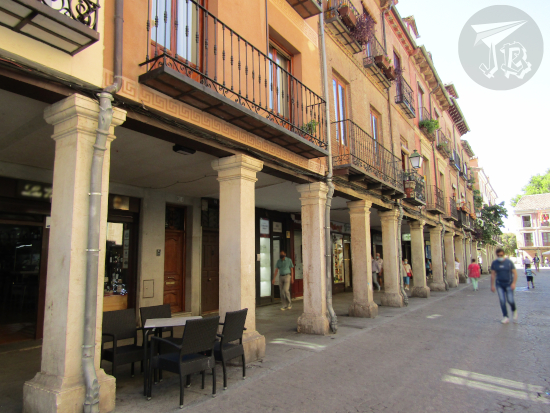
Then we walked down Main Street Calle Mayor, until we got down to the Obispado de Alcalá de Henares, the bishopric, with two towers from the former wall at their sides. That reminds me – we did not visit the cathedral or any religious buildings because they were all closed to tourism.

At 13:00 we took the guided visit to one of the university buildings, the Colegio Mayor de San Ildefonso. The university was established in 1499 by Cardinal Cisneros, an influential Spanish religious and statesman in the time of the Catholic Monarchs. A colegio mayor is basically a dignified “classic” dormitory. The façade was built between 1537 and 1559 in the Plateresque style, an architectural style that developed in Spain between the late Gothic and the early Renaissance. The architect was Rodrigo Gil de Hontañón.

Inside, we saw the cloisters and yards, the gate of honour (from where the successful students left the university), the classroom where the students defended their final thesis, and the chapel, with the tomb of the founding Cardinal (but not his body, which is in the cathedral).

We had a reservation to have lunch at the Parador de Alcalá de Henares, which is a rather modern building and not a historical one, but a stamp was needed (≧▽≦). Lunch was a looong affair because our waiter might not have been the… most efficient. We tried the combos with a little bit of everything to share (entrées and desserts), and some bull tail. Oh and coffee. Yay coffee. (Also, kudos to me for cutting that nut in half.)

After lunch, we walked down the Calle Mayor again and we made a stop at what is supposed to be the house where Cervantes was born, or at least a reconstruction, with a bunch of ancient objects thrown in – the Museo Casa Natal de Cervantes. There was also a photography exhibition. To be honest, it had a great quality-price relation. It was free, and the quality was… lacking. Or maybe I’m old and I have seen most of the stuff they showed in action, and used a few.

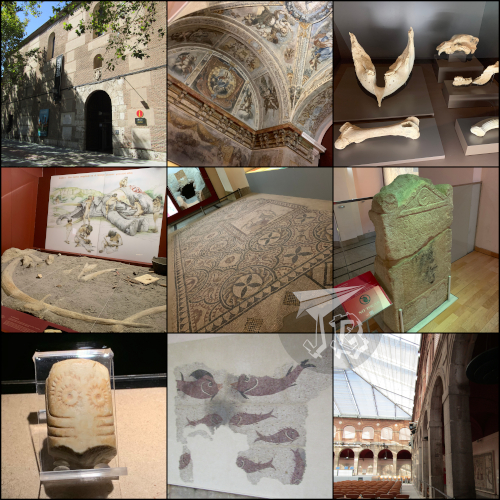
We continued on to the regional archaeological museum Museo Arqueológico Regional, located in the old Archiepiscopal palace. That was unexpectedly good, with the fossil record and the old Roman mosaics.

Pending for a future visit to Alcalá de Henares: Roman and Medieval areas, and the religious buildings, as the day finished up doing some necessary and work-related shopping before I drove back home.

Driven distance: Around an hour? I dumped the car as soon as I could and we walked the hell out of the town (≧▽≦)
Walked distance: 14.61 km