
For a while it felt that this day trip was cursed or something. Whenever I decided to schedule it, something happened – a family emergency, a weather alert, work hiccups, car trouble, you name it. I finally got everything ready on Friday and hoped for the best on Saturday morning. The weather was all right, family was okay, the car had passed its check, and work was calm for a minute. Off I went!
The Tiermes Archaeological Site Yacimiento Arqueológico de Tiermes is located in the municipality of Montejo de Tiermes, in the area of Soria. The ancient city of Tiermes was first inhabited in the Bronze Age. Before the Roman conquest, it was a Celtiberian dwelling, and during Scipio’s campaign around 134 BCE to conquer the Iberian Peninsula, it became an ally to Numancia. After the Roman Empire’s victory, the town was assimilated. In the year 98 BCE, Tiermes became a municipuim with two forums, a theatre, an aqueduct and several houses built to maximise the utility of the rocks of the area. In more recent times, a Romanesque hermit church was built nearby.
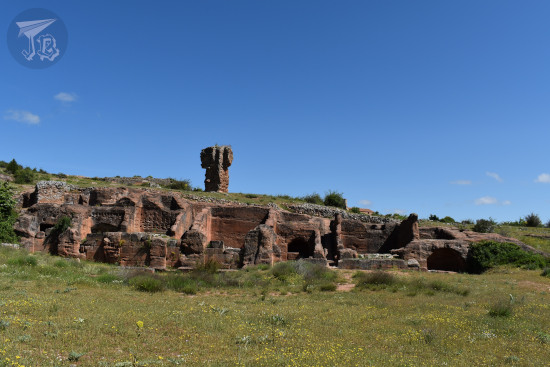
The site is located around 1200 metres high, in a sandstone landscape with flats and erosion cliffs. Both Celtiberian and Romans built around and into the rock, to the point that there are several “rock houses” which have been excavated into the mountain, with literal furniture carved out of the stone.
While the Romans made sure to keep the legend of Numancia alive – as it made the victory more glorious – Tiermes was eventually forgotten after it was abandoned, probably when the area ran out of water. The ruins were first excavated in 1960 by Teógenes Ortego and Juan Zozaya. It was however the work of José Luis Argente Oliver, between 1975 and 1988, which really brought out the ruins into the spotlight. There were new findings from 2008 onwards.
The drive was just shy of two hours, and since I left on a Saturday around 8:00, the roads were rather empty. I drove past the reservoir Embalse de Alcorlo, but the parking spot to look at the structure was behind a curve and I missed it. I also passed by the Medieval village Molina de Aragón, which had a festival the following day. I had an idea…
It was not extremely hot, and the drive was easy, even if I did not take the speedway. There was a stretch of the road which was really badly paved, and almost as soon as I drove into Soria it became pristine. I reached the parking area a bit before 10:00 – my Sat-Nav was way more on spot predicting the times than Google Maps. Though some of the roads had a speed limit of 90 kph, there was no way you could do more than 40 kph on them.
There is an area to park next to the hermit church Ermita de Santa María de Tiermes, the newest construction of the site, dating from the 12th century, which has a small cemetery associated to it. The little building looks like a 3D puzzle with its bricks and arches. It has a covered outer area, which indicates that at some point it was ready to receive pilgrims. Unfortunately, the church was closed so I could not snoop inside.

Instead, I set off for the walking route, which starts at the Roman forum. When the Romans took over the city, they transformed it according to their customs, and two forums were built throughout the Julio-Claudian and the Flavian dynasties (27 BCE – 68 CE and 69 – 96 CE). Most of the forum was erected above the ground and now it is gone.
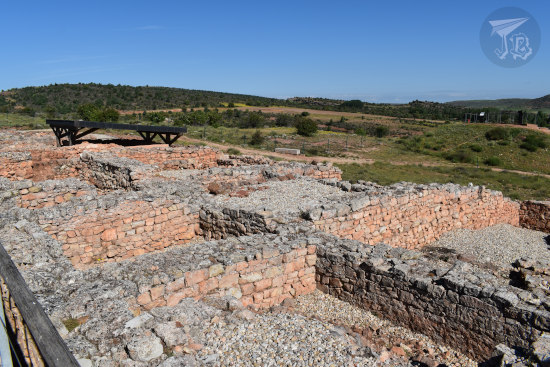
The same happened to the House with the Aqueduct Casa del Acueducto, though in this case you can walk into the different rooms – and there are reliefs on some rocks that comprise the basements and foundations of the structure. The original house would have had 35 rooms in different levels, with stairs to move around them. The plinth was made out of the red sandstone that comprises the area and the walls were built with wood.

As Tiermes was partially built into the mountain, it has two levels. The upper one, with the forum and the Aqueduct house, and the lower one, where you can see (and enter) houses carved in the rock. I was on the upper part, heading towards the vertical wall to descend onto the lower area. In order to do so, I had to go down the West Gate of the city Puerta del Oeste, which now is just a small gorge between the levels, with a steep slope.
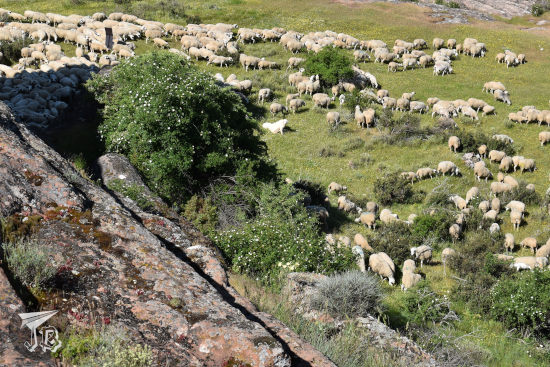
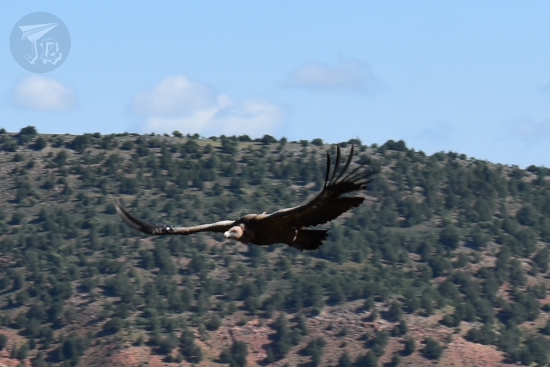
Whilst I was walking towards the Gate, I heard bells, and when I got to the edge of the rocks, I saw that there was a herd of sheep walking underneath, along a shepherd and five huge mastiffs. There was no way I was going to walk near the herd and bother the dogs, so I stayed in the upper part. One of the mastiffs gave out a warning bark, and at first I thought it was directed at me. However, I realised that the dog was barking at a couple of griffon vultures which were circling for any food available, namely if they could snatch a lamb, I guess. And then, one of the vultures decided to circle me instead of the sheep.
When the herd was at a safe distance, I went down and crossed the Gate to walk alongside the rock wall, which has houses carved into it. Not only that, there is a whole underground aqueduct Acueducto y Túnel de Tiermes dug into the rock. And you can actually explore its whole length! I went in. It was completely dark except for a couple of ventilation holes, and at the end of it I found myself at the Aqueduct House. I decided to backtrack using the same way in order to continue the route and not miss anything by accident, or because the whole experience was wickedly cool. Take your pick.
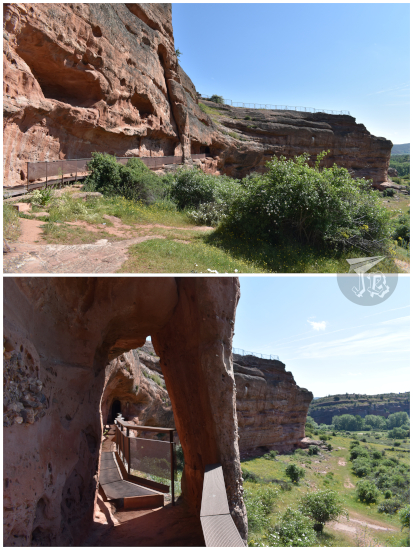
From the entrance of the aqueduct, I walked alongside the rock wall and explored the houses built into it – Casa de las Escaleras (The House with Stairs), actual apartment blocks up to seven floors, Casa de las Hornacinas (The House with Shelves) and Sección Rupestre Sur (Southern Area), which was built half into, half onto the rock. Most of these date from or were repurposed during the Roman area, so it is difficult to point the original Celtiberian work.

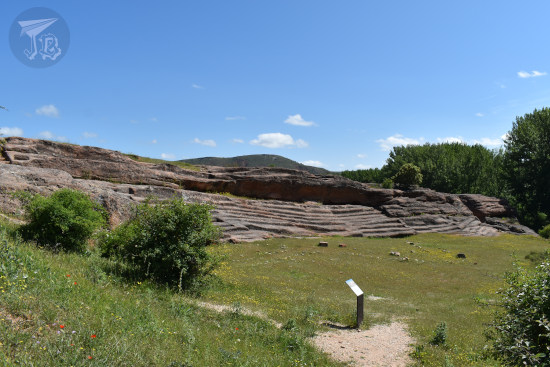
A bit away from the rest of the town stands El Graderío, an area with sitting terraces carved onto the rock that could have been a meeting place or a theatre. Then, I found another of the gates Puerta del Sol, which again gives way to the upper area.
There was also the reconstruction of the Roman wall, with… a couple of pieces of the original defensive wall, and a lot of new ashlars that looked quite fake, so you could see what was original and what was not. As far as archaeological sites go, though most of what can be seen in the town is Roman, it was cool to see so much standing – especially the aqueduct – considering how little of Numancia exists on site, though the reason is probably the constructions into the rock.
I got back to the car and backtracked a little to the museum Museo Monográfico de Tiermes. The small hall exhibits pieces of pottery and artifacts recovered from the nearby necropolis Necrópolis de Carratiermes – brooches, weapons, and other burial paraphernalia which are indeed Celtiberian. The museum was free since it was a weekend.

On the drive back, my Sat-Nav made a weird noise. It speaks everything except… Well, route changes. It decided to propose a different route, that is what the sound meant. I think it’s a new update or something, because it had not done it before, and it has a couple of items since then. As I could not check it – it was not safe – I missed my turn for the easy secondary road and had to take an alternative route. I ended up in Jadraque.
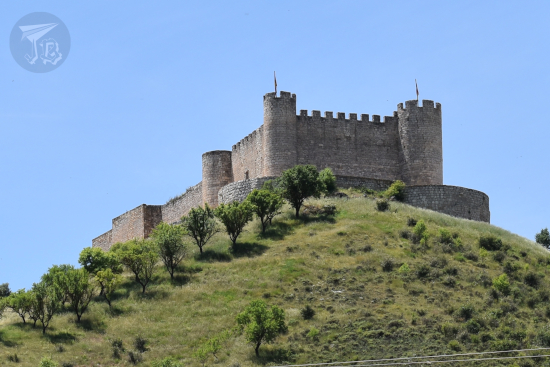
While it is true that the castle Castillo de Jadraque is amongst the places I need to visit at some point, it was high noon. Too hot, even if you can drive nearby, for a castle which is closed for restoration. I’d rather wait till it is reworked. I did stop at a viewpoint for a couple of pictures.
Not long afterwards I found my way to the highway and it was easy to get home from there, though I do prefer the secondary road to all the lorries in the highway. I got home by lunchtime to wait out the heat and have a post-hike lunch.
 JBinnacle – A Travel Logbook