11th June 2023: Cuevas del Cerro del Águila {WNW Spain, with a splash of Portugal, June 2023}

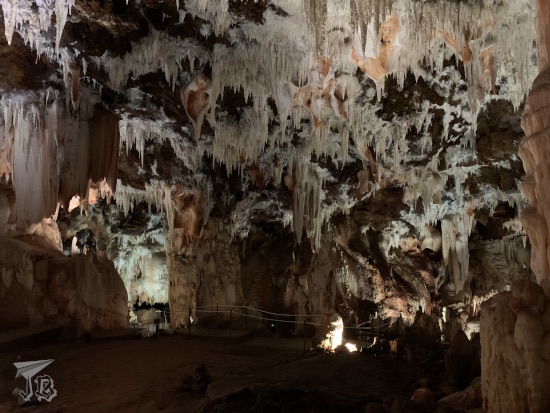
We had decided to split the way back, so we booked tickets for the natural cave known as Cuevas del Cerro del Águila. They are located in the mountain range Sierra de Gredos, quite literally in the middle of nowhere. They were discovered by accident in 1963, and have been open to the public since 1964.

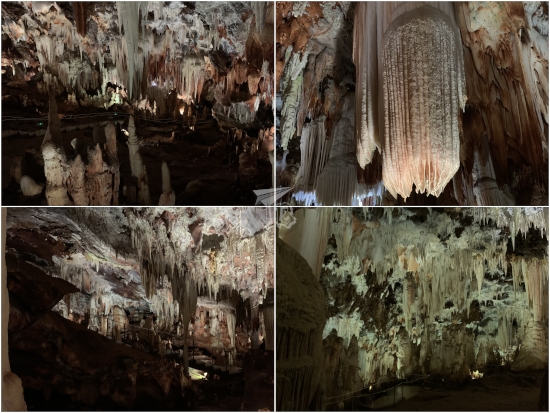
The geological construction dates back 500 million years, from the time when the area was a dolomite-filled marine platform. When Spain emerged as dry land, rivers started flowing, dissolving part of the rocks, and created de underground halls. Mineral-saturated water dripping creates a wide variety of speleothems – stalactites, stalagmites, columns or stalagnates, flowstones…

Caves Cueva del Águila

Caves Cueva del Águila

It was a really cool thing to see – I’ve been to caves before but this one was the most impressing I’ve visited in a while.

Afterwards we just drove off back home for a late lunch, a nap, and getting ready for the work week.

10th June 2023: La Alberca & Plasencia {WNW Spain, with a splash of Portugal, June 2023}

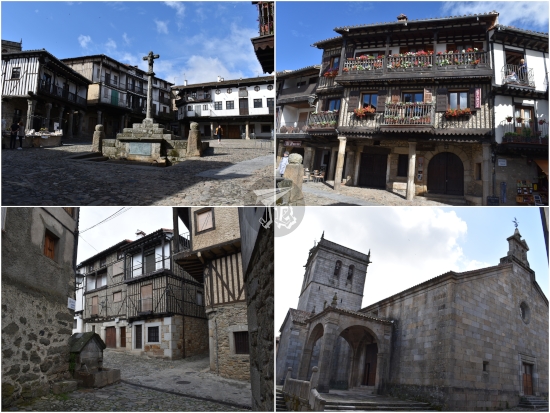
We left off the castle to have breakfast at the village of La Alberca, a municipality known for two things. The first one is the timber framing of its houses. The buildings have a stony ground floor and a lime-white second floor with the post-and-beam style in dark wood.

La Alberca

The second one is the tradition of the whole village raising a piglet together. The swine is freed mid-June (we missed it by a couple of days) and everybody in the village keeps track of it – feeding and sheltering the animal – until it is auctioned for charity when the time for slaughter draws near, in January. There is a sculpture as homage to the animal in the middle of the church square, yielding to what I’d say is the most iconic sight. However, the amount of butcher and delicatessen shops makes the whole thing a little… weird.

Monument La Alberca pig

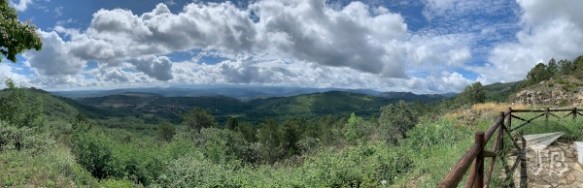
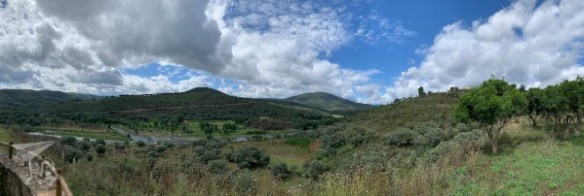
We drove through the natural area of Sierra de Francia, and stopped over at the viewpoint Mirador del Madroñal. From there we could see the abundant vegetation – oaks, chestnuts, and vine-fields. A bit further, we reached a second viewpoint Mirador Las Juntas.

Viewpoint Mirador del Madroño

Viewpoint Mirador de las Juntas

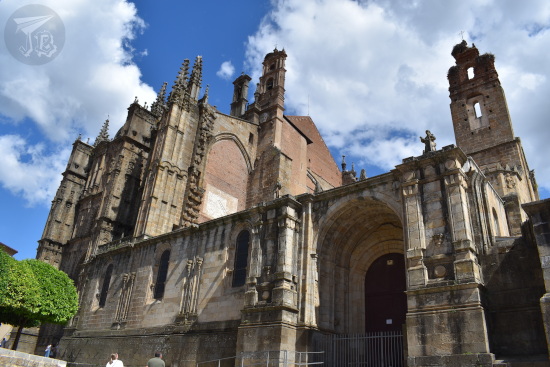
Our road was closed, so we had to take a detour, but we eventually reached Plasencia with a lot of big plans. Unfortunately, when we arrived at the Parador de Plasencia, built in the former convent Convento de Santo Domingo, we learnt that the town was in the middle of the local festival. Such thing meant outdoor bars and music – almost rave-like, and most monuments being closed. It had never even crossed our minds that we might run into such a thing, and it was a bit of a bummer that not even the cathedral Catedral de Plasencia was open.

Former convent turned Parador in Plasencia

Cathedral in Plasencia

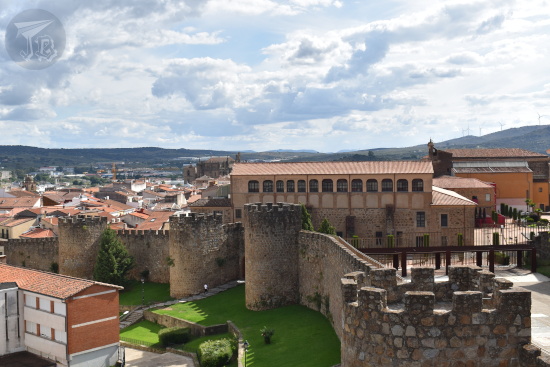
We walked around for a while, and eventually we found the walls and their mini-museum Centro de Interpretación de la Ciudad Medieval de Plasencia. They reminded me of the wall in Ávila, but in a much-smaller scale.

Buildings in Plasencia

Wall in Plasencia

Plasencia

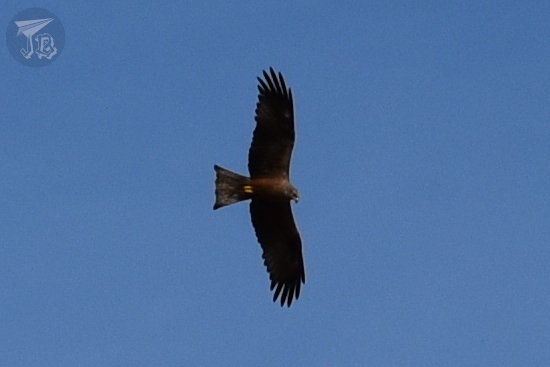
Plasencia is also a bird-protection area and nestling zone of the lesser kestrel (Falco naumanni), so that is what I guess we got to see (but it could totally have been an eagle…). We had lunch and dinner at the Parador as it was the least busy place, and they took forever both times. We did not feel like going out to check out the town in the evening considering how busy everything was even in the afternoon. Probably it was the first full-blown post-COVID festival, but it was a tad disappointing for me.

Krestel

9th June 2023: Arribes del Duero & Ciudad Rodrigo {WNW Spain, with a splash of Portugal, June 2023}

We set off from Zamora in order to drive up towards the Portuguese town of Miranda do Douro, though we were not due to reach the town itself. We were heading to the International Biological Station, which organises environmentally-friendly cruises up River Douro.

The drive was to take around one hour, and we stopped at the reservoir Embalse de Ricobayo, which has a dam and a hydroelectric central. We stumbled upon a nice little outlook above the reservoir to see both the dam and the meandering river. It was not long before we noticed the vultures – a kettle of Eurasian griffon vultures (Gyps fulvus), and even some solitary birds that showed off (or were trying to find breakfast, who knows?).

Meander and Dam of Ricobayo

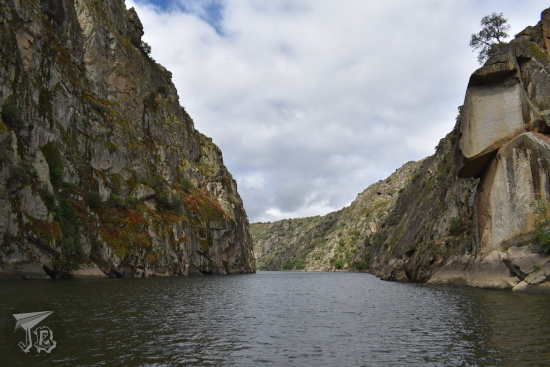
We reached the International Biological Station Estación Biológica Internacional | Estação Biológica Internacional (EBI) in time to swap our 12:00 tickets for 11:00 tickets, and the little boat took off. The cruise runs up the area of River Douro Río Duero called Arribes del Duero, a gorge nor dissimilar to the Galician gorge of River Sil. It was an hour-long course where we got to see some more birds of prey, a few nests, lychens and local flora, but none of the wild otters that are supposed to swim on the river. The guide collected some water to observe under the microscope and show us copepods and water fleas. At the end of the boat ride, we saw the “emotional therapy otters” (Lutra lutra) that the EBI keeps at the entrance. Oh, and had a sip of Porto wine. I was not too keen on the whole thing though, despite the pretty landscapes.

Arribes del Duero

Otter playing in the water

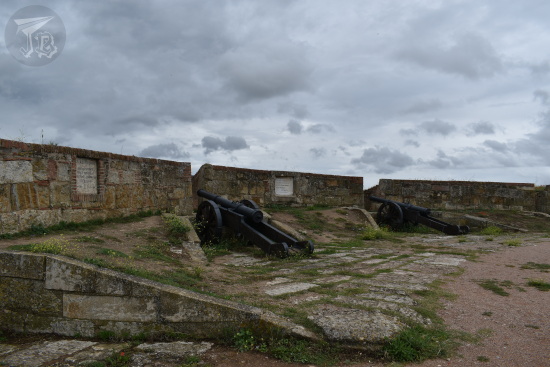
We “boycotted” Miranda do Douro as the ascent road from the river to the town looked horrible and full of curves. Thus, we headed off to Ciudad Rodrigo, in the Spanish region of Salamanca. We had booked at the local Parador Parador de Ciudad Rodrigo, Castillo de Enrique II de Trastámara. It is a really cool building – a castle from the 14th century, commissioned by the King . The main feature of the building is the keep, which you cannot climb (technically you can, but you have to know that you need to ask beforehand), but you can walk around the walls to have a look at the skyline. In front of the Parador stands a pre-Roman sculpture of a verraco – a granite animal, maybe a pig or a boar, dating back from the Vettones (3rd century BCE – 1st century CE).

Parador of Ciudad Rodrigo

There was a mishap with our reservation, so instead of getting a three-person room, we got the doggy-friendly room. I’ve been long-supporting of pet-friendly travel, but this made me rethink my stance. The room did have a pull-out sofa bed, but the layout made it awkward to share it among three people. Furthermore, it smelt and there were a bunch of flies and fruit-flies at the windows. That was a bit of a bummer.

We went to walk around town and found the tourist office in the mansion called Palacio de los Águilas, a 16th century Renaissance building erected by the family in charge of the castle upkeep. It has two patios with arches, and an exhibition area about the role that the town had in the war against Napoleon’s armies in the 19th century.

Palacio de los Aguila

We wandered around the town for a little, but then it started pouring. Thus, we hurried towards the cathedral Catedral de Santa María de Ciudad Rodrigo. The original building dates back from the early 12th century, and it was in construction and reconstruction until the 18th century. The main building was finished in the 14th century, but the tower collapsed after the Lisbon Earthquake in 1755. One of the most important features of the cathedral is the Romanesque portico Pórtico del Perdón, similar to the one in the cathedral in Santiago de Compostela. The gothic cloister is really nice, and it holds frescoes from the Romanesque period.

Cathedral of Ciudad Rodrigo

Cloister in the Cathedral at Ciudad Rodrigo

By the time we finished, the storm was over. I climbed up the remains of the town’s defensive walls Adarve Juan Martín Zermeño.

Ciudad Rodrigo: wall

We ditched the chamberpot museum (yes, it is really a thing) and to end the day we walked around the town for a little to find the traditional buildings – the manors Casa de la Marquesa de Cartago and Palacio de los Miranda, the square Plaza del Buen Alcalde, the old army HQ Antiguo Cuartel de Artillería,–the churches Iglesia de Cerralbo and Capilla de la Venerable Orden Tercera, and the main square Plaza Mayor.

Ciudad Rodrigo typical buildings

8th June 2023: Tordesillas & Zamora {WNW Spain, with a splash of Portugal, June 2023}

Tordesillas used to be one of the Spanish Crown’s strongholds throughout the Middle Ages, starting around 1340 when Alfonso XI ordered the construction of a palace. In 1494, the Spanish and Portuguese monarchs signed a Treaty which divided the lands “discovered” by Columbus among them – of course, this Treaty was largely ignored by any other European powers which wanted to explore America, and never acknowledged by any indigenous people. In 1519, the town was part of the rebellion against Carlos I, naming his mother – and daughter of the Catholic Monarchs – Juana as queen, despite the rumours that she was insane. After the defeat of the revolts – and beheading of the instigators – the town lost importance.

We left early in the morning to try and ditch the traffic, but we were not successful – driving around Madrid, we ran into a couple of jams traffic caused only in part by the intermittent storms, which made the beginning of the road trip stressful. Thankfully, we parked at the outskirts of Tordesillas and the sun was shining again, as we had to cross the village on foot. Our first stopover was the Main Square Plaza Mayor. In the Castilian Main Square fashion, it is actually square in shape, with the main buildings supported by columns, where cafés and shops stand today. The current plaza dates back from the 16th century, and has been painted in a questionable bright mustard colour.
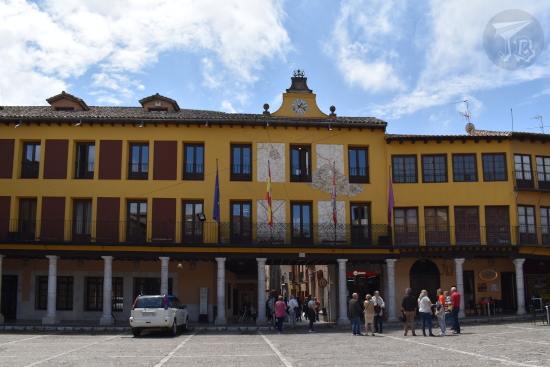
Main Square in Tordesillas

In the end, most of the history in Tordesillas is linked to Alfonso XI’s palace, known today as the Convent of Saint Clare Convento de Santa Clara, which stands a few minutes’ walk from the square. It was home, and later prison, to royal women, both loved and unwanted ones. It became a convent of the Order of Saint Clare in 1363, and the nuns living there were tasked with praying for the health and salvation of the Royal Family. Today, it is managed by the Spanish National Heritage Foundation Patrimonio Nacional. It can only be visited under supervision – seriously, aside from the guide, you get a security guard following you around – and photography is forbidden in all the interior areas.

The castle-convent was built throughout the 13th to 18th centuries. The oldest part of the building is a chapel dating from the 11th century, and the bulk of the construction was carried out in the 14th century. The monarchs employed Mudejar builders, a fact that yielded to multifoil arches, ceramic decorations, and Quran verses (officially “decorative nonsense”) in some of the chapels and the façade of the building.

Inside the palace there is a Baroque cloister and the gothic church, with a wooden ceiling painted gold and the emblem dragons of Carlos I’s shield. Truth be told, the church had been pretty much hyped up on me, so I found it a bit underwhelming.
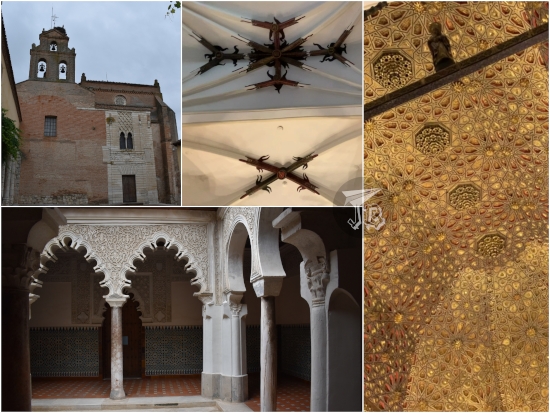
Santa Clara convenent in Tordesillas

The party separated for a bit so I could explore on my own for a while. I got to the stone bridge over the River Douro Río Duero, just called “the bridge” el Puente, right at whose ends stands a monument to the fighting bull Toro de Tordesillas. The associated bullfighting festivity was one of the oldest in Spain until it was vetoed by the regional government – the fighting bull was set loose in the meadow, chased by horsemen and lanced to death. Today, the festivity is controversial and it’s trying to find its place in the midst of new sensitivities.

Tordesillas

I climbed up the medieval wall Muralla de Tordesillas to the park where the monument to Queen Juana Monumento a la Reina Juana I de Castilla stands, in front of the museum dedicated to the Treaty Casas del Tratado, and the church Iglesia de San Antolín.

Monuments in Tordesillas

We walked back to the car to drive off to the next spot in the route, and Tordesillas became the first spot where we spotted birds of prey during this trip, maybe a golden eagle Aquila chresaetos. Or, you know. Anything else.

Eagle

We drove off towards the municipality of Zamora, a Medieval town and villa by the Douro, known for its Romanesque churches. We reached the Parador de Zamora in the middle of a horrible downpour that was over as quickly as it had started. The Parador hotel is a former noble family’s Renaissance palace, with a military style and a middle patio with a glass-window gallery
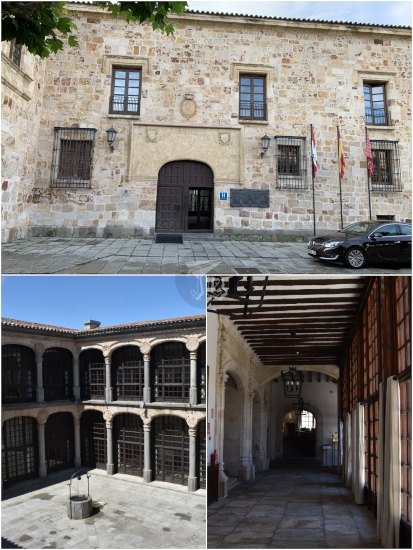
Parador in Zamora

We had a late lunch and walked to the manor Palacio de los Momos, near the Main Square Plaza Mayor, home to a church Iglesia de San Juan de Puerta Nueva which has a sculpture representing two figures of the local Holy Week celebrations Monumento al Merlú. Other buildings include the old and new town halls Ayuntamiento Viejo and Nueva Casa Consistorial, and blocks of colonnaded buildings.
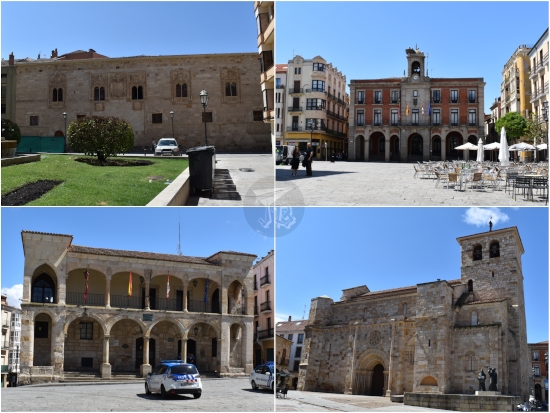
Buildings in Zamora

The first Romanesque building we came across was the church Iglesia de Santa María Magdalena, which contrary to many other places has got rid of the Baroque add-ons, and stands severe and naked in its stony glory. It is considered one of the most important and pure Romanesque constructions in Europe, sparsely decorated save for the tomb to the side.
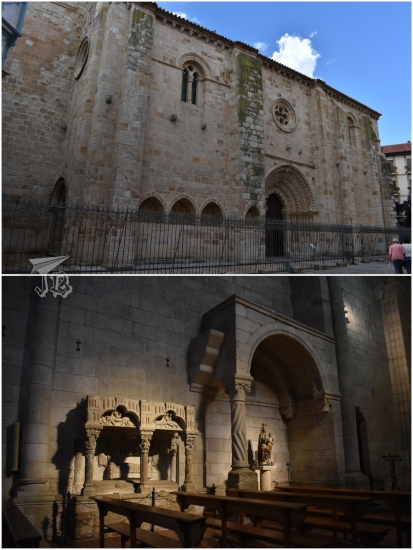
Church of Saint Mary

From a side stop I overlooked the river Río Duero and the medieval bridge Puente de Piedra.
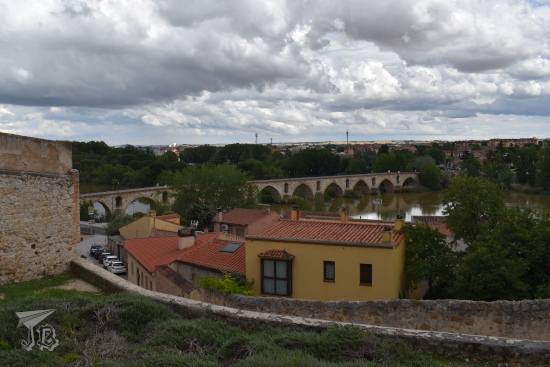
Zamora Medieval Bridge

We continued off to the cathedral Catedral del Salvador de Zamora. It is considered the first cathedral in the “Douro Romanesque” style. After the original cathedral was destroyed during the Muslim conquest of Spain, the reconstruction began around 1151. It must have been finished towards the beginning of the 13th century. The building has two particularities – the thick tower, and the umbrella dome, in a style that travelled from Byzantium to the Islamic architecture and reached Spain with the Nasrid artists. The inside holds a cloister and two small museum – one of religious art and the other of archaeology.

Zamora Cathedral

Afterwards, we visited the ruined castle Castillo de Zamora – a purely-defensive Romanesque fortress built around the 11th century. The castle has a moat, and you can wander up the walls and defensive towers. The interior is ruined, but the ancient structure can be guessed by the arches and different walls that would have separated the fortress’ halls.
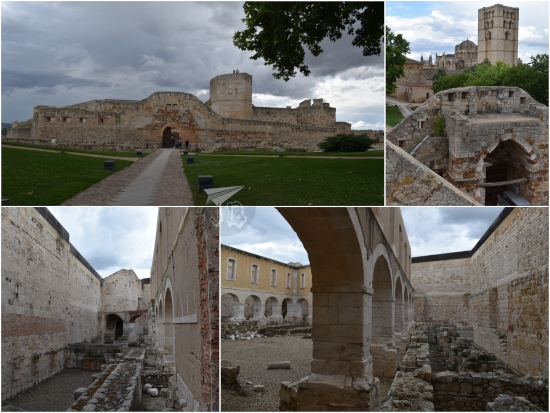
Castle in Zamora

Finally, we explored a few more religious Romanesque buildings: Iglesia de San Pedro y San Ildefonso, Convento de Clarisas El Tránsito and Iglesia de San Cipriano. From the viewpoint next to this last church, we got to see a stork nest with a baby chick in it.

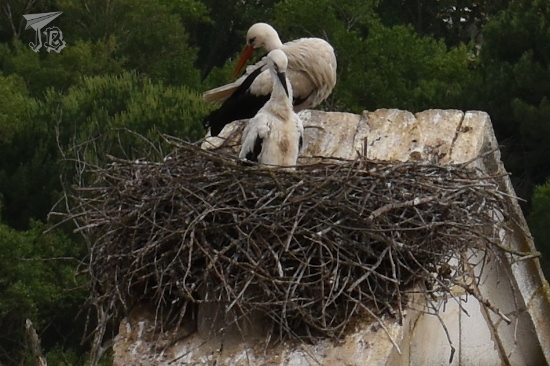
Zamora churches

Stork nest

We had dinner at a restaurant called El Horno, a traditional places that offers tablas – wooden trays full of treats to share. We shared a serving of tabla de fiambres – Iberian sausages (ham, loin, chorizo…) and cheese on a bed of crisps.


Zamora at night