6th October 2024: Cappadocia {Türkiye, October 2024}

I had made a thing out of two coffees for breakfast, and today was no exception. The whole group was now in the hotel so we were ready to go see the sights. The bus had barely hit the road when our guide gave us a huge grin and decalred “I’m the first Turkish face you meet during this trip. Trust me. We’re going on the balloon is too expensive, so we’re not gonna do it here. We’re going to do it somewhere else”.

I was crushed at these words. Had he said this the previous day, I would have arranged to go onto the balloon on my own – today. Now, with a 5:00 departure time the following day, it was impossible. I don’t have words to write how I felt – devastated, cheated, furious. The option to ride a balloon in Cappadocia was in the documentation, and I had budgeted for it. And this guy had plain and simply… robbed me from it, because he did not want to wake up early after picking the other half of the group from the airport. Looking back, I should have tried to do it myself, hiring the flight on the hotel for today – and knowing that does not make it any better, because I could not do this one activity, which was important for me, not because of the weather or any actual problem. Just because the guide did not want to do his job. I did try to get him to reconsider, but he was like “no can do”.

Thus, I reached the conclusion that the travel agency, Oxin Travel and the guide himself sucked. Through the day (and the rest of the trip), I would build evidence on this – such as hearing explanations that did not make sense, or just contradicted what was written on the panels. I’m surprised it did not cross my mind to leave the trip at that time, because I was seething and heartbroken. In the past, I have tried to leave unsavoury experiences out of JBinnacle, but this would not be an honest trip report without all the emotions that coursed through me during that day – and to be honest, this was just the beginning of the problems. I wrote an email to the distributor that very same day, told the guide, and have complained formally to my travel agent. I have no hope for any solution, but at least I made it known that I was not happy with the services provided. And this trip was not cheap, at all.

I had to try to get over the disappointment in order to at least see what I could of the region. It was hard, I felt a cloud over my head ruining the mood. I almost did not care about anything else, but I knew I had to make do with what I had, or let my whole trip be ruined. Thus, I tried to get myself into the right mindframe to enjoy the World Heritage Site Göreme National Park and the Rock Sites of Cappadocia as much as I could.

Around 9:00, we reached Christian Keşlik Monastery Keşlik Manastırı outside the town of Ürgüp, which is a cave monastery. Human history in Cappadocia is tied to its geology. Tuff is easy to carve, and a lot of civilisations have made their dwellings into the earth instead of on it. First, it was the cavemen, and much, much later the Christians. The first buildings from the monastery date back from the 3rd century CE. Between the 1st and the end of the 4th centuries CE, Christianity spread through the Roman Empire, coming into conflict with the established religion, which deified the Emperor. As Christianity forbade idolatry, their refusal to adore the Emperor as a god made them a target of persecution, accused of treason. In some Roma cities, the Christians took to the catacombs. In Cappadocia, they dug cave monasteries.

Within the tuff structures, ancient Christians created all the items that one would find in a regular monastery – a church, two actually, St. Michael and St. Stephen, a refectory, a winery, dwellings, a baptistery created from a sacred spring… The monks could perform their rituals and protect themselves from any possible attack. It was a functioning Orthodox church well into the 20th century.

The most important cave-building in the rock is the Church of Saint Michael. Its ceilings are decorated with black backgrounds and colourful figures, although many were damaged by iconoclast movements. There were also tomb-like structures where the monks meditated. Underneath the church, there is a baptistery, and next to it the refectory, with a long table and seats carved out of rock. Outside, you can wander around the dwellings, halfway between caves and houses, which served as rooms for the monks.

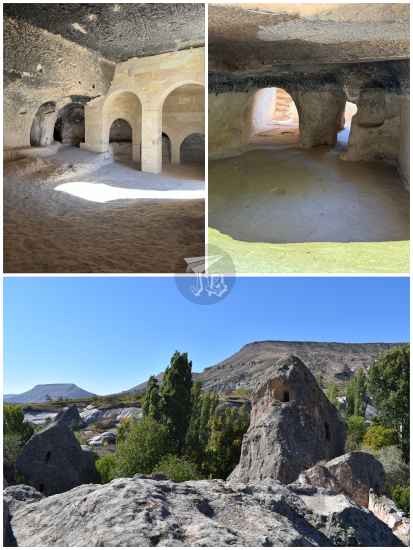
Keslik Monastery Church of St Michael

Keslik Monastery - chambers inside the rock and panoramic

Afterwards, we headed out to the Underground City of Mazi Mazı Yeraltı Şehri, known in the past as Mataza. There are between 150 and 200 known “underground cities” in Cappadocia. They were initially carved between the 8th and 7th century BCE by the tribes which dwelt in the area. Turf is easy to carve and there is no water in the soil, which made it easy for the tribes to dig “caves” under their houses. These caves became “rooms” which ended up connected to one another through tunnels. As time passed, the cities became more and more complex, with decoy tunnels and booby-traps that the locals could use to hide, safeguard their resources, and protect themselves from raids.

The cities were layered, and the levels were used for different activities – upper floors were for stables, underneath which stood the wineries and ovens… They had wells and ventilation systems that could not be tampered with by the enemies, and even a communication system to talk to people who were in other rooms. Mazi itself had eight stories, four different concealed entrances, and rounded rocks that could be used to close off the corridors. About 6,000 people could survive in its tunnels for up to a month. We did not have much time to explore as we had to move as a group, but it looked really cool.
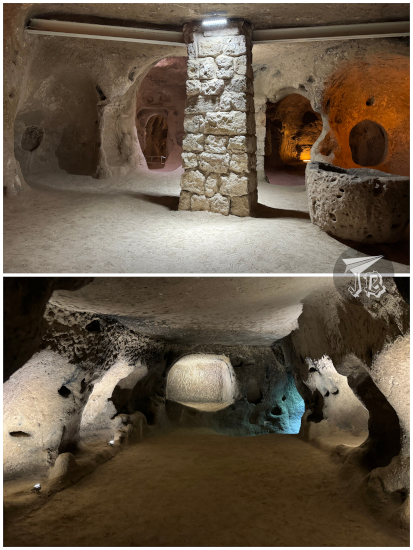
Mazi subterranean city

We went back onto the bus to head to Guvercinlik Vadisi, Pigeon valley – so called because the geological formations were excavated into dovecotes, since pigeons were used for food and their droppings as fertiliser. As we had 20 minutes there, I could hike down into the valley for a bit and even step into one of the dovecotes. Since it has become a tourist spot, locals have decorated trees with Turkish amulets – evil eye charms – to create photo spots they can request a tip if you get your picture taken there.
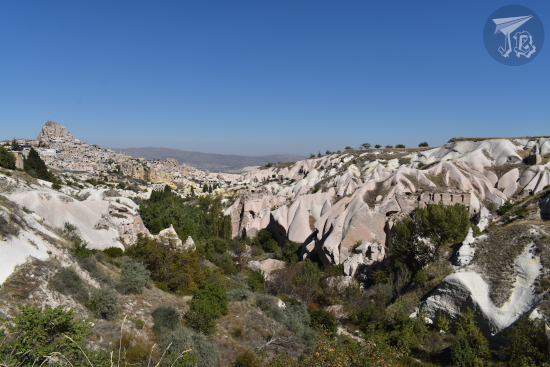
Cappadocia Guvercinlik valley

Back on the bus, the guide “graciously” and “secretly” stopped at Üçhisar, a town which has turned a lot of its fairy chimneys into hotels and cafeterias. It is dominated by Üçhisar Kalesi, Üçhisar “castle”, the only natural castle in the world, built in a tuff hill.
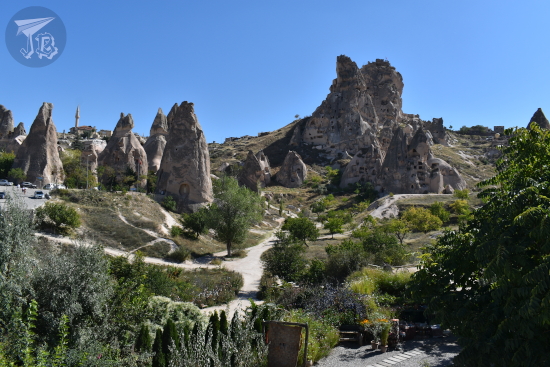
Natural castle of Uchisar Cappadocia

Then we were taken for lunch, a rather nondescript buffet which ran out cacik (Turkish tzatziki) way too fast, and afterwards to a “jewellery atelier”. The rocks they showed us were pretty, but the jewellery was rather tacky – and their star product? A pendant made of the local semi-precious stone sultanite inside a balloon, so we were not amused. I was not the only one angry about the whole debacle.

During the bus ride the guide had pitched several optional activities, and I decided to take a so-called jeep safari, run by locals, which takes you in a kind of luxury jeep up and close with the geology of the area. I got that one because it was external and better than nothing, but I did not sign up for the “traditional Turkish night of alcohol and dancing” – I don’t drink alcohol and I was not in the mood for dancing.

The jeep safari drivers picked us up from the jewellery shop around 16:00, whilst the rest of the group went back to the hotel. I felt so cheated – six hours in Cappadocia to go back to the hotel at 16:00 is disgraceful. But then again, I was not in my best disposition. Good that I still had the chance to drive right into the heart of the valleys, at least.

It was a pity that the drivers spoke zero English or Spanish, because it made it impossible to determine where exactly he was taking us. However, we got close to the rock-houses, saw the valleys, the castle, and finally, finally, finally got close to a fairy chimney! We even caught a glimpse of one of the volcanoes responsible for the landscape. It was hard having to go back to the hotel at sunset, but I had a lot of fun – I shared the car with a couple, and the poor lady was terrified by the driver’s antics. I was honestly more worried about the times on the road than the bouncing through the trails.
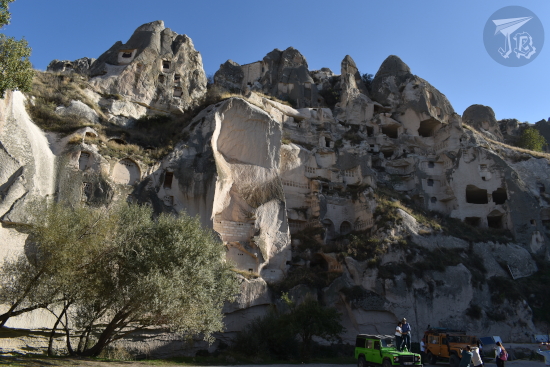
Cavemen dwellings in Cappadocia

Cappadocia volcanic valley

Cappadocia volcanic valley

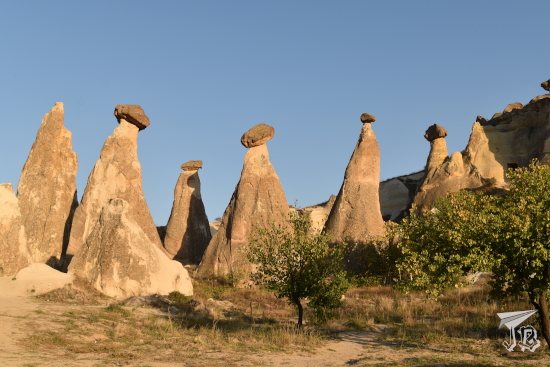
Cappadocia Fairy Chimmneys

However, back in Suhan Cappadocia Hotel & Spa before 18:00 made the sadness hit – and no internet in the rooms did not help for any kind of distraction. I tried to walk around the village to try to see something, but I did not find a way, and it was getting dark. I packed for the next day as we were leaving the area. After dinner, I wrote to the travel agents’ in Spain to complain, with zero hope for a solution as it was a Sunday, but I wanted it out of my system. I spent a really bad night, and it was stupidly short because I could not fall asleep…

20th July 2023: Herculaneum and the Naples National Archaeological Museum {Southern Italy, July 2023}

Knowing my way to the station of Napoli Porta Nolana, this time I only had to buy the ticket and wait for the 8:14 Circumvesuviana Line 4 to Poggiomarino, which was supposed to reach Ercolano Scavi in the town of Herculaneum [Ercolano] by 8:33. It took longer than that because there were a lot of stops. Then again, my strategy of the first station in order to travel sitting down was successful once more.

Unlike the modern city of Pompeii, the modern Ercolano was built before the ancient town was discovered. It was originally called Resina, but the name was changed in 1969. Despite the legend saying that the Greek hero Heracles (Hercules in Latin) founded the original Herculaneum, the early history of this city is parallel to that of Pompeii. It was first an Oscan settlement, then Etruscan, then Greek, and it eventually became a Roman municipium in the first century BCE. It was a small vacationing town for people from the north, apparently.

Much like Pompeii, the ancient city of Herculaneum – what today is the Parco Archeologico di Ercolano or Herculaneum Archaeological Park – was buried by the 79 CE eruption of Mount Vesuvius, and it belongs to the Archaeological Areas of Pompei, Herculaneum and Torre Annunziata Unesco World Heritage Site. However, the different location of the town changed how it fared during the eruption.

The 79 eruption lasted two days (thought to be 24th and 25th October 79 CE). The citizens of Pompeii and Herculaneum who fled and survived were the ones who escaped during the first 12 hours – during these, heavy pumice and ash came down on Pompeii, destroying buildings. At this time, Pliny the Elder was commander of the Roman fleet at a nearby town, and he sent galleys to help the evacuation of the coast. We know this because his nephew, Pliny the Younger – a teenager at the time who would grow into a lawyer and magistrate – left in writing what he had seen in two letters. Those letters are now lost, but Medieval copies of them survived.

At the time of the eruption, Herculaneum stood right by the shore. Most of the bodies found were at the coastline, probably trying to escape by sea or reach Pliny’s ships. A boat was actually found carbonised in the vicinity. As wind blew pyroclastic flows towards Pompeii, burying it in volcanic ash and pumice, only a few centimetres of ash fell onto Herculaneum. These, however, rightfully freaked people out, and caused most of the population to flee during the first day.

As Herculaneum lies closer to the volcano, when the cloud of volcanic material (called a “volcanic surge”, composed by gas, ashes and pumice) collapsed in the middle of the night, it hit the town at over 400 ºC. Everyone who had stayed behind was instantly killed by the heat, leaving behind the skeletons of around 330 people. There were no casts made of them – unlike the thousand unfortunate Pompeiians.

Pliny the Elder died in the early morning of the second day. During the second day, the second pyroclastic cloud collapsed on top of Pompeii, but at this time, not a soul remained alive in Herculaneum. Subsequent volcanic clouds and pyroclastic surges (not lava) buried the towns until excavations started in the 18th century – barring some grave robbers, apparently.

About one fourth of Herculaneum has been unburied, even if it was the first city to be discovered. There is a bit of a paradox here – although it is in better condition and it suffered less structural damage, it is worse preserved. It still holds a lot of mosaics in situ, despite many frescoes taken to the Archaeological Museum. Unfortunately, its current condition has deteriorated terribly.

Herculaneum is less famous than Pompeii. A much smaller area can be visited, and the unexcavated part is underneath the modern cities of Ercolano and Portici. There are many buildings closed and a lot of scaffolding is needed due to a period or abandonment at the end of the 1990s. One of the telltales that it expects fewer tourists is that the webpage is only in Italian.

I reached the station Ercolano Scavi around 8:45, and ten minutes later I was at the entrance of Parco Archeologico di Ercolano. The park was already open and there was a line to buy tickets, and people struggling with their phone passes. I had printed mine out, so it was stupidly easy to wave it, get it scanned, and go through. Most people who went in before me decided to stay at the museums because that is the first thing you reach, but I reasoned that the earliest I went into the archaeological area, the less time I’d be under the sun when it became scorching. Again, this helped to be alone in a couple of houses.

Herculaneum general view

Restoration is a race against time in Herculaneum and as you walk you can see the scaffoldings and workers going on their daily lives – archaeologists, restorers, gardeners. Here, the effect of the volcanic activity are seen extremely clearly, on the floors and the walls – bulging mosaics and cracked frescoes and tiles. There is no doubt, however, that the damage was less. There are columns that still stand, covered in their original paint, and the bathhouses could just be used today with some refurbishing – and of course running water.

Another phenomenon that happened in Herculaneum was that a lot of wood became instantly charcoal when the pyroclastic surge collapsed onto the town. That means that some of the beams that are still in the buildings are the original ones, which is unbelievable. There are even surviving stairs and furniture. I wandered the streets for a few hours, going into anything that was open and in general feeling in awe at the mosaics and the frescoes. I was also astonished as how people felt comfortable poking the slabs and the paint – as there were fewer caretakers than in Pompeii.

Some highlights included:

Terme Maschili or Male Baths, where you can see the wavy mosaic on the floors.
Herculaneum mosaic - Merfolk

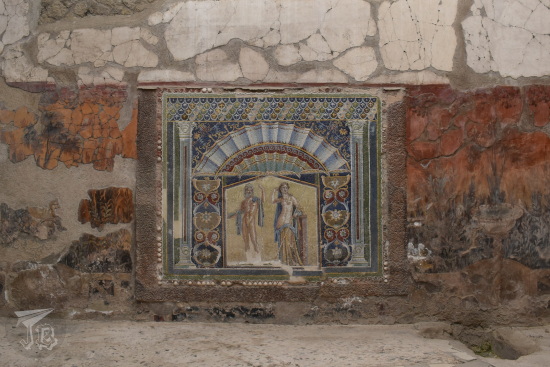
– The mosaics in Casa di Nettuno e Anfitrite or House of Neptune and Amphitrite.
Mosaic covering a foutnain in Herculaneum

Casa del Rilievo di Telefo or House of the Relief of Telephus, one of the best preserved structures with a lot of paintings, even on the columns.
Herculaneum: House of the Relief of Telephus

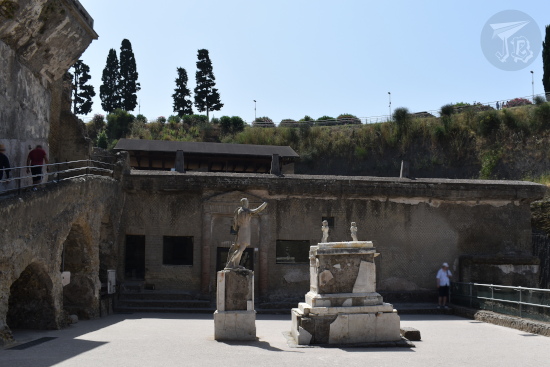
Terrazza, statua e altare di Marco Nonio Balbo or Terrace, statue and altar of Marcus Nonius Balbus.
Terrace, statue and altar of Marcus Nonius Balbus

It was noon when I decided to retreat towards the museums, which hold only small trinkets and some jewellery. Just as I was thinking that the Herculaneum inhabitants could rest in peace instead of being on display, I reached the Boat Pavilion Padiglione della Barca, which holds a carbonised boat where some of the residents tried to escape. There are panels which explain that they are planning to make copies of the three hundred something skeletons they found at the coastline and place them in the same spot they were found. So much for resting in peace.

I went back towards the station and took a train back to Napoli, where I transferred to the underground and headed off to the National Archaeological Museum – Museo Archeologico Nazionale di Napoli (MANN). I had read online that the ticket was valid for two days, so the plan was to grab a leisure lunch there, wander around for a while in the air-conditioned areas of the museum, then come back the following day. Unfortunately, the ticket read that it was only valid for one admission that day. I had to reconsider my plan then. It was barely 13:30, so I decided to go right into it. Also… there was no air-con.

The roots of the MANN are the so-called Collezione Farnese, or Farnese Collection, one of the first collections of the Greco-Roman Antiquity. The original collector was Pope Paul III when he was still Cardinal Alessandro Farnese (1568 – 1549). In the 18th century, the marbles were inherited by Elizabeth Farnese. Her son Charles would become King of Naples, Sicily and Spain, and was the great sponsor of the excavations in Herculaneum and Pompeii. The mosaics and frescoes taken from these two cities are the second core conforming the museum.

The Farnese Marbles are fantastic. It’s been a while since a work of art took my breath away, but some of these did. The collection preserved a lot of Roman copies of Greek original sculptures, and although a lot of them were restored during the Renaissance, I enjoyed the gallery a lot. Some favourites were the Resting Hercules, Atlas, Apollo playing the lire, and of course the Farnese Bull.

Farnese Marbles: Farnese Hercules, Farnese Bull, Farnese Apollo, and Eros with a fish

The Hercules sculpture shows the hero leaning on his club after having finished the last of his tasks – the apples of the Hesperides garden, which he holds behind his back. Atlas kneels, holding the world. The Farnese Bull is the biggest surviving sculptural group from antiquity – the twin brothers who founded Thebes, Zethus and Amphion, tie their stepmother Dirce to the horns of a wild bull as revenge for how she tormented their mother. The original is attributed to Appollonius of Tralles. Apollo playing the lire is sculpted in two marbles, one darker for the tunic and a white one for skin and the lire – and one of the few sculptures I can share on social media as he is totally clothed…

After the Farnese marbles, I explored the rest of the classical sculptures. Then I moved onto the second floor to the collection of mosaics from Pompeii and Herculaneum. When I was little I saw a mosaic of fish in my history book, and I had always wanted to see it. I finally did, along with one that implies “beware of the dog”. I did not get to see the Alexander the Great mosaic because it was being restored (though I did see the in-situ reproduction in the Casa del Fauno / House of the Faun). There was even a whole fountain with columns that were almost completely covered in mosaics.

Mosaics from Pompeii and Herculaneum

At the end of this area stands the “Secret Cabinet”, which holds the images and sculptures from Pompeii and Herculaneum that were over the centuries considered “too pornographic to be seen” – including penis amulets and a sculpture of “Pan making love to a goat”.

I continued on to the second floor, to “Archaeological Naples”. In this area there also were sculptures, a lot of bronzes too – including a beautiful Athena and a Drunk Faun. The central hall of this floor held an exhibit about Alexander the Great and his influence in the Mediterranean. It hosted the Farnese Atlas and the Artemis of Ephesus. Afterwards, I went to the Protohistory and Prehistory area – which did not hold many attention-grabbing artefacts, especially consider how spectacular everything else was.

Sculptures in the Napoli Archaeological Museum

By this time, I needed a break. It was a bit later than 15:00 so the café was practicable. I got myself a lemon sorbet and… fried pasta pasta frittata, a typical street food bite. Which is basically a croquette made out of pasta. It was surprisingly good, actually.

Pasta fritatta

I went back upstairs – I was tired by now, and if I had had the chance to do the museum in two days, I would have left now. But I did not, so I continued towards the exhibitions of “everyday life” and frescoes of Pompeii and Herculaneum. These include dishware, glassware, decoration, mirrors, jewellery… and of course the frescoes, including the Portrait of Terentius Neo and his Wife, that were taken down from the walls of the houses during the 18th century in order to preserve them. They feel weird as they hang on the blank walls – framed, far away from the place they used to be. I know it can’t be, but it would be cool to see them all on site. While I could really imagine how some of the houses would have looked 2,000 years ago when I was in Pompeii, I could not imagine the perfectly-framed frescoes on the walls. It was a bit unsettling.

Pompeii and Herculaneum frescoes

I bought the extra ticket to see the Magna Graecia Collection. At first I was not convinced because after a while all the Greek pottery starts looking the same to me. You get to wear shoe coverings in order to walk in there, at first I thought it was not to upset the marble floors, but then I walked onto the mosaics and wow. Just wow. I mean… after a bit you don’t even realise that you’re supposed to be looking at pottery and just keep staring at the floors…

Magna Graecia Mosaic

I ended the visit with the Egyptian collection, where – on top of it being the only area of the museum with air conditioning – I saw one of the crocodile mummies that I might have seen at Kom Ombo.Finally, after basically snooping round the whole museum including the gardens, I headed back to the station area to buy some food and go get some rest in the hotel.


For the sake of completion, here is a relation of all the spots I visited in Parco Archeologico di Ercolano or Archaeological Park of Herculaneum:
Boathouse and shoreline
Access bridge
Casa dello Scheletro or House of the Skeleton
Casa dei Galba or House of Galba
Terme Maschili or Male Baths
Casa dei Due Atri or House of the two atriums
Sede degli Augustali or Hall of the Augustales
Casa dei Salone Nero or House of the black salon
Bottega del Plumbarius or Shop of a plumbarius (metal worker, welder or blacksmith)
Casa del Bel Cortile or House of the Beautiful Courtyard
Casa di Nettuno e Anfitrite or House of Neptune and Amphitrite
Terme Femminili or Female Baths
Casa Sannitica or Samnite House
Casa del Tramezzo di Legno or House of the Wooden Screen
Casa del Papiro Dipinto or House with the painted papyrus roll
Casa dell’Alcova or House of the Alcove
Casa dell’Erma di Bronzo or House of the Bronze Herm
Casa dell’Ara Laterizia or House of the Brick Altar
Casa dell’Atrio a Mosaico or House of Mosaic atrium
Casa dell’Albergo or House of the Inn
Casa del Telaio or House of the Tailor
Casa del Mobilio Carbonizato or House of the Wooden Furniture
Casa dell’Apollo Citaredo or House of Apollo the Lyre-player
Casa del Bicentenario or House of the Bicentenary
Pistrinum di Sextus Patulcius Felix or Bakery of Sextus Patulcius Felix
Taberna di Priapo or Bar of Priapus
Casa della Stoffa or House of the Cloth
Casa dei Cervi or House of the Deer
Palaestra
Casa del Rilievo di Telefo or House of the Relief of Telephus
Terrazza, statua e altare di Marco Nonio Balbo or Terrace, statue and altar of Marcus Nonius Balbus
Terme Suburbane or Suburban baths
Area Sacra or Holy Area
Sacello di Venere or Shrine of Venus
Grande Taberna or Large bar
Casa del Gran Portale or House of Large Portal
Thermopolium (food shop)
Casa di Aristide or House of Aristides
Antiquarium (museum)
Padiglione della Barca or Boat Pavillion

19th July 2023: Pompeii {Southern Italy, July 2023}

Pompeii [Pompei] is a town belonging to the greater Napoli Metropolitan Area. There is not much there “except” for the ruins of the ancient city that names the area. Pompeii Scavi (ruins of Pompei) or Parco Archeologico di Pompei (Archaeological Park of Pompeii) is the name given to the ruins nowadays, which belongs to the Unesco Heritage Site Archaeological Areas of Pompei, Herculaneum and Torre Annunziata.

The ancient city of Pompeii dates (dated?) back to an Oscan settlement in the 8th century BCE. The Etruscans arrived around 524 BCE, and the Greeks in 450 BCE. From the year 340 BCE, Pompeii was controlled by the Romans, first tacitly, then as a confederate, with its own administration and language. After it tried to rebel, it was forcefully conquered and made a colony in the first century BCE. The different civilisations expanded the city according to their own tastes.

The preservation of Pompeii makes it possible to appreciate the different styles in decoration, in mosaics, but chiefly on the frescoes in the houses. The first decoration style was called “incrustation” and it made the wall look like it was composed of actual marble bricks when it was in reality flat. The second style was the “architectural” one – areas of the wall were painted to look in relief, with or without decoration, such as a brick with a still life decoration on top, an open door, a window or a garden. The third style was the “ornamental” – there was a central element and all around it, linear separations and smaller motifs occupying whole walls and even rooms. The fourth and final style was called “Intricate” because it just fills the walls with ‘main’ motifs – the more the merrier, with as many colours and decoration as possible.

In the year 62 CE, there was an earthquake that heavily damaged the city. The citizens were not too worried, because quakes were common in the area. Reconstruction started. By the year 79 CE, the city had thousands of inhabitants. In October, Il Vesuvio, the volcano known as Mount Vesuvius, erupted. The eruption happened in the early afternoon, which caused most of the population to flee during the first hours. The ones that stayed behind were killed instantly when a cloud of volcanic gas with a temperature higher than 300 ºC collapsed onto the city. By the end of the eruption, Pompeii had been buried by 20 m of volcanic ash, whose weight caused most roofs to collapse.

Romans never came back to Pompeii, though after the eruption some valuables were salvaged, some excavations were made and building materials were taken. Subsequent eruptions covered the city completely, until the first walls were excavated in 1693. When Herculaneum was discovered in 1738 while building the Royal palace for the King of Naples (later Spain’s Charles III), the king was greatly interested and he sponsored excavations, which continue even today. The archaeological importance of Pompeii resides on the fact that this was not a fancy town, but an everyday one, which can teach us a lot about how Romans really lived.

Nowadays, about two thirds of the city have been uncovered and most areas that are not being actively worked on can be visited. Scientists and experts say that the primary goal at the moment is conservation rather than uncovering the rest of the site. Pompeii was not destroyed by lava, it was only covered in pumice and ash – lava would have disintegrated the whole city. As it became buried, time stopped. Unfortunately, as soon as anything is unearthed, the clock starts again. Furthermore, there are problems with conservation, bad restoration techniques, vandalism, theft and overtourism.

Another thing that makes Pompeii special was that “remains” of the victims were found – skeletons encased in a “hollow” where the body decomposed. Giuseppe Fiorelli came up with the idea of making casts out of those moulds in 1863 – though many of these casts were destroyed or damaged during WWII bombings. Some of them, or their copies are displayed through the site. I personally find it a bit morbid, but they are useful for archaeologists, apparently. It is calculated that around a thousand people perished in the eruption, but 90% of the population survived.

I woke up early to take the train to Pompeii – the modern town next to the ruins has taken the name of the ancient city. While most people take the train at Napoli Garibaldi (the easiest train station to reach on public transport), I was coming on foot. The terminus, Napoli Porta Nolana, was just three minutes further and the ticket price was the same, so I went there to hopefully be able to sit. I was successful and I rode the Circumvesuviana Line 1 8:09 train to Sorrento, which reached the station Pompei Scavi-Villa dei Misteri a bit after 8:30. After a couple of minutes, I was in line to get into Pompeii Scavi. As I had an entry ticket booked (and printed), once gates were open at 9:00 I was inside the archaeological park in a couple of minutes (my first picture is timestamped at 9:04).

I spent in Pompeii from 9:00 to 15:30, most of it walking, though I made a stop around noon for a snack, and I also had multiple breaks to apply sun lotion. The strada (streets) have little shade, and the few trees are planted on recreated orchards and gardens, and you can not sit under them. Also, there is a system of rotation on houses – not all of them are open, and none are open all the time. A few are the “house of the day”, which in my case (Wednesday) was the Terme del Foro (Forum Baths). There are also a lot of fountains throughout the site, and the water is drinkable.

A typical Roman house – where most people lived – were called insulae. They were “apartment blocks” with up to seven floors. The ground floor usually had a shop, and the owners lived right above, with windows and balconies. The higher the floor, the worse the apartment was – smaller and with fewer to no windows.

Rich people, in contrast, lived in a type of house called domus (villa for extremely wealthy individuals). A domus was a single-storey house built around an wide area, the atrium which had an opening in the celling with a small pool underneath to gather rainwater. This was the most important place of the house and it hosted a place to worship the ancestors or the household gods. Most of the rooms in the house led to the central atrium – the bedrooms (cubicula), dining room (triclinium), the study (tablinum) and the kitchen (culina). At the rear of the house there was an orchard or garden (hortus) and at the front, the shops (tabernae ). The domus was accessed through the fauces, a small decorated corridor. Bigger houses had a second building with a sort of patio (peristylum) similar to a cloister, with columns, plants, and a pond in the middle (piscina). At the very end there was a resting area (exedra).

The walls were decorated with frescoes, and the floors with mosaics. In Pompeii, both are damaged in most houses due to the earthquakes and the weight of volcanic ash and pumice, but they are still the best examples we have of Roman domestic frescoes. A lot of them have been removed and are in the Naples Archaeological Museum – only the most recently-unearthed ones are still at their original place. It is an interesting debate though – should they have been removed? If they had not, they might have got destroyed by decay and insufficient protection. But now they hang in the museum, devoid of all context, and it is weird.

A problem with Pompeii is the sheer amount of people that visit it – another paradox: maybe fewer visitors should be allowed, but it is visitor revenue is what keeps the place working and pays for conservation, research and further excavations. The best was the first 30 to 40 minutes, when I even had the Santuario di Apollo and the Casa dei Mosaici Geometrici all for myself.

All in all, the city is awe-inspiring. It’s not only that it has a huge architectural and archaeological value. It also shows the will of humanity to learn and discover, and at the same time, how small we are in comparison to nature – some of the originally-flat mosaics are now wavy due to the volcanic earthquakes, and the mosaics are cracked.

The streets are wide and the pavements are raised. There are raised crossings that would have slowed down the chariots and allowed people to cross without getting wet when it rained, or hm… when people… dumped… stuff there. Today, aside from tourists, there are lizards – absolutely indifferent to tourists – and cats – absolutely adored by tourists.

Some highlights of the visit included:

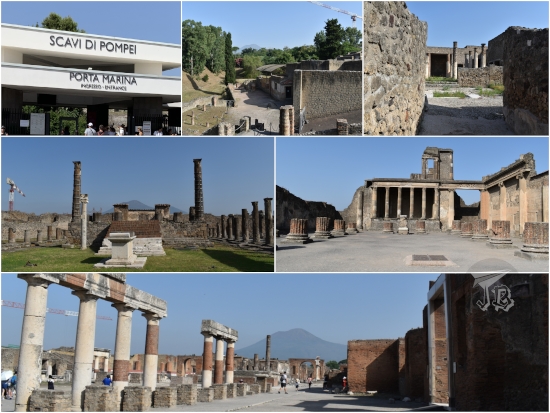
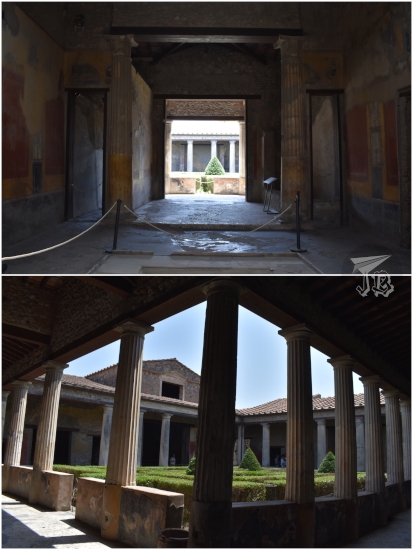
Casa di Romolo e Remo or House of Romulus & Remus; Santuario di Apollo or Temple of Apollo; Basilica (building where politics were discussed); Foro or Forum. Some sights even have Il Vesuvio looming about.
Collage showing some buildings of Pompeii

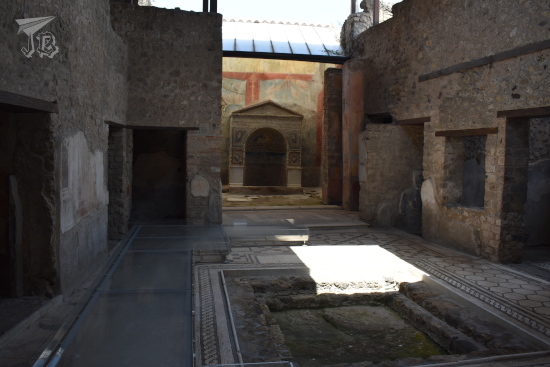
Casa del Menandro or House of Menander, with an almost completed atrium and peristylum, with great frescoes in situ.
Pompeii Casa del Menandro - hall and garden

Casa dell’Orso Ferito or House of the Wounded Bear, with incredible mosaics (closed, unfortunately)
Pompeii House of the Wounded Bear

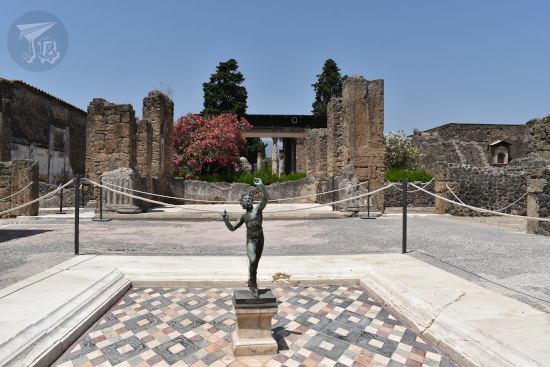
Casa del Fauno or House of the Faun, one of the most famous houses, and original home to a mosaic depicting Alexander the Great in battle.
Pompeii House of the Faun

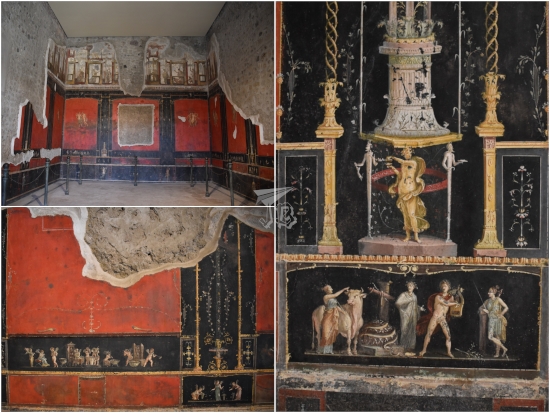
Casa delle Nozze d’Argento or House of the Silver Wedding, with fantastic frescoes, and tiny details, extremely detailed.
Pompeii House of the Silver Wedding

Casa dei Dioscuri or House of Castor & Pollux, in which the columns still keep some of the painting.
Pompeii House of Caxtor and Pollux

I visited around 75 buildings, and entered as many as I could. Towards 15:00, I again had a few buildings for myself, or with fewer people, and I wish I had had the energy to continue on. Unfortunately, the inner restaurant was super-full whenever I checked – which I did repeatedly between 12:00 and 15:00. However, by 14:00 I knew that I was overdoing it, so I started my retreat. I still had to see the Antiquarium or Pompeii Museum.

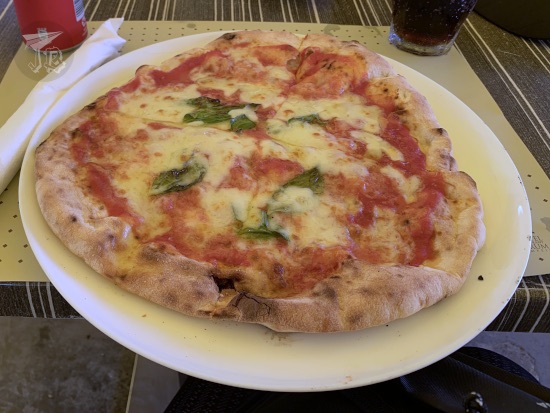
After I left the site, I stopped for a very late lunch (or a very early dinner) at a restaurant just outside the ruins. One of the waiters did not want to give me a table – or actually acknowledge me at all, I think this is the first time that I have actually felt the whole “solo travellers not welcome” echo, However, another one sat me, and I ordered the famous pizza Margherita, which is the big pizza in the Naples area. Not the Napoletana one, go figure.

A whole pizza Margherita

I took the train back, and I was in Naples with time to do something else. I had eaten and I was feeling better, but I thought that I had overdone it, and was worried about crashing the following day if I was not careful. Thus, I took a trip to another supermarket and went back to the hotel for a shower.


For the sake of completion, here is a relation of all the spots I visited in Parco Archeologico di Pompei or Archaeological Park of Pompeii:
Casa di Romolo e Remo or House of Romulus & Remus
Santuario di Venere or Temple of Venus
Casa di Trittolemo or House of Tryptolemus
Basilica (building where politics were discussed)
Santuario di Apollo or Temple of Apollo
Comitium ed Edifici Municipali or Hall of the Elections and Municipal buildings
Foro or Forum
Casa dei Mosaici Geometrici or House of the Geometric Mosaics
Palestra Degli Iuvenes or Gymnasium of the Iuvenes
Casa dei Cinghiale or House of Vesbinus
Terme Repubblicane or Republican Baths
Foro Triangolare or Triangular Forum
Santuario di Atena ed Eracle or Temple of Athena and Heracles (Greek Doric Temple)
Teatro Grande or Large Theatre
Quadriportico dei teatri / Caserma dei Gladiator or Quadriporticus of the theatre / Gladiator Barracks
Ingesso al Teatro Piccolo od Odeon or Entrance to Little Theatre or Odeon
Domus Cornelia or House of Cornelius Rufus
Tempio di Asclepio or Temple of Aesculapius
Casa degli Epidii or Casa de Marco Epidio Rufo or House of Epidio Rufo
Casa del Citarista or House of the Citharist
Casa de Casca Longus or House of Casca Longus
Fullonica di Stephanus or Fullery of Stephanus
Casa del Larario di Achille or House of the Lararium of Achilles
Casa del Criptoportico or House of Cryptoporticus
Casa di Paquius Proculus or House of Cuspius Pansa
Casa di Fabius Amandio or House of Fabius Amandus
Casa del Sacerdos Amandus or House of the Priest Amandus
Casa dei Casti Amanti or House of the Chaste Lovers
Casa e Thermopolium di Vetutius Placidus or House and Thermopolium of Vetutius Placidus
Casa di Giulio Polibio or House of Julius Polybius
Casa del Frutteto or House of the Orchard
Casa di Trebio Valente or House of Trebius Valens
Taberna di Sotericus or Tavern of Sotericus
Casa di Octavius Quartio or House of Octavius Quartio
Casa della Venere in conchiglia or House of Venus in the Shell
Anfiteatro or Amphitheatre
Palestra grande (Exhibition: “Arte e Sensualità nelle case di Pompei” Art / Sensuality in the Houses of Pompeii)
Pradeia di Guiulia Felice or Farms of Julia Felix
Casa del Triclinio all’aperto or House of Summer Triclinium
Casa del Larario Fiorito or House of the Floral Lararium
Osteria del Gladiatore or Inn of the Gladiators
Porta Nocera (gate)
Necropoli di Porta Nocera or Necropolis of Nocera Gate
Casa del Menandro or House of Menander
Casa dell’Efebo or House of the Ephebus
Casa del Criptoportico or House of Cryptoporticus (again)
Casa dei Ceii or House of Fabia and Tyrannus
Casa di Sirico or House of Siricus
Casa di Marte e Venere or House of Mars and Venus
Casa dell’Orso Ferito or House of the Wounded Bear
Casa dei Cornelii or House of the Cornelii
Terme Stabiane or Stabian Baths
Lupanare or Brothel
Arco di Nerone or Arch of Nero
Portico Della Concordia Augusta (Edificio di Eumachia) or Portico of Concordia Augusta (Building of Eumachia)
Tempio del Genio di Augusto or Temple of the Genius of Augustus
Arco di Caligola or Arch of Caligula
Terme del Foro or Forum Baths (this was the “house of the day”).
Casa del Fauno or House of the Faun
Casa della Caccia Antica or House of the Ancient Hunt
Casa di Arianna or House of Arianna
Casa della Fontana Grande or House of the Large Fountain
Casa della Fontana Piccola or House of the Small Fountain
Casa dei Vettii or House of the Vettii
Casa delle Nozze d’Argento or House of the Silver Wedding
Thermopolium (food shop)
Casa di Paquius Proculus or House of Cuspius Pansa.
Porta Ercolano (gate)
Necropoli di Porta Ercolano or Necropolis of the Ercolano Gate
Casa del Poeta Tragico or House of the Tragic Poet
Casa dell’Ancora or House of the Anchor
Casa di C.N. Caetroni Eutychi or House of C.N. Caetroni Eutychi
Torre di Mercurio XI or Tower of Mercury XI
Casa dei Dioscuri or House of Castor & Pollux
Tempio di Giove or Temple of Jupiter
Macellum (food market)
Antiquarium (museum)

30th May 2022: The Slopes of Mount Teide {Tenerife, birthday 2022}

Due to the amount of near-misses, I had started thinking about this as the luckiest unlucky trip in a long time. Unfortunately, this was the day the luck ran out. As I woke up and turned on the phone I received the notification that the cable-car to go up Mount Teide was closed due to bad weather, which was a bit of a blow. I mean, I was in the middle of the natural park, without anything to do within a couple of hours by car as the hiking trails are closed on Monday mornings as it is then when the mouflon population is controlled – using rifles. I did not want to end up shot.

If you consider that the island Tenerife is one big volcano, Mount Teide is the most famous eruptive fissure. Considering it an independent item, it is a stratovolcano. The cone stands around 7500 metres from the sea floor, with an emerged 3715 m above sea level. Its base is located on a previous crater called Las Cañadas. Mount Teide last erupted in 1909, so it is still considered an active volcano, and it hosts a bunch of towns on its slopes, that might get obliterated in an eruption. Aside from being a National Park, the area is a Unesco World Heritage Site.

Historically, an eruption was reported by Christopher Columbus in 1492. Most recent eruptions happened in 2805, 1798 and 1909. Looking back, Mount Teide formed around 160,000 years ago, after the collapse of Las Cañadas. The last summit eruption happened in the 9th century, which caused the black lava blocks that seem to run down the slopes.

The whole point of my being there was going up the mountain, so I resolved to try and do that. I knew there was little chance I could make it to the top even with the access permission, but I would try. I decided to gamble the track Sendero de Montaña Blanca, which is the most typical one. For this, I had a good breakfast and started walking around 9:45 am. The track runs 8 km and starts at an altitude from 2348 m. If you have the permission, you can access the track Sendero de Telesforo Bravo that peaks the volcano at 3718 metres.

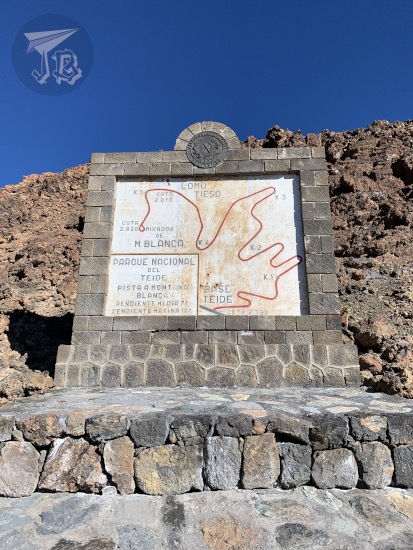
A stone and tile marker, with a map of the trail.

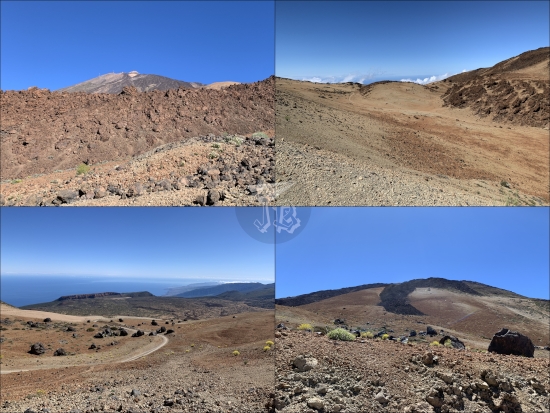
The first part of the morning, I spent on Montaña Blanca. I hiked around 3 km upwards in an hour or so. A park ranger told me that the bad weather was actually strong winds and to be careful. I’d never hiked with wind, so I decided that I would not do anything stupid. As I walked, I went by the accretion balls affectionately called “Teide Eggs” Huevos del Teide.

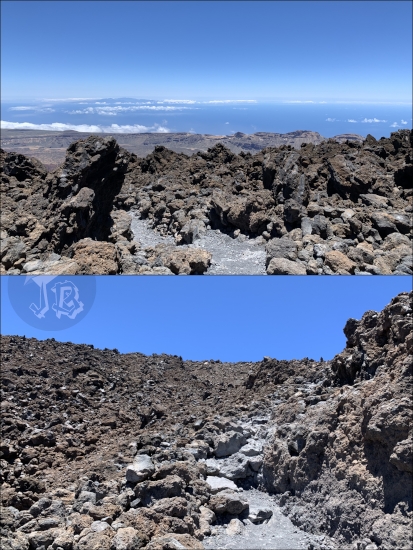
Collage: The Montaña Blanca trail. The landscape is desertic, reddish and brown, and there is barely any vegetation. When turning back, the sea peeks in the distance, and when looking up there are black rocks from an eruption.

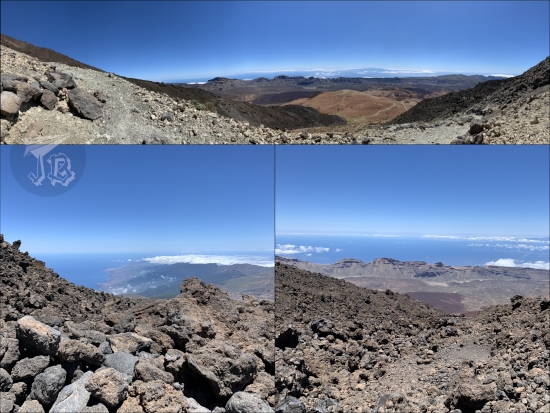
Eventually, I reached the actual foot of Mount Teide, and this is when things got hard – and spectacular. The slope became much steeper and the wind made it hard to move forward. I walked between the two dark petrified lava flows, and could see Montaña Blanca and the Atlantic Ocean beneath.

View from the slope of Teide. Montaña Blanca is underneath, in red-gold. To the sides, the black and dark grey rocks trailing the old lava flows

I reached Refugio de Altavista at 3260 m around 14:00. At this point I was two kilometres away from the next station and 650 m away from the crater. Unfortunately, the elevation was still around 500 m. At this point the wind was very strong and shortly after the refuge I saw an area of the slope I knew I could climb up… but I knew I wouldn’t climb down with such strong wind, not safely. So I realised I had to turn back, even if that meant I wouldn’t see the peak, much less reach it. However, it was the sane thing to do.

Standing in the middle of the two solidified coladas - looking down there are black and grey rocks, and the sea in the horizon. Looking up, only more rocks.

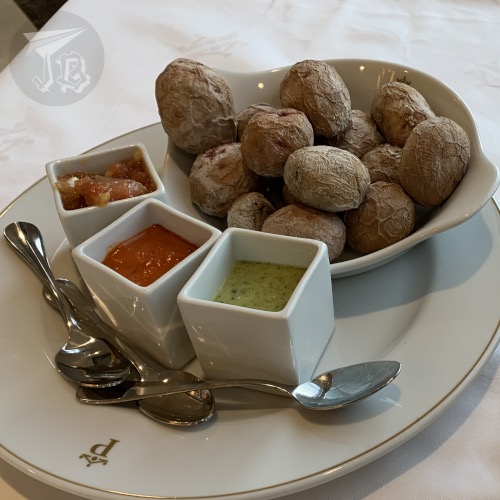
It took me two and a half hours to hike down, and I made it back at the Parador around 17:30. I had a shower and I felt tired, though not as sore as I imagined. For dinner, I tried some local speciality “wrinkled potatoes” papas arrugadas, which are boiled in saltwater, and they are so high-class that can be eaten without being peeled. They come with some dips, a bit too spicy for my taste, but they were delicious.

Small voiled potatoes and three small bowls of sauces. The potatoes are unpeeled and they look wrinkled.

I was a bit bummed that I did not manage to reach the crater, but I think I did a good job, almost 1000 metres up and down. I guess it just meant I had to go back at some point…

29th May 2022: La Orotava, Icod de los Vinos & Parque Nacional del Teide {Tenerife, birthday 2022}

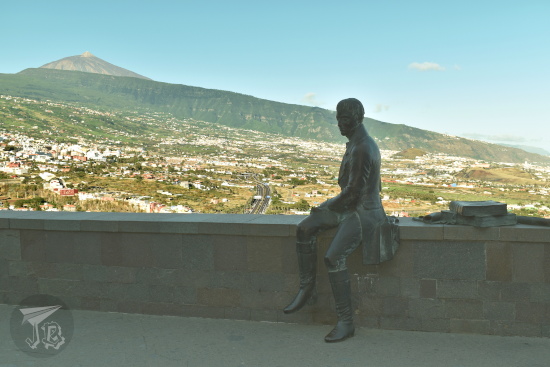
I got up rather early in the morning (especially considering that the Canary Islands are an hour behind my usual time zone) and I was surprised at how many people there were already on the streets of Santa Cruz de Tenerife before 8:30 on a Sunday morning. I drove out of the town and headed north-west, where I came across my first stop – a viewpoint of Mount Teide called Mirador de Humboldt honouring the German explorer from the late 18th century (though I kept thinking that there was a missing penguin opportunity there). The viewpoint overlooks the ocean and Mount Teide, which Humboldt climbed in 1799.

Mount Teide, a volcano, looms in the background. The top is bare and barren, but the slopes look green and fertile, with plantations and some villages. In the foreground, there is a bronze sculpture of Alexander Humbolt, sitting on the low wall of the lookout, and looking to the side.

I continued driving towards La Orotava, the municipality which Mount Teide actually belongs to. After parking the car, I walked towards the historical centre and ended up at the square Plaza de la Constitución, which stands next to the church Iglesia de San Agustín. Mount Teide loomed over the streets, ready to celebrate Pentecost Sunday. And guess what? The main church is called… Parroquia Matriz de Nuestra Señora de la Concepción. The initial hermit church was built in the 15th century, and it was completely rebuilt in the Baroque style throughout the 18th century, though the interior was remade in the 19th century and there was yet another renovation in the 20th century. It is considered the most important building of the Canarian Baroque.

A collage of La Orotava. The buildings are built with white plaster and black volcanic rock. Mount Teide peeks from the background.

The most representative construction in La Orotava is the “house of balconies” Casa de los Balcones. The house was built in the 17th century. The façade shows a front-long balcony on the third floor, and five smaller balconies on the second, all of them made from dark teak wood. The interior holds a museum, but I decided to give that a miss because I reached there at the same time as a very disorganised group of forty or fifty people who were going in at the time.

A colonial house. It is built in white brink. It has three floors. On the ground, there are brown windows. On the first floor, five balconies, with decorated ironwork. On the second floor, a long balcony or gallery in dark wood.

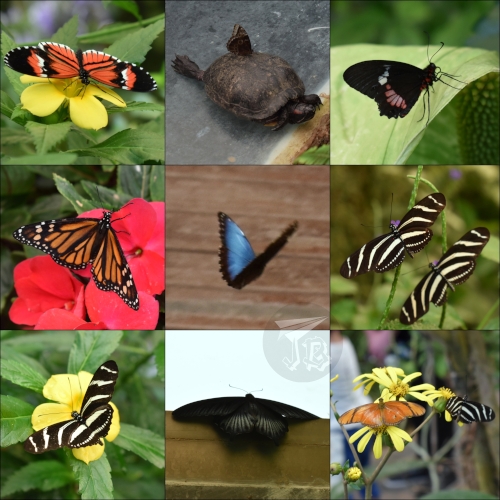
Instead, I went back to the car and drove towards Icod de los Vinos. There, my first stop was the butterfly house Mariposario del Drago, since the ethnographical museum Museo del Guanche is closed.

A collage showing colourful butterflies - red, orange, blue, black, black and white. One of them is chilling on the shell of a turtle, and another one is caught mid-flight. Most are on flowers and plants.

The butterfly house stands next to a botanical park Parque del Drago built around the symbol of the town – and maybe the whole island – the Drago Milenario. This is the largest and oldest specimen of Canary Islands dragon tree or drago (Dracaena draco). Folklore says that it is a thousand years old, hence the name “the thousand-year-old dragon tree”, though in reality, it is probably around 600 years.

The dragon-blood tree. It has a knotted grey trunk and bony branches. Around it there are bright-green palm and laurel trees

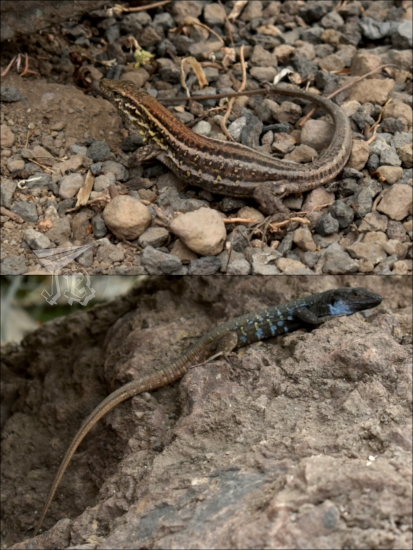
The park, built around the drago, holds local species trying to reproduce the local biotopes with height, there is also a small volcanic cave. It was here where where I managed to catch my first glance at the local fauna – two of the endemic lizards (though not as big as the one I had seen in the museum): lagarto tizón (Gallotia galloti) or tizon lizard, a blue-spotted male and a brown-striped female.

Two lizards. One camouflages on the grey and brown ground. The other on has a brown tail, but the body is black and bright blue

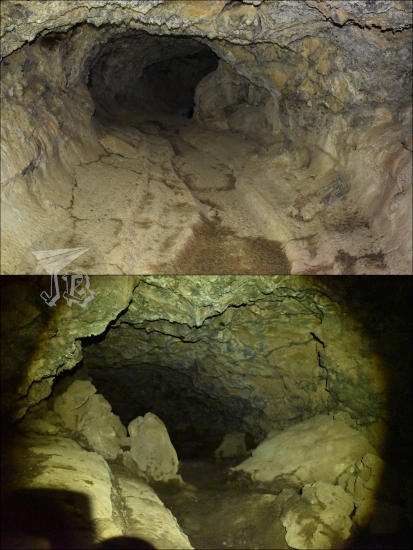
Then I went back to the car to climb up a crazy slope until I reached the visitors’ centre of the lava tube Cueva del viento. A lava tube is a “cave” formed the flowing lava of a volcano. As the outer part solidifies, the inner core continues flowing until it empties the tube. The guided visit is the only way you can enter the tube, so I had reserved that a few weeks earlier.

The visit started with a small introduction in the visitor’s centre, with a lot of “gotcha” questions on the guide’s part. I tried really, really hard not to be a smartarse, but I did sit down on the floor at a point because I did not feel like standing around for twenty minutes. The important information we received was that there were two types of lava that had formed the island of Tenerife: pahoehoe and block lava.

Then we took the centre’s vehicles to the outer area of the cave, where we could see the solidified lava, now turned into stone. Pahoehoe lava is basaltic, it flows slowly, and it is the responsible for creating the tubes. As it flows and solidifies, it creates undulations and wrinkles. On top of it, only small trees and bushes can grow.

Old Pahoehoe lava trails. The rock looks wrinkled or similar to pillows.

Block lava is more acidic, with a higher silica contents, it flows less and creates “blocks” as it solidifies. Pines can be found growing on top.

Pines around an old colada, which seems rocky and broken.

The cave itself was very cool. Unfortunately, there were a couple of families with kids and grandparents, all trying to be braver than the next – and thus acted loud and boisterous. More interesting information – mummified guanche aboriginals had been found in the cave, along with remains of a giant rat and lizard that were the ones reproduced in the Museo de Ciencia y Antropología de Tenerife. It is one of the biggest lava tubes in the world, with up to three levels and maybe 18 km of tunnels, though only a short walk can be had.

Inside the lava tube. It looks alien, like the rock is going to start dripping any second

Back in the parking lot, I had a snack and headed off towards the Parador de las Cañadas del Teide, where I had booked my next couple of nights. On the way, I went through several amazing volcanic landscapes that I could not photograph as I was driving. However, I did stop at several lookouts throughout the Parque Nacional del Teide.

Mirador de Samara.

Pines growing up on the dusty remains of a lava flow. In the background, there are three mountains - three craters of the same volcano

Mirador de las Narices del Teide, which shows the collapse on the mountain during the last known eruption.

A view of the black collapse of lava from the last eruption. Everything is barren, brown and grey, except for a black spillage coming down ominously. The sky is blue in the background, which makes the whole thing look even more bizarre.

Mirador Zapato de la Reina.

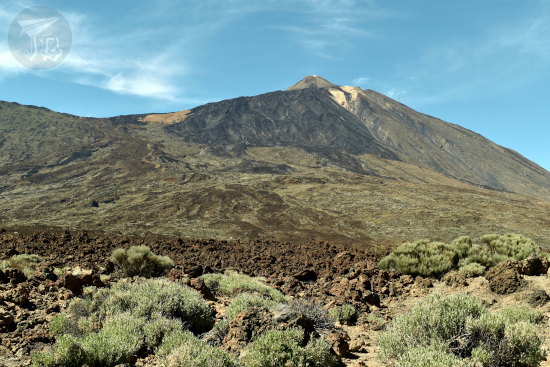
The top of Teide. This is the point where vegetation has become scarce, with low bushes, that creep up the slope. The summit looks naked.

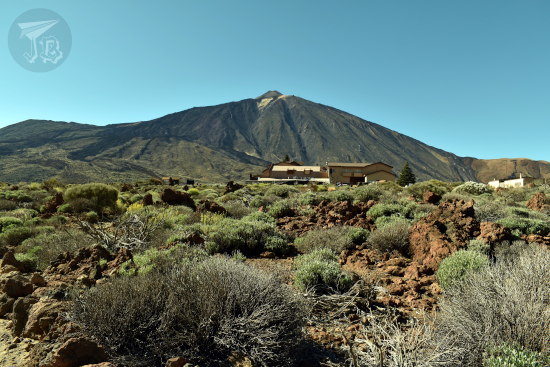
Finally, I arrived in the area of Las Cañadas del Teide or Las Siete Cañadas where the Parador de las Cañadas del Teide stands. I was lucky that the season was good to see the flowering bugloss Echium wildpretii (tajinaste in Spanish), an endemic flora species mostly found on the Teide slopes. After checking in I wandered around the different tracks and paths – Cañada Blanca, Roques de García and Mirador de la Ruleta, which show the different stages of various volcanic eruptions.

Mount Teide rises in the background. It looks wrinkled due to the different eruptions. At its foot, a low building, looking completely out of place. In the foreground, small bushes in grey and green.

Collage: Different rocks and structures created by lava and erosion, the rocks are reddish or grey, and they have weird shapes. The tajinaste is a tall bush, with tiny red flowers, it stands about 1m above the rest of the plants.

I turned in early, and I had booked my dinner in the Parador both nights I’d be sleeping there, so that was an easy one. The staff made it a little awkward though, even if I was not the only solo traveller around. After dinner, I tried to get some pictures of the night sky, but I was unsuccessful.

10th & 11th August 2019: Once in a lifetime – The Great Fuji-san Adventure {Japan, summer 2019}

Mount Fuji aka Fuji-san [富士山] is a special mountain in Japan, both geologically and culturally. Japanese and tourists enjoy Fuji-san in different ways – contemplating it, visiting it, climbing it, going around it… Well… Guess who got into their thick head that they wanted to climb it? raises hand Exactly! Yours truly. I was already toying with the idea back in 2018, but I chickened out. However, as I mentioned before, this one time I wanted to scratch as many things off the bucket list as possible, so… There I went – kinda pushed by a feeling that if I did not do it, by the time I were back in Japan it might be too late as my health is not.… complying lately. But I had not hiked up a mountain before in my life…

Mount Fuji is the most famous mountain in Japan. Its iconic image is everywhere – enamel pins, t-shirts, postcards, classical art… Located around 100 kilometres south-west of Tokyo, it is 3,776.24 metres high, which makes it the highest peak in the country. It was declared a UNESCO World Heritage Site in 2013.

Technically, Fuji-san is neither a mount nor a mountain, but a type of volcano known as a stratovolcano. Its current morphology was shaped by consecutive layers (“strata”) of lava hardening. It is mainly composed by a rock called basalt, and it is one of the few large basalt volcanos in the world. Basaltic lava is rather thick and slow-moving, so there are many lava tunnels and tree moulds created by the eruptions.

Fuji-san, as we know it today, was formed from a previous volcano (Komitake), and became active around 5,000 years ago. Around 2,300 years ago, there was a mud landslide (Gotemba mud flow [御殿場泥流, Gotemba deiryū]) that can still be identified. There have been several historical eruptions, twelve of them between the years 800 and 1083. There was a ten-day eruption of ashes and cinder in the year 864 (Jōgan 6 in the Japanese calendar, based on the different Emperor’s reign; 2019 is Reiwa 1, as current Emperor Naruhito just ascended the throne). In the year 1707 (Hōei 4 in the Japanese calendar), a few weeks after a big earthquake, the last known eruption took place. In the current Japanese Volcanic Alert Level, Mount Fuji is categorised as “Level 1: Potential for increased activity”, which is the lowest level.

Mount Fuji has frequently been depicted in Japanese art, most famously in Katsushika Hokusai’s [葛飾 北斎] Thirty-six Views of Mount Fuji [富嶽三十六景, Fugaku Sanjūrokkei] by, a series of ukiyo-e block prints (which are actually 46). Probably the best known among these is The Great Wave off Kanagawa, one copy of which is displayed at British Museum in London (actually, in 2017 they ran a whole exhibit around it and Hokusai).

Fuji-san is also an important element in the collective spirituality of Japan. In Shinto mythology, the goddess of Mount Fuji is Konohanasakuya-hime [木花咲耶姫]. She is enshrined in Fujinomiya town Fujisan Hongū Sengen Taisha [富士山本宮浅間大社]. Technically, this shrine has owned Mount Fuji since 1609, though there are no current records of ownership. The volcano stands at the boundary between the prefectures of Shizuoka and Yamanashi, and in order to manage the natural area, the Fuji-Hakone-Izu National Park [富士箱根伊豆国立公園, Fuji-Hakone-Izu Kokuritsu Kōen] was established.

Depending on the actual weather, Fuji-climbing season extends from late June or early July to early September. It is not allowed to climb Fuji “off-season” without a permit. However, people do not usually climb the whole mountain, but start quite closer to the summit. There are roads leading up Mount Fuji up to around 3,200 metres, to an area called the Fifth Stations However, no private cars are allowed on those roads.

From the Fifth-Stations there are four trails or paths to the summit, colour-coded to help people find their way, especially on the way down:

  • Yoshida Trail [吉田ルート] (yellow). It starts at the Fuji-Subaru Line 5th Station [富士スバルライン五合目] (Yamanashi Prefecture). This is the trail recommended to “beginners” and thus the most crowded.
  • Subashiri Trail [須走ルート] (red) Head. It starts at the Subashiri Trail 5th Station [須走口五合目] (Shizuoka Prefecture).
  • Gotemba Trail [御殿場ルート] (green). It starts at the Gotemba Trail New 5th Station [御殿場口新五合目] (Shizuoka Prefecture).
  • Fujinomiya Trail [富士宮ルート] (blue). It starts at the Fujinomiya Trail 5th Station [富士宮口五合目] (Shizuoka Prefecture).

When I told D****e that I was planning to try to organise the climb, she did not believe me at first. As she realised I was being serious, she decided that she was crazy enough to want to come with me as “she could not let me do such a thing alone” and actually took over most of the planning, since she had done it before. I would have just found an agency, but I think she was better.

So off we went. As she was working, we organised our hike on a Saturday-Sunday trip weekend trip – and we did not realise until afterwards that we would be climbing during Mountain Day – Yama no Hi [山の日]. We packed snacks, water, and everything we thought we might need – in my case, also gloves which I eventually lost, and a ridiculous amount of layers. D****e was chill, but I was a little worried about all the equipment the Official webpage for Mt. Fuji Climbing said that was needed, including oxygen and helmets. There were also warnings in place, such as your mobile phone battery dying super-fast, or the need for an evacuation plan in case altitude sickness got too much. I was also worried about weather (especially rain) and temperature changes – thus all the layers. She insisted we would be fine.

After a big lunch, we took the Shinjuku Expressway Bus around 16:00 on Saturday the 10th, and arrived at the Fuji Subaru Line Gogōme [富士スバルライン五合目] / Fuji Subaru Line 5th Station at 2,300 m around 17:30. We (she) had booked a mountain hut at the Seventh station so we “only” had to climb two stations, right? Right. Read: wrong.

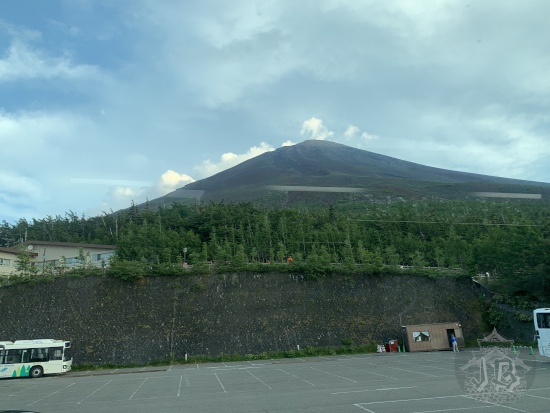
Approaching Mount Fuji: the mountain looms half-hidden by the clouds.

Right about the time of taking this picture it had sunk on me how much of a bad idea this had been (≧▽≦). I really wondered if it was too late to turn back and go home.

A date banner at Mount Fuji 5th Station, reading 2019 08 10

My first step was buying a staff – that we nicknamed the “Fuji-climbing stick”. The idea is that you use it to feel your way around and make sure that you step on solid ground, and especially when you hike down. However, (you’d never guess), you can get stamps burnt into the wooden stick as you hike up – usually for 300 ¥. Climbing Fuji can get expensive… D****e had chosen the Yoshida Trail [吉田ルート] for our ascending side (noborigawa [登り側]). And so… off we went.

From the Fifth Station, looking up at the summit.

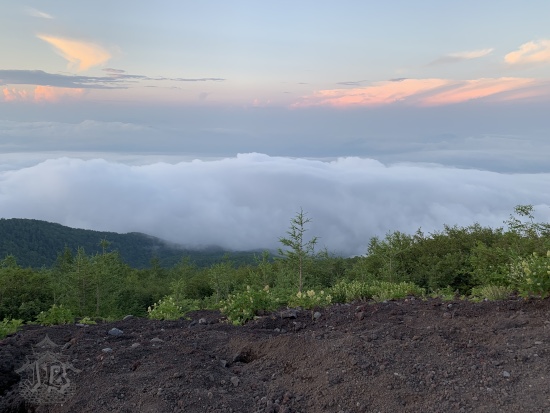
From the Fifth Station, looking down at the car park and a sea of clouds underneath

We started off climbing at around 18:00. Between the Fifth (2,300 m) and the Sixth Stations (2,390 m), you walk along some dirt paths in the forest, and there isn’t really that much “ascension”. As there was also light, the first hour was easy enough. This area is crowded due to all the “visitors” going for a “walk” from one of the Fifth Stations to another. We actually saw someone using up their oxygen at this point. That was weird.

From the Sixth Station there was a first zig-zag upwards, with paths held up by some dams. This is one of the parts I found the hardest, as it is the same inclination all the time and I was not warmed up yet. Then, sunset came, and while it was pretty, it brought darkness upon us (yeah I’m being literary on this). Not that I had a problem with actual darkness, but other people’s torches and headlights kept blinding me, which made the most difficult parts hard to climb – because some people are idiots who point their lights forward and not downwards, where the ground is. Sheesh. There were parts that were just a gentle incline up, while others were stuck rocks or lava flows that you had to climb with your hand and feet.

At the Seventh Station (2,700 m), the path changed and we started. Though there were some slopes, there were also stuck rocks and lava flows that I had to climb with my hands and feet. Fortunately, I could make use of the short stops we made to stamp my staff. Workers of the Mountain Huts use hot irons to burn the stamp into the wood. I think I got all the ones I could on my way up (no stamps on the way down).

The sea of clouds at the foot of Mount Fuji

Distant lights in the night, down

Mountain huts [富士山の山小屋, Fujisan no yamagoya] are tiny establishments where you can get some food or spend the night for around 10,000 ¥. They often require reservations, usually in Japanese, that is why D****e took charge of that part. Some of them have a bin for rubbish – because you can’t dispose of trash on the slopes, you have to take back what you brought in. They have toilets too, and require a tip. Most of them follow an “honour system” with a small coin box, but some have a guardian to collect the money.

We continued upwards until we made it to our Mountain Hut, Shichigōme Torii sō [七合目 鳥居荘], the Seventh Station’s Torii-so at around 21:00. We had been told it was the one with the red torii, and it was a sight for sore eyes. It stands at 2,900 metres high, closer to the Eight Station than the Seventh – we had expected to find it sooner due to the name.

A torii gate lit up in the dark

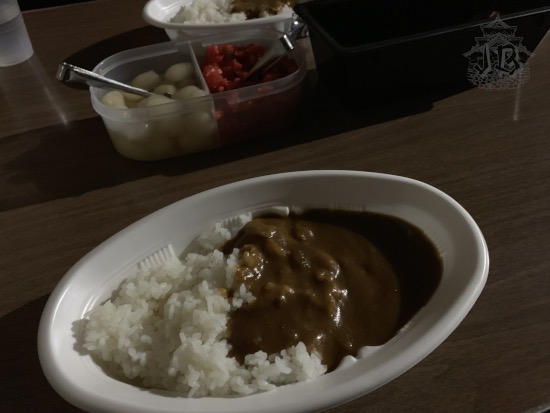
D****e had booked a bed and a meal. As we came into the hut, our staffs and backpacks were hung over the door, and we were given bags for our shoes and personal effects. We had a small riff-raff with the owners, because they claimed that we had arrived too late for food. However, D****e argued that the webpage said nothing about a time limit. Thus, we got some curry and rice as the dinner we had booked.

A dish of curry and rice.

Around 22:00, we used the toilet, and then we were shown to the common dormitory – the bed bunks are basically a line of futons put together so you share a blanket with the person next to you. The idiot I had to share with decided to lie on the blanket instead of under it, so she had me uncovered half the time until she left.

Thankfully, at around 23:00 there was a call for people who wanted to set off in time to see sunset from the summit, and she got going. Between getting uncovered, and lying down too soon after food, I started feeling queasy. I freaked out a little. I started turning in my head that I was going to get sick and not get to the summit and have to be evacuated. D****e helped me calm down and I managed to get a few hours of sleep.

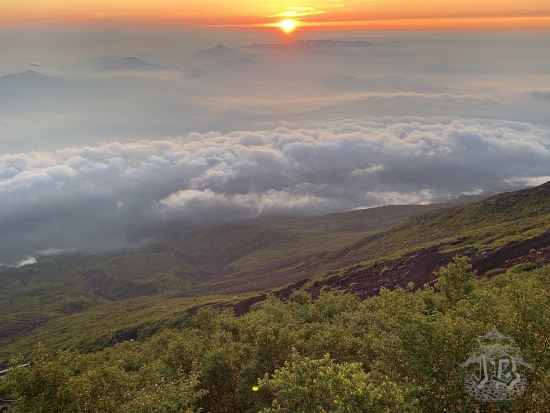
But just a few. We were woken up by the noise around us around 4:15. I felt strangely not tired, and D****e indulged me. Thus, we got up and went outside to see sunrise. Sunrise from Mount Fuji!!! I mean… I can’t even. Unfortunately (and ironically) we left too early to get the stamp from our own hut! We continued our way and had breakfast at the next big rock where we could sit down.

Sunrise from the slopes of Mount Fuji.

After coffee (yes, I’m addicted enough to carry coffee to Mount Fuji), we went on hiking. To be honest this second day was not as bad as I had imagined – as in I was rather convinced that I was not going to be able to make it, especially during the night freak-out. My painkillers kicked in and I only felt a small buzz in my ears as pressure changed.

It did not take too long to arrive at the New Eighth Station (3,100 m). Once again the trail became irregular, which on one hand was tiresome, but at the same time, it was not tedious, so it did not feel as hard. Gloves were useful for this part of the hike, as I could hold on to things. We continued up to the Original 8th Station (3,400 m).

After the Original Eighth Station the trail became path-like again, with torii and stairs and fewer rocks you had to climb over, but a bunch of smaller ones that you had to step up on. Here I learnt to appreciate the actual usefulness of my staff. Vegetation disappeared gradually until the ground was barren.

I think I lost my gloves at the Ninth Station. We saw a group of people evacuating an injured / ill climber – we mentally awarded them like a million karma points, and after getting the injured person to help, they happily went back up again. One of them told us their group does it every year. I remember hugging some torii on the way, and a thousand thoughts twirling in my head.

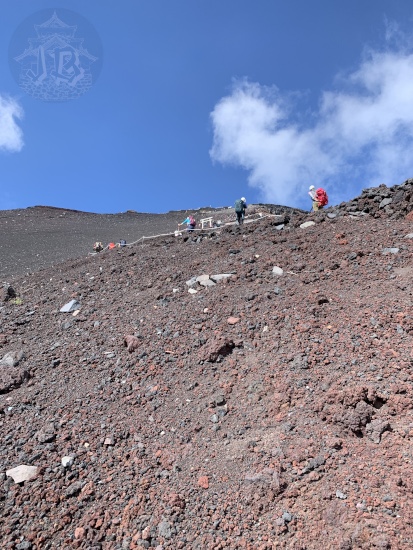
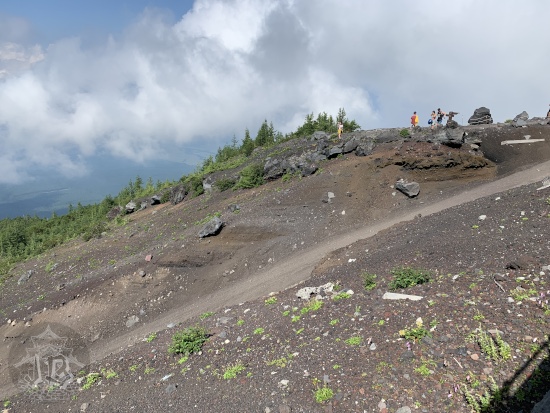
Area closer to the summit of Mount Fuji. There is no vegetation and the ground looks reddish and more like gravel than actual rock.

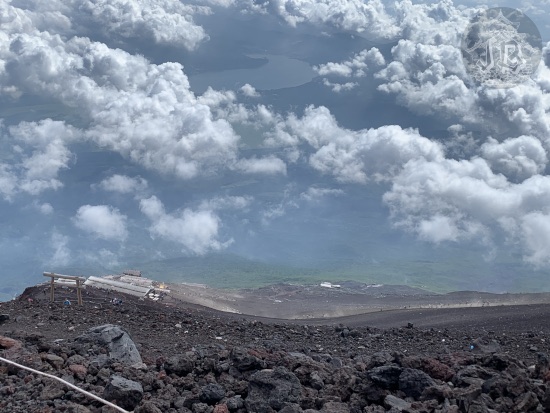
Looking down from the barren area, there are clouds and a river at the foothill

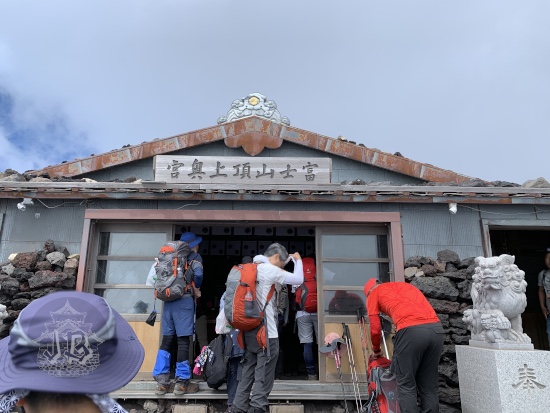
And then we made it. Around 11:00 we reached the rim of crater. I could not believe my own eyes when I stepped in front of the shrine Asama Taisha Okumiya Kusushi Jinja [淺間大社 奧宮 久須志神社] and Fuji-san Chōjō Yamaguchi-ya Honten [富士山頂上 山口屋 本店] aka Top of Mt. Fuji Yamaguchi Shop. I had made it. I had beaten my own limits, and reached the crater.

Entrance to the Temple on the Summit of Mount Fuji

Online certificate that you can download using a QR from the Top. It has the date as August 11 2019

Of course I needed to get all the stamps and the shuuin and the exclusive Coca-Cola bottle. We decided not to go around the crater to the highest point, just a handful of metres higher, because it would add some 90 minutes to our trek, and we preferred to just hang around where we were for that long. Because I was at the freaking crater of Mount Fuji! I was the Kami of the Mountain.

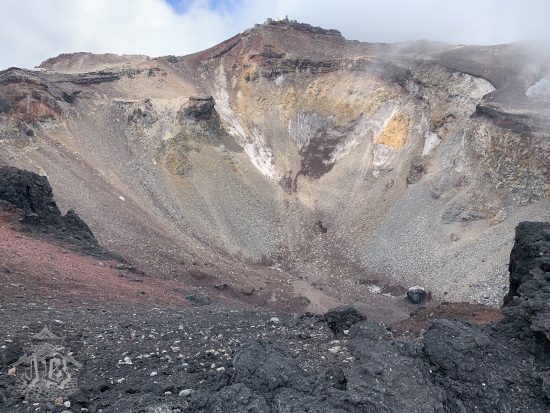
Brim of the crater of Mount Fuji

Crater of Mount Fuji

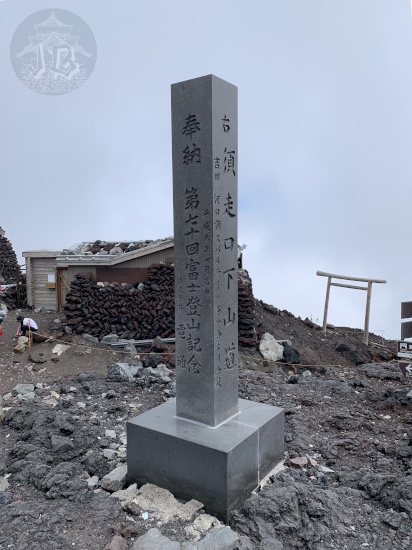
Stone marker at the summit

Cheers with two Mount Fuji exclusive Coca-Cola bottles

Walking around the crater would have been great, but we would be hard-pressed for time for our bus if we took too long. D****e asked me what I wanted to do, and I was happy staying around the crater taking pictures and enjoying the feeling. After an hour or so, we set on our way back down – the trail was a bulldozered zig-zag of gravel, boulders and volcanic sand, and it was even more exhausting than the way up.

It was tricky not to slide and fall. It took us about three hours until we were back to the forest area and the Sixth Station. We reached our Fifth Station around 15:30. I did not fall even once – thank you, Fuji-climbing boots from the Decathlon Children Section for not letting me down, literally!! I also acknowledge that we were super-lucky with the weather, we only had a few clouds just under the crater, and it was not too cold even for me – and no rain, which would have made the experience miserable.

The path down, bulldozered into a straight line.

We actually made it with some time to catch our bus, so we looked at the souvenir shops and Fujisankomitake Jinja [冨士山小御嶽神社].

A colourful and crowded shrine. A lot of the tourists in front of it are wearing shoes that were definitely not made for climbing.

My made-for-climbing shoes, and lower jeans, which were originally blue, looking orange due to the volcanic dust.

As we left, we could see Mount Fuji in all its glory, and I could not believe that I had actually been up there! The total experience had taken a bit over 27 hours, and it was exhausting but exhilarating.

View of Mount Fuji from the bus

However, the downfall had to come, and it came in the bus, about 20 minutes into the ride home – once I stopped moving, my body completely shut down in pain. My back cramped, headache hit, left knee got stuck, and the road trip was horrible. I did not want to have any dinner even if I knew I needed it, but a hot pot in the conbini managed to draw me and it was exactly what I needed!

Hot pot with vegetables, mushrooms and pork

Walked distance: 10th: 9988 steps / 7.14 km; 11th: 21107 steps / 15.1 km. However! The damn watch does not take into account that I CLIMBED A VOLCANO!! I mean, come on! Some of those steps had a 70 cm difference in height! I managed to do it, and I feel damn proud of myself for it, and I will forever proudly display my Fuji-climbing stick as proof of the feat. Also, just so you know 11th of August is Yama no Hi [山の日] (Mountain Day) so this was ironically well-timed, even if by pure chance!

The walking cane I used, covered in hot-iron stamps.

I know that hundreds of people climb Fuji-san every year, but for me those almost 3,776 metres represent something special. It was my very own challenge, something I never thought I would be able to do, and yet I managed. I was extremely proud of myself. I think it helped me become more adventurous, as I found out that I could really push my limits. There was a price to pay afterwards, yes. But I had made it and I don’t regret it (I did regret it a bit the following day going down the stairs though. But not much). I was the Kami of the Mountain.

21st July 2017: Beppu – Hell day~ (in a good way) {Japan, summer 2017}

Beppu is, as I said before, known for having a lot of volcanic vents. It has decided to exploit this as a tourist resource. Beppu is still trying to open up to foreigners. It’s trying, at least partially. So cheers to the nice people.

The main attraction are the Jigoku [地獄] or hells, which are, depending on who you ask, seven, eight or nine. I visited eight of them. They are spectacular hot springs and vents which are too hot for bathing but really interesting to look at. The whole pack is called Beppu Jigoku Meguri [別府地獄めぐり]

I got myself a map, bought a ticket pack and a bus pass, and set off to the bus. Most of the jigoku are located in the Kannawa [鉄輪] District, but two of them are pretty far away, in Shibaseki [柴石] (2 km is far in the boiling summer, if the weather had been nicer, I would have walked back and forth).

I visited the Onishibozu Jigoku [鬼石坊主地獄] (Hell of the Demon-monk) which is a boiling mud puddle and a strong sulphur smell. I did not manage to get any bubble exploding, but the idea is that the bubbling mud looks like a monk’s shaved head.

Second I headed walked into the Umi Jigoku [海地獄] (Sea Hell), which is a turquoise pond of boiling water with a small shrine. It also has a smaller reddish pond to one of the sides.

After this I took a break to have a made-in-hot-spring-water pudding and have something to drink, just because I could. It was delicious.

And there was Onsen Jinja [温泉神社] (Hot Spring Shrine) to snoop around, too!

Third, I dropped by the Yama Jigoku [山地獄] (Mountain Hell), which comes off from the mountain slope and complements that it is not the most spectacular one with having a small petting zoo, where I somehow ended up feeding a capybara. Don’t ask me XD (This hell is independent, so you have to pay extra to come into it).

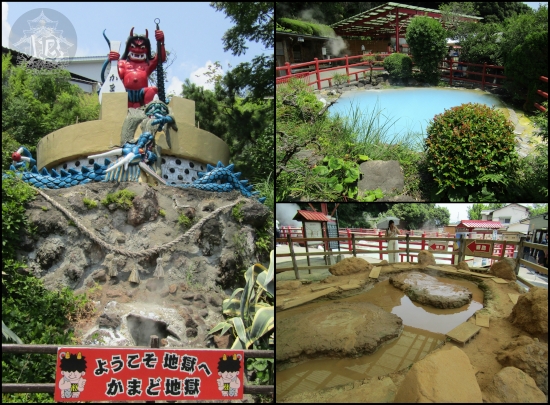
Fourth, I went to the Kamado Jigoku [かまど地獄] (Cooking Pot Hell) which has a big oni cook to greet you.

Fifth, I found the Oniyama Jigoku [鬼山地獄] (Devil Mountain Hell) which for some reason breeds crocodiles, and what the hell, that was scary for a second. Even if they were behind bards, the crocs would follow you under the water and snip at your shadow and some of them were enormous! Creepy! The hot-spring itself was not that impressive but basically because it was steaming too much to see any of it.

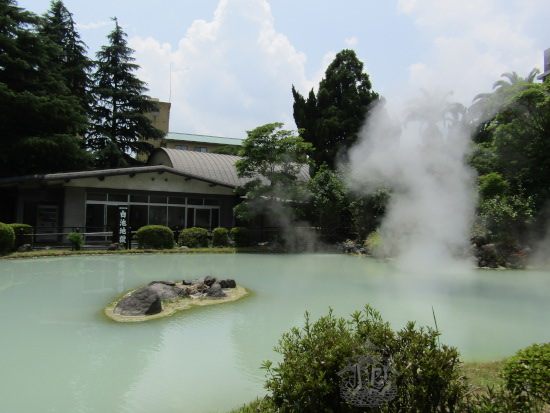
Sixth, I went to the Shiraike Jigoku [白池地獄] (White Pond Hell) where there was nobody to take my ticket. A nice old couple explained that I was to cut it myself and put it in a jar over there. We were talking a little and they asked where I was from. Then they continued on their way and I stayed petting a random cat who decided I was to scratch it right then and there. In this jigokku they also have a small aquarium with several tank of freshwater fish, among them “man-eating piranhas”…

I took the bus then to Shibaseki where the other two remaining hells were. Had the weather been more agreeable I would have walked, but I had the bus pass anyway and it was very hot. As I stepped out of the bus I came across the same couple from before. they explained that they had visited Spain before when they were younger and told me that they were from Osaka. We parted ways to go into the Chinoike Jigoku [血の池地獄] (Blood Pond Hell) which is a boiling red pond. Here I decided to take a foot bath as the area was empty and I was tired.

The final hell was Tatsumaki Jigoku [龍巻地獄] (Spout hell), a geyser you have to wait for, as it has its own timing. Here the old couple brought me a lemonade because they were adorable. And after the geyser it was over, or so I thought.

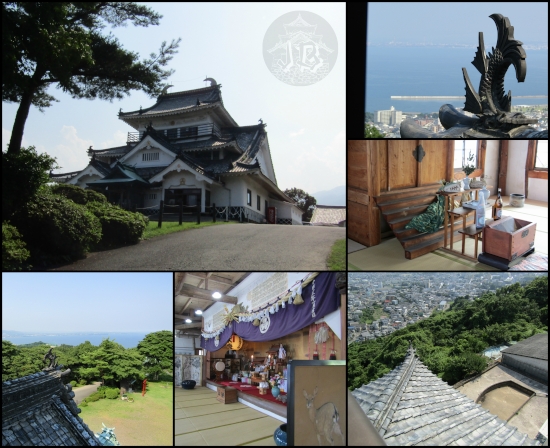
I had decided to give the aquarium a miss, because I was very tired but when I was taking pictures of the “castle” from afar I decided… I could not miss the chance, so I took the bus again towards Kifune-jo [貴船城] (which is quite new but pretty enough). Unfortunately the bus stopped right at the foot of the hill, so I had to go up and climb all the slope. I arrived just in time to pray to a snake which is supposed to bring happiness to whomever pats it.

After the castle I headed back downtown and took the train to backtrack to Kokura / Kitakyuushu [小倉 / 北九州]. While it is true that I had passed Kokura on my way from Fukuoka to Beppu, the idea was always to spend the minimum time on a train per day, but I wanted to combine Kokura with Okayama and make the following day a “castle day”.

Once in Kokura I checked in and went to see Kokura-jo [小倉城] by night.

22nd & 23rd June 2013: Odawara and Hakone {Japan, summer 2013}

One of the few perks about a tectonically-active area is the volcanic landscapes, and Hakone has plenty of those. We headed off to Odawara [小田原] early on Saturday morning to visit the local Castle, Odawara-jō [小田原城].

Then we headed off to Ashi no Ko [芦ノ湖], Ashi Lake, which formed in the caldera of a supervolcano after a huge eruption millions of years ago. We crossed the Hakone Sekisyo [箱根関所], the Hakone Checkpoint, which back in time prevented undesired people from moving around – which meant anyone who was not friends with the shogun.

We made it to the city of Hakone [箱根] later in the day. There, we visited Hakone Jinja [箱根神社], which has a torii set within the lake itself. This torii is called the Torii of Peace, Heiwa no torii [平和の鳥居]

Then there was onsen – Japanese hot springs. No pictures of that XP.

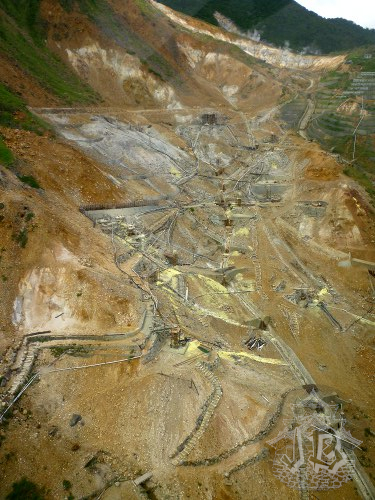
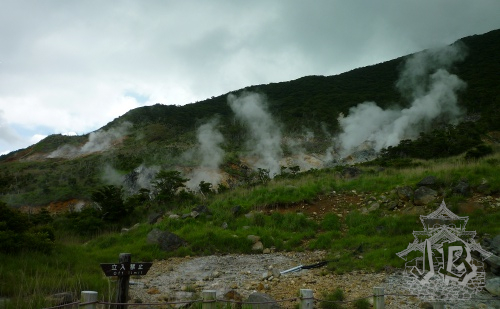
The following morning we went up one of the mountains, to an area called Ōwakudani [大涌谷] via murderous device called the Hakone Ropeway [箱根ロープウェイ] to watch the sulphur mines, the volcanic gases eruptions and to eat the famous black eggs, kurotamago [黒卵], which are normal eggs cooked in naturally-boiling sulphurous water puddles.

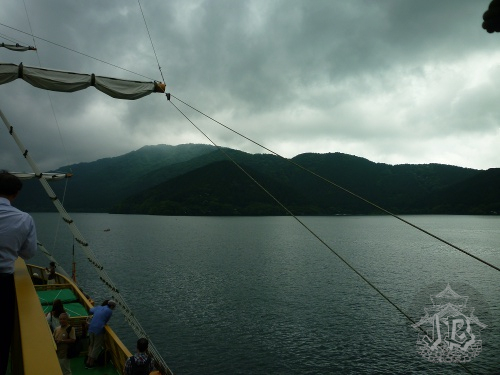
Finally, we crossed the Ashi no Ko in a “pirate ship” before heading back to Tokyo [東京] to karaoke the last hours of the weekend away. Unfortunately it was too cloudy to see the supermoon.

7th July 2012: Nikkō {Japan, summer 2012}

Nikkō [日光市] is about 140 km north of Tokyo, a couple of hours train ride. While the town itself might not seem much, close to it there is lies the Shrines and Temples of Nikkō Unesco World Heritage Site, and here we headed off on Saturday.

The area holds a whooping 103 buildings or structures, though the natural setting around them is also considered heritage. The buildings belong to two Shinto shrines: Futarasan Jinja [二荒山神社] and Tōshō-gū [東照宮], and one Buddhist temple Rinnō-ji [輪王寺]. Nine of the structures are designated National Treasures of Japan while the remaining 94 are Important Cultural Properties. Unesco listed the site as World Heritage in 1999.

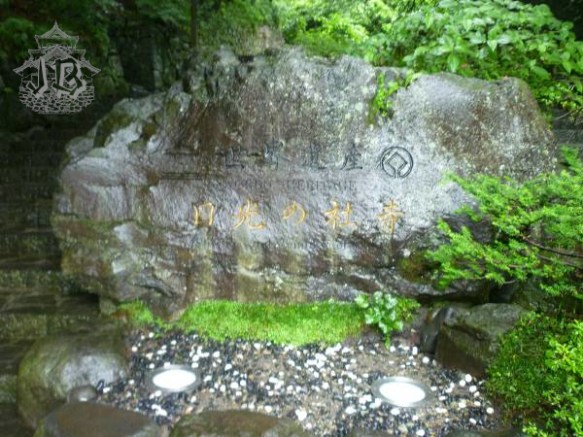
A rock reading World Heritage Shrines and Temples of Nikko in English and Japanese

As you might be able to tell, it was raining. Like magic. Like hell. Cats and dogs. And then some.

Highlights include the Three wise monkeys, “see no evil, speak no evil, hear no evil”:

Wooden carvings of three monkeys: one is covering its ears, another is covering its mouth and the other is covering its eyes

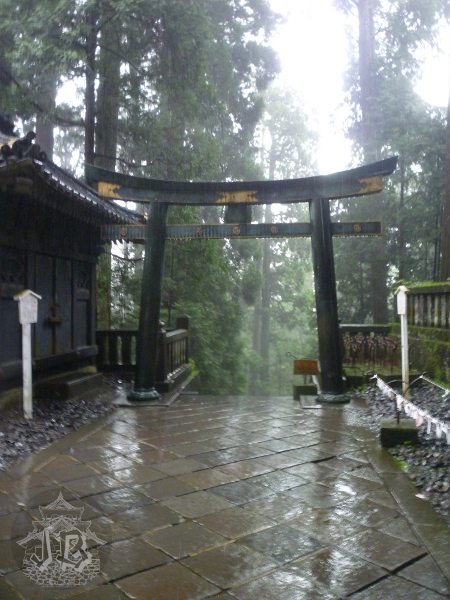
The mausoleum of Tokugawa Ieyasu:

A torii in black and gold. It's raining

A small one-story pagoda, the mausoleum itself

A five-storey pagoda (gojūnōto) belonging to Tōshō-gū:

A five-story pagoda, in red, green and gold. It's still raining.

The inner buildings of Furata-san Jinja:

Dark wood buildings decorated in green and gold. It's still raining

The entrance to Tōshō-gū:

Shrine entrance. The entrance is completely golden. It's still raining

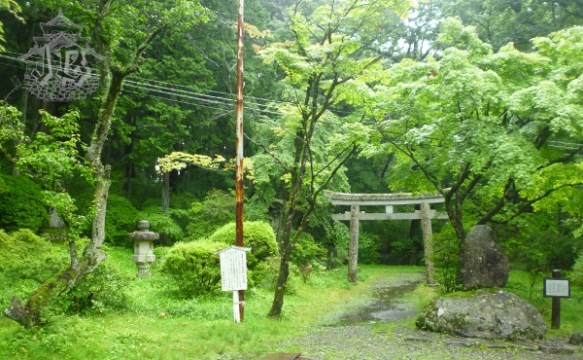
However, since I would not be me without finding (and falling in love with) something obscure and creepy, have a small shrine to the side of the road nobody was paying attention to:

A forlorne stone torii forgotten in the middle of the forest

Did I mention it was raining? Because it was. All the damn day XD