While Zaragoza (Saragossa) is not a super-busy city, the noise from the large avenue the hotel was in woke me up early enough to be amongst the first customers at Pannitelli Original Bakery. I had a toast, orange juice, and a coffee, then set off to the not-so-easy task of retrieving my car, driving back to the hotel, getting my deposit returned, and going on my merry way. It took a while, but once that was taken care of I could drive off. Getting out of Zaragoza was easier than getting in had been, and there were few cars on the road. One of them was the traffic police, so every driver seemed on their best behaviour…
Once in the speedway, the first stop of the day was a petrol station, as there was no way I made it home with one quarter of a tank. Unfortunately, there were no low-cost fuelling points on my way, so I had to use a big-name one. Thirty euro don’t take you as far with branded fuel…
To be fair, I could have driven home the previous day, but I thought that after such a week, an extra night of sleep could only be beneficial. Staying also allowed me to see the Asian treasure exhibits in the Lonja and make a stop on the way. My first idea had been going downtown to see the Natural History Museum, but it closes at the weekend. That was why I asked about the visit during the course, and it turned out it was doable. Thus, in the end, I decided to make a stop in a small palaeontological site that I would not travel to otherwise. Furthermore, the site popped up during the course twice – the signage had been handled by Paleoymas and the Natural Science Museum had quite a few specimens from there.

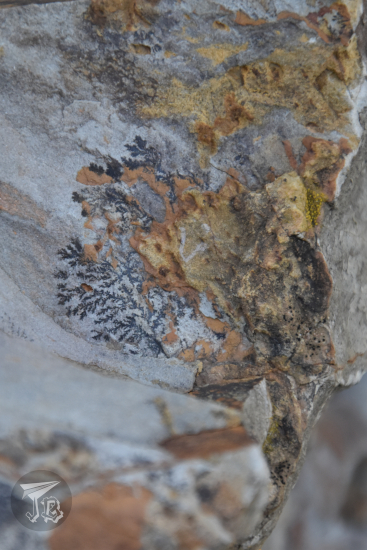
The Yacimiento Paleontológico de Murero palaeontological site holds remains from the Cambrian Period, extremely important because there are around eight million years’ worth of fossils (511 to 503 million years ago) preserved in the strata. Palaeontologists have found about eighty species of trilobites, along with echinoderms which had not yet developed five-way symmetry, brachiopods, worms… It is mainly composed of shales which allow for soft-bodied organisms to be fossilised along the hard bits like shells or exoskeletons. The site is famous because it allowed researchers to identify sexual dimorphism in trilobites – they were able to describe two distinct types of animals within a same species, which are interpreted as male and female. What they don’t know is which animal is which sex.
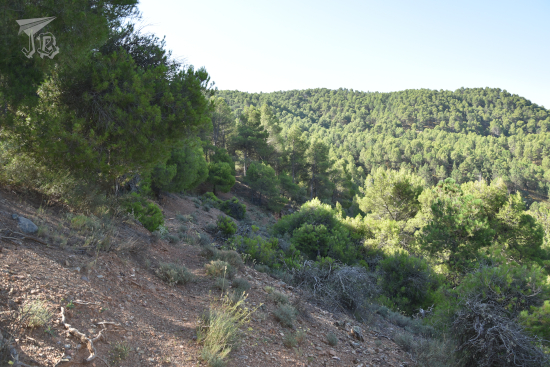
I left Zaragoza using the A23, then turned to a national, smaller road (N234) that crossed over to the A2. The site and the municipality it technically belongs to, Murero, lie halfway through this road. As mentioned before, not somewhere I would purposely travel to, but since I was literally in the area, it was a convenient stop. The regional road was all right, but the local one was narrow and the curves were very sharp and steep. I was thankful that all of the cars I saw passed while I was hiking or taking photos of the site, and none while I was driving. I decided to only stop at the area which had a small parking lot so it was safe for me and any potential driver.
To be honest, I expected to see more in the palaeontological site. The signage has either weathered out or been vandalised and nothing is readable. It is a short walk up and down a hill where you can’t really see anything except for a box at the top where people leave what they find, but there was not a chance to see anything in situ. I guess the palaeontologists and the amateurs have taken out everything that is worth anything already – or left it well buried so it can’t be pillaged. I wouldn’t even consider it a nice hike because broken pieces of slates made the path extremely slippery (I forgot my hiking boots in the car…).

And oh, the temptation to steal a trilobite from the display box was strong! I resisted it though, and headed back to the car after an hour or so. I undid the path towards the N234 road and continued onto the A2. I made a stop in-between for some caffeine and a snack, but I was home for Spanish lunchtime. I have to admit I had pondered stopping somewhere along the way, maybe Daroca, Belchite or Calatayud, but considering that I still had to drive back, I decided to leave it for another time.


On my first solo road trip, I was surprised by the sheer amount of people who like driving at the same speed all the time. A bunch of drivers in the regional road, with limits of 90 kph, did 70 kph even when they drove through 50 kph towns. The same happened in the speedway – some people drove at 110 kph, both at the 120 kph or the 100 kph stretches. There were also those who liked aligning their cars with the markings that separate the lanes, effectively occupying both. The lorries were more manageable on the way back than towards Loarre, as it was a Saturday morning, and because the speedway feels more “downwards”.
Once home, it hit me how tired I was, so I guess it was a good thing that I had not made another stop. Checking Murero out was a good idea as it broke the trip in half and was a small hike that helped me keep alert, but more would have been overdoing it.
As a recap of my experience with the course Técnicas de restauración en paleontología a través de la preparación de los huevos de dinosaurio de Loarre: Palaeontological Restoration Techniques through the preparation of Loarre dinosaur eggs, I can say that all in all, it was amazing. The professors were extremely knowledgeable, they made learning effortless and entertaining, and the group was fun and easy-going. The course was way more hands-on than I had expected, literally covering everything from geological analysis to the fate of a dug-up piece, either in display or in storage within the museum, including working with the fossils themselves. It was not cheap, mostly due accommodation choices, but booking in advance probably made it better – and honestly, decent hotels were a must. As Loarre is a small village, food options were limited. Though there was a bakery / shop, we were out doing stuff while it was open. However, I made do with crisps or nuts for dinner, as I had a good breakfast. Probably lunch in Ayerbe was the weakest, and most awkward since it involved getting to know each other (and ten bucks for a frozen pizza was daytime robbery).
The whole trip involved driving around almost 700 km. It did show me that I (and my coffee-maker of a car) can manage the long drives better than I had expected, even during a “peak” time such as a holiday-period opening date. I am more comfortable on the road than in towns, though, even when caught in a jam. Was it the smartest idea to head to Loarre directly after work? Probably not, but if I had to do it all over again, I probably would – it was the only actually available option. And knowing that not all the course openings were filled, I would not have stressed as much over the University’s lack of efficient sign-up.
The only downside I can find is the lack of mental reset – I was constantly learning new facts, and I did not get much me-time. It was extremely fun, but not really a holiday where I could plan and do stuff at my own pace. Would I do it again? Well, the University of Teruel runs a similar summer course using Dinópolis resources, and sign ups open in February…
Stay tuned.
 JBinnacle – A Travel Logbook