
Palacio del Infantado (Palace of the Infantage) in Guadalajara is an impressive building designed by architect Juan Guas. It is one of the most iconic representatives of the Isabelline architecture or Gótico Isabelino – a sub-style of Civil Gothic – sprinkled with some Renaissance details. Some people claim that it is even the only representative of its own style, gótico mendocino.
The palace was commissioned by the Second Duke of Infantado, Íñigo López de Mendoza y Luna (1438 – 1500). The Mendoza family was important in the area, and also an asset to the Catholic Monarchs in both the political intrigues of the time and their wars to conquer and rule all of Spain. The Duke himself participated in the siege of Granada, and was personally involved in several battles. Aside from the palace, also commissioned the castle in Manzanares El Real.
Palacio del Infantado was erected around 1480. It features a main façade decorated with diamonds, and a series of reforms in around 1596 added Renaissance details, frescoes in the inner halls, and a garden. It was heavily damaged during the Spanish Civil War, and some of the reforms were undone during the restoration afterwards. For a few years at the end of the 20th century, it hosted the local public library, which was great to access the building for free. After the library was moved away, the palace was repurposed as the local museum – a few halls of artefacts haphazardly thrown together in order to justify its existence. Entering the museum gives access to the frescoed rooms. Whether or not you get a ticket for the museum you are able to walk into the Renaissance patio, which used to be plastered white, and now sports a weird burgundy-red colour behind the stone carvings representing lions and griffin. The original wooden roof has never been restored, but when the storytelling marathon takes place, the space is shaded using flags and parasols.
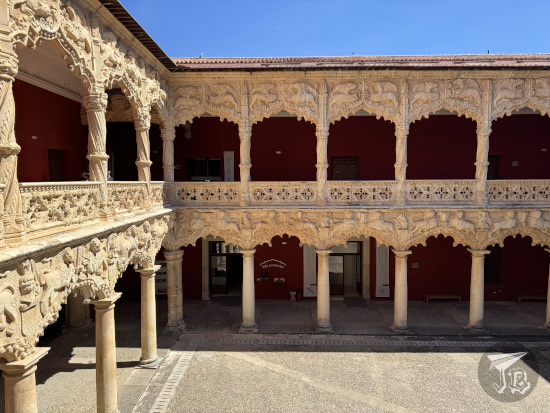
The first part of the museum deals with “stuff” – while it tries to arrange the artefacts in some sort of logical order, there are too few of each to comprise an actual collection – beehives, pottery pieces, and a Medieval lady’s sepulchre rest here. Then there is an area dedicated to the palace itself, with remains of the original pieces that were recovered after the destruction in the war. The last area showcases the decoration and frescoes on the walls and ceilings, before accessing the patio and the staircase to the upper corridor, where the temporal exhibitions are held.
Such exhibition at the time was Las Civilizaciones del Bronce en el Suroeste de China [中国西南地区青铜文明], Bronze Civilisations in South-Western China. It was organised by the Chinese National Cultural Heritage Administration, NCHA [国家文物局], part of the Ministry of Culture and Tourism of the country. Itinerant exhibitions and claiming back objects on display in foreign countries are the two main axes of the bureau’s activities.
The exhibition brought to Guadalajara almost 60 original pieces and reproductions from 14 museums in Sichuan, Yunnan-Guizhou, Guangxi and Guangdong. The peoples who created these objects were the Ba, Shu, Dian, Yelang, and Ouyue, from around 1600 BCE to 220 CE.
The Bronze Age is found across civilisations in Africa, Asia and Europe, with different time ranges. It follows the Neolithic period and it refers to the time humans learnt how to use metals, particularly how to produce bronze, which has a high smelting point and is resistant and hard. Bronze is produced alloying smelted copper with other metals, mainly tin and arsenic. Civilisations who went through a Bronze Age were also the first to develop practical writing system. The Bronze Age would give way to the Iron Age as metal technology evolved.
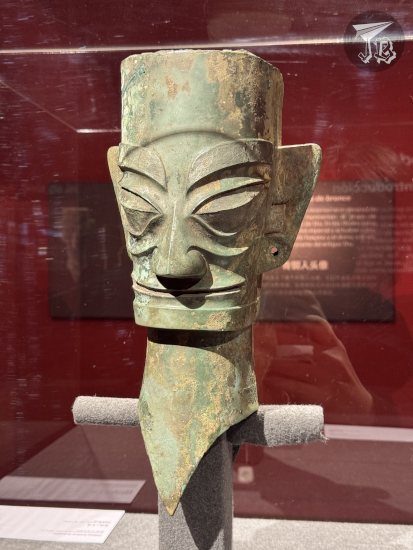
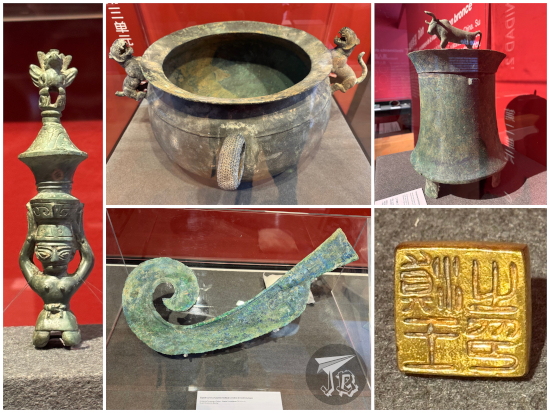
The exhibitions show how bronze was used for both practical and decorative purposes, both for the living and the dead – there were items from graveyards, temples and everyday life, along with jewellery, complements and even games. Not something I would have expected from a place like Guadalajara, but quite interesting none the less.

