When planning the weekend in Vienna, D****e and I had a discussion. She wanted to be “free” on Sunday in case Hyde did something unexpected, but I didn’t want to spend the day waiting around without anything to do. In the end, we reached an agreement to… go somewhere and back before the singer would even get out of bed. And that is how we found ourselves on the 6:24 train to Semmering, within the Austrian Alps.
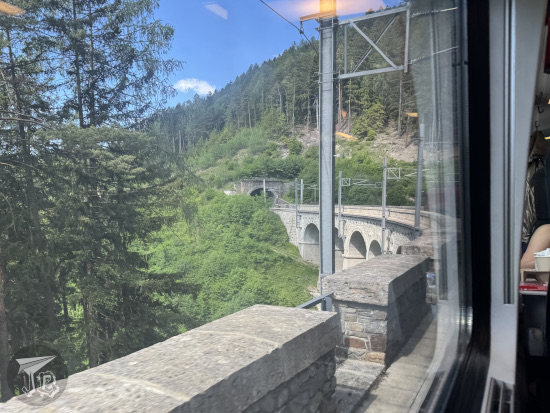
Technically, Semmering is a dignified ski resort, remanent of the time in the 19th century when the sport was all the rage amongst the upper classes, who would take the train to get there. The Semmering Railway Semmeringbahn runs 41 kilometres through the Alps. Built between 1848 and 1854, it is considered one of the greatest feats in early railway engineering, with bridges, viaducts, tunnels, charming mountain stations, reaching over 895 metres above sea level. It was declared World Heritage by UNESCO in 1998 with the name Semmering Railway.
Thus, a big thing about Semmering is the journey itself, not only the destination. Especially because in late spring the mountain village is in the middle of low season and most everything is closed. The idea was to find a window seat on the train to enjoy the trip until we got to the area. Once there, we would wander around for a couple of hours, take in a few views, maybe have breakfast at a fancy café, and finally head back.
The train ride was spectacular once we reached the Alps. This Central Europe mountain range stretches between France and Slovakia (around 10,000 km), and is in part responsible for the continent’s climate. The Alps were formed during the aptly-named Alpine Orogeny that started in the Late Mesozoic, when Africa began pressing against the Eurasian tectonic plate in the north – of course, this took tens of millions of years. Aside from over 80 peaks higher than 4,000 m, there are lakes, glaciers (some of which used to be permanent and not any more) and several of Europe’s most important rivers, along with their tributaries. There is evidence of human presence in the mountain range since the Palaeolithic period, along with prehistoric treading of both man-made and natural ways and paths – passes – to cross them on foot. Semmering is one of them.
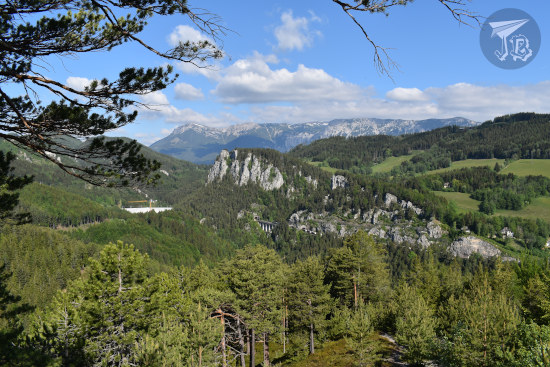
The train route was extremely beautiful, both due to the landscape itself and the fourteen engineered tunnels along the tracks. We reached Semmering a bit after 7:30. As no cute café was open, we just went on a short hike. We strolled down the Semmering-Kurort neighbourhood, walked by a modern art garden called Skulpturenpark and finally reached the tree line. Our first stop was the so-called 20-schilling view 20-Schilling-Blick, which overlooks the historic train line (part of it, as the viaduct is currently under construction). The he area was featured in the 20-schilling note, before the euro, hence the name. You can actually take the exact same picture that was printed on the bills using a conveniently-placed box – except for some works going on that has one of the bridges covered in scaffolding.
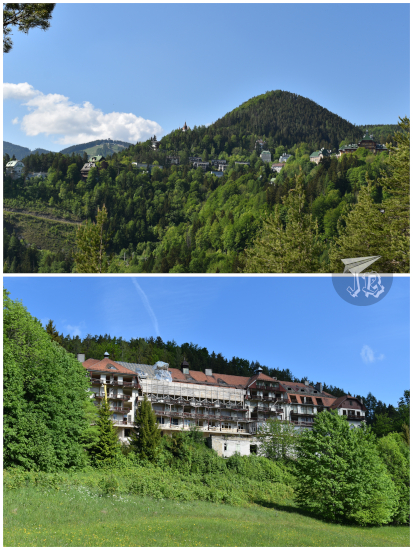
On our walks we found other spots and views, including the observation deck Aussichtsturm auf der Doppelreiterwarte. We walked by the Kurhaus Semmering Hotel, a grand hotel dating back from 1909, which now is closed for renovation so it can be restored to its former glory. We got a bit lost on the way back, because the way we wanted to take was closed down, but made it back to the station with ten minutes to spare. Once back in Vienna, D****e and I had different plans for a few hours.
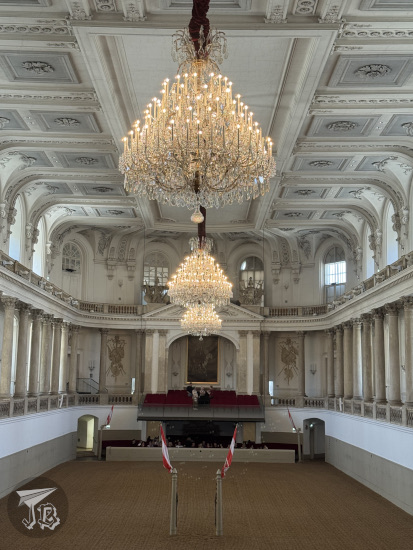
The train ride back was all right, but upon entering Vienna, we got stranded due to a “firefighting emergency”. We had to find alternative our alternative way to the city centre. It is a good thing that I am paranoid enough that I had chosen my next visit with almost an hour and a half’s margin, so I got there with ample time. I had booked at 13:00 to take a tour of the Spanish Riding School Spanische Hofreitschule. The shop was packed with people so it was hard to see anything, but the tours themselves were rather empty.
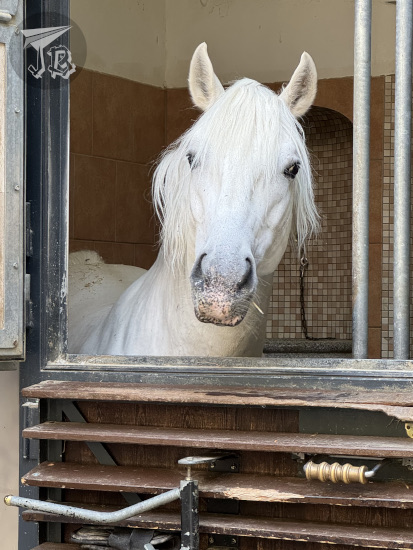
The Spanish Riding School takes its name from the main horse bloodline that was used to create the breed it showcases, the Lipizzaner. Breeding traditions of these animals are considered Intangible Cultural Heritage by UNESCO. Contrary to what is usually thought, the horses are not white, but grey. Their skin is grey, and they are born with a dark coat which turns white in age. The school is one of the “Big Four” riding academies, along the Royal Andalusian School. It focuses on “classical dressage”, and its roots are in military horsemanship, which shows in their performances. The building itself, in the Baroque style, was erected in the 1730s, commissioned to Joseph Emanuel Fischer von Erlach by Emperor Charles VI.
Within the School, we got to visit the summer arena – which has individual “stalls” for each horse to exercise in – the winter arena, the courtyard and the stables. We got to hear how the horses are born and raised in Piber, and that the actual reason why only stallions are used in the work is because the pirouettes, cabriolets and jumps imitate how they behave in the wild. The guide actually said that mares would not understand or care about learning the steps. We also learnt that each horse has two names – the first one is the name of the father and the second is the name of the mother. Pictures were not allowed in the stables, and I am not sure why – maybe so there is no proof where each horse is so nobody can lure them using their names? For the record, 13:00 is not a good time to take a tour, because the horses have just been fed, and you get to see lots of horse butts, but not enough faces.
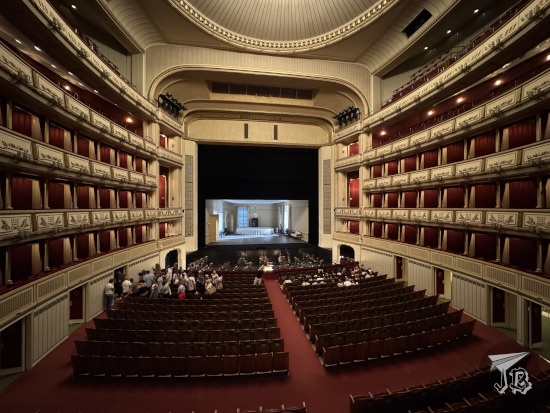
My next tour was at 14:30 at the Vienna State Opera Wiener Staatsoper. That was chaotic. We had to queue outside to be let in and be directed to either buy tickets or get ours checked out. Once inside the hall, there were mobs of people waiting for different language tours. As a matter of fact, an Australian gentleman decided he had to push to the front of the English-speaking group, and was sent back to the end of the line. Once the tour started, the whole thing was surreal. I learnt next to nothing about the place, as the only thing that our guide did was complain about people with money, either from the past or the present. One thing I did realise is that the actual music hall is extremely small – no wonder it fills out so quickly.
The main hall seats around 1,700 people per show. The Renaissance Revival building was erected in the 1860, and there were two architects involved in its construction: August Sicard von Sicardsburg, Eduard van der Nüll, along with contractor Josef Hlávka. At the time, it was considered “not grand enough”. The interior and stage were destroyed during WWII, in a modernised version of the original. Nowadays, it is home to the opera and ballet companies of the city.
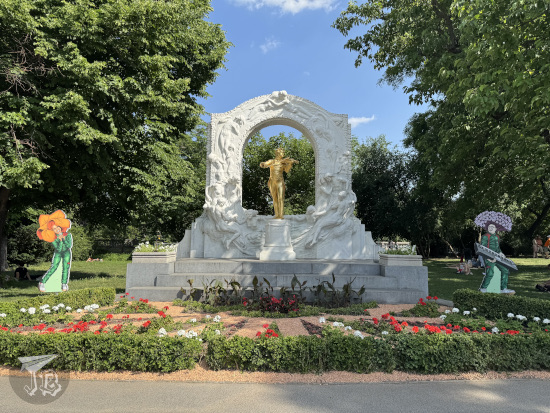
Once done, I walked by the Starbucks to grab a cold drink – cookies-and-cream frappuchino was not the best option – and headed to Stadtpark to meet with D****e again. I stopped by Johann Strauss monument Johann-Strauss-Denkmal, which depicts a golden sculpture of the musician playing his violin.
We did not do much for the rest of the afternoon until we headed off for dinner. On our way, we came across something called the Ankeruhr or Anchor Clock, a mechanical clock built in 1914, commissioned by an insurance company. We did not see it in action, but it looked cool.
Dinner had been booked at the rooftop terrace Organics Sky Garden, and I have to say it was one of the worst dinner experiences of my life, and I’m not too much of a demanding customer. When we arrived, the responsible / managing person apologised because there had been an event and they were a bit overwhelmed. Fine, stuff happens. We get shown to our table and to our surprise, food and drink have different order / payment systems. All right, weird. What sold it, though, was not the bland food or the tasteless drinks – our waiter was drunk. Absolutely wasted. It took her four times to get the card-reader working, and in the end she had to call someone else to charge us.
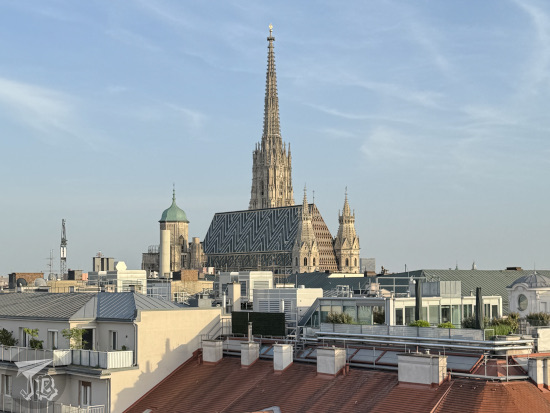
The drink price was ridiculous for something that was mostly tasteless. My Organics Purple Berry drink was not even pale pink. The waiter managed to spill D****e’s Organics Simply Cola and she did not even offer a replacement, but laughed stupidly. The one food I found appealing was the Margherita pizza and that was not even that good. The only good thing about the place were the views of Domkirche St. Stephan (St. Stephen’s Cathedral).
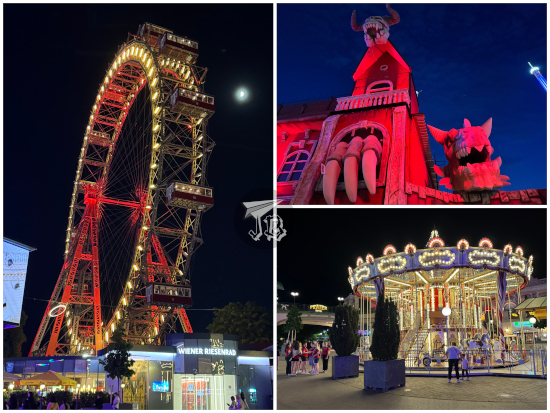
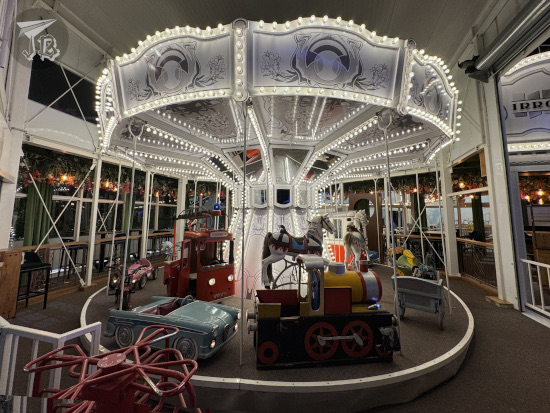
After that experience, we headed off to Prater. The area, originally a hunting ground, was cleared out to set up the 1873 World Exhibition. Today, it is an urban green and an amusement park. Though some of the rides are obviously very modern, some of them were established in 1897, including the Ferris wheel and symbol of the park Wiener Riesenrad. D****e wanted to find the spots where Hyde had taken photographs, and I wanted to see the nostalgia carousel Familie Karussell, because I like merry-go-rounds, the older and more kitsch, the better, I guess. It was palate-cleansing.
And when we eventually made it back to the hotel, I was tired enough that I actually slept through the night.
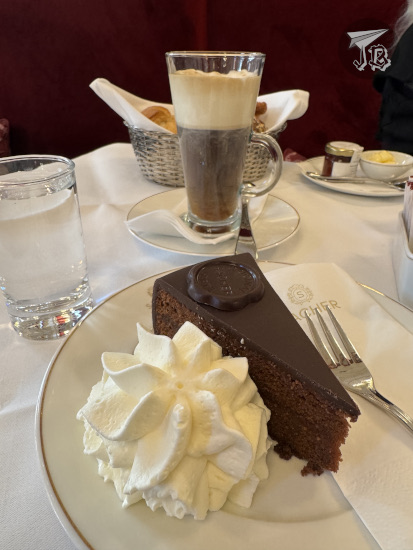
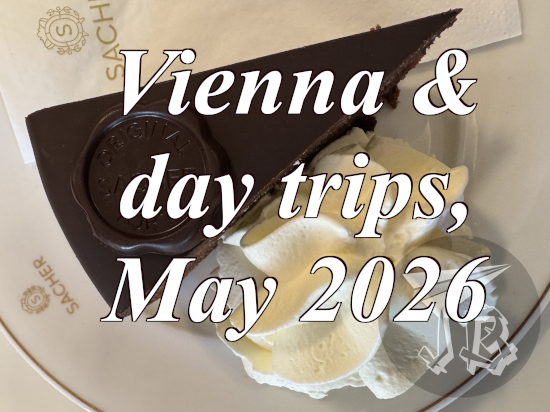
It was ridiculously early in the day, but D****e and I were ready to go. Our first self-appointed destination in Vienna that morning was the historical Café Sacher for breakfast. The café is located within the no-less-historical Hotel Sacher. The hotel’s origins can be traced back to an actual confectioner, hence the eventual rise to fame of the Sacher-torte – a chocolate cake with a thin layer of apricot jam in the middle and coated in dark chocolate icing, served with a side of unsweetened whipped cream.
The Hotel Sacher was founded in 1876, and under the management of Anna Sacher, it became the most exclusive hotel in the world. Originally, it catered exclusively to the aristocracy. In the 1930s, it changed hands and was completely renovated, but then WWII hit. It would not be until the late 1980s that the hotel recovered its status as a luxury destination. Between 2005 and 2012, the hotel was refurbished and modernised, with only 10 weeks of downtime throughout the period. Since then, smaller works have been carried out, and the brand has expanded to other cities in Austria. Currently, the Vienna establishment currently has 152 rooms and suites, with the lowest category I found being a “junior suite”, and prices that range from 500 to 10,000 € a night.
Throughout its history, the hotel has battled other confectionery creators to hold the rights to its original Sacher-torte. It is offered in the hotel cafés, shops, and can even be ordered online. It is given out as complimentary little cubes (Sacher Würfel) with some of the other dishes, too.
Though the Café Sacher queues can be insane, there was none at 7:55 when we walked in for breakfast. We had a packed day ahead of us, including a crossing a border, hence the early start!
I required coffee, of course, and I had been torn between two specialities. In the end, I chose the Einspänner (Double espresso topped with whipped cream, served in a served in a tall glass with a handle), because it had more coffee in it. I wanted something substantial and savoury, and though I considered the eggs, something else caught my eye – Sourdough bread with whipped butter and chives (Sauerteigbrot, Aufgeschlagene Butter und Schnittlauch). I also ordered the Sacher-torte. After a while, our waiter came to check on us and I… had finished my Einspänner… so I ordered myself a Sacher Melange too (Single espresso with steamed milk and whipped cream). Caffeine was not loading…
Breakfast was amazing and customer service exquisite. D****e had been there the day before and they remembered her! The maître gifted us a Sacher pen each, and I was ecstatic – laugh, but somehow I ended up with a… minishrine of Sacher mementos from this trip… It’s almost embarrassing.
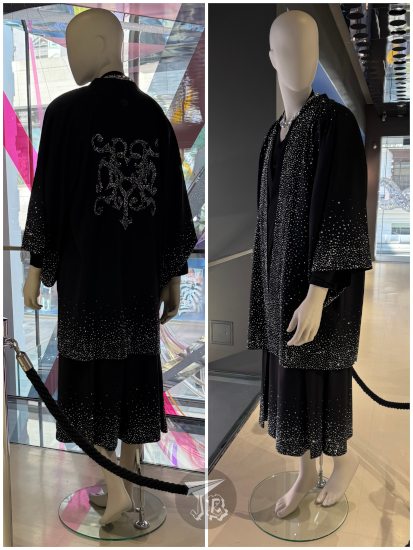
We still had some time before our train, so instead of heading directly to the station, we popped into the Swarovski flagship shop for a bit. Aside from the toilets, there was a connection with Hyde, too. He had his hat for the [Inside] tour made by them, along with the microphone stand he was going to use on the Konzerthaus concert. Furthermore, he had “designed” a piece of clothing to wear for some promotional activities that featured some 2,000 crystals. It was, to commemorate the event, exhibited in the shop. There were also necklaces described as part of the collaborations, priced at around 600 €. And, unrelated, they also had little boxes full of crystals of hundreds of colours. I decided to get one of those – don’t judge me, I could afford them (I think they were rainbow coloured because Pride was coming?).
We walked towards Vienna Central Station Wien Hauptbahnhof to board a train to Bratislava, the capital of the neighbouring country of Slovakia [Slovenská republika]. Slovakia and the Czech Republic used to be one country before the Velvet Divorce (1992), one of the few bloodless disintegrations of the old Europe towards the end of the 20th century. When the two countries split up, Bratislava took over as capital of Slovakia, while Prague, the capital of the dissolving unit, remained as such for the Czech Republic. Hence, Bratislava gives off a bit of a “new” vibe, despite having existed for over a thousand years. The train ride from Vienna barely takes an hour (50 km distance), and you really don’t get to see / feel / realise when you cross the border between countries, which feels weirdly amazing and sad at the same time. The only notice you get is that you must bring printed tickets if you buy them on the internet, digital ones are not accepted – but there is no gate control to access the trains at Vienna Central. You have to love the presumption of honesty there.
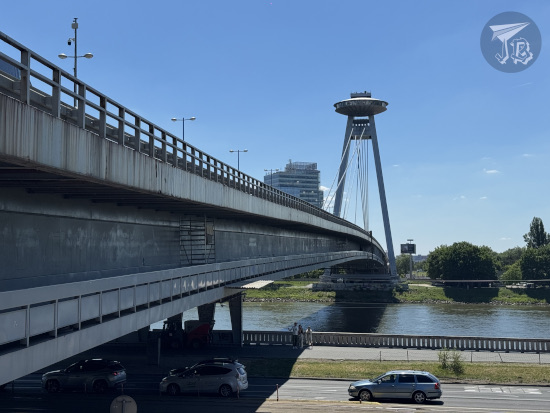
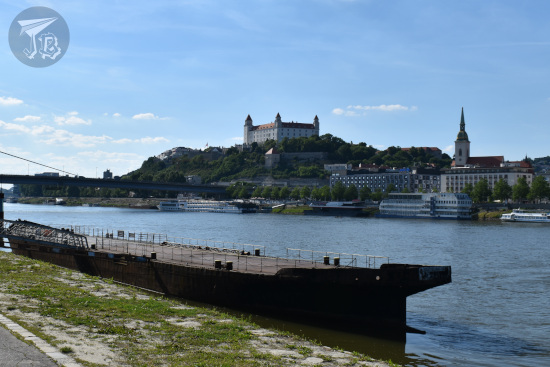
We reached Bratislava Petržalka (the central station, though it is on the outskirts of town). If Prague was scarred by WWII, it seems that Bratislava was most damaged by its time as part of the Eastern Bloc, when the Communist Party reached power in 1948. During the years of Communism, a great deal of the historical centre, including the Jewish quarter, was demolished in order to modernise the city – and actually to build one bridge, which we crossed on our walk from the station to the downtown area. This is the Most Slovenského národného povstania (Bridge of the Slovak National Uprising), most commonly known as the UFO bridge, because of the flying-saucer-shaped restaurant and observation deck it features. Over 400 metres long, it was quite a walk in order to cross over the Danube.
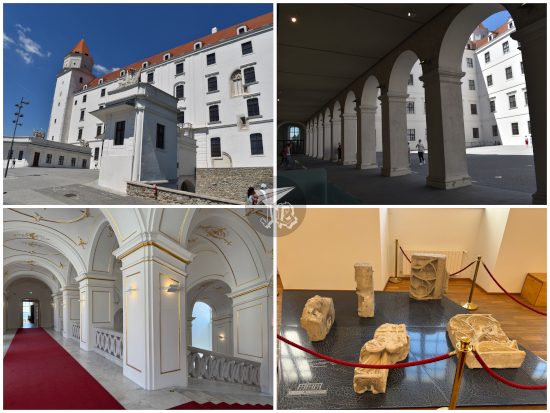
Once on the correct bank of the river, we undertook the climb to the Castle Bratislavský hrad, which we could visit for half price because they were celebrating Museum Day. The castle may have been built around 4,500 years ago, but the oldest remaining areas date back from the 9th century. Most of what can be seen today is Baroque, erected in the 18th century under the reign of Maria Theresa (Holy Roman Empress between 1745 and 1765 and Queen of Bohemia between 1740 and 1780, except for 1742 and 1743), and restored in the 20th century. Today, the castle is the site of the SNM Museum of History Historické múzeum.
We visited the palace, which gave us access to the courtyard, the building itself – wide staircases decorated with golden stucco – the treasury, and several historical exhibitions, including the religious art that used to be found in the Medieval chapel. We climbed up to the Queen’s Tower – a bit of a mistake on my part, the stairs down made me dizzy and queasy – and the Romanesque foundations, including a deep well. On our way out we stopped by the Baroque Garden.
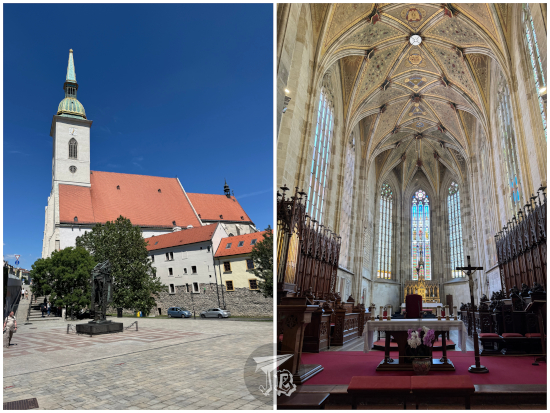
As we headed towards the city centre, we stopped by St Martin’s Cathedral Katedrála svätého Martina. The interior and the exterior clashed in my mind. The outer area was white with a terracota-coloured tiled roof, and a metallic spire atop the tower. The interior is lined with gothic arches built in stone, dating from 1311. The ceiling is decorated with golden details, and the windows behind the altar let beautiful light in. When we left the cathedral, through a different entrance, I saw that the other side of the church features stonework indeed. So it seems that the angle matters a lot!
A few minutes later we were in Ventúrska, the main street of the historical centre, to have lunch. We ended up getting an outside table at a small place called Loclub Food & Drink. We shared a bruschetta with avocado (two pieces of bread, tomatoes, olive oil, red onion, garlic, basil pesto, avocado) and Bryndzové pirohy, sheep cheese pierogi (potato dumplings with cheese, sour cream, and fried bacon). I did not feel like food, but I think I was less light-headed after it, and my stomach had settled.
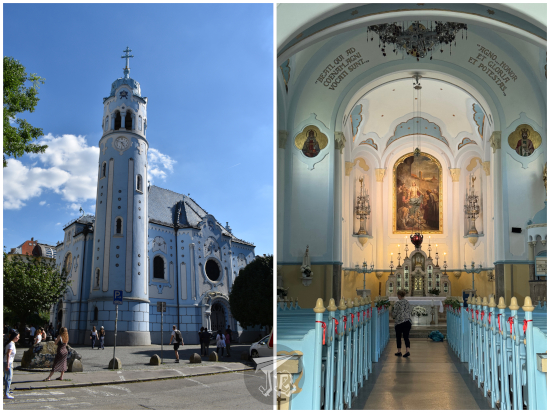
We continued on the street and we got to Michalská brána (Michael’s Gate), which during Medieval times was one of the city gates. The building that stands today is a Baroque reconstruction. We did not go in, but turned at the corner and undid a bit of our way until we got to Main Square Hlavné námestie, which holds palaces, the town hall, statues, a fountain and lots of overheated tourists searching for a drink or an ice cream. We were on our search for Farský kostol sv. Alžbety, Church of Saint Elizabeth, better known as the Blue Church. Its main feature is… being baby blue. It’s built in a style I had never heard about, Hungarian Secession, designed by Edmin Lechner in the early 20th century. It was indeed… very blue. It reminded me of kids’ toys.
We slowly made our way back towards the station, through the iron bridge Starý most and the park Sad Janka Král’a along the Danube, which led to some amazing views of the Castle Bratislavský hrad.
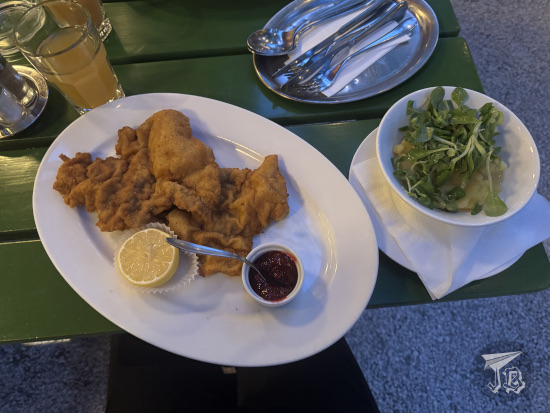
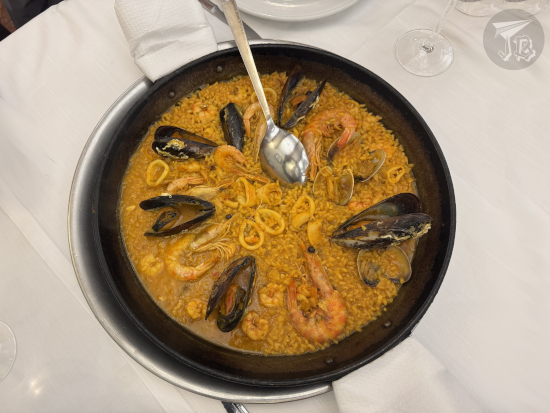
We took the train back to Austria and left Slovakia behind. That evening we had a reservation for dinner at the beer garden Glacis Beisl in Vienna. The place was packed and loud, but the food was good. The one upside of the heatwave is that dining outside felt really nice. I decided to treat myself to my own Schnitzel – Original Wiener Schnitzel from Austrian milk-fed veal with potato and coleslaw salad and cranberries (Original Wiener Schnitzel vom österreichischen Milchkalb mit Erdäpfel-Vogerl-Salat und Preiselbeeren) and an apple juice drink, which came in a pint glass – awesome.
You’d think we would be turning in afterwards, right? Wrong. D****e had also arranged to meet another friend for a drink afterwards, so we headed out towards Selleny’s Bar, adjacent to the Hilton. I had a very lemony (and overpriced) lemonade there. Finally, we headed back to the hotel for a shower and bed, but once more I did not sleep much.
Of course, when the drive to the airport is smooth and you avoid the worst of the daily traffic jam, something else happens. This time around, it was a security-check screw-up. The lady had decided that every item needed a different tray – it was unthinkable that a backpack and a fanny pack could coexist in the same space. Unfortunately, the tray system had broken down and was not moving. Travellers got stuck explaining “there are no trays” while she yelled “one item per tray” in a never-ending cycle that took at least five minutes to break.
My plane left at 8:40 and I landed in Viena a few minutes ahead of schedule, around 11:30. That gave me enough time to reach the train station and take the 12:19 S7 train to Rennweg, which was the very convenient station next to the hotel (I had booked something near a transport hub; the fact that it had a direct connection to the airport was direct was a plus we discovered later). I got myself a snack, and walked to the hotel to check in and meet D****e, who had arrived a few hours earlier. After she had freshened up, we headed towards the Austrian National Library Österreichische Nationalbibliothek while she told me that she had come on the same flight as Hyde, and gave me updates on all her Japanese friends’ status as they converged onto Austria.
As we walked, we entered the Unesco Heritage Site Historic Centre of Vienna, recognised in 2001 and placed in the List of World Heritage in Danger in 2017, due to urbanistic pressure. One of the main elements in the Viennese architecture is the Hofburg, the main imperial palace of the Habsburgs in Austria. At the end of WWI in 1918, the Austria-Hungary Empire came to an end, and since then the palace has been repurposed – different parts of it may be visited, such as Sisi’s quarters, the Riding School, or the library itself (and all its branches).
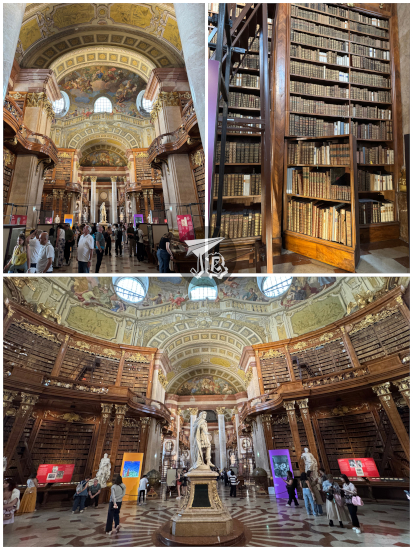
The seed of Austrian National Library Österreichische Nationalbibliothek dates back to Emperor Karl VI (Charles VI), who established the court library around 1739. The building was erected in the Baroque style, designed by Johann Fischer von Erlach. Its main feature is the State Hall Prunksall, which houses the book collection amassed by the Habsburgs, particularly some 15,000 books belonging to Prince Eugene of Savoy. The library hosts around 200,000 volumes in dark walnut cases that reach the ceilings, decorated with frescoes. The floors are marble, and here and there stand world globes and sculptures by Lorenzo Mattielli. Oh, and there are secret doors within the shelves that lead to hidden rooms. We only visited the State Hall that day, but I would come back to the Papyrus Museum on Monday.
A couple of days prior to our arrival, Hyde had tweeted (or whatever) that there were posters of his show throughout Vienna. One of them was easy to find – it had the Neogothic Votive Church Votivkirche in the background. D****e wanted to find them all, and I wanted to see the church, which was unfortunately closed. Also unfortunately, it seemed that all the weather forecasts for the few days I’d be in town had been… wrong. Despite announcing mild spring temperatures, we got hit by a heatwave. I am okay with heat but… I did not have appropriate clothes for it so… whoops. Despite the weather, we walked a lot, and did a lot of checking for the posters as we did. We may have spotted around 20 or so (and only after the concert checked if we could unglue one).
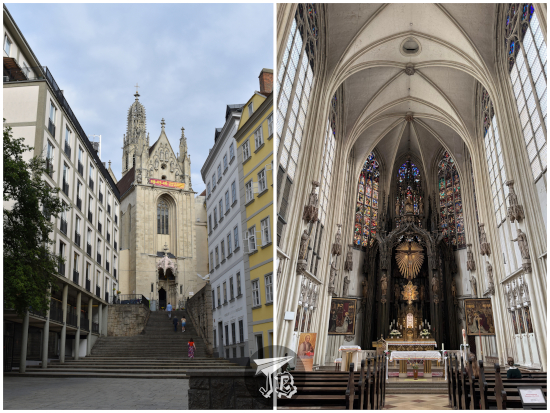
I was getting a bit dizzy, so I suggested stopping for a snack. We sat at a McDonald’s Hyde ordered food from once, so it fit our theme. D****e had a map of locations that were more or less related to Hyde’s activities in town. Following that, we stumbled around the church Kirche Maria am Gestade. In front of it stood a figure of Minerva, holding a little owl in one hand, a crown in the other. I thought it was a street art installation, and I wondered about the placement, but it turns out to be something for the… European Congress of Radiology, which took place in March, and had a Classical gods and goddesses theme, maybe because there was a very important person there called Minerva Becker.
Kirche Maria am Gestade (Mary at the Riverbank) is a catholic church built in the Gothic style between 1394 and 1414. It is one of the few actual Gothic buildings in town, and was popular amongst sailors on the Danube – it stands on the former fluvial terrace of one of the now disappeared flows of the river. It is not a big church, with a narrow nave and a 56-metre tower slightly newer than the body of the church. It was a very pretty structure that I enjoyed a lot.
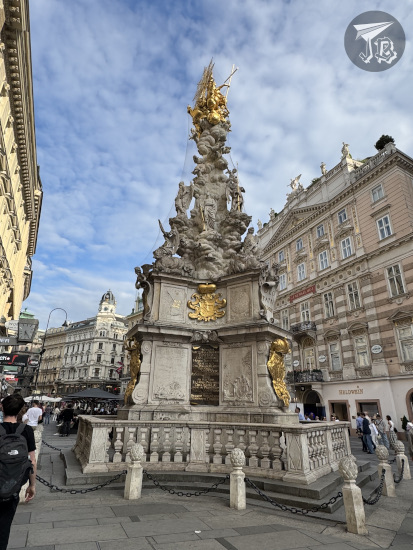
We walked a little towards the town centre and ended up at Kohlmarkt, from where I got a view of Michaelerplatz and the Hofburg palace. We turned towards Graben to find the Column of Pest Wiener Pestsäule, a High Baroque column built to commemorate the victims of the plague epidemic of 1679. It was designed by Paul Strudel, but many other sculptors had a hand in it, apparently. Erected in white stone and gold, it represents from the highest level down, the Holy Trinity, the angels, King Leopold I, and his citizens.
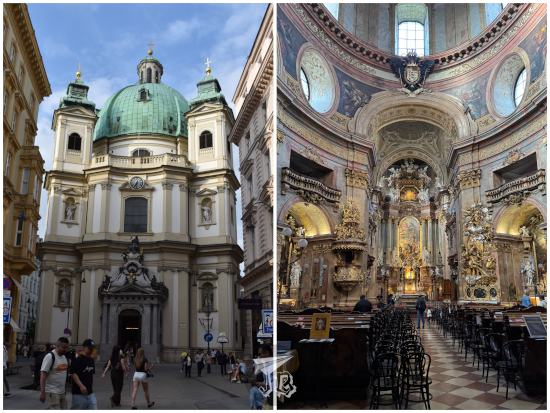
Next, we visited the Baroque church Peterskirche (St. Peter’s church), built in the first third of the 18th century to replace and earlier Romanesque one. After two failed designs, the main architect was Francesco Martinelli, who drew inspiration from St Peter’s in the Vatican. Hence, it was the first domed building in Vienna. It is however very… small, erected in a very confined space in a crossroads, it feels cramped.
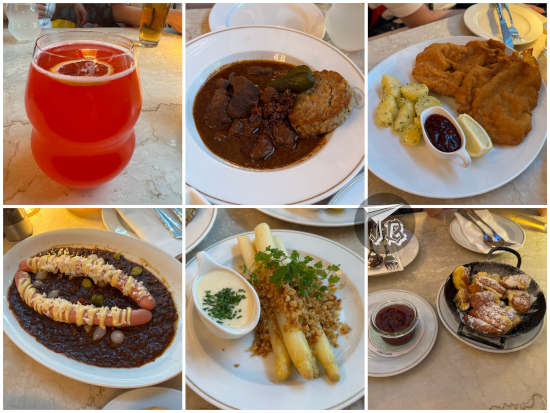
Eventually, we made our way towards Café Landtmann, which calls itself “Vienna’s most sophisticated coffee house” to have dinner with some of D****e’s friends who had also come from Japan. Though it is one of the iconic places in town (and also held a connection to Hyde, hence why they wanted to go), dinner was a mess. Five of us were crammed into a tiny booth, the eatery was bustling and there was barely any space. And jet-lagged excited Japanese is no way near understandable by my poor language skills. They decided they wanted to share everything, which I thought was a mistake – very little space, large plates difficult to share… But I’m not going to raise a ruckus out of food of all things. I’m just going to order an alcohol-free cocktail (actually a raspberry-lemon lemonade) that matches in price all the beer and alcohol they are going to order.
We shared „The Legend“ („Die Legende“: Viennese Schnitzel made from the finest cut of breaded veal, parsley potatoes, leaf salad, cranberry jam and a lemon wedge); Viennese Beef Goulash (Wiener Rindsgulasch, with bread dumpling, goulash crunch and pickled cucumber); White Asparagus (Spargel with beurre blanc, chives and buttered panko crumbs); Landtmann Sausages “à la bonne heure” (Landtmannwürstel à la bonne heure, boiled sausages in goulash jus with mustard mayo, horseradish, goulash crunch and a hand roll).
I ended up mostly eating the bread with the Schnitzel lemon and the salad. I had not realised the goulash would have so much garlic on it. Finally, they ordered coffee and Kaissermarn (shredded pancakes) as dessert. In the end, it was 40 bucks per person for a cramped mediocre experience. The staff was nice and people-watching interesting, from people super dolled-up because they were coming from / going to the opera, to ripped jeans.
We left and walked back to the hotel. After a long shower, we went to bed, but I did not sleep much and was definitely up at sunrise. That helped with the following day’s insane plans, which included breakfast…
This story actually begins long before May 2026, forging behind the scenes sometime in 2023. On the 13th of November that year, the Austrian Embassy in Tokyo held a ceremony to appoint Japanese singerHyde as “Ambassador of Tourism for Austria”. Technically, a “tourism ambassador” is a trained professional who deals with tourist experiences, but in this case, Hyde’s job was promoting a country he had never visited and encouraging his fans to travel there. And he did the work so well that the assignment was extended. He later travelled to Vienna and Salzburg to make whole photo books and film promotional music videos. He also promoted trips from Japan and popped up into the Austrian pavilion in the Osaka Expo.
Hideto Takarai, known artistically as Hyde was born in Wakayama, Japan, in 1969. The year 2026 marks the 25th anniversary of his music activities, either with the rock band L’Arc~En~Ciel [ラルク アン シエル | Laruku an Shieru], VAMPS, or on his own. He has sporadically collaborated with other artists such as Starset and Yoshiki, with whom he also worked on the the failed “supergroup” The Last Rockstars alongside Miyavi and Sugizo. In 2019, Hyde became the Tourism Ambassador for his hometown, and in 2021 he received a commendation for his activities (maybe that inspired the Austrians?), and he seemed pretty comfortable promoting the place. The city even opened a commemorative gallery in the town hall to thank him for his efforts (which included his own train).
During the European leg of the Hyde [Inside] Live 2025 World Tour there was a lot of speculation and questioning about no stops in Austria. I mean, they must have some live houses, along with all those amazing classical music halls, mustn’t they? Even before the [Inside] tour was over, on the 26th of October 2025, a new one was announced – Hyde Orchestra Tour 2026 JEKYLL. It was an acoustic tour, with classical arrangements of his greatest hits and new songs. Right up Austria’s alley, don’t you think?
Any rumour of an Austrian concert was, however, met with a firm “no” at first. Until on the 23rd of December, it turned out that… yes, there was a concert scheduled for Vienna, the capital of Austria – a special live named Hyde Orchestra Tour 2026 JEKYLL in Wien. And it was, I kid you not, aimed at Japanese fans, to the point that there was an organised trip from Japan that for around half a million yen, which provided tickets, hotel with breakfast, basic airfare and transfers airport-hotel-venue. There were a lot of “not included” items, one of them being a day trip from Vienna to Salzburg, (three hours each way. I toyed with doing something similar, but changed my mind) to visit some of the spots chosen for photos and videos.
At 00:00 on the 13th of January 2026, tickets went on sale through the Wiener Konzerthaus website, and by the time I managed to get through the “buy tickets” English page, my friend D****e had already succeeded in securing seats for both of us in the first row on sale (115 € per person), using the German version. I was extremely impressed.
As soon as I had dates locked, I booked my plane tickets and blocked those days out of the calendar, then got the hotel room. Since D****e and I had decided to bunk together, we had a virtual planning meeting in early April. I was tasked with buying train tickets, she was with booking restaurants, as she wanted to try places that Hyde had visited beforehand. We also agreed that we would not do everything together, but split up for a few hours both Sunday and Monday – as we had some different priorities. Hence, the weekend before I left, I got myself some tickets and made my own plans, which would also give me some time alone to get into my head space and recharge.
We would both arrive in Vienna on Friday the 22nd, meet at the hotel, and plan the day from there, depending on how jet-lagged she was. On Saturday the 23rd, we would take a day trip to Bratislava, the capital of Slovakia. Back in Austria, on Sunday we planned to take a short trip to the Alps, then split until the evening. The concert would take place on Monday – assigned seats meant no need to queue up, which is always good news. We left Tuesday rather open to see what we felt like.
It was going to be an intense few days and a couple of early mornings, but she was going to be in the wrong time-zone and I would be in early-morning mode anyway.
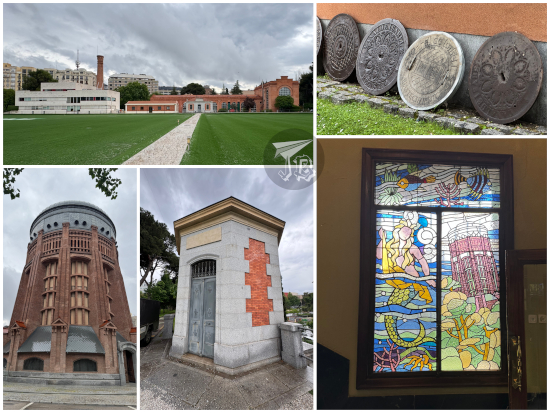
I’m in no position to deny that I have a thing for any “limited time only” visit, so I won’t. I had seen in the newspaper that the water company Canal de Isabel II had installed some Japanese-inspired manhole covers around Madrid, and I went on their website see if I could find any. While there was no map, I learnt about a bunch of activities that they were carrying out for their 175th anniversary, and one of them was opening the headquarters in the Chamberí district for four guided visits over the weekend. I had walked around that one before and wondered about the locked-away sports fields which always seemed to be empty. As it was a “limited time only” thing, I found a date I could take myself there. Ten days in advance was too early for a good weather forecast, but as the date grew closer, it was clear that I had high chances to get caught in May showers. Joy.
When the Spanish court set permanently in Madrid in the 16th century, it soon became clear that the city lacked something that other European capitals had. London had the Thames, Paris the Seine, Vienna the Danube – rivers with a decent flow of water to sustain the growing population. Madrid had Manzanares, which is barely a stream in comparison. It became a state matter to somehow guarantee a steady supply of drinking water. Hence the Viajes del agua – aqueducts and fountains, and later the dams and waterways from the Lozoya (originally the failed one in Patones, followed by the newer ones).
Canal de Isabel II was the entity created to manage and provide (and of course charge) the city with this water. Barring the short Republican Period, it has always carried the name Queen Isabella II, who occupied the throne when the infrastructures were first inaugurated. The entity’s activities started in 1851, in order to get running and drinking water to Madrid and the court that had settled there. The company went on to work on channels, reservoirs and water tanks in the city and around it – most of the water-related infrastructure in the Community of Madrid is owned and / or managed by them. In the early 2000s, the entity was involved in a corruption scandal, and part of of the revenue was diverted in a face-saving foundation to carry out activities for “the greater good” – exhibitions and cultural events – called Fundación Canal de Isabel II.
The day started having to trust that I would get to Madrid – while the trains were running, they were doing so on alternative route and schedule, and my station had been left in limbo. The train did eventually arrive, and it was actually faster than the usual one. That was a surprise – I had actually booked the visit at noon because I felt I needed to give the commute some extra time. I walked from the station to the headquarters of Canal de Isabel II, where I was expected at 11:45 for “security reasons”. I was there on time, along with a whole bunch of others, and a very tired security guard who kept instructing people to wait for the ticket-checker. It did not help that said person was late, nor that it started raining.
The visit was scheduled as an introductory talk in the auditorium, a walk around the buildings, and a “tap-water tasting truck” (I’m not even kidding). However, we were warned that they might cancel everything outside if it started pouring. That would have been a bit of a bummer. Fortunately, rain was down to a manageable drizzle in the end, and we were able to take the whole tour. The talk was of course a PR one – water supply in Spain is not an open market, but what is called a “strategic monopoly”: each town has its own one supplier and there is no way to choose another. Nevertheless, Canal de Isabel II needs some face washing from time to time, one guesses. They even bragged about their “water recipe” and how Madrid’s sales of bottle water are the lowest in the whole country.
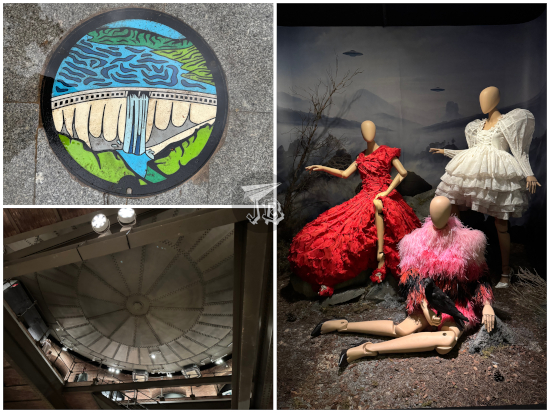
The presenter also told us about how fantastic it was to work for the business, and mentioned 2025’s rainy season and how many of the dams had to be open to let water out. One of them was El Atazar, and the image of water cascading down the structure was turned into a template for the new manholes. It turns out though that novelty manholes are illegal in the city, so Canal de Isabel II can only use them in their own properties.
When we came in, they gave us one of those little audio receptors used for guided visits. Since it had stopped raining, or at least the rain was down to a manageable drizzle, we were divided into three groups – according to the colour of the audio thingy – to follow our guides around. First, my group was shown a collection of historical manhole covers resting against a wall. Then, we went to see the elevated tank from the outside. The tank was the third built, and designed to serve “high” neighbourhoods, so it had to be elevated using a brick tower so water flowed down. That required energy to get the water up to the spherical metal tank in the first place. Hence, a water-pumping station was devised. Neither the tank nor the station are used any more, the former having been turned into an exhibition room.
What I had always thought were empty sports fields turned out to be the roof of the major tanks currently in use though, covered in artificial grass, because it looks pretty, I guess. It used to be actual grass, but it’s apparently more hygienic this way. We trotted on the walkways above the tanks, saw the turrets, and were eventually led back inside to see the steel-stained windows with motifs that range from classical to weirdly niche – including the elevated tank itself.
We also saw one of the Japanese-style manhole covers exhibited there. On our way out, it had started drizzling again, but we were still treated to the water sampling. It… tasted like water.
I had a little bit of time before my lunch reservation, so I walked into the former tank, now used by the regional government as an exhibition hall, called Sala Canal de Isabel II. There was one of the novelty manholes there, but it felt a bit ironic that the ground was full of puddles. The hall was running a fashion exhibition, Ana Locking. Nostalgia / Utopía. Ana Locking (born Ana González Rodríguez) is a Spanish fashion designer and artist, active since 1996. I will not lie, and confess that I had never heard of her before. Then again, I am not much into the fashion world. Apparently, the exhibition merges past (nostalgia) and speculative futures (utopia) with pieces of clothing that I can’t see anyone wearing, but the colours were shiny?
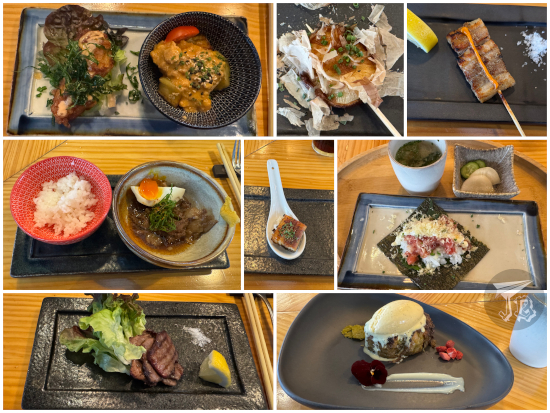
I had booked lunch at a Japanese restaurant called Tori-Key. As an early birthday present to myself I had booked the 60-euro omakase lunch. Omakase [お任せ] is a Japanese way of dining which consists on leaving the menu up to the chef, who decides on what the restaurant can best serve. Here, it was basically a tasting menu with ten dishes. Besides asking me if I was all right with everything, I don’t think it was completely personalised. The owner of the restaurant, Hiroshi Kobayashi, came to Spain in 2004 to study wine and become a sommelier, and ended up opening a non-sushi Japanese restaurant in the capital, with really high-quality ingredients and traditional recipes – with very little fusion except for the proximity ingredients for some of the dishes. The food was excellent, and the menu comprised:
Edamame salteado – sautéed edamame (枝豆, immature soybeans in their pods).
Ensalada de Cebolla Fina y Parmesano con katsuobushi – Thin onion salad with Parmesan cheese and katsuobushi (鰹節, flakes of simmered, smoked and fermented skipjack tuna).
Karaage con salsa de vinagre y soja – Japanese-style fried chicken with vinegar and soy sauce.
Lengua de vaca con toque de sésamo (a la parrilla) – grilled beef tongue with sesame.
Carne de Tajima salteado con Setas Japonésa – Tajima wagyu (和牛, Japanese cattle) stew with Japanese mushrooms. Tajima [但馬] is one of the Japanese cattle bloodlines, which comprises most of the Kuroge Washu [黒毛和種] breed, considered the best as its meat is very finely marbled.
Cucharita de Anguila – bite of grilled eel.
Kushimon Cerdo Ibérico (sal) – skewer of salted Iberian pork.
Shitake con Ponzu y katsuobushi – skewer of shiitake mushroom with Ponzu sauce and katsuobushi.
Picadillo de pollo casero tsukune con huevo a baja temperatura – tsukune (chicken meatball skewer) with low-temperature cooked egg.
Falso temaki de Atun de Mediterania y Sopa de Miso – tuna tartar on a bit of rice and dry wakame (fake temaki) and miso soup
Torrija de té verde con helado de vainilla – Spanish variation of French toast soaked in green tea with vanilla ice-cream.
Complimentary glass of green tea.
Not only was everything delicious, the care and attention from the staff was magnificent, especially considering I was sitting alone and at the bar, and the restaurant was incredibly busy. Only by the end did the shining service fade a little, as I had to ask for the bill twice. While I was at the restaurant there was another spell of hard rain, but when I came out, it was almost sunny again.
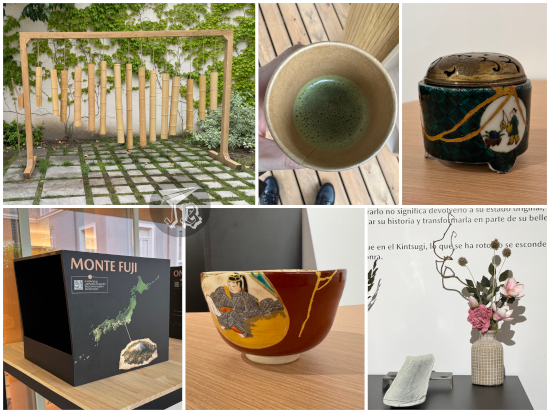
I walked towards the cultural centre Fundación Ortega-Marañón, where the car maker Mazda was carrying out a sort of exhibition / publicity stunt called Mazda House – Un paseo por Japón. El Camino de la Armonía [マツダハウス―日本散歩。調和の]. It was a… weird compendium of “things that make Japan famous” merged with titbits of Japanese philosophy that looked out of the Japan Tourist Organisation play book and mixed with publicity for the cars.
I had a matcha tasting at a booth with a lady boosting that “her preferred matcha was too strong for us novices”. I tasted her matcha. It was not worth the price tag. There were some pictures of plants, and inside activities for kids (such as drawing calligraphy), exhibits of objects repaired with gold (Kintsugi [金継ぎ]), and snippets about how traditional Japanese values inspire the car brand. It was not extremely impressive, but fun (and free) – and, of course “limited time only”.
It had started raining once more, so I headed towards the station, to wait for a train to take me home in the opposite direction I usually take, which was bizarre. I got the end of the platform wrong, too. Weird feeling. As soon as I stepped out off the train, it started storming again. Unfortunately, my light travel umbrella did not survive this last deluge. RIP.
I organised a day out for a friend who needed a small pick-me-up, making plans for two. Again, the main issue getting to Madrid was transportation. For once my train was pretty much on time (ish. I’ve grown desensitised to whether 15 minutes are actually a delay), but hers was late despite it being a shorter ride.
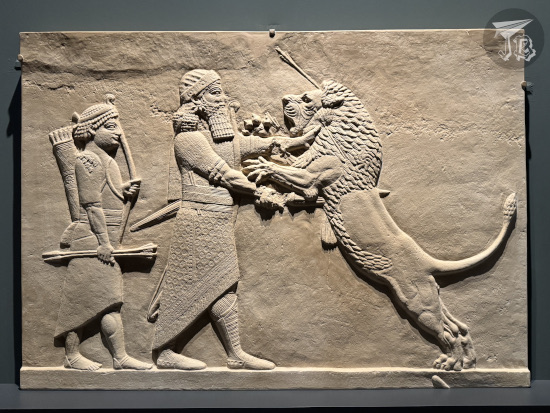
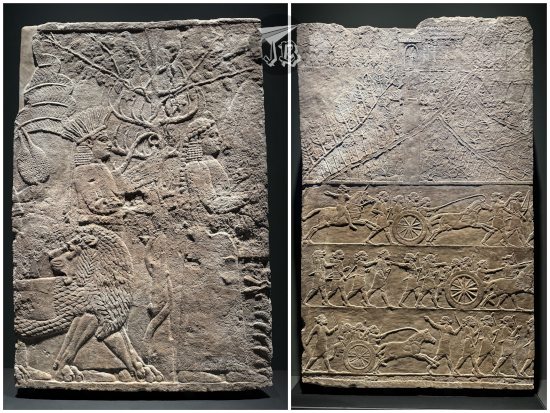
We got reunited at the station and together walked to CaixaForum Madrid, a few minutes away from Atocha on foot. They were running one of the British Museum travelling exhibition of part of the Assyrian collection – Soy Asurbanipal. Rey del mundo, rey de Asiria, a direct translation from the original name “I am Ashurbanipal: king of the world, king of Assyria” – obviously someone wanted to make sure the visitors were aptly informed that this had been an important figure in Assyrian history.
Assyria existed from around 2600 BCE to 240 CE. Its golden age was the Neo-Assyrian Empire (911 – 609 BCE), which at is maximum extent comprised most of the Middle East, what is historically called Mesopotamia: from today’s Turkey to the Persian Gulf, and to Egypt to the south. Ashurbanipal ruled the Empire from around 669 to 631 BCE. He is considered the last great king of Assyria, as the imperial structure collapsed during the reign of his heir, Ashur-uballit II
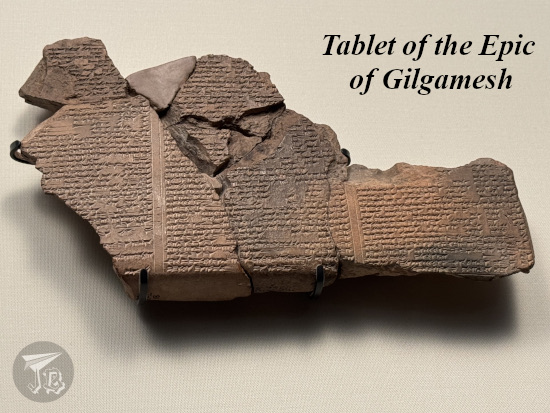
Ashurbanipal reigned for almost 40 years after being appointed heir by his father. His ruling was marked by wars, including battles against his brother the king of Babylon, the massacre during the destruction of Elam (Persia) and the squashing of any rebellion in the bloodiest ways possible. However, more important than his warring campaigns were his efforts related to arts and cultures. He built the Library of Ashurbanipal, considered the first great library in history. As cuneiform writing was already spread, he was able to assemble over 100,000 texts, out of which almost a third have survived to the present. They include fragments of the Epic of Gilgamesh, possibly the oldest form of literature in the world, maybe even dating back from 2100 BCE.
Ashurbanipal’s palace and library were in Nineveh (modern Mosul, Iraq), on the bank of the Tigris River. The Nineveh archaeological site was first excavated between 1845 and 1852, though it had been recorded as early as 1761. The British Museum’s collection dates back from the works of Austen Herny Layard, a British diplomat who explored the ruins in 1847, looting everything he could to send it home. He was the one to dig up the palace and the library. The British did most of the work on site until WWII, when Iraqi archaeologists took over. Unfortunately, IS decided to destroy the archaeological remains of Nineveh during the time they controlled Mosul, but new excavations have been carried out since the liberation of the modern city, starting in 2018.
Most of the travelling exhibition is composed by large slabs that comprised the palace walls. These limestone artworks are covered in bas-reliefs depicting the life of the king – from great deeds such as fighting lions, to victories in war campaigns, and more domestic ones, such as what happened in the gardens. These reliefs would have originally been painted in bright colours, but today only a few specs of pigments remain.
The exhibition is really cool and once again presents an ages-old debate. On the one hand, the British Museum is exhibiting artefacts that were obtained in a way that we consider unethical today. On the other, how much of the material on display would have been destroyed or sold for profit anyway during the IS and Daesh rampage between 2014 and 2017, had it remained on site?
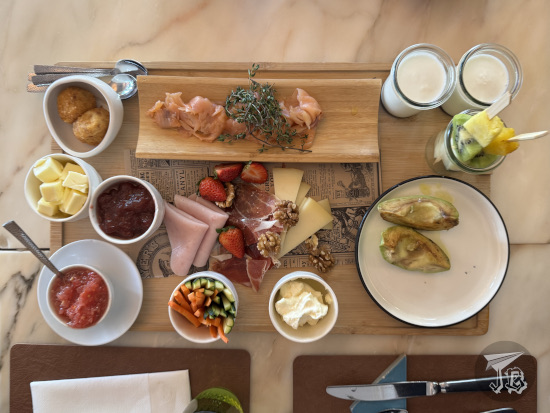
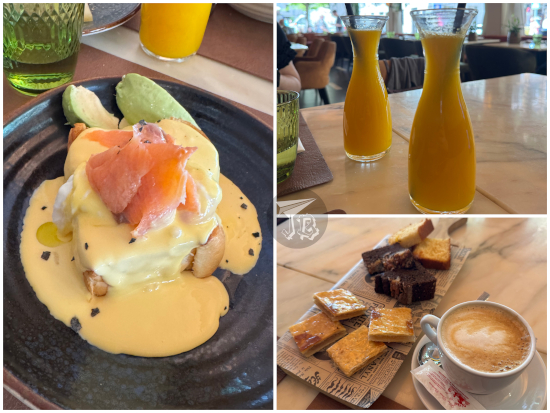
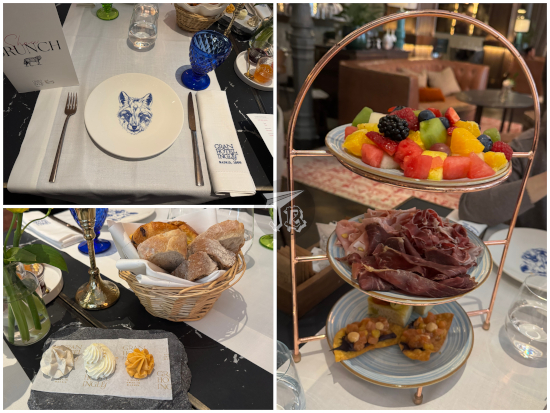
Since the weather was nice, we took a short walk from the gallery to the place where I had booked brunch. Not that I’m obsessed with brunches lately, but that timing worked perfectly for my friend. I had booked a Late Brunch at Café de la Ópera. We started off with a natural orange juice as my friend decided that we would have the coffee and sweets at the end.
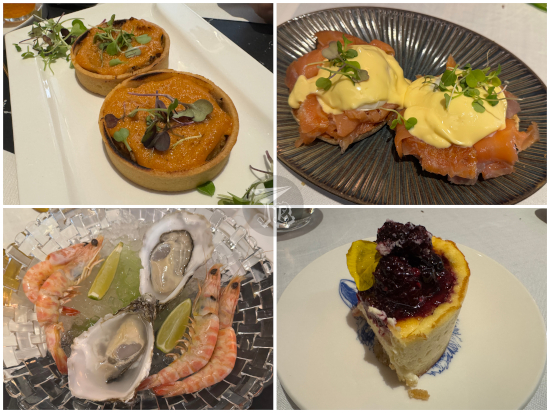
The savoury treats included a basket of rye and seed bread with butter, jam and tomato sauce. Then we had a huge tray with a fruit skillet, Greek yoghurt (which was supposed to come with oats, but had some fruit instead), Iberian ham, roasted turkey (which was not roasted), semi-cured cheese with nuts (the cheese was advertised as Gouda though), veggie sticks to dip in reported blue-cheese sauce that was just cheese cream, smoked salmon, grilled avocado, and homemade ham croquettes – all that to share. For the main dish, I chose eggs Benedict with truffle. Finally, we got a selection of cakes with our coffee.
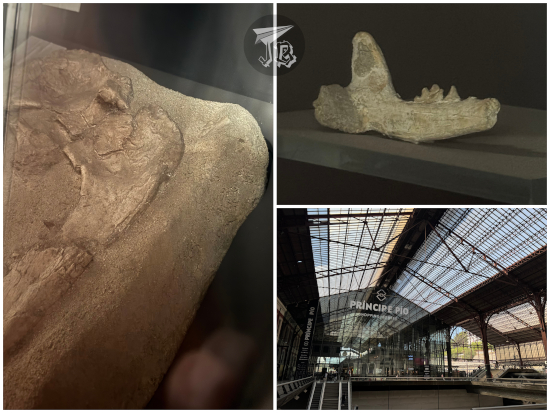
Afterwards, we walked towards Casa de Campo for a sit-down and chat, and later to the transport hub Príncipe Pío, because I had read they had made a palaeontological display. Unfortunately, someone had placed an orange juice machine dispenser in front of the two key pieces – the reproductions of a jaw of the rhinoceros Hispanotherium matritense and a jaw of the mustelid Magerictis imperialensis, and massage sofas in front of the illustration panels. Thus, the Yacimiento Paleontológico de Príncipe Pío was nothing extremely impressive to see.
My friend took the bus home there, and I made my connecting train by pure chance. The train was at the other platform when I arrived, I made a dash for it, and the doors started closing when I was a few steps away. The person running in front of me threw their purse in, blocked the doors, and I jumped in behind them.
I either need to run faster, or get a purse to block train doors…
After my car failed its technical inspection in February, I was a bit apprehensive about driving further than work and back. As I wanted to get over the feeling, I got myself to organise a short road trip, three villages with some stuff I wanted to see, and a total of around three or four hours behind the wheel.
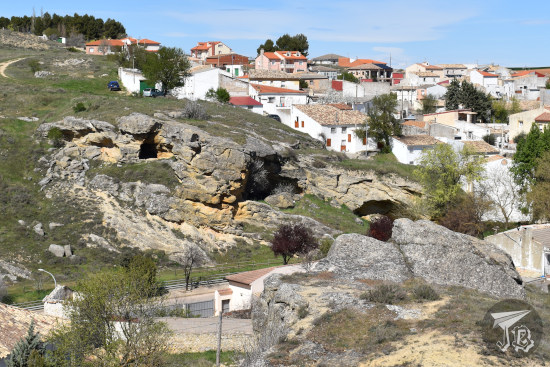
On my way out, I calculated an hour and a half and added some buffer time, which turned out to be more than enough. I reached my first destination, Pinilla del Valle, a tiny village in the middle of a valley, where thousands of years ago giant hyenas and Neanderthals roamed the land. Today, one can find the palaeontological and archaeological site that has been called Valle de los Neandertales (Neanderthal Valley). The site has been open to visitors under some specific circumstances with a nominal price (2€) and the village has decided to capitalise on the tourists.
They have set up a “museum of jobs” Museo de los Oficios, a glasshouse where a bunch of not-that-old rural implements have been arranged to define the tasks that used to be carried out in the fields before the steam engine changed everything. They decided to add ironwork tasks, too. I however ended up more interested in a pair of storks nesting on a nearby tree.
It takes around four minutes to walk from one end of the village to the other. I strolled along and saw a very cheesy photocall-mural that someone had thought was a good idea to paint, cherry and lilac trees and a mother-cow who gave my camera and I the stink eye.
The tourist information office was locked down, and so was the museum Museo de los Neandertales, the building where they take all the archaeological discoveries and which will eventually open. The only thing I could actually do was climb the observation tower Torre Mirador, though I did not see much due to the trees all around. I also got myself an airport-priced Coke before the visit started at noon.
The guide picked us up and we started walking towards the site, which was a twenty-minute hike away, as to get there one has to border the reservoir Embalse de Pinilla. Once there, we got a lecture that… could have been given anywhere else, to be honest.
Between 400,000 and 30,000 years ago (Mid to Upper Pleistocene), there was a system of caves and rock shelters in the area. These refuges were first used by spotted hyenas – the website says Crocuta crocuta, but that is the extant one, so it might have been Pachycrocuta brevirostris. Later, another species used them for as hunting “bases” of sort – Homo neanderthalensis, the extinct human species known as Neanderthals.
The first humans with Neanderthal characteristics appeared in Europe around the beginning of the Middle Pleistocene, but the fossil record is spotty and theories disputed. They went extinct around 40,000 years ago, possibly replaced by current humans’ populations. One theory is that the Würm glaciation killed off the Neanderthals’ usual prey, and they starved to death because they needed a much larger calorie intake than Homo sapiens.
Though popular culture tends to present Neanderthals as brutish (my own textbooks used to do it too), they were advanced enough to have a complex society with division of labour, caring for the wounded and elder, and even a surprising knowledge of medicinal plants and their use. They hunted in the valley, but they did not live there – they went, hunted, worked the prey there and took back what they needed. On top of that, they created a sort of funerary chamber for a child, decorated with deer antlers. As time passed, the caves collapsed, preserving the archaeological remains inside. The whole valley thing might become a sight to behold eventually, but at the moment, with all the excavations covered by wooden beams, and the museum closed, it feels more like an attention-grab than anything else. Fortunately, the weather was nice enough and although it thundered, we had no rain.
I moved on. Hopping back onto the car, I drove off towards Patones, a village in the mountains divided into two neighbourhoods, with Patones de Arriba (Upper Patones), being the older one. It was established as far back as 1555, it is a “black architecture” village that has in recent years exploded in popularity. One of the reasons is that it cannot be accessed by car: there is only one small parking lot at the edge of the village and you have to walk from there. Since the village is on top of a mountain, it has become a bit of a “hold my beer” feat to find a parking spot nearby instead of hiking the “gorge path” to brag about having parked close-by.
However, I thought that walking the trail was part of the experience. Thus, I parked at the foot of the hill in the more modern Patones de Abajo (Lower Patones), and got ready for the “ecotrack” (whatever that means) Senda Ecológica del Barranco. The trail runs parallel to the local torrent, and it took around 20 minutes to walk it upwards. It was nice and warm, and I had stopped for a snack beforehand, so it didn’t take much effort.
Halfway through the hike there is a bit of an aqueduct, as the area is near the Lozoya infrastructure owned by Canal de Isabel II, which provides the city of Madrid with drinking water. When I arrived at the top, I had to walk a bit by the road – that should be better organised. If using the trail is the recommended way, the last stretch should not be that hazardous. I finally passed by the parking lot and stepped into the village.
Spanish black architecture arquitectura negra takes its name from the black slate that has traditionally been used to erect houses in the mountain range Sierra de Ayllón, where this metamorphic rock is quite abundant. Despite Spain having the reputation of being warm / hot, winters in the central plateau (the meseta) are cold, dry and unforgiving. Black rock absorbs what little sun the area gets, which has been often cited as a reason for the importance of the constructive style. The truth might be as simple as it was the only thing available, especially since slate was also used for fountains and bridges, which would need no heat.
You are supposed to visit the village at weekends, when everything is open and it is teeming with tourists. At 15:00 on an April weekday, there were a few people snooping around and most eateries and treat shops were closed. However, it suited me just fine to snoop around and avoid others for the most part. The village was charming, but I had expected something more after reading so much about it. It was nice with flowers decorating the streets and all, but in the end, just a small village with dark houses. Now that I think about it, though, it’s probably unbelievable for a city-dweller though.
There was a drinking fountain, a washing pond, and old animal enclosures, alongside the townspeople’s houses, which included ovens, though some structures had become abandoned and ruined. After an hour or so I had wandered all the streets and greeted all the stray cats, so I decided to make my way back down using the track. At that time, I was grateful for the couple of frozen-water bottles I had kept in the car.
I still had one more spot I wanted to check out. The nearby hamlet of Viñuelas had apparently rehabilitated a windmill Molino de Viñuelas a few years back in order to attract some tourists to the area. Apparently, it did not work out too well, because the blades fell, and nobody bothered to put them up again. Without the blades, the building is just a roundish-looking construction in the middle of nowhere. Never mind how much the town hall tried to pump out the cultural offer, the village only has a couple of religious buildings, both of them locked down. I had wanted to see the windmill for a while, since I found about its existence shortly after coming back from Consuegra. Pity about the blades.
I drove off and was back home by early evening. The day might have not been spectacular, but it cleared my head. It also convinced me that I needed to have my tyres replaced, as the car complained about skidding on a few curves on the secondary roads. It might be time to start thinking about getting a new vehicle instead. Oh, joy.
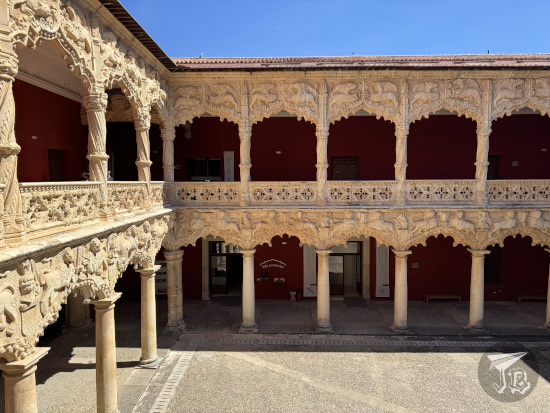
Palacio del Infantado (Palace of the Infantage) in Guadalajara is an impressive building designed by architect Juan Guas. It is one of the most iconic representatives of the Isabelline architecture or Gótico Isabelino – a sub-style of Civil Gothic – sprinkled with some Renaissance details. Some people claim that it is even the only representative of its own style, gótico mendocino.
The palace was commissioned by the Second Duke of Infantado, Íñigo López de Mendoza y Luna (1438 – 1500). The Mendoza family was important in the area, and also an asset to the Catholic Monarchs in both the political intrigues of the time and their wars to conquer and rule all of Spain. The Duke himself participated in the siege of Granada, and was personally involved in several battles. Aside from the palace, also commissioned the castle in Manzanares El Real.
Palacio del Infantado was erected around 1480. It features a main façade decorated with diamonds, and a series of reforms in around 1596 added Renaissance details, frescoes in the inner halls, and a garden. It was heavily damaged during the Spanish Civil War, and some of the reforms were undone during the restoration afterwards. For a few years at the end of the 20th century, it hosted the local public library, which was great to access the building for free. After the library was moved away, the palace was repurposed as the local museum – a few halls of artefacts haphazardly thrown together in order to justify its existence. Entering the museum gives access to the frescoed rooms. Whether or not you get a ticket for the museum you are able to walk into the Renaissance patio, which used to be plastered white, and now sports a weird burgundy-red colour behind the stone carvings representing lions and griffin. The original wooden roof has never been restored, but when the storytelling marathon takes place, the space is shaded using flags and parasols.
The first part of the museum deals with “stuff” – while it tries to arrange the artefacts in some sort of logical order, there are too few of each to comprise an actual collection – beehives, pottery pieces, and a Medieval lady’s sepulchre rest here. Then there is an area dedicated to the palace itself, with remains of the original pieces that were recovered after the destruction in the war. The last area showcases the decoration and frescoes on the walls and ceilings, before accessing the patio and the staircase to the upper corridor, where the temporal exhibitions are held.
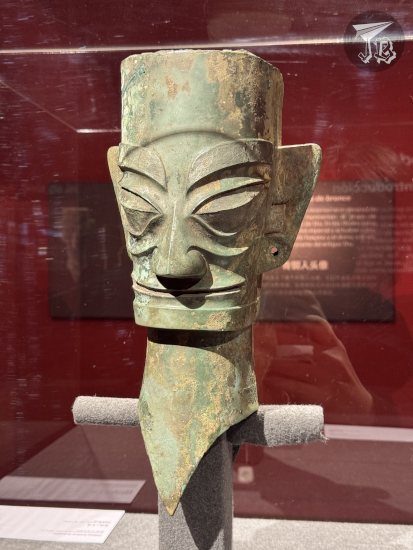
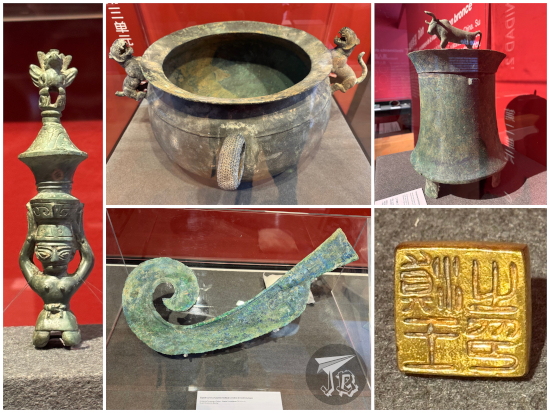
Such exhibition at the time was Las Civilizaciones del Bronce en el Suroeste de China [中国西南地区青铜文明], Bronze Civilisations in South-Western China. It was organised by the Chinese National Cultural Heritage Administration, NCHA [国家文物局], part of the Ministry of Culture and Tourism of the country. Itinerant exhibitions and claiming back objects on display in foreign countries are the two main axes of the bureau’s activities.
The exhibition brought to Guadalajara almost 60 original pieces and reproductions from 14 museums in Sichuan, Yunnan-Guizhou, Guangxi and Guangdong. The peoples who created these objects were the Ba, Shu, Dian, Yelang, and Ouyue, from around 1600 BCE to 220 CE.
The Bronze Age is found across civilisations in Africa, Asia and Europe, with different time ranges. It follows the Neolithic period and it refers to the time humans learnt how to use metals, particularly how to produce bronze, which has a high smelting point and is resistant and hard. Bronze is produced alloying smelted copper with other metals, mainly tin and arsenic. Civilisations who went through a Bronze Age were also the first to develop practical writing system. The Bronze Age would give way to the Iron Age as metal technology evolved.
The exhibitions show how bronze was used for both practical and decorative purposes, both for the living and the dead – there were items from graveyards, temples and everyday life, along with jewellery, complements and even games. Not something I would have expected from a place like Guadalajara, but quite interesting none the less.
While we were on the train to have Father’s Day brunch, I was asked what my plans for Easter break were – either a couple of day trips or meet my sibling. I explained about the gypsum mines in the Cuenca area, and one of my parents was immediately interested, to the point that they ended up hijacking the whole thing. They, however, drove, so I am not going to complain, just be low-key amused at how it all went down.
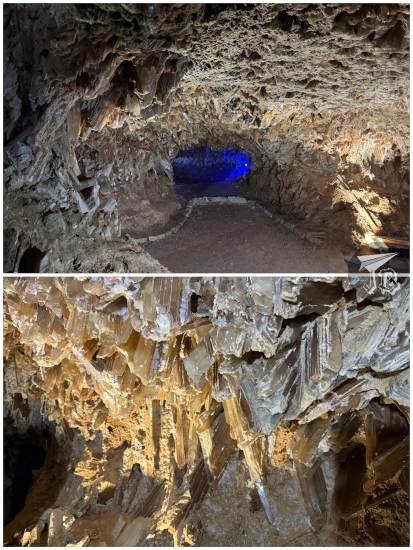
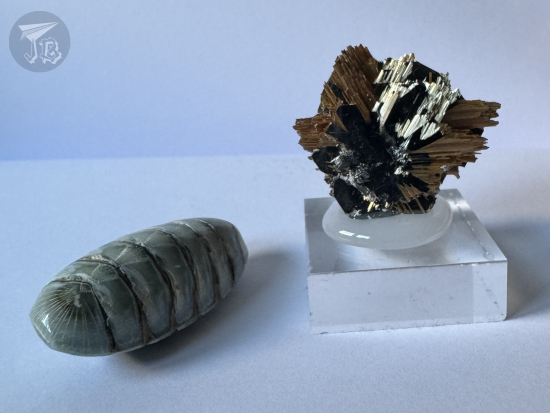
Gypsum (Calcium sulfate dihydrate, CaSO4·2H2O) is a very common mineral, a type of evaporite that forms when solvents precipitate as water evaporates from from seas, lakes or hot springs. It can be a white powder (actually very small crystals), rocky white veins, or selenite crystals. Selenite is a transparent crystallised variety of gypsum, and it can be tinted with the presence of impurities. In Roman times, a variety of selenite, referred to lapis specularis (stone mirror) was used to create windows throughout the Empire.
A lot of that lapis specularis was mined in Spain, and distributed from the Ancient Roman settlement of Segóbriga (which I wanted to visit on my way back from Almadén, but they were on weather alert and I decided to skip it in the end). The mines extended up to 100,000 steps (150 km) around the city, and a couple of vistable ones were about an hour’s drive away. My curiosity was piked. When I was a kid, in Tendilla, I used to dig up a lot of small gypsum crystal, and I guess I wanted to see if there was much difference between what I had and what Cuenca offered. I have to own up that Cuenca’s crystals are larger (by far) and more transparent.
The two mines I wanted to explore are located in the village of Huete (technically, in Saceda del Río, but it is the Huete Tourist Office that exploits them since Saceda is barely a neighbourhood). They can only be accessed by car and my plan was to get there, see the mines and then drive back stopping at several archaeological sites. My parent took over planning and was able to get a visit for 11:00 on Good Friday, which is a holiday in most (if not all) of Spain, therefore traffic would be limited. We actually did not meet many cars until we reached the meeting point by the road, around 10:30. I hiked up the hill to see what was ahead, and there was a parking spot right at entrance of the mines, so we drove up there. The guide was late, but someone from the Tourist Office came to collect the money (5 € per person) and “open up” the mines, which are locked away using grilled bars. Not sure whether to protect them or to be able to charge entry (probably… both).
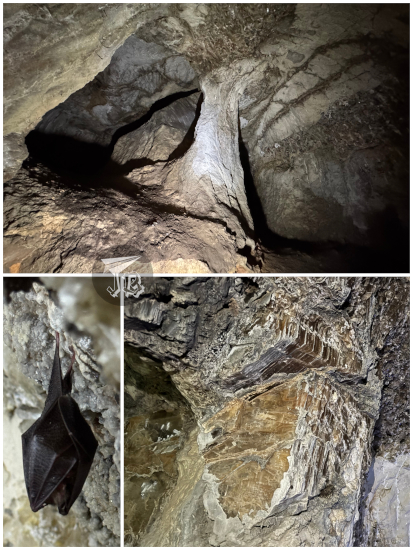
When the guide finally arrived, we were shown (rushed) in. The visit to both mines / caves was only about 30 minutes, and we could barely snoop around, just at the entrance of both.
The first mine is called Cave of Knives, Cueva de los Cuchillos. This is due to the way the lapis specularis crystallises, in small(ish) crystals that protrude outwards from the ceiling. The second is Cueva del Sanabrio. Apparently, the sanabrio was a monster made up by adults to prevent kids from entering the mines and getting lost. Not that we had any chance to do so, considering how little we were allowed to explore. The crystals in this cave were larger, and could have been mined off in one sizeable slab. I did not pick any minerals inside, but there were a few easy to grab in the parking lot so I hauled a couple of tiny samples.
The guide “invited” us to go to the nearby village of Huete for the guided visit at 12:30. My parent loves guided visits, so they decided that we should drop by. When we got to the tourist office in town, we learnt that the village has four museum (2 € entry for each), and that the guided visit was 7 €. We paid for the visit but adding up the museums and the mines, the whole thing would have been 20 € per person – daylight robbery, I thought. The visit started at 12:50 as the guide still had to come from the mines with a second batch of visitors.
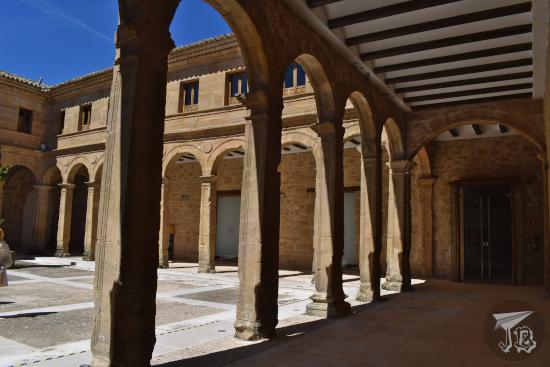
We used the idle time to book a spot for lunch at the local grill, which happened to be near the old town walls. There is not much left of the fortification except one of the gates Puerta de Almazán and the clock tower Torre del Reloj. The meeting point for the visit was the Tourist Office, located in the monastery Monasterio de Santa María de la Merced, which now belongs to the town hall and has been used as museum and local offices.
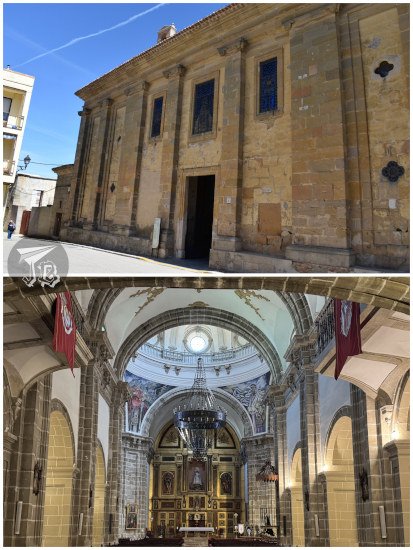
It’s not a secret that I’m not a fan of guided visits, but this was probably the worst one I’ve attended in a while, not even considering the tardiness. Besides the guide’s high tone of voice, the bad sound amplifier, and the reverberation in the church… the whole thing was bad. Really bad. Our first visit was indeed the church, where the guide spent 30 minutes telling us about how Huete was great, its history, and the lives of kings and saints vaguely if at all related to the village. What she did not say? For example, the name of the church. I later learnt that it was the Baroque temple Iglesia San Esteban Protomartir, designed by José de Arroy. When the guide was about to let us leave the church, a religious procession came back from parading the streets, so we waited for them to pass out of respect.
After that, we trotted towards the former convent Antiguo Convento de Jesús y María de Huete, where the photography museum Fundación Antonio Pérez. The foundation of the convent happened in the mid 16th century, but the building has been renovated again and again. Here, we saw the Renaissance façade, and the Baroque cloister.
We then were ushered towards the city wall, the gate Puerta de Almazán and the clock tower Torre del Reloj, where we learnt that the only function of the latter was telling the time – hence… the clock? (what she meant is that it was not a defensive tower). Afterwards, we went walked past the “royal barn” Pósito Real and reached the second gate of the Medieval walls, Puerta de la Medina. At this point, my parents and I gave up and left for lunch, sunk cost be damned.
Lunch was… forgettable and slow. At least we were next to the air-con and that was set on heat, so I was warm and content. After eating, we took a small detour on the next street and saw the outside of the church Iglesia de Santo Domingo and the rural hotel Palacio de los Condes de Garcinarro.
We got back to the car and headed back. We missed a Roman mausoleum which is marked on the Sat-Nav, but there was no way to park so it must not have been that important. What we did find was the so-called “Prehistoric Valley” Valle Prehistórico de Altomira. The only thing we saw at first were a bunch of caves, but apparently they are home of scattered Palaeolithic, Neolithic and Chalcolithic remains, mainly pottery and stone tools.
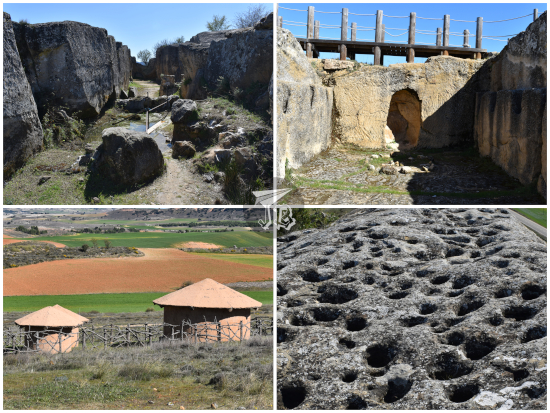
We drove a bit further (closer?) and stopped at the archaeological site Yacimiento Arqueológico de la Cava, in Garcinarro. The area was first occupied around 4,000 years ago in the Bronze Age, strategically situated on top of a mountain. The problem, of course, is that you have to actually climb the mountain to get to the site. A wall lizard thought we were crazy to be out and about at that time in the afternoon.
The oldest structure is a horizontal layer of rock with small circular petroglyphs, called cazoletas (cups) – there are around 8,000 of them, and nobody currently knows their function. From the Celtiberian period in the Iron Age, there is a three-room building. It faces south (probably for warmth), and it was carved out of rock, and protected by a sort of moat. Facing north there are newer remains from the Bronze Age, where a bunch of artefacts have been recovered. These are kept in the museum, but we did not get there. The settlement was eventually abandoned – probably destroyed by an earthquake.
All in all… I don’t know. The caves were cool, the Huete visit was really bad, and the archaeological site was okay – and free. The prehistoric valley needs more research and exploration though, but it was not something I could do with my parents. Some other day when I’m in the vicinity, because I still need to get to Segóbriga…
I was on break for Easter, and my sibling, who works in Madrid, proposed to “have lunch and whatever”. That usually means that they want me to find a good place for lunch, and a plan for “whatever” afterwards. The original plan was Monday, but way too many things were closed on that day, hence we rescheduled for Tuesday. I organised two “whatevers” – one for myself, one to do with them.
I took the train towards Casa de Campo, and I actually made an earlier train than I had calculated. I was at the final underground stop around 9:15, so I had 45 minutes to explore around before my 10:00 ticket. The park known as Casa de Campo was established as royal hunting grounds in 1561, under the reign of Felipe II (Philip II). It was at the time designed by Juan Bautista de Toledo, who divided the area in three parts – orchards, gardens and the actual hunting grounds. In 1656, engineer Pietre Jansen established the large pond in the centre, Lago de la Casa de Campo. Later royals would add modifications for their own enjoyment until the area was open as a public park in 1931, during the Second Republic. In 1997, it was declared historical park (Parque histórico). Today, the Madrid Zoo and the Amusement Park are located within its grounds. It also hosts an area for travelling exhibitions, Escenario Puerta del Ángel.
I’ve always wanted to explore the park a little, and this was my chance. There are several constructions of historical importance there. Beside the lake, which was already teeming with sportspeople, the first one I found was the aqueduct Acueducto de la Partida, a former waterway that carried water from the lake to one of the orchards. I also saw the former house to breed pheasants in, and the forest around it – La Faisanera and Bosque de la Faisanera – but mostly, I wandered around, scaring a bunny or two.
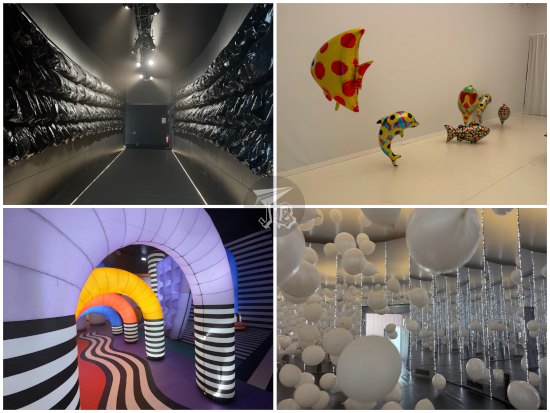
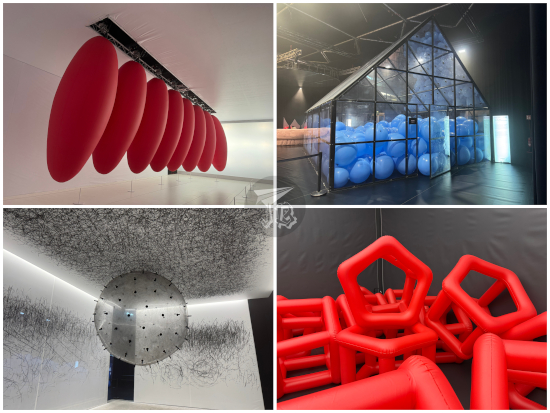
Eventually, I headed towards Escenario Puerta del Ángel where Euphoria, a new exhibit by the Balloon Museum had just opened. The first time I had been to one of their exhibits I had not known what to expect, but this time around I was ready. The Balloon Museum specialises in immersive artworks (each of them can take up a whole room), most of them created with inflatables and light. You can touch and play and be silly with a lot of them too.
The artworks displayed, and a bit about them, are:
One Hundred and Twenty by Nils Völker. A short corridor flanked with garbage bags that inflate and deflate as if they were breathing. A bit unsettling, so I am glad that was the first one and I could leave it behind.
My Room Is Another Fish Bowl by Philippe Parreno. A room full of helium balloons in the shape of fish and seahorses that you could play with as they floated gently along the room. This was very cute – but I guess I like fish.
Follow Me, I Think I Know the Way by Camille Walala. It was like a kid’s monkey jungle but made of inflatables. I wish I were younger and could climb on them.
Invisible Ballet by Hyperstudio. A room full of balloons that floated around at the centre. You could stand amongst them as they move and turn and the wind messes with your head (and the balloons hit you on the face, of course). This had a very pretty, but mostly hilarious, effect.
Ovoids by SpY. A bunch of egg-like giant… things that gently swayed from the ceiling, making it a bit (actually very)… creepy.
Work No. 3883: Half the air in a given space by Martin Creed. A greenhouse full of huge blue balloons that you had to cross, it was like an adventure. Of course I went in, who do you think I am?
Our Floating by Alex Schweder. A round bed-like structure you could sit and lie on as it inflated and deflated randomly so you kept falling and rising. A welcome break, and giddy fun to flop down on.
ADA by Karina Smigla-Bobinski. A big… bouncy ball with charcoal pencils attached to it. You could push it or let it float around, and as it hit the walls it drew random lines on them. This was stupidly fun, but it did stain your hands – and whatever else it came in contact with, if you were not careful.
Crazy Love for Polygons by Cyril Lancelin. Hexahedral balloons that you could stack to make shapes with – unfortunately this was hijacked by toddlers who did not want to share with the rest of the attendees.
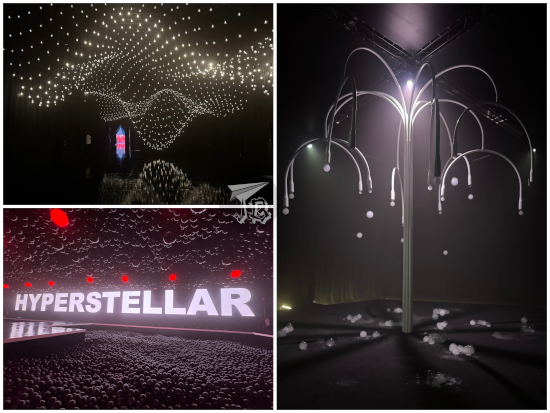
Pulse Topology by Rafael Lozano-Hemmer. A lot of lightbulbs hung from the ceiling in some sort of wave shape. You could put your hand under a sensor and the bulbs pulsated along your heartbeat. When you took your hand off, one of the bulbs remembered the rhythm and kept pulsing. It was a pretty intense feeling, to be honest, though I am not even sure why.
New Spring by A.A. Murakami. The installation resembled a cherry tree, but instead of cherry blossoms, it shed bubbles of pinkish mist that popped into scented vapour if poked or when they hit the ground. The scent was rather beautiful, too.
Hyperstellar by Hyperstudio with Quiet Ensemble and Roman Hill. A huge ball pit with a light and sound show. This is pretty similar to the Hyperstudio artwork I had seen the first time around, so I guess it is a signature kind of work.
Kaleidoscope by Karina Smigla-Bobinski. There were three tables in the middle of the room, and when you touched them, the liquid on top moved around, changing colour. That reflected or was projected on the walls… I didn’t quite get the idea.
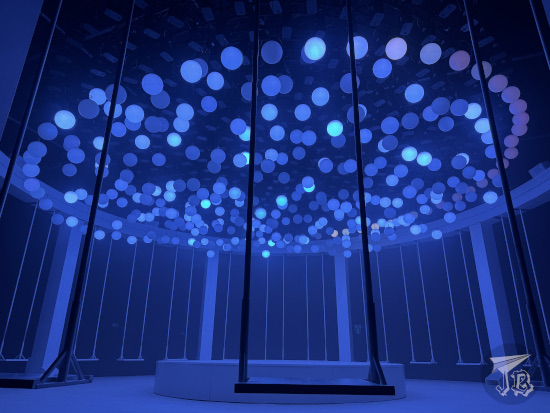
10 Agosto (10th of August) by Hyperstudio. A circle of swings looking at big round lightbulbs that turned on and off, and moved along the rhythm. It was quite relaxing even if the music was not designed for it.
At the end of the tour there was a gift shop, where I got myself a sweatshirt, because at some point, I had a wardrobe malfunction and the zipper of my sweater had dislodged. I thought that was a sign. It was all good because the weather was weird – the wind was cold, but it was nice out in the sun.
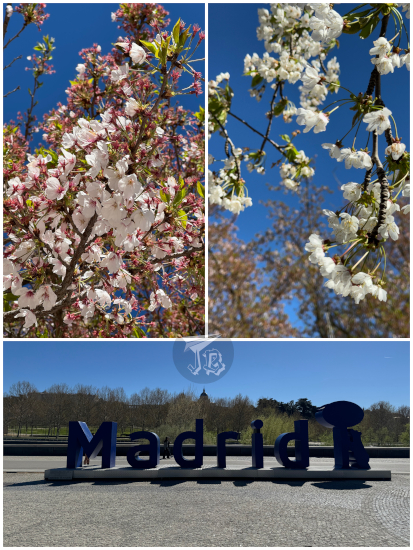
I left the museum and walked out of the park and into a wide avenue. There, I found a “trail” of trees in bloom, until I reached the edge of the park, which takes the name of Huerta de la Partida, strolled by the Madrid Sign and crossed over the river Río Manzanares. I headed into the former station, now shopping centre Estación de Príncipe Pío, where I tried the seasonal Starbucks drink – I did not like it too much – before I reached the royal gardens Campo del Moro. There, the Spanish Heritage management, has restored and sort of opened the historical Túnel de Bonaparte.
I feel the need to keep “opened” in quotation marks because I was expecting to be able to walk from one side to the other – but it turns out that no, only the first few metres are accessible – the rest are locked down (and the closed-off area is not even the historical part, but a reconstructed concrete bunker of sorts). The tunnel was conceived to be an underground connection the two parks – Campo del Moro and Casa de Campo. It was designed by Juan de Villanueva under orders from Napoleon’s brother, Joseph Bonaparte. Only the first few metres are the restored original, built in brick and open to visitors. It was a bit anticlimactic, because it would have been a nifty way to cross the busy avenue overhead.
I walked across Campo del Moro, emerged near Plaza de España and found Casa Gallardo, one of the few true Art Nouveau buildings in town. A restaurant has opened there, and there’s a part of me tempted to go for lunch some day so I can see the interior, but I don’t really think it would really be worth it. The house / palace was built between 1911 and 1914, and its architect, Federico Arias Rey, was awarded the “best house of 1915” recognition for it. The roofs are black slate, and the white façade features rounded balconies are uncommon in Madrid. Today, everything is private or residential, so no snooping around.
After wandering around for a bit, I finally walked into the underground to meet my sibling at the Tetuán stop, for our lunch reservation at Shanghai Mama (Infanta Mercedes), part of the group China Crown, whose first eatery tackled trying to tear down the Spanish idea that Chinese food was all cheap and greasy, or fried rice (and yet, our waiter was very surprised that we did not order any rice). We shared Crunchy duck bundles with plum sauce (Paquetitos de pato crujiente con salsa de ciruela | 缤纷鸭卷), Xiaolongbao filled with Iberian pork secreto (a shoulder blade cut, one of the best parts of the animal, apparently), mushroom and foie (Xiaolongbao relleno de secreto ibérico, setas y foie | 鹅肝鲜肉小笼包), Prawn chop suey (Chop suey de langostinos | 什锦炒大虾) and Lacquered duck magret with orange sauce (Magret de pato laqueado en salsa de naranja | 香橙酥鸭胸肉). Everything was delicious, but especially the chop suey. I had not had chop suey in years, so I was really happy it was so good. The duck was incredible too.
We did not have dessert, because I wanted to try the nearby Muua Bubble Tea. Spain came into the bubble tea fad a bit late, and while the place was pretty, the tea was extremely sweet. They were extremely generous with the tapioca, too, and very friendly.
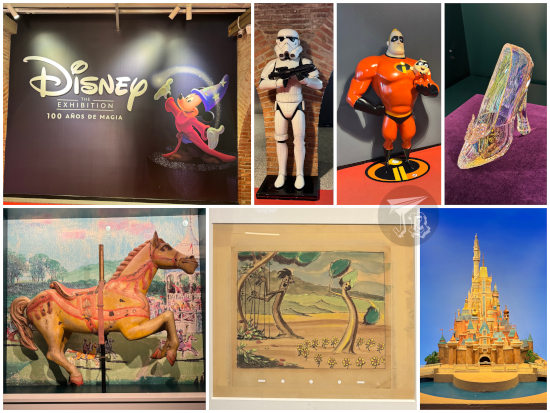
Afterwards, we walked up towards Sala Castellana 214, one of the exhibition halls that Fundación Canal manages. They were running an exhibit by the Walt Disney Company’s Archives – Disney: The Exhibition – 100 Años de Magia (Disney: The Exhibition – 100 Years of Magic), which was half price for Easter. While I’m not a big Disney person, my sibling is.
The displays claim to honour 100 years of Disney’s creativity (103, actually, as the century-mark was 2023, when the original exhibit was held in the USA). I have a couple of problems with the way it was presented. I was honestly expecting that they would focus on the actual “Disney” work, as we were greeted by a lady from the “Disney Archives”, not stuff created by other people than Disney later bought. So in my opinion, Indiana Jones, Star Wars and all the Marvel stuff were an add-on.
The first room was an introductory video, and the second had a bit of an introduction to the company and the first films, including the birth of Mickey Mouse. In the upcoming areas, there were props like Cinderella’s shoe (from the live action film), one of the carousel horses from Mary Poppins (my sibling is rather sure it’s Bert’s), an original Winnnie the Pooh puppet (quite creepy, if you ask me)… I really liked a reproduction of the book from Sleeping Beauty, which projected the scenes on a screen. Other “not Disney in my head” props included an Indiana Jones outfit, Star Wars paraphernalia (a BB8, a prog, a lightsaber handle), Marvel’s suits and accessories (Captain America’s shield, one of Black Widow’s outfits, Avengers’ helmets…). There were also items from live action films such as The Little Mermaid and Cruella.
Another room focused on music, with a big screen projecting iconic songs, Mickey dressed as an orchestra conductor, or the outfit of the actor who played Mufasa in the Broadway version of The Lion King. There were also examples of how to create different sound effects. Further, there were items used in parks and films and an interactive Rocket Racoon that was not working.
Finally, there were references to the Disney Parks, a collaboration with National Geographic, and some more projections and a kids’ activity zone. Oh, and of course the shop. You can’t go wrong with a shop, especially when a good part of the attendees are going to be under the age of nine.
We had a bit of a bad connection as Metro has closed down a few stops on Line 10, but we were lucky enough to catch the courtesy bus service that took us right to our station – for free, even. The train ride back was okay, there were issues with the carriage filling up and almost catching someone at the doors, but in the end everything worked out.
A bunch of people kept telling me about DinoVerse, an immersive exhibition in Madrid. I had visitedNomad Museo Inmersivo before, so I was really not too keen on getting there for just a forty-minute video. However, I ended up finding a promo which allowed me entry for less than half price on Friday the 27th, and I thought why not? It was not the brunt of Easter yet, so it might be worth it.
I had to work in the morning, so I booked a ticket for the museum at 17:00. I was able to catch a train around 14:20 and transfer without an issue. I walked to the museum, which I reached a bit before 16:30. The lady at reception let me through, and when I got to the immersive room, the atmosphere was rather sad: two dads, three kids – all five bored out of their minds – and myself. I caught the show half-way through the Cretaceous, and waited for it to restart until I had seen it all.
The premise is that you live in the year 2126 and you go to the past as a “time tourist” to explore from the Triassic to the meteorite impact. I can’t even complain about all the parents with little children that came to fill up the room – the exhibit was indeed aimed at them. The scientific accuracy was… slippery. Some dinosaurs’ names were wrong, some animals called dinosaurs weren’t, and the recording placed the meteorite impact and the K-Pg extinction 45 million years ago, when it would have been around 66. Also, there was a disturbing amount of herbivores killing off carnivores, which I’m sure happened sometimes, but the video showed that all predation attempts went awry, except for a few Carnotaurs snacking on carrion.
There was a bit that took the visitors under the sea, so we got to see marine reptiles and a megalodon, the latter created the biggest jump-scare as it “hit” and made it look like it almost broke the wall. At the end of the recording, the time machine is supposed to malfunction and land in 2026, where the viewer is told to stay and “watch birds” (avian dinosaurs). The whole thing was okay-ish, but I would not have missed anything had I skipped it. It was also difficult to take pictures avoiding the toddlers and having the camera focus.
I wandered the rest of the museum for a bit after I had seen the whole video and left. I was also lucky with my connections back, and since I was riding with a monthly ticket, the trip came rather cheap.
From September 2025 to February 2026, I took an online course in the long-distance-learning university, UNED. As it was financed by the European Union, it was free. The name of the program was “Digital Skills for Culture and Creation Professionals” – Competencias Digitales para Profesionales de la Cultura y la Creación and I chose the specialisation “Digital Creation of Cultural and Creative Content” – Creación digital de contenidos culturales y creativos.
I thought it would be nice to have a reference or even a benchmark for JBinnacle. The biggest downside was that they wouldn’t let you work at your own pace, despite the program being online. The tutors wanted a regular schedule and daily connections, especially during the second module. Whenever I spent several days offline, they messaged me demanding I went online. I repeatedly explained that I was taking the course in bursts, but during my November France and Monaco escapade, the tutor wrote every day. Even after I had handed in all the projects necessary to pass the module, I would get messages of “you haven’t been online for X days. Remember this course is free because [Sponsoring European Funds] is paying for it. Let me know if you have problems connecting” – I was offline for a whole week out of four months. I didn’t have issues, but apparently others did – especially those who had trusted the student licences for the software, which ran out a month too early. The forum was plagued with messages by people who were absolutely lost with how things worked – when they worked. Contents did not always do so and if a tutor sent you feedback in the platform, you couldn’t see it.
I chose to focus on social media for my third module and final project, in hopes of developing a strategy. While the tutor was knowledgeable, the general advice was “post often, and make quality content”, but I didn’t get info on how to achieve that. Despite liking technology, the mechanics of the course actually put me off working on the whole thing for a while. Nevertheless, I managed to pass all three modules, so I was invited to the closing ceremony or “graduation” in Madrid. And you know what? I decided to just go, even if it was a stupid decision. I would have to get out of work, drive to the train station and hope for decent connections, about two hours each way. No time to go home and change clothes, so I would have to work in formal(ish) clothes – which of course drew way too many comments.
The ceremony would happen in one of the UNED buildings in Ciudad Universitaria, the Education Building Facultad de Educación. The area is called the “University City” because bunch of faculties are homed there, alongside dorms and other facilities. It is not a convenient area for me to either drive or reach by public transport.
I was able to catch a train twenty minutes ahead of schedule, and my connections went smoothly, so I reached the area around 16:10, which was great. The ceremony was at 18:00 and we had to be there at 17:30. I had a snack, then started walking. Between 18 minutes by bus and 22 on foot, I prefer the latter if the weather is good. Furthermore, I could make a stop on my way.
The botanical garden Real Jardín Botánico Alfonso XIII belongs to one of the University bodies (Universidad Complutense de Madrid), and it’s thus only open during schooldays. It is not really convenient to get to, but since I was around, this was my chance to visit. King Alfonso XII came up with the idea of building Ciudad Universitaria in 1927, including the garden, nestled between the Science and the Pharmacological sciences buildings. It would not be until 1997 that engineer Fernando Gil-Albert created the space, which remained closed until 2001. Nowadays, it is free access.
The garden has a central rotunda that aims to represent a geological calendar from the origin of earth to the current eras (trust me to find the fossil replica in a botanical garden), traversed by one large avenue, and surrounded by a circular path. There are around 1,000 plants, grouped in several collections around three particular “topics”: ethnobotany (plants that are important for people, mainly medicinal ones), gymnosperms (“naked seed plants”, mostly pines in this case), and Mediterranean flora.
The end of winter had been really rainy, followed by some sudden warm days, so a lot of the flowering plants were in full bloom, which made for really pretty pictures. The collection of ornamental bulbous plants was in full display – especially the narcissuses and tulips. Several trees were doing their best too, such as the almond (Prunus amygdalus) and pear (Pyrus communis) trees, along with the Japanese flowering crabapple (Malus floribunda) – which I had never heard about before.
The pollinators were pretty chill, too, gorging themselves in nectar without being bothered by people taking pictures. I found more than a couple of bumblebees, and one particular very hard-working Spanish bee (Apis mellifera iberiensis) who did not mind me taking pictures one bit. She was more cooperative than the bunch of mallard drakes (Anas platyrhynchos) living in the pond, who would not stay still for the pictures – actually I managed to take a photo of one of them in flight… but my phone focused on the trees behind him.
I spent over an hour in the garden, exploring around, and then headed off towards the ceremony. I was there at 17:30 sharp, after a walk following the phone’s directions. Once there, however, I did notice that on my way back I could cut through the parks as there were walkable paths that the maps app did not consider.
Upon arrival, the security guard was unfriendly as hell, annoyed that we were there, apparently. Then, the organiser wanted to call people in one by one, and allowed “companions” to sit on the same rows as the attendees were assigned – which made it for very awkward walks to pick up the diplomas. The worst thing about it though was realising that even through the University network and with my student ID, I could not access the Science website. There were a few articles I wanted to get access to – I eventually figured out the method to do it.
The organisers had been very insistent on punctuality. However, we started late because it turned out that the representative from the Ministry who had to open the ceremony had gotten lost and gone to another building in a completely different district. We could not start without the guest of honour, I guess. After she arrived, we got the typical “pat ourselves on the back” from the her, and the university themselves.
Afterwards came a talk by special guest Ana Beltrán Porcar, an artist whose works centre mostly around the visual and performance arts. She explained her career and work process whilst she drew a hand and a blue bird, using a video presentation, which she timed so at the end, the hand-drawn bird became animated and flew away.
The bunch of people who had decided to attend the ceremony – as the course had been online, there were many who did not sign up, and even some of them who had did not get there – received their diplomas in a bit of a chaotic moment (why were they taking attendance if they were going to call people who had not come?). Then there was more self-back-patting by the course coordinators. Finally, we had a performance by Clara Olóndriz, an indie pop singer who won the 2025 “Best Message in a Pop Song” recognition in the Premios Latinos (Latin Awards, sort of like the Latin Grammys but organised by Spain and Latin America). She sang three songs – Corona de Rey (King’s Crown), Brindis Eterno (Eternal (glass) Toast) and Huracán (Hurricane). While she wouldn’t usually be my cup of tea, she sounded really cool, and her voice was incredibly clear. She seemed like a nice person, too.
Finally, there were official pictures, and I did not stay for the cocktail as there were a few trains to take. I left the university a bit after 19:00 and did not make it home till around 22:00, even if I was quite lucky with transport. There was junk food, and also a long shower before bed, because I had to work the following morning (who organises a graduation on a Tuesday anyway?). No rest for the wicked, but a diploma and some pretty photographs of a botanic garden in spring.
Spain celebrates father’s day on the 19th of March (Saint Joseph’s Day), but my parents were scheduled to be out of town. As a family, we’ve recently decided to try and repurpose Christmas presents into trips and smaller celebrations into experiences. My sibling had a look at different options and after weeding them out, we presented our father with a couple of ideas. When he decided to “leave it to us”, I suggested a closed-menu brunch with a singer, which felt different enough from the one we had done for my sibling’s birthday.
Thus, we booked a table at Gran Hotel Inglés (Grand English Hotel) for their Show brunch at 13:30, an hour after it had started. Not the time I would have chosen for a “brunch”, but I can’t get my family off the Spanish timetables. We took a train to Madrid and arrived with an hour’s time. It was early, but it gave us some wiggle space in case there were railway delays. I had proposed just showing up at the hotel, but the family did not agree, so we started wandering around. We ended up at the nougat artisan Casa Mira, a patisserie established in 1842, distinguished with the honour of being a “royal supplier”, meaning the Royal Palace used to buy from them. We ended up heading towards Gran Hotel Inglés around 13:10.
Established in 1886, Gran Hotel Inglés is considered the oldest hotel in Madrid. Other historical “firsts” include being the first hotel with its own restaurant, and one of the first buildings to use electric lights in the city. It was opened by businessman Agustín Ibarra, who by then already owned a famous café. His vision was offering high-class hospitality and lodging at European levels – a hotel with a restaurant might something normal today, but in the 19th century, Spain was considered an “exotic and slightly dangerous” country to travel to – meaning “uncivilised” in the Grand Tour mentality. Part of the marketing included every room having both cold and hot running water, phone and heating. Latest technology and comfort at the time!
The hotel became popular amongst intellectuals, both Spanish and international, from Valle-Inclán to Virgina Woolf. However, as many things did, its popularity faded away during the 20th century, what with the two World Wars and the Spanish Civil War and subsequent dictatorship making luxury… well, unaffordable. The hotel reopened in 2018 as a five-star member of the Hidden Hotel brand, a high-end hotel cartel that specialises in luxurious hotels in heritage buildings.
The café / restaurant area in the hotel is called LobbyTo, a pun between the word lobby and a reference to lobo, Spanish for wolf, because the street it stands on used to be called that. Even if we were a bit early, the table was ready for us. The “show” had already started – a lone male singer with a boom box of sorts, singing classics in a sultry voice, from Disney to Oasis. He managed okay in Spanish, but his English was lacking. He did have the voice to sing almost non-stop for three hours though.
The first impression I got when I walked into the area was a definite “whoops”. The table next to us had a small dog with them – my family is not too keen on pet the pet-friendly fad. I did my best to block view of the animal – fortunately, although spoilt as hell (at one point it ended on its master’s lap, cuddled in a napkin), it remained quiet and did not bother us. For a second, I thought that we would turn around and leave. Fortunately, my father did not notice, and we manoeuvred so he was sitting the farthest away from the critter.
The menu was pretty much closed, with just a couple of choices to make. It started with a juice – since I had studied the menu in advance, I knew I wanted the Antioxidante drink, made with lots of things ending in “berry”. Not that much of a strong flavour, but nice nonetheless.
The first dish was already waiting for us at the table when we arrived – Assortment of bread & pastries accompanied with grated tomato, homemade jams and butters (Surtido de pan & bollería, acompañado con tomate rallado, mermeladas y mantequillas caseras). There was actual bread, pastries, a croissant or two, way too little tomato, bitter orange marmalade, strawberry jam and three types of butter with slightly different colours and textures. Then came the tray tower – two towers for four people with the first set of appetisers. The lowest plate contained the seafood snacks: Salmon and Mango Tartar Taco (Taco de tartar de salmón y mango) and Tomato focaccia with homemade pesto and smoked sardine (Focaccia de tomate con pesto casero y sardina ahumada). Before we had even had the time to start on that, an independent plate with the warm Spider crab Tartlet with king prawn velouté (Tartaleta de txangurro y velouté de carabineros) was brought.
Back to the trays, the middle was a Selection of national cured meats and cheeses: Iberian ham, Italian mortadella and a Spanish smoked cured beef named cecina (Selection of national cured meats and cheeses), which unfortunately lacked any cheese. The upper serving was a Seasonal fruit bowl (Bowl de fruta de temporada), which included grapes, strawberries, blueberries, blackberries, and chunks of watermelon, pineapple, orange and kiwi.
But, this was not the end! Next came another plate of seafood, with a Gillardeau Oyster No. 5 (Ostra Gillardeau Nº 5) and two striped prawns (Langostinos tigre). Gillardeau oysters are supposed to be amongst the best in the world. They are farmed by the Gillardeau family under the commercial name of Maison Gillardeau in Ireland, Normandy (France), and Portugal. The company was founded in 1898 and it has cultivated Pacific oysters (Crassostrea gigas) since then, with an extremely curated process that involves moving the oysters through different farming areas in different stages of their lives in order to improve meatiness and flavour. Number 5 identifies a small oyster (the smallest commercial size), between 30 and 45 grammes. It honestly did not feel small… I just wish I had hidden away a shell to see if it had really been engraved with a laser G, which is something the company claims to do to avoid counterfeiting. I might have accidentally stolen the menu though, I thought it was going to be a disposable one…
All this was the set part. There was still a main to choose, and dessert. For my main, I had ordered Eggs Benedict on English muffin with smoked salmon (Huevos Benedictinos sobre English muffin con salmón ahumado), because it is not brunch if you don’t have Eggs Benedict, or at least some kind of poached egg. There was a lot of salmon on them! So much fish made it a little tricky to let the muffin soak on the egg yolk, but they were really nice, I’m not going to complain!
Finally, we could go to the dessert display carrito de postres, a side stand full of confectioneries, to choose a sweet treat. I went with cheese cake, and a decaf latte on the side, to wash it down.
All in all, it was a good experience. I do think the wait staff was not as ready as they should be – a bit on the clumsy side. The entertainer was not top-notch either. He did not do badly though, and held his ground for three hours. He was far away enough so we could have a conversation along his singing, but he did not really add to the atmosphere much, except for him dedicating Happy Birthday to someone in another table.
It did draw my attention how pet-friendly the lobby was, with as many as four or five dogs inside at the same time. I might have to come back for afternoon tea at some point, as Gran Hotel Inglés has been in my radar for a while – however, the machine translation of the website had put me off…
After we had settled the bill, we had a nice walk towards the station to take the train back.
It might very well be that Madrid’s Expominerales is my favourite drop-in convention – free, easy-to-reach, and full of (literal) shiny stuff, most of which I can’t afford anyway, but I can gape at. For the 2026 edition, I informed my parents I was coming, and they decided to tag along. Ideas for the day included Expominerales and a Japanese wood-prints exhibition. One of my parents decided to add lunch to the mix, and we had a complete plan drawn up. From my previous trainless Expogema experience, I knew that the right time to leave the ETSIME is noon, so we planned to be there around 10:30, since that put us on the most convenient train.
Expominerales is held once a year, usually on the second weekend of March, in the Mining and Engineering School Escuela Técnica Superior de Ingenieros de Minas y Energía (ETSIME). The main event is a literal rock fair – vendors from all over the world (but mostly Madrid) head there to sell their items at the cloister of the university: minerals, fossils, gems, meteorites, or items related to geology, such as magnifying glasses. Sometimes there are conferences or extra activities, and it is always a great moment to visit the little mining and mineral museum Museo Histórico-Minero Don Felipe de Borbón y Grecia. I’ve come to recognise a few of the vendors by now, there is a lady who always has very random shiny things, one who sets a large stand of marine fossils, and a seller who will talk your ear off just because you say hi. One I did not know had brought some rutile (titanium dioxide, TiO2) from Brazil. This mineral is a titanium ore and it is used as a bright white pigment, and also as an ingredient of sun lotion, as it absorbs UV light. I however was just taken by how pretty it looked – and got myself a piece.
Something else I got is a “fossilised” chiton – I’m not completely sure whether it is an actual fossil and not just a cleaned out shell, it’s very light. Chitons are marine molluscs belonging to the class Polyplacophora. There are around 900 extant and 400 fossil species, all native to salt water, usually intertidal and sub-tidal areas. Chitons have one articulated dorsal shell with eight valves, usually composed of aragonite. Early Polyplacophora appeared in the Late Cambrian or Early Ordovician (around 487 million years ago), maybe stemming from a mutated limpet. Their current form evolved during the Paleozoic, having changed little since the Mesozoic (252 – 66 million years ago). Most are herbivorous grazers, scraping algae from the rocks they live on. They can glue themselves to surfaces, or roll into a protective ball if needed.
Of course, we all know that what I really wanted was a huge megalodon teeth that cost as much as I make in three months, but that I did not fall for it. After an hour or so, we headed out towards the underground towards the Real Academia de Bellas Artes de San Fernando, one of the most important cultural institutions in Spain – the Royal Academy of Fine Arts.
The Academia was founded by Felipe V in 1752, right in the middle of the Absolutist period. It was conceived as a “trustee of knowledge and transmitter of the artistic tastes”, to mirror the Paris Academy for the Arts. It became a vehicle to promote Neoclassicism, the “correct” ways to create art (instead of Baroque, which had fallen out of grace), the teaching of the artistic protections and the research on the distant past – including Roman history, such as Pompeii, as at that time Naples was part of the kingdom of Spain. Today, it aims to “promote artistic creativity alongside the study, spreading and protection of cultural heritage, especially painting, sculpting, architecture, music” and whatever is meant by “the new imaging arts”. To be honest, I am not too sure what they do nowadays besides organising exhibits, concerts and conferences. It was running the exhibition “Beauties of the floating world – Bijin-ga in the golden age of ukiyo-e” Bellezas del Mundo Flotante. Bijin-ga en la edad de oro del ukiyo-e.
While the Museum of Zaragoza (Saragossa) is closed down, a lot of its collections are travelling or on loan. One of the strengths of that museum is its Asian Arts collections, part of which is the personal property known as Colección Pasamar Onila (formerly Colección Víctor Pasamar Gracia).
The collection comprises almost 300 pieces of Japanese woodblock printing [木版画, mokuhanga], specialised in the bijin-ga [美人画] topic within the ukiyo-e [浮世絵] genre. Ukiyo-e – images of the floating world – flourished between the 17th and 19th centuries. They were produced en masse, stamping rice paper with successive ink-coated wood blocks that created the final picture. The images represented landscapes, travel scenes, mythology, the passing of the seasons, and famous people – including kabuki actors, sumo wrestlers, members of the nobility, and courtesans. The term bijin-ga [美人画], literally means “images of beautiful people”, mainly beautiful women (美 is a gender-charged kanji, kind of more similar to pretty).
The exhibition organised by the Academia hosts 77 prints that span the whole history of ukiyo-e. Most of them depict beautiful women with different focuses – noblewomen, courtesans, ladies at home, and snippets from the Tale of Genji (one of the classical works in Japanese literature). One of the important details about the collection is that a lot of the prints were originally published by female artists, making it unique in Europe.
My favourite piece of the exhibition was a print from 1823 (Edo Period) by Kikugawa Eizan [菊川英山筆] Momiji no ga [紅葉賀] (“Atumn leaves”, one of the chapters in the Tale of Genji) from the series Azuma sugata Genji awase [東姿源氏合] Eastern Figures Matched with the Tale of Genji, which just shows a woman reading the book looking absolutely absorbed in the story. However, a lot of the prints were extremely impressive, especially considering how rare it is to see so many together, spanning all the ukiyo-e golden age. It does make me wonder the need to announce that the exhibition “contains explicit images” as there are… a whole two erotica wood-prints.
The exhibition is located next to the Goya collection Gabinete Francisco de Goya. Francisco de Goya was one Spain’s most important painters, and he also did several collections of prints in aquatint and etching. The plates that he originally engraved are preserved in the Academia. Unfortunately, these happened in his era of being disappointed by any and everything, so they are gory at best, disgusting at worst – they show humanity at its lowest, to the point that the witchcrafts motifs might be the less disturbing ones.
Afterwards, we crossed over towards Galerías Canalejas, which now features a not-so-small art gallery selling contemporary art. There were no prices, but nothing I would feel drawn to… except some… doughnut-like art with people presented as ants… which was weird, but colourful. Hey, it was cold and rainy, so it was just a pastime out of the winter weather.
We headed to La Casa Gallega for lunch. This is a place that my parent likes, which is always tricky due to family dynamics. In the end, I got away with a dish I wanted, empanada gallega (tuna pie). We also ordered some smoked cod carpaccio carpaccio de bacalao ahumado and one of the Spanish rices they prepare paella marinera, with seafood (prawns, mussels, squid and clams). It was really good, and I enjoyed it much better than the steakhouse we tried in January.
Finally, we headed back towards the railway system and headed home. Or nap on the train while digesting the rice.
I think it was in early September 2025 when I saw the announcement that fesFE[M], one of the Japanese visual kei bands that I enjoy, was doing a mini tour in Spain. It was originally stated that they would play in Málaga, Madrid and Barcelona, though the first never happened in the end. I put it on my calendar and made sure to keep up with social media for announcements, since the organiser was not considered the most reliable one. There was very little promotion, but I was able to learn through the band’s own Instagram when tickets would go on sale.
I paid 30 € (+ 2 € fees) for a ticket, 47 € (+ 3 € fees) for the VIP upgrade on 11th November 2025, to attend the MAMA. × fesFE[M]: Harmony in Dissonance EU Tour in Madrid on Saturday 21st February 2026. The concert turned up to be the same weekend as the Medieval Fair in Tendilla, so I had to give that up this year.
I first saw fesFE[M] in 2019, when they came to support Jupiter, also in Madrid. They were the discovery of the day – despite the horrible planning on the promoter’s side, which made us VIPs miss most of their performance. After the concert, the band was happy to take pictures and sign CDs. Later that year, I made a point to see them again in the Saitama Summer Rock Festival, though I was not lucky enough to meet any of them there.
fesFE[M] is a six-man band, where all the members have a “doll” persona. At the moment, they are “Japanese clothing dolls”, donning pretty yukata and Japanese traditional masks (well, their cheap versions). When I saw them in 2019, they were tragic or horror puppets. The ensemble features Rion [リオン] on vocals; Aito [アイト] and Zeno-P [ゼノP] on guitars; Tohru [徹] on bass; Rensa [蓮沙] on drums; and Jun (not a doll, but the “dollmaster” – I think they meant puppeteer) on keyboards. They have a very particular style that ranges from energetic to creepy, and I of course could not pass the opportunity to see them again.
MAMA.defines its own style as “visual hybrid music”, whatever that means. The core of the band is composed by vocalist Mei [命依], guitarists Kagome [かごめ] and JiMYY, and bassist Mana [真], alongside a support drummer whose name I honestly didn’t catch.
My original plan was driving to Madrid’s venue Sala Silikona, and back home, but two factors altered that plan. First, Chinese New Year – though it fell on the 17th, the parade was scheduled for Sunday the 22nd. The second was the schedule, released a week before the concert – VIP access would open at 19:00, doors would be at 20:00, and the support act, AKNIA, would start at 20:30. That meant driving back in the middle of the night and waking up early to take a train back to Madrid on Sunday. I decided that I was not doing that – and thus I searched for a hotel along the underground line that stopped near the venue. It was not cheap, but it was convenient.
I decided to head to Madrid mid-morning, and took a connection towards the park in the Usera district Parque de Pradolongo, where the first activities to celebrate Chinese New Year were to take place – I wanted to check those out. In its core, Chinese New Year marks the beginning of spring – hence its official name “Spring Festival” [春節 | chūn jié], and it’s a worldwide celebration that has been classified as Intangible Cultural Heritage as Spring Festival – Social practices of the Chinese people in celebration of traditional new year, with traditions that have been recorded since the Han Dynasty (202 BCE – 220 CE). It is celebrated on the first day of the first lunisolar month, which is in turn determined by the new moon – usually the second new moon after the winter solstice. Technically, the year starts on the new moon closest to lichun [立春], the first Chinese solar term, determined by the Sun reaching the celestial longitude of 315º. In the Western calendar, all that translates into sometime between the 21st of January and the 20th of February. In 2026, the date fell on the 17th of February, marking the start of the year of the Fire Horse. Public celebrations include lion and dragon dances, fireworks, firecrackers, and red decorations.
For the last few years, the Chinese community in Madrid has been organising ever-growing activities to celebrate the Spring Festival. I had to miss welcoming the Year of the Snake, but I was there for the Parade of the Year of the Dragon (2024). I think they only had the parade and the food market that year, but there were tons of activities this time around. One them was an exhibition of the traditional Yingee Dance [英歌] by the Fumei Yingge Dance Troupe [富美英歌舞团队 | Fù měiyīng gēwǔ tuánduì]. The performing company was founded in 1998 in the village of Fumei (Guangdong), and since 2005 it has been a sort of ambassador for the dance, travelling internationally under the blessing of the Ministry of Foreign Affairs.
Yingge (literally “The Hero’s Song”) Dance is a folk dance with elements of acrobatics, Chinese opera and martial arts, typical of the eastern region of the coastal province of Guangdong. It is performed after the beat of one or several drums. The dancers’ make up calls back to the 108 heroes of the 14th-century Chinese novel Water Margin [水滸傳 | Shuǐhǔ Zhuàn], attributed to Shi Nai’an [施耐庵]. With 108 protagonists and 100 chapters, its plot would be too complex to explain, but it boils down to “good vs evil” struggle. In 2026, Yingee became national intangible cultural heritage. It combines dancing, martial arts (especially the style known as “southern fist” [南拳 | nán quán]), and Chinese opera acting. During the dance, every performer holds two wooden sticks or mallets which are used for acrobatics and noise. There are also jumps and leaps and incredible stunts.
I reached the park Parque de Pradolongo a bit later than I would have liked, even if I was lucky with my connection. The food trucks and the stands were already overrun, and the poor girls who were supposed to give out information had none. It turned out that the dancing troupe had run into some transport trouble, so instead of a first show at noon, they would do it at 12:30. Just as well. I waited around and I actually stayed for two of the performances, repositioning myself between the first and the second to get a better view. It was extremely impressive, not only due to the artists’ coordination, also because the acrobatics seemed impossible.
After the second dance, I walked around the park to figure out the layout of the parade for the following day, then headed back towards the train system. It did not take long to reach my hotel. The façade was under restoration, and the automatic doors did not want to let me in. My room ended up being on the 8th floor, with views of the Madrid rooftops. I popped out for a second to buy some lunch, and got ready for the concert. Since VIP was around 19:00 I left the hotel around 17:00, so I arrived at the venue Sala Silikona, where the the MAMA. × fesFE[M]: Harmony in Dissonance EU Tour concert was to take place, around 17:30. The queue was pretty relaxed. There were no incidents at the queue, and we even managed to successfully handle the security guard’s power trip. I found it a bit offensive though, that after carding everyone around me, he said he did not have to see my ID…
The VIP included early entry, a present – which turned out to be a bunch of trading cads – and photos with the bands. We also got a lanyard, and sooner than I would have imagined I found myself inside the venue, where we were admitted in small groups. I knew one of the organisers so I asked her to allow me to ask for fesFE[M]‘s autographs on the printed photo I had from 2019, and she told me it was fine as long as I had my own marker – which I did. The only drawback was that I had not found a silver one, only a black one.
I first had my picture taken with MAMA.. I thanked them for coming and we exchanged basic pleasantries. Then I got my turn with fesFE[M]. I told them it had been a long time since I saw them in Saitama in 2019 (hence I became “Saitama-san) and got them to sign our photograph together. They acted both surprised and happy, and asked if the picture was from their last time in Madrid. Of course it was, you silly geese. It was a nice moment when I had their undivided attention and they looked genuinely happy. After that, we took a reboot of that same photo – I am in the same position, only instead of holding the signed CD from Madrid’s 2019 concert, I am holding the autographed picture from that day. I look exactly as awful.
Afterwards, I got out of everyone’s way and found a spot on the tiny first row. I think we were like eight people there, tops. I was a little to the left and, for once, it was the almost-perfect place to be. The stage was not raised, there was no barrier whatsoever… You can say this was a close-up experience. I say that my spot was almost perfect because while it was awesome for viewing (I never thought I’d end up too close for pictures in a concert)… I ended up with a guitar head slammed against my shoulder and a bit of a “war wound”. It did not really hurt at any point, but it’s made for an interesting crescent-shaped scar…
The Spanish support band AKNIA (with a backwards K) might have been good, but they had not done their sound homework. The quality was pretty much a disaster, to the point that at some point the singer stopped and helplessly pleaded “my guitar is not working”. They looked and sounded pretty young and full of enthusiasm but I don’t think they were the right choice for the crowd.
The venue was so weird that the bands had to walk through the crowd to get to the tiny stage – despite there being a door there, it was blocked by the instruments. As the support act went away, the venue’s crew plugged and re-plugged instruments and brought out a stand for the main vocalists to stand on… a couple of honest-to-god beer boxes. The first band to come out was MAMA.. Aside the support drummer, there is four of them, and three – Mei, JiMYY and Mana – stayed on my side of the stage all the time, while Kagome owned the other side. Maybe… three metres away, it was a cosy gig. They were okay, I kind of liked them. They did not steal my heart though (which is good, because there is no way I can support even more bands).
MAMA.’s setlist:
1. Omen
2. Cry Morry
3. Nope
4. 罪×罰 [Tsumi to batsu]
5. ALiCE iNSOMNiA
6. めいさんの成分 (抽出) [Mei-san no seibun (Chūshutsu)]
7. Witch??
8. 命日 [Meinichi]
9. Pink Moon
10. 毒入りミルクはママ.の味 [Doku iri milk wa mama. no aji]
11. Murder Red Chainsaw
12. Maria
It was finally time for fesFE[M], and the beer box was now right in front of me. I think I got hit by Rion’s sleeves twenty to thirty times. I haven’t seen any artist that close in my entire life. I am still not sure who hit me with their guitar / bass, it might have been JiMYY, Tohru or Zeno-P. But I did not notice that until later.
I used to say that Kamijo is the only singer who has ever sung to me – and hence my huge soft spot for him. But now I’ve gotten a heart-gesture from Rion, too. I think I had not enjoyed a concert this much in years. It was silly and fun and cathartic. I mean, I got my favourite song from the band, Night Circus, in second place. The rest of the concert did not disappoint.
As they were preparing, vocalist Rion glued a lot of katakana for his emcees under his feet – and I actually managed to get those papers after the concert, along with a guitar pick and some hair decoration from Zeno-P’s. While Rion did slip into a lot of Japanese, he was at least brave enough to try some Spanish. It was adorable. And yet, I’m not sure how any of them can breathe in so many tight layers.
The band came out in “traditional Japanese outfits” and wearing masks – cheap masks from the one-hundred-yen store – that they kept in for the first song. They might have tried to make it look creepy, but it looked like cute, like kids dressing up using their older siblings’ cosplay. I am all in for the look though, it fit the mood.
fesFE[M]’s setlist, including the emcees, since I managed to grab the papers from stage and thought it would be fun to transcribe them:
1. 月蝕の逢瀬 [Gesshoku no ōse]
2. Night Circus
3. Mr Imitation
4. the WORLD; Nightmare cover
¡Hola Madrid! Qué alegría estar aquí. ¿Estais listos para la fiesta? ¡Vamos!
Hello Madrid! (We’re) so happy to be here. Are you ready for the party? Let’s go!
5. バラバラパーティー [Bara Bara Party]
6. 狂咲幻花 [Kyoushou Genka]
7. 君のアニマに届かぬモノログ [Kimi no anima ni todokanu Monologue]
8. Doll in ブルーベリィジャム [Doll in blueberry jam]
9. 黒き森と愛惰と [Kuroki mori to aijou to]
10. Doll’s bride
¡Queda poco pero todavía podemos (seguir) más, Madrid! ¡Vamos a darlo todo hasta el final!
There’s little (time) left, but we can still (continue) a bit more, Madrid. Let’s give everything to the end!
11. Obake no Tomodachi
12. Darkness and collusion
13. 百花繚乱 -A riot of colors- [Hyakka ryouran -A riot of colors-]
MC:
ラスト!!ラスト. マドリー·ダロ·トド
Last!! Last. Madrid, dalo todo.
Last, last. Madrid, give it all
14. フレイヤ [Freya]
MC:
グラシアス
Gracias.
Thank you.
I enjoyed myself so much that at the end of the concert I dropped 60 quid on a fan, a pick, and a “2shot”, which is a small Polaroid with one of the members. Rion had been nice and noticed me, so I decided to get a photo with him. Afterwards, I headed back to the underground, bought a snack in a fast-food joint that closed in the wee-hours of the morning, and turned in for the day after fighting my contacts off.
The next morning I woke up and headed down for breakfast – it was included in the room rate. The buffet was pretty well-stocked and it had coffee, juices and chocolate con churros (hot chocolate and fried dough pastries). Next, I left my backpack at reception and headed off towards the train. I had arranged I would meet my sibling at the train station near the park Parque de Pradolongo to find a place to watch the Chinese New Year Parade. The Chinese New Year started on the 17th of February, and will end on the 5th of February 2027; it is a lunisolar calendar. The Calendar Year is bing wu nian [丙午年].
The Chinese lunisolar calendar has been used for around 4,000 years, as it was first established during the Xia Dynasty in the 21st century BCE, but it does not use numbers. Each year is named after a Heavenly Stem (in this case Bing) and an Early Branch (Wu), and assigned a zodiac sign, one of the five elements (earth, wood, water, fire and metal), and either Yin or Yang. The combinations of 10 Heavenly Stems and 12 Earthly Branches generates a super-cycle of 60 years. Apparently, this is not confusing at all.
The accompanying zodiac comprises a cycle of twelve animals chosen according to an old legend – the Jade Emperor wanted 12 guardians for his castle, so he commanded the animals to go to him. The first animals to arrive would be the guardians, and the earlier they arrived, the higher their rank would be. These animals were, in order, the mouse, the ox, the tiger, the rabbit, the dragon, the snake, the horse, the sheep / goat, the monkey, the rooster, and the pig. The thirteenth animal to arrive was the cat, who got left out from the horoscope after being tricked by the rat, hence kickstarting the rivalry between cats and rats. Each animal has its meaning, strengths, weaknesses, and compatibility with others, of course.
Chinese New Year is also called “Spring Festival”, a festivity which falls on the first day of the Chinese Year. While some claim that “Lunar Year” is more inclusive than “Chinese Year”, the community in Spain advertises it as the latter, which is the notation I use. Hence, the New Chinese Year is the Year of the Fire Horse: the horoscope is the Horse (马, mǎ), the element is fire (火, huo), and it is a Yang year.
The Madrid festivities have been moved from the main streets in Usera to the park Parque de Pradolongo and while it is great for some of the activities, I think it was not the best place to hold the parade, mainly because the route was too narrow. People – especially dancers and martial artists – got stuck and did not have enough space to move.
The parade started at noon, and it took about an hour and a half to pass in front of us. We were pretty close to the beginning, as I wanted a barrier spot and tiled ground under my feet (and also to avoid solar flares in photographs). I was flabbergasted though by the sheer audacity of some people – a couple of older ladies who arrived 10 minutes before the whole thing started and wanted barrier spot. They managed to push the family next to me away and had the nerve to complain I was not moving. Lady, I arrived almost an hour and a half in advance to grab the spot. Why on earth do you think I’d give it up to you? I’ve survived Japanese festival crowds, you ain’t shoving me out of your way…
All kinds of groups walk the parade – Embassy representatives, language and primary schools, associations, shops and business… Everyone of them marches alongside the designated dragon- and lion-dancers. It was less elaborated than the other time I had seen it, but still pretty cool. The parade opened with inflatable horses to commemorate the starting year. People of all ages (both Chinese and Spanish) participated demonstrating traditional dances with fans and lanterns. There were also martial artists. As Madrid’s “Chinatown” is a popular neighbourhood amongst Latin American people, they also participate in the parade. One of the last groups to come were Bolivian, and one of their Carnival (Carnaval de Oruro) characters came to dance with me!
After the parade, we headed back into town. We thought we could check the Sweet Space Museum, but it was closed. We picked up my luggage from the hotel instead and spent some time in a Starbucks until 16:00, when I had booked afternoon tea at Flor y Nata in the hotel Rosewood Villa Magna. I feel like I’m on a mission to try all the afternoon teas in Madrid…
When we arrived at the hotel, at first we thought the place would be in the terrace behind it, where there are several cafés and restaurants. It wasn’t, so we had to walk inside the hotel. I was certainly not dressed for that – or so I thought. I realised that I have more style – and manners – than some of the people who can afford more than afternoon tea at that place.
The staff were incredibly friendly – but I suspect the reservation had slipped their mind, or their system. We informed them that we had a booking for afternoon tea, and we were seated next to the chimney, at their “usual tea table”, which was not ready. They asked us if we were celebrating anything special, but just my afternoon-tea-addiction I guess.
The menu included a glass of white sparkling wine, but I gave mine to my sibling. Tea time started with a selection of savoury sandwiches. Then there was a palate-cleansing yuzu and red berry granita (lovely). I usually have my scones before moving onto the sweets – they were warm and accompanied by raspberry jam and clotted cream – though the menu calls it “sour” cream – and I am team “first cream, then jam”. The sweets included chocolate cake in textures, almond éclair with vanilla and candied pear, spiced Sablé Breton cookies with pecan ganache & praliné, mini financier and mini cookies. This last part was a bit too sweet for me, but the sencha tea we ordered to accompany it all was a good balance. I was, however, unable to finish the desserts. It was fun that the treats were prepared in an open kitchen and we could see the process.
Since the tea was paid for at reservation, we just left when we were full – but seriously, I got the impression that we could have walked there without any kind of booking, ad they would have served us just the same. Or maybe not, considering how packed the space got. As a funny note, all the decorative plants were so pretty that I thought they were plastic. However, they were natural – they broke havoc with my allergies. And regarding the dress code… I understood that some people are happy to spend a lot of money on shabby-looking designer clothes… and to seep at the tables with their feet on the sofas in front of them without a care in the world for their luxury shopping bags…
We eventually walked back towards the train station to catch a train home.
When I have a “big oh” birthday, I go climb a volcano, when my sibling does, we go for high-end brunch. Not that I am going to complain, at all – I get to tag along. The day, however, could have started better. We left 30 minutes behind schedule, then we ran into a traffic jam in the highway and finally, when we reached Madrid, we could not access the parking lot we had planned because not all the street closures had been published on the town hall’s website. We managed to find a different place to drop off the car, fortunately, but none of us was really wearing walking shoes…
Everything got better when we reached The Palace Hotel, officially The Palace, a Luxury Collection Hotel, Madrid, colloquially El Palace. This five-star hotel was established in 1912. It is both a Spanish Cultural Asset (BIC) and part of the Unesco Heritage Site Paseo del Prado and Buen Retiro, a landscape of Arts and Sciences. The Palace is recognised as the first luxury hotel built in Spain, erected as an early 20th response to the new ways of travelling and King Alfonso XIII’s efforts to modernise Spain, which had previously been considered an “exotic and a bit dangerous” country to travel. The building was designed by architect Leon Eduard Ferrés i Puig in the Beaux-Arts style, one of the multiple “neo” fads from the 19th century, drawing from French Neoclassicism, Renaissance and Baroque whilst at the same time using new building materials – reinforced concrete, iron, steel and glass (another grand example of this style is the Casino in Monte-Carlo).
Historically, The Palace Hotel has hosted national and international names of renown – Spanish artists such as Picasso, Dalí and Lorca, composers like Igor Stravinsky and Richard Strauss, scientist Marie Curie, and showbiz personalities including Josephine Baker, Rita Hayworth and Ava Gardner. Today, El Palace is part of one of the Marriott brands, and after an integral renovation between 2023 and 2025, it comprises 470 rooms and 51 suites across 6,000 square metres on six floors. It is also home to several gastronomic spots: a high-end Chinese restaurant (China Taste by El Bund), a cocktail bar (27 Club) and a flexible restaurant and bar – La Cúpula, so called because it sits in a rotunda underneath the iconic stained glass dome (cúpula in Spanish) and skylight that has become the “heart of the hotel”.
There are also several works of art scattered around the hotel, and just past the lobby, I almost walked into one I was not expecting at all – “The Palace Dino”, El Dino del Palace, a sculpture by Lázaro Rosa-Violán depicting… a spinosaurid dinosaur. The piece is a scaled-down marble skeleton of an outdated interpretation of Spinosaurus aegyptiacus (Cretaceous period) with a thick tail and a bony crest. I say “outdated” because Spinosaurus was discovered in the early 1910s and for a while, it was described as bipedal theropod. Two skeletons were recovered in Egypt but kept in Nazi Germany and destroyed during WWI, so nobody could study them further. Later, in the 21st century, a proposed neotype was unearthed, this time in Morocco. Subsequent discoveries hinted that the animal was actually both quadrupedal and semi aquatic. In 2005, a Spanish spinosaurid was discovered in La Rioja area and named Riojavenatrix lacustris (Lake huntress from La Rioja) – I may have worked on a fossilised piece of bone of this animal in Loarre. I was really surprised to find any dinosaur connection in such a place, but I have exactly zero problems with it.
Dinosaur hype aside, every Sunday afternoon between 13:30 and 16:30, La Cúpula offers an event called Opera & brunch, with a self-service buffet and professional opera singers popping up to delight the attendees with several arias by famous maestros. The crowd was extremely diverse – from middle-aged couples to families with children to solo-diners. When I grow up, I want to be like the lady sitting on her own at the next table, whom both waiters and singers stopped to greet and welcome.
For now, however, I don’t think I can afford the price tag, which might be steep for some pockets – but as I said, milestone birthday. We had chosen the Deluxe Opera & Brunch, which is 125 € per person. There is a more expensive option which includes a lot more alcohol. Despite its given name, the affair is not really a brunch, but a full-blown lunch.
Waiters serve sparkling wine (cava) and water, and they focus more on the wine than the water, which is slightly inconvenient for a non-alcohol-drinker like myself. Food is organised in a buffet-corner, divided in three spaces. The first one is the “self-service area”: artisan cheeses, Iberian sausages – including a hand-cut ham leg (100% acorn-fed Iberian breed) – baked goods, seafood and raw bar, with lobster and oysters, salad bar and a “hot buffet” with roasted suckling pig and side dishes of potatoes, peppers and chickpeas. In another area stood the live cooking stations, manned by people serving the food: roasted sea bass, beef Wellington and a rice station (paella); an egg station was advertised, but it was not there – hence not a brunch: no option of eggs Benedict. Finally, there was a desserts table with mini cakes, pies, tartelettes, verrines, chocolates, and macarons. I learnt the names of so many desserts that day…
The music program included a pianist, a soprano and a tenor, and we had a little sheet of paper with the setlist: Non ti scordar di me (Don’t forget me) by Ernesto de Curtis (1935). Ebben? Ne andrò lontana (Well, then? I’ll go far away) from La Wally by Alfredo Catalani (1892). Musica Proibita (Forbidden Music) by Stanislao Gastaldon (1881). Io son l’umile ancella (I am the humble servant of the creative spirit) from Adriana Lecouvreur by Francesco Cilea (1902). Eri tu (It’s you) from Un ballo in maschera by Giuseppe Verdi (1859). Il bacio (The Kiss) by Luigi Arditi (1860). Mattinata (Morning) by Ruggero Leoncavallo (1904). Die lustige Witwe Waltz (Waltz of the Merry Widow) by Franz Lehár (1861). Amapola (Poppy) by Joseph Lacalle (1920). O sole mio (Oh my sunshine) by Eduardo Di Capua (1989). Granada by Agustín Lara (1932). Nessun dorma (Let no one sleep) from Turandot by Giacomo Puccini (1926). Brindisi (Toast or Driking Song) from La Traviata by Giuseppe Verdi (1853).
The singers and the pianist were excellent. The only complaint I could have is that we were seated right behind the piano, and the artists were on the other side, so their voices did not carry that well, but once the soprano came to sing to us and that was great. I moved at some point so I could hear them better, too (and take pictures). The food was abundant and quite good – I even tried an oyster for the first time. Truth be told, I would have liked to taste a bit of each dish – everything looked delicious – but there was just too much! The sitting and bar area looked beautiful, and there was even a bit of a Chinese New Year decoration (since China Taste is doing a special menu to celebrate). I particularly loved the skylight dome above the bar, created by artisans Casa Maumejean.
It was a great event that we could have complemented with something else nearby – the Naval Museum, or the Palace of Cibeles. However, my parents had been so stressed by the drive that they did not want to stay over. Besides, we had eaten a lot. The most reasonable course of events was heading home for a food coma, after deciding that maybe – just maybe – Sunday mornings were not the best to drive around Madrid.
A local cultural association organised a day trip to Madrid on the 31st of January to witness the historical re-enactment Día de Los Tercios (Tercios Day). Tercios (thirds) were the Spanish Empire’s infantry force, usually considered to be the origin of modern European armies. They were formed by volunteers-turned-professional soldiers, the elite of the Spanish military.
Despite their 1534 establishment as an actual unit, the strategies and structure of the Tercios can be traced to the 1480s, when the Christians were trying to conquer Grenada from the Arabs. They were known for effectively mixing bladed weapons, usually pikes, and firearms (primitive rifles known as arquebuses). They had a very characteristic hierarchy system in which old soldiers trained newcomers. They had rankings amongst themselves, medical staff, chaplains, even their own justice system. Their most recognisable symbol was the Cross of Burgundy on different backgrounds.
Tercios battled all across Europe with the expansion of the Habsburg house. They fought in Italy, and most famously in the Belgian region of Flanders – there are several monuments in Antwerp hailing the locals who opposed them. Velázquez painted the most famous work of art around the Tercios, La Rendición de Breda – the “Surrender of Breda”, an Italian city conquered in 1625. As world and war changed, their battlefield tactics became obsolete in the 18th century, and they eventually dissolved away, transformed into regiments, as the figure of the pikeman was dropped.
The name Tercios survives in naming the Spanish Navy and Legion units. The historical recreation association 31 Enero Tercios appeared (as far as I have been able to find) around 2020, formed by history professional and amateurs who wanted to remember the Tercios units, organising re-enactments and activities all around the country. Their website is a bit chaotic, and might be slightly problematic with its language at points, but most people just seem to enjoy dressing up, playing with fake weapons, and going home to their phones after they wrap up.
One of the goals of the association is to establish the 31st of January as Tercios Day Día de los Tercios, organising activities and re-enactments throughout the country. It sounded interesting enough so we thought we would sign up the aforementioned day trip… only for it to be cancelled a couple of days later due to general lack of participation. Since there was no forecast of rain or snow, but sun for a change, we thought we could drop by on our own.
There were two main stages for the activities in Madrid: one was Plaza de la Villa (site of the historical town hall), the other Main Square Plaza Mayor. We walked through the latter on our way to the former, and there was absolutely no indication of anything going on. When we arrived at the Plaza de la Villa, they were still setting up camp (literally), so we went to have breakfast somewhere in order to be out of the cold. We had decided to join the “theatre visit” at 11:00, which was difficult as inscriptions were chaotic.
I’m not a guided-visit person, but this was… bad. My parent, who actually likes them, concurs. The “theatre” part came from three people tagging along in period dresses and a two-minute “assassination” in the end, after walking through a number of alleyways and stopping in the most awkward and windy points to see… unrelated buildings. I was completely unable to follow the theoretical plot line of the visit and how it… was any kind of plot, really. I’m still even unclear on who or why was assassinated and their relation to the Tercios.
The visit ended near the Army cathedral Iglesia Catedral de las Fuerzas Armadas, so I asked my parents if they minded stopping by St Michael’s church Iglesia de San Miguel, which had been closed the previous time I had been around. We were able to snoop inside, but just a little, as they were holding mass.
We then headed back towards the Plaza de la Villa, where there was a demonstration of how the pikers would train. This is the kind of thing I like to watch, but my parents don’t, especially in the cold. After a few minutes, they wanted to move on. By the time we reached the Plaza Mayor, the event there had finished and I only managed to get a photo of the ensemble.
We then headed off to a high-end traditional grill Asador de Aranda that my parent wanted to try. I can’t say I’d recommend the place, as they broke my heart. First, the menu promised baked potatoes and the waiter brought microwaved ones. As we were sitting near the actual wood oven, I had really hoped for oven-baked potatoes. The meat was all right, maybe a bit overcooked, and finally the advertised “five-star pudding” was not-at-all stellar. In general, it felt overhyped and overpriced.
After lunch, I debated whether to stay in Madrid or head back with my parents, but the next event on the Día de los Tercios schedule was a parade at 20:00… too long to wait in the cold. Hence, I decided to just make a note in my calendar for 2027, and quietly slip out to see all the re-enactments on my own. Knowing in advance that this event exists, I can keep an eye on it and plan for down time between the different activities.
I had arranged to meet my sibling in Madrid for a late lunch when they got off work. Before that, I had a free morning that I could invest in checking out an interesting-sounding exhibition, and as it seemed that the weather was going to give us a small reprieve, I headed out on the train. Upon reaching town, I stepped out of the station and walked towards a former brewery, now turned cultural centre – Complejo Cultural El Águila.
The original brewery was established around 1900 under the commercial name “El Águila” (The Eagle), aiming to become one of the first large-scale beer producers Spain. The location was chosen due to the nearby Delicias station – then an important transportation hub, and the high quality of the water in Madrid – as apparently water is the key ingredient in the making of beer, even more important than the malt. The building was designed by Eugenio Jiménez Corera, in the Neomudejar style. It was expanded between 1915 and 1935 as El Águila managed to take over a quarter of the beer market during the 20th century. In the mid 1980s, production was moved to more modern facilities, when the brand was overtaken by Heineken. At the turn of the century, the factory buildings were repurposed into the Regional Archive, a library, and an exhibition hall.
It was raining when I walked in, and the security guard came towards me, looking annoyed. I said I was there for the toys exhibition and he directed me to the – very visible – signage. I thanked him even though I had seen the information. He came at me. I would have found my way on my own.
The exhibition ¡Me lo pido! Juguetes en el Madrid de nuestra infancia (I’ll ask for it for myself! Toys in our childhood’s Madrid) is a collection of classic toys, from the beginning of the 20th century to the late 1980s or early 1990s. While during the years after the Civil War toys were an absolute luxury, the 1960s saw Spanish urban society thrive. It became common amongst children to write their letters to the Three Wise Men (or the Three Magi, in Spanish the Wizard-Kings, Reyes Magos) with their gift requests – no Father Christmas then. Kids would also voice (still do) those wishes out loud using the expression ¡Me lo pido!. It’s difficult to translate it, but maybe it could be “I’ll ask for it for myself”. The “myself” is actually key, because it sets some sort of “claim” over the item somehow. It is a sort of spell that seems to ban all the other kids in the friends group from wanting it, or something. I guess that makes sense if you are five…
The Magi are actually figures in the Bible who present offerings to Infant Jesus in Jerusalem. In the Spanish folklore, each has a distinct personality and appearance – they are called Melchor, Gaspar and Baltazar. Melchor is usually characterised as Northern European with a long white beard, bringing gold to Jesus as King – he sort of resembles Santa Claus. Gaspar is supposed to be Persian and sports a gold-brown beard, he presents Baby Jesus with frankincense, symbolising his Godhood. Finally, Baltazar, the dark-skinned Magus, brings myrrh to the mortal man. For a decades, before the black population in Spain grew after the dictatorship, it was an honour for men to paint their faces black in order to portray Baltazar, who is the most popular of the Magi! Nowadays, Baltazar is usually portrayed by an actual black man.
All the items in I’ll ask for it for myself! Toys in our childhood’s Madrid belong to the private collection Colección Quiroga-Montes. They range from extremely high-end, such as the doll Mariquita Pérez and metal reproductions of vehicles, to the more popular like marbles or spinning tops. In the middle, the most famous toys throughout the century – the Meccano, Nancy, Disney stuff – and my absolute favourite, the Lego before Lego, Exin Castillos (which I still use to build castles when I am stressed out). There were also photographs, some chronicling the children outside their houses – staring at toy shop windows – some intimate, after the Magi had done their yearly job.
The whole thing was endearing and I loved every bit, especially the toys dating from my childhood. It was extremely interesting to see how toys changed from metal and wood to plastic all around. However, it was also a bit unsettling to see the rigid divide between “girl presents” and “boy presents” for so long, even more than “inside presents” and “outdoors presents” any more.
When I finished, I walked outside again. It had been raining hard while I was inside, but now it was cloudy but dry. I mentioned before that the brewery was near Delicias station. Today, the original station is no longer in service, but it has become the railway museum Museo del Ferrocarril, a project that was created to salvage the building. Madrid-Delicias was the first monumental station built in the city. It was however short-lived: inaugurated in 1880, it closed down less than a century later, in 1969. There is a widely-believed rumour that it was designed by Gustave Eiffel, but it was actually Émile Cachelièvre who drew the blueprints. The building was erected in iron, glass, and red and black bricks, maybe trying to echo some Neomudejar touches. During its prime, it was the terminus of trains that went to the west, including Lisbon, Portugal.
In 1984, Delicias became the Railway Museum, and it hosts a number of artefacts including whole tractors – steam, diesel and electrical – and cars, along with smaller rooms dedicated to specific pieces. The main ward, which would have made up the platforms, is occupied by real trains that have long gone out of service. The side rooms host smaller collections, either historical or thematic – such as the clock room, the infrastructure room or the model room. On the upper floors, the largest train model in the country is kept running when there are visitors to snoop around. There were many things to see that were closed off when I was in the museum for the flea market Mercado de Motores (despite no running mini-trains).
I had planned to stay for longer, but it was cold – the gates were open and the wind came through, so in the end, I decided to go wait for my sibling at their underground stop, which would be much warmer. I was lucky enough that I skipped the two downpours of the day though, as I was inside when the heavy rain came – twice.
Once my sibling was done with work, we rode the underground towards Le Chinois. This high-end Chinese restaurant advertises itself with a different name in Chinese [梦香楼 | Mengxianglou]. It claims, in Spanish, to offer a mystic experience that transports patrons to Ancient China. In Chinese, it asserts to seek authenticity before beauty in food, using the best ingredients. Either text sounds a bit pretentious, honestly, quite on par with the decoration. Everything is wooden and there is an actual dragon model running above the dining area.
We ordered a few dishes to share. We started with some dim sum – an assortment of small one-bite dishes, aptly called “Dim Sum Assortment” [点心拼盘]: Sum Siu Mai (猪烧卖; steamed, handmade dumplings with spring onion, charsiu sauce, and quail egg), Xiao Long Bao (黑猪肉灌汤小笼包; bao stuffed with Iberian pork and chicken consommé), Ha Kao (大海水晶虾饺; Steamed dumplings stuffed with tiger prawns and dehydrated bamboo) and Jiao Zi (牛肉饺子; Chinese garlic, sautéed with fresh ginger, carrots, and chives). We also ordered some Soft Shell Crab [椒盐软壳蟹] (crispy, battered, and sautéed with salt and pepper) and Rice Noodles (干炒牛河; Stir-fried noodles with black soy-marinated beef, roasted ginger, wok-fried free-range egg, and seasonal vegetables). I think – I swear none of the noodles description matches the dish we got. For dessert, we shared an selection of chocolates and tea.
While the food was all right, none of it actually blew my mind. Furthermore, the experience itself did not feel up to par with the pricing, especially considering that the service was not that great. A beer slammed on the ground just next to us and splattered my coat – the staff only noticed when I cleaned it up. We ordered water, but they kept the bottle away and did not refill it as needed. We had to ask for it every time. All in all, way overpriced for “just okay” dishes, so I don’t think I will come back.
After the restaurant, I had booked a ticket at OXO Museo, the museum of video games. It features old-time games, arcade machines, and even a copy of the Atari ET video game. The game, released in 1982, was a massive failure. Urban legend had it that Atari buried all the unsold copies in the middle of the desert in New Mexico – and for once, the urban legend turned out true! A stash of games was found in Alamogordo, and a bunch of them (not only ET, also Pacman, Space Invaders…) and dug out in 2013. Around 1,300 cartridges were recovered, and one of then is exhibited in the museum.
The museum is set up as 100% interactive – you can basically play with any video game in display – form the classics on arcade machines to the more modern Play Stations. There was even a taiko game. Decoration features sculptures and holographic displays. On the upper floor, there is a Lego and Video Games exhibition, where you can participate in creating a huge Sonic mural. It’s a pity that one can only stay in the museum for two hours at a time, there are a lot of things to do! The museum is so much “for all ages and skill levels” that even I managed to win a game or two.
We made the most out of our time there, and then headed off to the train to try to head back home. There were delays, so we took forever, but eventually we made it. And again, I did not get rained on!
Madrid is the seat of the United Nations World Tourism Organisation (UNWTO), so it makes sense that the city hosts a yearly International Tourism Fair – Feria Internacional del TURismo, or FITUR. For years, I had been hearing how amazing it was, and how many networking opportunities for travellers there were.
I had wanted to snoop around for as long as it came on my radar, but timing never worked out until this year. I bought a general entry ticket and hoped for decent enough weather to be able to drive to IFEMA – where I can get in 40 minutes on my car or 3 hours by public transport. I’m not even kidding. IFEMA parking lot is chaotic, and so is the nearby Parque Juan Carlos I one. However, if you’re willing to add a 10 minutes’ walk to the experience, there is another convenient lot nearby you can use, where I directly headed upon seeing how traffic was. That should’ve given me an idea of the mayhem and overcrowding I was going to find inside.
FITUR takes up most of IFEMA, which makes sense considering how much money tourism makes around the world. According to the UNWTO, there were 1.52 billion international tourists around the world in 2025, and 2.2 trillion US dollars in revenue from the industry. The catchphrase of this year’s FITUR edition was “where journeys begin”, so I thought that worst case scenario, I would come back with a bunch of leaflets of cool places I wanted to visit.
Upon entering the convention centre, the first thing I found was a recreation of the new Egyptian archaeology museum in Cairo. However, the reproductions of the pieces were… bad, almost childlike. I walked into the first pavilion – Europe. There I found a lot of stands, but the catch was that very few of them held actual information about countries, most were travel agencies advertising their products. I secured some information about Sardinia, because I have wanted to go there to see the Mont’e Prama Archaeological site since I learnt about the Giants. The lady was nice enough to give me a tote bag, though I was carrying my own.
The Africa pavilion had about twenty stands of companies organising safaris, some of them even playing into the Great White Hunter stereotype! I got a few leaflets from them too. In Asia Pacific I was scolded for calling Australia an “island” and not a continent (hm, hello Oceania?) and the business pavilion was so empty it looked like a completely different fair.
Next, I headed off towards the three interconnected pavilions that made up Spain. Here I started encountering mini-parades representing different tourist resources in the country. At one point I found myself surrounded by a re-enactment of the Crucifixion (Holy Week), the ladies from Valencia’s Fallas festival and a small batallion of Napoleonic troops. Here I did find actual information stands about regions and not travel agents’, but when I had questions about specific recommendations, I was irrevocably directed to “check the website”. There were never-ending queues whenever any stand gave out anything – blocking the ways and aisles – and whenever there was anything related to food, such as samples, visitors almost came to blows. I did my best to avoid all of them.
At one point I did come across a company that prided itself in “solo travel” – they even had it in the name. Upon a slight enquire, I found out that they… charge supplementary fees to solo travellers. Like, what? However, it was the Americas pavilion that broke me in the end. I got shoved twice, almost to the ground, around the Argentina stand, only to be unable to find any information regarding Patagonia’s MEF (the reportedly most important dinosaur collection in South America, and where the Patagonian Dinosaur Exhibition originated).
All in all, my FITUR experience felt bizarre and extremely overcrowded. It was like paying to have the right to be bombarded by travel agency commercials. Not disappointed, but having realised that FITUR was not for me, I decided to head back to the car and drive off. I had been there for around three hours, and taken a walk around the whole fair. At first I thought I would stop for junk food, but it was too cold even for that, so I just headed home, with a bunch of leaflets and a list of websites to look at. Most of the brochures are still sitting on the shelf…
A while back I visited the printing museum Imprenta municipal in Madrid. I’ve since learnt that they have book-binding workshops, and I would very much like to attend one. So would at least one of my parents, and I was asked to sign them up online for one on the 22nd of January, a day when I was supposed to be at work. My project got delayed, so I ended up workshop-less and a bit envious. Just a bit. There’ll be other chances.
On the 21st, I received a notification that I could pick up some paperwork in town, so we arranged we would have lunch together after I had my documentation and they were done. We would all be taking the train, and I was a bit uneasy. I’ve complained about the railway system before, but just a few days before there had been a horrible train accident that killed over 40 people, and a slightly less horrific one that killed one person.
Though it did feel a bit uncomfortable when the train shook within the rails, we reached Madrid just a few minutes late, and I hopped off. It was extremely cold, not only because it was January, Spain had been hit with a string of storms just one after the other. After getting my documents, I realised I was rather close to the fountain I had missed when I was in the Bravo Murillo area exploring after Expogema, Fuente del Río Lozoya, which honours the river Lozoya, the source of the city’s drinking water. It was my third time trying to find the fountain and… it was getting cleaned, and thus empty and fenced off. I felt it was hilarious.
I headed towards the underground and headed towards Tirso de Molina station. The station opened in 1921, and one of the halls retains the original tiling and decoration, the historical hall – Vestíbulo Histórico de Tirso de Molina, which is considered part of the underground museum network Museos de Metro de Madrid. The station has a bit of a black urban legend / history. It is located underneath the square Plaza de Tirso de Molina, which honours a Spanish friar, dramatist and poet. The square named after him used to be home to his own convent, a building that was expropriated and demolished during the Ecclesiastical confiscations in the 19th century. Apparently, there was a small graveyard associated to the convent, and human remains were found (and quietly reburied behind the walls) during the construction of the station. Creepy.
Quite close stands the manor known as Palacio de la Duquesa de Sueca, an Age of Enlightenment building which was for a while featured in one of the most successful fictions on Spanish TV – El Ministerio del Tiempo (The Ministry of Time). It has been abandoned forever, it seems, and nobody quite knows what to do with it, so it is slowly wasting away.
I walked to the small metropolitan museum Museo de San Isidro, which was running a special exhibition about the Temple of Debod and the town it used to stand on, fittingly called Debod. 1954-1964. Debod is the only free-standing Nubian temple outside Egypt. The building was dismantled during the International campaign to Save the Monuments of Nubia between 1960 and 1980, as the rising waters from the Nile, turning into Lake Nasser, swallowed them.
The exhibition did not only focus on the temple Templo de Debod, but put a lot of emphasis on the town of Debod itself, whose people were forcibly relocated to Kom Ombo. The region of Nubia stood between today’s Egypt and Sudan. It was home to the Kerma culture from around 2500 BCE until the area was conquered and incorporated to the New Kingdom of Egypt around 1500 BCE. Kerma culture is regarded as one of the earliest civilisations of Ancient Africa. A lot of knowledge about the region, including culture and customs, was lost with the move. It was a bit heart-wrenching, surprisingly even more than hearing about it in Egypt itself. The exhibit comprised a lot photographs and videos that showed the people who left, and you could see the desperation in their eyes.
A good part of the items shown were photographs of how the temple stood and how it was documented before getting dismantled in order to rebuild it – which in the end, they did wrong, as one of the entrance pillions was placed backwards. The building was originally erected in the 2nd century BCE, dedicated to the God Amun, creator and King of the Gods. He would later be merged with Ra, hence the Amun-Ra denomination for the Sun God. The small structure would be later expanded by Kings and Roman Emperors. It reached the Nile through a processional walkway that ended at a quay.
The temple was gifted to Spain in 1970, dismantled in 2,300 pieces. The whole thing was reconstructed as well as it could be, filling up the gaps with newer material in a process called anastylosis, and experts say it’s not even a good one. Today, the Templo de Debod stands in a park in the middle of Madrid, and can be accessed at weekends. Unfortunately, the sandstone is getting weathered, which threatens the integrity of the whole structuture. What is surprising is the contrast between all the photographs in the exhibition, and the complaint that there was not enough good documentation to re-erect the building.
After the exhibition, I walked around the museum once, then went out in the cold again. At least it was sunny, and after noon, so not that bad. During a conversation about Madrid must-dos, someone had mentioned two churches I did not know, which happened to be rather close. The first one I found was the Cathedral Church of the Armed Forces Iglesia Catedral de las Fuerzas Armadas (also known as Church of the Sacrament Iglesia del Sacramento). Though Spain is technically a non-religious country, this has not always been so. For a long time it was an officially Catholic country, and there is a strong catholic tradition amongst the armed forces. As a matter of fact, there is even a Military Archbishopric of Spain (Arzobispado Castrense de España), with seat in this cathedral. I am not sure how one can be an soldier and a priest, much less a bishop / colonel, but I am not an expert.
The cathedral is a Baroque building designed by Juan Gómez de Mora, with a Neoclassical altarpiece and many frescoes. It was built between 1671 and 1744 to be the church of a convent that has since disappeared. The main façade was built by Pedro de Ribera towards the end of the construction period. Today it belongs to the Ministry of Defence – I did not know state agencies could own churches in Spain.
Nearby stands another important church, the Pontifical Basilica of Saint Michael Basílica Pontificia de San Miguel, another Baroque structure – actually it is considered one of the most important buildings in the Spanish Baroque. It is attributed to Italian architect Giacomo Bonavia and dates from the 1730s. Unfortunately, it closed at 13:15 and it was 13:13, so I could not come in.
In front of the church there is a sculpture called The Reader El Lector, a bronze statue by Félix Hernando García. The statue was recently moved there as part of the urban sculpture program, since a library was installed there in 2011. It is apparently a homage to Carlos Cambronero y Martínez, apparently one of the first “Madrid Historians”.
I headed back towards where I had to meet with my parents, and though I was early, so were they. Their workshop, which was scheduled to finish at 14:00, wrapped up at 13:20, so in the end I had to head there in a bit of a hurry. Once I picked them up, we walked to “a random restaurant” in theory. In practice, one of them had a very specific place in mind – Museo del Jamón. Self-described as a “family chain of restaurant”, the idea of a ham-focused restaurant was born in 1978. Since then, they have opened seven different eateries specialising in ham and other pork products, alongside several typical tapas.
The Spanish word for ham is jamón. It is obtained from the hind leg of a Black Iberian pig, usually. The ideal ham-producing swine lives range-free in oak groves (the dehesa) so it can feed on acorns, as they lead to the best meat, apparently. After the animal is slaughtered, the hind legs are salted and left to dry, in a curing process that may take up to 48 months. How much acorn the pig consumes as part of its diet, and whether or not this is supplemented, determines the quality of the final product, with the best hams being “100% acorn fed” – jamón 100% ibérico de bellota, marked with a black label.
Of course, many other products might be obtained from a pig – the most important sausages are lomo, chorizo and salchichón. Lomo refers to the tenderloin, the piece of meat underneath the ribs and along the spine, cured for about four months after being marinated in spices – normally oregano, garlic and paprika. Chorizo is a sausage made from pork meat and fat with added garlic, and can be either cured or fresh (the former is eaten as is, the latter is usually cooked). The meat is seasoned with smoked paprika (pimentón), which determines how spicy it becomes, and gives it a bright red colour. The best chorizo comes in natural casings, usually the intestines of the pig, and the curing process can take several months. Salchichón is similar to cured chorizo but there are more spices added – salt, pepper (often black grains), oregano, nutmeg, and garlic – and curing can last for three months. If the animal was an acorn-fed black Iberian pig, the monicker ibérico de bellota is added to the name.
We shared a salad (Ensalada de tomate y ventresca de atún), with tomato, tuna and orange – because my parents are unable to be in a restaurant without ordering a salad. We also ordered some battered squid Calamares a la andaluza, and a dish called “Recorrido Ibérico Bellota” – with bits of the different pork cuts: jamón de Bellota 50% Ibérico, chorizo Ibérico de Bellota, salchichón Ibérico de Bellota and lomo Ibérico de Bellota. Despite Madrid being dead in the centre of Spain, battered squid is an extremely typical dish, especially in sandwich form.
I had been extremely lucky that the rainy weather had given a reprieve and I could carry my paperwork around safely, but it was windy and not that nice. Thus, after lunch we headed back towards the train, and we were rather lucky with the connections, so we were home rather early. During the train ride, I learnt hat someone from the binding workshop had decided to leave in a huff because it was “too basic”. I could have totally taken that spot!