
Today, Hita is barely more than a hamlet at the foot of a hill, lost in the middle of the Spanish central plateau, in the Guadalajara region. Its origins date back to pre-Roman times, and the settlement was first recorded in Roman roadmaps. The area later became part of the Caliphate until 1085, when it was conquered by king Alfonso VI and the town was incorporated to the Crown of Castile. The town flourished in the Middle Ages. In the 14th century, a then-famous poet, known as Juan Ruiz, the Archpriest of Hita (Arcipreste de Hita), wrote one of the most important literary works in Spanish-speaking history, the Libro del Buen Amor (Book of Good Love), a bit of a parody of the local society of the times in poem form.
Also in the 14th century, the lord Íñigo López de Mendoza took over the region. He rebuilt the castle from the ruined Moorish alcazaba and erected a wall around the settlement. However, the village eventually lost its importance, inhabitants, and vineyards, as the feudal system evolved. It was mostly destroyed during the Civil War in the 20th century. In 1961, historian Manuel Criado de Val wrote a play based on the Book of Good Love and it was played in the town square. People liked the idea, which eventually grew into the town’s Medieval Theatre Festival. It revitalised the village a little, and the first summer of June, the town fills up with plays, a marketplace, tournaments and jousts, and people dressing in period clothing. Today, Hita has fewer than 300 inhabitants, and it’s trying to build a reputation as a picturesque day trip “Medieval villa” – it has even built a visitors’ parking lot.
We arrived around 11:00, and left the car at the entrance of the village, in said parking lot. By 11:20 we had walked by all the whole historical centre – which, given how the town is promoted as a Medieval marvel, was a little underwhelming. We parked in front of the area named stockade or palisade, Palenque, where the medieval tournaments are carried out. Its construction is fairly recent, so it does not hold any historical importance outside the festival.
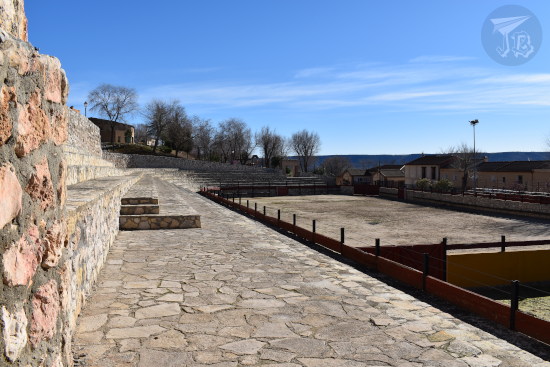
Next to the Palenque stands one of the remaining sections of the medieval walls Muralla Medieval that still remain around the village. There is also the sculpture of a semi-mythical figure – Álvar Fañez de Minaya. Minaya was Rodrigo Díaz de Vivar, El Cid’s, right-hand man. El Cid’s deeds are known from the Spanish epic poem Cantar de Mío Cid, which presents him as someone akin a Round Table knight. Though he probably did exist – along with his lieutenant – he was probably more of a mercenary and a warlord than the legendary hero.

The access to the historical centre is done through the stone gate Puerta de Santa María, the only one of the wall entrances that has survived – although it has been heavily restored. It was originally an arch, in civilian gothic; today the upper part is completely reconstructed, with two turrets. In front of the gate stands the pillory Picota, which signals that in medieval times there was a justice department.

The village is small, and mostly uphill. There is a main square, some ruins, and a church. Since the church was closed and we could not snoop around, we decided to visit the local museum and sign up for the guided visit that was offered, as they would open the visitable monuments up.
The museum, Casa Museo del Arcipreste, multitasks as archaeological display, ethnographic museum, festival promotion, and recreation of the Archpriest’s writing chamber, with some facsimiles of the pages. There are masks from the festivals, and the town’s botargas.

When the guided visit started, we first overlooked the landscape. We got a commentary of the location of the village and its historical importance, and the kind of soil and crops that used to and still are grown in the area. I had chosen the weekend because the weather was going to be nice, and it was – especially no wind, which would have made things awkward.
We then visited the ruins of Saint Peter’s church Ruinas de la Iglesia de San Pedro. Originally a Romanesque temple turned mudéjar, it was blown up during the Civil War. Today, only the altar stands, and it is used as stage for cultural acts. As a memento of its original mission, the town has kept the tombstone of the last governor of the castle before it was destroyed, still on the ground.

We moved onto the church Iglesia de San Juan Bautista. The building was erected in the mudéjar style throughout the 14th and 15th century. The tower is herrerian, erected in the 16th century. Inside, the most remarkable detail are the wooden ceilings, also dating from the 16th century. The floor is sprinkled with gravestones that used to be in the other church. There are two baptism fountains, and a small statue of the Virgin Mary with the Child, carved halfway between Romanesque and Gothic styles. Then she was embellished with baroque jewellery.
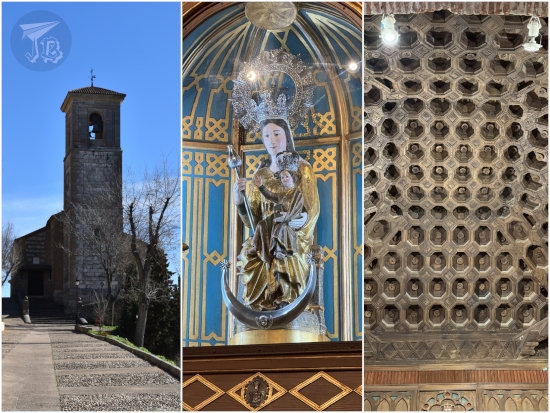
Thankfully, we only looked at the ruins of the castle,and did not climb up to it – today, only a wall and the base of a tower stand, high up the hill that in the Medieval Age controlled the whole plain.

Instead, we were invited to peer into a bodego, a traditional cave-house. The one we saw was restored, but it felt pretty authentic. There was a bedroom, a kitchen, and the end of the dwelling was more cave-like, working as stable and barn. The smell was damp, and it was good that they’ve put electric lights on it, because the tiny windows would have made it a little claustrophobic.

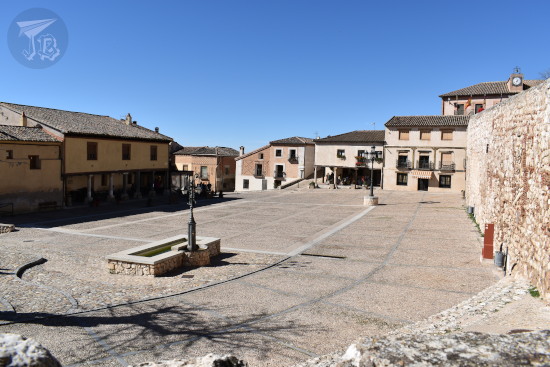
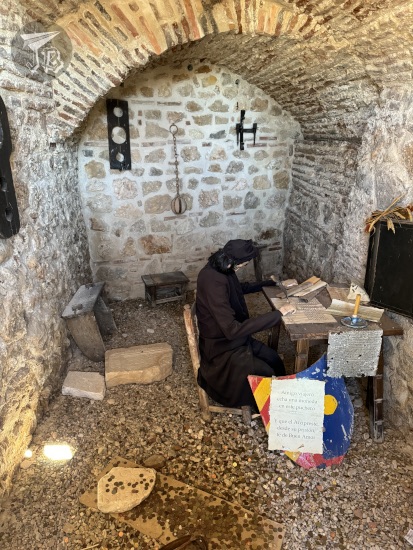
We then descended towards the main square Plaza Mayor, which was the old marketplace and even older synagogue. A hollow on the wall has been used to recreate a cell where the Archpriest was imprisoned. Opposite the wall, there are popular architecture houses, with typical porticos.
To end the visit, we looked at the gate Puerta de Santa María, and then were invited to see a traditional wine cellar excavated into the medieval wall. Though wine production was abandoned long ago, the cellar Bodega de Doña Bellida still exists with its traditional structure and huge clay vessels. It was excavated into the mountain, just like the bodego.

There was not much more to see in the village, so we just headed off afterwards. I was a bit underwhelmed about the whole thing, I am not going to lie.
 JBinnacle – A Travel Logbook