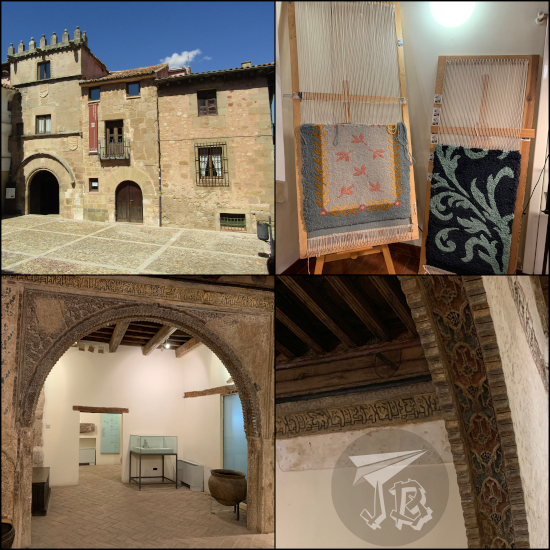
9th October 2022: Atémpora, Sigüenza (Spain)

Sigüenza a Medieval town in the centre of Spain that is currently trying to gain the status of Unesco World Heritage Site. It has a castle, a protected historical centre, and in the heart of it stands the cathedral Catedral de Santa María La Mayor de Sigüenza . The cathedral dates back to 1124, when the original Romanesque building was was erected. The construction finished in 1326 , with remodelling and decoration elapsed several centuries, with different add-ons, until it was “declared” finished after the Spanish Civil War, with later works being just conservation.
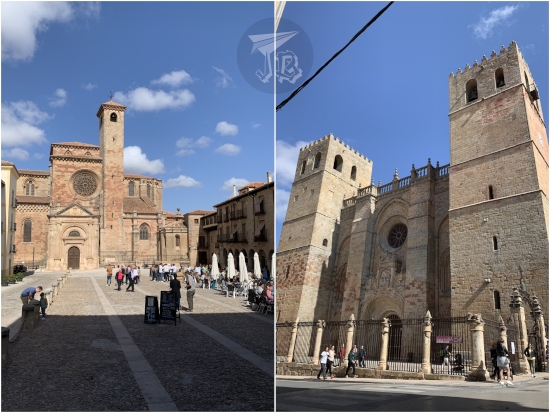
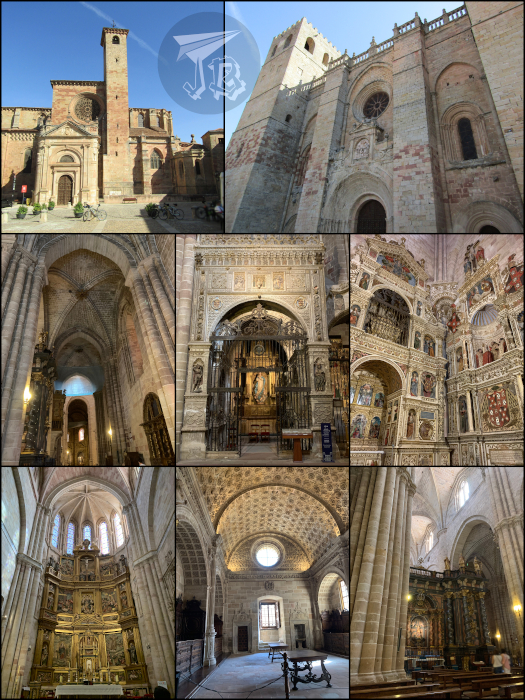
Cathedral in Siguenza, a late-Romanesque / early-Gothic building, in a reddish colour. Left: side view, showing the bell tower. Right: façade, with two side towers.

In summer and autumn 2022, there is an exhibition in the cathedral – Atémpora. Sigüenza entre el Poder y la Gloria, which translated to something akin to “Timeless. Sigüenza between Power and Glory”. It displays some of the treasures of the cathedral and the museum, along with a few archaeological devices. We had seen most of the religious artefacts in a previous visit, but the historical chronicle was rather interesting.

The first block, around the cloister, deals with Celtiberian (the Arevaci tribe) and Roman weapons and everyday life. The second block deals with the Goth conquer and the newfound Christianity.

Upper Left: entrance to Atempora, flanked by two angels. Upper right: Celtiberian Daggers. Bottom left: oil lamp looking like a bird. Bottom left: clay bowl.

Interwoven with the exhibition are the treasures of the cathedral, including two collection of Flemish tapestries, one focused on Athena, the other on the story of Romulus and Remus. Another highlight is an Annunciation painting by Domḗnikos Theotokópoulos “El Greco” a Greek artist of the Spanish Renaissance (since he moved to Toledo in his prime). Of course, the cloister is fantastic. There is a tiny gothic altarpiece in one of the chapels that is delicious. The problem? As always, Baroque trends building choirs in the middle of the naves, blocking the view, and overdecorated altarpieces. The wooden ceilings are extremely beautiful where they have been preserved.

Upper left: tapestry collection, hanging from walls. Bottom right: Annunciation by El Greco. Bottom left: decorated wooden ceiling. Bottom right: Cloister of the cathedral.

The three final blocks present different Christian symbols and pieces of art from the Middle Ages onwards, and interestingly enough, a watermill from the old salt marshes. The exhibit makes a particular emphasis on Wilgefortis, a Catholic folk saint which is supposed to be buried in the cathedral, with the silver arch where her body lies brought from the altar. Other pieces include coins, sceptres, and even a few elements from the times when there was a Medieval university in town – one of them being a human skull with “anatomy notes” on it. There are also late Medieval sculptures, most importantly crucified Christ representations and Virgins with the Child, though probably the nicest one is the one which is permanently at the entrance of the cathedral. Next to it, a mill from the nearby salt mines (Salinas de Imón) has been brought – I really want to visit those at some point too, so great reminder.
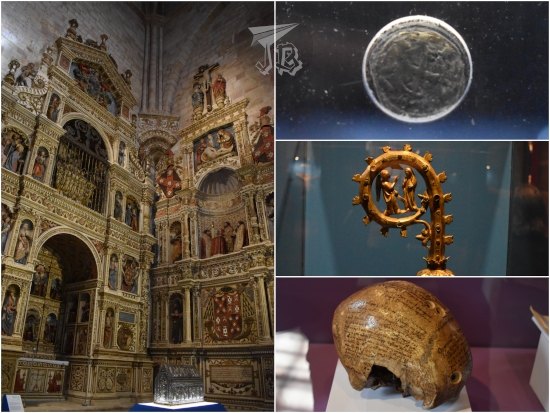
Altar of St. Wilgefortis on the left. On the right, a coin, a scepter and half of a skull with writings on it.

Top left: Romanesque virging with child. Bottom left: watermill. Right: Crucified Christ with four nails on his hands and feet.

The most important monument, or area, in the Sigüenza cathedral is the chapel called Capilla del Doncel. It holds the tombs of Martín Vázquez de Arce and his parents. The de Arce men participated in the war against Granada Muslims during the 15th century, where the son was killed in an ambush, as the Muslims created a flash flood from the watering system they had to control the waters of River Genil. Though he was already 25 years old, too old to be called a doncel, teenage boy, the name has stuck for centuries. The parents’ tombs are traditional burials, however, the Doncel’s grave is an arcosolium, with the decorative sculpture showing the young man awake and reading a book, rather than lying in death as it is the typical representation.

Chapel of"El Doncel", showing the traditional burials in the foreground, and the Doncel's tomb in the background.

We went to have lunch after the visit, we went to have lunch at La Taberna Seguntina, where we shared some typical cheese, sausage, and roasted pork before we went home.
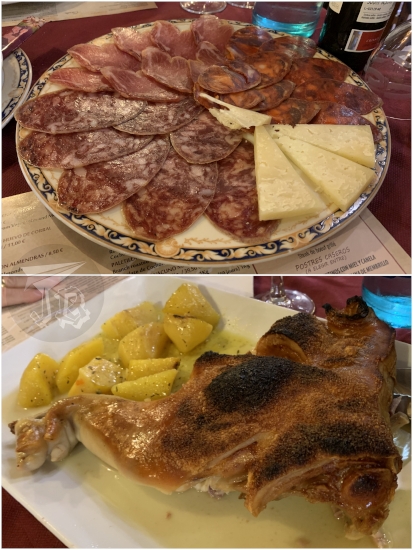
Typical Siguenza Dishes. Top: sausages and cheese. Bottom: roasted pork leg with potatoes.

12th September 2020: Sigüenza (Spain)

We took a drive to Sigüenza, in Spain. This medieval town? big village? had a big relevance through the Middle Ages, and the historical centre reflects that. The most prominent point is the castle on top of a hill. The Castillo de los Obispos is a fortress that can be traced to Roman times. However, the actual castle was a Moorish alcazaba. After the Christians took it over in the 12th century, it was remodelled and enlarged. Due to its vantage point, the castle was a key element in different wars and strife, including the Napoleonic invasion and the Civil War, thus resulting pretty damaged. In the late 20th century it was decided to restore it turn it into a Parador with around 50 rooms.

During our planning stage we called and tried to book a restaurant for lunch, and we were told they were not taking them, we had to call on the same day. Of course, when we got there, it was impossible to book – there was a course and the celebration of a communion (seriously, people, learn to say no so others can get organised). Unfortunately, you could not see the interior or even the yard if you had no reservations, so I can only share a picture from the parking lot, where we left the car.

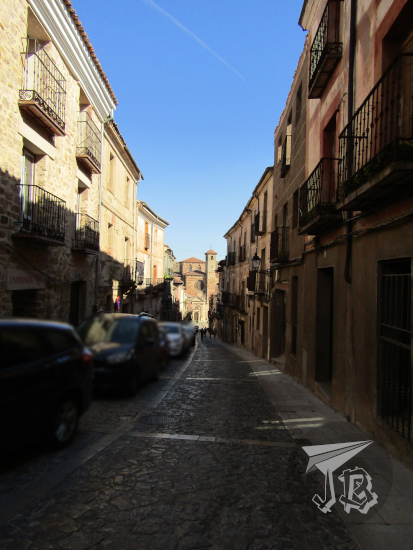
We walked down the main street Calle Mayor, a clobbered slope that ends (well, technically begins) at the town’s main square.

Main Square or Plaza Mayor is home to the Town Hall or Ayuntamiento de Sigüenza, an old palace with a typical Castillian inner yard or patio.

Opposite the town hall stands the cathedral Catedral de Santa María La Mayor de Sigüenza. The Gothic building was built upon a previous Romanesque one and it had some Neoclassical and Baroque additions. Thus, the façade sports Romanesque doors and rose window, and the main body is Gothic. The altar and the choir are awfully Baroque too, and some of the chapels sport Cisneros, Plateresque and Renaissance decorations. All in all, an interesting pout-pourri of architectural and decoration styles.

The most important piece of art of the cathedral, however, is a funerary piece to the right of the altar. It is the sepulchre of Martín Vázquez de Arce “El Doncel” (“The Young Man”). The chapel holds him, his parents and grandparents, but the sculpture on his sepulchre is the most impressive one. The Vázquez de Arce family were vassals of the Mendoza family, the most important family in the area during the Middle Ages. During the war to conquer Al-Andalus, the Vázquez de Arce males followed the Mendoza to the war in Granada, where Martín died in a trap set by the Arabs, which consisted on damming the River Genil to a creek, and then releasing the dam so the water took over the enemies crossing (which… kinda sounds like something out of the Lord of the Rings, doesn’t it? At least, it makes me think of Arwen and Treebeard). The sepulchre, commissioned by Martín’s brother, presents him taking a break during training and reading a book. He even has pupils, so if you could climb up, you’d see what he’s reading!

The cloister is also Gothic, as the previous Romanesque one was torn down. It holds a central garden and a number of side rooms where there is a collection of mythology-themed tapestries. In one of the chapels, there is also a painting by El Greco, a Greek painter rooted in Spain who was one of the key artists during the Spanish Renaissance.

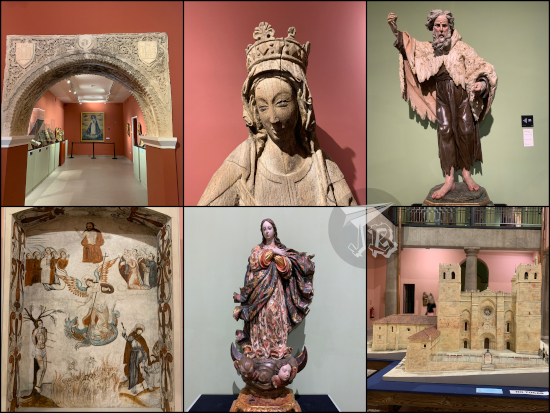
The cathedral ticket also allows a visit to the Diocesan Museum Museo Diocesano, which holds many pieces of religious art, along with a few models of the cathedral in its different construction stages. These days I’m trying to learn some hagiography, which means how to identify religious figures by how they’re presented. Getting there, three out of ten times or so, because half the time they cheat.

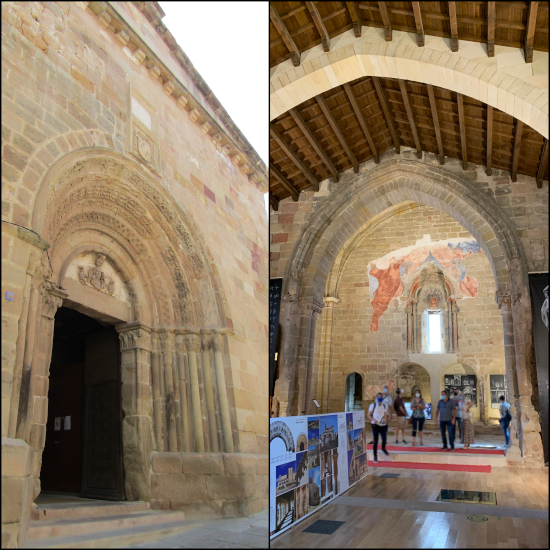
After the cathedral we climbed up towards the castle, and we stopped at the former church Iglesia de Santiago, now transformed into a mini-introduction centre for all the “hidden” or “unknown” Romanesque in the area. The church itself had some beautiful paintings, but it was destroyed during the Civil War.

Continuing our way up, we turned a little to see the house where the Vázquez de Arce family used to live, now turned in a museum, Museo Casa del Doncel. There is a little paintings exhibition and a guitar museum, along with some ancient artefacts such as vases or looms. The most interesting part are the Moorish “Mozárabe” decoration. Here is a bit of historic trolling: when the Christian “conquerors” hired Arab craftsmen to do decoration, one of the things the Arabs did was decorate using Quran verses.

Then we saw the outside of the church Iglesia de San Vicente Mártir, Romanesque to boot.

Afterwards, we ended up at the square Plazuela de la Cárcel, where the old gaol jail stood.

Finally, we headed over to the restaurant where we had booked a lunch table, a traditional grill called La Taberna Seguntina where I chose to have a “summer menu” with salmorejo (a thick soup or purée made with tomato, oil, and bread and sprinkled with boiled egg and cured ham) and roasted cochinillo (suckling pig, roasted whole) with potatoes and herbs. For dessert I had a pudding!

And that was it, really – Medieval Sigüenza has nothing else to see. As the façade of the castle was being restored, we did not even take pictures of it as we drove away.