
I had the chance to spend a few hours – seven, to be exact – in Valencia | València (first name in Spanish, second one in local dialect) due to unforeseen circumstances. I’ve been there before, but it was to visit the Oceanogràfic, and I had not entered the historical area.
Valencia is the third-largest city in Spain. It is known for its love of pyrotechnia – Las Fallas – and its famous paella rice dish. The city dates back to the Roman period, in the 2nd century BCE. During the Middle Ages, it was one of the most disputed areas between the Christian and the Moor troops, changing hands a few times. The city flourished in the Late Medieval Period under Christian ruling. It played an important role during the Napoleonic war, and during the 20th century it became a great importer of wine and citrus, especially oranges. During the Civil War, it was the Republican capital, so it was heavily bombarded. With the advent of democracy, the city invested in development and tourism.
I arrived at the station Joaquín Sorolla around 11:30, which is not far from the centre. It was pretty hot, even if it was October, so I was ready for a few weekend-tourists. One detail that I had not planned on, nor thought about, was that it was a long weekend over there, Monday the 9th was a holiday, and there were way more than “a few” weekend-tourists. Also, I walked into a lot of preparations forfor institutional acts, which got in the way of photographs – the city hall square was cordoned off and it was really hard to get a good view. On one side of the closed-off area stands the town hall Ayuntamiento de Valencia | Ajuntament de València, on the other, the old central postal office Palacio de las Comunicaciones de Valencia | Palau de les Comunicacions de València. The town hall is actually a mash-up of two different buildings, one from the late 19th century, and another – the façade – from the 1930s, with Renaissance and Baroque inspirations.

I continued off towards the main market – Mercado Central | Mercat Central. This is an impressive Modernist building designed by architects Alejandro Soler March and Francisco Guardia Vial. Construction started in 1914 and finished in 1928 – the building was erected in iron, glass and ceramic tiles, the central dome is 30 metres high. This is one of those places I wish I were a VIP and could see closed, because it was fantastic. Unfortunately, though it is the largest market of fresh produce in Europe, it was extremely full, and it was hard to even stand to the side and take a photograph or two.

Next to the market stands the church Royal Parish of the St Johns Real Parroquia de los Santos Juanes | Església dels Sants Joans also known as St John of the Market. When checking if the city tourist card was a good choice for me – it was not – I bought a combined ticket that included this church and two other buildings for 12 € (considering that each on its own was at least 7 €, it was a sweet deal.
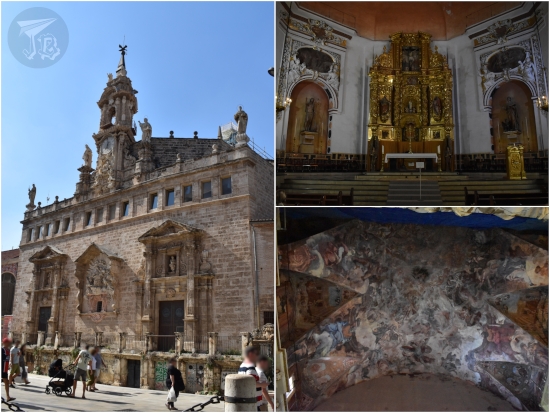
Most of the original Gothic building has been destroyed, and its appearance today is mostly Baroque. It seems that the church is prone to fire accidents, and burnt down totally or partially at least three times. It is undergoing inner restoration at the moment, which takes away from the fresco decoration of the vaulted nave. The frescoes were carried out by Antonio Palomino in the 16th century, and the Baroque altarpiece was brought from another church in the north of Spain. An add-on to the church is the Capilla de la Comunión, the chapel of the Holy Communion was added in the 18th century. The church reminded me of the Italian Baroque I saw in Naples.
In front of the church, on the other side of the square, stands what I consider the most important building in the city – the Silk Exchange, or Lonja de la Seda | Llotja de la Seda, also called Lonja de los Mercaderes | Llotja de Mercaders. In Spanish, a lonja is a type of public building where merchants would negotiate and auction their produce, traditionally fish. In this case, instead, it was used for trading in silk during the Middle Ages. Silk was important for Valencia, and the city is considered part of the Silk Route. The Arabs introduced it in the 14th century, planting mulberry trees to produce it, and the trade became so important that it required its own building.

The Exchange was originally designed by Francesc Baldomar in the late 15th century, though he died before completing it. His disciples Joan Ivarra and Pere Compte finished the building according to Baldomar’s original plans and drawings. The building has four distinct areas: the Tower, the orange garden (Patio de los Naranjos), the Contract or Trading Hall (Sala de Contratación) – which were the original ones – and the Sea Consulate Hall (Sala del Consulado del Mar ). There is also a small basement.
The building is considered the masterpiece of the civil Valencian Gothic, a style that flourished in the east of Spain towards the end of the Gothic period. It is characterised by a heavy reliance of traditional Roman architecture and a little Mudejar influence. Wide open halls are typical, with decoration and sculpture influenced by Flaming Gothic. The Exchange is decorated with tiny gargoyles sprinkled all around the outside of the building towards the garden.
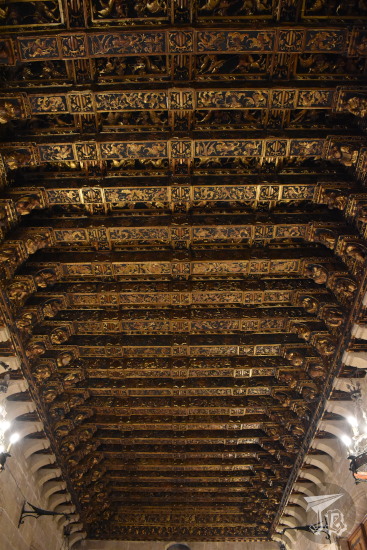
The Trading Hall has three naves which rest on eight helical columns and 16 pilasters that hold the vaults, eleven metres above ground. Further ribbing extends from the the columns, creating a net that spreads all over the ceiling. The combination of columns and ribbing tries to represent heaven – the palm tree trunks and the celestial sphere. Another ceiling that deserves admiration is the painted wooden one in the first hall of the Sea Consulate.

I loved the Exchange, but it is not as if I have ever scorned anything Gothic. However, I could not stay forever, so I pushed myself to leave. I went around the building once and then, after a short stop at a cute little round square, Plaza Redonda, I found my way to the large square Plaza de La Reina, where the cathedral stands.
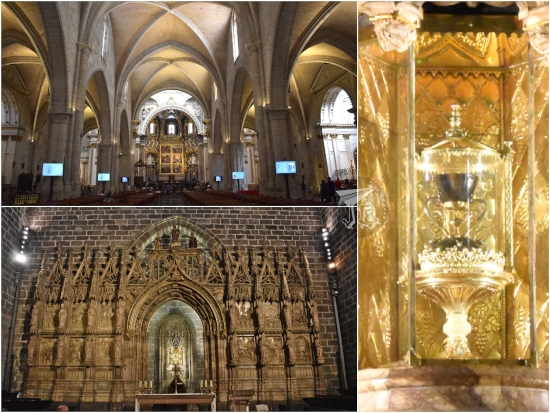
The Iglesia catedral-basílica Metropolitana de la Asunción de Nuestra Señora de Valencia | La Seu is also built in Valencian Gothic on Romanesque foundations. It was erected over a Roman Temple, and part of the Roman remains can be visited in the “archaeological area” of the museum, underneath the current church. The main building that stands today was erected between the 13th and 15th centuries, thus the prevalence of Gothic, but there are earlier and later styles – as recent as Neoclassical.

In a side chapel, in the middle of an alabaster Gothic altarpiece (1777), the cathedral holds and exhibits its most important treasure – the Holy Chalice (Santo Cáliz), sometimes called Holy Grail. According to the Christian tradition, the Holy Chalice is the vessel used by Jesus Christ during the last supper. If we follow the Spanish legend, when the Virgin Mary died, Jesus’ disciples gathered everything that belonged to him, and Saint Peter took it to Rome. During the persecution of Christians in the Roman Empire, the Chalice was entrusted to Saint Lawrence, who brought it to one of the former Spanish realms. It was eventually presented to the monarch in 1399. In 1437, King Alfonso V of Aragón donated it to the Cathedral of Valencia.
According to other legends, there was this King called Arthur, and something about a knights and a round table. In the Arthurian legend, there was a mystical object called the “Grail.” which was originally a Celtic cauldron with magic powers. However, the concept became mixed up with the Chalice when the story was “Christianised” – the chieftain on whom Arthur is based on, and his legend, originates in the 5th century BCE, so there is no way that Arthur looked for the Chalice anyway.
The Valencia Chalice itself is a stemless cup made of carnelian (dark red agate) – and that is the relic itself. It was most likely produced in Syria, Palestine or Egypt, and it has been dated between the 2nd century BCE and the 1st century CE. There is an Arab Kufic inscription on its base. I am not sure it fits what Indiana Jones would have called “the cup of a carpenter”. The cup is mounted on a gold stem embellished with gold, pearls and emeralds, with a foot and two handles, which were added in Medieval times. Now, the cathedral claims that it cannot be proven that it is not the Holy Chalice, and the translation of the Kufic script is supposed to be “Allah Josua”, translated as “Jesus God”.
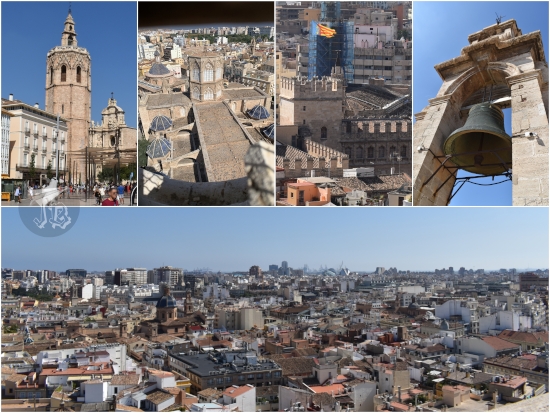
The cathedral also has a museum and the previously-mentioned archaeological areas, with a Roman road and human remains. The museum has sculptures and paintings from the cathedral itself and religious artefacts. The bell tower is famous in its own right. Erected between 1381 and 1429, it is called Miguelete | Micalet – “Little Michael”, which is actually the name of the bell at the top. . The tower has eight sides on the outside, and is circular in the inside, with 207 steps up to the terrace. The bell-gable was added in the 18th century, but the tower itself is Valencian Gothic just like the cathedral. The views are not as impressive as expected as the whole thing is netted off and it is hard to see anything unobstructed.
The cathedral is connected to the Episcopal palace on the other side of the street by a sort-of bridge called Arco sobre la calle de la Barchilla | Arc del Carrer de la Barcella that I saw when I went round the cathedral. I also saw the Tribunal de Aguas de Valencia | Tribunal de les Aigües de València and Palacio de la Generalidad Valenciana | Palau de la Generalitat Valenciana on my way to the church of Saint Nicholas and Saint Peter Martyr (part of my combined ticket).
San Nicolás de Bari y San Pedro Mártir | Sant Nicolau de Bari I Sant Pere Martir stands at the end of an alleyway that comes from one of the main arteries of the city. It quite humbly calls itself “The Valencian Sistine Chapel”. It is a single-nave church, built in the 15th century on top of a Mosque which was in turn built on top of a Visigoth palaeo-Christian temple. During the Baroque period, the whole vault was decorated with frescoes, to the point that. And when I mean “whole” I mean… whole. There was no space for an extra soul, saint, angel or whatever. It was so full I could not process the painting as individual items, just as a whole.

Afterwards, I went into the small streets that led into the Arab Quarter, marked by the archway Portal de Valldigna. I also spotted an Islamic tower Torre islámica | Torre islàmica in side a private parking lot, and the remains of the Arab walls Muralla Árabe de Valencia | Muralla àrab de València.
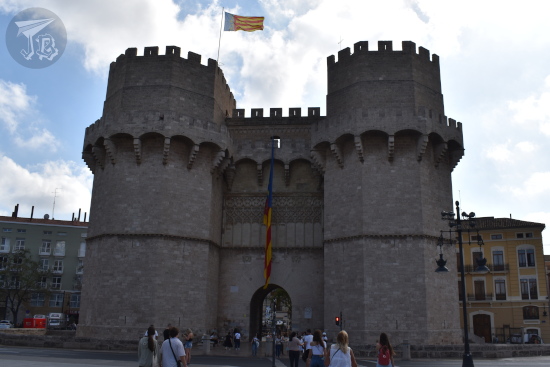
I finally reached one of the gates of the Medieval city walls – Torres de Serranos | Portal dels Serrans. The gate was flanked by two polygonal defensive towers built in the Gothic style and finished in 1398. They survived the destruction of the wall ordered in the 19th century as they were used as prison. Today, they can be climbed and hold a small museum, but I had already gone up the bell tower, so I decided I was good with heights for the day.
I headed back to the historical centre and reached the area of the cathedral. I decided to buy a stupidly expensive typical drink of the area, horchata de chufa | orxata de xufa, made from sweetened tiger nuts, usually with a severe quality control. I remembered trying it as a kid and that I did not like it much, but I decided to try it anyway – I had riskier culinary adventures in Egypt after all. It was not bad, but decided that I am still not a fan – and it was chilly, which helped against the heat.
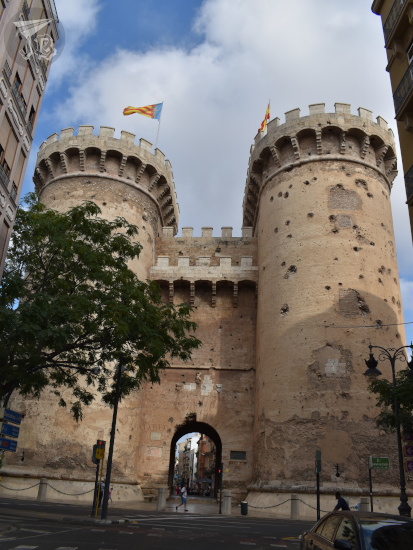
There is another surviving gate structure of the Medieval wall, the Torres de Quart | Portal de Quart. They were a bit out of my way, so I left them for the time when I started retreating back towards the station. Unlike the Serrano ones, the Quart towers are cylindrical, but they share the Valencian Gothic style. They were built between 1441 and 1460 have been damaged in the different wars that the city has survived, and holes from shelling are clearly visible on the stone.
Taking a small detour from my way to the station, my next stop was the silk museum – Museo y Colegio del Arte Mayor de la Seda | Museu I Collegi d’Art Major de la Seda. I only went here because it was the “extra” museum my triple ticket had it, and I had the time to do. I was not impressed though, as more than on silk it focused on the local re-enactment of the Medieval battles in Valencia and the costumes.
Just next block over however, I found the park Jardines del Hospital | Jardins de l’Antic Hospital, where the 15th-century hospital used to be until it was demolished in 1974. The park was reorganised between 2009 and 2012, and an “archaeological garden” has been prepared next to the skate park, with free-standing columns, and a shelf with chapitels and the remains of sculptures that have been found in the area.

Unexpectedly, I walked by the monument to Spanish Medieval warlord El Cid Monumento a Rodrigo Díaz de Vivar | Monument a Rodrigo Díaz de Vivar, a copy of the original sculpture of Anna Hyatt Huntington, which is in the Spanish Society of America in New York.Rodrigo Díaz de Vivar, El Cid, became Lord of Valencia. He besieged the Moorish city between 1092 and 1094, until the city surrendered. Having proclaimed himself Prince-Lord, he died in 1099 – the legend says that after he died, he was placed on his horse and just catching sight of him made his enemies run away.

My final stop was the gastronomic experience Mercado de la Imprenta | Mercat de la Imprenta. Aside from horchata, Valencia is known for its ice-cream, and I was hoping to find one. There were none, unfortunately, so I just walked the last bit towards the train station – and had a sundae there, because why not?
All in all, I think I spent as much time on trains / at stations as roaming and visiting monuments, but I reckon I did a good job out of getting a feeling off the old town of Valencia. Lots of pretty Gothic buildings to see, which was enjoyable. It probably warrants a whole weekend to see the dozen or so small public museums. It was bit too hot, especially for October, but it did not feel as humid as I imagined it might be.






 JBinnacle – A Travel Logbook