While Zaragoza (Saragossa) is not a super-busy city, the noise from the large avenue the hotel was in woke me up early enough to be amongst the first customers at Pannitelli Original Bakery. I had a toast, orange juice, and a coffee, then set off to the not-so-easy task of retrieving my car, driving back to the hotel, getting my deposit returned, and going on my merry way. It took a while, but once that was taken care of I could drive off. Getting out of Zaragoza was easier than getting in had been, and there were few cars on the road. One of them was the traffic police, so every driver seemed on their best behaviour…
Once in the speedway, the first stop of the day was a petrol station, as there was no way I made it home with one quarter of a tank. Unfortunately, there were no low-cost fuelling points on my way, so I had to use a big-name one. Thirty euro don’t take you as far with branded fuel…
To be fair, I could have driven home the previous day, but I thought that after such a week, an extra night of sleep could only be beneficial. Staying also allowed me to see the Asian treasure exhibits in the Lonja and make a stop on the way. My first idea had been going downtown to see the Natural History Museum, but it closes at the weekend. That was why I asked about the visit during the course, and it turned out it was doable. Thus, in the end, I decided to make a stop in a small palaeontological site that I would not travel to otherwise. Furthermore, the site popped up during the course twice – the signage had been handled by Paleoymas and the Natural Science Museum had quite a few specimens from there.
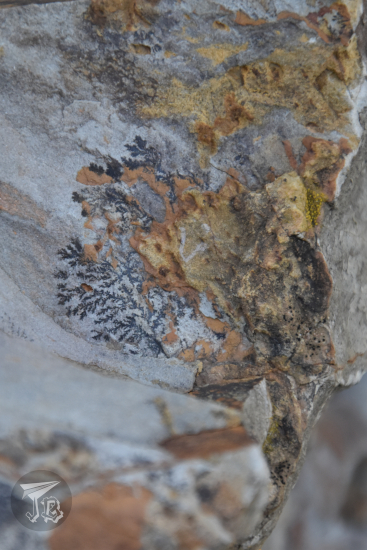
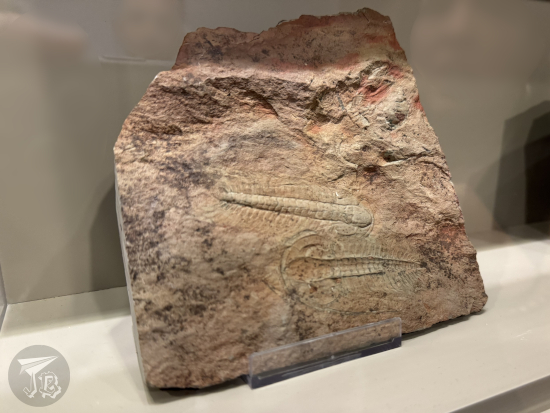
The Yacimiento Paleontológico de Murero palaeontological site holds remains from the Cambrian Period, extremely important because there are around eight million years’ worth of fossils (511 to 503 million years ago) preserved in the strata. Palaeontologists have found about eighty species of trilobites, along with echinoderms which had not yet developed five-way symmetry, brachiopods, worms… It is mainly composed of shales which allow for soft-bodied organisms to be fossilised along the hard bits like shells or exoskeletons. The site is famous because it allowed researchers to identify sexual dimorphism in trilobites – they were able to describe two distinct types of animals within a same species, which are interpreted as male and female. What they don’t know is which animal is which sex.
I left Zaragoza using the A23, then turned to a national, smaller road (N234) that crossed over to the A2. The site and the municipality it technically belongs to, Murero, lie halfway through this road. As mentioned before, not somewhere I would purposely travel to, but since I was literally in the area, it was a convenient stop. The regional road was all right, but the local one was narrow and the curves were very sharp and steep. I was thankful that all of the cars I saw passed while I was hiking or taking photos of the site, and none while I was driving. I decided to only stop at the area which had a small parking lot so it was safe for me and any potential driver.
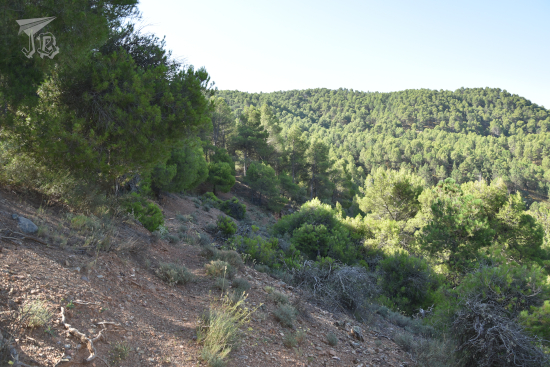
To be honest, I expected to see more in the palaeontological site. The signage has either weathered out or been vandalised and nothing is readable. It is a short walk up and down a hill where you can’t really see anything except for a box at the top where people leave what they find, but there was not a chance to see anything in situ. I guess the palaeontologists and the amateurs have taken out everything that is worth anything already – or left it well buried so it can’t be pillaged. I wouldn’t even consider it a nice hike because broken pieces of slates made the path extremely slippery (I forgot my hiking boots in the car…).
And oh, the temptation to steal a trilobite from the display box was strong! I resisted it though, and headed back to the car after an hour or so. I undid the path towards the N234 road and continued onto the A2. I made a stop in-between for some caffeine and a snack, but I was home for Spanish lunchtime. I have to admit I had pondered stopping somewhere along the way, maybe Daroca, Belchite or Calatayud, but considering that I still had to drive back, I decided to leave it for another time.
On my first solo road trip, I was surprised by the sheer amount of people who like driving at the same speed all the time. A bunch of drivers in the regional road, with limits of 90 kph, did 70 kph even when they drove through 50 kph towns. The same happened in the speedway – some people drove at 110 kph, both at the 120 kph or the 100 kph stretches. There were also those who liked aligning their cars with the markings that separate the lanes, effectively occupying both. The lorries were more manageable on the way back than towards Loarre, as it was a Saturday morning, and because the speedway feels more “downwards”.
Once home, it hit me how tired I was, so I guess it was a good thing that I had not made another stop. Checking Murero out was a good idea as it broke the trip in half and was a small hike that helped me keep alert, but more would have been overdoing it.
As a recap of my experience with the course Técnicas de restauración en paleontología a través de la preparación de los huevos de dinosaurio de Loarre: Palaeontological Restoration Techniques through the preparation of Loarre dinosaur eggs, I can say that all in all, it was amazing. The professors were extremely knowledgeable, they made learning effortless and entertaining, and the group was fun and easy-going. The course was way more hands-on than I had expected, literally covering everything from geological analysis to the fate of a dug-up piece, either in display or in storage within the museum, including working with the fossils themselves. It was not cheap, mostly due accommodation choices, but booking in advance probably made it better – and honestly, decent hotels were a must. As Loarre is a small village, food options were limited. Though there was a bakery / shop, we were out doing stuff while it was open. However, I made do with crisps or nuts for dinner, as I had a good breakfast. Probably lunch in Ayerbe was the weakest, and most awkward since it involved getting to know each other (and ten bucks for a frozen pizza was daytime robbery).
The whole trip involved driving around almost 700 km. It did show me that I (and my coffee-maker of a car) can manage the long drives better than I had expected, even during a “peak” time such as a holiday-period opening date. I am more comfortable on the road than in towns, though, even when caught in a jam. Was it the smartest idea to head to Loarre directly after work? Probably not, but if I had to do it all over again, I probably would – it was the only actually available option. And knowing that not all the course openings were filled, I would not have stressed as much over the University’s lack of efficient sign-up.
The only downside I can find is the lack of mental reset – I was constantly learning new facts, and I did not get much me-time. It was extremely fun, but not really a holiday where I could plan and do stuff at my own pace. Would I do it again? Well, the University of Teruel runs a similar summer course using Dinópolis resources, and sign ups open in February…
I woke up and for the first time in days I put on “person clothes” (for the city) instead of “scarecrow clothes” (for hiking & working in the field). Before setting off on the trip, I went to the sales to buy some jeans that would work for sitting on rock or walking through thistles and dry grass, and while they are not particularly nice, they are comfortable and resistant. Saragossa / Zaragoza was still waking up as I headed for breakfast to a bakery close to the hotel, Pannitelli Original Bakery, which I had chosen for two reasons. One, they opened at 7:30, which gave me plenty of time to walk to the university afterwards and two, they had waffles, I had seen them online. I wanted waffles, and a big coffee. I had both (and some orange juice, just because I could).
It turned out that not driving to the university Universidad de Zaragoza had been a great idea. Though it had been my first thought (dump the car there, then walk to my accommodation), I was lucky that in the end I was able to reserve my parking spot with the hotel. It happens that access to campus is restricted to working staff. Students can drive into the parking lot ten times in the school year. And on top of that, there was a farmers’ market for some reason.
Having 20 minutes to walk, I was the first one there, and I sat down in the rock garden of the Earth Sciences building to wait for everyone else for the last day of the course Técnicas de restauración en paleontología a través de la preparación de los huevos de dinosaurio de Loarre: Palaeontological Restoration Techniques through the preparation of Loarre dinosaur eggs. By 9:00, when class was to start, I was the only one besides the teachers who had managed to arrive. Everyone else had either got lost, left Loarre late, or was taking forever trying to park. So yay me being lucky for once (and for the 20 € which the hotel parking cost for the whole stay).
The first chunk of the morning was a tour through the Rock and Hard Material Preparations, 3D Printing and Scanning Service (Servicio de preparación de rocas y materiales duros, impresión y escaneado en 3D) in the university. They have two main lines of work. One is to make thin translucent sections out of specimens so they can be studied under the microscope, and the other is digitalising and making 3D models and copies of items so they can be lent or studied through a computer. The inner works of the department were explained by Raquel Moya Costa, who not only described in detail all her complex machinery, she also gave each of us a 3D printed T-Rex charm from the Dino Run Game!
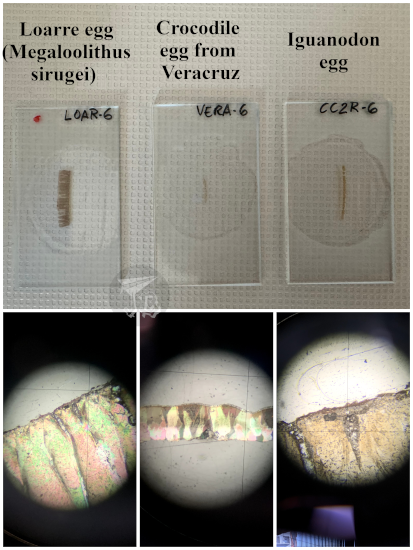
We then moved onto the Petrology lab to look at thin sections on the transmitted-light microscopes – preparations of a sauropod eggshell, a crocodilian eggshell and an iguanodon eggshell. There were other preparations we could snoop around if we promised not to take pictures and publish them. We also got to play with the 3D copy of one of the first eggs recovered from Loarre. Much less heavy than the real thing, for sure.
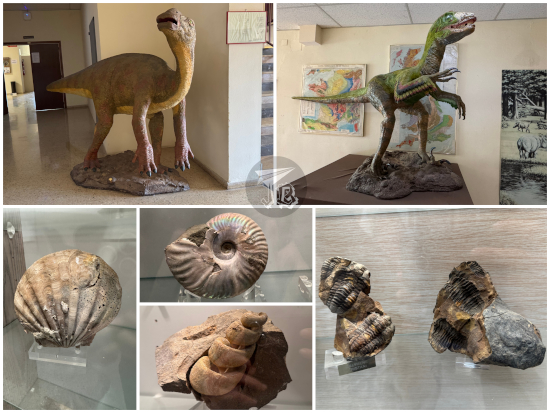
Then a bit of chaos ensued as we got distracted by the shiny exhibits of the Palaeontology department, and a couple of post-docs offered to show us their lab and what they were working on. Having finished all the activities of the course, the coordinators had organised an extra visit to the Natural Science Museum Museo de Ciencias Naturales de la Universidad de Zaragoza (which might have actually been my fault as I asked how come that would not happen, considering that most of the region’s fossils are officially deposited there). A few people left first, but some of us got delayed looking at the lab specimens, and then we had to hurry to the museum…
Once we were at the site of the Museo de Ciencias Naturales, we were taken on an express visit of the palaeontology ward by Ester Díaz Berenguer, curator of the collections. The museum is located in one of the historical buildings of the Zaragoza campus. Designed by Ricardo Magdalena in 1886, it was erected with academicist criteria, in brick, with large windows and striking symmetry. It opened in 1893, and during the 20th century, it served as Faculty of Medicine. When the university moved to the newer campus, the building was refurbished as cultural spot and seat of the government body. The basement was turned into the exhibition site of the Science Museum, which has three main areas – palaeontology, natural science, and mineralogy.
The palaeontology ward of the museum comprises nine rooms. The first one is an introduction to the science and the concept of fossilisation, and the following ones run through the Earth’s history, from the Precambrian to the Quaternary. The Precambrian is the earliest “calculated” period in geological time, and spanned from 4567 to 539 million years ago (give or take). Though we cannot pinpoint when life actually originated, it was already there when this “supereon” gave way to the Cambrian. During the Ediacara Period, at the end of the last Eon of the Precambrian, the Proterozoic, the earliest complex multicellular organisms that we know about thrived in a state that has been called “The Garden of Ediacara”. The word “garden” tries to evoke the idea of the “Garden of Eden” as there was no active predation and life just… existed.
The next rooms focus on the “Cambrian Explosion”, a term used to refer to the point in geological time when living things took over the planet. At first, this brand-new life was comprised of ocean-dwelling invertebrates. In the room there are impressive trilobites from the Murero Palaeontological Site, which I had actually planned to drive through on my way back. But not only animals appeared, so did plants – organisms which produced a new toxic gas that would change the planet forever: oxygen. To the side of this area there is a curtained room, the “aquarium”.
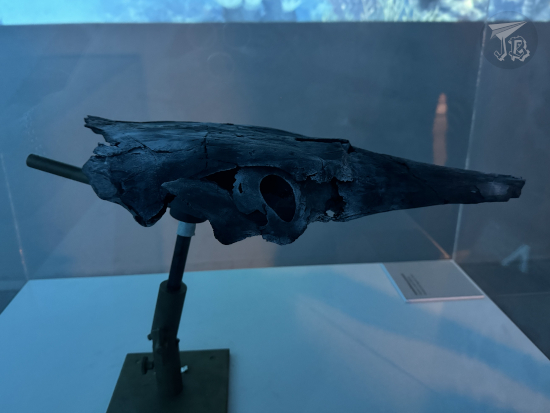
Here you can see the cranium of Carolowilhelmina geognostica, a fish which lived around 392 million years ago, during the Devonian period. It was a placoderm, a group whose main characteristics were being covered in armoured plates, and having developed an actual jaw and true teeth. The specimen is not just the holotype, it is the only known fossil of the animal. The cranium alone measures almost 45 cm, and by its shape, palaeontologist speculate that the animal was probably a predator of invertebrates. A first fragment of the fossil was found in Southern Aragón in 1971 by palaeontologist Peter Carls. Carls kept returning to the site to search for the rest of it every summer, until in 1986 he unearthed the rest of the skull, which was finally extracted in 1993.
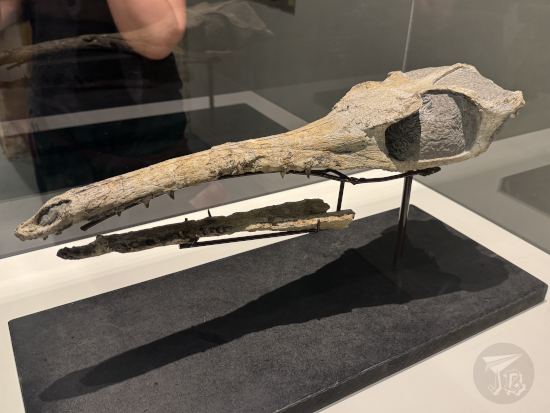
The following room is devoted to the Mesozoic, and it hosts another of the museum treasures, the skull of the holotype and only specimen of Maledictosuchus riclaensis, the “Cursed Crocodile from Ricla”. This crocodilian lived in saltwater around 163 million years ago, during the Middle Jurassic. It had flippers instead of legs, and probably ate fish. The fossil was found during the construction of the high-speed railway between Madrid and Barcelona in 1994. It earned the name of “cursed crocodile” because despite the fact that it was the oldest crocodilian found in Spain, exceptionally preserved on top of that, it took 20 years until someone could tackle its study and description. The “curse-breaking” researcher was Jara Parrilla Bel, one of the post-docs who shown us her lab work at the university.
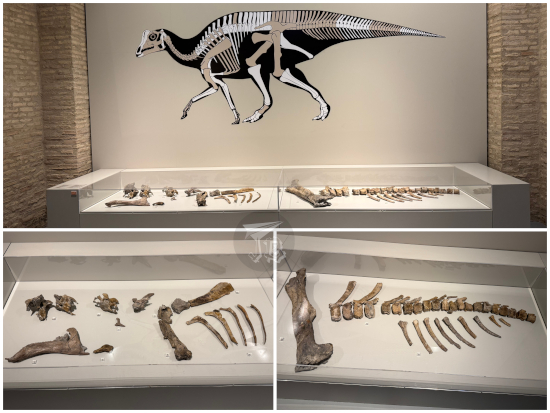
Of course, the “stars” of any palaeontological exhibit are dinosaurs. The museum hosts several iconic pieces, amongst them replica of the feet of the first dinosaur ever described by researchers belonging to the local university Universidad de Zaragoza, Tastavinsaurus sanzi (a titanosaur), a whole specimen of the Mongolian Psittacosaurus (a small ceratopsian), and a good part of an Arenysaurus ardevoli, a hadrosaur which lived in the Pyrenees area around 66 million years ago, during the early Maastrichtian; the rest of the specimen is located in Arén, where it was located, and which is one of the museum’s satellite centres, just like Loarre’s museum-lab. In the same room there were trunks of fossilised wood that could be touched, and a skull of the extinct crocodile Allodaposuchus subjuniperus.
After a small room with an audiovisual representing the impact of the meteorite and the K-Pg mass extinction (which we skipped due to time constraints), there was an exhibit of the spread of mammals. The specimen of honour in this exhibit is the ancient sirenian Sobrarbesiren cardieli (holotype, and the topic of our guide’s thesis). This species lived during the Eocene, around 45 million years ago. Sirenians (manatees and dugongs) are a type of marine mammals whose closest relatives are elephants – and not other ocean-dwelling mammals. After life spread through land, a number of mammals went back to water, and it looks like this species is a snapshot on the readaptation process: it was already completely aquatic, but it still had four functional limbs. Its hind legs had started reducing and its tail was getting flat. It was a strict herbivore, eating sea grass, but less efficiently than current sirenians.
There was also an impressive aquatic turtle of the genus Chelonia, several remains of Gomphotherium angustidens, an elephantimorph, and smaller pieces including crabs, sea urchins, gastropods and even insects. Several of these specimens are holotypes, too.
The final area was almost contemporary considering when we had started. It hosted remains of cave bears (Ursus spelaeus, 40,000 years ago), the skull of an aurochs (Bos primigenius, a species that actually lived until the 1600s), evidence ancient hyena nests, micro-invertebrate bones, mammoth defences… These animals coexisted with human beings, whose skulls comprise the ending room before moving onto the “nature collections” which we did not visit because a) the course had after all to do with palaeontology and b) it was closing time – quite literally, museum security was turning off lights behind us since the museum shut down at 14:00.
We had a mini closure “ceremony” in the hall of the building – coordinators Miguel Moreno Azanza and Lope Ezquerro Ruiz thanked us for attending, we clapped and thanked them back. Then we all went off to have a drink, a snack and a chat. A bit after 16:00, when most students had already left and the professors had been joined by university staff, I took my leave.
Hopping from shadow to shadow to avoid the sun and the heat as much as I could, I headed downtown. On my way I made an exception regarding the walking in the shade when I found the only remaining gate of the original Medieval Wall, today called Puerta del Carmen. Calling it “original” is a bit of a stretch though. While it is in the same place as the first gate, it actually dates from the early 1790s, and it follows Neoclassical patterns.
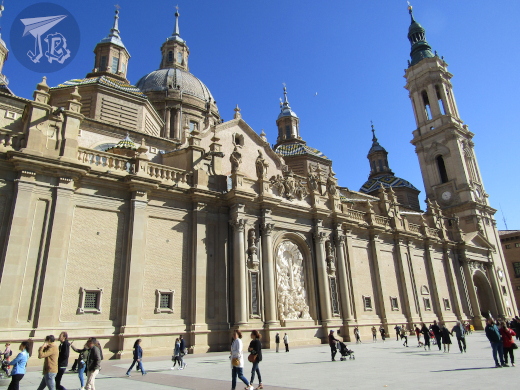
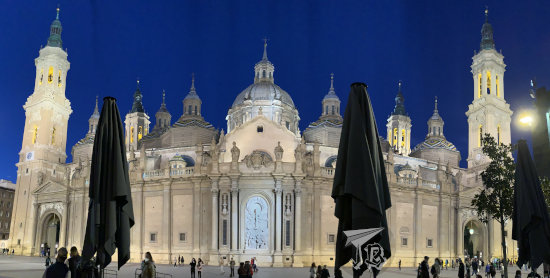
I also stopped at Starbucks for a Vanilla Frappuccino – I’m on a bit of a matcha remorse trip due to the alleged shortage, so I’ve reverted to my old drink of choice. With a temperature of around 38 ºC, I reached the most important square in town, Plaza de Nuestra Señora del Pilar, where the namesake basilica is. I kid you not, what was running through my head was “I’ve got a 0.5 zoom on my phone now, I’ll be able to take a nice picture of the whole building with its towers…”. Only to find said towers covered in scaffolding. I was able to take the picture, but it could have been nicer. I entered the Cathedral-Basilica of Our Lady of the Pillar Catedral-Basílica de Nuestra Señora del Pilar, a Baroque / Neomudejar catholic temple which is considered the first-ever church dedicated to the Virgin Mary. I sat at the chapel for a little bit, but when I was ready to have a walk around the church, there was a call for mass, so I did not do it out of respect.
Instead, I strolled to the former exchange building Lonja de Zaragoza, which has been turned into a free exhibition centre. The building is Renaissance with a touch of Neomudejar, and it is considered the most important civil architecture construction erected in the whole area of Aragón during the 16th century.
I had read that there was an exhibition on Asian culture called Tesoros. Colecciones de arte asiático del Museo de Zaragoza – Treasures: Asian art collections from the Zaragoza Museum. At the moment, the Zaragoza Museum is closed and has loaned a few of its artifacts to be displayed elsewhere. This one exhibition displays items that were originally part of personal collections and were donated to the museum. The Colección Federico Torralba, comprises religious items and art pieces from China and items from Japan. The Colección Víctor Pasamar Gracia and Colección Miguel Ángel Gutierrez Pascual have woodblock prints – landscapes, noh [能], kabuki [歌舞伎], even modern ones. The. Finally, the Colección Kotoge displays lacquered tea bowls (chawan [茶碗]). There are also modern calligraphies, paintings, and the compulsory samurai armour. The regional government has undertaken buying artefacts to engross the Asian collections. Though they looked a bit out of place in the historical building, the items were fantastic – and you could even make your very own “woodblock print” at the end.
Though the exhibition was the reason I had wanted to go downtown, after I left the (nicely air-conditioned) Lonja, I still had some time to do stuff. I wandered back into the cathedral for a bit – between the 17:00 mass and the 18:00 mass, and left before the second one started.
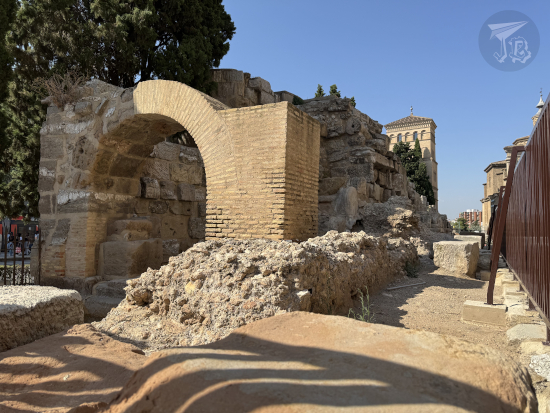
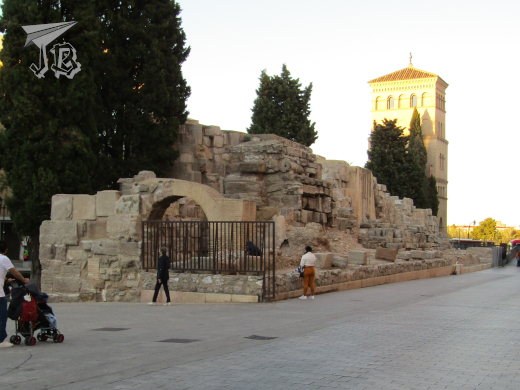
I continued towards the Roman Walls Murallas Romanas de Zaragoza, which sadly have had to be fenced off because people have no respect (I vividly remember a mum letting her toddlers to climb all over them one time I visited). At the end of that square stands the marketplace Mercado Central de Zaragoza, a wrought iron architecture building designed in 1895 by Félix Navarro Pérez. Being a Friday evening, in the middle of summer, many of the stands were closed, so it was not crowded.
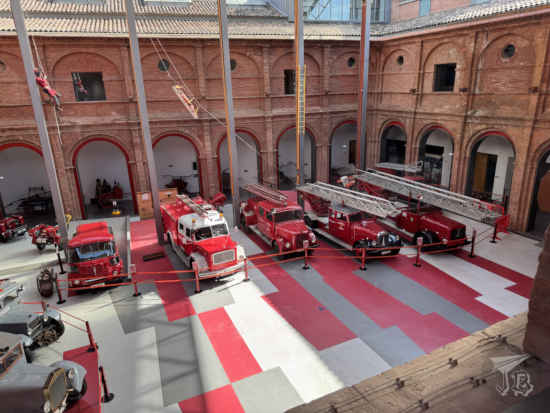
I continued towards the Fire and Fireforce Museum Museo del Fuego y de los Bomberos, where a nice gentleman wanted to give me a guided visit which I declined. Honestly, I just wanted to look at the old fire trucks (and actually, support any initiative by firefighters if it helps fund firefighting). It is a little quaint museum located in part of a former convent, the other half is an actual fire station. The exhibition covers documentation of historical Zaragoza fires, firefighting equipment, a collection of helmets, miniatures, and quite an impressive collection of vehicles used to fight fire. There were two immersive rooms, one which showed damage to a house and another about forest fires. I really enjoyed it, though I only had a quick visit – they closed in an hour, and I was the only guest along a family.
On my way back towards the hotel I walked by CaixaForum Zaragoza, where they were running the Patagonian dinosaurs Dinosaurios de la Patagonia. Seeing the Patagotitan on the balcony made me want to go in, but I had already seen it, and I knew I was just on a palaeontology high.
I headed back to the hotel – crossing a couple of quite unsavoury neighbourhoods – and bought some fast food dinner again. It was stupidly early, but after eating I could have a shower and relax on the bed while I studied the route for the following day. Furthermore, it was so hot I really needed that shower, and I knew I would not be going anywhere after taking it. Thus, I showered and plopped down to watch the Natural Science Museum’s YouTube Channel after I had learnt how to get out of the city.
I got up around 7:30 and got dressed. I finished packing and before breakfast I took my luggage to the car, as I was leaving Loarre in the evening and I had to clear the room. Since I was outside, and the sky was clear, I went to explore the village a little more. There were some fountains and older farmhouses – one of them had been transformed into the rural hotel which never replied to my query. Some buildings had decorated their windows with cute homemade mascots.
At 8:30 I went back to the Hospedería de Loarre for breakfast. Since there was nobody at reception, I asked the lady at the restaurant what to do with the key when I left the room. I had my coffee(s) and toast, grabbed what I needed for the day, dropped off the key, and headed to the museum-lab for the third day of the course Técnicas de restauración en paleontología a través de la preparación de los huevos de dinosaurio de Loarre: Palaeontological Restoration Techniques through the preparation of Loarre dinosaur eggs. Today was the day when we would work hard at the laboratory.
Once again we got divided in three groups. One group opened a cast jacket using a radial saw – no way I was going to try and operate heavy machinery. Opening the jacket is the first step to study what it has been protecting, now that it is safe in the lab. The cast is removed in layers, and the rock is processed so the matrix (everything which is not actual fossil) is removed from around the eggs. Afterwards, there are two jobs. One is going through the discarded matrix / sediment for any and every interesting thing that can be found. The second is cleaning up the fossilised egg or eggs from any extra sediment to reveal their actual shape and colour.
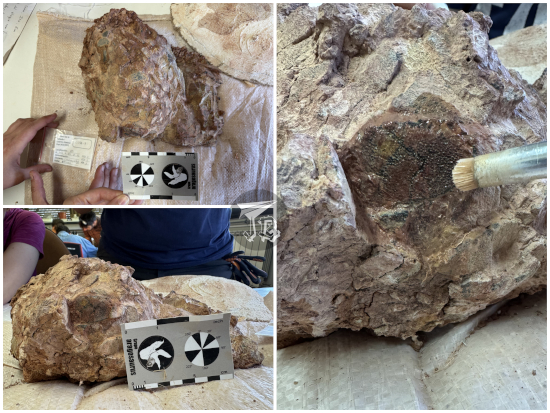
I started with the cleaning crew (again). Under Ester Díaz Berenguer’s guidance, we worked on chemically removing sediment from a fossilised egg using alcohol diluted in water and brushes. It was a slow but very Zen work – wax-on-wax-off kind of thing. The others in my group sounded a bit frustrated with the task, but I guess it’s because they were younger people and more impatient? I know that I did not finish cleaning one shell fragment after an hour, but I was just… aware that fossil prep was a slow process?
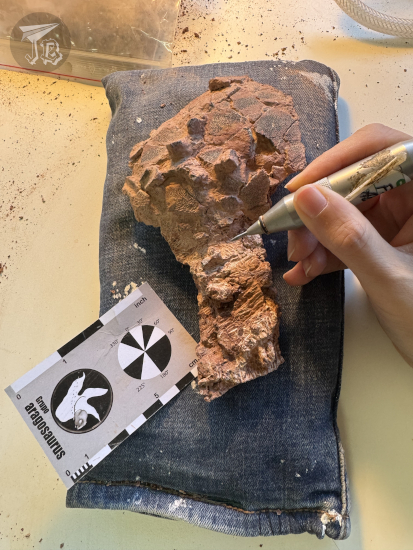
My second activity was also cleaning, but this time mechanically, using an air pen to remove as much of the remaining matrix as possible without damaging the general structure. This step would actually happen before chemical clean-up. The air pencil is a pneumatic tool so you really don’t have to press against the rock, to see the sediment peel away. It’s even more Zen than the chemical clean up – unless you’re working on a fragile bit. The important thing is to always clean away from the shells. I worked on that for another hour or so, and I even got to use some gluing materials to make sure a crack did not cause a problem – that was the bit that was more stressful, worrying I might damage the fossil.
We had a short break which I used to go to the car to organise the car boot – I had thrown all my things there, but a classmate had asked me to drive him to Saragossa, and I had to adjust for his luggage to fit too. Then my group moved onto studying the removed matrix from a jacket, under the direction of Manuel Pérez Pueyo. This consists on checking bags upon bags of broken rock bits to find anything that could be an eggshell. Though the main find of the Santa Marina site are the sauropod eggs, there are eggs belonging to other species – crocodilians and theropods. You weigh some sediment, spread it on a tray and move it around until you’ve taken out anything that can be useful to science. You have a microscope handy in case you need it. I am proud to report that during my three rounds, I did not miss anything key (before you discard your sediments, you call an expert to recheck). I did not find anything out of the ordinary, but I pulled out a couple dozen egg shell fragments.
At the end of the morning, I snooped around what they were doing on the opened cast jacket, and someone was using the air pen on it, trying to locate the eggs. The jackets are opened upside down, so there’s a bit of detective work to find the fossils again. In order to protect the eggs, the casts are made big enough to protect them from any saw, so casts may be huge (and of course heavy). Thus, a lot of cleaning work is required at the lab, which translates in an insane amount of time. The palaeontologists must find an equilibrium amongst protection, weight, and lab-work when deciding on the size of the cast.
For lunch, all of us went to Casa Lobarre, the village restaurant, I think a concession from the town hall, as it is in the same building. The inside is decorated with reproductions of Romanesque frescoes and painted to look like a castle, as it was used as the set in a film some time ago (Kingdom of Heaven, 2005 I think. Don’t quote me on it). They offered a set menu with the choice of a (hearty) starter, a main course, and a dessert, drinks included. It was a big lunch! I ordered stuffed courgette and assorted grilled meats. The food was quite all right, especially for the price, and the desserts were handmade.
Afterwards, we had two lectures. One was given by Manuel Pérez Pueyo, who explained to us the hard science data of the Garum facies, which could be the key to understanding the last dinosaurs surviving in Europe. He also talked about the K-Pg limit and dinosaur extinction. He also made a comparison between the little Santa Marina site with the American Hell Creek formation – as the presentation said… size matters. That’s why there have been so many dinosaurs found there, compared to the more humble sites in Spain.
The final lecturer was José Ignacio Canudo Sanagustín, the director of the University of Saragossa’s Natural Science Museum Museo de Ciencias Naturales de la Universidad de Zaragoza. He explained how a museum works (I was reminded me of the visit to the inner works of the geomineralogical museum in Madrid), and the museum-lab status. The Saragossa Museum, as an institution, is the custodian of the Loarre fossilised eggs, even if they stay in the Laboratorio Paleontológico de Loarre. This is not unique to this village, as there are several similar schemes in place all throughout Aragón, known as “satellite sites” or “remote halls”.
Canudo also talked about counterfeit fossils – a reason why I only buy my fossils during Expominerales or Expogema, I don’t trust random vendors. Then, he moved onto the topic of the Museum itself – how it works, what kind of items they hold, how they came into the museum, and a little pride-flex, that they are home to a whooping 319 holotypes (the specimen that is used to describe a species), mostly from the Aragón region. The museum only exhibits a tiny proportion of the treasures that are deposited there for their protection and research.
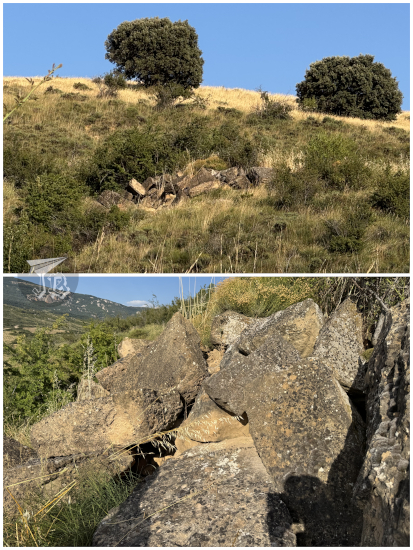
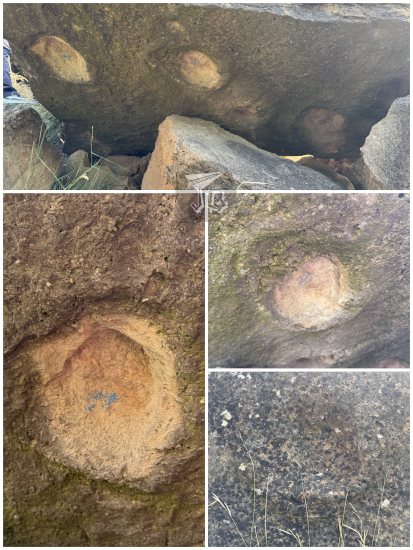
Towards the end of the evening, we hopped onto the vans yet again to head to the middle of nowhere for some amazing views of the castle. No, really. We were headed to another “palaeontological site”. It turns out that a few years ago, a farmer was ploughing his land and found a few slabs of rock which he discarded to the side. These slabs held footprints from hornless rhinoceros from maybe 15 – 10 million years ago. The slabs are haphazardly stacked with the footsteps on the underside, which is great for conservation. Also, the way is so unkempt that nobody would get there to damage them for kicks and giggles, which is good too. We had to waddle through thistles and dry plants about hip-height to get there, then climb up the rocks so all of us could get a look. Afterwards, we found a shaded spot to talk – and the professors brought cold drinks (and chocolate) again for the hike. They were crazy prepared.
Here’s the thing with the rhino footsteps – scientifically, they’re out of place, so they have lost a good part of their intrinsic / purely scientific value. But legally, they must be protected and conserved. So, what to do with them? It would be expensive to move them, and once they were transported, where would they end up? Neither the lab nor the museum were willing to take them on… Each of the coordinators told us about pros and cons of different actions. In the end, what we were brought to realise was the big discrepancy between what must be done (considering the law), what should be done (considering the science) and what can be done (considering the money). The museum-lab has an idea or two about what to do with them, and I wish they succeed. I really hope the rhino footsteps become well-known some day. That way I can boast I knew them before they became famous…
Technically, the day was over then, but the coordinators asked for our help with some stuff – getting the jacket we had extracted from Santa Marina into the lab, and moving one of the display cases to change the exhibit inside. We happily complied with both, being the first to see the new display in the museum. Are we special or what?
Afterwards, my classmate and I set off towards Saragossa Zaragoza. We arranged that I would drive him to my hotel and he would get a taxi from there. The drive from Loarre to outer Zaragoza takes about an hour, but once you get into the city itself, all bets are off. Furthermore, Google Maps had given me some strange instructions to enter Saragossa, but fortunately, traffic was light, as I had predicted / hoped. The hardest part getting to the hotel parking lot – I had to go to the hotel first (and find a parking spot for that) to check in, and get the key to the parking lot, then drive there. Of course, the only place I could drop off the car near the hotel was a one-way street in the opposite direction from what I needed, with no convenient turns allowed. In the end, it took 20 minutes to be able to leave the car, but it was really the most convenient option. Zaragoza is really not made for visitors to park in the streets, even if the hotel was far from the centre. It was the closest to the university as I had been able to find so the next day was nice and easy.
It was insanely hot, sticky hot, and I needed some dinner. I found a nearby fast food place and headed back to the hotel room with take-out. I finally had a long shower – this was a bit of a theme during this trip, wasn’t it? The room was small and a bit claustrophobic (honestly, it reminded me a little of a prison cell), and the air-conditioning machine was right above the bed, so it was a bit tricky to find the correct temperature / fan combination. I was tired, but stupidly alert, so it took a while to fall asleep.
Sometimes I get weird ideas stuck in my head. I usually let common sense override them, but this time the temptation was too great, so I allowed myself to do something slightly insane. I don’t regret it one bit.
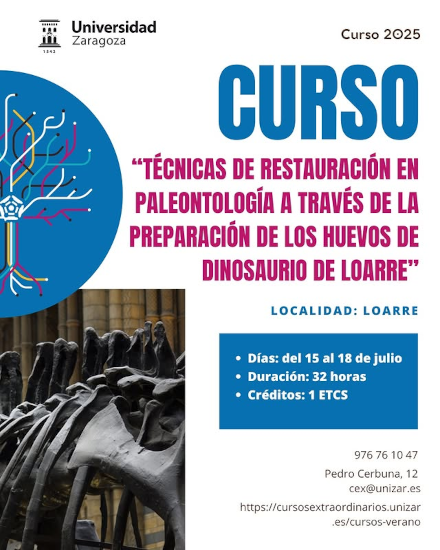
Until a few years ago, my work projects rarely extended past June. Lately however, I’ve had to work well into July, which means I have not been able to sign up for any summer university course. Especially, one summer university course from the university of Saragossa Universidad de Zaragoza called Técnicas de restauración en paleontología a través de la preparación de los huevos de dinosaurio de Loarre: Palaeontological Restoration Techniques through the preparation of Loarre dinosaur eggs. Until now, I had been working through both editions of the course – usually until the very same day the four-day course finished. However, this year my last day of work was the day before the course started.
I started mulling… what if? What if I signed up? What if I directly drove from work to the site of the course? What if I did something crazy and went to Loarre? It would mean driving for a about four hours through the late afternoon / early evening of the 14th of July, the day before lots of holiday periods kicked off… right after a whole work session. It was not the best of ideas. It was not the most reasonable thing to do. What if I did it anyway?
I made up my mind – I would do it, sanity be damned. My family also offered to subsidise part of the course and accommodation as my birthday present, too (thanks!). I found out all the information and decided to try for the course on the 27th of April. Now, I just had to wait for admission to open, sign up, be accepted, and pay. It seemed to be a simple process, like any other course I’ve taken before.
Except, it was anything but simple.
Sign-up for the Saragossa Summer University, Cursos de Verano UNIZAR usually opens the first Monday of May. That did not happen this year – because 2025 is special? Once I located the correct website, I checked every day – like keeping tabs on concert-ticket information – until a tiny banner reading “sing-ups will open on the 12th May” appeared. Since enrolment did not open a midnight, I deduced that slots would open at 9:00, so I was ready at the computer at that time. The online forms opened indeed around 9:20, but there were only five courses listed on the website, and none of them was mine. The rest opened gradually, but only as numbers… I kept refreshing the webpage until I finally saw my course just after 9:40. I filled in the information, and the webpage said that I would receive an email with confirmation and further instructions.
That email never arrived.
I gave the university a couple of hours, then phoned them up around 13:00. I was told there was a problem with the system and to call the following day if the email had not arrived. Thus, I called around 9:15 on the 13th of May, when I was informed that they had forgotten to activate sending the confirmation emails but not to worry.
On the 15th of May there was a webpage update, saying that the email that had never arrived held confirmation and paying instructions, so I rang the University again. They told me that they would send the information “manually” and “later”. Maybe. The conversation was not really reassuring in tone. I explained that I needed to book accommodation, and they checked again – I was number seven in the list, which meant I was in. They also informed me that there was a partner accommodation on the website – not really, there was a coding error and it did not display. I told the lady so, and she said she would update the webpage. I asked again if she was sure my enrolment had gone through, she insisted that I was in, and the email would come later. Definitely maybe.
I went on Google Maps to check for accommodation in town. Loarre is a 350-inhabitant village famous for its castle and since 2019, its palaeontological sites, where around a hundred sauropod eggs have been found. These eggs were the star of the course Técnicas de restauración en paleontología a través de la preparación de los huevos de dinosaurio de Loarre: Palaeontological Restoration Techniques through the preparation of Loarre dinosaur eggs, from the 15th to the 19th of July 2025. If everything worked in the end…
The accommodation recommended by the University was the campsite, but that was a bit out – it meant driving to the village every day, or a 35-minute walk each way. And that would be nice in the morning, but not after the whole day out. I sent an email to a nice rural cottage which never replied. Then I realised that the course actually was held in Loarre only for three of the four days, the last one would be in Zaragoza (Saragossa) itself. I tried to book at the recommended accommodation, but when they had not confirmed within 48 hours, I just went on a third-party site. I booked a place to stay in the heart of Loarre and a hotel near the university in Saragossa. Of course, a few hours later, the recommended accommodation replied, so I had to cancel. I still reserved everything with full cancellation, just in case. Can you tell I had little confidence in the whole process?
Of course, in between, work tried to change my schedule (already chaotic), because someone needed one of my days in exchange for the 15th of July, which I had to regretfully decline. I hope they don’t hold that against me, but after all the planning and the stress, I did not want to give up the chance to take this course to do someone a favour. On the 13th of June (Friday), the sign-up email arrived, with a payment deadline on the 23rd (Monday) – the course fee was 190 € (160 € discounted). I transferred the money right away, since the following day there would be a bank outage. I also sent proof of payment and a copy of the documentation that entitled me to the discounted price. A few minutes later, someone wrote to me to ask for the discount paperwork. I sent it again.
On Friday the 20th of June, I got a phone call from a long number at work. I rang back. It turned out to be an admin from the summer university asking me if I was still interested because I had not paid yet! I said I had transferred the money, sent the receipt, and the documentation. The person on the other side of the line was surprised for a second, then updated bank data or something, and it turned out that my payment had indeed gone through. Magic! Guess who emailed the University again to have confirmation on writing… It should not be so difficult to… enrol in a course from an establishment that has been offering them for literally almost a century.
To be honest, I was not 100% confident I was really enrolled until I saw my name in the roster the morning of the first day. But it was. Actually, that is a bit dramatic, as on the 7th of July 2025 I received an email from one of the course coordinators, Lope Ezquerro Ruiz with some information. In that email, he explained that some people had contacted them to try and organise transportation, so they were offering to drive people from Saragossa or Huesca on the first day, and back to Saragossa for the last session.
The truth is that public transport to Loarre was a nightmare. That is why I had decided to drive, even if I don’t like it that much, especially in the middle of the holiday rush. Had I known transport from and to Saragossa was a possibility beforehand, I would have planned accordingly. I might have considered taking a railway round trip to Saragossa instead of driving, but by then it was too late to rearrange and change the whole accommodation planning. Furthermore, it allowed me to pack for all kinds of eventualities (yay boot space). In the end, it was way more convenient to have the car, so I don’t regret it.
As the day approached, the weather predictions were al over the place. I decided to pack a bag for Loarre, and a different one for Zaragoza (Saragossa) that I would swap, I also prepared an isothermal bag with frozen water bottles, drinks and snacks – of course, the ice would eventually melt, but I had to leave the car outside while I was at work (and when I came back at 15:00, the the temperature it marked was usually 43 ºC), and I wanted to make sure no fizzy drink exploded. I finally readied an extra bag for “maybes” – extreme cold, extreme heat, rain, extra headwear…
Both the village of Loarre and the city of Zaragoza are located in the area of Aragón, a region of Spain which has gained a lot of traction in the palaeontological world due to the impact of Dinópolis and their exploitation of anything that can be even vaguely related to dinosaurs.
One of the things that surprised me, however, was how Loarre wants to attract tourists but does not seem to be willing to carter to them. I packed snacks for dinner because I was not sure I’d find a place to eat or a shop, and I was right. On Wednesday, we were too late for lunch and had to find alternative plans, and the Hospedería decided that they would not offer food in the evening because the cook had hurt her foot.
If you are interested in the “hard science” of what I learnt and will summarise here, I recommend these sources (in Spanish) by part of the course professors:
Moreno-Azanza, Miguel; Ezquerro, Lope; Pérez-Pueyo, Manuel & Gasca, José. (2021). Huevos de dinosaurio en las Sierras Exteriores de Huesca. You can read it here.
Díaz Berenguer, Ester & Canudo, José. (2024) El Museo de Ciencias Naturales de la Universidad de Zaragoza. Revista PH. 10.33349/2024.113.5663. Available here.
Pérez-Pueyo, Manuel; de Jorge, Laura; Ezquerro, Lope; Laita, Elisa; Moreno-Azanza, Miguel; Díaz Berenguer, Ester; Núñez-Lahuerta, Carmen; Barco, José; Cuenca-Bescós, Gloria & Canudo, José. (2023). Paleontología de proximidad: cómo fijar el patrimonio en el medio rural. Found here.
The museum-lab Laboratorio Paleontológico de Loarre website.
The company that manages the private side, Paleoymas website.
The Saragossa University Natural Science Museum Youtube channel.
Joan Manuel Serrat was born in Barcelona in 1943. He is a singer, songwriter, composer, actor, writer, poet and musician, whose long career started in 1965. Since then, he has sung first in Catalan, then in Spanish, and finally in both languages. In 1968, he was involved in a Eurovision controversy as there was a strife about singing in Catalan or Spanish, and in the end he was replaced by another artist – who ended up winning.
Throughout Franco’s Dictatorship, Serrat lived an unstable balance between the media veto caused by the Eurovision scandal, the censorship of some of his lyrics, and his growing popularity both in Spain and Latin America. During the 70s, he became a vocal protestor against the Dictatorship, with his songs, actions and words, which ended up with another veto and an exile to Mexico. In a way, he became the symbol of the discontent of the twenty- and thirty-somethings that had grown in the Spanish post–Civil War, who were then wading into adulthood. Serrat’s song Mediterráneo (Mediterranean Sea) has been repeatedly called the best song in the history of Spanish pop music. The album stayed as number 1 in Spain for weeks despite the censorship – since then, he has collected innumerable accolades and homages.
My parents… I don’t think I can call them fans, but they have listened to Joan Manuel Serrat for a long time – as a matter of fact, my father used to translate songs into Spanish for my mother back when they were young, as he spoke Catalan and she did not. But they are not concert people, so I was slightly surprised when back in April my mother commented in passing that, had tickets not been sold out, she would have liked to attend the Madrid concerts of Serrat’s goodbye tour El Vicio de Cantar. Serrat 1965 – 2022 (Singing is a vice. Serrat 1965 – 2022). I put the Internet machinery to work, and I found tickets for Zaragoza on the 13th of October. At that time, my parents asked if I would be interested, and I said yes, as he is indeed one of the most important singer–songwriter of the 20th century in Spain.
The problems started when I could not get the day off, so that meant driving there as I left work. I could have got away with leaving half an hour earlier to get to the train as they drove off earlier, but they refused, so we ended up getting to Zaragoza around 17:00. Checking into the hotel took 40 minutes due to the slow check-in process, and luckily we were on the third floor. Funnily enough, it seemed that everyone in the hotel was there for the concert, so a lot of older people not used to travelling nor hotels.
The concert was due to start at 21:30 in the local sports centre Pabellón Príncipe Felipe, and there was a delay of about 15 minutes. To be honest, I did not expect it to be such a powerful experience – I mean, we’re talking about a 79-year-old man here, I did not think he would still have such a powerful voice nor presence on stage. There were a lot of songs I did not know, but the ones I had heard before still retained the vitality of records as old as the 80s! The set list was a remix of his most iconic songs in Spanish, with a couple of them in Catalan language:
Dale que dale – “Go on and on”.
Mi niñez – “My childhood”.
El carrusel del Furo – “Furo’s carrousel”.
Romance de Curro el Palmo – “The romance of Curro el Palmo”.
Señora – “Lady”.
Lucía
No hago otra cosa que pensar en ti – “I keep thinking about you and nothing else”.
Algo personal – “Something personal”.
Nanas de la cebolla – “Onion lullaby”, with lyrics from a famous Spanish poet who wrote the poem in prison, when his wife wrote to him that there were only bread and onions at home, and she had to breastfeed their baby.
Para la libertad – “For freedom”.
Cançó de bressol / Canción de cuna – “Lullaby”.
Hoy por ti, mañana por mí – “Today it’s you, tomorrow it’s me”.
Tu nombre me sabe a yerba – “Your name tastes like herbs” – grass, actually, but it sounds horrid in English.
Los recuerdos – “Memories”.
Es caprichoso el azar – “Fate is whimsical”.
Hoy puede ser un gran día – “Today can be a great day” – I keep telling myself this.
Pare – “Father”.
Mediterráneo – “Mediterranean Sea”, I can totally understand how this is considered one of the best songs ever in Spanish.
Aquellas pequeñas cosas – “It’s the little things”, started the encore
Cantares – “Songs or Poems”, with lyrics by Antonio Machado, one of the greatest Spanish poets in the Spanish 20th century.
Paraules d’amor – “Words of Love”.
Penélope – though I knew this song, the lyrics were different from the ones I was used to.
Fiesta – “Festival”, a bit of a high-inducing song to finish the concert way past midnight!
It was hilarious to see all these sixty- and seventy- year-olds get out from the pavilion and walk to the hotel, all pumped up and way beyond their bedtime. By the time we arrived at the hotel, there was a queue at the lifts! All these exhausted boomers, hyped up and at the same time with no more energy left. That is when we were so happy to be on the third floor and not something like the seventh or eight (≧▽≦). The bed was comfortable but I did not sleep much.
Because life is strange sometimes, I found myself travelling to Zaragoza in a super-slow train that took three and a half hours (while the high-speed train takes around one hour). It was somewhat of an emergency so we had to leave on Sunday in the late afternoon, and came back on Monday. We booked a hotel next to the station, one that had been built for the Expo 2008, and it goes without saying that the hotel had indeed seen better times.
My company was not required on Monday morning, so I walked towards the area that had been the Expo’08. I crossed river Ebro using the bridge Puente del Tercer Milenio, the longest concrete bow-string bridge in the world, designed by architect Juan José Arenas de Pablo.
The north wind was blowing and it was a bit uncomfortable. Furthermore, the area where the Expo used to be was creepy. A lot of it was abandoned and / or fenced off, and even if they had tried to make it a park it just looked derelict and forsaken.
I looked over at the river Río Ebro. To both sides there were bridges – Pasarela del Voluntariado to the downstream to the left, and Pabellón Puente upstream to the right.
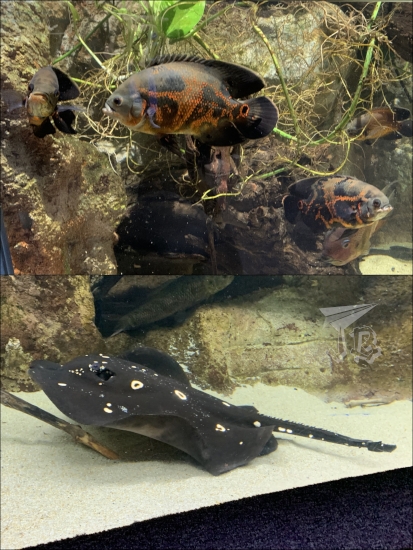
Then I went to the river aquarium Acuario de Zaragoza, which prides itself in being the largest freshwater aquarium in Europe.
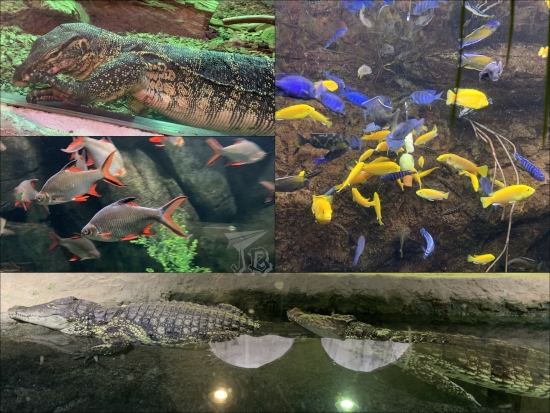
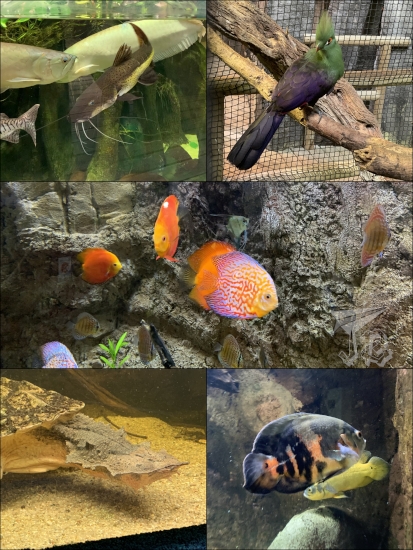
The aquarium is divided in five areas or rivers, organised surrounding a central freshwater tank called “World River”, where there are no sharks, but there are several arapaima (Arapaima gigas), one of the largest freshwater species of fish, up to 2 metres long.
The first river is the Nile (Egypt). It included (obviously) a bunch of fish, a couple of Nile crocodiles (Crocodylus niloticus), a Nile monitor lizard (Varanus niloticus, which had somehow by the way figured out that it lived in an enclosure with a sliding door and… was trying to get it open), a couple of lungfish, perches…
The second river is the Mekong (China), which is known for its giant fish – as a matter of fact, the largest freshwater fish ever was recently found there. There are also an insane amount of catfish – in the river, the aquarium has them under control. The most interesting thing about the Mekong is the freshwater rays.
The third river is the Amazon (Brazil), which is the largest river ever, so there are three separate areas – the blackwater-flooded forest or Igapó, the forest itself, and the mangrove. The displays included Knysna turaco (Tauraco corythaix), which is the “only true red and green bird”, green iguana (Iguana iguana), catfish, red-bellied piranha (Pygocentrus nattereri), electric eels (Electrophorus electricus), anaconda (Eunectes notaeus).
Then there is the Darling-Murray river (Australia), which must be saltier than I had expected, because apparently clownfish (Amphiprion ocellaris) and anemone (Entacmaea quadricolor) packs, and seahorses, along Pearl arowanas (Scleropages jardinii), tree frogs (Litoria caerulea), and the supercute (I think it was a) nobbi dragon (Diporiphora nobbi)…
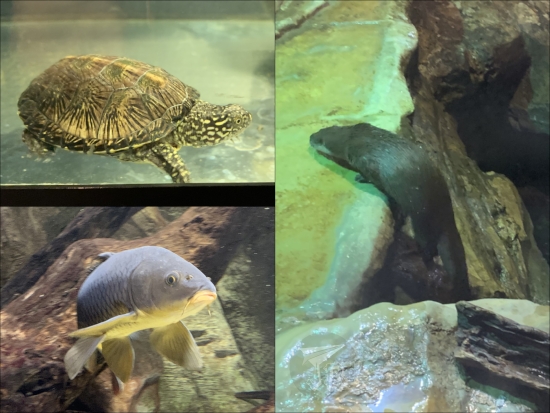
Finally, there’s the Ebro river, the local one. There are the endemic barbs (“barbo de Graells” Luciobarbus graellsii), the local otter (Lutra lutra) and sturgeons (Acipenser sp.).
Throughout the whole run there are hundreds of turtles – the aquarium runs a turtle rescue scheme in order to get abandoned pet turtles out from the rivers, mostly the pond slider (Trachemys scripta).
I saw some of the old Expo’08 mascot, and some people diving in the central tank – I don’t think I’d go into a tank with the arapaima, even if they were swimming near when I was feeding the manatee in Faunia. There were also some animals that had been rescued from illegal trade and donated to the aquarium.
After the aquarium, there was only coming back in yet another train that took over three hours. It was the weirdest trip I have ever taken…
We had a silly day-and-a-half and it turned out that for some reason a commuting train to Madrid took about as long as a high-speed train to Zaragoza, a town in the area of Aragón that we scratched off our summer route because there are lots of curves in the Pyrenees and time was limited.
22nd October 2021: Churches, Museums and a Palace
The train to Zaragoza arrives at the Delicias station, which is a bit away from the centre of the town, so we took a taxi to the hotel. This was around 9 am so we were of course not expecting any room, what with check-in being 2 pm – we just wanted to drop off the overnight bag. Not being able to give us a room seemed to upset the receptionist quite worried, and he promised to call as soon as a room was available. Honestly, I just set my phone to flight mode because we were starting to visit monuments right away, as the hotel was just by the most important square in town Plaza del Pilar.
Zaragoza is home to one of the most important Christian icons in Spain, the Virgin Mary of the Pillar, Virgen del Pilar. The image is hosted in Catedral-Basílica de Nuestra Señora del Pilar. The bulk of the current cathedral-basilica was built between 1681 and 1686 in the Baroque style, but was later modified quite a few times and it was finalised in 1872. Interesting items in the church include, aside from the virgin image, some frescoes painted by Goya, the main altarpiece, and two bombs that fell within the church during the Spanish Civil War (1936-1939). Zaragoza is very anti pictures inside so I had to sneak them in. Sorry, not sorry.
After a small detour to say good morning to the river, Río Ebro, and the Puente de Piedra (stone river), the second building we visited was the Old Market Exchange building – Lonja de Zaragoza. This was the first Renaissance building erected in Zaragoza, dedicated to commerce, with an amazing Gothic-imitation ceiling. Today it is used for exhibits, such as paintings or sculptures.
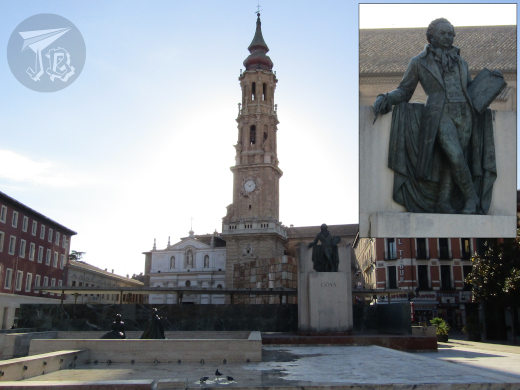
Coming out, we almost walked into one of the fountains in the square, Monumento a Francisco de Goya, featuring the artist – a brilliant Spanish painter from the Romantic times. He was as brilliant as bad-tempered though. Behind the fountain stands the cathedral, for which we had tickets for 11 am, and it was still early for that.
Thus, we started the route of the Caesaraugusta Museums. Zaragoza was founded in Roman times under this name (where an Iberian dwelling used to be) and in the latest decades, this Roman past has started being dug up. We first visit the museum focused on the original forum, Museo del Foro de Caesaraugusta where we could see the foundations of the old city and walk into the sewers (yeah, it’s cooler than it sounds). The Roman ruins date back from emperors Augustus and his successor Tiberius’ reigns.
After that it was almost time for our reservation to visit the Catedral del Salvador also known as La Seo de Zaragoza, the other cathedral of the town, literally at the end of the same square as the other one. The cathedral mixes several architectonic styles: Romanesque, Gothic and Mudéjar, these last tow being among my favourite styles, so a total win – Renaissance and Baroque elements were added, including the towers. The cathedral has a tapestry museum with a lot of works, not exactly “pretty” but rather impressive.
Following the cathedral we walked towards the rest of the Roman museums, but we made a small detour to look at the Mudéjar tower of the church of Mary Magdalene, Iglesia de Santa Magdalena.
Then we reached the museum of the Bathhouse, which was open but closed – let me explain. They run an “Audiovisual” and close the museum door for as long as it runs. It runs every half hour so finding the thing open seems to be hard. Thus, we moved onto the next archaeological site, related to the old Roman Theatre Museo del Teatro de Caesaraugusta. The theatre was apparently discovered by accident in the early 1970s, and it is apparently one of the biggest Roman theatres in Spain.
We tried our luck with the Bathhouse Museum again Museo de las Termas Públicas de Caesaraugusta. Unfortunately, just like before, we walked up to it while the audiovisual was running, and the concierge made a very studious effort not to see us – so we just peered over the glass roof to see what is left of the main bath.
More impressive was the river port museum Museo del Puerto Fluvial de Caesaraugusta, which keeps the foundations and some of the clay amphorae that were used for import / export.
And believe it or not, we did all that before lunch!! Therefore, we decided it was the right time for a break. We headed back to the hotel to see if we could wash our hands (and take off our facemasks for a while). To our surprise, the hotel had given us an upgrade to a junior suite, so we had a sitting room, a full bathroom and a bedroom – and a balcony that went all along the three. When I opened the window I could hear people playing the piano on the street, as there was some kind of festival going round. Believe it or not… I got to listen to Queen’s Bohemian Rhapsody and Rufus Wainwright’s Hallelujah.
We had lunch outside in a place that my companion enjoyed called La Lobera de Martín – not a cheap place, honestly! However, we splurged a little. We shared a smoked fish salad and I had a side of fresh Foie. As a main, ordered steak tartare, which to my surprise, was prepared for me next to the table! For dessert I tried the home-made berry yoghurt. I have to admit that I was totally planning on having a tiny dinner (or completely skip it!) at that time.
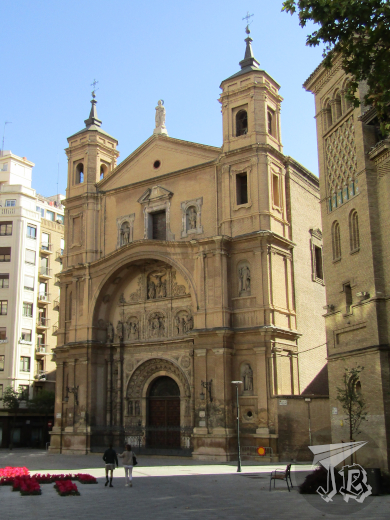
After lunch we walked along one of the main arteries of the town, Paseo de la Independencia, to find the Basílica Menor Parroquia de Santa Engracia, to at least see the outside, since we could not fit visiting the interior and the crypt with our tight schedule. One of the most interesting things about this church is how its façade is built like an altarpiece.
Next to the church stands the neo-Mudéjar post office, built in typical bricks from the area – Oficina de Correos de Zaragoza.
And finally, we looked at the current Science Museum, Museo de Ciencias Naturales, the former Medicine University. Why? Because that’s where my parents met *cue romantic music*!
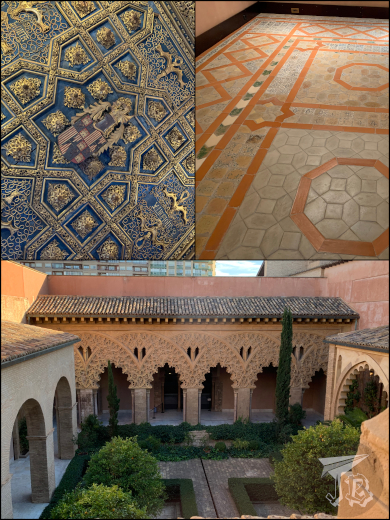
We did not go in though, because we needed a break and had booked a ticket for 5pm somewhere else, so we decided to raise our feet a little for a while in the hotel room – the sitting area was nice though unfortunately there was no more sun on the balcony, else I would have totally impersonated a lizard there (I did scare a pigeon away though, even if the startle was mutual). Our next target was the Medieval palace called Palacio de la Aljafería – a fortress that combines Islamic architecture and ulterior Christian elements. The Moorish palace was built around 1065 – 1081, and it holds a magnificent garden called the Golden Hall with a portico made out of interlocking mixtilinear arches (I totally looked the word up, and will forget it promptly). The palace was taken over by the Christians 1118 and became a palace for the monarchs of Aragón. It was not modified until the 14th century, and in the 15th Century the Catholic Monarchs extended it further into the Mudéjar Palace. Today it is the meeting site for the local government. I adored it, to be honest, I loved the Golden Hall most of all, but the original ceilings in the Christian palace were also really cool.
We walked back towards the Plaza del Pilar (probably through some streets we probably shouldn’t have, hindsight is 20/20 they say), and we reached the church of St. Paul Iglesia Parroquial de San Pablo. The restored interior leaves a bit to be desired, but the exterior, built between the 13th and 14th centuries in the Mudéjar style – it has an octagonal tower in dark tones, with the upper roof added in the 17th century with richly decorated with tiles and windows. It is worth mentioning here that several Mudéjar buildings in Zaragoza, along with others of singular architecture, are declared Unesco World Heritage Site.
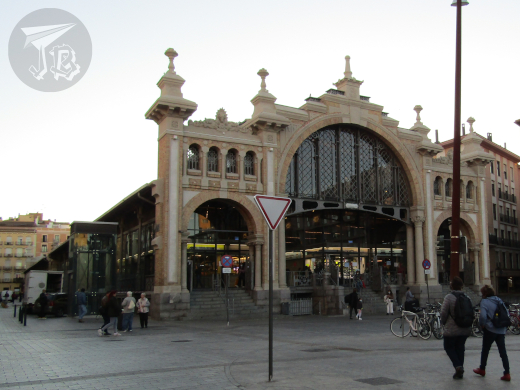
Between the church and the square we walked by the central marketplace Mercado Central de Zaragoza in the late 19th and early 20th century, in a combination of stone and iron-and-glass architecture.
Close to it we could see some of the ruins of the original Roman walls Antiguas Murallas de Romanas de Zaragoza, which are actually sprinkled all through the town and mixed with the Medieval ones at points. There, a lady was happily chatting on the phone while her child climbed the walls – so in case it is not evident, here’s a social clue: if there is any kind of barrier / signage around something, it should not be climbed on.
To finish off the day we visited the Museum dedicated to Goya Museo Goya. Goya, whose complete name was Francisco José de Goya y Lucientes (1746 – 1828) was a painter and printmaker from the Romantic age. He is probably one of the most important artists in Spanish history. He was a royal portraitist, fresco decorator, and also painted and printed many critical and fantasy works. To be honest, the museum was a bit underwhelming – with few of the minor works, and one of the least impressive major works, the Christ portrait. There was however a whole room full of prints.
After one more visit to the square, where I managed my only complete picture of the whole (night-lit) Basílica del Pilar from that angle, we just headed to the hotel. There was a sandwich shop at the entrance, so we took one each and had a late light dinner as we watched Night at the Museum in the hotel bathrobes – because it was cozier than turning up the heating. I did not sleep too well as the fire alarm was right on top of the bed and it kept flashing – at one point I thought that an electric storm had hit, but it was just the alarm…
23rd October 2021: Papercraft and walks
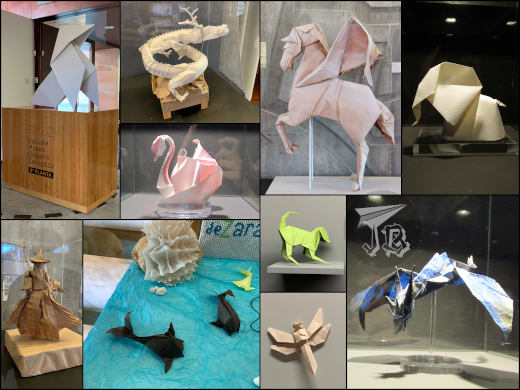
The next morning we had breakfast and headed off to the origami museum and workshop EMOZ: Escuela Museo Origami Zaragoza, located in the “Stories Museum” Centro de Historias. I remembered the exhibition from a few years back in Museo Cerralbo in Madrid, with an actual-size hippo, so I have to admit this time I was a little… underwhelmed, probably because the temporary exhibit ended up being “abstract” paper folding…
However, in the very same building there was a very fun exhibition about the evolution of household appliances throughout the 20th century. That was cute!
As we got ready to draw a close to our day-and-a-half getaway we went to say goodbye to the river Río Ebro. We walked by the modern Puente de Zaragoza bridge, and crossed over the Puente de Piedra, the traditional stone river of the town. The current one dates back (although reconstructed) from 1440, but there are records that a previous Roman one stood in its place and was destroyed in the 9th Century. Between the two bridges a flock of cormorant seemed to be sunbathing.
From Puente de Piedra I took my last picture of the Basílica del Pilar before we had a nice milkshake, then headed back to the station to take our train back. By the way – I find it ridiculous that the stations have blocked 60% of the seats while they’re filling up the platforms and the trains as normal…
Note: This is a flashback post, which means it is just a collage regarding a trip I took before I started the blog in 2012. Tags may be incomplete or slightly off.




























 JBinnacle – A Travel Logbook