14th September 2022: Leaving is also tough {Jordan, September 2022}

We were picked up at 7:00 for our 10:55 flight out of Queen Alia International Airport, not by the guide any more, but by a random driver who dropped us off about 8:00. At the airport, a liaison came to pick us up. He took us through a pre-check before we could even walk into the airport. He walked us to check in and when I told him we had already done so, I might have broken his brain. He placed us on a special line and took our passports so we… got paper boarding passes.

Then he took us to the security area and left us there. We went through the automatic gates with the boarding pass, then through passport control, where we got the exit stamp. Finally, we got through standard airport security that swabbed my camera for explosives. The whole thing took about half an hour because even if there were many steps, there were few people in the airport. We found the gate and settled down to wait.

Passport page showing entry (10th September) and exit (14th September) stamps for Jordan, along with a "Group Tourist Visa" stamp (by JBinnacle)

And boy, apparently there had been overbooking in the flight, so checking in early saved us a lot of stress! We had paid to sit together, so I politely declined exchanging seats when I was asked, and my neighbour did not take it well…

We had a snack during the trip again, but I think that the meal and the drinks should have been a bit more separated, that would have made the trip more comfortable. We were supposed to take a little over five hours; however, had we found a landing slot, we would have made the whole trip in just over four. Upon landing, our passports were checked at the plane exit, then at normal immigration, then there was Covid vaccination status… and we made it back home after 12 hours on the go.

All in all, this has been an interesting experience, but we did not see a lot of the “important” sites, even in Petra. However, I do not think that I need to come back to Jordan. Even though it is the most westernised of the Arab states, child labour, animal abuse, hassling, peddling, distrust, and the tipping culture have been a put off. Furthermore, I plan to avoid the trip’s organiser as much I can in the future, because I did not like the way this panned out – especially the rearranging, the hours (early enough to be uncomfortable, too late to beat the crowds) and the “forced shopping times”, which I am told is typical in Middle Eastern countries. I swear, this has made me rethink Egypt…

13th September 2022: Wadi Rum (and the bus) {Jordan, September 2022}

I had a boiled egg, potato hash-browns and coffee breakfast because my body was craving salt, I guess. Then we set off on the bus, where we ended up spending around seven hours (the 412 km are supposed to be done in 5 hours and a half, but that does not take into account bad traffic). Urgh. Our first stop was a viewpoint over the whole canyon area.

Wadi Musa valley panorama, showing the deep gorge from above

The second stop was a souvenir shop that had probably somehow bribed our guide or driver for it. None of us even bought anything, but we were forced to be there for about half an hour before we could continue to the only organised activity for the day – a two-hour jeep tour throughout the Natural Reserve and Unesco World Heritage Site of Wadi Rum | Wādī Ramm [وادي رم]. It is the largest wadi “valley”, created by alluvial fans and wind deposits, rather than the idea of a river bed. They are often found in deserts.

During the tour in Wadi Rum Reserve [محمية وادي رم] we drove through the desert and stopped at some rock formations that had built a gigantic dune. Wadi Rum used to be a granite and sandstone rocky formation. Thousands of years worth of wind eroded the sandstone back to sand, forming and shaping the desert dunes. Huge granite structures still stand, such as the Seven Pillars of Wisdom [عمدة الحكمة السبعة], just at the beginning of the route. One of the stops is the tourist-named Big Red Sand Dune, which you can climb for kicks, giggles and some nice views of the landscape.

Driving into Wadi Rum. The roof of the jeep is visible, along with a rock formation in the background. Between us and the rock formation there is the other jeep, causing a dust cloud

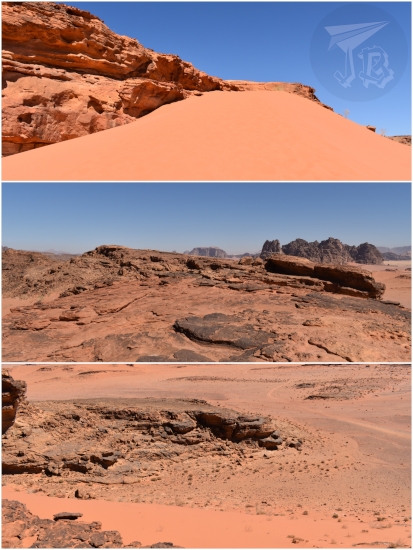
Back of a dune we had to climb, and the rock + sand landscape that could be seen from the top. Wind erosion marks have created soft ridges. The rocks are red-grey and the sand is rose-gold

Then we drove off to see some petroglyphs, and were offered dromedary rides. These petroglyphs, depicting early humans and their cattle – bovines and dromedaries – are the reason for the Heritage status.

A rock wall with some dromedaries in the foreground + a close up of the petroglyphs engraved in the rock, also showing dromedaries (by JBinnacle)

Finally we were shown a Bedouin tent at the feet of the Lawrence Canyon, a beautiful rock formation with faces of Jordan monarchs. Unfortunately, we did not get to see any onyx or fennec foxes, but I did see a small lizard. The Bedouins treated us to a cup of tea, but then we had to tip the driver about 10€…

Lawrence Canyon, a deep cut in the rock filled with sand at the bottom + details of engraved faces and Arab script, a lizard and a bit of tea, along with a traditional Bedouin coffee maker

Afterwards, we started off our trip back northwards back to Amman | ʻAmmān [عَمَّان]. Though the trip is supposed to take about 4 hours, it was way more than that, and we did not arrive at the hotel until way past 18:00. We went through the security checks and ended up learning that we could not travel between floors, so we could not go to the others’ rooms using the lifts, and the stairs were blocked… Well, at least we had… views?

A view of Amman skyline in the dark

After we managed to regroup, we had dinner and decided to try to check in online for the flight next day’s flight – and I was successful. Apparently, the airline only cared about us filling in our Covid certificate to enter Jordan, we were on our own for the way back.

11th September 2022: Roman, Byzantine and Nabataean archaeology {Jordan, September 2022}

The alarm clock went off at 6 am as we left at 7 for the initial leg of the tour, the city of Amman | ʻAmmān [عَمَّان]. The first thing we learnt was that traffic rules are little more than guidelines in Jordan – cars jumping lanes, honking at will, and driving whereever they could physically fit. The tour had 14 people in it, so we had a minibus. At least we had some presence / weight going on for us in that crazy traffic… so that was a good thing about the tour.

Around 8:00 we arrived at the Amman Citadel | Jabal Al-Qal’a [جبل القلعة] – and here is where my heart sank. The guide made clear that we had to be with him at all times unless he gave us “free time”. Unfortunately, he rushed us through, and he was droning, boring, and embodied everything I dislike about guided tours. And here I thought I had made my peace with them back at Stonehenge…

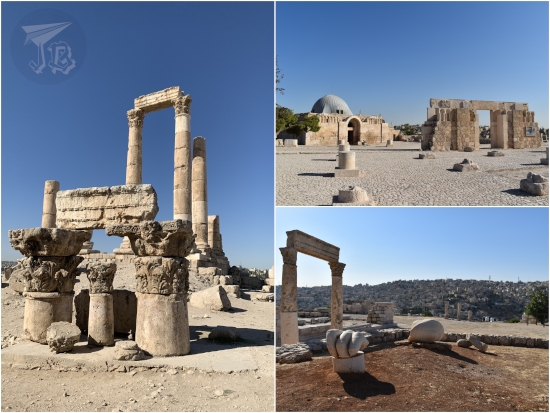
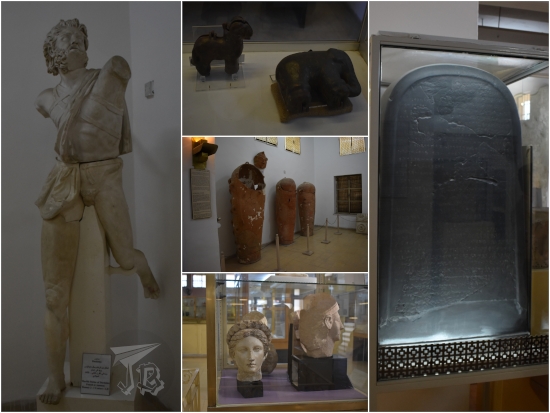
The most important remains in the Citadel are the Roman Temple of Hercules [معبد هرقل] and the remains of the colossal statue (2nd century CE), and the Umayyad Palace | Al-Qaṣr al-Umawī [القصر الأموي] (7th century CE). In the mid-20th century, the Jordan Archaeological Museum [متحف الآثار الأردني] was built within the Citadel. The museum is tiny, but it holds artefacts from all the historical eras the country has lived through.

Amman Citadel: Temple of Hercules and Palace

Amman archaeological museum: roman sculptures and trinkets, sarcophages, estelae

After the Citadel, we drove downhill to the Amman Roman Theatre [المدرج الروماني في الاردن] and Odeon [مسرح الأوديون], both of them are structures dating from the Roman period, 2nd century CE. Both are extremely well preserved, and still in use. There are also two tiny museums – the Folklore Museum and the Jordanian Museum of Popular Traditions.

Amman Roman theatre, from the outside

Amman Odeon, from the upper seats

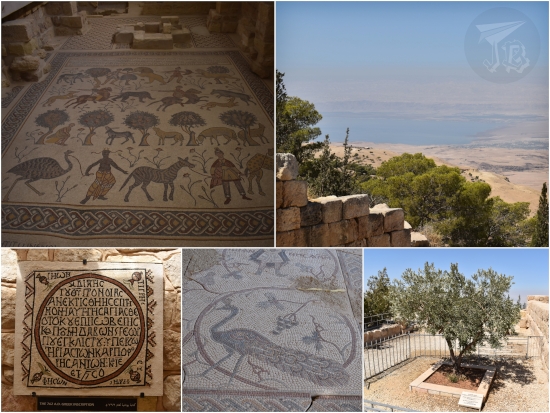
We got back on the bus and started our trip south. After an hour or so we reached Mount Nebo | Jabal Nībū [جَبَل نِيبُو]. According to the Bible, this was the place from where Moses laid eyes on “Promised Land” and died. Today, it belongs to the Franciscan Order. At the top stands the Memorial Church of Moses [كنيسة موسى جبل نيبو], which holds the archaeological remains of a Byzantine Basilica. A few astonishing mosaics can be seen inside. Next to the church stands the Brazen Serpent Monument (Nehushtan), and on the other side there is an olive tree orchard, with a tree planted by Catholic Pope John Paul II. From the viewpoint you can emulate Moses and look upon Promised Land, but the day was hazy and I only caught sight of the Dead Sea – a bit sad we did not get to got there, to be honest.

A collage: Mount Nebo mosaic showing men and animals, and Greek Writing. A panorama of the Dead Sea. The olive tree planted by the Pope

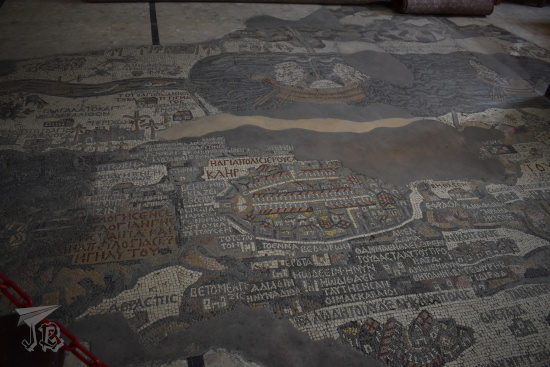
We drove forward to Madaba [مادبا] to see the Map of Madaba mosaic, dating from the 6th century CE and preserved on the floor of the Greek Orthodox Basilica of Saint George. It is a representation of the Middle East, essentially the Holy Land and Jerusalem. The mosaic was rediscovered in 1884, but the lack of preservation damaged part of it, until the Germans took over conservation in 1965.

Madaba Mosaic, showing Jerusalem

We continued our trip and made a stop for lunch at a restaurant / tourist shop in the three-hour ride southwards. The whole morning was rushed because the guide wanted to fit Little Petra | Siq al-Barid [سيق البريد] that afternoon, instead of Wednesday. It is part of the Unesco World Heritage Site of Petra and the Petra Archaeological Park. Little Petra was probably a suburb of Petra. The Nabataean built their desert cities by carving the buildings into the sandstone that made out the walls of the canyons, sometimes carving fantastic façades from top to bottom. One of the most interesting things in Petra are the frescoes found in the Painted Biclinium (dining room), depicting vines, flowers, and other leaves. Other constructions include water cisterns, the real secret of the Nabataean success flourishing in the desert, and the Triclinium. The city was built in the 1st century CE, “found” in 1906 by Père Abel, and excavated by Diana Kirkbride and Brian Byrd in the late 20th century.

Little Petra collage: Entrance canyon, triclinium, Nabataean paintings and stairs carved on the rock

Finally, we drove off to our hotel. The manager told us that we were the only group with an arranged dinner at the hotel that night, and he asked us to arrange a dining time for “salad and barbecue”. The salad turned out to be an assemble of Arab snacks and a plateful of barbecue lamb and chicken. Just wow.

Assorted Jordanian "salads" and a plate of barbecued lamb

In the end, we drove for around 300 km and about five hours, and walked about 6.5 km (10711 steps).

10th September 2022: Arriving is tough {Jordan, September 2022}

Officially named the Hashemite Kingdom of Jordan | Al-Mamlakah al-’Urdunniyyah Al-Hāshimiy [ٱلْمَمْلَكَةُ ٱلْأُرْدُنِيَّةُ ٱلْهَاشِمِيَّةُ], Jordan | Al-ʾUrdunn [ٱلْأُرْدُن] is located in the Middle East. It has limits with the Dead Sea, Israel / Palestine Syria, Iraq, Saudi Arabia, and it has a tiny connection to the Red Sea in the south. Due to its location, it is a semi-arid country, with relatively little rainfall, especially the further away from the Mediterranean. Today, it is an Arab nation, but it has been inhabited from the Palaeolithic – it has been Egyptian, Moabite, Assyrian, Babylonian, Persian, Roman, Nabataean and finally Islamic. In recent times, Jordan belonged to the Ottoman Empire, Britain, and it became independent in 1946, being a Parliamentary Monarchy that gives great power to the King (currently Abdullah II). Even though Jordan was left largely unscathed during the Arab Spring (2011), making it one of the most stable countries in the area, it was hit by terrorism in 2005. Al-Qaeda bombed three hotel lobbies, which crippled the tourism industry, which is one of the most important in Jordan.

It is probably the Nabataean period the one that has left the most unique cultural assets, and tourist sites. The Nabataean were nomadic Arabs that setted down and mastered the art of stone carving, creating the city of Petra as their capital. Petra is a Unesco World Heritage Site and one of the New Seven Wonders of the World, and possibly the most visited place in the country.

As of September 2022, in order to enter Jordan, you need to fill in a document declaring that if you get Covid you or your insurance will pay for any health cost, including hospitalisation or isolation / quarantine. That meant that unfortunately we could not check in online for the flight, as the air line – Royal Jordanian in this instance – had to check that declaration before issuing the boarding passes. That required being at the airport with a three hour margin, maybe a bit more. That made the whole thing a bit extra tiring (total travel time must have been about 12 hours). Fortunately, it went smoothly, we boarded without issues and took off on time.

The flight to Queen Alia International Airport in Amman | ʻAmmān [عَمَّان], the capital of Jordan, took about 4h30min (and plane food has not got any better since 2019). We landed late in the evening, and that was when the stress started off. There was a tourist guide / mediator / whatever waiting for us, with the name of the group my parents had booked for the trip. He gave us instructions which ended up being… “hand over your passport to this policeman and wait by luggage retrieval for your stamped passport, that I shall bring”. Okay, that was creepy, and I was more than a bit on the uncomfortable side until I had mine back.

Then we had about an hour bus ride and we reached the Amman hotel by midnight. The hotel X-rayed our luggage and bags as an anti-terrorism measure, and checked us in… weirdly. Apparently the tour operator had given names and reserved rooms but… there were no rooms associated to the names so my parents and my sibling and I ended up on different floors. Oh and even if dinner was included, they had already closed the kitchen so they gave us boxed dinner with sandwiches and salads. Fortunately though, they also gave us water and some complimentary bottles, which was handy. I wish I could tell you that I slept by the dead, but I was to wound up to do more than snooze a little.