13th September 2024: Cádiz, Jerez, Puerto Real & back to Cádiz {Escapade to Cádiz, September 2024}

After making sure there were no ants in my breakfast – I had stored it in the mini-fridge, and they were all in the trash can with the decoy – I left for an early walk around Cádiz as the sun rose. I went to Puerta de Tierra (the Land Gate), the remains of the walls that closed off the city in the past, which today separates the old and new areas. The original redoubt was erected in the 16th century, embellished in 1756 with a portal, and a tower was added in 1850. In the early 20th century, arches were opened into the wall to allow traffic to come through. There was a temporary installation to commemorate the “Phoenician Week” activities, but it was so garish that I was not even sure whether it was real or a parody of sorts.

Puerta de Tierra Cádiz

Afterwards, I walked to the train station to take the train to the nearby city of Jerez de la Frontera, where my first stop was the fortress-palace Conjunto Monumental del Alcázar. The first remains known of the alcázar date back from the 11th century, though most of what still stands was erected in the Almohad period (12th – 13th centuries). The fortress was repeatedly taken and lost in the war between Moors and Christians until the Catholic Monarchs finally conquered all of Spain. The building was owned by the crown, but it fell into disarray, and in the 18th century a Baroque palace was built.
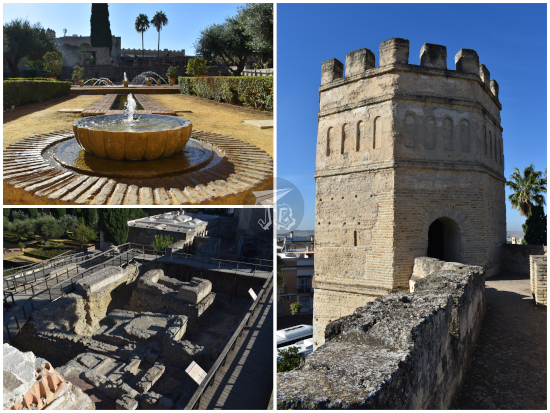
Alcazar de Jerez de la Frontera - exterior

Today, this palace is the only intact construction, and the one I left for last. I moved towards the garden first, which lead to the Arab baths, the octagonal tower, the cistern, the Royal Pavilion, and the walls, with some of the machinery from the Medieval times. The gardens were patrolled by peafowl. On the other side of the complex stand the mosque, an area with a reproduction of ancient oil presses, and the original gates in the walls.
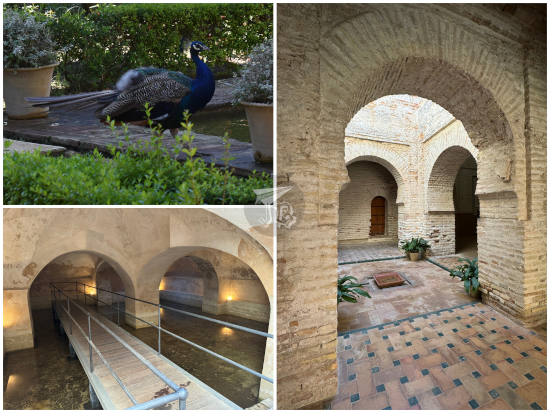
Alcazar de Jerez de la Frontera - cistern and mosque, and peacock

The Baroque palace Palacio de Villavicencio holds a wooden staircase, several rooms with rich decoration including hanging lamps and wall paintings, and a salvaged pharmacy from the 19th century.

Alcazar de Jerez: Palacio de Villavicencio

After the alcázar, which took longer than I thought to explore, I headed out to the Royal Andalusian School of Equestrian Art Real Escuela Andaluza del Arte Ecuestre to watch the show Cómo bailan los caballos andaluces (The way Andalusian horses dance), an eight-part show which has been performed since 1973. The exhibition showcases the different types of exercises that the horses are trained for – whether it is with a rider, or a handler on their feet, alone, or coordinating with other horses on the arena. It was a really impressive performance, and the horses were gorgeous.

Setlist of the show:
  1. Cómo se anda en el campo
  2. Al son de la garrocha
  3. Paso a dos
  4. Trabajos en la mano
  5. Fantasía
  6. Saltos de escuela
  7. Riendas largas
  8. Carrusel
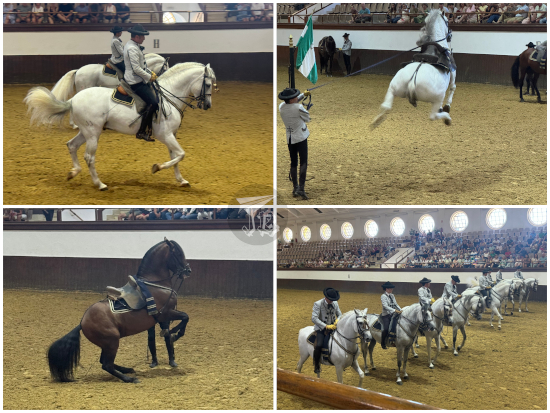
Royal Equestrian Art School, Jerez

After the show, I hung around for as long as I was allowed to, snooping the horse riding museum and the small palace in the grounds until they closed down and I had to leave. I bought a sandwich and a bottle of water from a supermarket in the way, and went on to the cathedral Catedral de Nuestro Señor San Salvador. The current building was not originally conceived as a cathedral. It was founded in 1778, built between the 17th and 18th centuries, and consecrated as cathedral as recently as 1978. It has a gothic structure, with a Baroque façade and a Neoclassic altarpiece. Behind the altar there is small treasury / museum and a spiral staircase to a secret chapel which is barely the painting of a saint – but the staircase was pretty, it reminded me of the one in the church in Tendilla. I also walked up the tower so I could see the city from above.
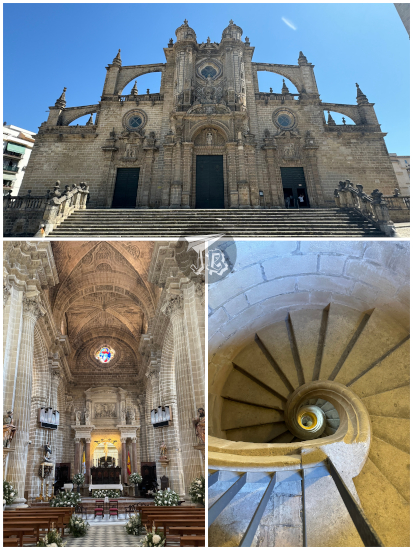
Cathedral Jerez de la Frontera

By the time I was on my way back, it was too late to snoop into the farmers’ market Mercado Central Abastos, so I headed directly towards the train station to fight the ticket machine, then headed to Puerto Real. This is a town between Jerez and Cádiz where I used to live. After checking out some places out of nostalgia, I went towards the seaside. It was an eerie feeling, because it had changed very little from what I remembered from almost two decades ago, when I left, and still it was slightly different. I visited the beach Playa de la Cachucha and walked along the promenade Paseo Marítimo until I saw my old university building.

The Andalusian Centre for Marine Studies Centro Superior de Estudios Marinos, CASEM, is a helix-shaped building, originally conceived by Manuel López Vázquez. The building has three “arms” in 120-degree angles, and a glass dome at the centre. It is located in the middle of the natural reserve. However, going there would have made me extremely sad. Thus, I decided to walk back towards the station and take a train back to Cádiz.

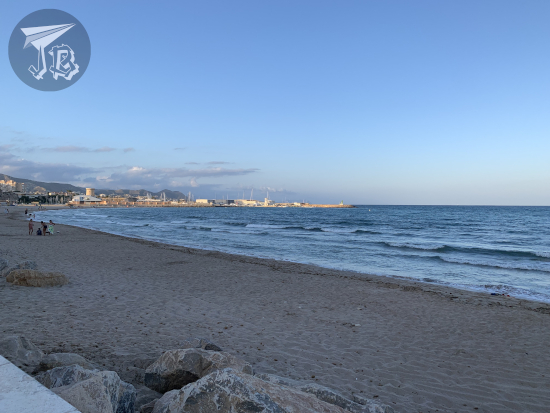
Puerto Real: Playa de la Cacucha

Since I had visited the land gates, I also wanted to see the Sea Gate Puerta del Mar, the remains of the entrance to the harbour. Today it is more of a monument than an actual gate, but it is still there.

Cádiz Puerta del Mar

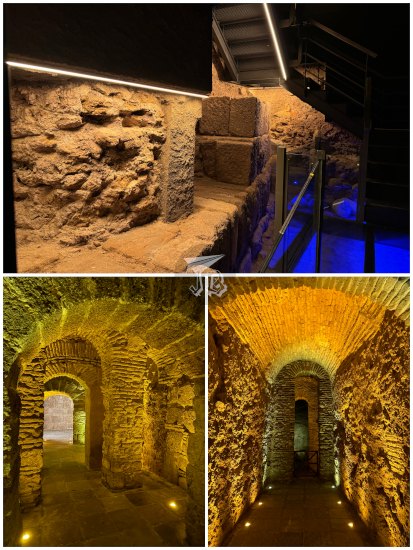
I was able to get there with enough time to head out to the archaeological site Yacimiento Arqueológico Gadir, one of the most important of its kind, since Phoenician settlement remains are far and few. The site, underneath a theatre, has two layers – the original one might date back from the 9th century BCE, with the remains of eight houses, complete with kitchen and oven, and streets. The settlement was destroyed in a fire, which also left two victims, a man and a cat, both of whose remains are exhibited there. The second layer is more recent – a fish processing factory with pools to preserve the product in brine from the Roman domination.

Yacimiento arqueológico de Gadir

Finally, I decided to end the day with a nice dinner. I went to the nearby market Mercado Central de Abastos de Cádiz, which has some eateries that work with local product. However, I did not locate the place I wanted to hit, and ended up distracted by El Viajero del Merkao, a place which advertised bluefin tuna, and offered it in tartar. I combined the tuna tartar with a typical tortillita de camarones, a fried batter made with water, chickpea flour, wheat flour and tiny shrimp, and a not so typical Taco de Cadi, Cadi, a tortillita with guacamole and salsa.

Tortillita de camarones & tuna tartar

I went back to the hotel to have a shower, then I turned in for the night (in a non-ant-infested room now).
12th September 2024: Cádiz {Escapade to Cádiz, September 2024}

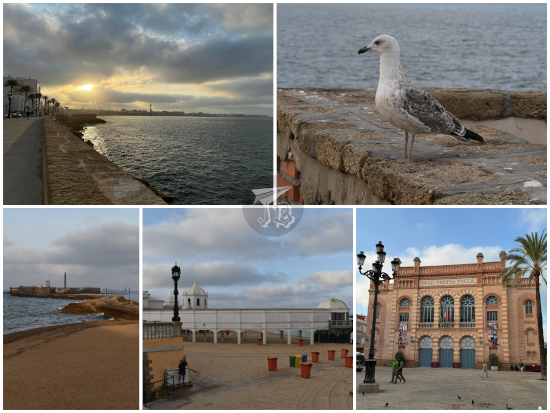
My paperwork-related appointment was at 9:30 in Cádiz itself, and I got up around 7:30. I left the hotel, but unfortunately the café where I had expected to have breakfast was closed. Thus, I instead headed out towards the promenade Paseo del Vendaval to see the ocean again. I turned to my right, in the opposite direction from the previous night, and I walked towards the central beach in town – Playa de la Caleta, a mostly-rocky area with tidal ponds and a long bridge called Puente del Hierro which leads to an old castle Castillo de San Esteban. I chased a few birds on the way for photographs. They were not at all cooperative.

I reached the former bathhouse Balneario de Nuestra Señora de la Palma y del Real, built in 1926 from an original design by Enrique García Cañas with one main access and two corridors that form a semicircle towards the ocean, and end in domes. It was build directly onto the beach, in reinforced concrete, with a style gravitating among Art noveau, eastern historicism and local decoration with azulejo tiles. It was abandoned in the 1970s, but restored for administrative use in the 1990s.

I ventured away from the ocean into the narrow streets of Cádiz downtown until I got to the town’s theatre Gran Teatro Falla, in the Neomudejar style. It was built between 1884 and 1905, on and off due to lack of funds, after a design by Adolfo Morales de los Ríos and Adolfo del Castillo Escribano. The theatre is one of the key spots during Carnival festivities. The Cádiz Carnival is one of oldest and most famous in Spain, known for its groups of people who parade the town in costume to sing simple songs that make fun of every- and anything, normally current affairs – coros, cuartetos, comparsas and chirigotas. The great Carnival contest is celebrated in the theatre, and prizes are awarded in each of the categories. The carnival brings in about 400,000 visitors each year. I tried to get to visit the theatre, but I did not manage to do so.

Paseo del Vendaval & Gran Teatro Falla Cádiz

Around 09:15 I decided to try my luck with the paperwork issue, even if it was early for my appointment, and I was successful. Since it was an important document, I ran back to the hotel to drop it there, and then headed off to the square Plaza de La Mina, where the local museum Museo de Cádiz stands.

It is said that Cádiz is the oldest Western city, founded around the 9th century BCE. Mythologically, it is associated with Hercules’ Columns and the city of Tarsis. The oldest archaeological remains date back to the 7th century BCE. The now-peninsula was originally a small archipelago where the Phoenicians settled down as it was a strategic point for commerce and mining of copper and tin, naming the settlement Gadir. It was later conquered by Carthaginians, whose march to Rome led by Hannibal started there. When Carthage lost the war, the city was taken over by Romans and became Gades in the 2nd century BCE.

As the Roman Empire declined, the city was invaded by the Visigoths, then the Byzantine Empire, and again by the Visigoths. In the year 710 CE, it was the first stronghold to fall to the Moorish conquest of Spain. After the Christians took it over again, it became a key point in commerce with the American territories.

In 1755, Cádiz was damaged by a three-wave tsunami caused by the so-called “Lisbon Earthquake”, 8.5 degrees in the Richter scale. In 1812, during the Napoleonic Wars, the Spanish patriots wrote the first Spanish Constitution, and throughout the 19th century, it was key in the numerous wars and battles through the return of Alfonso VII, the Republic and the Restoration of the Monarchy periods. However, during the 20th century, the city decayed suffering from lack of infrastructures, and rampant unemployment. Thus, it is happy to focus on tourism and the money it brings.

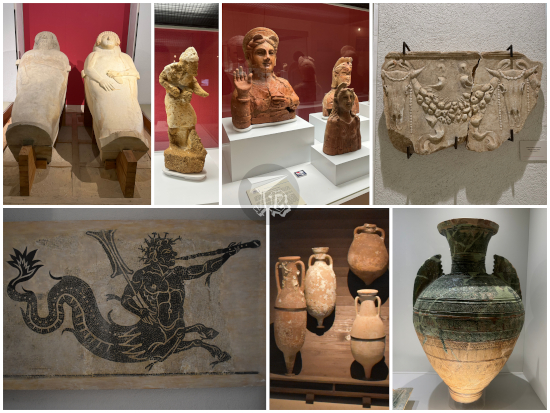
The Museo de Cádiz tries to follow this trail of history, but only the archaeological floor was open. The most important artefacts date from the Phoenician, Roman and Moorish periods. Of particular interest are two Phoenician sarcophagi which were found in completely different areas, but are presented as a couple of sorts, and a complete dowry. From Roman times, they exhibit a few dozen amphorae, sculptures and columns. Finally, the remains from the Moorish domination are quite colourful in comparison with everything else. The second floor of the museum was closed, so I was done earlier than expected.

Cádiz Museum

Thus, I decided to push my luck a little and try to get to the archaeological site called Cueva del Pájaro Azul for the 10:30 visit in English. The place is a former flamenco tavern built within the repurposed dry docks of the Phoenician Gadir. Most of the structure has been covered in brick and barely the original shape can be traced back, enough to calculate that the dry docks served war ships. While building new stairs, they did find part of the original Phoenician harbour though, the most important remain that survives. The tavern itself might be considered of minimal historical importance as it was a considerable cultural hub in the 1960s.

Archaeological site Cueva del Pájaro Azul

To keep in the mood, I decided to visit the archaeological site Yacimiento Arqueológico de Gadir, making a stop for a coffee first. Unfortunately, the site was closed that day. Thus, I decided to check out the Roman Theatre Teatro Romano de Cádiz – it might feel a little back and forth, but distances in central Cádiz are small and I wanted to prioritise Phoenician remains (I said I lived in the area, but all these archaeological remains are newly discovered). The theatre is the second largest one in what was Hispania, and dates from the 1st century BCE. It could host up to 10,000 people, and the stage, stands and the vomitorium (corridor underneath the seats) can be visited. There is an extra room with miniatures of the different stages of the history of the theatre.
Roman Theatre Cádiz

I left behind something called “The Elf’s Alley” Callejón del Duende, the narrowest street in town, now closed off. Very near both the alley and the theatre, I found the old cathedral Catedral Vieja de Cádiz officially Parroquia de Santa Cruz. This was the original cathedral of the town, commissioned by king Alfonso X around 1262. The original building was destroyed during the scuffles between the Spanish and the English at the end of the 16th century, and a new one was erected a few years later in a mixture of the Renaissance and the Baroque styles.

Former cathedral of Cádiz

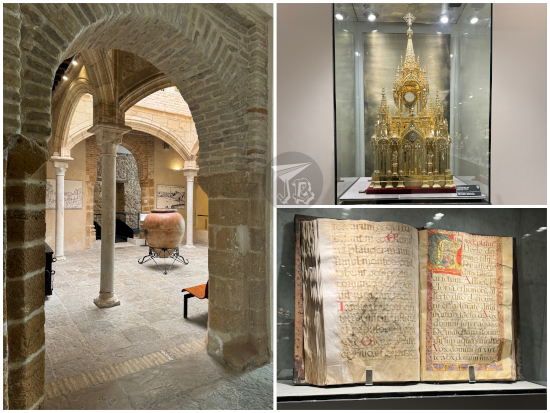
Next to the old cathedral stands the museum of the cathedral Casa de la Contaduría. The museum comprises a number of rooms disseminated in a conglomerate of buildings dating back from the 16th century – including the tower of the old cathedral and a Mudejar courtyard. The museum holds – obviously – religious items: paintings, sculptures, mass paraphernalia, codexes…

Cathedral Museum Cádiz

Afterwards, I crossed the city centre all over again, and reached the park Parque Genovés, a sort of botanical garden and the largest park in the old town. It has a small lake with a waterfall and a man-made cave with a lookout of the town and the ocean.

Park Parque Genovés in Cádiz

Then, I had booked lunch in the café of the Parador de Cádiz – Hotel Atlántico, a cute not-so-little place called La Tacita del Atlántico. I had set my heart on a grilled urchin dish – erizo de mar relleno y gratinado con huevos de arenque ahumado which I combined with a salmorejo (a creamy soup with a base of tomato and bread, garnished with ham and hard boiled eggs), though the dish had a local twist salmorejo cordobés, huevo y mojama. The urchins were delicious, but the salmorejo was lacking. I liked the idea of exchanging the ham for salt-cured tuna (mojama), but overall I found the food overpriced and the service mediocre. On my way out, I stopped by reception to get my stamp for the Red de Paradores rally.

Lunch at La Tacita del Atlántico

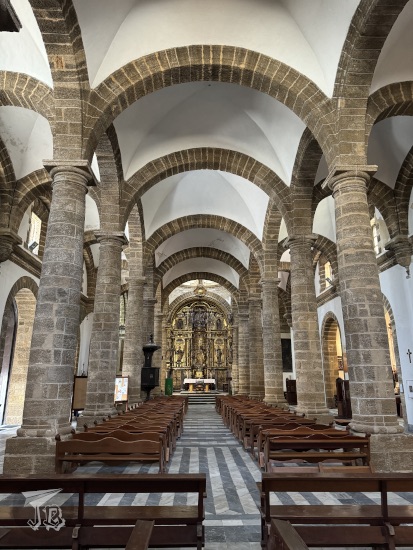
I stayed at Parque Genovés for a bit after lunch, then headed out towards the “new” cathedral Catedral de la Santa Cruz. The cathedral was built between 1722 and 1838, in a mixture of styles – Baroque, Rococo and Neoclassicism. It was erected in an assortment of materials, from noble marble to the humble local piedra ostionera, a sedimentary rock with a high concentration of seashells (biocalcarenite). The interior has three naves, and a Latin cross floor plan, over whose crossing there is a has dome, covered by golden tiles on the outside. The main altar is neoclassical.
Underneath the cathedral stands the crypt, and one of the towers can be ascended, leading to a great view of the town. The tower has very few stairs, most of the way is done on a ramp. Unfortunately, though, the cathedral is in rather poor state, and a net is cast under the ceiling to prevent debris from falling. I also climbed the tower since it was included in my combo ticket.

Cathedral of the Holy Cross in Cádiz

View of Cádiz from the cathedral tower

Behind the cathedral, I found myself back at the promenade Paseo del Vendaval, and I walked towards the beach Playa de la Caleta. In historical times, it was the natural port for Phoenician, Carthaginian and Roman shops, now it is a small-ish beach in the heart of the city. It is located between two of the castles of the old city, and its most characteristic structure is the bath house I saw in the morning.

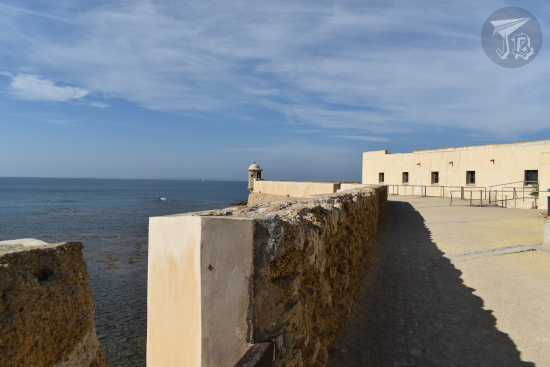
The beach has a sand area where most people sunbathe, but there is a long bridge separated in two sections – one directly built upon rock, Puente de Hierro and the other with arches to let the water flow through, Puente Canal. At the end of the half-kilometre of bridges, stand the ruins of the castle Castillo de San Sebastián, which today includes a working lighthouse, and an archaeological site. The first structure in the ancient island dates back from 1457, and the castle itself was built in 1706. Though it was warm and sunny, I walked the bridges and around the castle walls.

La Caleta Beach Cádiz & San Sebastián Castle

Upon my “return to mainland”, I passed by the bath house again and I reached a second castle, Castillo de Santa Catalina. The outpost, in the shape of a five-point star, was built towards the end of the 16th century to defend the city form sea warfare. In later years, a church and a sacristy were added, and from the 18th century onwards it was used as a prison. Today, it mostly hosts cultural or cinema-related events.

Santa Catalina Castle, Cádiz

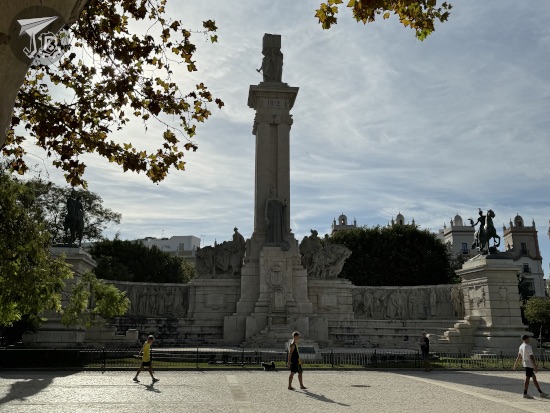
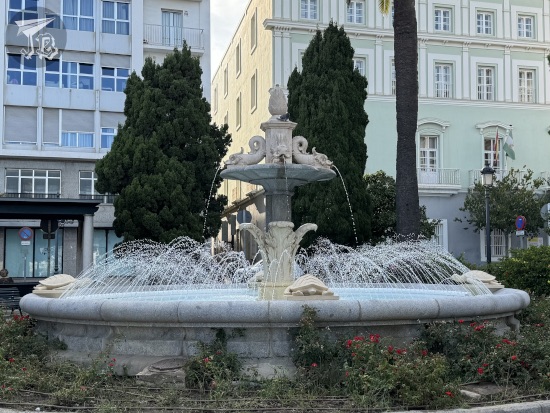
I continued on my walk around the city, left behind a knee cramp, the Parador de Cádiz and Parque Genovés until I reached the bulwark Baluarte de la Candelaria and the park Jardines Clara Campoamor. From there, I went on towards a second bulwark and the remains of the city walls Baluarte y Murallas de San Carlos. The bulwark was built towards the end of the 18th century to protect the harbour. Not far from there stands the square Plaza de España with the monument to the 1812 Constitution Monumento a la Constitución de 1812, the political response to the Napoleonic invasion. A bit further away stands the fountain Fuente de la Plaza de las Tortugas, with lots of cute turtles as decoration.

San Carlos Bulwark and Walls Cádiz

Monument to the 1812 Constitution Cádiz

Turtle fountain in Cádiz

At this time I decided to get an early dinner around 18:30, so I bought some fast food to take to the hotel. That is when the ant invasion started. It was something I was not expecting – one or two bugs is workable, but this was a whole nest out for my fries. It was not nice. I decoyed them into bathroom and decided to have the room cleaned the next morning.

I set off again about 20:15 to look for a place to watch the sunset at the beach Playa de la Caleta, which did not disappoint, and I sat there until the sun disappeared beyond the water line. Luckily, I made it today, as it would be ridiculously windy the following day.

Sunset at La Caleta, Cádiz

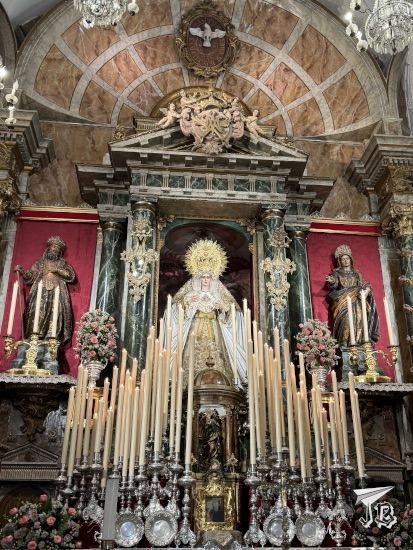
I then found the street Calle the la Virgen de la Palma, at whose end stands the small church Parroquia de Nuestra Señora de la Palma. It was built in the 18th century and it hosts a sculpture of the Virgin Mary credited with stopping the waters during the 1755 tsunami. In the street, there is a signal marking the highest water point, but there were so many restaurants and people that it was impossible to find it!

Sculpture of the Virgin Mary

I went back to the hotel afterwards to have some sleep – I was beat. I did manage to make a stop at a supermarket to buy coffee and pastries for breakfast the following morning though. Because one late latte per trip is enough.

24th September 2022: Manzanares el Real & Alcalá de Henares (Spain)

My friend, whom I had not seen since January 2020 as the pandemic kept us apart, dropped by for a visit as she was in the area. Since the weather forecasting had not been promising, I had not booked anything, but given her a bunch of options to do. She was particularly taken by the castle in Manzanares El Real, a town in the Madrid area, so we drove there.

The palace-castle Castillo Nuevo de Manzanares El Real was built in the late 15th century as a replacement of the previous one by the House of Mendoza. The noble family was given control over the area the previous century, and after a hundred years living in the older castle, the new one was commissioned to Juan Guas, who designed the building in a on a Romanesque-Mudejar style. It was built in granite stone, with Isabelline Gothic decoration, mixing defensive / military, palatial and religious architecture. It was inhabited for about a century before it was abandoned. The castle was declared a Cultural Monument in 1931, and it has undergone several restorations. In 1961, it was used as shooting location for Charlton Heston and Sophia Loren’s “El Cid” film.

Considered one of the best-preserved castles in the Madrid area, the building it has four towers, six floors, and a central patio. It holds a collection of tapestries, and most of it can be walked. Unfortunately, the towers cannot be climbed, but you can walk around the walls, both in the terraced gallery and outside. It was a bit overpriced, but well-worth the visit.

Collage showing the castle. It is reddish with hard corners and rounded towers. The decoration is white and ornate.

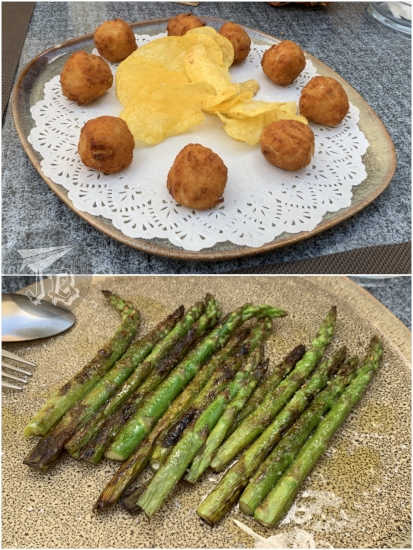
We made a pause for lunch and tried the best wild asparagus (Asparagus acutifolius) that I have had in ages – just grilled with salt and lemon. We had some croquettes too.

Plate of perfectly-round croquettes and some crisps in the middle + plate of roasted green wild asparagus

As we had walked into the village for lunch, we only had to walk a little further to find the ruins of the original castle Castillo Viejo de Manzanares el Real. At the moment, only the foundations can be seen, though it is similar to the new one. The archaeological excavation started in the year 2022, but nothing much is known of it, except this one was an actual military fortress that predates the new castle. From there, the views of the new castle and the local church make a nice skyline of sorts.

Foundations of the old castle. Not much is seen, there is a sign reading "Old Castle Archaeological Excavation"

View of Manzanares el Real, showing modern roofs, the church tower, and the castle in the furthest background

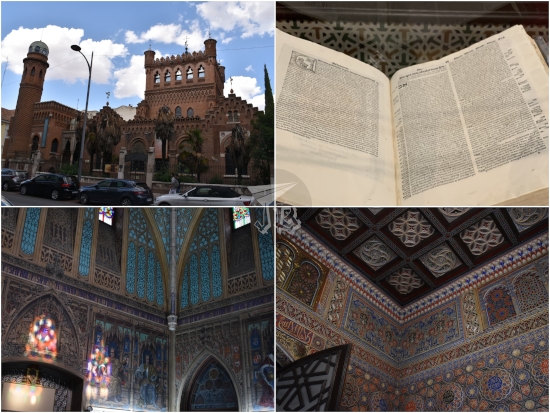
It was still early in the afternoon, so I suggested stopping by Alcalá de Henares. I wanted to make a stop at a shop to check for something, but after a quick visit to the shopping centre, we moved on to what is, in my opinion, one of the most interesting buildings in town – the small palace house Palacete Laredo. Built in the Neo-Mudejar style, it is a bizarre combination of mosaics, moorish-like decorations, and vibrantly-coloured windows that somehow work, somehow. Though only about half of the building can be visited, I just find it bizarrely alluring. My friend loved it. Furthermore, the building has a few Complutensian Polyglot Bibles in display – the first polyglot edition of the Christian Holy book, published in the 16th century under the patronage of the Cardinal Cisneros, a key figure in local history.

Palacete Laredo: exterior and interior decorations + close up of the open bible, in Latin and Hebrew

We continued on, and walked round the city. We saw two back-to-back weddings at the cathedral Santa e Insigne Catedral-Magistral de los Santos Justo y Pastor – that meant we could not snoop into the cathedral, but we did see one of the brides arrive in a Rolls Royce.

Finally, we dropped by the archaeological museum Museo Arqueológico Regional, which has opened a very interesting new palaeontology ward – holding reproductions and real fossils of animals that used to live in the Madrid area, with a few coming from the palaeontological site of Cerro de los Batallones – most interestingly a Tetralophodon longirostris and a Machairodus aphanistus sabretooth cat.

Skeletons and skulls: mastodon, giant prehistoric giraffe that looks similar to a humongous goat, and sabretooth cat

We did a little more shopping afterwards, and eventually we drove off into the sunset… and the traffic. We ended up walking for 12.47 km (19078 steps), and driving for a good three hours, though M40 was so busy it actually felt like much much longer.

18th – 20th February 2022: Extremadura, the not-at-all-wild west of Spain

With everything that keeps going on in the world, my little travel gig seems insignificant. Here it is, anyway, for the sake of completion.

18th February 2022: Jam and Ham

After a crazy crazy period, and within a just-slightly-less-crazy period, we made space for a mini escapade – just under 48 hours, but it was an interesting mental reset. We took the car and drove off to Cáceres after I finished work in the afternoon. The trip should have taken a little over 3 hours and 15 minutes, but we spent about 70 minutes caught in several traffic jams – or just a very long jam with different instalments.

Sunset from the road. The orange light zigzags through the grey and blue clouds

Cáceres is located in the autonomous community of Extremadura, which is famous because of its particular grassland with dwarf trees called a dehesa. The typical animal farmed in the area is the native Black Iberian pig – a traditional breed of the domestic pig (Sus scrofa domesticus). Through breeding with wild boars and millennia of adaptation, the Iberian pig has grown accustomed to eating oak acorns, and thus it has become a key part of the ecosystem. Furthermore, the breed has great tendency to accumulate intra-muscular fat. This means that its meat is delicious, especially as sausage. The most famous treat is the “Black label” (Etiqueta Negra or Dehesa de Extremadura) ham: a pig raised in the dehesa, fed acorns and natural grass, and whose meat has been cured for at least 20 months.

The area of Cáceres is also known for its sheep-milk cheese, Torta del Casar. It is a strong-flavoured creamy cheese that comes from controlled sheep, also raised in the dehesa. The cheese is especially curded with rennet made from cardoon (Cynara cardunculus). Another typical food from the area is the local paprika Pimentón de la Vera, which is made from smoked local red peppers. All three – ham, cheese and paprika – hold European Protected Designation of Origin certificates.

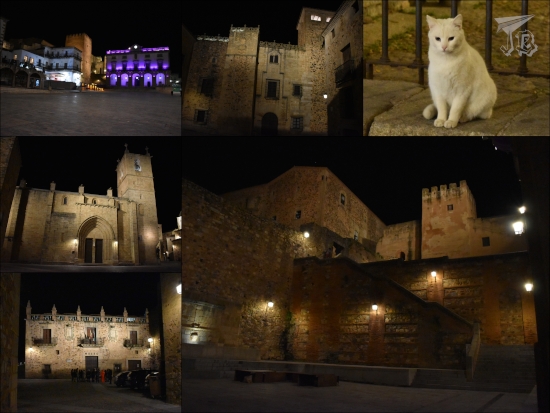
Of course, not everything is food in Cáceres. After we checked into our hotel near the historical centre, we headed off to the Main Square Plaza Mayor de Cáceres, which features the town hall, the former wall gate called Arco de la Estrella (Star Arch), and one of the watch towers Torre de Bujaco.

The medieval square of Caceres by night. It looks like a castle, with arches, battlements. The sky is completely black.

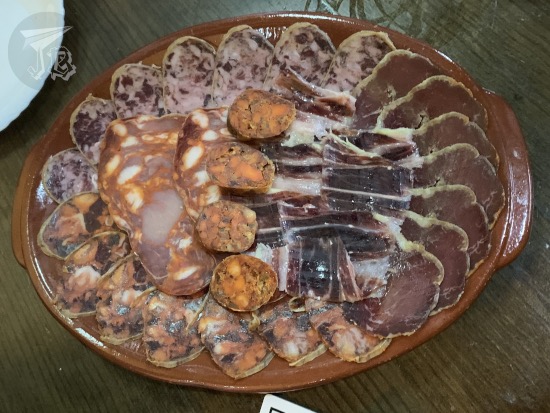
We found a place inside to grab a bite, and we tried the sausages for dinner before turning in – acorn-fed pork ham, loin, chorizo, morcón (similar to chorizo), salchichón, and patatera (pork mixed with potato and paprika in sausage form).

A plate of sausage slices and ham

Walked distance: 1.79 km (2838 steps)

19th February 2022: The Old Town of Cáceres

The Old or Walled Town of Cáceres, Ciudad Vieja de Cáceres was declared a Unesco World Heritage Site in 1986, and it is easy to see why. It is a small knot of streets between the ancient city walls and the gorge where cars can barely drive, sprinkled with Medieval and Renaissance palaces and manors. After finding an open café, we had breakfast, then headed off to explore that. Since it was a bit before 9 am, most everything was closed – but it was also empty, which was good. We crossed the Arco de la Estrella next to the Torre de Bujaco and walked into the walled area.

The medieval square of Caceres by daylight. It looks like a castle, with arches, battlements, and irregular bricks making up the walls.

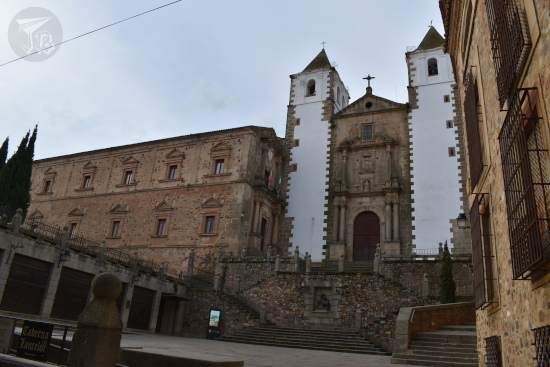
We walked past the co-cathedral – to which we would come back later and several palaces, and we ended up at a two-level square called Plaza de San Jorge (St. George Square), towered over by the peculiar-looking church Iglesia de San Francisco Javier – note the white-painted towers.

A church with two twin bell towers, both in white. Between them, the body of the church, in grey rock. In order to access it, you have to climb a staircase, which has a small sculpture of St George attacking the dragon

There was a small palace to the left, and while the building was closed off, the gardens Jardines de Doña Cristina de Ulloa were open, albeit as it was early February, still in winter mode but for some berries and roses.

Wintery garden with bare tree. There are also evergreen bushes and trees, stairs, and benches.

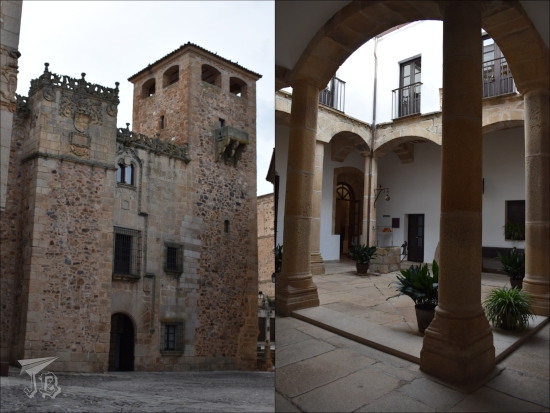
We wandered around for a while, the headed off to a visit we had booked in advance – the manor / palace of the Lower Golfines Palacio de los Golfines de Abajo, which has nothing to do with their position in the social scale, but literally the position within the city hill – in the lower part. The family is known to have owned the palace from the time of the Catholic Monarchs, in the 15th century, till the death of the last descendant in 2012. This woman willed all the heirloom to a foundation that today manages the palace. The foundation got the palace renovated and brought some of the furniture from other properties belonging to the family – among them a glass lamp way too big for the room it was set in, and a sofa which was identical to the one that used to be in my great-aunt’s living room… The lower floor holds the recreated rooms – with more or less success and taste – and a smaller area decorated with Medieval paintings which were discovered by accident. The upper floor holds a small ethnography museum and some documents from the family’s library. Unfortunately, the foundation takes itself a little too seriously and won’t allow you to roam freely in the palace or take pictures, except for the inner Castilian patio.

Gothic palace, with an ornate roof and a small cloister or patio.

After the palace, we walked a whole minute and a half for the co-cathedral Santa Iglesia Concatedral de Santa María. It is the oldest church in town, built around the 15th century, in a Romanesque-going-Gothic style. Outside the church, at the base of the tower, there is a sculpture of Saint Peter of Alcántara. Inside, the altarpiece was carved between 1547 and 1551, in unpainted pine and cedar. The tower can be climbed, and I decided that I wanted to do that, despite not being what I usually do. It was empty enough that I felt comfortable doing so, and I was treated to some nice views.

Collage: a gothic church with a bell tower; the inside showing a bare-wood altarpiece; the sea of columns from above, and a view from the belltower, showing another church and the roofs of some low houses.

By the time we went out, the city had already been taken over by walking tours and guided visits. There were so many companies that the guides put stickers on their tourists so they could herd them round. We backtracked to the Baroque church with the white towers Iglesia de San Francisco Javier (also known as Iglesia de la Preciosa Sangre), where there is no worship today. Instead, there is a huge collection of nativities (hundreds of them, literally). In order to visit the nativities you have to go up a perilous metal staircase. Once on the second floor – after having survived the peril – I decided to continue on the relatively safer stone staircase to one of the towers – only one, I did not climb up both of them. The lower floor holds two last nativities, a classical one and a hilarious set up made out of Playmobil, a German company that makes plastic figure toys.

Collage: The interior of a church with a baroque golden altarpiece, and a collection of Nativities.

We moved onto the following manor, to the side of the square, Casa Palacio Becerra, which shows some antique elements, and the house structure.

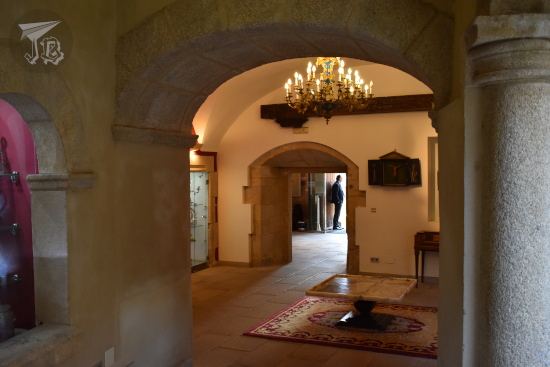
Inside a Renaissance palace, with a low arch, a glass lamp and a red carpet that try to look eclectic and end up looking bizarre

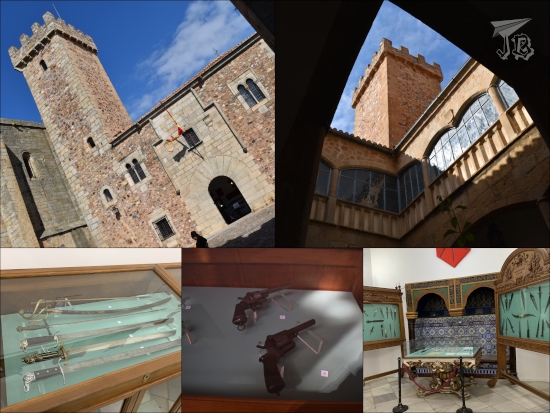
Later, we walked to Stork Square Plaza de las Cigüeñas. European white storks (Ciconia ciconia ciconia) are typical birds in Extremadura, and one wonders how they have not decided to make food out of them. In the tower stands one of the few towers that has kept its merlons, as the Catholic Monarchs were very into tearing tower tops down when they conquered a site. The adjacent manor, Casa de las Cigüeñas, hosts the military museum Museo de Armas Aula Militar.

A building with a tower. The inside is a museum, and there are some swords, firearms and Moorish decoration

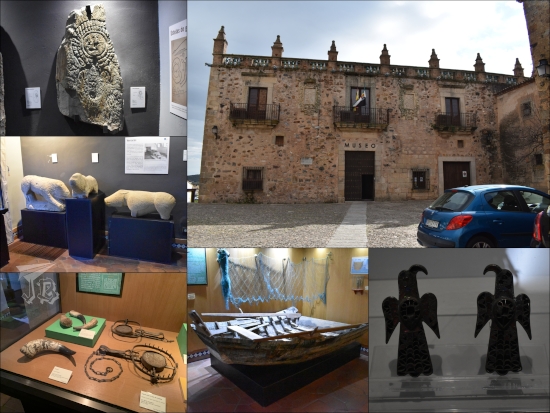
At the end of the square, in yet another palace – two of them, actually – lies the Museo de Cáceres, the local museum. The part in the Casa de Las Veletasis a regular archaeological museum, with the kind of things you would expect – prehistoric, Roman and Celtic remains, more modern artefacts. The other area, Casa de Los Caballos, hosts the modern art gallery.

Gothic building turned into a museum. The pieces shown are funerary stelae, prehistoric animal representations - bulls or pigs - and jewells, a boat, and Roman emblems

However, the palace was erected on top of the local Arab cistern or aljibe. It is the best preserved in Spain and it has been gathering the rainfall water since the 10th century. Pretty impressive piece of engineering if you ask me.

The aljibe: a moorish basement filled with water. The columns sustain horseshoe shaped arches

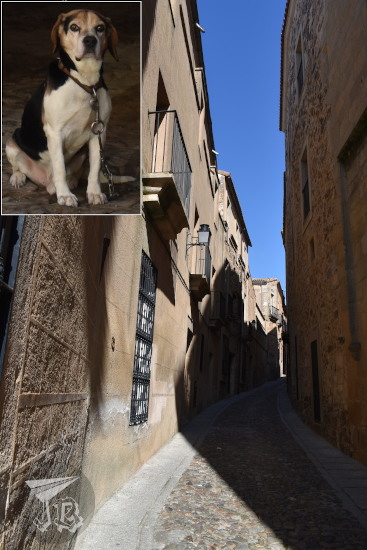
Afterwards we still had some time to kill until it was time for lunch, so we wandered around the area of the Jewish quarters or Judería, under the watchful gaze of the local Cerberus.

Narrow streets, and a guarding dog looking suspicious

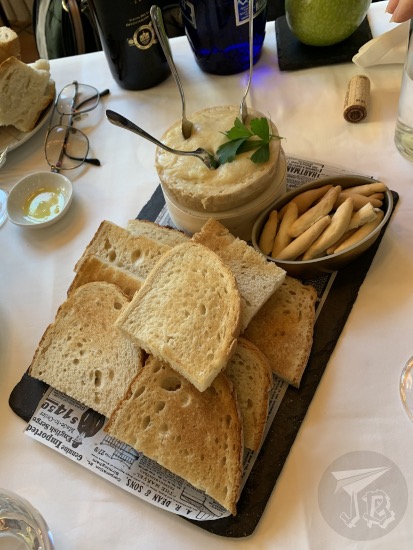
We had lunch in the local Parador de Cáceres, so I of course got my stamp. As a started we ordered the famous local cheese Torta del Casar cheese.

A tray with bread slices and breadsticks, and a cream cheese with spoons to be spread on the bread

In the afternoon we had a look at another church Iglesia de Santiago de los Caballeros. The church of St. James of the Knights was built in the 14th century over an older temple dating back from the 12th century. The altarpiece was carved and coloured by one of the most important sculptors of the Spanish Mannerism, Alonso Berruguete (1490 – 1561). This time I did not climb the tower – which had been happily colonised by a couple of storks.

Gothic church with a golden altarpiece. A stork snoozes on one of the towers.

After a little while, after sunset, I decided to skid around and have a walk through the old city at night. The artificial light made it look eery and romantic in the most… historical sense of the word. I came across some cats begging for food from a bunch of schoolgirls, and one of them very indignant because the girls would not beg it to take the food!

Different buildings of Cáceres at night. The are lit wit strategic lamps to give a mysterious feeling. There is also a white fluffy cat sitting and expecting food

Walked distance: 9.04 km (14766 steps)

20th February 2022: Trujillo & Oropesa (Toledo)

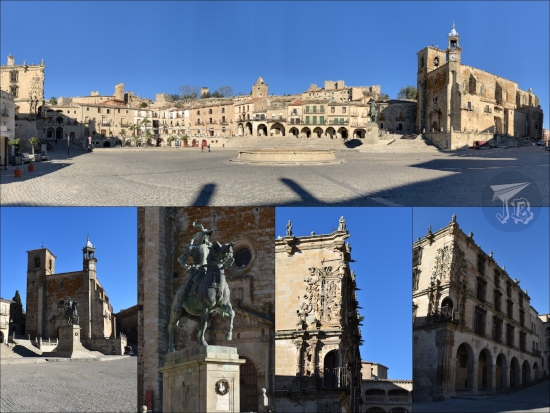
On this day I managed two more Paradores stamps. Trujillo is a town a meagre 30 minutes away from Cáceres. It also has a traditional / Medieval city centre, set around the main Square Plaza Mayor de Trujillo. It was the birthplace of one of the so-called conquerors during the colonisation of South America, Francisco Pizarro, whose equestrian statue, Estatua ecuestre de Francisco Pizarro (by American sculptor Charles Cary Rumsey). Other highlights in main square include the corner balcony in the “Conquest Manor” Palacio de la Conquista.

The large Reinassance square of Trujillo with decorated palaces and a sculpture of Hernan Cortez on his horse

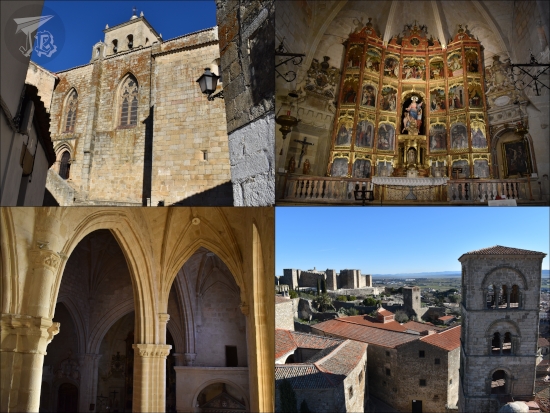
One of the most interesting churches in the area is Iglesia de Santa María la Mayor. Its tower dates back from the 13th century, but was almost completely rebuilt in the 16th century. Inside the richly painted altarpiece was erected around 1490. Apparently, my newly-discovered activity of climbing towers yielded to a new adventure, as for a few minutes I ended up locked down in the bell tower – I guess I’m a Disney Princess now (≧▽≦).

Gothic church with gothic golden altarpiece.

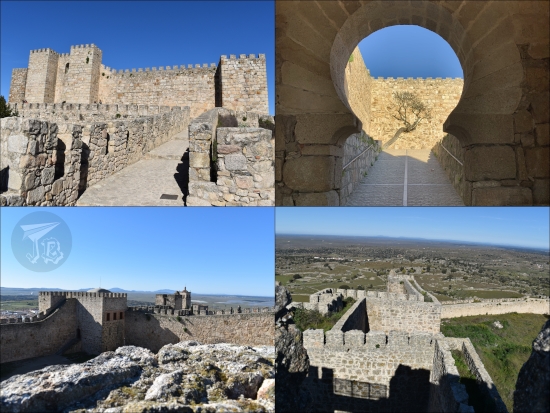
I got an hour and a little to wander round the town, so I climbed up to see the Muslim fortress Alcazaba de Trujillo (also called castle). Built between the 9th and the 12th century, it is a huge building with a defensive wall, an aljibe or cistern, several towers and a Christian chapel.

Moorish castle, from the outside and the inside. The walls and the battlements are amazingly well-preserved. It seems that the castle is built around the natural rocks defending the area

Then I hurried towards the other edge of the city to get my Parador de Trujillo stamp (only cheating slightly. I was there, after all). On my way I happened upon the Torre del Alfiler, with a family of storks happily clattering away the late morning.

Storks on top of a bell tower

I backtracked to the Plaza Mayor and I had twenty minutes before our rendezvous time, so I decked into the church Iglesia de San Martín. Its origins date from the 14th century, but it was not finished till the 16th century – which makes it so that the thick Romanesque walls are mixed with Gothic and Renaissance elements. No tower this time, but the second floor holds a religious museum.

Romanesque turning Gothic church. The inside is plastered in white and the celing above the altar and the nave retains the original decorated stone ceilings

After getting a general idea of the Medieval town of Trujillo, but it being a “working Sunday”, we moved on rather quickly, and drove off until we made it for lunch in Oropesa (Toledo) which also holds a Parador – Parador Museo de Oropesa, the first monumental Parador opened in 1930. That makes three stamps in two days, I’m almost impressed with myself!

Plain building with ornate balconies, and cars parked on a row in front of it.

The Parador is adjoined to the castle Castillo de Oropesa, which was unfortunately closed, but I shall put in on my list of “to re-explore”. It was built by the Arabs during the 12th – 13th century, probably on a former Roman fortress. Today, the Old Castle is joined to the New Palace and both belong to Paradores.

Classical Romanesque castle with towers and turrets. It looks heavily restored.

After that, we drove back home, and as we got a couple of wrong turns, we ended up avoiding the traffic jam we had found on our way to Extremadura, which was convenient!

Walked distance: 5.57 km (8836 steps)

22nd & 23rd October 2021: Zaragoza Getaway (Spain)

We had a silly day-and-a-half and it turned out that for some reason a commuting train to Madrid took about as long as a high-speed train to Zaragoza, a town in the area of Aragón that we scratched off our summer route because there are lots of curves in the Pyrenees and time was limited.

22nd October 2021: Churches, Museums and a Palace

The train to Zaragoza arrives at the Delicias station, which is a bit away from the centre of the town, so we took a taxi to the hotel. This was around 9 am so we were of course not expecting any room, what with check-in being 2 pm – we just wanted to drop off the overnight bag. Not being able to give us a room seemed to upset the receptionist quite worried, and he promised to call as soon as a room was available. Honestly, I just set my phone to flight mode because we were starting to visit monuments right away, as the hotel was just by the most important square in town Plaza del Pilar.

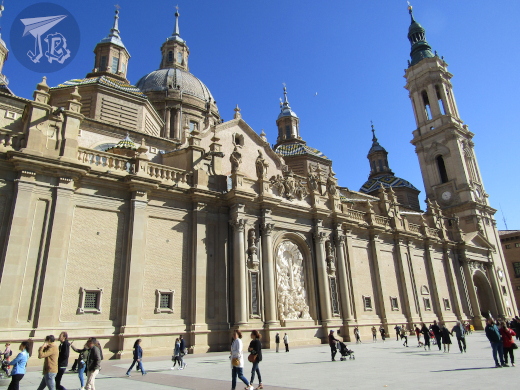
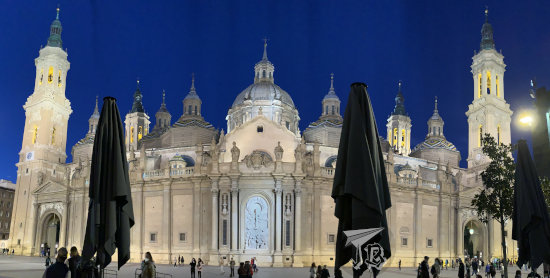
Zaragoza is home to one of the most important Christian icons in Spain, the Virgin Mary of the Pillar, Virgen del Pilar. The image is hosted in Catedral-Basílica de Nuestra Señora del Pilar. The bulk of the current cathedral-basilica was built between 1681 and 1686 in the Baroque style, but was later modified quite a few times and it was finalised in 1872. Interesting items in the church include, aside from the virgin image, some frescoes painted by Goya, the main altarpiece, and two bombs that fell within the church during the Spanish Civil War (1936-1939). Zaragoza is very anti pictures inside so I had to sneak them in. Sorry, not sorry.

A collage showing the Baroque Basilica, including unexploded bombs, and two of the altars

Virgin of the Pillar, wearing a mantle

After a small detour to say good morning to the river, Río Ebro, and the Puente de Piedra (stone river), the second building we visited was the Old Market Exchange building – Lonja de Zaragoza. This was the first Renaissance building erected in Zaragoza, dedicated to commerce, with an amazing Gothic-imitation ceiling. Today it is used for exhibits, such as paintings or sculptures.

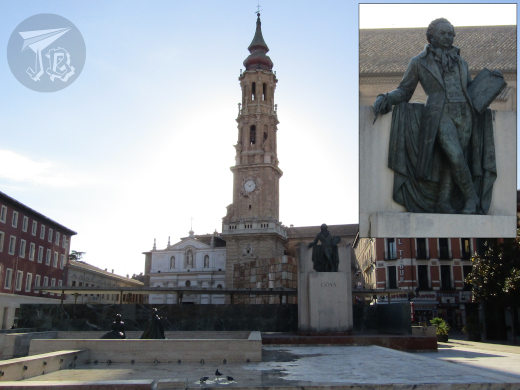
Coming out, we almost walked into one of the fountains in the square, Monumento a Francisco de Goya, featuring the artist – a brilliant Spanish painter from the Romantic times. He was as brilliant as bad-tempered though. Behind the fountain stands the cathedral, for which we had tickets for 11 am, and it was still early for that.

Thus, we started the route of the Caesaraugusta Museums. Zaragoza was founded in Roman times under this name (where an Iberian dwelling used to be) and in the latest decades, this Roman past has started being dug up. We first visit the museum focused on the original forum, Museo del Foro de Caesaraugusta where we could see the foundations of the old city and walk into the sewers (yeah, it’s cooler than it sounds). The Roman ruins date back from emperors Augustus and his successor Tiberius’ reigns.

After that it was almost time for our reservation to visit the Catedral del Salvador also known as La Seo de Zaragoza, the other cathedral of the town, literally at the end of the same square as the other one. The cathedral mixes several architectonic styles: Romanesque, Gothic and Mudéjar, these last tow being among my favourite styles, so a total win – Renaissance and Baroque elements were added, including the towers. The cathedral has a tapestry museum with a lot of works, not exactly “pretty” but rather impressive.

Following the cathedral we walked towards the rest of the Roman museums, but we made a small detour to look at the Mudéjar tower of the church of Mary Magdalene, Iglesia de Santa Magdalena.

Then we reached the museum of the Bathhouse, which was open but closed – let me explain. They run an “Audiovisual” and close the museum door for as long as it runs. It runs every half hour so finding the thing open seems to be hard. Thus, we moved onto the next archaeological site, related to the old Roman Theatre Museo del Teatro de Caesaraugusta. The theatre was apparently discovered by accident in the early 1970s, and it is apparently one of the biggest Roman theatres in Spain.

We tried our luck with the Bathhouse Museum again Museo de las Termas Públicas de Caesaraugusta. Unfortunately, just like before, we walked up to it while the audiovisual was running, and the concierge made a very studious effort not to see us – so we just peered over the glass roof to see what is left of the main bath.

More impressive was the river port museum Museo del Puerto Fluvial de Caesaraugusta, which keeps the foundations and some of the clay amphorae that were used for import / export.

And believe it or not, we did all that before lunch!! Therefore, we decided it was the right time for a break. We headed back to the hotel to see if we could wash our hands (and take off our facemasks for a while). To our surprise, the hotel had given us an upgrade to a junior suite, so we had a sitting room, a full bathroom and a bedroom – and a balcony that went all along the three. When I opened the window I could hear people playing the piano on the street, as there was some kind of festival going round. Believe it or not… I got to listen to Queen’s Bohemian Rhapsody and Rufus Wainwright’s Hallelujah.

We had lunch outside in a place that my companion enjoyed called La Lobera de Martín – not a cheap place, honestly! However, we splurged a little. We shared a smoked fish salad and I had a side of fresh Foie. As a main, ordered steak tartare, which to my surprise, was prepared for me next to the table! For dessert I tried the home-made berry yoghurt. I have to admit that I was totally planning on having a tiny dinner (or completely skip it!) at that time.

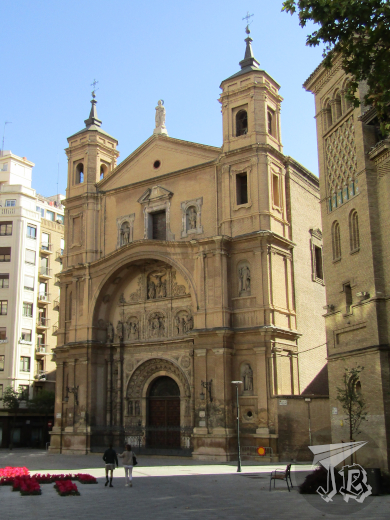
After lunch we walked along one of the main arteries of the town, Paseo de la Independencia, to find the Basílica Menor Parroquia de Santa Engracia, to at least see the outside, since we could not fit visiting the interior and the crypt with our tight schedule. One of the most interesting things about this church is how its façade is built like an altarpiece.

Next to the church stands the neo-Mudéjar post office, built in typical bricks from the area – Oficina de Correos de Zaragoza.

And finally, we looked at the current Science Museum, Museo de Ciencias Naturales, the former Medicine University. Why? Because that’s where my parents met *cue romantic music*!

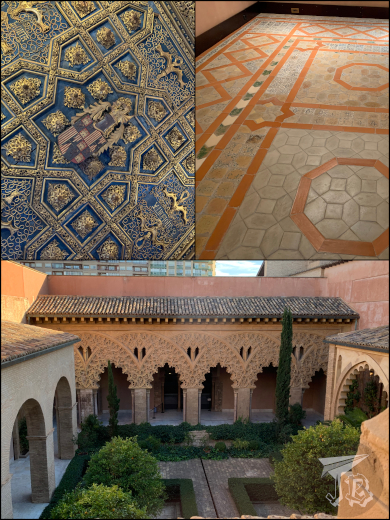
We did not go in though, because we needed a break and had booked a ticket for 5pm somewhere else, so we decided to raise our feet a little for a while in the hotel room – the sitting area was nice though unfortunately there was no more sun on the balcony, else I would have totally impersonated a lizard there (I did scare a pigeon away though, even if the startle was mutual). Our next target was the Medieval palace called Palacio de la Aljafería – a fortress that combines Islamic architecture and ulterior Christian elements. The Moorish palace was built around 1065 – 1081, and it holds a magnificent garden called the Golden Hall with a portico made out of interlocking mixtilinear arches (I totally looked the word up, and will forget it promptly). The palace was taken over by the Christians 1118 and became a palace for the monarchs of Aragón. It was not modified until the 14th century, and in the 15th Century the Catholic Monarchs extended it further into the Mudéjar Palace. Today it is the meeting site for the local government. I adored it, to be honest, I loved the Golden Hall most of all, but the original ceilings in the Christian palace were also really cool.

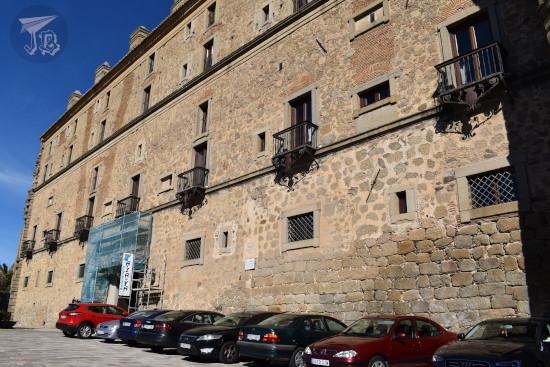
We walked back towards the Plaza del Pilar (probably through some streets we probably shouldn’t have, hindsight is 20/20 they say), and we reached the church of St. Paul Iglesia Parroquial de San Pablo. The restored interior leaves a bit to be desired, but the exterior, built between the 13th and 14th centuries in the Mudéjar style – it has an octagonal tower in dark tones, with the upper roof added in the 17th century with richly decorated with tiles and windows. It is worth mentioning here that several Mudéjar buildings in Zaragoza, along with others of singular architecture, are declared Unesco World Heritage Site.

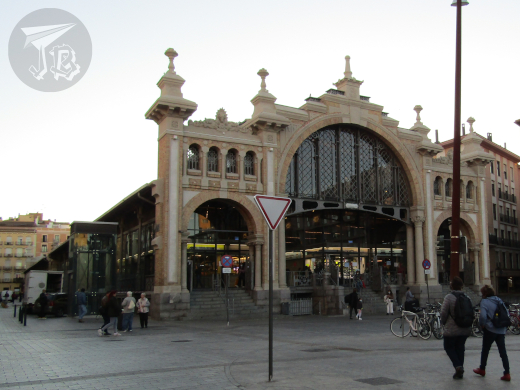
Between the church and the square we walked by the central marketplace Mercado Central de Zaragoza in the late 19th and early 20th century, in a combination of stone and iron-and-glass architecture.

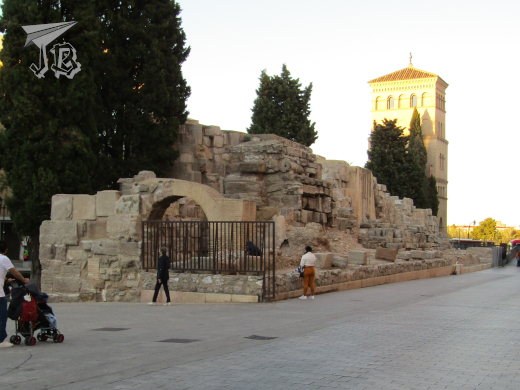
Close to it we could see some of the ruins of the original Roman walls Antiguas Murallas de Romanas de Zaragoza, which are actually sprinkled all through the town and mixed with the Medieval ones at points. There, a lady was happily chatting on the phone while her child climbed the walls – so in case it is not evident, here’s a social clue: if there is any kind of barrier / signage around something, it should not be climbed on.

To finish off the day we visited the Museum dedicated to Goya Museo Goya. Goya, whose complete name was Francisco José de Goya y Lucientes (1746 – 1828) was a painter and printmaker from the Romantic age. He is probably one of the most important artists in Spanish history. He was a royal portraitist, fresco decorator, and also painted and printed many critical and fantasy works. To be honest, the museum was a bit underwhelming – with few of the minor works, and one of the least impressive major works, the Christ portrait. There was however a whole room full of prints.

After one more visit to the square, where I managed my only complete picture of the whole (night-lit) Basílica del Pilar from that angle, we just headed to the hotel. There was a sandwich shop at the entrance, so we took one each and had a late light dinner as we watched Night at the Museum in the hotel bathrobes – because it was cozier than turning up the heating. I did not sleep too well as the fire alarm was right on top of the bed and it kept flashing – at one point I thought that an electric storm had hit, but it was just the alarm…

23rd October 2021: Papercraft and walks

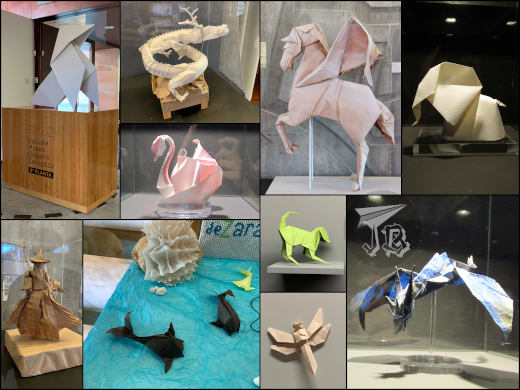
The next morning we had breakfast and headed off to the origami museum and workshop EMOZ: Escuela Museo Origami Zaragoza, located in the “Stories Museum” Centro de Historias. I remembered the exhibition from a few years back in Museo Cerralbo in Madrid, with an actual-size hippo, so I have to admit this time I was a little… underwhelmed, probably because the temporary exhibit ended up being “abstract” paper folding…

However, in the very same building there was a very fun exhibition about the evolution of household appliances throughout the 20th century. That was cute!

As we got ready to draw a close to our day-and-a-half getaway we went to say goodbye to the river Río Ebro. We walked by the modern Puente de Zaragoza bridge, and crossed over the Puente de Piedra, the traditional stone river of the town. The current one dates back (although reconstructed) from 1440, but there are records that a previous Roman one stood in its place and was destroyed in the 9th Century. Between the two bridges a flock of cormorant seemed to be sunbathing.

From Puente de Piedra I took my last picture of the Basílica del Pilar before we had a nice milkshake, then headed back to the station to take our train back. By the way – I find it ridiculous that the stations have blocked 60% of the seats while they’re filling up the platforms and the trains as normal…

Total walked distance: 8.69 km

8th – 12th July 2021: Beach weekend (El Campello & Elche, Spain)

The sea is far, far away and due to a number of situations coming together, we rented an apartment near the ocean for a couple of days. Our usual summer destination was not a good option this year due to – as everything that is going less than great these days – to Covid, so we gave a try to the town of El Campello. The town likes boasting itself as a beach paradise-resort, while it’s barely a standard Mediterranean village eaten which boomed along other, bigger resorts such as Benidorm. The apartment was not anything marvellous, but it was extremely close to the ocean – just beyond the waterfront promenade, Paseo Marítimo.

8th July 2021: The arrival

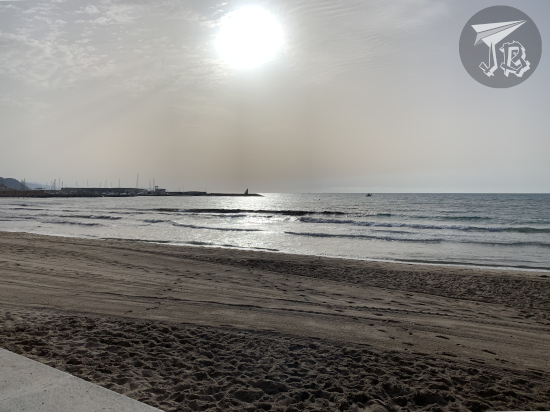
We arrived in El Campello at around 4pm, did a fast sweep of the apartment in order to feel safer Covid-wise and I decided to go for a walk at the beach, jeans and all. There were surprisingly fewer people than expected, and not as hot as I thought it would be – all in all we were pretty lucky, weather-wise.

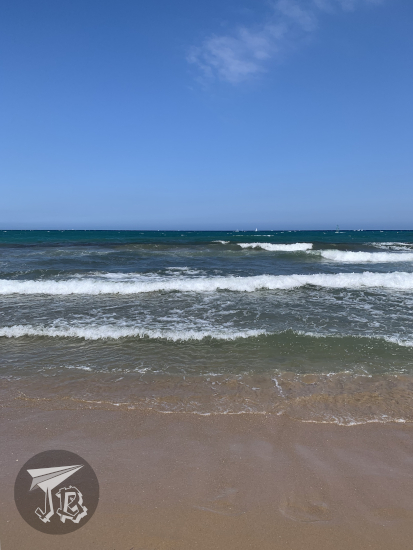
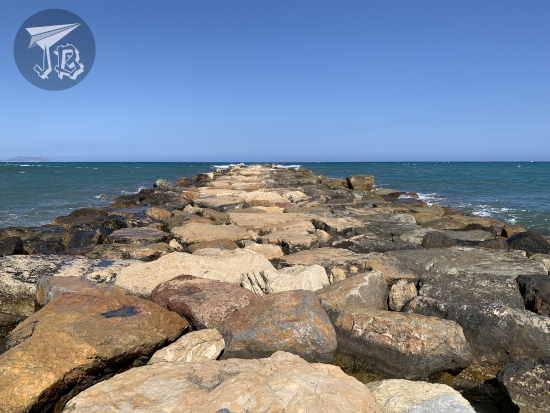
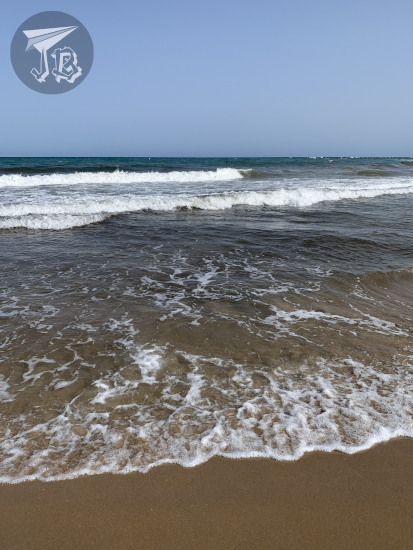
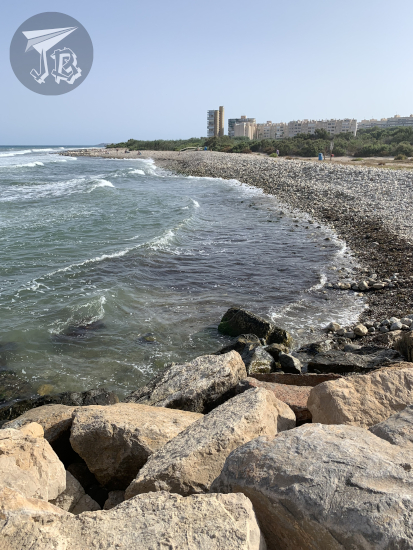
El Campello is built parallel to the coastline. The more traditional area has a small marina Puerto de El Campello to the north, and then a sand beach that extends towards the south divided into Platja de la Illeta and Platja del Carrer de la Mar. Though the beach has a couple of breakwaters, they are for protecting the beach against erosion and not to separate the different areas – the east of Spain has a reputation for building quite close to the beaches. Over the years, that caused the winds and waves to shift and the once amazing and long beaches started being washed away – now all those groins are necessary to keep the sand in place, and are liberally built along the Mediterranean coast.

I climbed on one, of course, more than once – and more than one too (≧▽≦).

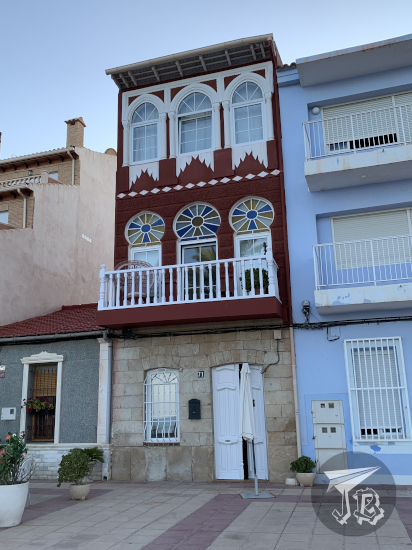
In the evening we walked along the waterfront promenade. While most of it is fronted by restaurants and souvenir shops, I did see this cute little house.

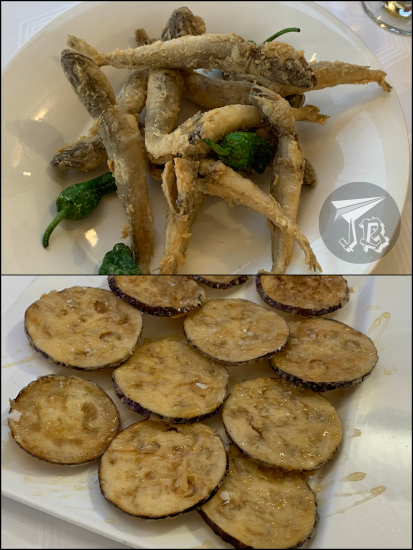
Eventually, we chose a place to have dinner – some fish and the area speciality: honey-soaked aubergine (berenjenas con miel), which is not actually made with honey, but a type of molasses – which actually makes this a vegan dish, as bees are not involved in making the “honey”, what do you know? The first time I tried this I was not too convinced, but if prepared well, this dish is absolutely delicious.

9th July 2021: The lady’s town

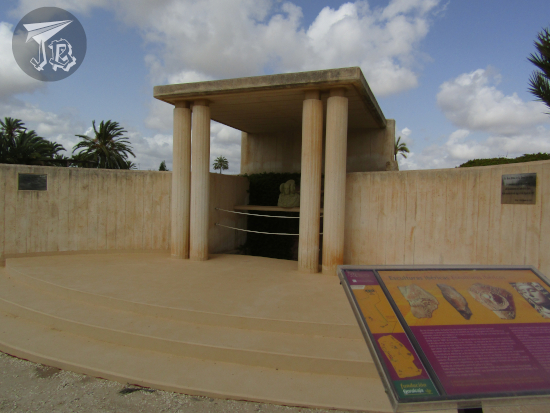
Elche is a nearby town a bit inland, and the third most populated in the area. It is famous due to the Iberian sculpture bust found nearby and because of its palm grove. The history of the town can be traced back to the current archaeological site Yacimiento Arqueológico de La Alcudia, whose stratigraphic sequence dates to the Bronze Age. There are ruins and artefacts, mostly from the Iberian and Roman ages, though there are findings until the Islamic era.

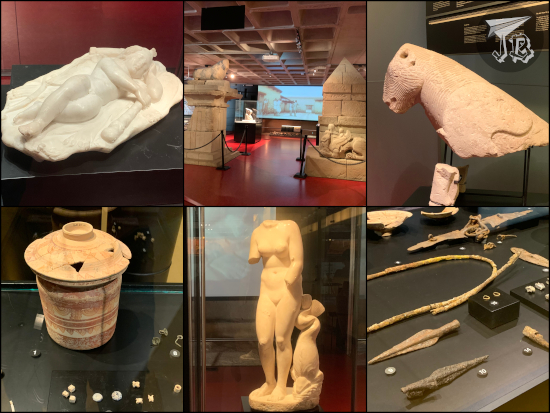
In 1897, a young farmer found the bust named La Dama de Elche, the Lady of Elche, which can be seen in Madrid’s archaeological museum Museo Arqueológico Nacional – it is the limestone bust of an Iberian woman, probably with funerary purposes, what was carved around the fourth century BCE. Since that time, a great deal of work has been carried out in the area of La Alcudia, and today is a full-fledged archaeological site with a Roman wall, several Iberian and Roman houses, a Roman temple and an Iberian one, a basilica, and hundreds of sculptorical and clay artefacts.

We visited the site in the morning, hoping to finish the stroll before it became too hot. There are still works carried out in the site, but you can visit and walk around the area – as long as you don’t step on the red ground. There are two museums on site, aside from the outer ruins. In one of them there is a reproduction of the lady, which yields to easier pictures than the glass protection in the National museum. There are also interpretations and reconstructions about what the Lady may have looked like when she had her colours. Unfortunately, reaching the site is hard, and probably not worth the detour unless you’re an expert in archaeology, but it turned out interesting to see.

… Except for the “commemorative site” of where they found the Lady. That was hideous.

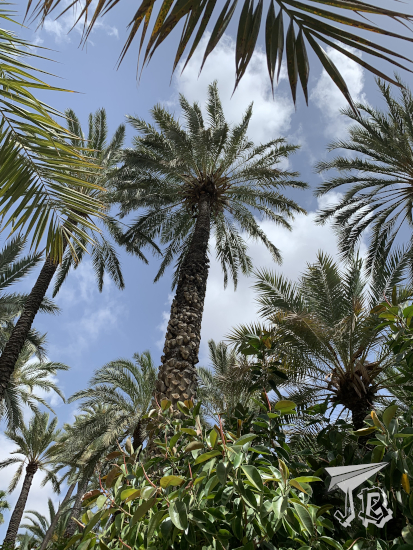
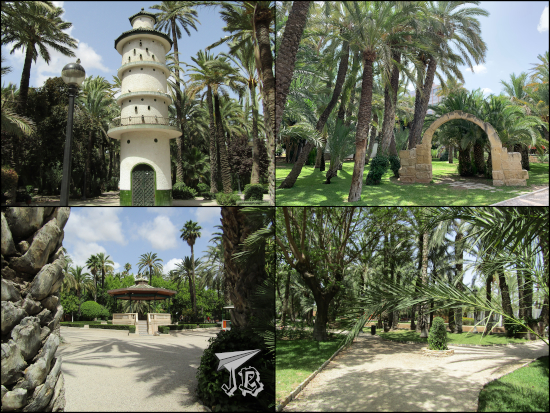
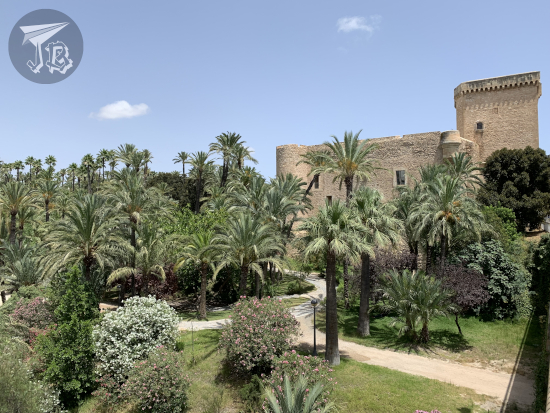
After La Alcudia, we drove off to the town centre to walk around Palmeral de Elche, the biggest palm grove in Europe, with around 200,000 – 300,000 trees, most of the date palm species, Phoenix dactylifera. The palm tree grove originates in the 10th century CE (planted by the Caliphate of Cordoba conquerors), and it has been a Unesco World Heritage Site since the year 2000. The most important palm grove is in the centre of the town (and we missed the dragon that stands on one of the trees 。゚(゚´Д`゚)゚。).

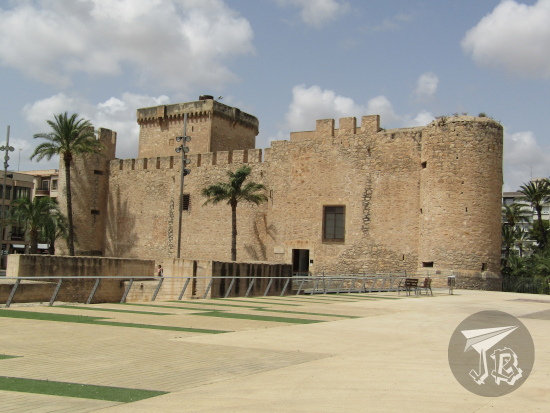
Close to the grove stands the local archaeological museum, Museo Arqueológico y de Historia de Elche, divided between the new building and the old Moorish castle or alcázar, Palacio de Altamira, which drinks from La Alcudia and other findings from the area.

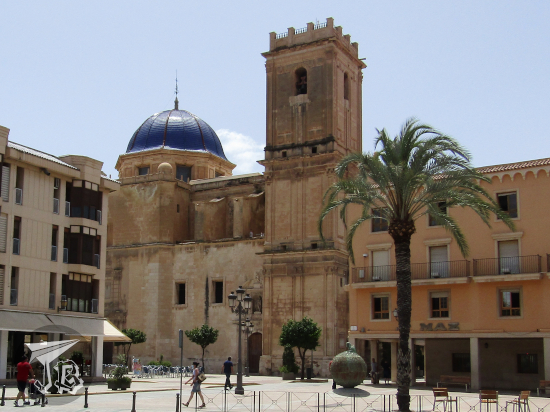
After the museum, we headed off to see the main church Basílica de Santa María, but we had just missed opening times. It stands on the place of the original mosque, and the current building – the third church that has been built – is Baroque. The bold blue dome is typical of the area, found all over the region on towers and churches.

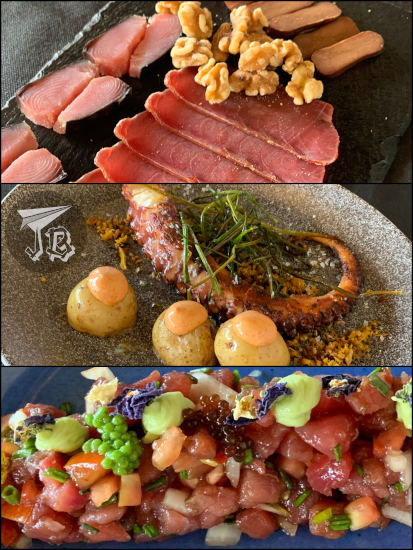
As we could not see the basilica, we just had lunch! After a bit of a banter with an over-friendly waiter we had some fish-based lunch to share – salt-preserved fish bits, grilled octopus and tuna tataki.

On the way back we got to see a different view from the palm grove and the castle and the palm grove – maybe it looked like this in the old Arab times?

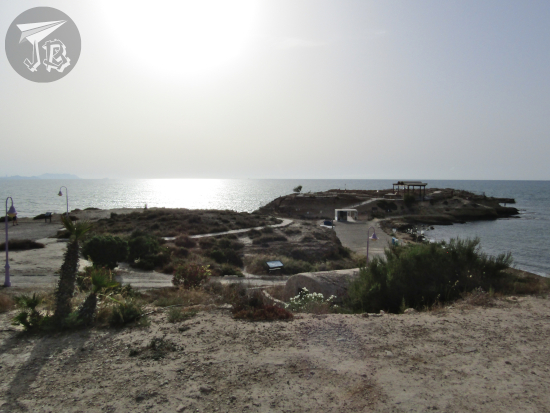
It was too hot to stick around and wait for the museums and church to open up again, so we drove back and after a while I headed back to the beach. This time I reached the end of the sand beach and got to the boulder one at the end of the waterfront promenade.

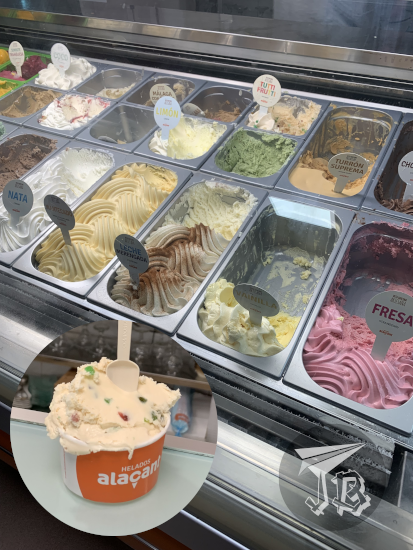
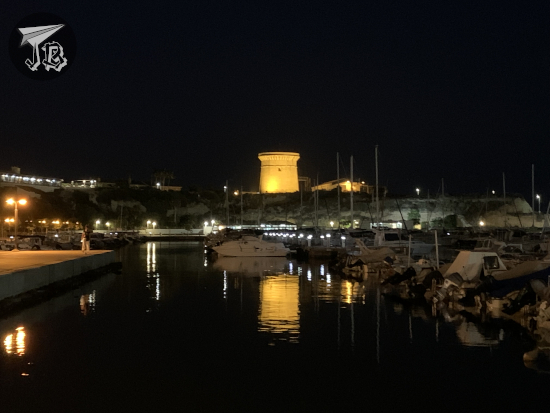
We had a quiet dinner at the apartment, then went out for ice-cream. We ended up walking to the marina, Port d’El Campello and caught sight of the Torre Vigía De La Illeta in the background.

10th July 2021: Not much to report

Just some pizza and a night-time walk along the waterfront promenade yielding tries to take artistic pictures without much success.

11th July 2021: The Tower

I woke up with a lovely reaction to the sun – not a sunburn, more like an allergy flare-up (here’s the plausible explanation for that), so we went out rather early for a walk, to then shield from the sun.

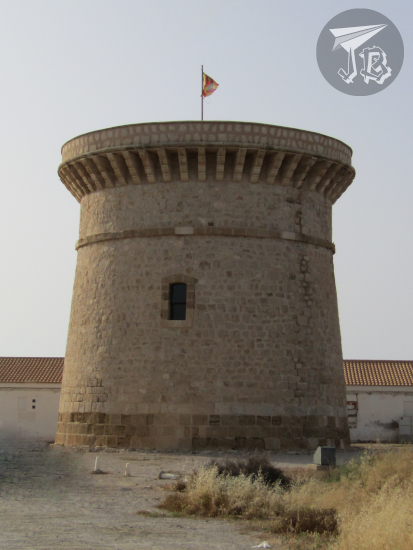
From the Roman times, a number of watchtowers were build along the Mediterranean coast to be on the lookout for pirates. The tower in El Campello, Torre Vigía de la Illeta was built between 1554 and 1557 (and restored in the 1990s), was part of a watch system commissioned by the Viceroy of Valencia at the time. The tower was manned by two infantry and two mounted soldiers – in case a pirate ship was spotted, the former would make smoke signals and the latter would ride to raise alarm in town.

The tower overlooks the marina, the town, and the archaeological site Yacimiento Arqueológico La Illeta dels Banyets, with ruins and artefacts dating from the Iberian and Roman times, but we did not walk to them as it was early in the morning and it was not even open.

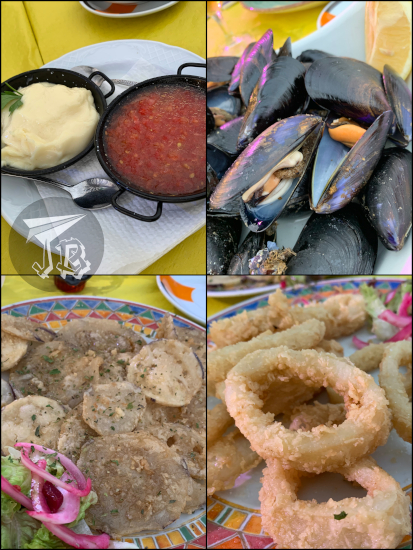
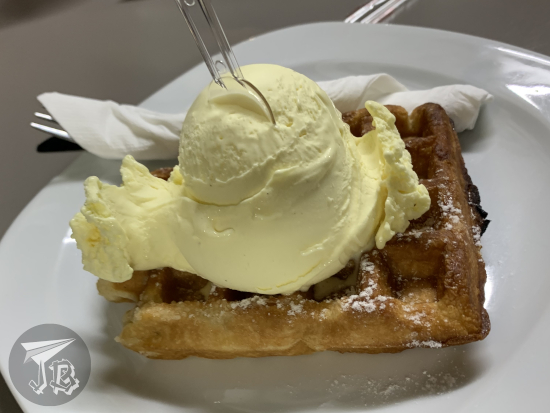
It was hot, so most of the day was spent under the air-con, to later have dinner out – some mussels, more aubergine with honey (not so good this time), and squid rings. But the highlight of the night was the final ice-cream waffle, which is a great, great idea.

And that was it, as we left early in the morning the following day, as soon as we could check out, as the trip is – as mentioned – long.

12th September 2020: Sigüenza (Spain)

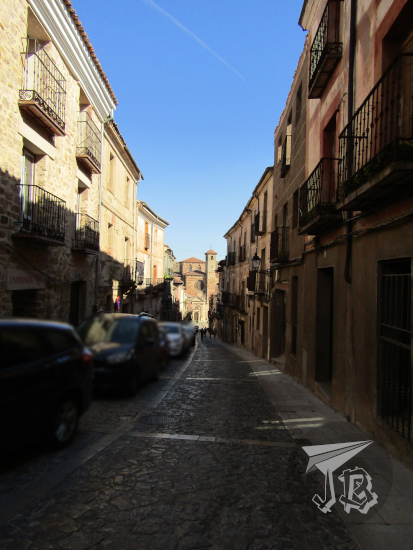
We took a drive to Sigüenza, in Spain. This medieval town? big village? had a big relevance through the Middle Ages, and the historical centre reflects that. The most prominent point is the castle on top of a hill. The Castillo de los Obispos is a fortress that can be traced to Roman times. However, the actual castle was a Moorish alcazaba. After the Christians took it over in the 12th century, it was remodelled and enlarged. Due to its vantage point, the castle was a key element in different wars and strife, including the Napoleonic invasion and the Civil War, thus resulting pretty damaged. In the late 20th century it was decided to restore it turn it into a Parador with around 50 rooms.

During our planning stage we called and tried to book a restaurant for lunch, and we were told they were not taking them, we had to call on the same day. Of course, when we got there, it was impossible to book – there was a course and the celebration of a communion (seriously, people, learn to say no so others can get organised). Unfortunately, you could not see the interior or even the yard if you had no reservations, so I can only share a picture from the parking lot, where we left the car.

We walked down the main street Calle Mayor, a clobbered slope that ends (well, technically begins) at the town’s main square.

Main Square or Plaza Mayor is home to the Town Hall or Ayuntamiento de Sigüenza, an old palace with a typical Castillian inner yard or patio.

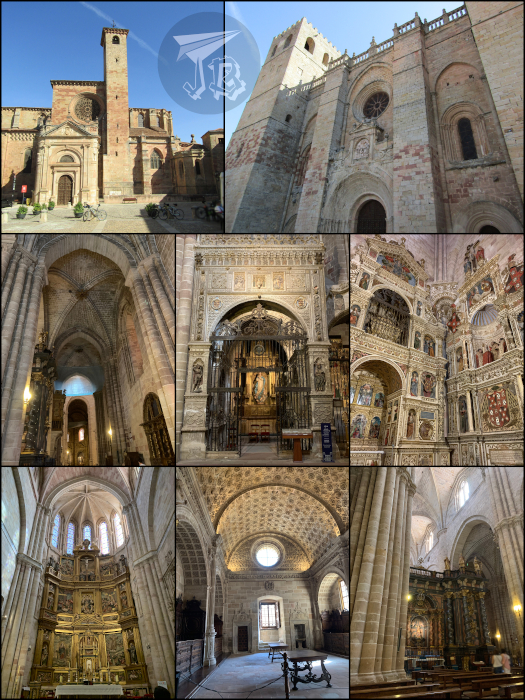
Opposite the town hall stands the cathedral Catedral de Santa María La Mayor de Sigüenza. The Gothic building was built upon a previous Romanesque one and it had some Neoclassical and Baroque additions. Thus, the façade sports Romanesque doors and rose window, and the main body is Gothic. The altar and the choir are awfully Baroque too, and some of the chapels sport Cisneros, Plateresque and Renaissance decorations. All in all, an interesting pout-pourri of architectural and decoration styles.

The most important piece of art of the cathedral, however, is a funerary piece to the right of the altar. It is the sepulchre of Martín Vázquez de Arce “El Doncel” (“The Young Man”). The chapel holds him, his parents and grandparents, but the sculpture on his sepulchre is the most impressive one. The Vázquez de Arce family were vassals of the Mendoza family, the most important family in the area during the Middle Ages. During the war to conquer Al-Andalus, the Vázquez de Arce males followed the Mendoza to the war in Granada, where Martín died in a trap set by the Arabs, which consisted on damming the River Genil to a creek, and then releasing the dam so the water took over the enemies crossing (which… kinda sounds like something out of the Lord of the Rings, doesn’t it? At least, it makes me think of Arwen and Treebeard). The sepulchre, commissioned by Martín’s brother, presents him taking a break during training and reading a book. He even has pupils, so if you could climb up, you’d see what he’s reading!

The cloister is also Gothic, as the previous Romanesque one was torn down. It holds a central garden and a number of side rooms where there is a collection of mythology-themed tapestries. In one of the chapels, there is also a painting by El Greco, a Greek painter rooted in Spain who was one of the key artists during the Spanish Renaissance.

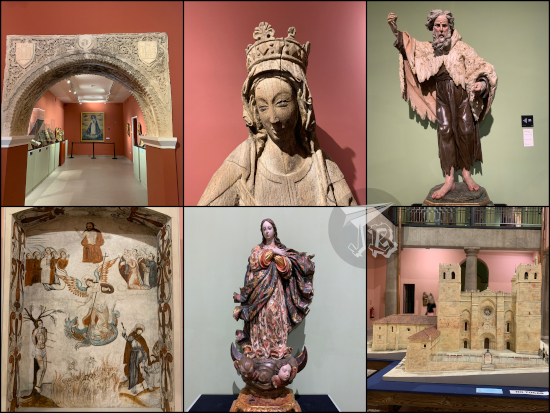
The cathedral ticket also allows a visit to the Diocesan Museum Museo Diocesano, which holds many pieces of religious art, along with a few models of the cathedral in its different construction stages. These days I’m trying to learn some hagiography, which means how to identify religious figures by how they’re presented. Getting there, three out of ten times or so, because half the time they cheat.

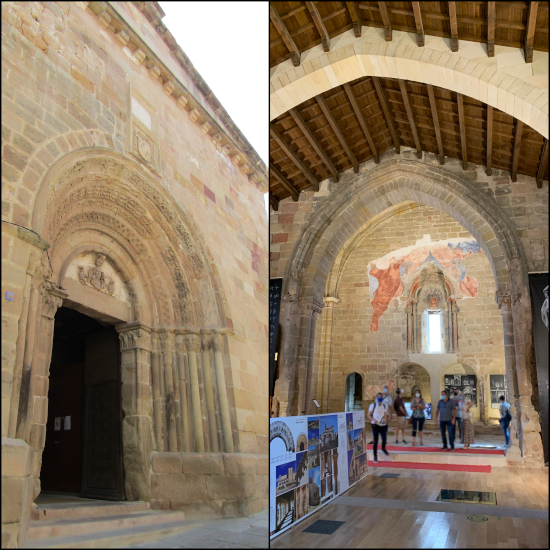
After the cathedral we climbed up towards the castle, and we stopped at the former church Iglesia de Santiago, now transformed into a mini-introduction centre for all the “hidden” or “unknown” Romanesque in the area. The church itself had some beautiful paintings, but it was destroyed during the Civil War.

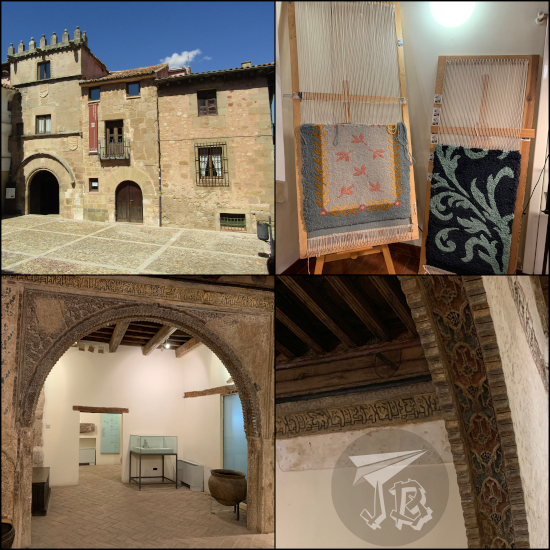
Continuing our way up, we turned a little to see the house where the Vázquez de Arce family used to live, now turned in a museum, Museo Casa del Doncel. There is a little paintings exhibition and a guitar museum, along with some ancient artefacts such as vases or looms. The most interesting part are the Moorish “Mozárabe” decoration. Here is a bit of historic trolling: when the Christian “conquerors” hired Arab craftsmen to do decoration, one of the things the Arabs did was decorate using Quran verses.

Then we saw the outside of the church Iglesia de San Vicente Mártir, Romanesque to boot.

Afterwards, we ended up at the square Plazuela de la Cárcel, where the old gaol jail stood.

Finally, we headed over to the restaurant where we had booked a lunch table, a traditional grill called La Taberna Seguntina where I chose to have a “summer menu” with salmorejo (a thick soup or purée made with tomato, oil, and bread and sprinkled with boiled egg and cured ham) and roasted cochinillo (suckling pig, roasted whole) with potatoes and herbs. For dessert I had a pudding!

And that was it, really – Medieval Sigüenza has nothing else to see. As the façade of the castle was being restored, we did not even take pictures of it as we drove away.

Flashback to 11th – 14th August 2010: Granada & the Alhambra

  • Catedral de la Encarnación de Granada (Cathedral of the Incarnation)
  • Alhambra de Granada (Granada Muslim fortress)
  • Jardines de la Alhambra (Fortress Gardens)

Note: This is a flashback post, which means it is just a collage regarding a trip I took before I started the blog in 2012. Tags may be incomplete or slightly off.