
The 2025 Medieval fair in Tendilla had fewer animals than usual, as the farm was not there on Sunday. However, there was a stand by a birds-of-prey rescue. I was sad I had missed the demonstration on Saturday till I got talking to the lady there. It turned out the rescue had visits. And activities. And activities you could book and pay for. This is important because animal interactions tend to favour kids, which is good for environmental education and all, but makes me jealous…
Emociones Al Vuelo is an education centre and birds-of-prey rescue / charity established in the small village of Aranzueque. It was set up in 2016 to fill a gap and take care of birds which could not be recovered nor released into nature due different circumstances – for example, a kestrel born in the wild, but taken as a chick to be sold in the black market. Or what’s even more shocking to me, hybrids! There are weirdos out there JurassicWorld’ing birds of prey (Your scientists were so preoccupied with whether or not they could, they didn’t stop to think if they should. Creepy). These animals often bounce from home to home as hunters acquire and then get rid of them, until the rescue intercedes. The rescue also takes care of animals that used to belong to negligent owners, with broken limbs, or out of breeders’ hands.
The organisation seems to be doing a good job. The birds looked relaxed and were allowed to… basically ignore their “jobs” until they were properly bribed with food, and if they did not want to “work”, they were properly excused. All the birds are tagged and have their names – all of them kind of nerdy: Star Wars, Game of Thrones… They seem to be quite comfortable with the handlers and with the strangers most of the time.
There are three ticket tiers: “basic”, “fly an eagle” and “emotion pass”, which allows you to hold – or be a perch for – five of the tamest birds, and fly the eagles on top of that. I decided that since the tickets were to support the rescue, I would make the sacrifice and get the highest tier… And we all know I’m lying, I totally got the highest tier because I was dying to play with the residents.
Birds of prey, sometimes called “raptors”, are a group of bird species who actively hunt and eat other vertebrates. These strict carnivores are fast flyers, have acute vision, and sharp talons and beaks to help them hunt. Some of them are also scavengers or piscivores. In general they’re characterised as active predators. Though the term “bird of prey” is not really “scientific”, it is very visual and easy to understand. They range from the smallest pygmy falcon, with a wingspan of around 40 cm to the largest Andean condor, whose wingspan can reach 3.3 m. In general, male and female of the same species are different in colours, and at the very least in size, with females usually bigger and stronger, even if usually raptors are lighter than their feathers make them look – on top of feathers having next to no weight, birds have hollow bones to help them fly. Fun fact: nocturnal raptors tend to have dark eyes, diurnal ones light-coloured eyes, and those which are active during dawn and dusk have reddish or golden eyes.
Birds of prey have been used for hunting – falconry – for over 4,000 years, with the earliest references coming from Mesopotamia and Mongolia. Writings from the 7th century CE describe it as widespread in Asia, but as it seems that nothing ever existed before the Europeans found out about it, one has to wait until Frederick II, Holy Roman Emperor (1194 – 1250) wrote his treatise On the Art of Hunting with Birds for it to become commonplace. During the Middle Ages, falconry became a symbol of power and status, especially for recreational hunting, until the raptors were substituted by firearms. Falconry became popular again in the 20th century, and in 2010, it was added to the UNESCO List of Intangible Cultural Heritage of Humanity.
While the birds in Emociones Al Vuelo are somewhat trained to at least tolerate human presence, what the rescue does cannot be considered falconry. The birds fly from protective glove to protective glove in search of treats, but they are not really trained for tricks. One of the things that we visitors were told is that the birds “fly off” the gloves, not made to take off, as you see in films.
I arrived in Aranzueque around 9:35 for the 10:00 show, with gates at 9:45. It was a crispy morning, but it had been raining all March, and finally there was sun and a decent forecast. I was wearing layer upon layer anyway, and was happy to shed them off as the day warmed up. To be honest, when I booked the place, I did ask if there would be a rescheduling should the weather be miserable, but aside from some mud on my boots, I had nothing to worry about.
Once gates opened, visitors parked inside – people from the rescue have maximising parking space down to an art – and checked in. I had paid when I booked, and I received a lanyard pass and a paper bracelet.
The base activity lasts about three hours. The guests sit on benches arranged in a circle under a tree – I found a spot and made sure my back was to the sun for pictures. There was a brief introduction of very logical rules for the animals’ wellbeing. The activity – I feel reluctant to call it a show – brought out 14 birds of nine species and I got to interact with five different species, and a total of six – seven animals.
The first bird to come out was Sansa, the (Western) barn owl (Tyto alba). Barn owls are mostly nocturnal birds, white to reflect the moonlight, and with brown specks on their back for camouflage on the ground. They are not the biggest raptors, though they can reach a wingspan of almost one metre. They’re mostly recognisable because they have a heart-shape face, and black eyes. At first, Sansa did not seem to want to make friends, and she flew high up the tree, but after some bribing she agreed to come say hi. She was the first bird we interacted with, she flew from glove to glove to snack.


The second raptor was a tiny one – a little owl (Athene noctua) called Xena. In Ancient Greece, little owls were considered the companions to Athena, Goddess of War and Wisdom. They’re small birds with yellow eyes and brown-and-white plumage which mimics the bark of trees. Xena was happy to be walked around and set on shoulders and heads for her interaction turns. She did not approve much of my glasses for some reason.

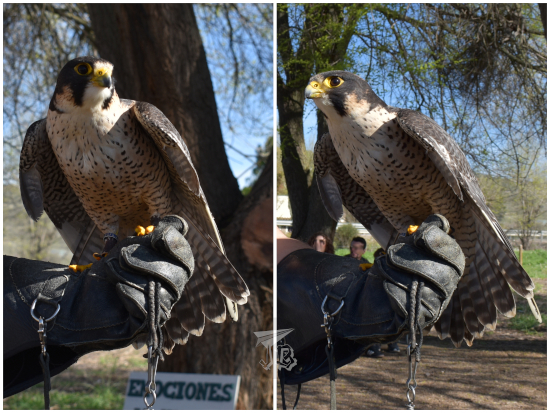
Afterwards, Nymeria was brought out. Nymeria is a rescue hybrid, born from combining a lanner falcon (Falco biarmicus) and a peregrine falcon (Falco peregrinus). She has never really flown and it was hard for the rescue to take care of her, since she had several congenital and behavioural issues when she was taken in. She’s still getting used to seeing people, but she is apparently getting better.
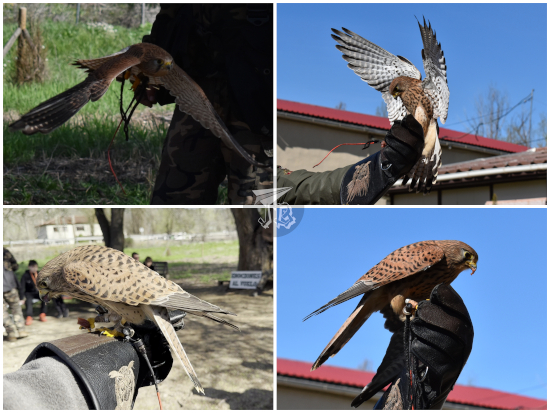
Another rescue was Ripley, a common kestrel (Falco tinnunculus). Kestrels can reach a wingspan of 80 cm, and though males and females look different, they tend to be chestnut brown with darker spots on the back, and lighter spots on the underside. They also have a black or darker mark around the cheek (malar stripe). Though they are not considered endangered, their nesting areas are protected in places like Plasencia. Ripley was chicknapped and ended up in a legal limbo – when she was found, she could not be kept, could not be released, until she found her home in the rescue. She was very happy to flop from glove to glove and snack on the fresh meat she was given as an incentive.
The Eurasian eagle-owl (Bubo bubo) is a bird of prey that has always fascinated me, since I was really small and I heard that a) there was one in our attic and b) they could hunt and eat little children. Somehow, looking back, I doubt either of those statements were true. And despite it all, I was literally never allowed in that attic for the nine years we lived in the house… Eurasian eagle-owls are amongst the largest owls, with almost two metres of wingspan. They are easily recognised by their orange eyes and their facial feathers pointing upwards looking like “ears” or “eyebrows”. They always look like they disapprove of you. They camouflage really well against tree bark, being different shades of brown in spotted patches. The rescue has two of them – Dracarys, the male I got to hold, and Storm, a less tame female.

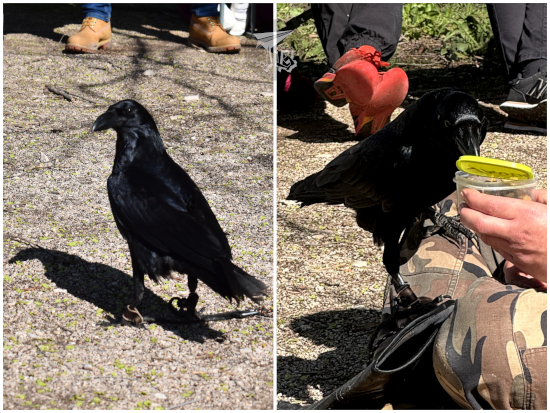
We then met Vader the common raven (Corvus corax). Ravens are not birds of prey, but are closely associated to them. In nature, when an animal dies, ravens are among the first scavengers to arrive. Their black-blue iridescent plumage is easily spotted by flying raptors, who come join the feast. Don’t get fooled, ravens are bigger than they look – they might reach a wingspan of 150 cm – but most importantly they’re smart – they analyse, problem solve, imitate, recognise individuals, and hold grudges. Vader has mastered the opening of lids in order to access snacks…
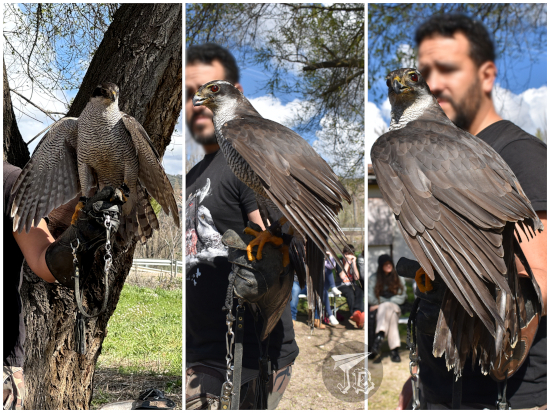
Next came the oldie-but-goldie Blue, a female Eurasian goshawk (Astur gentilis), who was taken in from a breeder after 12 years of laying eggs for them. Goshawks are medium-large raptors (up to 130 cm) with a distinctive striped pattern across the underside, and a greyish back. They have piercing reddish eyes and one hell of an attitude. They are extremely territorial, and usually live in breeding pairs, though females are known for being able to kill the male if he does not bring food to the courtship.
Later came Valyria the Red-tailed hawk (Buteo jamaicensis). She seemed that she would be happier chomping on fingers than perching on gloves. Red-tailed hawks are endemic to North America, and they are diurnal hunters of up to 141 cm wingspan, with females being much larger than males. They do not fly around for prey, but hunt from a perch, and their brown and dark plumage helps them camouflage against the bark of trees, their tail is predictably reddish when seen in flight.

The final species we got to see was the Harris’s hawk (Parabuteo unicinctus), which I’d also seen in the Medieval fair in Alcalá de Henares. They can reach 120 cm of wingspan and are also quite intelligent. They originate from the woodlands and semi-deserts in the Americas, thus they tend to be brown and black, with a little spotted white. They live and hunt in stable groups with a dominant female and her mate. They have developed pack-hunting strategies, with half of the group scouting and half of the group doing the killing. They currently are the most popular raptor in Western falconry, often used to control smaller birds’ population. They are apparently easy to train and they are quite social. There were three of these animals we got to interact with – Tyrion, Winter and Arya.
We could go out to the “flying field” and “play” with them. Tyrion did not seem to want to play a lot, and had to be benched. He actually did only two or three flights – the first one was towards me, and I got to hold him for a while longer since he did not want to fly away. Something that surprised me was how light all of the birds were – I had been worried I would be unable to hold them, but as I mentioned before, feathers and hollow bones make them absolutely… unheavy.
We had a few flights, which yielded to cool pictures, and then some “games” which involve trying to get the hawk to fly between two rows of people, or underneath someone else’s legs. There were some more explanations about behaviour in the wild and the dynamics of the birds and their human caretakers. We actually got to hear a lot about how the different birds interact with each other and their humans throughout the three hours the activity lasted.
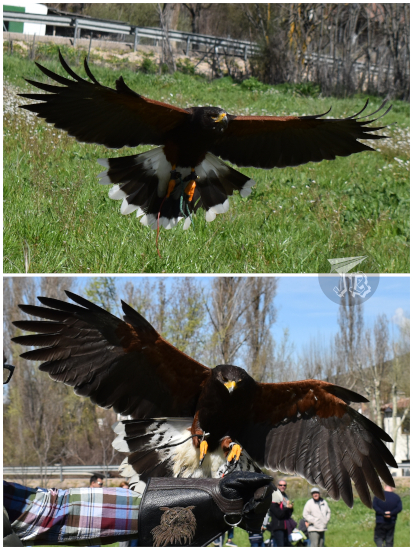

At the end, everyone – even those who had not got the interaction pass – could take a picture with one of the Harris’s hawks. I ended up signing up to another activity – a wildlife photography course – but that one was eventually cancelled due to lack of sign-ups. I drove back home, happy the weather had been almost perfect, and hoping I had not get sunburnt. I also managed to make it through the day without cracking a Jurassic Park joke, but obviously not a whole post – so I shall just remind you here that birds are direct descendants from dinosaurs… Or why do you think they chose “Blue” along all the Game of Thrones references?



 JBinnacle – A Travel Logbook