
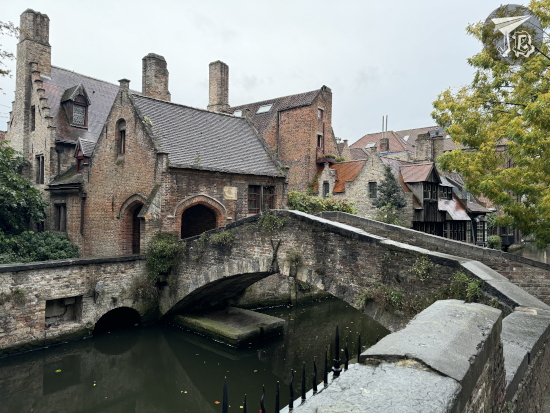
It was raining in Bruges [Bruges | Brugge] when I woke up, but it was supposed to stop by the time the monuments started opening. I asked reception to take care of my bag and I left around 9:30. I thought I would retrace my steps from the previous day, but when I got to the Church of Our Lady, it was not open yet, thus I took a small detour and explored its surroundings. I walked around the area taking in the scenery, and crossed Boniface Bridge Bonifaciusbrug, one of the iconic bridges overlooking traditional wooden and brick houses which face the canal. In front of the church stands the hospital-turned-museum Apotheek Sint-Janshospitaal. It was closed because it was a Monday, but the building was pretty.
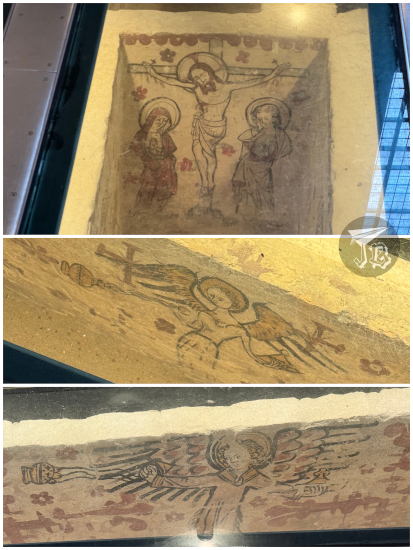
The Church of Our Lady Onze-Lieve-Vrouwekerk opened at 10:00 and I wanted to at least see the free area. The church is famous for having a statue by Michelangelo, but that was in the museum area, which I did not visit. The church also displayed original frescos and a small Via Crucis.

I then walked towards the city centre and Saint Salvator’s Cathedral Sint-Salvatorskathedraal. The cathedral is made mainly out of brick, along with tuff and limestone. The oldest bricks date from the 14th century, made outside the city and brought via the waterways. It was not originally built as a cathedral, but took over the role when the actual one one was destroyed in the 18th century. Instead of rebuilding it, the city made Saint Salvator the next cathedral in the 19th century. Unfortunately, shortly afterwards, there was a fire and the roof collapsed. English architect Robert Chantrell was in charge of the restoration, and he chose to build the neo-Romanesque tower that looks something like a Lego set. Later, a peak was added to the tower which makes it even more… Lego-like.

The cathedral has an organ originally built in the 18th century, and has been expanded thrice since then. The altar is surrounded by Flemish tapestries. Underneath the nave, there is a crypt where you can see the oldest bricks and a number of 14th century tombs, decorated with paintings in the fresco technique. They feature angels, Jesus, the Virgin Mary and Saint John. There is a small building adjacent to the cathedral with a closed off cloister which holds the treasure, full of works of art.
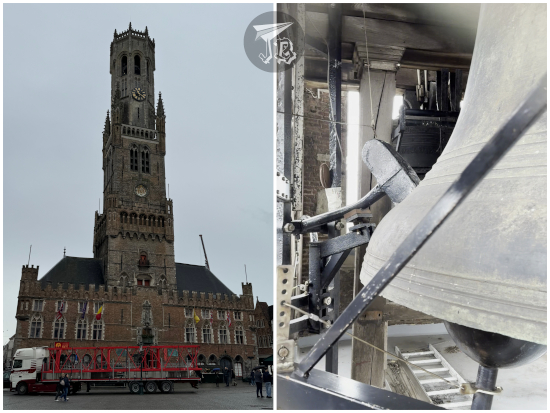
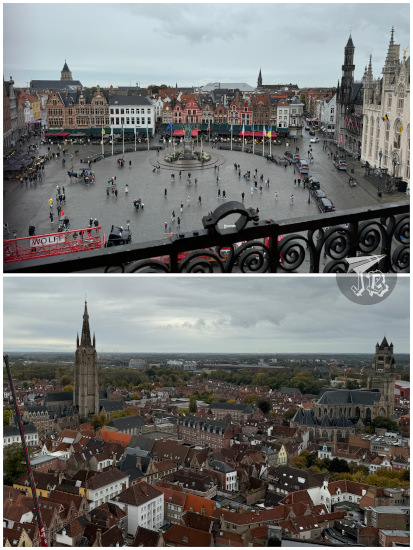
Afterwards, I headed off back towards Market Square Grote Markt. It was raining on and off, so I decided that maybe I could check out the Belfry of Bruges Belfort van Brugge – it turns out that the museum is… climbing the belfry. The belfry was originally built in 1240, though it burnt down and it was rebuilt forty years later. It has an octagonal end cap which was added in the late 1480s. After a few built and destroyed wooden spires, a stone neo-Gothic parapet was added in 1822. The tower is 83 meters high (366 steps, yes, I counted, I got 364) and contains a carillon with 23 bells (27 tons, no, I did not weigh them), and a total of 47 bells. Believe it or not, I was up there when the carillon stroke noon. That was awfully cool. There were also great views of the city.
There was a clearing in the clouds and very low chance of rain for the next hour or so, and thus I decided to find one of the official providers of boat tours on the canals. These are sanctioned by the town hall and all of them have the same price and the same route, so any one would do. The one I found first was De Meulemeester Boat Tours Rondvaarten De Meulemeester. The tour departed and arrived from Dock no. 5 (Wollestraat 34). We sailed to Jan van Eyckplein (Jan van Eyck Square) and the edge of the Lake of Love Minnewater. On the way we did not only see the most important monuments facing the water, we also came across Bruges’ famous swans. In the 15th century, keeping swans was a symbol of status, and they were added to the city as part of its image as a flourishing trade point. Today they’re still maintained by the city, which has actually taken them off from the canals for quarantines before. There were quite a few tours going on at the same time, and the boat captains seemed to know each other – or at least have enough familiarity for some banter.

After the boat ride, I found the Gothic Bruges city hall Stadhuis van Brugge, one of the oldest city halls in the historical region. It was built in a late Gothic style between 1376 and 1421, but it has been modified and renewed a few times – and since at this time I had decided that Bruges was a city to come back on a non-Monday, I decided to leave it for the next time, hoping that Antwerp would have better weather – a bit less cold at least.
Next to the town hall stands the Basilica of the Holy Blood Basiliek van het Heilig Bloed, which is supposed to hold a Relic of the Blood of Jesus Christ. I only visited the Romanesque chapel underneath, because I had just seen two huge groups of people go in.
It was then around 13:45, and I had decided to take the 14:25 train to Antwerp to try and make it to the last entry to Chocolate Nation. At the station, however, I decided to get a Belgian waffle with dark chocolate and strawberries. The waffle shop was out of strawberries, so I got a berry mix instead. That killed all my appetite, to be honest, but it was delightful. I even got a little Belgian flag on it – and good thing that I did not order whipped cream, because it was so filling that I was not able to eat anything else throughout the whole day. I regret nothing.

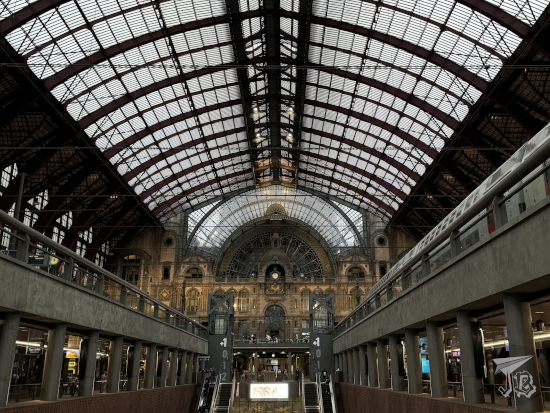
The train was on time and off I went to Antwerp [Anvers | Antwerpen]. I reached the stunning Antwerpen-Centraal railway station Gare d’Anvers-Central | Station Antwerpen-Centraal. The weather was not much nicer than in Bruges though, and it was still raining. I dropped my luggage off at the hotel, and went back to the station to take some pictures – I like hotels near travel hubs. Afterwards, I headed off to Chinatown / Van Wesenbekestraat, but the only interesting thing there was the pagoda gate.
I headed towards the historical centre and stopped by the Cathedral Cathedral of Our Lady Onze-Lieve-Vrouwekathedraal, which belongs to the Unesco World Heritage Site Belfries of Belgium and France. It is credited to architects Jan Appelmans and his son Pieter Appelmans. Both of them are honoured in a metal monument within the wall of the cathedral, which was erected in the Gothic style. The cathedral was never completed to its original concept, and only one of the two projected towers was ever finished. The church was damaged in several scuffles with time – as recently as WWI – and it was completely restored between 1965 and 1993. It had already closed, but I was counting on that.

I continued off to Main Square Grote Markt, which was almost empty due to the weather. There stands the Antwerp City Hall Stadhuis Antwerpen, a few guild houses, and Brabo Fountain Brabofontein, which represents a legend – a giant who cut off the hands of boatmen received the same fate by hero Silvius Brabo.

Then, I continued off towards the edge of river Scheldt, on whose banks Het Steen, a Medieval fortress dating back to the early 13th century. It is what one could call the Antwerp Castle from Wagner’s’ operas, and it was built as a way to control the river. It is currently used as a visitor centre.
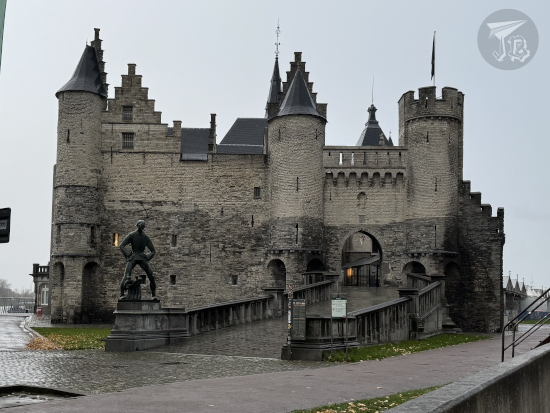
It was getting dark already and none of the monuments were lit, so I decided to get back, as it was raining rather hard. The second I saw reached the station though, the illumination was turned on. I decided to go to the hotel and wait the rain out, as it was supposed to clear out in about an hour. It did, so I retraced all my steps back towards the Cathedral of Our Lady Onze-Lieve-Vrouwekathedraal and the Main Square Grote Markt. I even reachedHet Steen, but it was not lit.

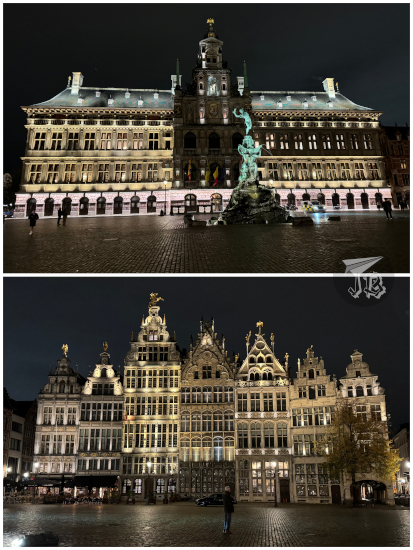
Though it was cold, it had fortunately stopped raining for the time being, and I could take my walk leisurely. I turned in for the day afterwards.
 JBinnacle – A Travel Logbook