Though October is usually my holiday month and I can go on long trips (such as Türkiye in 2024), this year I came across an unexpected project. That means extra money, but less time, and even though I had a blast in Loarre and Zaragoza, it was not really a holiday. I decided to take a day trip before the weather turned and work took over. I mulled over several ideas, and in the end I came down with two – basically an urban day trip or rural day trip, and in the end, I decided to go for the urban trip. A while back (longer than I thought), I visited Complutum, the archaeological remains of the Roman town which stood underneath what today is Alcalá de Henares. That time, one of the main buildings was closed off due to archaeological works, but it was now open. Furthermore, the city has recently opened a new museum. These factors pushed me to go there in the end. It helped that I needed to do some shopping.
The Romans first established provinces in Hispania around the 200 BCE, after the second Punic War. In the year 19 BCE, the first Roman Emperor, Augustus, formally added the Iberian Peninsula to the Empire. Despite some strife, Spain remained part of the Roman Empire until the latter collapsed in the 5th century CE. There’s a lot that Spaniards owe to the Romans, including a good road system, aqueducts and waterways, and lots of mosaics, a good number of them in the MARPA.
The city of Complutum was founded in the 1st century CE, and greatly expanded through the 3rd century. At the turn of the 2nd century, during the Christian persecution, two children were killed and are now considered martyrs. Unlike other sites, the city was never really abandoned, just gave way to newer civilisations and it was built over. During the 19th century, the archaeological sites were pillaged, and between 1970 and 1974 a lot of the remains were destroyed to build new dwellings. The archaeological site received protection from the 1985 Heritage Law, and further recognition as Cultural Asset (BIC) in 1992.
I did not feel like driving in the chaotic Alcalá de Henares traffic, especially now that they’re having construction along the main avenues, so I parked the car a bit away and walked – this is something I do when I go to the centre. The weather was nice so the 40 minutes did not feel long. I visited the three main spots: the larger archaeological site Ciudad Romana de Complutum, the new museum Antiquarium and, since I was not crazily far, the house Casa de Hippolytus.
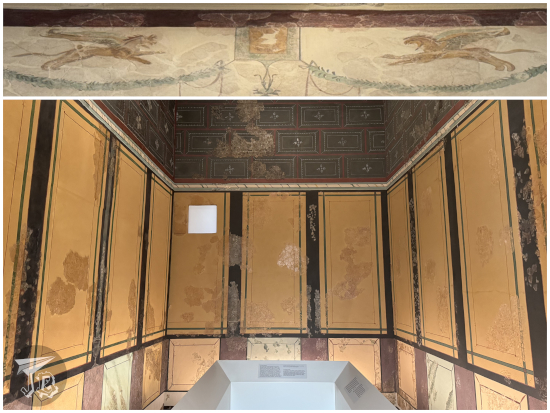
I first headed off towards the Antiquarium, the “new” museum. I call it new because it has opened in 2025, though the building had been erected over a decade earlier at the very least. It is a large space which hosts some of the elements recovered in recent excavations – though due to the general pillage of the site in earlier centuries and all the losses due to modern construction, it is not as rich as it should be in its own right. There are two key elements in the museum – room F of the House of Griffins, and the mosaic of the Winning Chariot Racer.
The House of Griffins, Casa de Los Grifos, is considered the best example of Roman mural painting in Spain. It was a large domus of 17 rooms at least. It was built in the 1st century CE, but it burnt and collapsed in a fire at the beginning of the 3rd century. Outside of Pompeii, it’s probably one of the best preserved houses I’ve ever seen, even if it is in two places. The room moved to the Antiquarium names the house. Amongst other mythological representation, the entrance is guarded by two griffins, animals with the head of an eagle and the body of a lion, facing each other.
The other key exhibit is the mosaic El Auriga Victorioso, which was found in an outskirts villa where Romans bred horses. The museum has woven a whole story around the mosaic, to the point that you could actually believe that everything they tell you about the hypothetical character is based on facts instead of just speculation.

Outside the building there is a fountain Fuente del Juncal, part of the water distribution system of the city, channelling water from the nearby river Río Henares. It was heavily restored in the 19th century, so there is no way to know how it looked originally.

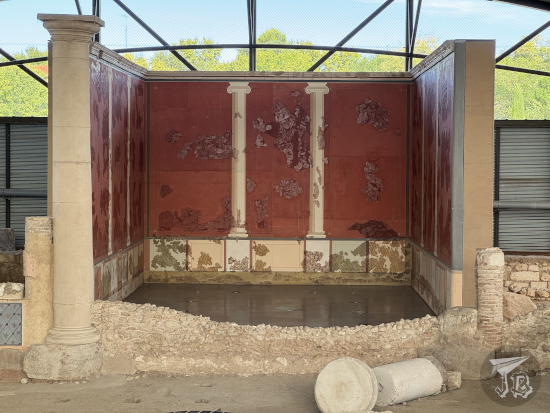
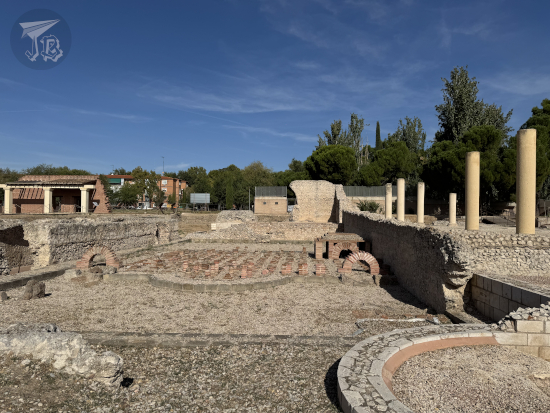
After the museum, I headed to the actual city to see the rest of the House of Griffins in situ, in the Ciudad Romana de Complutum Roman city. The vermilion walls which still stand were probably painted with cinnabar from Almadén. However, it was difficult to see from afar what parts were original and what had been restored. Other spaces that can be seen throughout the city are the foundations of a dwelling block, the forum and the therms. Two spaces require a lot of imagination – a piece of wall is supposed to be where the child martyrs Justus and Pastor were killed, and the restored auguraculum, where the oracles worked.
The last time I visited Complutum, the Antiquarium had not opened and the House of Griffins was closed due to excavation works there. I did visit the other house Casa de Hippolytus, which was completely accessible. However, since I was nearby, I decided to get there again. They have a very cool mosaic with Mediterranean fishery themes, including a moray eel, an octopus, a dolphin and a very-accurate lobster. Interestingly enough, Hippolytus was not the owner of the house, but the artist who signed this mosaic.

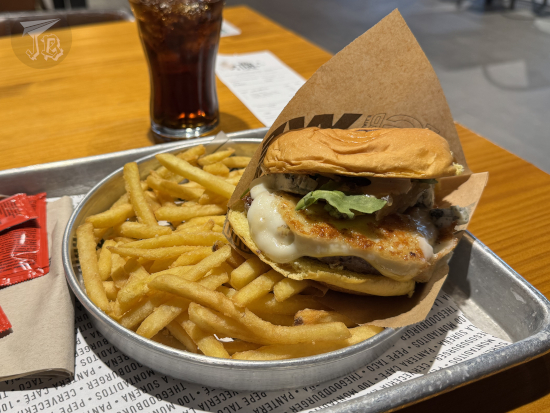
I headed back towards the shopping centre where I had left the car and went into a The Good Burger there, because I am very partial to their Cheese Lovers hamburger (and their soda refill policy). They had a menu option so I decided to go with the chips – I had the choice between chips with salt and chips with salt (and that’s not my typo). The burger in question is garnished with American cheese, goat cheese, Gorgonzola cheese, poached onion and honey-and-mustard sauce. Lots and lots of cheese, for real.
I did not do much afterwards. I bought a few items I needed and headed to the car to drive home.


 JBinnacle – A Travel Logbook