Though today Atienza is a remote village with fewer than 500 inhabitants, during the Middle Ages it was an important fortified villa. It was a strategic site in Castile, close to the frontiers to both Aragon and Muslim-controlled areas.
When Sancho III of Castile died in 1158, his eldest son became Alfonso VIII of Castile, being three years old at the time. It was a time of instability, a civil war broke between the two most important Castilian noble families, and the neighbouring kingdoms took over territories and cities taking advantage of the situation. The young king was hidden in several towns to protect him from “the enemies” by several “allies” – who the loyal guys were depends on the story you read. One of the hiding spots was the villa of Atienza.
The king of León besieged Atienza in order to retrieve Alfonso. In order to get him out of the city, on Pentecost Sunday 1162, the Brotherhood of Muleteers requested permission to hold a short pilgrimage (romería) to the small hermit church outside the walls. The attacking army agreed – religion is weird, I guess – and the muleteers snuck the royal child out of the villa. The fastest riders then galloped for seven days to get the king to safety in Ávila. The scheme worked, and Alfonso lived until 1214.
Nowadays, the Brotherhood of the Holy Trinity Cofradía de la Santísima Trinidad carries out a similar pilgrimage, in traditional clothes, on Pentecost Sunday to “honour their ancestors and their feat”. There are several events: a cavalcade – the romería on horseback – a mass at the hermit church, a communal meal, dancing, and at the end of the day, a joust tournament. The whole festival is called “Drove of Horses of Atienza” Caballada de Atienza. As I was driving past the village on Saturday I thought that maybe my sibling would be interested in dropping by, and could do the driving.
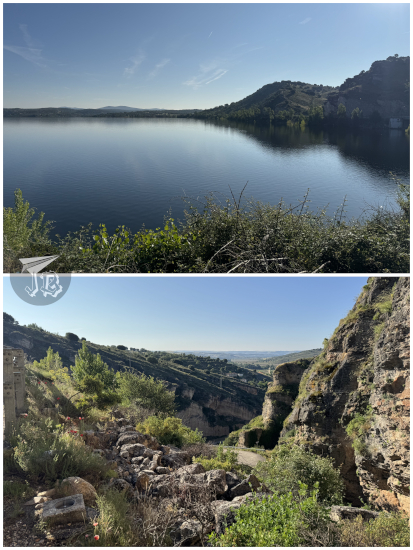
On the way, now that I knew where to park, we could stop for a little while next to the reservoir Embalse de Alcorlo, whose dam was opened back in March so it became part of the reason the river Río Henares had so much water. The reservoir was still pretty full.
It was clear from the get-go that we would only stay for a couple of hours. Since we were improvising, staying for the whole thing, without lunch reservations or a definite plan, in the heat, would not have been a great idea. I just wanted to get the gist of how the festival went and how many people there were. Surprisingly, not as many as I thought. We dropped the car off at the entrance of the village and followed the signs towards the centre. We knew we were going in the right direction when we started seeing horses.
The festival starts at 10:00. The Brotherhood is called into order and they bid to carry the flag and open the pilgrimage behind the musicians. The brothers wear black suits and some are allowed to wear capes – not sure how the horses feel about that. This happens in a narrow street with way too many people and nervous horses. We decided it was safer to stay at the corner rather than trying to approach the scene – we had already witnessed a couple of them getting spooked by oblivious passers-by.
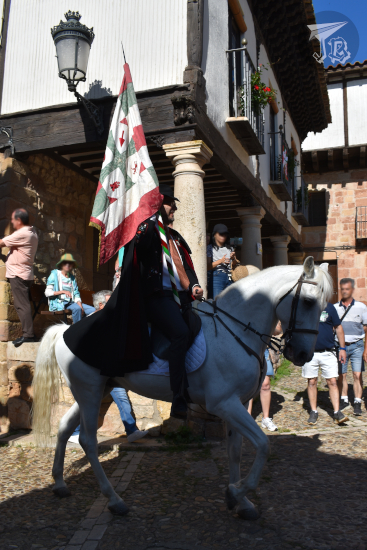

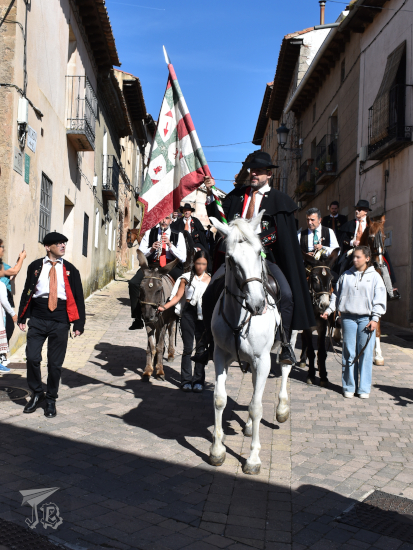

We watched the departure of the pilgrimage, and then jogged to a couple of other places for photos. We decided not to follow the cavalcade to the hermit church, because the return would have been at noon – way too hot. We waved the riders goodbye next to the remains of St. Francis’ convent, the ruins of a Gothic apse Ábside gótico del convento de San Francisco.
After the romería rode off towards the hermit church, we decided to explore the village a little. We went back to the Old Town Casco Antiguo de Atienza to have a look at the local monuments. We crossed the Medieval wall Muralla de Atienza through the arch Arco de la Virgen.

The Main Square is called Plaza del Trigo (Wheat Square), surrounded by traditional architecture, including the old council houses, a covered gallery, and the church of Saint John The Baptist Iglesia de San Juan Bautista. The current church was erected in Renaissance style in 16th century by architect Juan de la Sierra, to serve as substitute as the previous Romanesque parish.


Next to the church, serving as an exit from the square, stands the arch Arco de Arrebatacapas, the cape-stealing arch. Due to the configuration of the two squares it joins, a wind tunnel forms in the small alley – known to blow away capes or any other unsecured piece of clothing.

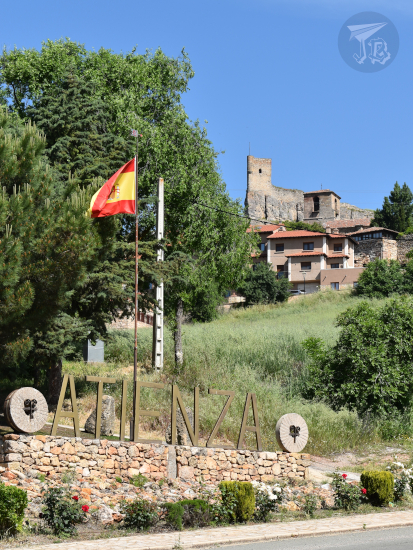
From an alleyway we got a good view of the castle – I’ll leave the visit for another time, when all the museums are open, and it is less hot. On the way out, we had a great view of the whole villa before we drove back for Chinese food and cold drinks.

 JBinnacle – A Travel Logbook