5th July 2025: Cheese, archaeology, pancakes (Madrid, Spain)

I am not completely sure how the conversation came up. My sibling said something about cheese tastings. I mentioned something about knowing about a shop in Madrid which organised them. Next thing I knew, I had been tasked with planning an escapade to try. However, closing on dates is not something my family is fast at doing, so by the time my sibling confirmed, the June date we wanted was sold out and I had to book for July.

The final date was Saturday the 5th of July at 13:00. The evening before, there was an explosion and fire in a factory in an area alongside both the speedway and the railway lines, and that forced me to reevaluate transportation – the warehouse worked with lithium batteries, which burn for a very long time. In the end, I decided to try for an early train, with a plan B to drive to a station halfway and meet my sibling there. While you could see the smoke from the wagon, there was no weird smell or anything and the train ran smoothly for once. Maybe we were five minutes late to Madrid? Funny, when I was warned at the station that there were delays. I had planned an extra activity in case we were early.

There was also Pride to take into account, as it was the main Parade, and that causes a cascade of station closures, including Recoletos, the station we had to go to. That would only be an issue to consider when we had to go back though, since they started at 18:00. We could always get the underground and find our way to Atocha.

We started off at the Museum of the National Library Museo de la Biblioteca Nacional. I had seen the museum already, but I had read that there was a temporal exhibit. However, we were unable to find it – it’s been apparently “temporarily closed”. It worked to pass the time out of the heat though. We were done at 12:30 – a bit too early to directly go to the store, but too late to try to see anything else. We decided to walk towards the shop, and we missed it at first, but we soon backtracked and walked into… a literal fridge.

Formaje (an old-fashioned Spanish word for cheese) is a specialised / delicatessen cheese shop. Created in 2020, it aims to “create community around artisan cheese”. They work with farmers, craftspeople, and traditional cheesemakers to distribute environmentally-conscious cheeses from producers who respect the natural processes, the landscape and of course the product. The store is designed to be a warehouse too, so it is… cold. Good thing I was carrying a jacket.

Formaje Castelló: Shop. A cheese shop full of pieces and whole cheeses

We waited in the shop, trying not to obstruct the customers, and gawked at all the types of cheese in display, all of which could be bought, and tasted beforehand! We saw some regulars who had their thermal bags ready for their shopping and debated getting a cheese subscription, and people wandering in out of curiosity. Around 12:55 a lady came to check us in. I was the closest to her, so I was able to take a picture of the whole set up and find a seat closest to the speaker. I have way too many attention issues not to want to be close to someone who is going to do some explaining I care about.

The tasting Cata de Quesos Edición Primavera involved fresh sourdough bread, butter, seven types of cheese, sweet quince paste, red and white wine, and “ice cider”. I am not a fan of alcohol in general, but the ice cider was magnificent. I am not going to gush about how all the cheeses were delicious. Assume I loved them.

Formaje Castelló: Cheese tasting. Long table and a tray full of sourdough bread

To begin with, there was real butter from the farm Airas Moniz in Chantada (Lugo, Spain). Made from the raw milk of Jersey cows grass-fed in the north of Spain, it was fresh, yellow, creamy and salted, and the bread was delicious. The first cheese was Olavidia (from Jaén, Spain), made from goat milk. It had a small layer of smoked wood halfway through. Even if I don’t care much about “the proper order you should eat things in”, I discovered that goat-milk cheese is supposed to be a “soft-tasting” cheese, I have always found it pretty strong. The cheeses were organised from softer to stronger, which apparently is how you should consume them.

The second cheese was a Camembert (protected designation of origin, AOP from its French acronym) from the region of Normandie, France; it was creamy, made from raw cow milk, with a slight moulded rind (with Penicillium camemberti) which protects the inner creaminess.

Then came a Manchego (protected designation of origin, DOP from the Spanish acronym), made with raw sheep milk. It originated in a farm called Finca Valdivieso (Alcázar de San Juan, Ciudad Real). In my opinion this one was the weakest cheese, as I am a fan of older Manchego and this was less than a year old, though still nice.

Number four was a cheese I had not heard about before, Tronchón (from cheesemaker Los Corrales, Almedíjar, Castellón). Tronchón is generally made from raw sheep milk, though sometimes it might be made with goat milk or a mix of both. The one we tried was made from goat milk. The rind is dark and unappealing on sight, but it was nice enough. Despite my ignorance, this cheese is old enough that it was mentioned in Cervantes’ Don Quijote.

Another discovery was the German Blossom Hornkäse. Hornkäse comes from the Bavarian region of Allgäu. The cows that provide the milk are fed with local grass and they don’t have their horns cut (Did you know that a cow’s horns are connected to her throat and they are part of the digestion process?). The cheese is made in wood recipients using only wooden tools. This version comes with a crust of dry flowers which makes it… just amazing.

Sierra Sur was… the icky one. It smelled like literal stable – and not a clean one. It is made with raw goat milk and you have to fight yourself a little bit to take a bite of the rind. It is a seasonal cheese, which I wouldn’t be able to say whether it has gone bad… It did look like it had gone bad… But it was nice enough, if you could ignore the smell. Not something I would buy on my own though.

The last cheese, Savel, came from Chantada – like the butter at the beginning. It is made from raw cow milk, from Jersey cows, injected with Penicillium roqueforti. This was extremely strong, but really good, especially with the bread, and the ice cider called Bizi-Goxo. Though this one brand comes from the north of Spain and is made from Errezile apples, ice cider originally comes from Canada. To produce this particular spirit, the apple is kept through the winter on straw mats, and it does not rot. The resulting drink is stronger and sweeter than a regular cider.
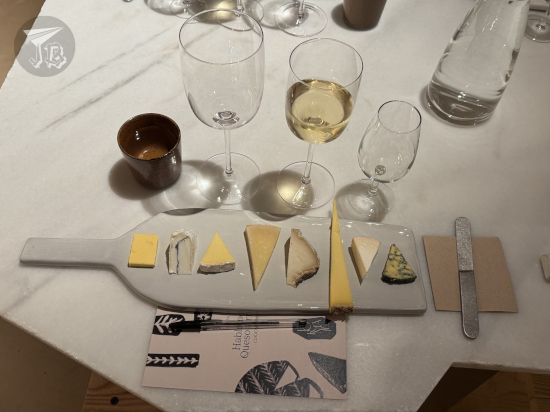
Formaje Castelló: Cheese tasting. Seven small pieces of cheese perfectly aligned on a tray

We spent some time chatting with the lady who had given the explanations, then went on our way. We walked to the archaeological museum Museo Arqueológico Nacional, where they were running two temporal exhibitions. One was a personal-turned-public collection of Egyptian Artifacts called El Egipto de Eduard Toda. Un viaje al coleccionismo del siglo XIX (Eduard Toda’s Egypt: A trip to collecting in the 19th century). Eduard Toda i Güell (1855 – 1941) was the Spanish Vice-Consul in Egypt for a couple of years, during which he amassed a rather impressive collection of artefacts, which he eventually donated to public institutions. The bulk of what he owned is now held in the archaeological museum as part of both the permanent collection and the archives. He had antiques, carbon copies of reliefs, photographies and a hefty number of fakes – apparently, knowing they were so.

Treasures from an Egyptian tomb

The second temporal exhibition we wanted to see was Alas para la guerra. Aratis y la Celtiberia: Wings for war, Aratis (a town, now an archaeological site) and Celtiberia. This one focuses on the Celtiberian culture and how it warred, using soldier helmets as a storyline. These particular helmets have a convoluted history – it turns out that between the early 1980s and 2013, someone used metal detectors to find artefacts from the ancient town and sell them out. This “gang” found and illegally auctioned up to 6,000 artefacts, including twenty helmets which had been forged between the 5th and 2nd century BCE. The archaeological site of Aratis, now called Aranda del Moncayo, would have been probably the most important Celtiberian site after Numancia if these guys had not systematically destroyed it.

The Aratis helmets are the most complete items of their kind that have ever been found. They were not really used for war, but were part of funerary treasures. Truth be told, Germany sounded the alert at some point around 2008 about the legality of the auctions, but the Spanish government did not stop them. Seven of the helmets were returned to Spain in 2018 thanks to the European buyers who learnt that they had been illegally exported, and 11 more have been located. The seven helmets are deposited now in the Museum of Saragossa, but that one is currently closed due to construction work (scattering some of its collections to be shown elsewhere), so they have been lent to the Archaeological Museum.
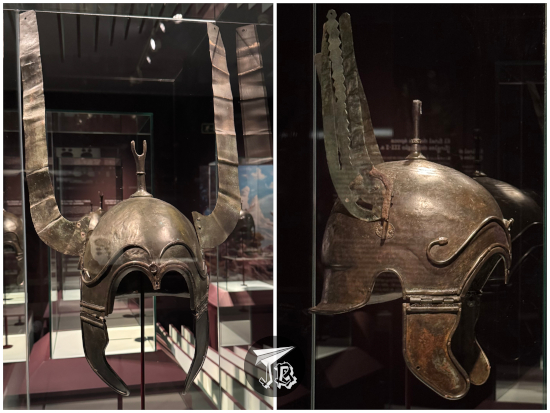
Celtiberian helmets with decorations on the sides

The exhibition also holds other weapons, parts of armours, and Celtiberian artefacts such as coins and brooches. I had seen some of the messed up spears in the museum in Tiermes, which makes sense, considering it also held Celtiberian items.

Afterwards, I finally (finally!) managed to find the reproduction of the Altamira Caves Neocueva de Altamira open! It just had not worked any other time I had been in the museum for the last ten years, and I had seen it once when I was really young, and something similar in the museum on site a lifetime ago. It was smaller than the one I remember from both times… And it makes me sad that I will never be able to see the real thing, because there’s a waiting list you can’t even get into any more, and only 50 people per year see the actual cave…

Reproduction of the Altamira Cave, with bisons, horses and bulls painted on the ceiling.

My sibling was not ready to go home just yet, so I thought they might like a stop at Kawaii Café before we turned in. We could take the underground and in under a change and 30 minutes – since I had been there just a couple of days before, I remembered the underground station. I was not sure whether there would be a queue to enter or not, but we were lucky. We alighted at Tirso de Molina and went into the café without problem – it was half empty at the time, around 16:30. They really wanted to order something cute – which is not hard. In the end, they chose teddy-bear-shaped pancakes with chocolate spread Ositos rellenos de Nutella, with chocolate syrup, whipped cream and banana slices. This time I went for a matcha frappé.
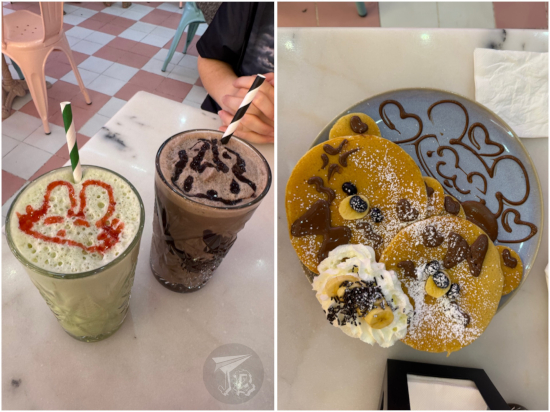
Two drinks with cute rabbits drawn on top, and pancakes decorated to look like teddy bears

Afterwards, we walked down to Atocha Station down one of the shopping streets. We made a few stops, and reached the station just before the Pride Parade blocked the streets. There, we settled to wait for a train. On the way back, the factory that had had the accident was still smoking, but the dark cloud seemed weaker. However, I never thought I would have to consider “lithium explosion” in my adventure planning, to be honest…

26th November 2024: Another Concavenator visit (Alcalá de Henares, Spain)

I had to run some errands in Alcalá de Henares in the afternoon, so I decided I would get there in the morning, and walk to the Archaeology and Palaeontology museum Museo Arqueológico y Paleontológico de la Comunidad de Madrid, MARPA. The exhibition “Dragon HuntersCazadores de Dragones was still running and since it was a random weekday morning, I thought it would be empty.

I was right, it was deserted enough that the security guard looked at me weirdly. Yes, I’ve been there before. Twice. I hope to be back at least once more before the exhibit closes in January 2025. The security guard should not be remembering me, I did nothing weird. Taking a few hundred photographs of a fossil is completely normal.

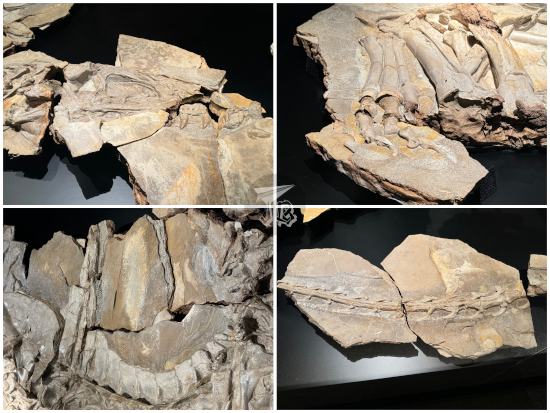
Why am I so obsessed about the Concavenator? Well, one does not always have such a unique fossil so handy, and for free. Furthermore, the usual home of the Concavenator does not allow pictures. And lastly, I’m a nerd. The species Concavenator corcovatus was described in 2010 by Francisco Ortega, Fernando Escaso, and José Luis Sanz from a single skeleton found at Las Hoyas site in 2003. The specimen was officially catalogued as MCCM-LH 6666. The animal was a medium-sized carcharodontosaurid. Carcharodontosauria, which included the likes of Giganotosaurus, Mapusaurus or Carcharodontosaurus, were a group of large theropods from the Cretaceous period. The skeleton was almost complete, with the tail and neck contorted in rigor mortis. The fossil shows two things that make it special – a hump or sail created by the spines of the back vertebrae, and the fact that some pigments were found on the fossil. Not unique but rare enough findings include impressions of skin and scales, and smaller bones in the belly area, rests of undigested dinner. On the arm bones there are insertions for ligaments similar to those that modern birds have at the insertion of feathers.

Concavenator corcovatus

The Concavenator lived around 125 million years ago, in an area of wetlands. Its teeth, general shape (it walked on its two hindlegs and had small-ish arms), along with the remains of animals that it had eaten, tell us it was a carnivore, and its placement in the carcharodontosaurid family, that it was a predator. However, no large predator is known for rejecting a good scavenging feed. The spikes or hump on its back, above the hips, can be clearly seen on the fossil, but nobody has any idea of what it was for – speculations have been made for communication means, fat deposits and thermoregulation. When alive, the animal would have been around 5 metres long, two metres tall, and 450 kilograms heavy.

Concavenator corcovatus details

All that to end up being dug up and named… Pepito, which is the diminutive of the diminutive of the Spanish version of Joseph. The equivalent of Joseph would be José, nicknamed Pepe, and changing the last “e” into “ito” – the suffix for small – would yield to something like Joey. So this magnificent predator was either named after a mini-mini-Joseph, or a small meat sandwich, which is also referred to as a pepito. Seriously, what happened to the illustrious tradition of Boaty McBoatface? This would have been a glorious Toothy McToothface (“Spanishised” as Dientito Caradientez or something).

Anyway, after the visit I dropped by the museum shop to buy myself some Concavenator-related merchandise. When was there the first time, I bought the exhibition catalogue, but since then they had received some silly cute items – I bought a pin, a badge, and a magnet, just because I could. Maybe as the exhibit draws closer to the end there will be discounts on other things…

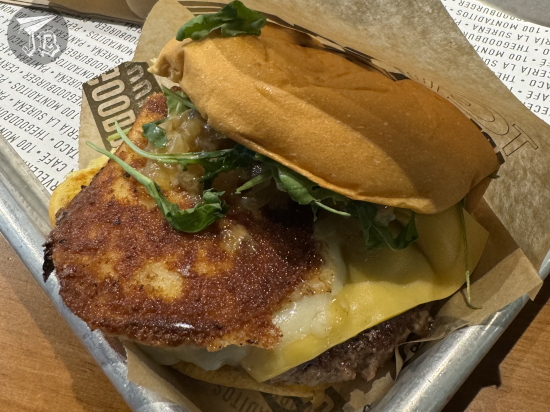
I left the museum and decided that since it was way past 14:00, I should grab a bite to eat. As I had parked my car next to a shopping centre, I headed there with the idea of some Asian food. However, there is a burger joint that usually has a long queue and that some friends had told me was really good – as good as fast food can be, I guess. It is called TGB – The Good Burger. It is supposed to serve “NYC style gourmet hamburgers”. The place was empty, so I decided to give it a try.

I ordered a “Cheese Lovers” burger, which consisted of a beef patty, American cheese, goat cheese, Gorgonzola, sautéed onions, arugula and honey mustard sauce. It was… very cheesy. It was nice, but nothing I feel I must try again, especially when there are cheaper options in the shopping centre. And sushi. But at least, I satisfied my curiosity before I went off towards all my dull, grown-up errands which I shall not bore you with…

The Cheese Lovers burger

28th May 2024: Architecture and a niche restaurant (Madrid, Spain)

I was talking to an acquaintance whose child likes superheroes – so does the acquaintance, actually – about Comic Planet. After exchanging experiences, they mentioned that their spouse also enjoyed another thematic restaurant, and I decided that it could be a fun thing to do – and since they don’t take reservations for one, I roped my sibling into tagging along. And of course, since we were braving the horribly-working trains, I felt we should fill the day out. We could not leave early in the morning as I would have liked because I had this stupid bureaucracy appointment I had to get out of the way first.

We arrived in Madrid around 12:30, and our first stop was the Casa de Correos, an iconic building in the middle of the square Puerta del Sol. I did not even know you could just visit that building, nor that they ran exhibitions. It was a cool opportunity to check it out. Furthermore, the exhibition was actually something that I was quite keen on – the architect Antonio Palacios, commemorating the 150th anniversary of his birth. The exhibition, called “the Metro architect” Antonio Palacios, el arquitecto de Metro, is part of the network of museums managed by the underground company Metro. It consists mostly of photographs, a few of them by photographer Luis Lladó, an original model of Palacio’s project to renovate Puerta del Sol, and a modern model of a now-lost station, including lifts. It was a bit underwhelming, but still worth it – and free, so it was good either way.

Exhibition Antonio Palacios El Arquitecto de Metro

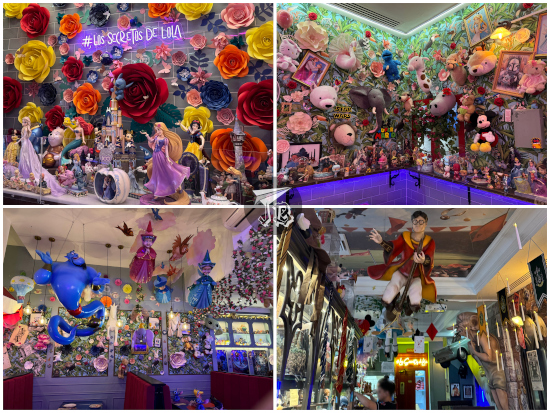
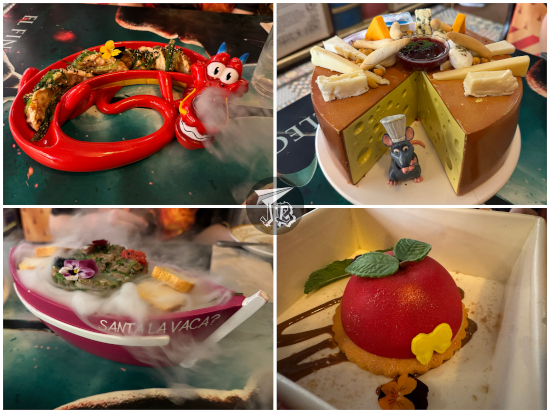
Afterwards, we headed out to the restaurant for our 13:30 reservation. The place is called Los Secretos de Lola (Lola’s Secrets ). It used to be just another bistro-grill in a street full of them, but some time after the pandemic, it reinvented itself. The restaurant has slowly turned into a Mecca of childhood mementos – Disney princesses, teddy bears, Harry Potter, Funko Pops… and crazy fun references like a Möet&Chandon spray to clean the tables. A lot of the food comes in a special piece of dishware – most of it Disney, but I can’t tell whether it’s actually licenced or a bunch of knock-offs. It was hilarious anyway. Though I am not much of a Disney person (my sibling is), my favourite film of theirs would be Mulan, and I just about lost it laughing when I checked the menu beforehand – I saw that they served gyoza in a Mushu-like dish, and decided we needed to order that. I was open to negotiation about anything else, really, but not the gyoza. The pasta in the Lady and the Tramp dish was also hysterical, but I could do without.

We reached the restaurant on point, and the owner directed us inside. We got a really cute Stitch table, but my sibling was not comfortable on high chairs, so we were accommodated at a Harry Potter one. We shared the non-negotiable teriyaki prawn-and-vegetable gyoza with wakame and bean sprouts, served on a Mushu-plate: Gyozas de gambas y vegetables al teriyaki, a plate of cheese Tabla de quesos variados (Blue cheese, Havarti, Mimolette, Emmental, Basilio, butter and breadsticks, on a Ratatouille’s Remy plate, which I had also found adorable) and a bluefin tuna tartar Tartar De Atún Rojo (on a little boat – I asked for no mango, and it was honoured; this was probably the weakest dish though). Finally, I tricked my sibling into a dessert called “Snowhite magic apple” Manzana Encantada Blanca Nieves: red chocolate capsule with white Kinder and a heart of caramel sauce, which came in an adorable “present box”.

Decoration: Los Secretos de Lola

Food Los Secretos de Lola

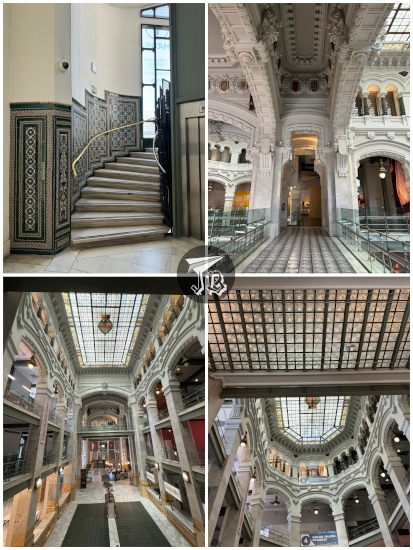
The food was good, and I really like themed restaurants, I guess, even if they are not “my” theme. We did not stay for the two hours, I think we were on our way after an hour and a half – and when we asked for the check, it came in a Frozen music box. Then, we left towards Palacio de Cibeles, the old “communication palace” of Madrid, designed by Antonio Palacios and Joaquín Otamendi, and erected between 1907 and 1919. It is considered one of the first and most important Modernist buildings in Spain, constructed in biocalcarenite, with three stained-glass skylights, catwalks on the third floor, and a magnificent lookout on the rooftop. Part of the building is being used by the town hall, the other by the public entity CentroCentro, which runs cultural activities in the open spaces – mostly conferences and exhibitions.

Palacio de Cibeles

We arrived a bit before 16:00. Since we had a ticket for one of the exhibitions at 17:30, we checked whether we could find a ticket for the rooftop. We found available slots at 16:30, which was great. Before the viewpoint access, we had time to wander around. Most of the free exhibitions were of modern art, and not that interesting, and I was more focused on the building itself. There is one dedicated to the World Heritage site Paisaje de la Luz, explaining why the area deserves its UNESCO place.

We found the staircase to one of the towers and we used it to move it through the different floors. It is a spiral staircase around the lift, with Palacios’ typical green tiles similar to the ones he used at Maudes hospital and Chamberí station. The catwalks were paved with glass tiles, and it was quite impressive above all. I loved the building, but after all, Palacios is one of my favourite architects, so it was to be expected.

Inside Palacio de Cibeles

Then, we went up to the rooftop, where we could have a view of all of Madrid around us, most interestingly one of the main arteries of the city – Gran Vía. The weather was great, maybe a bit too bright. The turns were 30 minutes, but we were done in about half the time, after taking two walks around the middle tower.

Lookout on the rooftop of Palacio Cibeles

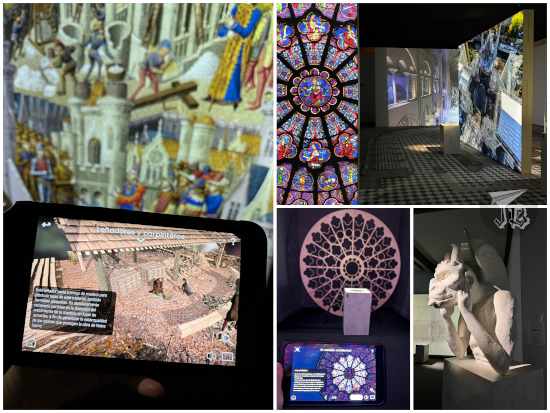
We went down and sat for a little before we headed down to the basement to see “Notre-Dame of Paris: The Augmented Exhibition” Notre-Dame de Paris: l’Exposition Augmentée. It was only 3€, so I was not expecting much, but it actually blew my mind.

The experience was created by the company Histovery, which specialises in “virtual exhibitions” through an interactive tablet called “HistoPad”. The Public Entity in Charge of the Conservation and Restoration of Notre-Dame de Paris cooperates with the event, and the beauty company l’Oreal is a sponsor. The exhibition (which is simultaneously running in several parts of the world) follows the history of the Parisian cathedral Notre-Dame de Paris – it starts with the 2019 fire, which is a bit heart-wrenching, and then it covers a few key moments in the history of the cathedral, using a mixture of written information, videographs and a “treasure hunt” where you have to find pieces of a puzzle hidden within the virtual information. This is done using the tablet to scan 21 “time portals” that take you to a particular point in history.

Around 1160. The Dream of a Builder. At that time, Bishop Maurice de Sully came up with the idea to build a new, better, cathedral in Paris. The previous one was a smaller, Romanesque building, but the goal was a larger, architecturally impressive building. In this room (the second, actually, but the first chronologically), you find out about the “treasure hunt” – you need to find a number of hidden “light spots” to build a “stained glass window”.

Around 1180. The Gothic choir. This makes a small overview of the kinds of workers that helped in the construction, the kinds of stones, building materials – quarries, forests. I was extremely disappointed at this point when I came across a dog in the virtual quarry, but the program did not let you pet it.

1241. The Holy Relics: Louis IX, the future Saint Louis, bought the Crown of Thrones in Jerusalem and brought it to Paris. There was a great procession into Notre-Dame, where the relics were to be kept. Here there’s a spectacular recreation of the gates with the original polychrome sculptures and decoration.

1645. The Royal Promise: Widowed Queen of France explained to her son, future Louis XIV, that he was to renovate the choir of the cathedral and build a new altar, dedicated to the virgin Mary. This was the original splendour of Notre-Dame, before the French revolution broke out – the church was one of the targets of the revolutionaries, and a lot of the art was damaged and / or destroyed.

1804. The Imperial Coronation. After the French Revolution, Napoleon crowned himself “Emperor”, but a very “equal and revolutionary” Emperor. He held a ceremony for himself in Notre-Dame, with the presence of the Pope and everyone who was anyone in the totally equal new society.

1857. The Spire. Enter Viollet-Le-Duc, a major architect and restorer in France’s 19th century, whose theories influenced countless others. He revalorised gothic style in the country, managing to turn it into a “national style”. The man had the goal to restore and create buildings in “the gothic style that would have been if the Medieval workers had had the technology he had access to”. Historians have not been kind to him, accusing him of “inventing” stuff instead of “restoring” but kudos to him, he managed to make a lot of buildings survive to our time. In Notre-Dame, he is responsible for putting back a lot of the sculptures that were destroyed during the French Revolution. He also built the spire that famously collapsed in the 2019 fire.

2019-2021 (first and last rooms). A description of the restoration works that have been happening in and outside the cathedral since the fire, with special attention to the Paris firefighters who worked the incident. There is a very interesting part about safely removing debris and the original scaffolding, and the fact that there was a lot of lead in the cathedral that the workers had to be safe around. They also homage the “vertical workers” who had to remove collapsed pieces from the ground… hanging from ropes.

Notre-Dame the Augmented Exhibition

We completed the stained-glass window and signed up to get a diploma. The fun part is that most of the exhibition was not really… even physical. There were a few posters, a reproduction of one of the chimaeras, some small models… Nevertheless, it was extremely interesting – possibly the best “virtual exhibition” I’ve seen to date. The length of the experience is said to be 60-90 minutes… we stayed from 17:30 to 19:45, much longer than I had anticipated! Thus, we had to forfeit the last plan of the day to go back to the train system – which of course was experimenting delays. It took forever to get home. Because what else is new?

Time-traveller diploma after completing the treasure hunt in Notre-Dame the Augmented Exhibition