In general, I’m not a fan of guided visits, but I’ve learnt to accept that they are sometimes the only way to get access to several monuments. Thus, I signed up for the free* “themed visit” about Ricardo Velázquez Bosco in Guadalajara. The route was organised by the town hall to commemorate the centennial of the architect’s death in 1923 (I know it’s 2024, the activities started in 2023, but they spread through January).
Velázquez Bosco is considered one of the most important architects in the Spanish late-1800s – early-1900s. Among his works are the Spanish Crystal Palace and the Madrid mining school. His style has been called “emphatic eclecticism” and described as eclectic historicism with academicist tendencies – which basically means that he did not like Modernism, and preferred combining historical styles instead.
In Guadalajara, he worked for the most important noblewoman of the period – the Duchess of Sevillano and Countess of La Vega del Pozo, María Diega Desmaissières y Sevillano (Duquesa de Sevillano y Condesa de la Vega del Pozo). The Duchess lived in Madrid, but was connected to Guadalajara through her aunt, Catholic Saint Maria Micaela, founder of the nun order known as Handmaids of the Blessed Sacrament. The Duchess of Sevillano (known in town as “the countess”) had a lot of buildings erected in Guadalajara and around it, most of which are now private property and have a very-limited-to-inexistent visit regime. The town loved its countess since she commissioned (also to Velázquez Bosco) the farming hamlet Poblado de Villaflores – the construction and subsequent agriculture and livestock activities created a lot of work in the area.
To honour her aunt’s charity work, the Duchess ordered Velázquez Bosco to build a school and an asylum, and though she never really lived in Guadalajara, she commissioned him to build her a palace when her Madrid home was expropriated. She never got to live there, as her heart failed in Bordeaux at the age of 64. She was buried in Guadalajara, in a pantheon that she had also ordered the architect to erect for her.
Today, both the asylum and the palace are schools, and cannot really be visited. The pantheon is privately managed by a private foundation Fundación San Diego de Alcalá, which also manages one of the schools, the adjacent gardens, and the church of the former convent.
The first stop of the visit was the pantheon Panteón de la Duquesa de Sevillano. It is a small eclectic building, the inside is a Latin cross, the outside is a homage to the First Romanesque buildings, with neo-Gothic ornamentation. The characteristic purple dome and the interior mosaics are of Byzantine influence. The crypt is a false one, as the pantheon is reached by climbing up a monumental staircase, so when you “go down” to the crypt, you are actually at ground level. The Duchess’ sepulchre, carved in marble by modernist sculpture Ángel García Díaz, represents the funeral procession. We had to pay 1 € in order to visit the pantheon, as there was no agreement between the town hall and the foundation.


We then were taken to another of the foundation’s buildings, the school Colegio Niña María Adoratrices. Today is a semi-private Catholic centre run by nuns from the congregation founded by Saint Maria Micaela. The school cannot generally be visited, so I was glad this worked out. The school building was erected in red brick, with a white limestone façade echoing the Renaissance building of the University in Alcalá de Henares. The school used to be a convent, and there is a restricted cloister. Legend has it that the cloister is only open for wedding photographies to brides who studied at the school. It is square, with two stories of neo-Romanesque arches and columns with vegetal decoration. We were also shown the chapel, with neo-Mudéjar panelling on the ceiling, and the monumental staircase.


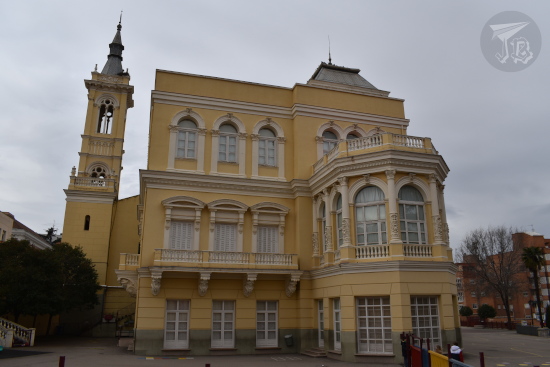
Finally, we walked to what was built as the Duchess’ palace in Guadalajara, Palacio de la Condesa de la Vega del Pozo, today another school, Colegio de los Hermanos Maristas, also Catholic and semi-private, and extremely difficult to visit. We were shown inside and got to see the actual outline of the palace. Inside, we saw the panelling and the ceramic decoration before we reached the inner patio, a mix between Castilian and Andalusian styles.
We then visited the smoking room upstairs, an astonishing ward with ceramic tiles decoration and wooden floors. As a last snoop, we could peek into the balcony, which keeps the original cement-tile (baldosa hidráulica) floor. It was extremely impressive – and one can forgive the horrible pale yellow exterior the palace has been painted. Ricardo Velázquez Bosco was one of architect Antonio Palacios’ teacher, and I had the feeling that Palacios took his ideas for the Fundación San Diego de Alcalá, Panteón de la Duquesa de Sevillano, Colegio Niña María Adoratrices, Colegio de los Hermanos Maristas, Maudes hospital from the walls and floors of this palace.

The visit took around two hours, and it was free except for the pantheon. Being able to see the inside of both schools was the best, because it is rare that visitors are allowed in either. Thus, I am glad I signed up for this, especially as the weather held – we had a tiny bit of drizzle, but not much, and the clouds kept the cold at bay.
 JBinnacle – A Travel Logbook