30th June 2024: Engines, illusions, history and tea (Madrid, Spain)

Since finding about my tea time outings, my sibling had been wanting to tag along to one. I was asked to organise something for the weekend that involved either Chinese hotpot or afternoon tea in Madrid. The hotpot place was booked out both days, but I found an afternoon tea opening on Sunday the 30th. I am too lazy to move out just for tea, so I organised a bit of a day out.

After an uneventful train ride, our first stop was at noon: Nave de Motores de Pacífico, the former energy centre that fed electricity to the original underground lines. Today, it is not in use and it has become part of the network of museums Museos Metro de Madrid. The warehouse was built by Antonio Palacios between 1922 and 1923 to home the diesel engines, transformers and fuel that single-handedly powered the underground system before the Spanish Civil War. The system was actually in place until 1972.
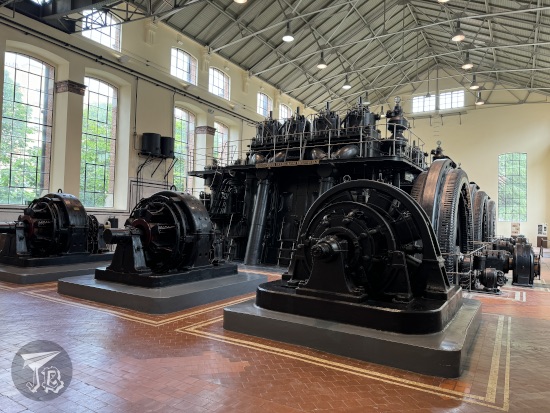
Warehouse containing the old underground engines

The building was erected in red brick, with white tiles inside, decorated with Palacio’s typical metallic green. The floors are ceramic tiles, and the engines are three monstrous vessel-powering pieces of engineering. These diesel engines created electricity, which then entered the transformers, and was sent to the power lines to feed the trains. At night, the excess was sold to the local street-light network.

Since we were going for afternoon tea to El Jardín de Orfila, where I have been before, I knew lunch was out of the question. However, we needed a snack. I planned that at Yatai Market, an… Asian food court of sorts. A number of stands come together to offer different cuisines and snacks, even full-sized meals. We tried a Chinese bao each and a couple of dim sums. I ordered a hoisin duck bao which was extremely yummy. I will definitely come back to try other stuff.

HotBao Yatai Market Cortezo

Afterwards, we headed off to the so-called Museum of Illusions. This museum is a compendium of optical illusion and installations designed to fool the brain into believing things that are either wrong or just not there: a distorted room so you look big in one corner but small in the other (Ames room), a vortex where you seem unable to walk straight, a rotated room, a room full of mirrors – there were a lot of illusions with mirrors actually – stereograms with hidden images, turntables, holograms…

We had a reservation for 14:00, and I was surprised at how chaotic entry was. I mean, they’ve been running the thing for a while now, someone should have figured out how to do crowd management, but no. Then, there were kids running and screeching all around, but it calmed down after a while. I had really hoped that the museum would be calm and half-empty at lunch time, but it was not so, not by a long shot. It was interesting though, and pretty fun.
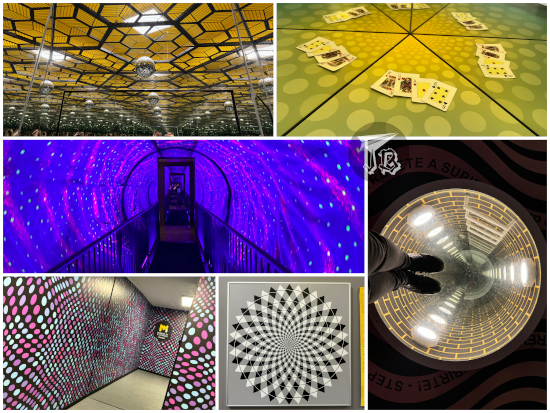
Museum of Illusions Madrid

However, the experience was shorter than I had calculated, so I had to improvise an extra stop. Thus, we entered the local history museum Museo de Historia de Madrid, which tells the city’s history since Madrid became the capital of Spain. There are paintings, models, typical costumes, plans, maps, and Playmobil sets depicting of the uprising against the French in 1808. The museum is hosted in a former palace-like building which was actually built as a hospice. To the side stands the original Baroque chapel. It also has a lovely garden with a monumental fountain, which was relocated from its original place for conservation.
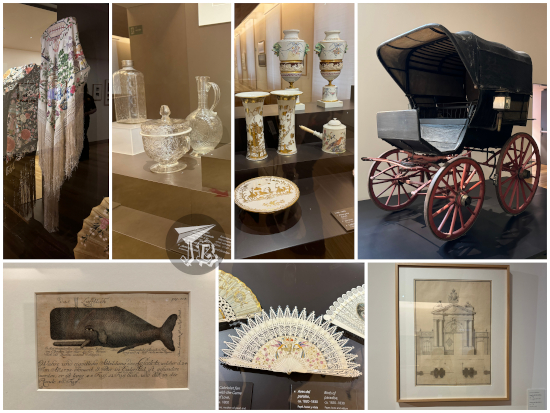
Museo de Madrid exhibits

Museo de Madrid - chapel and fountain

We spent some time there and then headed off to the building that now holds the office of the Copyright Owners’ association, a manor known as Palacio de Longoria. It was designed by José Grases Riera and built between 1902 and 1904. It is one of the few actual Art Nouveau buildings in Madrid, possibly the most important one. The façades were made in artificial stone, with sculptures and shapes resembling vegetation. I’ve wanted to visit it for a long time, but it is only open when there is an exhibition, and the stars had never aligned – until this time. There was an exhibition about urban music, and I was not going to let go of the chance to see the monumental staircase and the skylight.
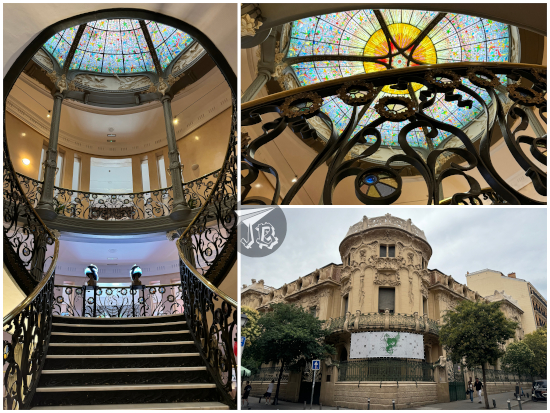
Longoria Palace

We finally set off for afternoon tea at El Jardín de Orfila. Out of the several places I’ve tried afternoon tea in Madrid, this has been my favourite to date. The outside garden is lovely, but mostly, their scones are the best around.

We ordered green tea, and the snacks were finger sandwiches – smoked salmon and cheese cream, classic cucumber and cheese, pastrami – pastries – carrot cake, macarons, lemon curd – and the scones. This time round, I decided to eat the scones after the sandwiches in order not to be full when it was their time. The afternoon was pleasant, but we shared the terrace with another table, and later a loud lady who wanted a smoke. That broke the magic a little, but the tea was fantastic and the scones were great.
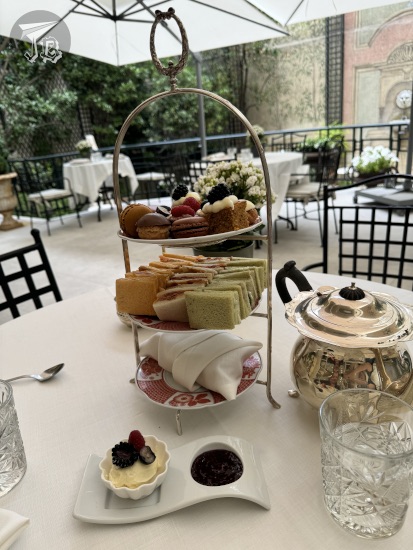
El Jardínde Orfila: tea serving for two

Afterwards, we just headed for the train station to get back to our places. Of course we missed the correct one since they run whenever they like. What else is new? But the fun part was being able to pull a fun day out from my sleeve, and it was not stupidly expensive either, so good fun, all in all!

14th May 2024: Three Museums and Tea, Madrid (Spain)

On a whim, I put together a plan for Tuesday, as it is currently my free day. I was too lazy to drive, so I decided to catch a train to Madrid. There was a temporary exhibition I wanted to check out, and it was close to several museums and eateries.

My first idea – breakfast at a French crêperie – went bust, because the place was still closed when I arrived in town – I swear, this is like the fourth time I try to have something there, and it just won’t work. Instead, I ended up at a Starbucks for breakfast, before heading out to my first destination – the exhibition The Art of Manga, held in the Architecture Bar Association building Colegio Oficial de Arquitectos de Madrid, COAM. The Art of Manga is a small exhibit that runs through the history of manga – Japanese comics – with a few snippets of what it was and what it has become, especially in Spain.

The entrance was a sort of tunnel with manga sheets hanging from the ceiling. It ended at a traditional scroll with animals acting like people – Chōjū-jinbutsu-giga 鳥獣人物戯画, which translates to “Animal-person Caricatures”. Some people consider that this is the origin of manga (note the “ga” at the end), though if there is one thing that the exhibition makes clear, it’s that nobody knows when manga actually started. Thus, it just runs through all the possible theories and important names. From the Edo Period, there were a few wood prints (ukiyo-e) – which are claimed to be original – among them two by Katsushika Hokusai [葛飾 北斎], The Great Wave off Kanagawa [神奈川沖浪裏, Kanagawa oki nami-ura] and Fine Wind, Clear Morning [凱風快晴, Gaifū kaisei]. Hokusai is another of the supposed starts (“the father”) of manga. There were also a few toba-e [鳥羽絵], similar to the first scrolls – for the first time in the evolution of drawings, there was text alongside the art. Then came the books, where texts dominated – though there were still drawings – and they became extremely popular during the period.

With the end of the isolation of Japan, Western influences – mainly comics – influenced local artists, and “speech bubbles” appeared. In the late 19th and early 20th centuries, Kitazawa Rakuten [北澤 楽天]’s works were published in newspapers. He is (also) considered the father of modern manga, and several of his works are displayed. There are also early 20th-century scrolls, painted in a style similar to toba-e depicting the Tokaido Road, which separated Edo (old Tokyo) and Kyoto, and its checkpoints. There were also kamishibai [紙芝居] cards – kamishibai is a traditional form of theatre involving telling a story using a narrator and different “postcards” with images drawn on it.

In the middle, the exhibit had a rock garden, and a torii gate with a lot of lanterns gave way to the second part – modern manga. Here there were pieces and mementos from famous artists and works – Osamu Tezuka [手塚 治虫], known as “The god of manga”, and one of the driving forces of anime. According to the exhibition, they were showing all of his works. There was a bit about Shigeru Mizuki [水木 しげる], and big international hits like Sailor Moon, Naruto, Dragon Ball and One Piece. After a screen showing a video about a cosplayer – which I did not care much about – there was a section on manga magazines, some of the early manga published in Spain, and a stand where you could get some stamps.

Snaps from The Art of Manga Madrid

Finally, there was a bit on merchandising and figurines. The shop did not even have a catalogue, which I would have bought. All in all, it was all right, smaller than I had expected.

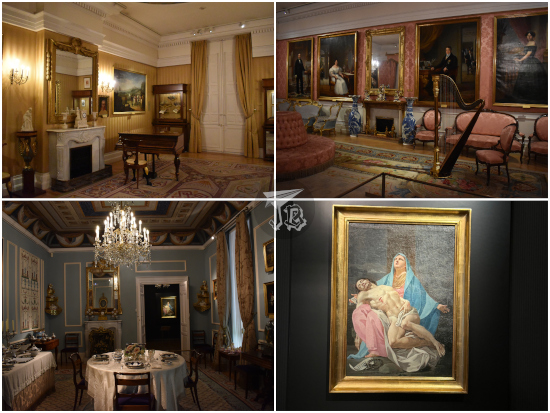
Then, I went to the nearby museum of the Romantic period, where I got a national museums card – I’ve been wanting one for a while, but unfortunately you still have to queue to use it. I had hoped you could just walk into museums with it, but I guess crowd control is a thing since Covid. Anyway. The Romanticism museum, Museo del Romanticismo is a small palatial residence which tries to recreate the ambience and atmosphere of the dwellings of the bourgeois families at the time. It had a lot of nice furniture, similar to the one in Riofrío, but I found it lacked on the landscape paintings I like. The museum is currently exhibiting an early painting by painter Francisco de Goya, a Pietà.

Museo del Romanticismo Madrid

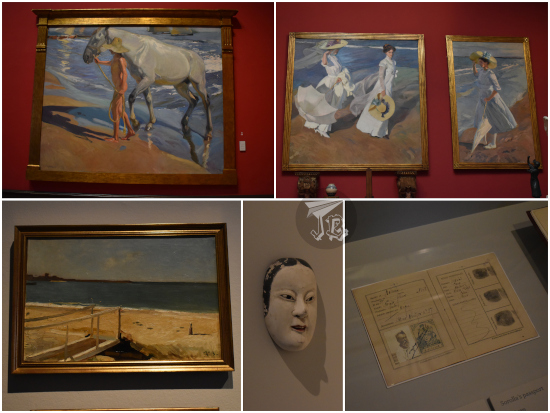
Afterwards, I headed out to line for the Sorolla Museum Museo Sorolla. I had to queue for nearly 40 minutes, but I was finally admitted in. Joaquín Sorolla (1863 – 1923) was a generally-impresionist painter (impressionist, post-impressionist and luminist) from Valencia. The museum was built in the artist’s own house, completed with some of his iconic artworks, including Paseo a orillas del mar, Walk on the Beach, and El baño del caballo, The Horse’s Bath. Sorolla excelled in portraits and landscapes, especially the sea side, and social criticism. He was a master depicting light, water, and the combination of both. He became one of the most important Spanish artists of his time – and probably the most famous. He participated in the Paris Universal Exposition of 1900, and was invited to exhibit his art in New York City.

Furthermore, there was a current exhibition called Sorolla in 100 objetos – Sorolla in one hundred objects – which had just opened to the public. It included personal items the artist collected, – some a bit bizarre–, photographies, his passport, the last painting he worked on, the medal he received from the US president, a photograph of his studio in Italy…

Snaps from Museo Sorolla

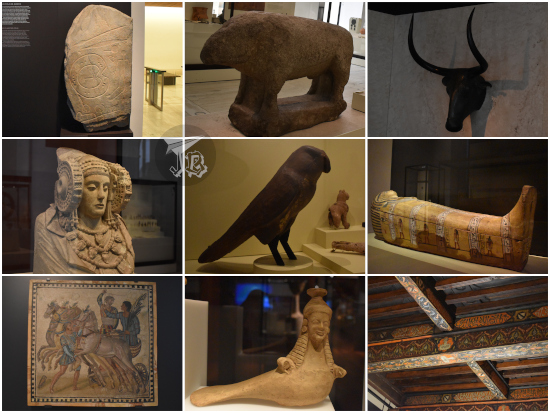
I then went off towards the archaeological museum Museo Arqueológico Nacional. I used to love this museum – when they remodelled it and they made it all modern and aseptic, it lost most of its allure. Of course, I still enjoy it, as the important items are the exhibits, and the museum has a lot of important items from the Celtiberian cultures – Celts and Iberians inhabited Spain before the Roman conquest, which started in the 2nd century BCE. Iberians were prevalent in the east and south of Spain before their arrival. The north and west were populated by the Celts, and there was a vague area in-between whose people have been called Celtiberian. the Talaiotic culture flourished in the Balearic Islands, and it has recently been declared World Heritage. These cultures were eventually assimilate by Romans, but Celts lived on elsewhere. Iberian and Talaiotic cultures, however, diffused with time. Today, there is little known about it, and most is just interpretation from archaeologists, even less about the more ancient tribes that lived in the areas during the Bronze Age.

Among the objects from pre-Roman Spain, there are mysterious steles from the late Prehistory. However, it is the Iberian funerary art which stands out the most – such as the bust called the Lady of Elche, La Dama de Elche, found in the town of the same name, and the full sculpture named the Lady of Baza La Dama de Baza. Both are fantastic, to the point that it was thought they were Hellenic for some time. Other items include bulls – both metal cattle heads with wide eyes, and vaguely-shaped stone sculptures, verracos. I remember going to the museum when I was little, and the importance of these bulls, called “Bulls from Guisando” Toros de Guisando was drilled into my head, to the point that I thought that the ones exhibited there were the only ones – it also made me sad that they were in the museum and not in the field where they had been found. I was petrified when I learnt, years later, that there are a bunch more…

The museum also hosts a nice collection of Moorish art, and what apparently is a special Egyptian exhibit, as Spain worked with Egypt during the 20th century, and got a lot of objects from that excavation from the Egyptians “in the split of the new discoveries”. I am not sure whether that’s accurate, or the story has a lot of make-up on. I had to leave around 16:15, but as this museum is also covered by the national museums card, I can come back any time within the year for free. I skipped most of the Medieval period.

Museo Arqueologico Nacional Madrid

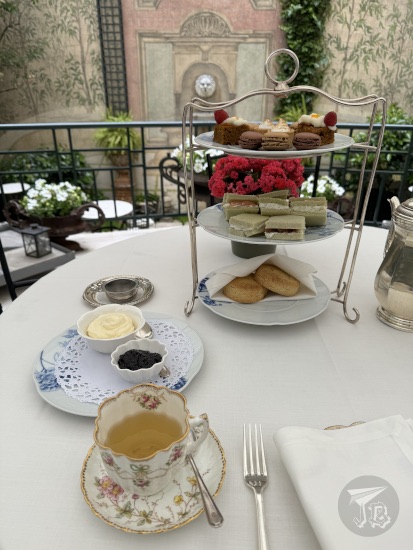
I had a reservation for afternoon tea a few minutes away from the museum, at 16:30 – I might be doing a bit of a rally around all the places in Madrid which have it. This time around, I went to El Jardín de Orfila – and good thing I had decided to only have breakfast and skip lunch and go straight from breakfast to tea. I was seated in a lovely outward area and I chose a delicious green tea with cherry. The food was plenty – finger sandwiches: pastrami, salmon and cucumber and cheese cream; macarons, carrot cake, meringue, and scones, along with clotted cream and berries jam. It has probably been the best afternoon tea I’ve had in Madrid up to date. The scones were a bit under-baked though.

Afternoon tea at El Jardín de Orfila

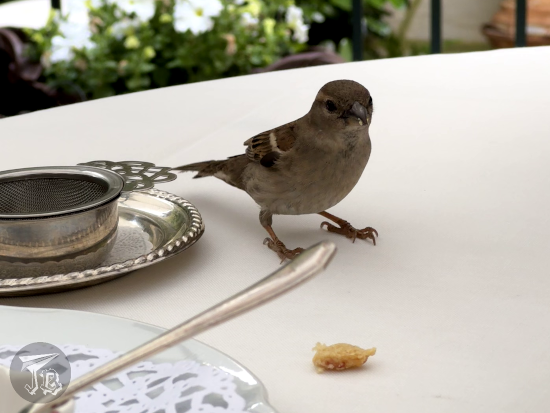
I was alone in the outer area for most of the experience, the waiter checked on me once after bringing my tea. It was actually so calm and quiet that I had a visitor – a little house sparrow (Passer domesticus) was very interested on the remains of my scone, so I shared with her. She was happy after two crumbs, and left – or maybe it was because another couple walked into the area.

Sparrow hopping towards a scone crumb

I left a bit before the two-hour timeslot was up so I could catch a timely train home – and because the couple came in, talking loudly, and kind of broke the spell.