There have been a lot of witches dripping into mainstream pop culture these last couple of months, what with Disney + / Marvel’s Agatha all Along and (half of) the musical Wicked released as a film. So when I read that the National Museum of Archaeology was running a special guided visit to the exhibition “Between Chaos and Cosmos: Nature in Ancient Greece” Entre Caos y Cosmos. Naturaleza en la Antigua Grecia and part of the permanent exhibition called “Nature, Magic and Witchcraft” Naturaleza, magia y brujería I thought “hey, the Heritage people are catching up with the times!” That day there actually were two guided visits, and the second one was centred around the sculpture Il Pugilatore. One was at 12:00, and the other one at 17:00, so they could be combined – hey, they were free, I just had to find something to do in-between.
Thus, I booked both visits and headed out to Madrid. I got to the archaeological museum Museo Arqueológico Nacional with ample time due to my distrust of trains. As I have the museum card, I decided to just walk in and wait for the time safe from the cold and the rain – and since it had just opened, from the crowds too. Though the ticket said to wait at the meeting point, the museum staff directed me somewhere else, and that is where I sat to wait ten minutes before the starting time. Apparently, a bunch of people did not get the information so when the time came we were few… and promptly joined by about half of the group once we had started.
The first visit was “Nature, Magic and Witchcraft” Naturaleza, magia y brujería. It started at the exhibition Entre Caos y Cosmos. Naturaleza en la Antigua Grecia – “Between Chaos and Cosmos. Nature in Ancient Greece”. As we walked in, the staff scanned a ticket and gave it to us.
The guide made a small introduction to Greek mythology with an emphasis on pre-Olympian “Chaos”. He mostly spoke about hybrids, such as satyrs or harpies, psychopomps (creatures that take souls to the afterlife after death), like Echidna, Cerberus, and the sirens. He also seemed to like the deity Achelous a lot. Achelous [Ἀχελώϊος] was the personification of one of the Greek rivers, a son to the Titans Tethys and Oceanus, and father of the sirens. He was able to shape-shift and would often be represented with small horns as he could turn in to a bull.
Regarding witchcraft, there is a small room in the exhibit about it, and the guide pointed out the concept of sisterhood, and some of the small artefacts and glass carafes. He mentioned the figure of Medea as the greatest witch in Greek mythology. That surprised me, because I had never associated her primarily with magic – I knew her from the Jason and the Argonauts myth, in which she originally helped Jason find the Golden Fleece, but she eventually killed the children they had together when Jason dumped her. Glad to know there was more from her than just being a “crazy lady”.
Afterwards, we moved onto the permanent exhibition. Unfortunately, the tickets we had been issued would not work any more because… reasons. Apparently, they could only be scanned once, and they had already been scanned at the exhibition. However, the person guarding the gates would not let us through without having a ticket beep – despite being with a member of the museum. It was solved quite quickly, but it gave off the feeling of everything being very disorganised.
In the permanent exhibition we mostly saw Talayotic and Iberian talismans and jewellery, then we moved onto the Roman area, where he mentioned the laws regulating the Augurs (people predicting the future), and some small curse tablets that the Romans slipped into each other houses when they were vexed – curses. All in all, the visit did not feel very on topic, just a number of objects vaguely connected together by a weak narrative. And witchcraft was the weakest topic, so it seems that the heritage people have not really caught up with the times. Oh, well.

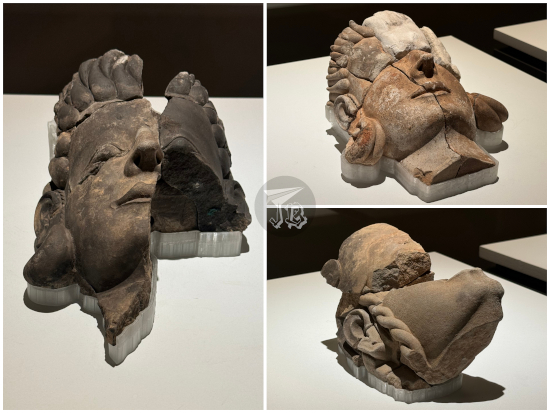
Before I left the archaeological museum, I dropped by the new “archaeological news” room (Sala de Novedades Arqueológicas). Currently, it holds the exhibit Rostros del Turuñuelo. Los relieves de Casas del Turuñuelo. Guareña, Badajoz – a name larger than the exhibit itself: “The Turuñuelo faces. The reliefs from Casas del Turuñuelo, Guareña, Badajoz”. The Turuñuelo, or Casas del Turuñuelo, archaeological site corresponds to the Tartessian culture – a mix of Palaeohispanic and Phoenician traits which flourished in the south and east of modern Spain (and a bit of Portugal) between the 11th and 5th centuries BCE.
The exhibit is a collection of five faces dating from the late period, found within the ruins of a two-storied building. It seems that the building and everything within were destroyed, set on fire, and buried intentionally. It is possible that the faces found belong to sculptures that can be recovered amongst all that material. The faces, discovered in April 2023, are the first and only human representations associated to the Tartessian culture.
After the visit, I went to have lunch. There is this place I have wanted to visit for a while and it has never panned out. I would have actually wanted to have breakfast there, but whatever – this was doable and convenient. Located near the French Institute, it is a crêperie called Prep’ La Crêpe – it would make sense to think they’re French, but in reality they belong to an English franchise. I ordered a basil crêpe classique (melted cheese, mozzarella, tomato, basil and Mediterranean sauce), a Kick-start smoothie (orange, carrot and ginger), and a Belgian (black) chocolate crêpe sucrée for dessert. All in all, it scratched an itch that I had had for a long time, and it was not bad. A bit on the pricey side, I’d say, but what is not expensive these days?

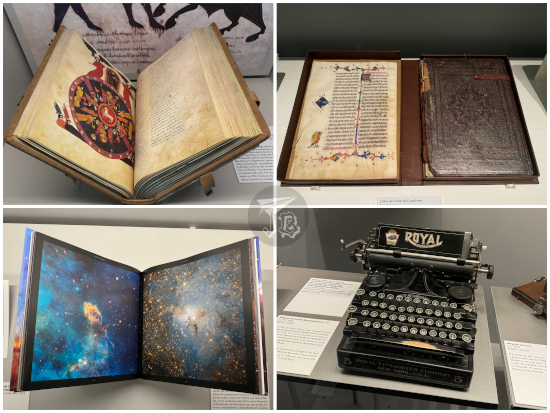
Afterwards, I still had a bit of time so I decided to go into the National Library Biblioteca Nacional de España, where they had transformed the book museum into something called “Hell and Marvels” El Infierno y las Maravillas, which runs through the history of printing and knowledge (marvels), then the history of book banning (hell). The exhibition continues with thoughts on how information is preserved, in books and other formats. Finally, the museum is hosting two special exhibits, one around the writer Gonzalo Torrente Ballester Gonzalo Torrente Ballester, la travesía de un creador, and a collection of historical documents belonging a noble family El archivo del Conde de Orgaz. Una ventana a la historia. The archive was really interesting, with a lot of privileges given to the family by successive kings of Spain. The former count was a member of the Friends of the Library, and the exhibition is a homage to him, aside from showing documents dating back from as far as 1220.
I then went back to the archaeological museum Museo Arqueológico Nacional for the second visit, with another long title Il Pugilatore y la escultura monumental en el Mediterráneo Occidental Antiguo: Cerdeña, Baleares y la Península Ibérica “The Boxer and monumental sculptures in the ancient Western Mediterranean Sea”. The sculpture Il Pugilatore, one of of the Nuragic giants found in the Mont’e Prama archaeological site in Sardinia, Italy. This ambassador giant, who travels the world to introduce people to his culture, is called Manneddu, and he is the statue in best conditions. He would have had a glove in his hand, and a dagger pointing forward, and his chest would have been painted red.

The guide explained that these sculptures – archers, warriors, wrestlers and boxers – were supposed to be armed, but no weapons from either the period or the culture have ever been found. The giants were found, purposely moved and destroyed, in a necropolis for young men. The sculpture also had “little brothers” with the same poses, made in bronze, which have been preserved. That is how the archaeologists know the different weapons and stances they had. The giants are considered the first monumental anthropomorphic sculptures in the coasts of the western Mediterranean Sea, and the only ones in Sardinia.
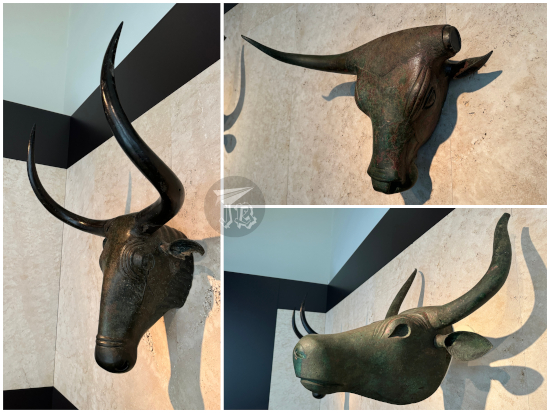
We also heard about the similarities between the Nuragic towers, which were used for water management and as meeting points, and Talayotic ones in the Balearic Islands. Then, the guide ended up talking about the bronze bull heads that represent Talayotic cultures, and insinuating that they might have been brought from somewhere else…
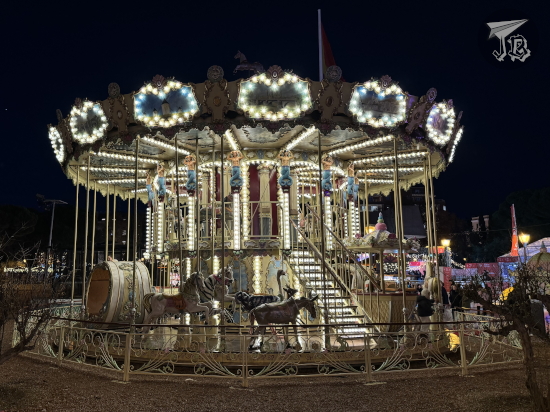
The visit ended there. I then wandered around the museum for a little longer, then checked the Christmas market – and a classical merry-go-round similar to what I rode the previous week. Since it was dark already, the lights were on, but it was raining on and off, so the weather was not nice enough to wander around for long. Thus, I headed to the train to get home.




 JBinnacle – A Travel Logbook