31st March 2026: Euphoria, Shanghai Mama, and 103 Years of Magic (Madrid, Spain)

I was on break for Easter, and my sibling, who works in Madrid, proposed to “have lunch and whatever”. That usually means that they want me to find a good place for lunch, and a plan for “whatever” afterwards. The original plan was Monday, but way too many things were closed on that day, hence we rescheduled for Tuesday. I organised two “whatevers” – one for myself, one to do with them.

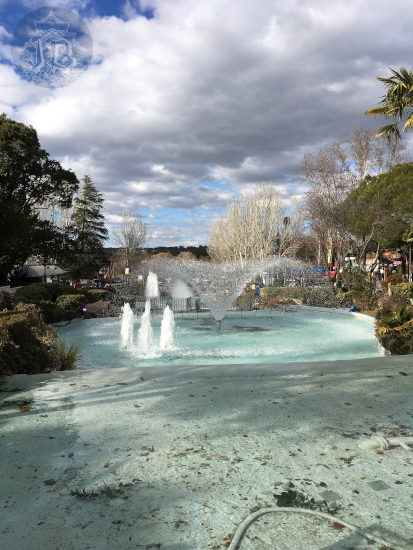
I took the train towards Casa de Campo, and I actually made an earlier train than I had calculated. I was at the final underground stop around 9:15, so I had 45 minutes to explore around before my 10:00 ticket. The park known as Casa de Campo was established as royal hunting grounds in 1561, under the reign of Felipe II (Philip II). It was at the time designed by Juan Bautista de Toledo, who divided the area in three parts – orchards, gardens and the actual hunting grounds. In 1656, engineer Pietre Jansen established the large pond in the centre, Lago de la Casa de Campo. Later royals would add modifications for their own enjoyment until the area was open as a public park in 1931, during the Second Republic. In 1997, it was declared historical park (Parque histórico). Today, the Madrid Zoo and the Amusement Park are located within its grounds. It also hosts an area for travelling exhibitions, Escenario Puerta del Ángel.

I’ve always wanted to explore the park a little, and this was my chance. There are several constructions of historical importance there. Beside the lake, which was already teeming with sportspeople, the first one I found was the aqueduct Acueducto de la Partida, a former waterway that carried water from the lake to one of the orchards. I also saw the former house to breed pheasants in, and the forest around it – La Faisanera and Bosque de la Faisanera – but mostly, I wandered around, scaring a bunny or two.

Eventually, I headed towards Escenario Puerta del Ángel where Euphoria, a new exhibit by the Balloon Museum had just opened. The first time I had been to one of their exhibits I had not known what to expect, but this time around I was ready. The Balloon Museum specialises in immersive artworks (each of them can take up a whole room), most of them created with inflatables and light. You can touch and play and be silly with a lot of them too.

The artworks displayed, and a bit about them, are:

  • One Hundred and Twenty by Nils Völker. A short corridor flanked with garbage bags that inflate and deflate as if they were breathing. A bit unsettling, so I am glad that was the first one and I could leave it behind.
  • My Room Is Another Fish Bowl by Philippe Parreno. A room full of helium balloons in the shape of fish and seahorses that you could play with as they floated gently along the room. This was very cute – but I guess I like fish.
  • Follow Me, I Think I Know the Way by Camille Walala. It was like a kid’s monkey jungle but made of inflatables. I wish I were younger and could climb on them.
  • Invisible Ballet by Hyperstudio. A room full of balloons that floated around at the centre. You could stand amongst them as they move and turn and the wind messes with your head (and the balloons hit you on the face, of course). This had a very pretty, but mostly hilarious, effect.
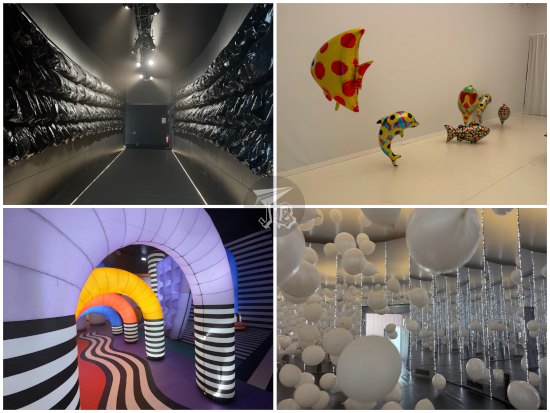
Collage - balloons in different shapes, including a bridge-like structure

  • Ovoids by SpY. A bunch of egg-like giant… things that gently swayed from the ceiling, making it a bit (actually very)… creepy.
  • Work No. 3883: Half the air in a given space by Martin Creed. A greenhouse full of huge blue balloons that you had to cross, it was like an adventure. Of course I went in, who do you think I am?
  • Our Floating by Alex Schweder. A round bed-like structure you could sit and lie on as it inflated and deflated randomly so you kept falling and rising. A welcome break, and giddy fun to flop down on.
  • ADA by Karina Smigla-Bobinski. A big… bouncy ball with charcoal pencils attached to it. You could push it or let it float around, and as it hit the walls it drew random lines on them. This was stupidly fun, but it did stain your hands – and whatever else it came in contact with, if you were not careful.
  • Crazy Love for Polygons by Cyril Lancelin. Hexahedral balloons that you could stack to make shapes with – unfortunately this was hijacked by toddlers who did not want to share with the rest of the attendees.
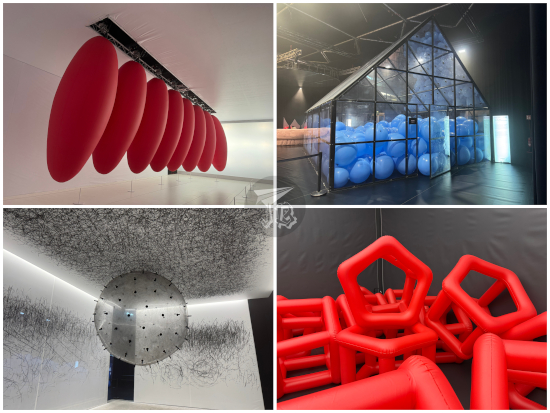
Collage - hanging balloons in different shapes

  • Pulse Topology by Rafael Lozano-Hemmer. A lot of lightbulbs hung from the ceiling in some sort of wave shape. You could put your hand under a sensor and the bulbs pulsated along your heartbeat. When you took your hand off, one of the bulbs remembered the rhythm and kept pulsing. It was a pretty intense feeling, to be honest, though I am not even sure why.
  • New Spring by A.A. Murakami. The installation resembled a cherry tree, but instead of cherry blossoms, it shed bubbles of pinkish mist that popped into scented vapour if poked or when they hit the ground. The scent was rather beautiful, too.
  • Hyperstellar by Hyperstudio with Quiet Ensemble and Roman Hill. A huge ball pit with a light and sound show. This is pretty similar to the Hyperstudio artwork I had seen the first time around, so I guess it is a signature kind of work.
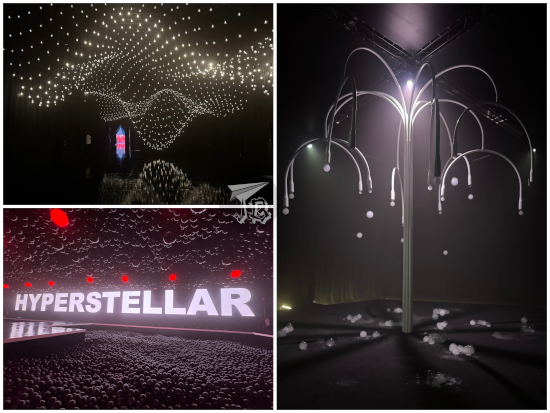
Collage - Waves made out of light; tree with bubbles; ball pool

  • Kaleidoscope by Karina Smigla-Bobinski. There were three tables in the middle of the room, and when you touched them, the liquid on top moved around, changing colour. That reflected or was projected on the walls… I didn’t quite get the idea.
  • 10 Agosto (10th of August) by Hyperstudio. A circle of swings looking at big round lightbulbs that turned on and off, and moved along the rhythm. It was quite relaxing even if the music was not designed for it.
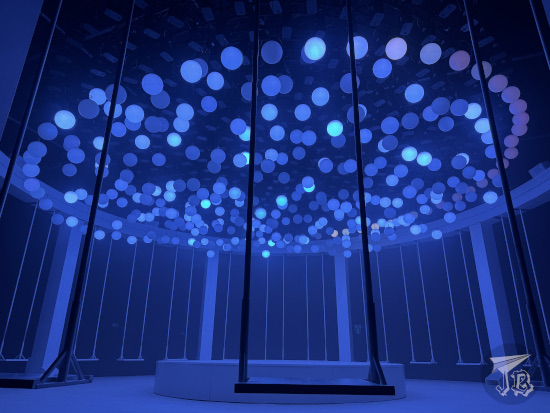
Slings amongst bulbs of light

At the end of the tour there was a gift shop, where I got myself a sweatshirt, because at some point, I had a wardrobe malfunction and the zipper of my sweater had dislodged. I thought that was a sign. It was all good because the weather was weird – the wind was cold, but it was nice out in the sun.

I left the museum and walked out of the park and into a wide avenue. There, I found a “trail” of trees in bloom, until I reached the edge of the park, which takes the name of Huerta de la Partida, strolled by the Madrid Sign and crossed over the river Río Manzanares. I headed into the former station, now shopping centre Estación de Príncipe Pío, where I tried the seasonal Starbucks drink – I did not like it too much – before I reached the royal gardens Campo del Moro. There, the Spanish Heritage management, has restored and sort of opened the historical Túnel de Bonaparte.
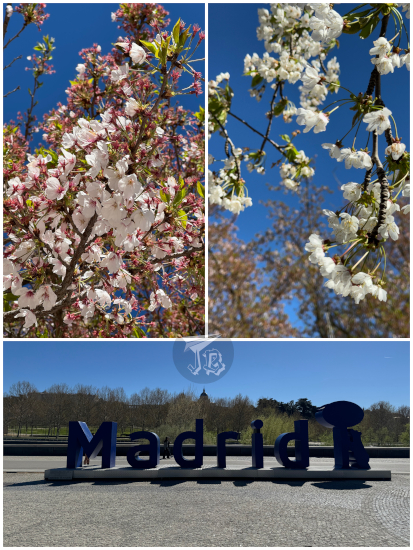
Spring blossoms and the Madrid sign

I feel the need to keep “opened” in quotation marks because I was expecting to be able to walk from one side to the other – but it turns out that no, only the first few metres are accessible – the rest are locked down (and the closed-off area is not even the historical part, but a reconstructed concrete bunker of sorts). The tunnel was conceived to be an underground connection the two parks – Campo del Moro and Casa de Campo. It was designed by Juan de Villanueva under orders from Napoleon’s brother, Joseph Bonaparte. Only the first few metres are the restored original, built in brick and open to visitors. It was a bit anticlimactic, because it would have been a nifty way to cross the busy avenue overhead.

An artificial tunnel structure within a park

I walked across Campo del Moro, emerged near Plaza de España and found Casa Gallardo, one of the few true Art Nouveau buildings in town. A restaurant has opened there, and there’s a part of me tempted to go for lunch some day so I can see the interior, but I don’t really think it would really be worth it. The house / palace was built between 1911 and 1914, and its architect, Federico Arias Rey, was awarded the “best house of 1915” recognition for it. The roofs are black slate, and the white façade features rounded balconies are uncommon in Madrid. Today, everything is private or residential, so no snooping around.

After wandering around for a bit, I finally walked into the underground to meet my sibling at the Tetuán stop, for our lunch reservation at Shanghai Mama (Infanta Mercedes), part of the group China Crown, whose first eatery tackled trying to tear down the Spanish idea that Chinese food was all cheap and greasy, or fried rice (and yet, our waiter was very surprised that we did not order any rice). We shared Crunchy duck bundles with plum sauce (Paquetitos de pato crujiente con salsa de ciruela | 缤纷鸭卷), Xiaolongbao filled with Iberian pork secreto (a shoulder blade cut, one of the best parts of the animal, apparently), mushroom and foie (Xiaolongbao relleno de secreto ibérico, setas y foie | 鹅肝鲜肉小笼包), Prawn chop suey (Chop suey de langostinos | 什锦炒大虾) and Lacquered duck magret with orange sauce (Magret de pato laqueado en salsa de naranja | 香橙酥鸭胸肉). Everything was delicious, but especially the chop suey. I had not had chop suey in years, so I was really happy it was so good. The duck was incredible too.

We did not have dessert, because I wanted to try the nearby Muua Bubble Tea. Spain came into the bubble tea fad a bit late, and while the place was pretty, the tea was extremely sweet. They were extremely generous with the tapioca, too, and very friendly.

Chinese food and bobba tea

Afterwards, we walked up towards Sala Castellana 214, one of the exhibition halls that Fundación Canal manages. They were running an exhibit by the Walt Disney Company’s Archives – Disney: The Exhibition – 100 Años de Magia (Disney: The Exhibition – 100 Years of Magic), which was half price for Easter. While I’m not a big Disney person, my sibling is.

The displays claim to honour 100 years of Disney’s creativity (103, actually, as the century-mark was 2023, when the original exhibit was held in the USA). I have a couple of problems with the way it was presented. I was honestly expecting that they would focus on the actual “Disney” work, as we were greeted by a lady from the “Disney Archives”, not stuff created by other people than Disney later bought. So in my opinion, Indiana Jones, Star Wars and all the Marvel stuff were an add-on.

The first room was an introductory video, and the second had a bit of an introduction to the company and the first films, including the birth of Mickey Mouse. In the upcoming areas, there were props like Cinderella’s shoe (from the live action film), one of the carousel horses from Mary Poppins (my sibling is rather sure it’s Bert’s), an original Winnnie the Pooh puppet (quite creepy, if you ask me)… I really liked a reproduction of the book from Sleeping Beauty, which projected the scenes on a screen. Other “not Disney in my head” props included an Indiana Jones outfit, Star Wars paraphernalia (a BB8, a prog, a lightsaber handle), Marvel’s suits and accessories (Captain America’s shield, one of Black Widow’s outfits, Avengers’ helmets…). There were also items from live action films such as The Little Mermaid and Cruella.

Another room focused on music, with a big screen projecting iconic songs, Mickey dressed as an orchestra conductor, or the outfit of the actor who played Mufasa in the Broadway version of The Lion King. There were also examples of how to create different sound effects. Further, there were items used in parks and films and an interactive Rocket Racoon that was not working.

Finally, there were references to the Disney Parks, a collaboration with National Geographic, and some more projections and a kids’ activity zone. Oh, and of course the shop. You can’t go wrong with a shop, especially when a good part of the attendees are going to be under the age of nine.
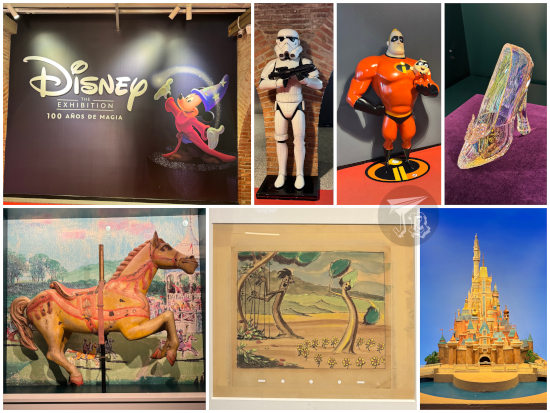
Exhibits at the Disney exhibition - stoorm trooper, Mr Incredible, a glass shoe, a merry-go-round horse, sketch from an old animaton, a reproduction of the Disney castle

We had a bit of a bad connection as Metro has closed down a few stops on Line 10, but we were lucky enough to catch the courtesy bus service that took us right to our station – for free, even. The train ride back was okay, there were issues with the carriage filling up and almost catching someone at the doors, but in the end everything worked out.
24th March 2026: Sort of a graduation trip (Madrid, Spain)

From September 2025 to February 2026, I took an online course in the long-distance-learning university, UNED. As it was financed by the European Union, it was free. The name of the program was “Digital Skills for Culture and Creation Professionals” – Competencias Digitales para Profesionales de la Cultura y la Creación and I chose the specialisation “Digital Creation of Cultural and Creative Content” – Creación digital de contenidos culturales y creativos.

I thought it would be nice to have a reference or even a benchmark for JBinnacle. The biggest downside was that they wouldn’t let you work at your own pace, despite the program being online. The tutors wanted a regular schedule and daily connections, especially during the second module. Whenever I spent several days offline, they messaged me demanding I went online. I repeatedly explained that I was taking the course in bursts, but during my November France and Monaco escapade, the tutor wrote every day. Even after I had handed in all the projects necessary to pass the module, I would get messages of “you haven’t been online for X days. Remember this course is free because [Sponsoring European Funds] is paying for it. Let me know if you have problems connecting” – I was offline for a whole week out of four months. I didn’t have issues, but apparently others did – especially those who had trusted the student licences for the software, which ran out a month too early. The forum was plagued with messages by people who were absolutely lost with how things worked – when they worked. Contents did not always do so and if a tutor sent you feedback in the platform, you couldn’t see it.

I chose to focus on social media for my third module and final project, in hopes of developing a strategy. While the tutor was knowledgeable, the general advice was “post often, and make quality content”, but I didn’t get info on how to achieve that. Despite liking technology, the mechanics of the course actually put me off working on the whole thing for a while. Nevertheless, I managed to pass all three modules, so I was invited to the closing ceremony or “graduation” in Madrid. And you know what? I decided to just go, even if it was a stupid decision. I would have to get out of work, drive to the train station and hope for decent connections, about two hours each way. No time to go home and change clothes, so I would have to work in formal(ish) clothes – which of course drew way too many comments.

The ceremony would happen in one of the UNED buildings in Ciudad Universitaria, the Education Building Facultad de Educación. The area is called the “University City” because bunch of faculties are homed there, alongside dorms and other facilities. It is not a convenient area for me to either drive or reach by public transport.

I was able to catch a train twenty minutes ahead of schedule, and my connections went smoothly, so I reached the area around 16:10, which was great. The ceremony was at 18:00 and we had to be there at 17:30. I had a snack, then started walking. Between 18 minutes by bus and 22 on foot, I prefer the latter if the weather is good. Furthermore, I could make a stop on my way.

The botanical garden Real Jardín Botánico Alfonso XIII belongs to one of the University bodies (Universidad Complutense de Madrid), and it’s thus only open during schooldays. It is not really convenient to get to, but since I was around, this was my chance to visit. King Alfonso XII came up with the idea of building Ciudad Universitaria in 1927, including the garden, nestled between the Science and the Pharmacological sciences buildings. It would not be until 1997 that engineer Fernando Gil-Albert created the space, which remained closed until 2001. Nowadays, it is free access.

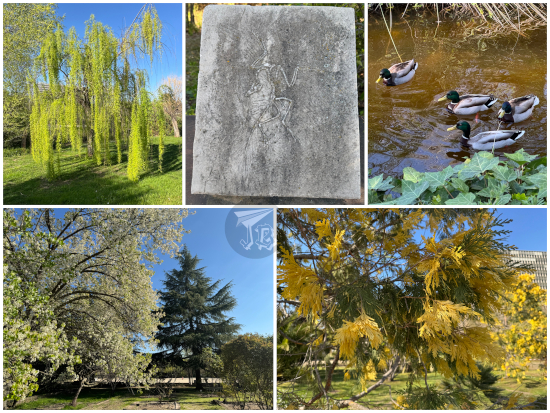
The garden has a central rotunda that aims to represent a geological calendar from the origin of earth to the current eras (trust me to find the fossil replica in a botanical garden), traversed by one large avenue, and surrounded by a circular path. There are around 1,000 plants, grouped in several collections around three particular “topics”: ethnobotany (plants that are important for people, mainly medicinal ones), gymnosperms (“naked seed plants”, mostly pines in this case), and Mediterranean flora.

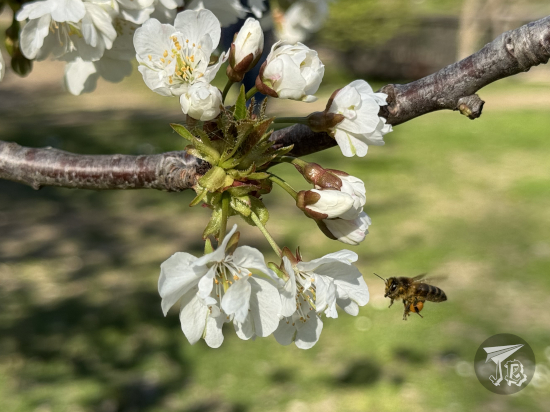
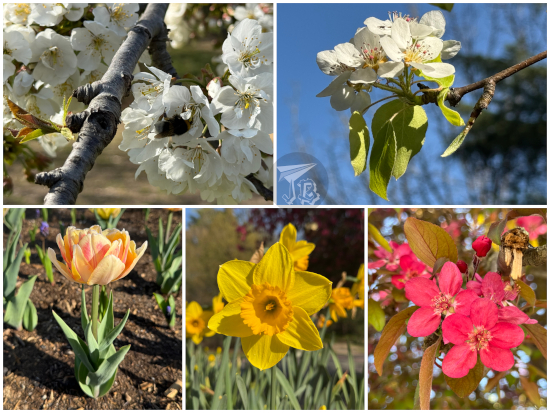
Flowering trees and plants, one of them with a bumblebee

The end of winter had been really rainy, followed by some sudden warm days, so a lot of the flowering plants were in full bloom, which made for really pretty pictures. The collection of ornamental bulbous plants was in full display – especially the narcissuses and tulips. Several trees were doing their best too, such as the almond (Prunus amygdalus) and pear (Pyrus communis) trees, along with the Japanese flowering crabapple (Malus floribunda) – which I had never heard about before.

Collage showing non-flowering plants, a small flock of mallards and a reproduction of an archaeopteryx slab.

The pollinators were pretty chill, too, gorging themselves in nectar without being bothered by people taking pictures. I found more than a couple of bumblebees, and one particular very hard-working Spanish bee (Apis mellifera iberiensis) who did not mind me taking pictures one bit. She was more cooperative than the bunch of mallard drakes (Anas platyrhynchos) living in the pond, who would not stay still for the pictures – actually I managed to take a photo of one of them in flight… but my phone focused on the trees behind him.

A bee carrying a blob of nectar flying into a flower

I spent over an hour in the garden, exploring around, and then headed off towards the ceremony. I was there at 17:30 sharp, after a walk following the phone’s directions. Once there, however, I did notice that on my way back I could cut through the parks as there were walkable paths that the maps app did not consider.

Upon arrival, the security guard was unfriendly as hell, annoyed that we were there, apparently. Then, the organiser wanted to call people in one by one, and allowed “companions” to sit on the same rows as the attendees were assigned – which made it for very awkward walks to pick up the diplomas. The worst thing about it though was realising that even through the University network and with my student ID, I could not access the Science website. There were a few articles I wanted to get access to – I eventually figured out the method to do it.

The organisers had been very insistent on punctuality. However, we started late because it turned out that the representative from the Ministry who had to open the ceremony had gotten lost and gone to another building in a completely different district. We could not start without the guest of honour, I guess. After she arrived, we got the typical “pat ourselves on the back” from the her, and the university themselves.

Afterwards came a talk by special guest Ana Beltrán Porcar, an artist whose works centre mostly around the visual and performance arts. She explained her career and work process whilst she drew a hand and a blue bird, using a video presentation, which she timed so at the end, the hand-drawn bird became animated and flew away.

The bunch of people who had decided to attend the ceremony – as the course had been online, there were many who did not sign up, and even some of them who had did not get there – received their diplomas in a bit of a chaotic moment (why were they taking attendance if they were going to call people who had not come?). Then there was more self-back-patting by the course coordinators. Finally, we had a performance by Clara Olóndriz, an indie pop singer who won the 2025 “Best Message in a Pop Song” recognition in the Premios Latinos (Latin Awards, sort of like the Latin Grammys but organised by Spain and Latin America). She sang three songs – Corona de Rey (King’s Crown), Brindis Eterno (Eternal (glass) Toast) and Huracán (Hurricane). While she wouldn’t usually be my cup of tea, she sounded really cool, and her voice was incredibly clear. She seemed like a nice person, too.

Finally, there were official pictures, and I did not stay for the cocktail as there were a few trains to take. I left the university a bit after 19:00 and did not make it home till around 22:00, even if I was quite lucky with transport. There was junk food, and also a long shower before bed, because I had to work the following morning (who organises a graduation on a Tuesday anyway?). No rest for the wicked, but a diploma and some pretty photographs of a botanic garden in spring.

7th November 2024: The Spanish Cultural Heritage Institute (Madrid, Spain)

I know you do not believe me when I say I don’t like guided visits, but they are the only way to do some stuff – such as stepping into the Stonehenge circle, or basically anything managed by the Madrid city hall. The Spanish Cultural Heritage Institute Instituto del Patrimonio Cultural de España IPCE is a governmental organisation whose functions are preservation and conservation of cultural items, research, communication, and safekeeping of the documents in its archive. It can only be visited on certain dates, by appointment, and with a guided visit. I managed to secure a free Thursday visit at noon, so I headed out to Madrid. Surprisingly, neither trains nor underground had issues, so I was over an hour early on site. The IPCE is located in its own building in the area known as “University City” (Ciudad Universitaria), close to the Fine Arts faculty – by design – and the President’s official residence – by chance.

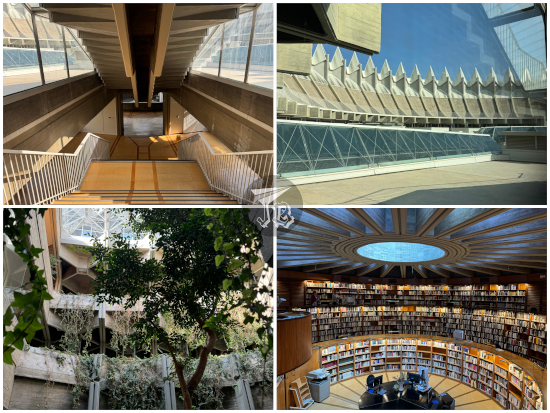
The headquarters building was commissioned in 1965 to architects Fernando Higueras and Antonio Miró. The architects’ original project had to be severely modified, but it became a very different structure. Construction was stalled for years, and the building was not usable until 1985 – when new remodelling was tackled. The building is circular, nicknamed the “Crown of Thorns” (La Corona de Espinas) because at the top there are “spikes” of sorts. Top-view, the structure is divided in 30 sectors, with 56 semi-sectors and four empty ones for the main access staircase and gate. It has four floors and at least one basement. It was built in concrete and glass, with some cork floors, but lacking plaster or any kind of concealment for the structural items. The centre of the building is an open space with a glass dome, and serves as reception. Unlike the original project, this space is covered with a glass vault. The interior has a lot of plants, even three small “gardens” mainly with hanging plants. The building is considered an important cultural asset BIC (Bien de Interés Cultural), and these plants are protected along with the structure.

Spanish Cultural Heritage Institute building

The visit consisted of an introduction to the building and the work which is carried out there. We saw the model of the original project – the only similarity is that it was also vaguely circular. We climbed the stairs to the upper floors to snoop at the rooftop and the “thorns”, and then rode the lifts down to the basements to see some X-rays of paintings and sculptures. Back on the main floor, we were shown into painting restoration workshop – they were working on Maerten de Vos’ Abundance, having repaired the work and erased some extra (puritan) clothing to make the goddess Ceres look less… naked. Finally, we were invited into the library, which is round and has three levels. It has natural light due to its own skylight, a decorative glass dome in the middle of the main open area.

Spanish Cultural Heritage Institute inside

The visit started at noon, and it lasted two hours. Heading out to the centre of Madrid would take around half an hour of walking and underground. Thus, it gave me the opportunity to book a late 15:00 lunch. Since I was lucky with my connections, I was in the Cuzco neighbourhood almost half an hour in advance.

It was the perfect opportunity to go get some groceries at the Chinese supermarket Ibero China Madrid in the street Calle General Margallo. While I needed some items, I was distracted as I walked the “geek” fizzy drink aisle. There is a company called Ocean Bomb which makes sodas – sparking water, yoghurt drinks and bubble milk tea with “creative packaging”. I was aware of them because a friend collects the Sailor Moon ones and we checked for them in London in 2023. Well, now I went and found myself some Saint Seiya sodas – Gemini Saga (grape yoghurt flavour) Aries Mu (apple yoghurt flavour) and Virgo Shaka (peach yoghurt flavour). They were out in 2023, but I had not heard about them, it is the first time I saw them. And of course, I bought them (I have no idea if they are official or not, but the publicity I found afterwards has the Toei stamp on it, so I’m hoping they are).

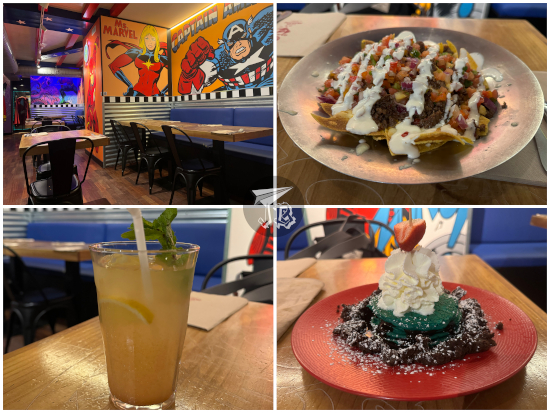
For lunch, I had a reservation at Comic Planet. Last time I was there, a member of the party was late, so in order to keep the table, we ordered appetizers. They were great, but afterwards there was no stomach-space for dessert. And dammit, I wanted some dessert – particularly, I wanted pancakes. I had been looking at coming back to Comic Planet for a while just to have them, but it never worked out. This was finally my moment. I had a lemonade, some nachos – which were delicious – and I finally got to eat my pancakes – which are green and called Hulkcakes, and come with whipped cream, brownie and shortcake crumbles , and around ¾ of a strawberry. I ended up extremely full, but happy.

Comic Planet lunch

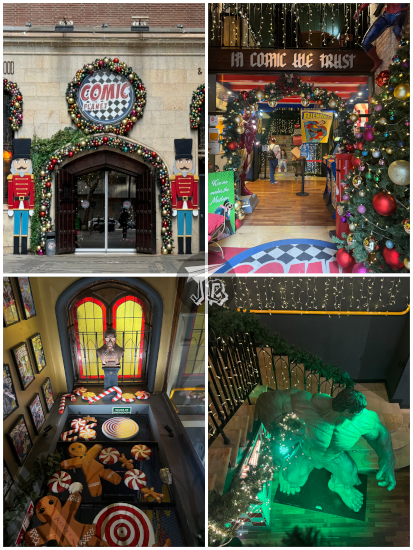
Oh, and I was confused because it was early November but… already Christmas in Comic Planet!

Comic Planet Christmas decoration

I left the restaurant and headed towards the archaeological museum Museo Arqueológico Nacional, which is running a temporal exhibit regarding Nature in Ancient Greece “Between Chaos and Cosmos: Nature in Ancient Greece” Entre Caos y Cosmos. Naturaleza en la Antigua Grecia. It hosts over one hundred pieces of classical Grecian art. Most belong to the museum’s own collection, acquired from the 19th century collector Marquis of Salamanca, and some are national and international loans. Since a large percentage of items were original and not replicas, it was really cool. Then again, I have to admit I have a thing for Grecian vases, especially with mythological motifs.

Entre Caos y Cosmos. Naturaleza en la Antigua Grecia

The exhibition was not big, so later I used my National Museums card Tarjeta de Museos Estatales to go and take a walk around the permanent exhibition. There is a loaned exhibit from the Mont’e Prama archaeological site in Sardinia, Italy. Mont’e Prama was discovered in 1974, unearthing remains from the Nuragic culture (1800 – 700 BC). This Bronze Age civilisation created large sculptures called the Giants if Mont’e Parma (Giganti di Mont’e Prama), depicting wrestlers, archers, warriors and boxers. One of these colossi Il Pugilatore (The Boxer) has been brought to the MAN for display for a few months. Boxers were characterised for having a glove with metal reinforcements on their right hands. Il Pugilatore is the largest sculpture, two metres tall and 300 kilograms heavy – which has been travelling across the world to promote the archaeological site. There was… something imposing about the whole thing, and not even its size. Some kind of… presence there. It made me want to visit Sardinia, to be honest (and it is much, much affordable than Easter Island…), so I guess the promotion… worked?

Il Pugilatore

I took a stroll through the permanent collection afterwards, especially the Iberian and Talayotic areas, because I am fascinated with them these days – and I shall make the most out of my pass for as long as I can. It was getting dark though, and the commute to the IPCE had taken long, so I headed back.

Museo Arqueológico Nacional

8th August 2024: The Museums in Moncloa (Madrid, Spain)

It’s quite hot out there, but I decided to hit a couple of museums in Madrid. A few months back, I got a card for the national museums, thinking I was getting a better deal than I did. Though it is true that you can get enter (most of) the national museums for free, you have to ID yourself, so you still have to queue, which is what I was expecting to avoid. However, it has at least pushed me to try and see a couple of museums I would not really visit (or even be aware of!) otherwise.

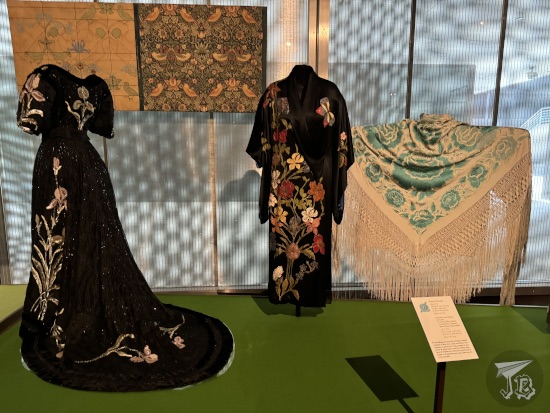
There are two museums in the district of Moncloa-Aravaca, an area I’m not usually around. One, I was curious about. The other is one I would not have even considered without the card: the Costume or Fashion Museum and Ethnographic Heritage Research Centre Museo del traje. Centro de Investigación del Patrimonio Etnológico (CIPE). It is a collection of pieces of clothing, textiles and accessories from the 17th century onwards, and I’m sure it is amazing if you know anything about fashion… which I don’t. The museum is organised chronologically, with a few pieces from the Middle Ages, then fabrics, costumes and complements since they became a thing.
There is also a collection of traditional outfits from different regions throughout Spain. The visit finishes with some of the big names in fashion, including Coco Chanel, Balenciaga, or Christian Dior. There was also an area for visually-impaired visitors, which allowed them to touch mannequins and fabrics from different style periods in history.

Costume and Fashion Museum Madrid

They were running a temporary exhibition called Vistiendo un jardín (Wearing a garden). It deals with the nature and flowers in fabric and costumes from the Baroque period onwards. They were in the middle of a guided visit so there was a big group, and I could only have a quick walk.

Wearing a garden Temporary exhibition

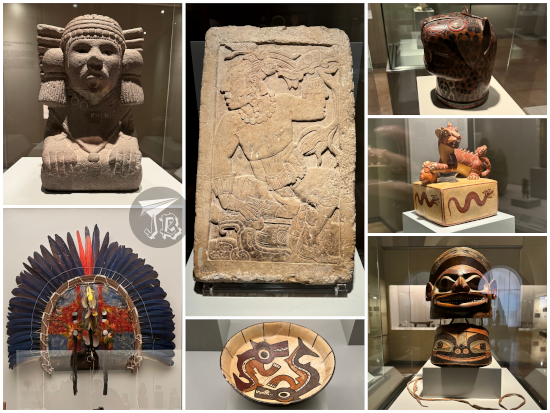
I walked over to the museum of the Americas Museo de América. The institution exhibits archaeological and ethnographical artefacts from the Americas, alongside art from the Palaeolithic period to the present, with a strong presence of Colonial art.

The origin of the collection was the Royal Cabinet of Natural history that Charles III had established in 1771. The collection increased with objects brought from discovery expeditions and Spanish colonies in America, especially those unearthed during archaeological excavations. In 1815, the science artefacts from the cabinet were integrated into what became the National Museum of Natural Sciences, and in 1868 the antiquities, ethnography, and art were transferred to the Museum of Archaeology. In 1941, the American artefacts were transferred to the newly formed museum. A more recent source has been that of donation and legacies.

Nowadays, the collection comprises around 25,000 artefacts and about 2,500 of them are exhibited – though the most important ones are copies due to “conservation issues”. The archaeological artefacts include Mayan, Inca, Aztec, Nazca, Amazonian, and even from North American native cultures who lived in what we now call the Great Plains or Alaska. The Colonial art pieces mostly include religious art and what is called pintura de castas, which tries to represent the appearance and daily life of the peoples of mixed race, descendants of European, African and Indigenous inhabitants of the colonies. There is also a ward dedicated to modern art and social criticism against colonisation. I found the organisation of the museum a bit strange, by theme areas instead of time-and-place.

Artefacts from the Museum of the Americas

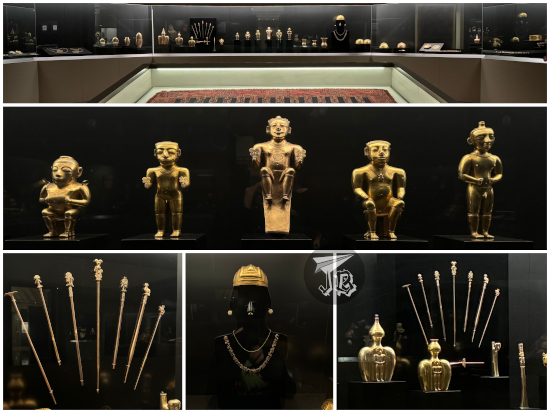
Arguably, the most important group of pieces that the museum exhibits is the so-called Tesoro de los Quimbayas (Quimbaya Treasure). The Quimbayas were a small indigenous group from precolonial America, who lived south of what is now Medellín, Colombia. They were known for their works in gold and an alloy of copper and gold called tumbaga. The treasure comprises 122 pieces, which represent about one fifth of the original findings. It is believed that the belonged to two sets of grave goods, and dates from the 5th or 6th centuries CE. The treasure was dug up during the Colombian gold fever, when archaeological items were sold for their weight in gold. The artefacts include figures, crowns, jewellery (nose- and ear-ornament, necklace beads, pins, pendants), containers, ceremonial vessels and poporos (used to keep coca leaves for religious ceremonies), and musical items such as bells.

Quimbaya treasure

I actually had been thinking about staying in Madrid and do something else, like the observatory known as Faro de Moncloa, which is literally next to the Museum of the Americas. Or a nice themed restaurant or something. But it was ridiculously hot and I just did not feel like it. It was early for lunch too, but by the time I got anywhere cool, it would be right in the middle of the rush. So I just went back into the transport system. Of course, the train was delayed. I need to stop planning around the official train schedules, especially around food times…

3rd December 2023: Sushi, I“k”ons, Goddesses and Light Bugs (Madrid, Spain)

I had evening plans in Madrid with my sibling, and they wanted to have lunch in town and make a day trip out of it. Since I had previously ascertained that the Running Sushi franchise was all right and fun, I proposed to check out another of the locations. They agreed and I had booked a 13:00 slot at Running Sushi in Akihabara, near Plaza de España. It was even more fun than the one I had checked out before, with Godzilla, Taito Station signs, Pacman, neon, anime graffiti in the toilets, and Japanese music playing. From the outside, the restaurant is shaped like a train carriage, and the sliding doors relay the same message they do when Tokyo JR stops at the station at Akihabara. In general, Running Sushi Akihabara offered the same food as the In Market restaurant, but this time there was tuna. I don’t know if it is because of the location, or because it was a weekend – and thus more expensive. Reservation was a great idea, because though I had no problem booking for 13:00, there were plenty other people with and without bookings, and when 14:00 – standard Spain lunch time – approached, the place became almost crowded. We stayed for the whole hour since we had a late start due to missing chopsticks and napkins, and I own up that the last takoyaki might have been excessive. This time, I remembered to ask for the membership card – you get a reward if you visit all the restaurants in the holding, something I’m considering to aim for.

Running Sushi Akihabara

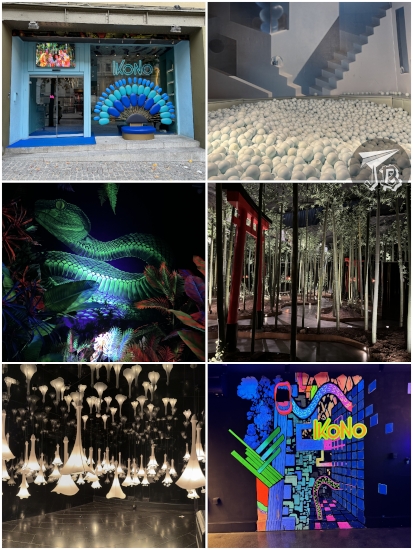
After lunch, we had a 14:50 ticket for a place called IKONO. I have to say I’m warming up more and more to these Instagrammable places – I’ve recently read one of them described as a “fun house” and I think it’s a more than accurate idea. I like them because they’re silly places for, quite literally, kicks and giggles. According to themselves, IKONO was born as a leisure option alternative to “restaurants, shopping and clubbing” for young people – I disagree with the “young people” take though. Out of the permanent establishments of its kind in Madrid, it is probably my favourite.

The IKONO mood kicks off even before you go in, with a peacock-like armchair just outside the main entrance. Spread over three floors, the venue has 15 different experiences / things to do. Once your tickets have been checked, the first “door” you go through is a thick wall of foil fringe curtains in a gradient of shiny colours,which felt like going through the Stargate! (I know, I know, niche comment). All through the place, there is bouncy music playing.

Once you have crossed the curtain – I somehow ended up in a weird inner space instead of where I was supposed to reach, but that’s just me – the first room is a ball pit, and a deep one at that. It was quite hard to move there. There are quite fewer rules than in other ball pits too – you can jump in, and throw balls up. Once you manage to drag yourself out of the ball pit, you get to go upstairs, what I’ve mentally named the “paper floor”. It has three rooms – the landing one has a pretty origami tree and some wings for you to take pictures with. There is a “psychedelic” ward with black-and-white décor and a blue-and-pink confetti cannon. The third one is a dark “jungle scenery” with glow-in-the dark colourings and paintings that I really loved – the frogs were adorable, and the serpent god quite impressive.

Back on the ground floor, the following room is a Japanese-style bamboo forest with wooden lanterns and a torii [鳥居], the traditional entryway to a Shinto shrine. As you may imagine, this was my favourite area. The room walls are covered in mirror, so it looks like a long path, that ends in the following room, a “bamboo forest” which a felt a little underwhelming in comparison. According to the website, the idea of IKONO cemented while visiting the Japanese Arashiyama bamboo grove, and these two rooms are a homage to that place.

Then we walked downstairs, to the “lights area”, with a few more rooms, including some hanging bellflower-shaped lamps, and another with lights made with marbles that went on and off to the music, some modern art inspired by The Last Supper, and a cube of infinite light dots. Back upstairs, there were a couple more panels for photo-ops, and a small souvenir shop. The staff offered a small present if we left a Google review, so we did. Oh, and they had a cloak option for coats, which was amazing.

IKONO Madrid highlights

We walked outside towards our following spot Caixa Forum Madrid, where there are two exhibitions at the moment. The one I really wanted to see was Veneradas y Temidas: el poder femenino en el arte y las creencias, “Worshipped and Feared: Feminine power in art and beliefs”, an exhibit on the female presence in the religion and spirituality of different cultures. The other one was Horizonte y Límite: Visiones del Paisaje. Colección de Arte contemporáneo, “Horizon and Limits: Views / visions of Landscape. Collection of Contemporary Art”, which I had not read about beforehand – because I am biased.

Veneradas y Temidas: el poder femenino en el arte y las creencias is a British Museum’s touring exhibition, Feminine power: the divine to the demonic (which I feel is a more appropriate name, but that’s just me and my problem with translations). It is a collection of artefacts (most of them not exhibited anywhere else) originating from different cultures, trying to convey the “female spiritual power”, though it also has snippets of erotism and homosexuality. One of the most important and impressive pieces include a copy of the Campo Iemini Venus, a “modest Venus”, halfway though covering herself – a copy of the Capitoline Venus, it was found in an Italian Roman villa in 1792. Aphrodite / Venus was the Greek / Roman goddess of Goddess of beauty, love, lust, passion, pleasure, and sexuality. Other Ancient Greece and Rome pieces include Hecate / Trivia (goddess of boundaries, crossroads, ghosts, magic, necromancy, transitions, and the New Moon), Athena / Minerva (Goddess of handicraft, warfare, and wisdom) or Eros / Cupid (God of desire, love, lust, and sex). There are several pieces of pottery, both red and black, depicting different scenes of various… degrees of erotism.

Halfway between Athena and Aphrodite, the goddess Ishtar, Queen of Heaven, and goddess of love and sexuality was worshipped in Mesopotamia (modern Iraq). Though according to the mythology, she had many lovers and was responsible for creation, she was not considered a “mother goddess”, and one of her advocations is the goddess of war.

The Divine to the Demonic: Greece and Mesopotamia

The first thing we saw from Asia were three masks. There was Taraka [Tāṭakā], a Hindu spirit, whose rage upon the murder of her husband turned her turned into a man-eating ogre (ogress?). From Bali, there was Rangda, the demon queen, antagonist of the forces of good, leader of an army of evil witches, and child-eater. From Japan there was a hannya [般若], the jealous vengeful spirit of a scorned woman.

Also from Hinduism, there is a creepily fantastic (or fantastically creepy?) devotional icon (murti [मूर्ति]) of Kali [काली], goddess of death, doomsday and time. The sculpture is the advocation Dakshina Kali – depicted with four arms, a scimitar, a collar made of heads of her slain enemies, and Shiva at her feet. The murti represents a passage in which Kali goes on a rampage after fighting demons, having lost control, and her consort Shiva throws himself at her feet hoping to calm her down.

Theatre masks and Indian Goddess Kali

Among the Egyptian representations, there was Sekhmet, the warrior goddess, represented as a lioness, who was also the goddess of medicine and one of the sun deities. There were also Bastet, who started off similar to Sekhmet but became more of a protector figure, represented as a cat. There were also references to the cosmic goddess Nut, who symbolises the sky, stars, astronomy, the universe, and mothers.

From China, there was a gorgeous Guanyin [觀音] as the Goddess of Compassion, a very different style from the one I had seen in either the British Museum and the Victoria and Albert Museum. There was also a Shiva porcelain which was astonishing.

Egyptian Sekhmet and Chinese Guaiying

From Meso- and South America, there was a beautiful sandstone of Toci, the “mother of the gods” who is depicted with bare breasts and her hands on her belly. There was also a statue of a Mexican cihuateotl. The cihuateteo were spirits of women who died in childbirth, and received the same honours as the warriors who died in combat. There were other references, such as the Hawai’ian goddess of the sea Na-maka-o-Kaha’i, talismans of sex and love (because the Victorians were a bunch of perverts), references to the Mesopotamian demon Lamashtu, Egyptian protection sculptures, funerary steles… and some modern art kind of thing, like a lady sitting down with a ball python slithering on her because… yeah? I really enjoyed the exhibition, though I have to admit I ignored the interactive art a little, to focus on the mythological aspect.

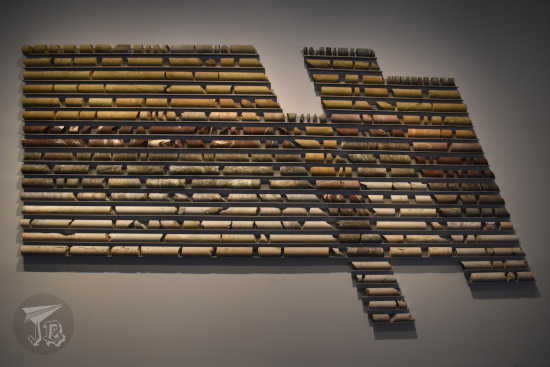
Afterwards, we visited the contemporary art exhibition Horizonte y Límite, which focuses on different… I’m not sure because I know squat about contemporary art (see above comment about the lady and the snake). There were paintings, imaginary photographs, a piece made from different geological cores representing a fault, a panel with postcards, a glass box filled with smoke to represent climate change… Pleasant, but not really my thing. Except the geology cores, they were cool.

Art piece fromthe exhibition Horizonte y Límite: Visiones del Paisaje

After seeing both exhibitions, we headed off towards our next stop. We took a break and sat down for a while to have a great banana-and-strawberry smoothie of all things. Then we walked towards the park Parque Enrique Tierno Galván, where we had tickets for the light show Naturaleza Encendida: Insectos “Lit-up nature: Insects”. The Naturaleza Encendida show used to take place in the Botanical Garden, which is smaller. This year, it has been relocated this year for “reasons unknown” and it feels a bit too long and almost unconnected. All that without taking into account that the idea of a larger-than-me butterfly and giant spiders is a bit creepy to be honest. We had premium tickets which gave us access to the enclosure at any time between 18:00 and 19:00 without queueing, and decided to arrive there around 18:30 as it would already be dark. We had also ordered a cute “magic lantern” – a bunch of sparkling LED filaments – for the giggles.

After an entrance of archways and carpets of light, there is a swarm of dragonflies as a centrepiece. You walk around it, and enter the zig-zagging path. Along the route, you encounter butterflies of different kinds, a line of hard-working ants, bees, grasshoppers, more bees, mosquitoes and flies, more bees, eggs, more grasshoppers, disco balls, larvae (I think? If I had to hazard a guess I’d call them anemones), beetles, ladybugs, spiders and a row of differently-coloured Christmas trees. There were “light corridors” in-between, hive-like hexagons projected onto the trees, and lots of artificial smoke. There are supposed to be some praying mantises somewhere but… I did not see those?

Naturaleza Encendida Insectos figures

All in all, Naturaleza Encendida: Insectos felt too spread out, as if trying to justify the bigger space. Though we had a premium ticket, there was no special premium-only area, and the only benefit was having an hour to go in, without having to queue – which is already enough in my books. I think you really have to be into the topic – we came across a lady who was very freaked out and mostly running so she could get away from the bugs. I have been to three editions of Naturaleza Encendida, and the only one I really enjoyed was the sea-creatures one, Explorium. I thought that the bad weather last year had damped the experience – literally – but I’m going to stop holding my hopes high.

Finally, we headed back to the train station. My morning train had had a five-minute delay, which by the early evening had progressed to the upper 40s. Joy. I’m hoping that when free ticketing is over, service will improve, but I’m not holding my hopes too high…

12th & 13th February 2023. The Epic Apocalypse Tour in Madrid (Spain)

The year 2020 was going to be so amazing that I actually would have had to choose the things I wanted to do and sacrifice others. It didn’t turn out that great in the end, with lots of rescheduling and cancellations. I was eventually able to budget time and money for one of those rescheduled events – the joint concert by the metal bands Epica and Apocalyptica in their Epic Apocalypse Tour. For a while, however, there was a bit of uncertainty with dates, as they bounced between Sunday 12th and Monday 13th of February, so I needed to juggle work dates in order to make sure I’d be free on Monday. In the end, I was all clear, all the concert-related activities were set for Sunday evening, and I decided to make a two-day trip out of it – I needed to take a hotel for Sunday anyway.

I arrived in Madrid around 9:30 in the morning. I had some time before my first appointment so I walked into one of the large parks of the city Parque del Buen Retiro, which is part of the Unesco World Heritage Site Paisaje de la Luz (Light Landscape), officially called Paseo del Prado y el Buen Retiro, paisaje de las artes y las ciencias, declared in 2021.

Parque del Buen Retiro was built in the 17th century for one of Felipe IV’s palaces, and it was opened in the late 18th century as public park. The park was almost destroyed during the war against Napoleon’s troops in the early 19th century, so most of it has been rebuilt. Aside from the obvious flora, it features sculptures, fountains, buildings… It is home to a lot of birds, and unfortunately a large number of invasive and fearless monk parakeets (Myiopsitta monachus), whose culling has been controversial in recent years. I got to see common blackbirds (Turdus merula), a European green woodpecker (Picus viridis) and a European robin (Erithacus rubecula).

One of the most important features of the park is the sculpture Monumento al Ángel Caído, which represents an angel falling from grace. It was originally designed by Ricardo Bellber, who made it in plaster in 1877. It was later cast in bronze and the original plaster destroyed, and eventually the sculpture was made into a part of a fountain in 1885. Around the area, there is also an ancient water mill, and to my surprise, the almond trees (Prunus amygdalus) had started blossoming.

Retiro Park collage: a pathway with trees and bushes on both sides, ducks, and a robin.

Retiro Park collage: a water mill, blossoming almond trees, and the fallen angel fountain

At 10:15 I had a guided visit to the Real Observatorio de Madrid (ROM), commissioned around 1785 by Carlos III, as an centre to develop and study astronomy, geodesy, geophysics and cartography. The main building is the astronomical observatory, built by Juan de Villanueva in what then was the outskirts of the city. Today, ROM belongs to the National Geographical Institute (IGN), and it is home to the National Astronomical Observatory, the Central Geophysics Observatory, and the data gathering division of the National Volcanic Service, though no measurements are taken there. The main astronomy measurements are carried out in the Centro Astronómico de Yebes, in a town around 80 km north-west of Madrid. The observatory is also part of the Unesco World Heritage Site.

The visit comprises three stops. The first one is the main building, called Edificio Villanueva, which has three rooms – the main rotunda with a Foucault pendulum, the library, with the spot where gravity was first measured in Spain, and the “Time room”, where the sun used to be traced to determine the hour.

ROM collage. A small Neoclassical building, an inner room with a pendulum and telescopes, a telescope and a 19th century library.

The second stop is the Great Telescope, a replica of one that William Herschel built in the 18th century – Hershchel was one of the greatest telescope makers of the time, and is credited with discovering the planet Uranus, two of its moons, and two moons of Saturn. The telescope was destroyed during the war against the French, but later rebuilt thanks to the number of laminates that had been preserved – the original had a focal distance of 7.6 m and a 61-cm diameter mirror (which is displayed in the main building), and Herschel himself considered it the best he ever built.

Herschel grand telescope: a wooden scaffolding structure keeping a huge black tube pointing at the stas

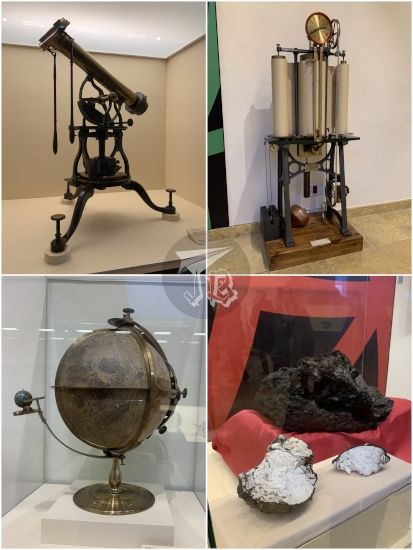
The final stop, the little museum of “Earth and Universe Sciences” has a small collection of ancient instruments used for astronomy, navigation, and geophysics. There are also a couple of seismographs – one of them new, which is up and running – and material retrieved from the volcanic eruptions of El Hierro in 2011 and La Palma in 2021.

Collage. Ancient telescope, old tide measuring device, an old globe, and lava bombs

I had planned for a typical sandwich at an iconic bar afterwards, but I ran into a political demonstration. Thus, I scratched that idea and took the underground westwards. When I was in Egypt, one of the places I visited was Lake Nasser, created by the Aswan High dam. The lake swallowed a lot of villages and monuments, but a few of them, such as Abu Simbel and the Temple of Philae were saved by Unesco. Between 1960 and 1980, a total of 24 monuments were saved, and five out of these were presented as “grants-in-return” to five countries which had offered exceptional technical and financial assistance to the campaign – Germany, Italy, Netherlands, the United States and Spain, the latter being impressive as Spain was in the middle of the dictatorship, and pretty shunned by the international community at the time.

The monument was a small and ruined temple in the now-flooded town of Debod, to which it owns its name Templo de Debod (Temple of Debod). Dedicated to the god Amun, it was built around the location of the First Cataract of the Nile, some 15 km south of Aswan, about 2200 years ago, though the core of the building may have been older. The monument was actually affected by the original dam at the beginning of the 20th century, and it was covered in water for most of the year, which destroyed its colours and damaged the reliefs.

During the Unesco salvage mission, it was dismantled, and eventually granted and taken to Spain, and “freely” reconstructed – a lot of information had been lost, and there were missing blocks. National stone was used to fill in the gaps, and the gates (remains of the pylons) were built in the wrong order, according to some old pictures. The restorers built an air-conditioning system, a wooden roof, and the main hall was closed off with a glass door and window panes. Today, the temple is open to the public at weekends, but unprotected from the Spanish weather – rather different from the Egyptian one – and pollution, it is rapidly deteriorating.

I went inside the temple once when I was a child, and I had a clear memory of it that kept surfacing when I was in Egypt – so I wanted to go back. The entry is free, but capacity is reduced, so I had to queue for almost an hour to enter. I finally matched my memory to reality. The interior of the sanctuary has a small chapel and some carved stones had been taken to a makeshift second floor to display them as a little museum.

A collage of a small Egyptian temple - it has two floating gates that lead up to the main building, which is small with four columns. One picture shows a tiny and dark inside room with an altar.

After the temple, I got lunch on the go, then walked towards the hotel to check in and change clothes. Around 16:15, I set off to La Riviera for the concert. I had a Meet and Greet ticket and had to be there before 17:00. Personnel from the venue were extremely nice, and there was no chaos at all, even if things had been a little disorganised and some fans were lacking M&G confirmation emails. Everything was well-handed and everyone who had paid for an upgrade got through. There were about 30 people to meet and greet Epica and we were ten for Apocalyptica.

Apocalyptica is a Finnish four-man band – Eicca Toppinen, Perttu Kivilaakso, Paavo Lötjönen and Mikko Sirén – founded in 1993. They are “semi-officially” a symphonic metal band, but they’ve ventured into everything from Metallica covers (which was their origin) to pure classical works. They have a very specific style heavily using classical cellos and combining them with modern drums. They currently collaborate with American – self-identified as Cuban in the concert – singer Franky Perez for vocals.

Meeting the four of them was really fun. I got autographs and took the most epic picture I’ve ever taken with a band or artist before. As we were only ten, after it was over, I had time to buy some merchandising and still be the second person to settle on first row – despite having decided that I was going to sit back and relax.

Apocalyptica white and black poster, signed by the four members

General admission started at 18:00, and the crowd was surprisingly tame throughout the whole thing. The venue filled up and the supporting band, Wheel, came up at 18:30. Wheel is a Finnish progressive metal band that consists of James Lascelles (Vocals/Guitar), Santeri Saksala (Drums), Aki ‘Conan’ Virta (Bass) and Jussi Turunen (Lead Guitar).

Wheel Setlist

  1. Hyperion
  2. Blood drinker
  3. Movement
  4. Vultures
  5. Wheel

Wheel playing, each member at his insturment: bass, guitar, singer and drummer

The second band was Epica, which I remember having listening to back when the world was young. They are a Dutch symphonic metal band currently composed by Simone Simons (lead vocals), Mark Jansen (rhythm guitar, vocals), Coen Janssen (keyboards, synthesizer), Ariën van Weesenbeek (drums), Isaac Delahaye (lead guitar) and Rob van der Loo (bass). Simone can go insanely high with her voice, and she has an amazing presence on stage, and the whole band has an immense amount of energy – she also reminded me of a comic character. The keyboardist had a lot of personality too, and he was extremely fun.

Epica Setlist

  1. Abyss of Time – Countdown to Singularity (recording)
  2. The essence of silence
  3. Victims of contingency
  4. Unleashed
  5. The final lullaby
  6. The obsessive devotion
  7. The skeleton key
  8. Rivers
  9. Code of life
  10. Cry for the moon
  11. Beyond the Matrix
  12. Consign to oblivion

Collage of Epica playing, showing different members at their choice of insturment - singer, bassist, guitarist, and keyboardist with a portable keyboard

Finally Apocalyptica came on stage, and it was extremely fun. The things those guys do to their classical cellos would make some classical musicians cry, but the sound is super-powerful. We had Franky Perez for vocals, and a very fun moment regarding “listen to our classical music album at home, because we still feel like death metal”. They interacted a lot with the public, and it felt somehow very friendly / warm – yes, I’m talking about metal here. It was really that fantastically weird.

Apocalyptica Setlist

  1. Ashes of the Modern World
  2. Grace
  3. I’m not Jesus
  4. Not strong enough
  5. Rise
  6. En route to mayhem
  7. Shadowmaker
  8. I don’t care
  9. Nothing else matters
  10. Inquisition Symphony
  11. Seek & Destroy
  12. Farewell
  13. In the Hall of the Mountain King

Apocalyptica playing with Franky Perez. Perez is in the foreground, dressed in black. The thee cello-playing members are in the frame, playing. The drums peek behind them, but you can't spot the drummer

Apocalyptica playing at La Riviera. They have classical cellos. Two of the members stand on the sides, playing their cellos. Another one is walking swinging his as if it weighed nothing, The final one is slamming drums in the background.

We finished off just short of 23:00, I bought off some fast food for dinner, and headed back to the hotel to have a shower and get some sleep. I was woken up early in the morning due to the cleaning crew and the garbage mini-vans noises, but I did not leave bed until 9:00, then set off at 9:30. I bought some cold coffee on the way and walked into the former royal palace gardens, now public park Jardines del Campo del Moro.

Though I’d seen the gardens a few times before, this was the first time I actually walked into them. Despite the frost covering everything, I got a nice view of the palace and different fountains and buildings sprinkled throughout the green – Chalet de Corcho, is a small hut with coloured windows; and Chalecito de la Reina a wooden house that is currently closed. I was insanely amused by a little grass-cutting robot.

Jardines del Campo del Moro. Collage. It's winter and most trees are grey and bare. At the end of the walkway stands the Neoclassical Royal Palace. Two smaller buildings - one of them is white with brown beams, reminscing of German architecture; another one is a small kiosk with colourful windows - red, green...

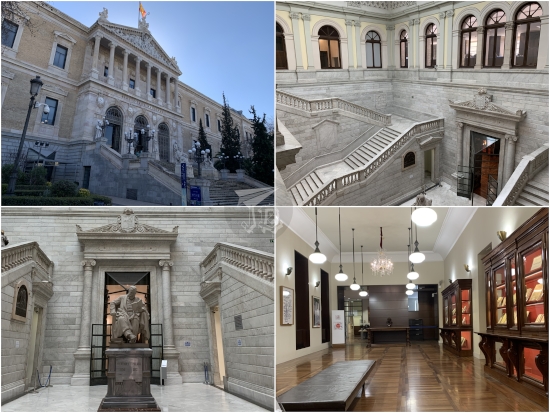
I wandered around for an hour or so, then headed off via underground to the National library of Spain Biblioteca Nacional de España for the absolutely worst guided visit of my life. Like… it’s true that it’s free, but tickets run out within hours of coming out – on the 20th of the month, for the following month. I’d actually been trying to do this since Covid lockdowns ended… It turns out, we did not see any real books, we could not even peer into the reading area, the book and reading museum is closed and the only information we got was… that the guide did not like the Library. We did not get to see anything interesting or that we could not see on our own, and we did not get to learn anything, so this was a huge blunder. Live and learn – but it was one of the few things that was open on a Monday. The library is a huge Neoclassical building with a fantastic marble staircase inside. The doors and gates are protected by intrincate ironwork fences.

Biblioteca Nacional de España. A Neoclassical building in white and grey tones. The exterior has columns and statues of writers. The interior showcases a pair of twin staircases with the statue of one of the most important library directors between both.

I met with family for a quick lunch and then we went for a walk. We had thought about going to one of the terraces to see the cityscape, but it was closed because it was a Monday. We ended up at the Parque del Retiro park again to make some time and walk. We sat in the sun for a while, then went to see the Palacio de Velázquez there. Currently, it’s part of the modern art museum Museo de Arte Reina Sofía, and I did not really care much about the exhibits, but I like the building. Architect Ricardo Velázquez Bosco built it in brick (with ceramic tiles by Daniel Zuloaga) for the Mining Exhibit in 1883, inspired by London’s Crystal Palace, now gone. The interior is pristine white with hints of iron architecture, but the building’s official style is “neorenaissance historicism” whatever that means.

Palacio de Velazquez: A brick building with large windows and tile decoration. The inside is all white with bits of iron architecture.

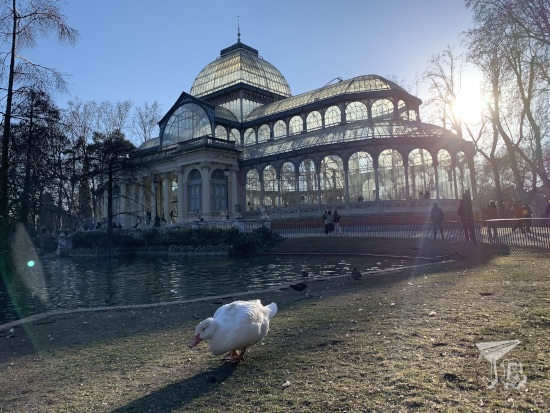
Velázquez Bosco and Zuloaga also came together when they designed another building I really like, the glass-and-iron greenhouse Palacio de Cristal, which was built to home tropical flora and fauna from the Philippines in an exhibit in 1887. In front of the palace, there’s a small pond home to some cheeky ducks and geese.

Palacio de cristal. A huge greenhouse with a dome, and two wings. A white duck wanders in the foreground. Between the greenhouse and the duck there's a small pond.

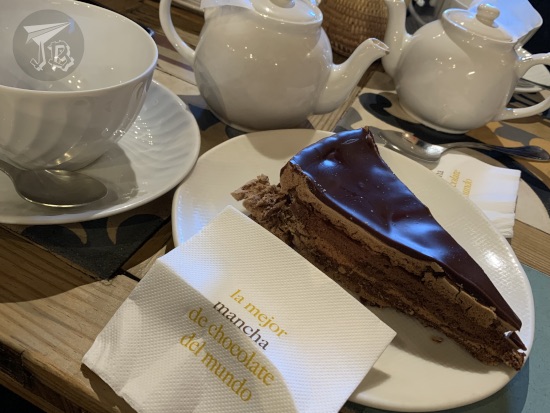
Then, we went to have a snack. Trying to find something on the map before the trip, I’d come across a place called La Mejor Tarta de Chocolate del Mundo, which translates to “The best chocolate cake in the world” and that had to be tried! It was really nice, even if the place was pretty small and felt a bit cramped.

A slice of chocolate cake in front of mugs and teapots

We finally took a stroll down towards the sunset, and I took the train back without much of a hitch, then drove home

28th January 2018: Amusement Park in Madrid (Spain)

I had a friend over for the weekend and she wanted to “do something” so I got thinking. She is adcenturous, so I thought that the Madrid amusement park could be a good idea. The Parque de Atracciones de Madrid was established in 1969. I’ve never been much of a rides person, for two reasons. One, it is one of those things that you take up when you’re young, and when I was young my parents were rather opposed to funfairs and rides and so on (with good reason, to be honest, but that’s another story). Two, I tend to be worried that random rides are going to trigger my headaches, especially when I have to take my glasses off.

For this trip, I decided to wear my contacts, so I actually got to go on a few of the rides. I was mostly happy staying back and letting my friend do the roller coasters though.

I was all good with the ride called “The Jungle”, which turned out not only to have animals, but… different cultural approaches.

I enjoyed the “Zeppelin”, and the sights…

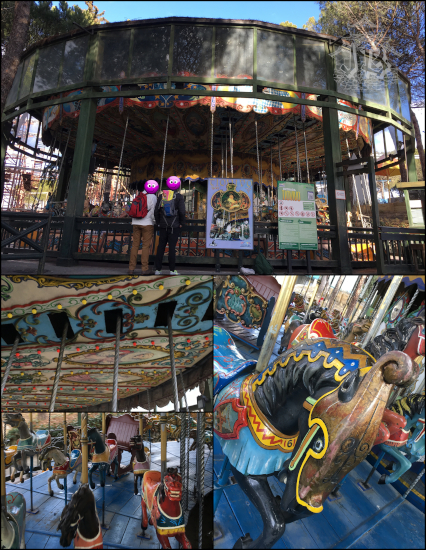
And, of course, I rode the carousel “Tiovivo”. Several times to be honest.

It was low season, so the price was much cheaper than normally. Unfortunately, it also meant that a few of the rides were closed. Then again, I wouldn’t have wanted to go onto anything with water in January…