
I had booked a visit for 15:30 using Madrid’s program to divulge the Heritage of the city Pasea Madrid (“Walk Madrid”), and I had planned a great day around it. Unfortunately, such plan had me on the best train to get to the demonstrations happening there at noon and therefore it would most likely be “delayed due to uncontrollable circumstances” or worse. Thus, I needed a new plan. Since there was a yellow weather-alert in effect across the parks in the area I wanted to be , I just drew a general list of places I could check out and decided to keep it flexible.
The day did not start off as I had imagined it. I slacked off a bit in the morning and by the time I was ready to leave, it was too too late to catch the original train of the second plan. There was part of me which was really not in it, and I considered just cancelling the visit and staying home. Then again – I reasoned with myself – the visit was sold out every other day, I had been lucky to secure a spot. I did not know whether I would be lucky enough to be free when the next batch of tickets were released, nor if the dates were convenient – if they ever opened again, or as the webpage said, it was a “special occasion” (honestly, I think that they just say it is to hype up the reservations). Thus I set off to catch the next train, still in good time for plan B as it was flexible and I could just kick one stop off if necessary.
Once in Madrid, I headed off to the Railway Museum Museo del Ferrocarril, technically closed that day due to the monthly flea market Mercado de Motores. It turns out that the ground floor of the museum is still open, which allows you to have a look at the main train collection (actual historical trains) and take some cool pictures. For once, I was not the only one with the camera, but one among a bunch – to the point that a few of us ended up queueing for a similar picture at some point.
The Railway Museum is located in what remains of the former terminus of Delicias, which opened in 1880. Designed by French engineer Émile Cachelièvre, it had three distinctive areas – the passenger building, the loading docks, and the customs building. The last train left the station on the 30th July 1969, at 22:15, headed for Badajoz. In 1984, the Railway Museum opened in the passenger building, which kept the former platforms.

I am not sure how crowded the museum is during normal days, but for the market, it was packed. I had secured a free entry reservation, just in case. The main building hosts a number of actual trains which serviced passengers and cargo throughout Spanish history – real locomotives and cars on the tracks they used to travel. Before Covid, one of the cars was used as cafeteria, and another as an Orient-Express-inspired restaurant, neither of which are in active now. Though the side rooms of the ground floor and the upper floors were closed due to the market, I got to see the trains from the outside and admire the building structure.

In the outer part of the museum, I found the food court and the former tracks which disappear into the nearby park. To the side stands the miniature train complex Ferrocarril de Las Delicias a layout of tiny trains – a 265-metre long, 127-millimetre wide track, to be exact – where you can travel on equally-scaled trains, with classical tickets and all. My original idea had been riding it, but I found a great spot for photographs and decided not to queue through all the toddlers and their parents. I thought that since I wanted to go back to the museum to see all the rooms, I could do that on a day when the tiny trains were running.

I left the station-turned-museum and walked towards the so-called Pantheon of Spain Panteón de España, a burial site for remarkable Spanish politicians, noblemen and military personalities – formerly known as the “Illustrious Men”. Before mobile phones with a camera were a thing, my school took my class to the crypt, but nowadays only the upper area and the gardens can be visited. The original plan, designed by Fernando Arbós y Tremanti in the Neobyzantine style, comprised a basilica with a bell tower and a cloister. The project began in 1891, but only the tower – now part of a school – and the cloister had been built when construction stopped in 1899 due to astronomical costs. In the cloister, there are funerary monuments to a number of important Spaniards who were exhumed and reburied there, such as Mateo Sagasta, Antonio de los Ríos y Rosas, Anonio Cánovas del Castillo or José Canalejas. Eight tombs and a central monument can be visited in the cloister and the central garden. The entrance is decorated with golden mosaics, and the interior is white calcite and grey slate, with domed rooftops. The central garden had flowering winter roses and a view of the abandoned bell tower.

I headed out towards Madrid’s main park Parque del Retiro, part of which had been restricted until noon due to predicted strong winds. The weather, however, was fantastic, even warm, which felt weird for such autumn-coloured day – it made the yellow alert issued a little strange. The park was gold, red and orange everywhere, a stark contrast with the green grass and bushes. I reached the crystal palace Palacio de Cristal, which looked extremely cool with the fall tones, though it was packed.


I took a turn towards an area that I had not visited before inside the park. In the 18th century, when the now-public park was the monarch’s garden, the royal gardeners kept complaining that flowers bloomed where they had not planted them, and blamed a magical force living in the park. The Spanish word used is duende, which is a nature creature somewhere in-between a fairy, a spirit and a gnome. The sculpture Duende del Retiro was created by José Noja in 1985 to honour the legend. The duende plays a flute while sitting on a stone hut, which used to be a cage for the bears of the former zoo Casa de Fieras del Retiro, now turned into the garden Jardines de Herrero Palacios. I’m glad no animals live there any more, except some geese and ducks that can fly – or waddle – away any time they want, but considering how much they get fed by passers-by, I doubt they care about doing so.

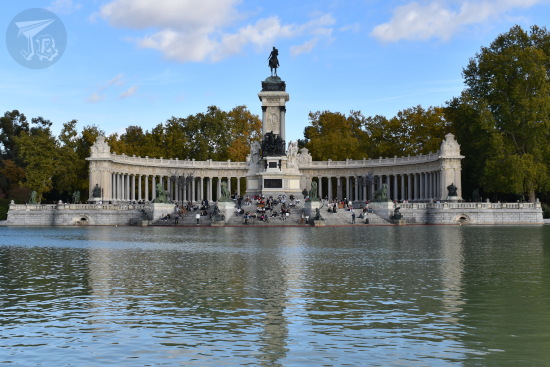
I finally made my way towards the central pond of the park Estanque Grande and the monument to King Alfonso XII Monumento a Alfonso XII, my 15:30 visit. The monument is composed by a colonnade, two lion-gates, four mermaids sitting on different marine animals, and a triumphal column with a sculpture of the king riding a horse on top. The complex measures 30 metres high, 86 metres long and 58 metres wide. The colonnade is public access, and I would not have booked a guided visit for it. However, what made the visit special is that we were granted access to inside the column to climb to the lookout that lies within the top pedestal where the horse stands (97 steps, thankfully on newish metal ones).
Alfonso XII became king of Spain in 1874. He grew up in exile in France until his mother, Queen Isabel II abdicated when he was 17 years old. He reigned for almost eleven years. His first wife, reportedly his one-and-only love, died within a few months of marriage. He married again, and had three children with his second wife, Queen María Cristina, two more with his opera singer lover. He was charismatic and the Spanish loved him, he was called “the bringer of peace”. He died while María Cristina was still pregnant with his son, king-to-be Alfonso XIII, and she became Regent. It would eventually be Alfonso XIII who inaugurated the monument to his father.
The monument was designed by architect José Grases Riera and involved as many as 20 sculptors. Probably the most important one was Mariano Benlliure, who made the horse and the king in bronze – the horse is about seven metres long, and the whole sculpture from the horse’s hooves to the King’s hat, about eight metres high. Grases Riera placed his project on the existing pier of the pond, in order not to cut down any tree from the park, as a pier could always be rebuilt somewhere else. The monument was funded by the public, so it alternates cheaper stone and more expensive bronze, according to how much money there was at nay given moment. The colonnade features shields from the different Spanish regions at the time, and the main column has scenes from the King’s life and allegories to Peace, Industriousness, the Arts… Completion took 20 years from the call for projects in 1902 to the monument inauguration in 1922.
The lookout is encased in the pedestal where the horse stands. It has windows made of glass to allow a 360-degree view of the park, and I swear I had never even realised it was there. The stairs were not steep and there were cool views from the lookout, especially with the autumn colours, and the sun starting to set. The guide was good – just again impressed by the camera – and explained to us everything that could be seen from there. A relative, however, took the same visit a few days later and, when we compared notes, the information we had been told was rather… different.

The whole visit took an hour, with 15 minutes at the lookout, and we were out by 16:30. It took me a bit over 25 minutes to reach the station, but the train was late – it was actually at the platform when I got there even if it should have left ten minutes beforehand. I hopped in, and I spent the ride organising the photos on the phone. I am glad I did not cancel the visit and went on with it. I shall remember that for the upcoming one.
 JBinnacle – A Travel Logbook