12th September 2020: Sigüenza (Spain)

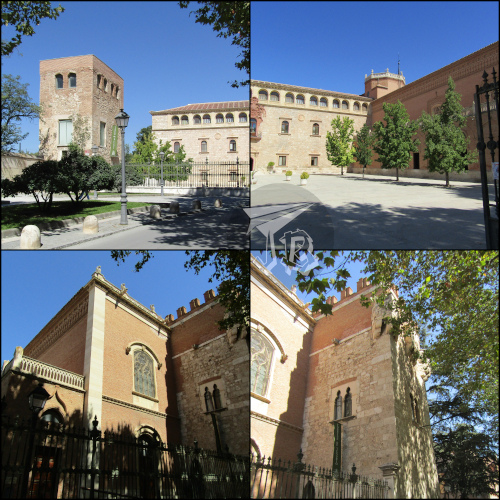
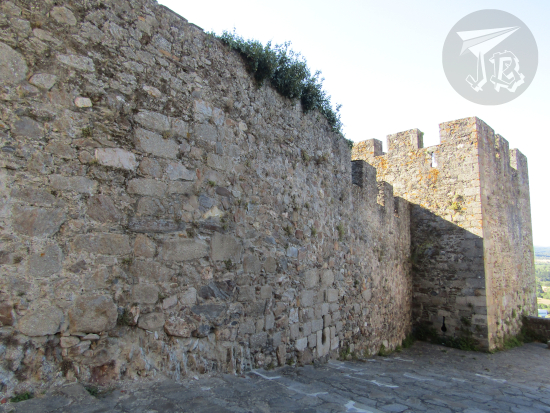
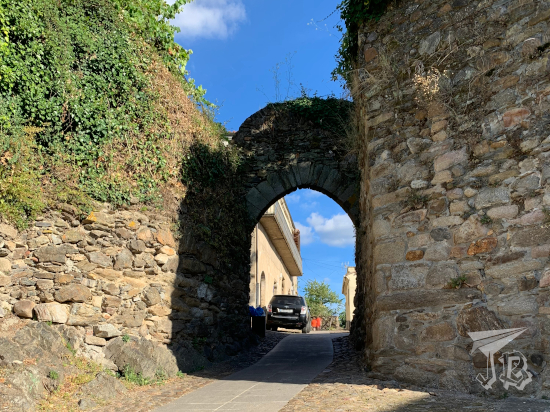
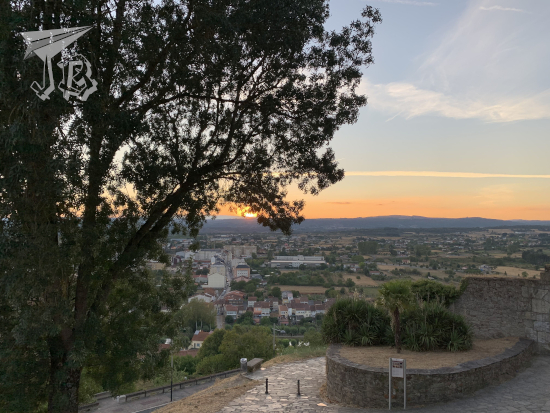
We took a drive to Sigüenza, in Spain. This medieval town? big village? had a big relevance through the Middle Ages, and the historical centre reflects that. The most prominent point is the castle on top of a hill. The Castillo de los Obispos is a fortress that can be traced to Roman times. However, the actual castle was a Moorish alcazaba. After the Christians took it over in the 12th century, it was remodelled and enlarged. Due to its vantage point, the castle was a key element in different wars and strife, including the Napoleonic invasion and the Civil War, thus resulting pretty damaged. In the late 20th century it was decided to restore it turn it into a Parador with around 50 rooms.

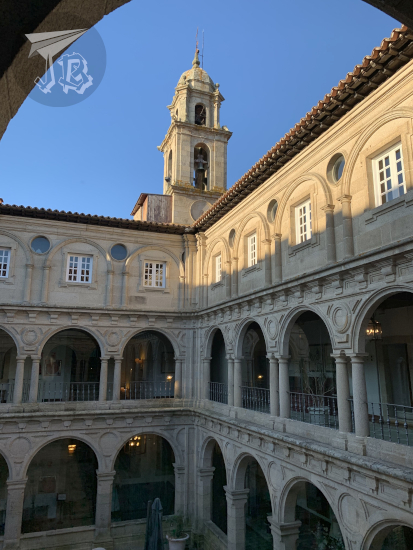
During our planning stage we called and tried to book a restaurant for lunch, and we were told they were not taking them, we had to call on the same day. Of course, when we got there, it was impossible to book – there was a course and the celebration of a communion (seriously, people, learn to say no so others can get organised). Unfortunately, you could not see the interior or even the yard if you had no reservations, so I can only share a picture from the parking lot, where we left the car.

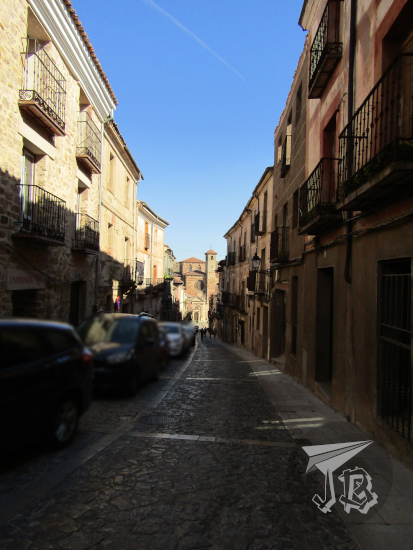
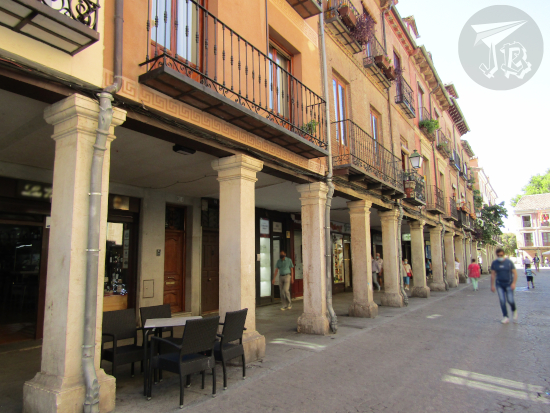
We walked down the main street Calle Mayor, a clobbered slope that ends (well, technically begins) at the town’s main square.

Main Square or Plaza Mayor is home to the Town Hall or Ayuntamiento de Sigüenza, an old palace with a typical Castillian inner yard or patio.

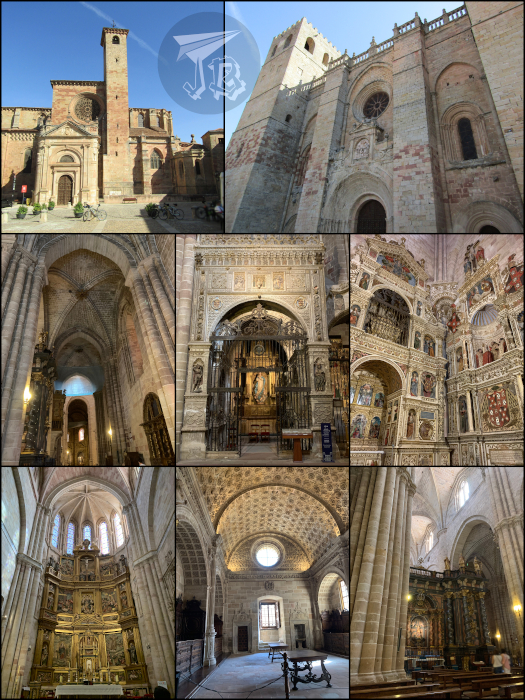
Opposite the town hall stands the cathedral Catedral de Santa María La Mayor de Sigüenza. The Gothic building was built upon a previous Romanesque one and it had some Neoclassical and Baroque additions. Thus, the façade sports Romanesque doors and rose window, and the main body is Gothic. The altar and the choir are awfully Baroque too, and some of the chapels sport Cisneros, Plateresque and Renaissance decorations. All in all, an interesting pout-pourri of architectural and decoration styles.

The most important piece of art of the cathedral, however, is a funerary piece to the right of the altar. It is the sepulchre of Martín Vázquez de Arce “El Doncel” (“The Young Man”). The chapel holds him, his parents and grandparents, but the sculpture on his sepulchre is the most impressive one. The Vázquez de Arce family were vassals of the Mendoza family, the most important family in the area during the Middle Ages. During the war to conquer Al-Andalus, the Vázquez de Arce males followed the Mendoza to the war in Granada, where Martín died in a trap set by the Arabs, which consisted on damming the River Genil to a creek, and then releasing the dam so the water took over the enemies crossing (which… kinda sounds like something out of the Lord of the Rings, doesn’t it? At least, it makes me think of Arwen and Treebeard). The sepulchre, commissioned by Martín’s brother, presents him taking a break during training and reading a book. He even has pupils, so if you could climb up, you’d see what he’s reading!

The cloister is also Gothic, as the previous Romanesque one was torn down. It holds a central garden and a number of side rooms where there is a collection of mythology-themed tapestries. In one of the chapels, there is also a painting by El Greco, a Greek painter rooted in Spain who was one of the key artists during the Spanish Renaissance.

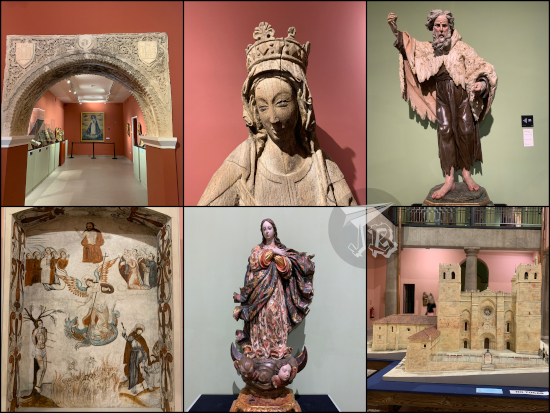
The cathedral ticket also allows a visit to the Diocesan Museum Museo Diocesano, which holds many pieces of religious art, along with a few models of the cathedral in its different construction stages. These days I’m trying to learn some hagiography, which means how to identify religious figures by how they’re presented. Getting there, three out of ten times or so, because half the time they cheat.

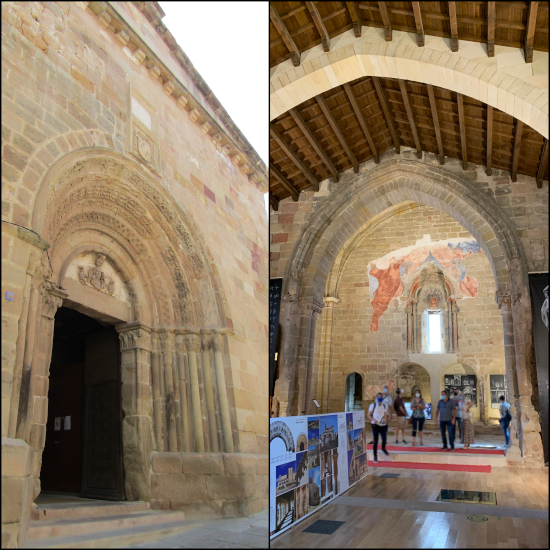
After the cathedral we climbed up towards the castle, and we stopped at the former church Iglesia de Santiago, now transformed into a mini-introduction centre for all the “hidden” or “unknown” Romanesque in the area. The church itself had some beautiful paintings, but it was destroyed during the Civil War.

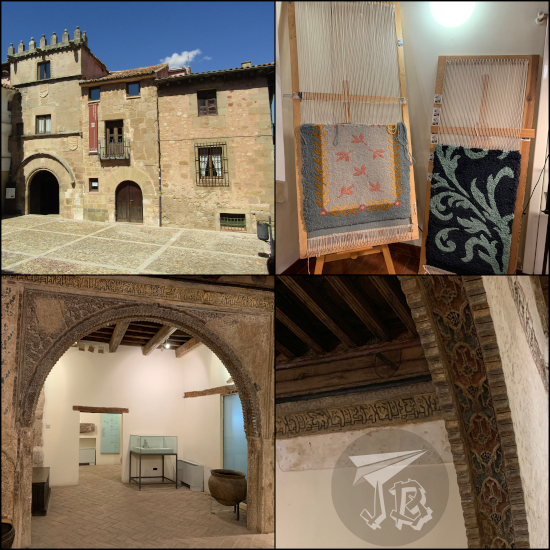
Continuing our way up, we turned a little to see the house where the Vázquez de Arce family used to live, now turned in a museum, Museo Casa del Doncel. There is a little paintings exhibition and a guitar museum, along with some ancient artefacts such as vases or looms. The most interesting part are the Moorish “Mozárabe” decoration. Here is a bit of historic trolling: when the Christian “conquerors” hired Arab craftsmen to do decoration, one of the things the Arabs did was decorate using Quran verses.

Then we saw the outside of the church Iglesia de San Vicente Mártir, Romanesque to boot.

Afterwards, we ended up at the square Plazuela de la Cárcel, where the old gaol jail stood.

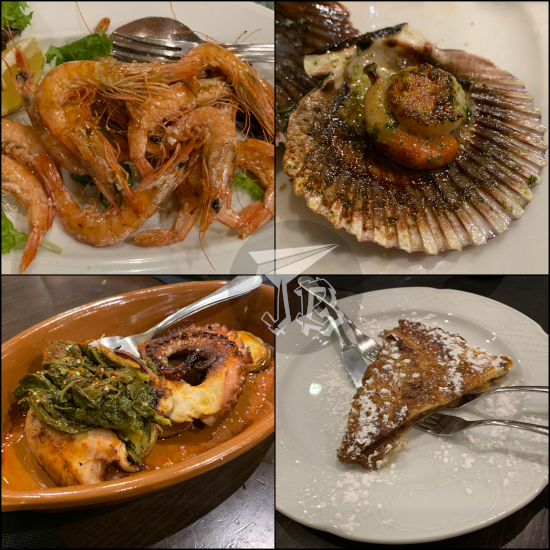
Finally, we headed over to the restaurant where we had booked a lunch table, a traditional grill called La Taberna Seguntina where I chose to have a “summer menu” with salmorejo (a thick soup or purée made with tomato, oil, and bread and sprinkled with boiled egg and cured ham) and roasted cochinillo (suckling pig, roasted whole) with potatoes and herbs. For dessert I had a pudding!

And that was it, really – Medieval Sigüenza has nothing else to see. As the façade of the castle was being restored, we did not even take pictures of it as we drove away.

4th September 2020: Alcalá de Henares (Spain)

After looking for a place to park the car for 12 minutes, I left the car and I went off on foot towards the centre with a relative who is living in Alcalá de Henares. The town centre has been a Unesco World Heritage Site since 1998.

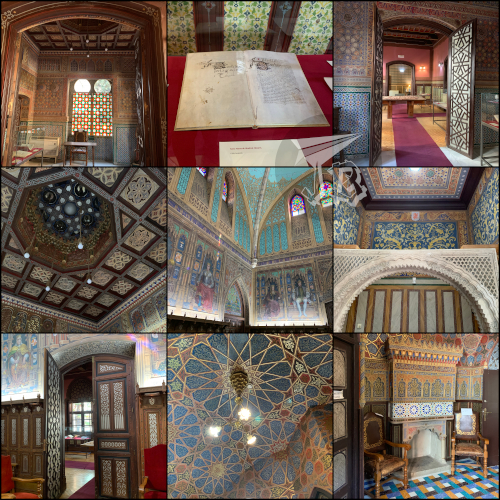
Our first stop, at 10:30 almost sharp was the Palacete Laredo, a small palace built in the Neo-Mudéjar style, a type of Moorish Revival architecture. It was designed and built between 1880 and 1884 by the Spanish artist Manuel José de Laredo y Ordoño. After a century in private hands, it passed to the town hall, which allows the university to use it as a museum, showing a collection of ancient documents.

The palace is built in brick, it has two floors and a minaret-like tower. The inside is decorated with coloured-glass window, tiles and paintings. The visible ceilings on the first floor are wooden artesonado (decorative beams joined together). There is also a garden, but it was closed.

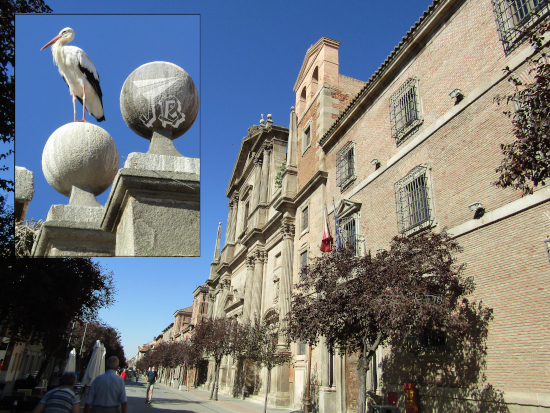
Afterwards, we headed off towards the centre. We walked by the church Parroquia de Santa María la Mayor and is inhabitant the stork on photo duty.

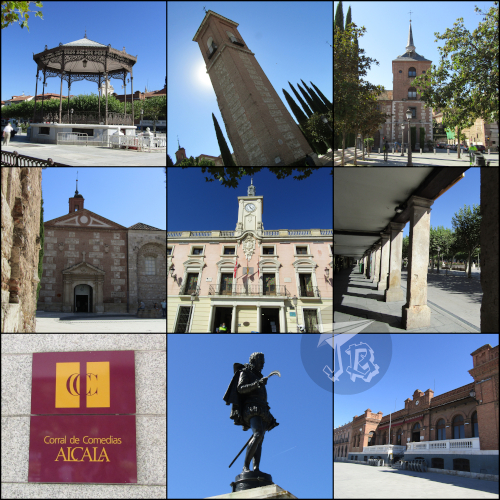
We had tickets to see the Corral de Comedias, a theatre built in the site of an ancient “theatrical courtyard”. These were open-air theatres that were common during the late middle ages and exploded in popularity in the 16th century. The Corral in Alcalá de Henares was built in 1601 by Francisco Sánchez, member of the Carpenters Guild. It suffered several changes – the ceiling was built in the 18th century, then it became a cinema, and eventually was “lost” in the 1970s. In the 1980s, it was rediscovered, restored, and finally opened as working theatre in 2003.

Alas, we were too late for the 12:00 visit to the university, so we wandered around the town’s main square Plaza de Cervantes – Alcalá de Henares was Cervantes’ birthplace. Miguel de Cervantes was a 16th century Spanish writer, most renown for his novel “The Ingenious Gentleman Don Quixote of La Mancha”, which many authors consider “the first modern novel” and “the best literary work ever written” (though… I disagree). The square features a bandstand, the statue of Cervantes, and is surrounded by several buildings of importance – the ruins of the church Iglesia de Santa María, the Town Hall and the Círculo de Contribuyentes, former casino, and the Corral de Comedias.

Then we walked down Main Street Calle Mayor, until we got down to the Obispado de Alcalá de Henares, the bishopric, with two towers from the former wall at their sides. That reminds me – we did not visit the cathedral or any religious buildings because they were all closed to tourism.

At 13:00 we took the guided visit to one of the university buildings, the Colegio Mayor de San Ildefonso. The university was established in 1499 by Cardinal Cisneros, an influential Spanish religious and statesman in the time of the Catholic Monarchs. A colegio mayor is basically a dignified “classic” dormitory. The façade was built between 1537 and 1559 in the Plateresque style, an architectural style that developed in Spain between the late Gothic and the early Renaissance. The architect was Rodrigo Gil de Hontañón.

Inside, we saw the cloisters and yards, the gate of honour (from where the successful students left the university), the classroom where the students defended their final thesis, and the chapel, with the tomb of the founding Cardinal (but not his body, which is in the cathedral).

We had a reservation to have lunch at the Parador de Alcalá de Henares, which is a rather modern building and not a historical one, but a stamp was needed (≧▽≦). Lunch was a looong affair because our waiter might not have been the… most efficient. We tried the combos with a little bit of everything to share (entrées and desserts), and some bull tail. Oh and coffee. Yay coffee. (Also, kudos to me for cutting that nut in half.)

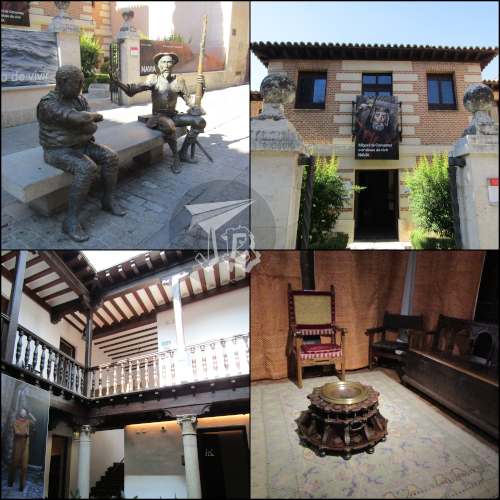
After lunch, we walked down the Calle Mayor again and we made a stop at what is supposed to be the house where Cervantes was born, or at least a reconstruction, with a bunch of ancient objects thrown in – the Museo Casa Natal de Cervantes. There was also a photography exhibition. To be honest, it had a great quality-price relation. It was free, and the quality was… lacking. Or maybe I’m old and I have seen most of the stuff they showed in action, and used a few.

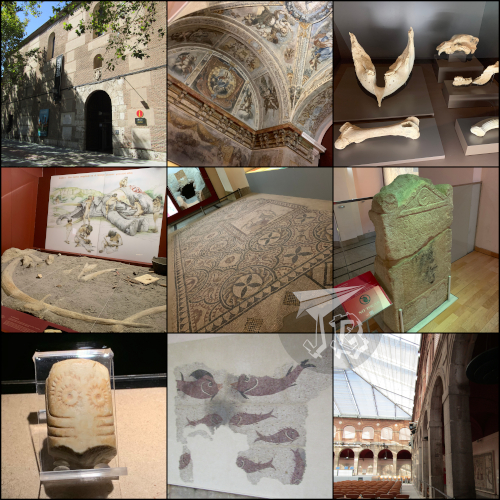
We continued on to the regional archaeological museum Museo Arqueológico Regional, located in the old Archiepiscopal palace. That was unexpectedly good, with the fossil record and the old Roman mosaics.

Pending for a future visit to Alcalá de Henares: Roman and Medieval areas, and the religious buildings, as the day finished up doing some necessary and work-related shopping before I drove back home.

Driven distance: Around an hour? I dumped the car as soon as I could and we walked the hell out of the town (≧▽≦)
Walked distance: 14.61 km

5th August 2020: Monforte de Lemos {Spain, summer 2020}

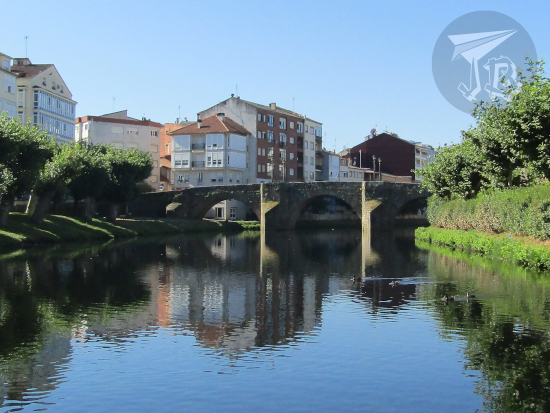
After so many curves, we deserved a calm day, which included some art in Monforte de Lemos . We started off at the river Cabe, crossing the bridge Ponte Vella and the newer iron one.

We had booked to visit the Christian Art Museum in the Clares’ convent Museo de Arte Sacro / Convento de las Clarisas, which features some interesting pieces of art, among them a dead Christ by Gregorio Fernández, and hundreds of reliquaries with supposed remains of Saints.

Then we moved to the Piarists School, the church, and their painting collection Colegiata de Nuestra Señora de la Antigua / Pinacoteca de los Escolapios . The school is built in a Renaissance Herrerian style and the guide constantly tried to one-up San Lorenzo del Escorial.

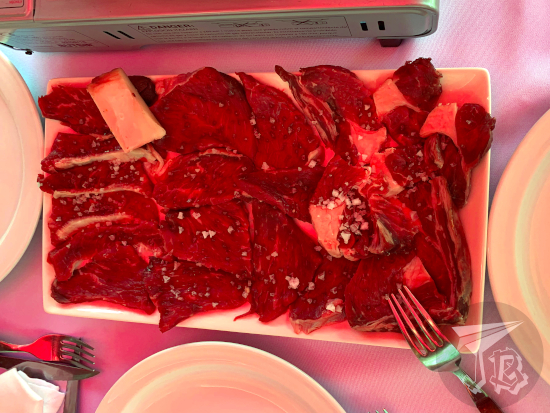
Then we found a good meat restaurant, Mesón JM for some local beef T-bone that we could prepare ourselves, although I get the nagging feeling they actually short-served us as they never showed us the meat piece. Please excuse the reddish tint of the pictures. It was the parasol and at the time I did not notice (≧▽≦).

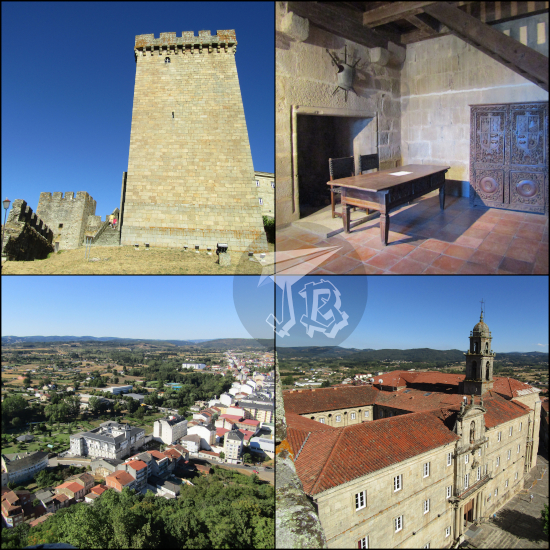
After lunch and a break, we took a climb into the old castle keep Torre del Homenaje, and walked around for a little.

We ended the day at the tapas bar La Fábrica for some seafood.

And finished the day with some in-accomodation exploration at the Parador de Monforte de Lemos.

Walked distance: 9.03 km

4th August 2020: Meanders and Curves {Spain, summer 2020}

The area we were visiting that day, called Ribeira Sacra, is sprinkled with Christian monasteries [mosteiros] and churches [Igrexas] in the Romanesque and Gothic styles. These religious sites became commonplace during the Medieval times, along the way that leads up to Santiago de Compostela, an important Christian pilgrimage site. The route is called Camino de Santiago (St. James’ Way).

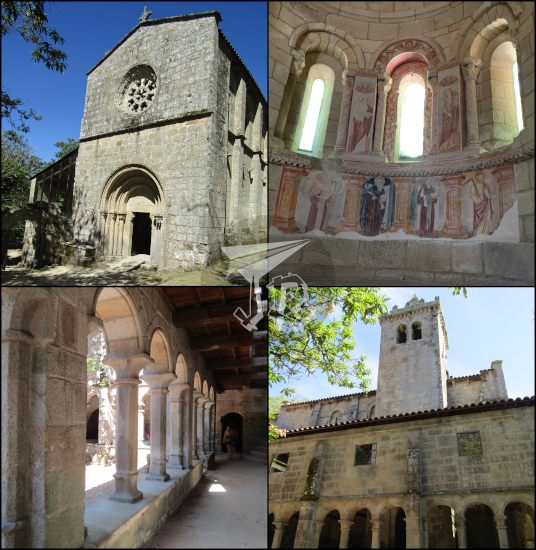
We started off with a fierce battle against the car’s sat-nav as it refused to take us to our first stop, the church of St. Michael in a tiny hamlet. I managed to trick the navigator and we arrived at the Iglesia de San Miguel de Eiré only a little later than expected. The church is small and it was built in the Romanesque style, which is common the Ribeira Sacra. The church was built in the second half of the 12th century, and has a remarkable archway. Back in the day, it belonged to a monastery.

Afterwards we backtracked to what is probably its successor – another monastery, the Monasterio Cisterciense del Divino Salvador in Ferreira, which was built in three styles – the church is Romanesque (12th century), the main building and the walls are Baroque (18th century) and the inner cloister is Renaissance (16th century). There are also two Romanesque wooden sculptures.

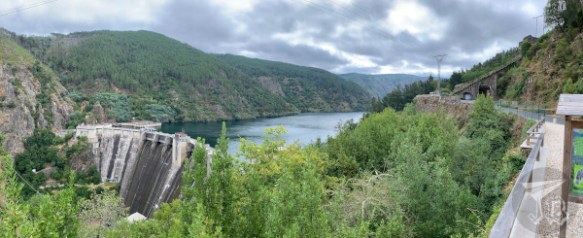
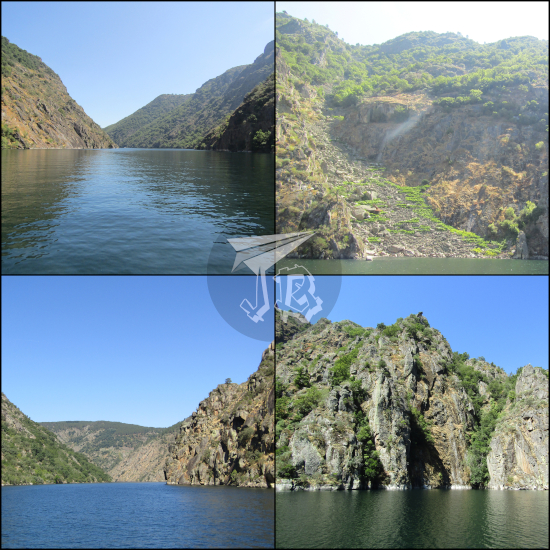
Then we set off towards a salad of curves the heart of the Ribeira Sacra, the area of the River Sil where the water has excavated a deep canyon – well, ish. There was a lot of tectonic activity going on in the area a long time ago that helped the development of the river canyon, the Canón do Sil. It is dammed at the moment, which has made the river depth increase.

We had booked a “cruise” in a “catamaran” that turned out to be a plain-old boat and way too packed for my peace of mind. Fortunately everybody wore masks, we had the N-95 that protect both ways ones, and used a lot of hand sanitiser – my nails are really, really off due to the use and abuse of hand sanitiser. We sailed off the wharf Embarcadoiro do Santo Estevo and the views were pretty nice. Both the narrator and narration not so much, though the bit about the “special” vineyards perched on the canyon walls was interesting.

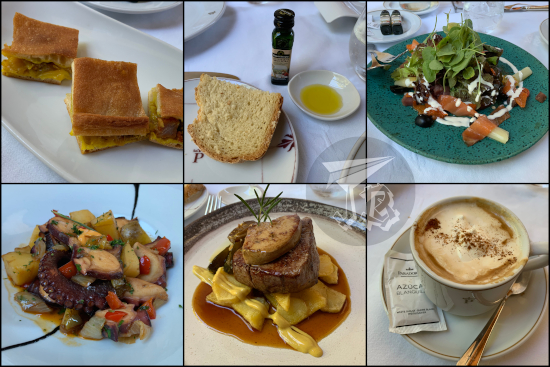
After a ninety-minute sail, we disembarked and took the car again to drive to the Parador de Santo Estevo to have lunch (cue stamp number three), where I tried the local beef with foie, while the rest went for the octopus.

Then we took a stroll down the Parador, which is an old monastery that has not one but three cloisters, as the Monasterio de Santo Estevo de Ribas de Sil has existed since the tenth century and buildings have been added. Two of the cloisters are Renaissance and the third is Baroque / Gothic.

Finally we stopped over at the church, whose interior is late Romanesque but with a later façade (and a very Baroque altar).

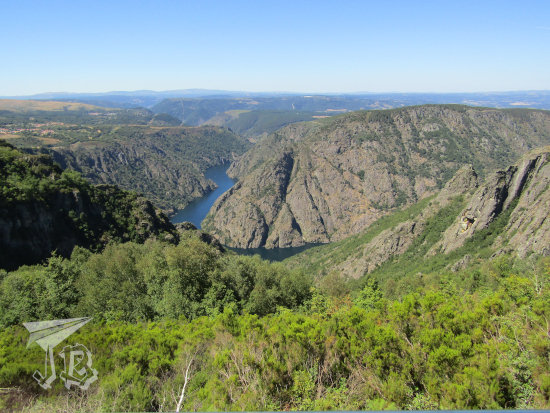
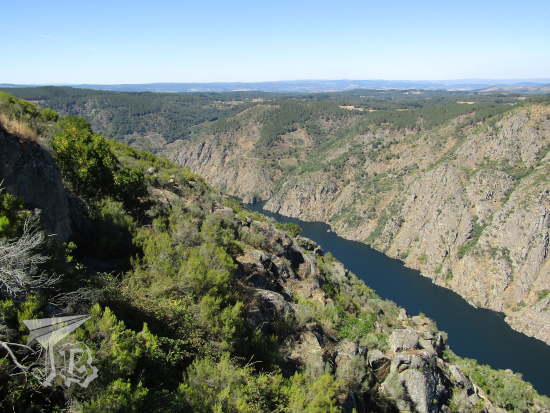
And then we went back to the curves. Lots and lots of curves. The road ran along the canyon, so we stopped over at a couple of viewpoints to observe the canyons – Miradoiro de Cabezoás:

Miradoiro Balcones de Madrid:

Then we continued onto the ruins of another Romanesque Monastery, Mosteiro de Santa Cristina de Ribas de Sil, with some very nice paintings and a very pretty cloister.

Afterwards we drove back up the road and we found another viewpoint Miradoriro Xariñas de Castro (a.k.a. Miradorio A Mirada Maxica) for more views of the canyon.

We continued to the monastery Mosteiro de Santa María de Montederramo, where we had booked at 19:00 but could join the 18:00 visit instead. Shifty, I know, but we were there at 18:04 and… yeah. Not really worth the wait, even though the Gothic church and cloister were neat, even if a bit unkempt.

And as we were finally driving back towards Monforte de Lemos, we came across the castle Castelo de Castro Caldelas, which was actually on the planning for the next day but we thought we would… how to put this… avoid some curve-driving if we took the stop.

All in all: 135 km driving; 6.96 km walking; around 20 km sailing; hundreds of curves.

3rd August 2020: On the road again {Spain, summer 2020}

After having to cancel London and Greece, we decided to try to at least take a few-day’s worth road trip within Spain as some sort of consolation prize. We were, of course, very careful, using a lot of hand-sanitizer and never taking off our face masks except within the car, hotel rooms or when we were eating – strictly so.

We started off just in time so we surrounded Madrid right after rush hour so we did not get caught in any traffic jams. We drove northwards towards Medina del Campo, a town which played an important role in Spanish history, specially around the time of the Catholic Monarchs and their direct descendants. We were there at 11:00 sharp, right at the time when the castle Castillo de La Mota opened to visitors. Mota is the Spanish word for motte, which is a raised area of ground where a castle keep, and a walled courtyard or bailey, are built. They are protected by a ditch and a palisade. These castles are thus called motte-and-bailey castle. In particular, the castle of La Mota is made of red brick, typical to the area, but it is heavily restored today. The visit included the outer building, the yard and the chapel of St. Louise.

We stopped for a quick lunch at the Parador de Puebla de Sanabria. Paradores is a Spanish brand of state-owned hotels and restaurants which have a good reputation all around the country. In our lunch stop, I got my stamp passport because I can find stamp rallies wherever they are (≧▽≦), and Paradores has launched one.

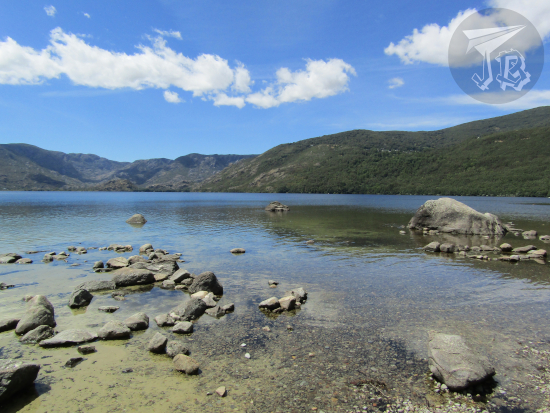
Then, as we were a couple of hours ahead our very informal schedule, we decided to take a small detour and check out the Parque Natural del Lago de Sanabria y alrededores, the natural park that surrounds the biggest natural lake in Spain, Lago de Sanabria. It is also one of the few, if not the only glacier-origin lake in Spain. It was full of people swimming and sunbathing, but the landscape was still beautiful.

After lounging for a while we continued on our way towards Galicia and our destination, Monforte de Lemos. We stayed at the Parador de Monforte de Lemos, situated in the Monastery Monasterio de San Vicente do Pino at the top of a hill. It is part of a monumental compound, along with the former castle Keep and the palace of the former Count’s family, Palacio de los Condes de Lemos . Due to some kind of fluke, my room was doubled as “supreme” and the door came out to the actual cloister of the monastery, which was super-cool! (Also: Stamp number two)

We took a short stroll down the village, and we passed by the small sanctuary to the Virgin Mary’s image Santuario de la Virgen de Monserrat.

Then we saw the walls and the old gates.

Finally, we went back to the hotel to have dinner over there. Our choices included trying a species of scallop I had not tried before, the zamburiña, variegated scallop (Chlamys varia). We also tried the local pie, empanada. For dessert, they had a ‘variety of chocolates’.

The day finished watching the sunset before turning in for the night.

Driving distance: Aprox. 600 km
Walking distance: 5.02 km

7th – 10th February 2020: Paris (France) for DIR EN GREY & BABYMETAL

I organised a weekend in Paris because two concerts conveniently aligned on Saturday and Sunday, and I had Friday free, as well as Monday morning. It was a great mental break that I needed badly. ETA: There were rumours about a flu from China, and some of the airport workers were wearing masks. We had no idea what was about to hit us…

7th February 2020: Through the Strikes

I had found quite a convenient flight that left at 9:00 on Friday for 35 €, which was a great deal. At first, I did not understand why it was so cheap. It turned out, the plane came from South America and it was on a Madrid stopover – so it was pretty much full already. It was a huge aircraft with on-board entertainment. That came in handy when the pilot informed us that we were going to have to wait something between one and two hours to be able to take off due to the air controllers’ strikes in France. But at least we were flying and I had films to watch.

We took off at about 10:00 and our big plane made the jump in just one hour, as opposed to the 2h10 minutes of estimated travel, which meant we were almost on time! Of course, this did not sit well with the strikers, who had us wait first for the parking spot, and then for the stairs to deplane. I finally managed to leave the airport and get onto the train so I reached downtown Paris around 13:00. I wanted to inspect the damage caused to the cathedral Cathédrale Notre-Dame de Paris by the 2019 fire. My first impression, looking at the main façade and towers, was optimistic, but as I walked round the building, I could see the real damage and reconstruction efforts. Furthermore, it still reeked of burnt wood, probably because they were still pulling out debris. My optimism did not linger long, I’m afraid.

Collage of Notre Dame showing the cranes and scaffoldings in the repairs

As it was sunny, I decided to walk to the Sainte-Chapelle (Holy Chapel) and see its windows in good weather. The Sainte-Chapelle is a small two-level chapel inside the Justice Palace Palais de Justice de Paris in the Île de la Cité, smack in the middle of Paris and not far from Notre Dame – actually, both of them belong to the same Unesco World Heritage Site, Paris, Banks of the Seine. The chapel has a lower early Gothic level, and an upper level with impressive stained-glass windows which I love. As the sun was shining outside, the views were stunning.

Collage. Sainte-Chapelle: outside showing the spire, inside with some colourful windows and pointed arches

Collage of the upper floor of the Sainte-Chapelle. It shows different angles of the long gothic windows, covered in colourful glass

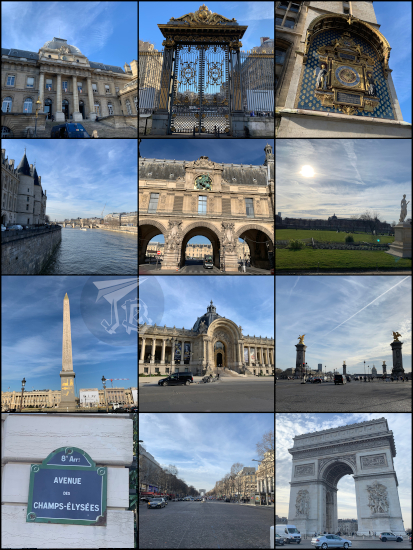
The weather was great – especially considering February in Paris, which is always more to the north than I mentally place it. Unfortunately, the forecast for the following day was quite miserable, and thus I decided to just walk along from the Île de la Cité towards the Arc de Triomphe (some 5 km away). On my way, I walked by the Louvre, Les Tulleries, the Grand Palais, the Petit Palais, the Alexander III Bridge, and into the Avenue des Champs-Élysées – the Banks of the Seine that the Unesco declared World Heritage.

Collage with different landmarks of Paris - the river, neoclassic palaces, Luxor obelisk, Champs-Élysées.

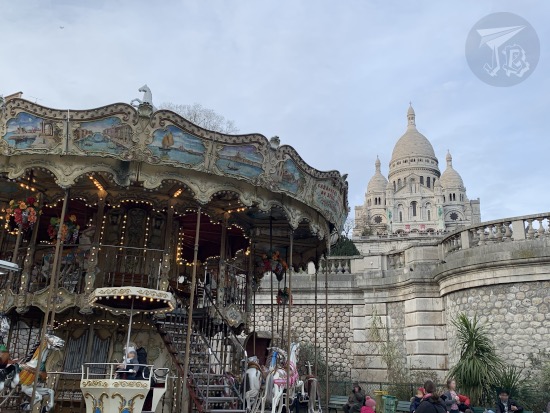
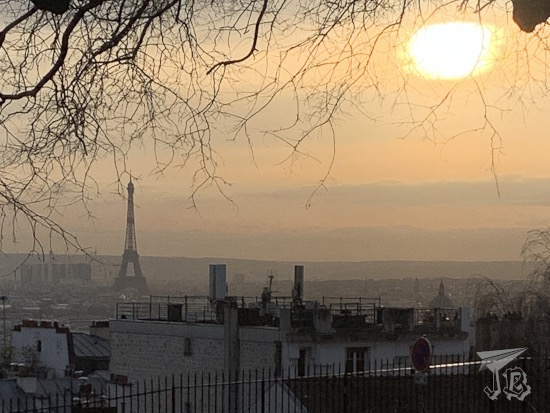
Finally I reached the Arc de Triomphe, which honours the fallen in the French Revolutionary and Napoleonic Wars. It was commissioned by Emperor Napoleon in 1806, and completed in 1836, and you can actually climb it, which I might do some day. From there, I took a train towards Montmartre, where I had booked my hotel. I dropped off my luggage and walked up Square Louise Michel, a sort of urban park which leads up to the church Basilique du Sacré-Cœur (222 steps). There was a pretty carousel Carrousel de Saint-Pierre, and from the square, I could watch the Eiffel Tower Tour Eiffel against the sunset from the lookout Vue de Paris.

A view of the Sacre Coeur with a classical carousel in front of it

A profile of the Eiffel Tower in a blurry sunset in orange tones

I went back to the hotel for a while during twilight. On the way, I bought a snack in a nearby supermarket for dinner as I waited for the evening to get dark and the lights to come up. When it did, I took my last adventure for the day, and walked off to see the Moulin Rouge while I listened to KAMIJO’s song of the same name. It was a few minutes’ walk away from my hotel, and Moulin Rouge [ムーランルージュ] is one of my favourite songs of his. Since the man is obsessed with France, he has a few songs that fit my weekend. Truth be told, I did consider dinner and a show there, it is after all the most famous cabaret in the world. However, it was a bit expensive and I had read quite a few reviews about bad seats if you are alone. I did not want to waste money, and I did not know how tired I would be that evening in the end – and to be brutally honest,I really had not felt like packing fancy clothes for the evening.

The Moulin Rouge cabaret, all lit up in bright red for the night

8th February 2020: Louvre and DIR EN GREY

The weather forecast was accurate, and despite the lovely weather on Friday, Saturday dawned stormy and dark. I decided to go to the Louvre Museum Musée du Louvre, even if I had been there before. It is after all one of the greatest museums in the world.

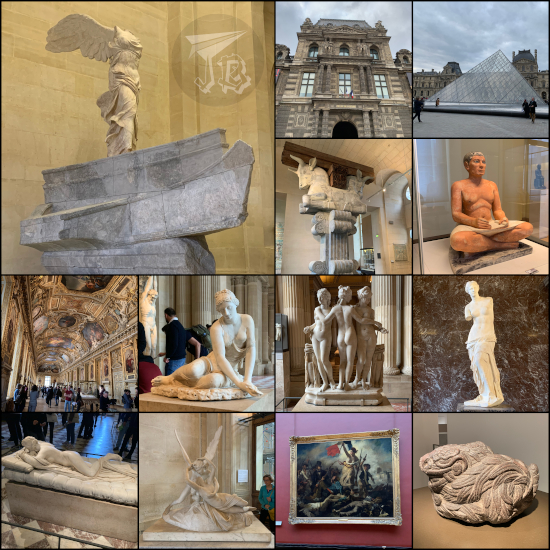
The Louvre holds so many pieces (over 600,000) that it would be impossible to describe them all, but for me, its core is the Winged Victory of Samothrace, a Greek sculpture from the Hellenistic period, around the 2nd century BCE, and my favourite piece of art. The Louvre is a national art museum, which opened in the post-revolutionary France in 1793. It exhibits around 35,000 items – Egyptian antiquities, Sumer and Assyrian pieces, Greek, Etruscan and Roman items, Islamic art, neoclassical and Baroque sculptures, a collection of objets d’art (Decorative arts), paintings, prints, drawings… It is located in the former French Royal Palace of the same name.

A collage with several Louvre pieces of art - Winged Victory, sitting scribe, the three graces, Diane washing her hair, Hermaphroditus sleeping, Psyche and Eros kissing, Liberty guiding the people, Venus de Milo

I wandered there for a few hours and I might have lost my way in the galleries a few times. In the end, I managed to (re)visit all the artefacts and artworks that I wanted. Because there are hundreds of thousands of items, but I must always see the Sitting Scribe, the Borghese Hermaphroditus, Canovas’ Eros and Psyche, and the remains of the Gates of Istar. I had a bit of a headache, so I eventually went back to the hotel to get some rest and prepare for the DIR EN GREY concert and VIP experience in the Élysée Montmartre live house. DIR EN GREY or “Diru” is a Japanese heavy metal band known for its dark themes and scenography that I thought I needed to check at least once (the final verdict was that I don’t need to repeat the experience, but it made for a nice mental break). The band has remained stable since its formation in 1997, and it is composed by Kyo [京] (lead vocals), Kaoru [薫] (rhythm guitar, backing vocals), Die (lead guitar, backing vocals), Shinya (drums) and Toshiya (bass, backing vocals).

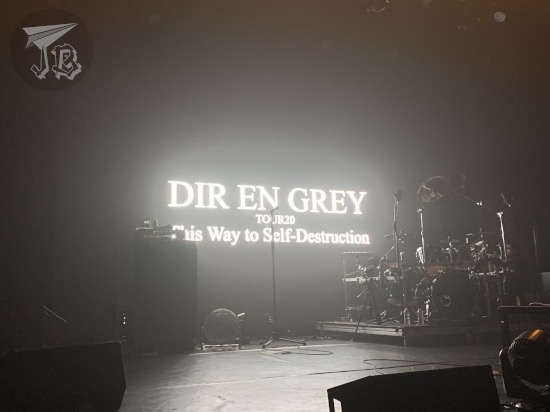
A dark stage with a drum set. Letters projected on the screen behind the stage read Dir en Grey Tour 20 This Way to Self-Destruction

Setlist:

    1. 絶縁体 [Zetsuentai]
    2. 人間を被る [Ningen wo Kaburu]
    3. Rubbish Heap
    4. Devote My Life
    5. 軽蔑と始まり [Keibetsu to Hajimari]
    6. Celebrate Empty Howls
    7. 赫 [Aka]
    8. Merciless Cult
    9. Downfall
    10. Values of Madness
    11. 谿壑の欲 [Keigaku no Yoku]
    12. Ranunculus
    13. The World of Mercy
First encore:
    14. Followers
    15. THE DEEPER VILENESS
    16. 詩踏み [Utafumi]
Second encore:
    17. Sustain the untruth

Listing of all the concerts in the Dir en Grey 2020 tour

The concert was the final of DIRU’s 2020 European Tour TOUR20: This way to Self-Destruction. When I walked by the venue on Friday evening, around 18:00, there was a small number of people queueing already. I did not care enough to queue all day, and I had a VIP ticket with early entry, so I just headed to the line about 15:00. When the queues were separated and organised, around 16:30, I was VIP number 42. The weather was miserable, and I could have totally skipped the downpour while waiting, but I was lucky enough to be against the live house and not in the middle of the boulevard, where the General Admittance queue was. Doors opened at 19:30 for GA, and the VIP experience was held beforehand. The VIP queue started getting in around 17:30. As present we got a VIP pass and an “exclusive VIP only merchandise item” which turned out to be a scarf – very appropriate with the weather. The experience itself was a group photo with the band. There were five cushioned chairs for the fans, and the band stood behind. They did not say a word, nor interacted with fans in any way, not even acknowledging a hello or a thank you.

Afterwards, I headed for the hall, and I found an almost-barrier spot in the left area, on the second row. The people in front of me let me grab the barrier between them so I had something to hold on while I waited. The special guest was a DJ, who was more focused on getting recorded by his buddy on the phone than mixing music. The main show started a little after 20:30.

DIR EN GREY’s music is quite powerful, with a heavy focus on strings and drums. They also have a huge flare for theatricality and they enjoy the shock factor as part of the aesthetics. The singer, Kyo, donned a Joker-like make-up appearance, with a fake-suicidal attitude on stage, using the microphone to mimic stabbing his chest, or the wires to hang himself. It became a bit disturbing because it was repeated more than once. The act also felt rather distanced, there was very little interaction with the fans. At some point, a pick flew in my direction and the person behind me actually felt me up to try and find it in the folds of the coat I had tied around my waist. That was probably even creepier than the act.

The guitars and bass were tremendously powerful, and the drumming was amazing. The crowd was extremely loud, and the singer, Kyo, later confessed that he had been pretty exhausted and burnt out from the tour, which maybe explained why the concert felt so distanced. The encores were the probably best part of the concert, the part that felt more real and relaxed. After the concert was over, I headed off to the hotel to catch some sleep. Since I remembered that the area had felt a bit rough when I was there in 2014, this time over I wanted close accommodation so I could get back quickly without needing to use the underground.

9th February 2020: Destroy the Bastille!

Sunday morning was around 2 ºC, and it was windy. I lingered in bed for a while to recover from the previous evening, and then I headed out – I should have brought the merchandise-scarf with me! I saw the Place de la Bastille, where the revolutionary prison used to stand. In the middle of the square stands the “July column” Colonne de Juillet, which commemorates the Revolution of 1830 (which is not the “famous” French Revolution, which happened between 1789 and 1799). A few minutes away, in the Square Henri-Galli, I came across the base of the tower Tour de la Liberté (Freedom Tower), which was unearthed while building the first metro line. There are only a few stones remaining from the foundations, but I’ll take my fun wherever I can – so I stopped and used my music player to find another KAMIJO song, Bastille, just because I could.

Monument to the French Revolution

A few brick stones forming a circle, considered the last remains of the Bastille

It was too cold to wander, but I had a great plan. I headed off to the science museum Galerie de Paléontologie et d’Anatomie comparée (Palaeontology and Comparative Anatomy Gallery), which was a short walk away. I had read about it and was curious. To be honest, I’m still trying to decide whether it was amazing, or the materials nightmares are made of.

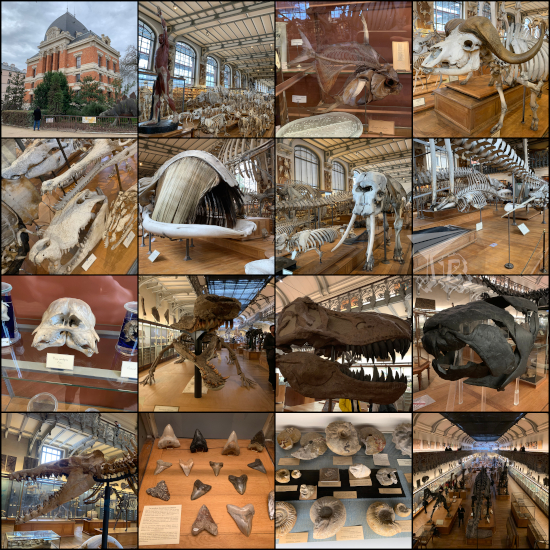
The museum was founded in the 19th century, and it keeps the atmosphere – and the charm – of the old exhibitions. There are stands and wooden cases, and the smell of dust and old paper. The first floor holds a “Cavalcade of Skeletons” – the whole floor is occupied by preserved skeletons of mammals and birds. In the glass cases along the walls, there are taxidermy specimens, preserved animals and dissected specimens. In the far corner, there is “gallery of monsters” with natural oddities. It was enchanting, but at the same time deeply disturbing – especially the male human figure displaying muscles and blood vessels, with a vine leaf on his groin.

The second floor hosts the dinosaurs and other fossils, including a very cool toothed whale, giant crocodiles, a Bernissart iguanodon, a diplodocus, shark teeth… Most of the fossils are either casts or reconstructions – I swear I’ve seen that Irish elk at least three times before. Also, the T-Rex skull was adorably flawed, as it was imagined to be in the 19th century.

The third floor is… ammonite-land. There were cases upon cases of ammonites in different shapes, colours, rocks and materials.

Shots of the museum. Skeletons of animals - fish, oxen, crocodiles, elephants, whale. Fossils: Dinosaurs, fish, toothed whale, shark teeth, snails

After I was done with the museum, I decided it was too cold to wander the neighbouring Botanical Garden. Instead, I headed off to yet another one, the Musée national des arts asiatiques Guimet – the National Museum of Eastern Arts or Museum Guimet, which holds pieces of art from Cambodia, India, China, Japan, Korea and so on. There was a gorgeous dancing Shiva sculpture, collections of religious artefacts, calligraphy, samurai armours, even modern art and clothes inspired by the Far East. It was a really cool museum I had recently found about and was happy to visit.

Different pieces in the museum: Dancing Shiva, sitting Buddha, Calligraphy in the shape of a dragon, elaborate kimono, samurai armour, Indian goddess

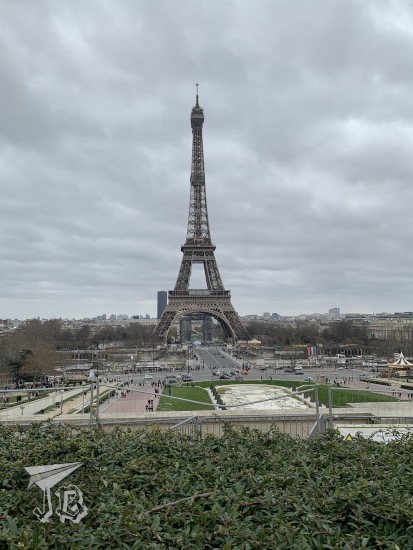
After leaving the museum, I walked towards Trocadero to take the underground. I made a small detour to have a look at the Eiffel Tower Tour Eiffel, and saw a bunch of peddlers playing shell games with tourists. Someone lost about 400 €, I really hope they were in on the game.

The Eiffel Tower in front of a cloudy sky

Since it was too cold to continue walking around to find something to eat, I decided to get take-out, and I headed back to the hotel to get ready for the BABYMETAL concert. I had never listened to them before, but they are a sensation, the basic ticket was not expensive, and two concerts in as many days seemed convenient. They actually played in the same venue as DIR EN GREY on Saturday, so I found out by sheer coincidence on the live house’s website. At that time, I thought “why the hell not?”. Afterwards, they added Madrid to their Europe tour, so if I had known that beforehand, I might have acted differently. BABYMETAL is one of those insanely-profitable Japanese marketing stunts involving cute girls that had never really been in my radar more than in passing.

Notice with the date of Babymetal's concert

BABYMETAL is a product of the “Japanese idol factory”. It was created artificially to fill a market gap. Three girls were chosen to form an act that would mix the idealised cute idea of girl idols with the heavy metal genre. When they debuted in 2010, the term “Kawaii Metal” was coined. One of the girls left in 2018, so there are two main members and and support dancer on rotation. The members are Nakamoto Suzuka, “Su-metal”, the main vocalist, and Kikuchi Moa aka “Moametal” on back-up vocals and screams. The supporting musicians are called the “Kami Band”.

BABYMETAL’s long-awaited European tour is officially called Metal Galaxy World Tour. The VIP tickets sold for around 170€, and did not even entail a M&G, so even if I had had the chance, I would have not even considered them. Despite that, they sold out, along with the show itself.

When I left the hotel at 9:00, the queue had started organising, and the tour buses were already there. I had no intention to queue or try for a barrier. I had decided to sit back and relax, so I reached the venue around 18:45 for the 19:30 concert. There were tons of people waiting to buy merchandise, but I was good. Thus, I just headed to the floor, and found a spot in the back. Since the venue has sort a bit of an arena and some upper stands, there was a wall I could lean against and it was not the end of the room.

The crowd was quite different from DIRU’s, ranging from good ol’ metalheads to families with little girls between five and ten years old with a bizarre range of in-between: people with fox masks, goth and loli dresses, explicit heavy-metal t-shirts (a bunch of those T-shirts were much less kid-friendly than the show… everything you could imagine. I… don’t think most parents knew what they were getting into, and a few of the kids ended up crying.

At 19:30 sharp, the support act started – a German band called SKYND. Their sound was really good, but their lyrics are based on true crime, which makes them a bit on the disturbing side (and very much not kid-friendly). The name of the songs are all serial killers or similar criminals.

Setlist:

    1. Richard Ramirez
    2. Elisa Lam
    3. Katherine Knight
    4. Jim Jones
    5. Tyler Hadley
    6. Gary Heidnik

At 20:30, the BABYMETAL show kicked off with the projection of the Future Metal video as an introduction of sorts. The musical act relied heavily on the Kami Band, and Su-metal carried the weight of the vocals. She spent the whole one-hour concert jumping and dancing while singing, and her voice did not break even once. If she is not lip-synching, she has the most impressive lungs ever. Both she and Moametal encouraged the crowd, making a lot of eye-contact. Su-metal addressed the audience a lot, even – I think – trying French. The concert was non-stop, and it ended up feeling a bit short, but much better than I had expected. The one annoying thing were the daddies putting their babes up on their shoulders in the middle of the floor, when the kids gave clear signs of not caring or were distressed. But it was fun. Not sure I would repeat unless I made it a thing with friends or something, but I enjoyed the act, and had a good time.

Setlist:

    1. DA DA DANCE
    2. Gimme Chocolate!!
    3. Shanti Shanti Shanti
    4. BxMxC
    5. Kagerou
    6. Oh! MAJINAI
    7. メギツネ [Megitsune]
    8. PA PA YA!!
    9. Distortion
    10. KARATE
    11. Headbangeeeeerrrrr!!!!!
    12. Road of Resistance

A group of girls dressed in black dancing in front of a logo that reads Babymetal

I was back at the hotel before 22:00. Thus, I got a good night’s sleep before I left, once again happy that I had taken nearby accommodation.

10th February 2020: No bells of Notre Dame

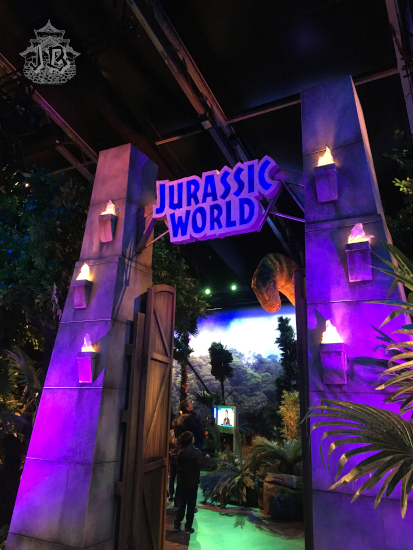
My plane boarded at 10:00 so I had to leave early for the airport. The weather was rainy again, so I took the underground to Gare du Nord, and then the train to Orly. As I was riding the train, I had a nice view of the Paris at dawn, but the bells of Notre Dame were not tolling, and my inner child was sad about that. Despite issues with the airport security staff, the stupidly-expensive food, and the general unpleasantness of early-morning public transportation, I made it to my plane without actual problems. As it was a big plane again, I settled down to watch Jurassic World during the flight, because I’m a nerd. Going straight into work from the airport was not fun, but it a small price to pay

I only had three days, but this trip was a very welcome getaway, and even if the weather did not help, I got to do a lot of stuff. I had to discard a few plans and improvise due to the weather. However, there is that film quote, “We’ll always have Paris”. After all, I’ll be coming back for the Saint Seiya Symphonic Adventure. ETA: Or so I thought, at the time of writing the article…

13th August 2019: Steamy steamy Tokyo {Japan, summer 2019}

Following recommendations from some Japanese acquaintances, I headed off to the Shinagawa [品川区] area to visit Hebikubo Jinja / Kamishinmeitenso Jinja [蛇窪神社 / 上神明天祖神社], a pretty shrine where I got a pretty shuuin (aaaand discovered another stamp rally).

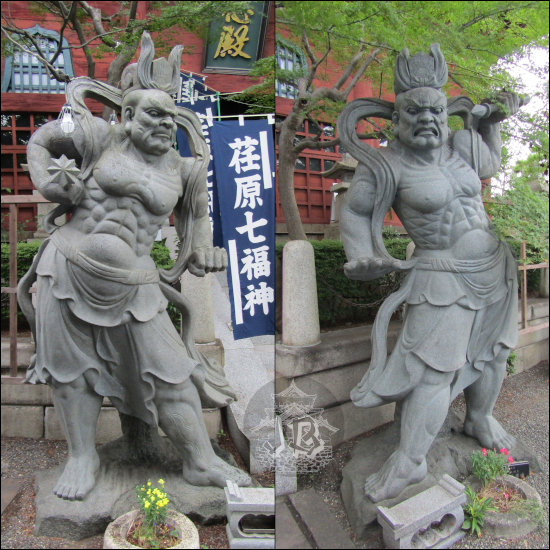
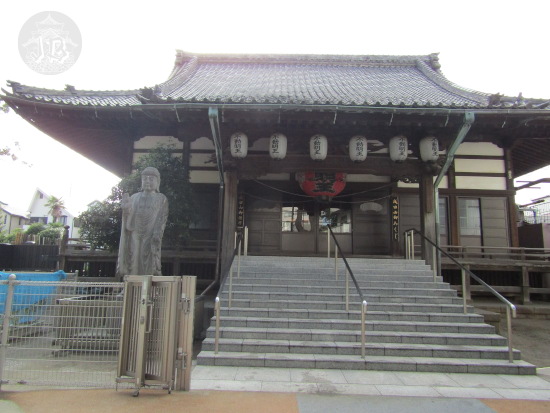
Among rain, sun and drizzle it was exhaustingly hot. I continued on to find Kimyozan Yogyokuin Nyorai [帰命山養玉院如来寺], a temple with amazing guardians.

And then I found an obviously very dangerous and aggressive tiny pond, I mean, look at those meshes (yes, I know that it’s probably for children safety, but I shall still make jokes about it). It was the Hara no Suijin-ike [原の水神池].

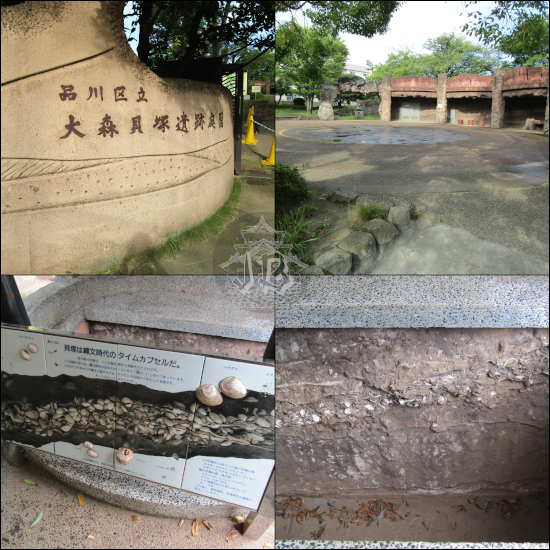
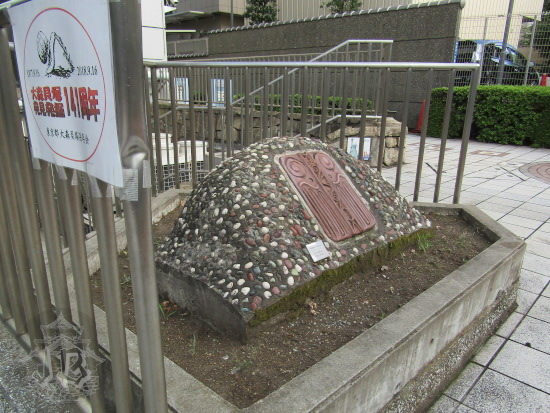
Checking how to come back I came across Ōmori Shell Mound Ruins Garden, Ōmori Kaidzuka Iseki Teien [大森貝塚遺跡庭園] and the Statue of Ōmori Shell Mound, Ōmori Kaikyo no Ishibumi [大森貝墟の碑]. The Ōmori Shell Mound was apparently the first archaeological excavation in Japan. They dig out a seaside village from the Jomon period (14,000 to 300 BC).

Opposite I found Naritasan Ennoji [成田山圓能寺].

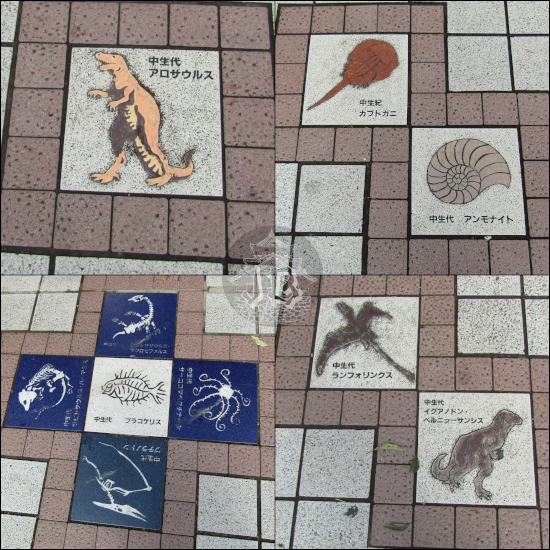
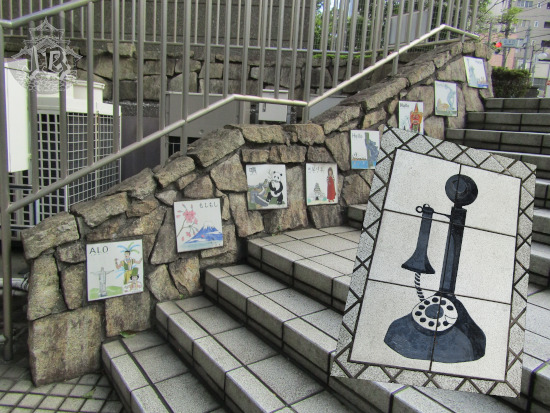
And before I left I noticed the ground decoration on the pavement – life evolution and… telephone greetings. Because Japan, I guess…

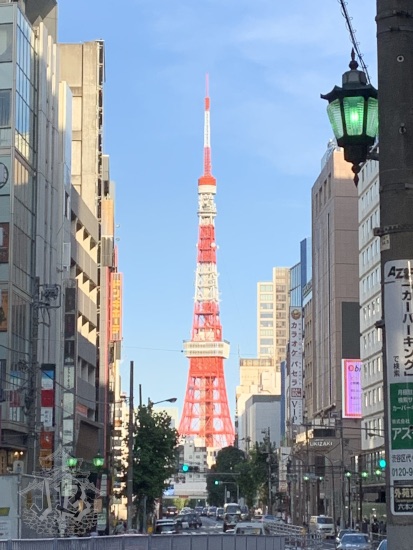
Then I looked at Tokyo Tower [東京タワー] from Roppongi [六本木], as I checked the Don Quijote for Tokyo Coke bottles, without success.

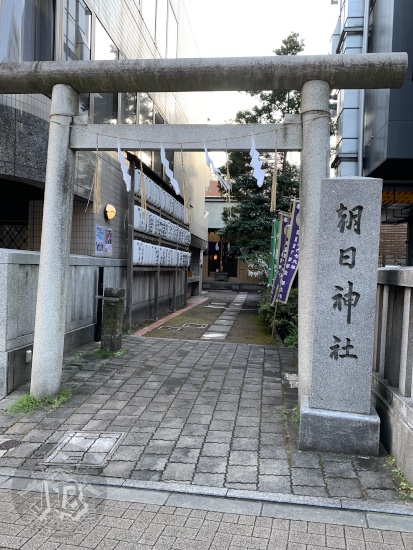
I also came across tiny Asahi Jinja [朝日神社].

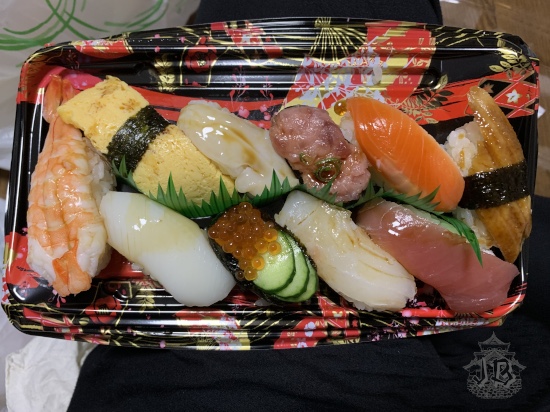
Then dinner was supermarket sushi, which was very, very yummy.

Walked distance: 14009 steps / 10.0 km

30th July 2019: Journey to the East (1): Sakaiminato → Okayama {Japan, summer 2019}

For the second part of my Sakaiminato adventure, I got breakfast on the go, and around 9:00, I set off to the Yumeminato Tower in the park of the same name. I had a plan of things to watch and walk around that unfortunately fell through due to, again, a perceived temperature of over 42 ºC and bright sun. But the Yumeminato Tower [夢みなとタワー] could not be skipped as it is part of my still ongoing All Japan Tower Stamp Rally. Aside from the customary observatory, the Tower featured an anthropology exhibition about the cultures of “countries historically related to Sakaiminato in matters of trading” such as Korea or China.

Yumeminato Tower and views from it. There is also a betobetosan (a… white ball with teeth).

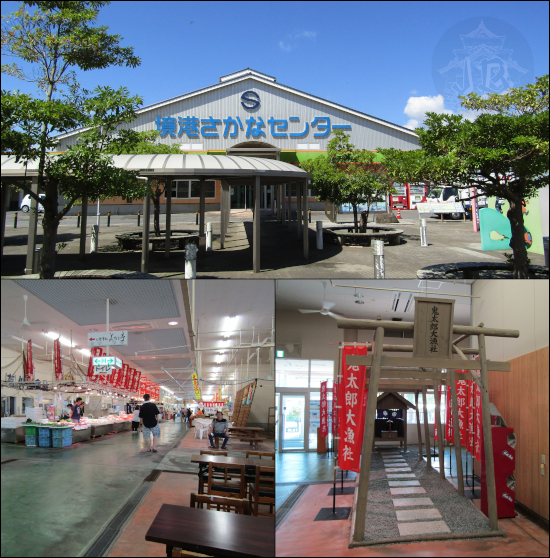
At the feet of the tower is the Sakaiminato Fish Center [境港さかなセンター], a fresh fish market – remember that Sakaiminato is “The City of Kitarō and Fish”. Here is where the homage to fish starts. Sakaiminato is both a trading and fishing key point in western Japan, so this spot is quite important for local business. They have even built a small shrine to give thanks to the ocean for providing the catch.

Sakaiminato fish market, outside and inside, including a small shrine.

Both the tower and the market buildings are encased in Yumeminato Koen [夢みなと公園], a huge – and shadowless – park. It was quite hot, to be honest, and looking back I should have probably just taken the tourist shuttle, but the schedule was inconvenient.

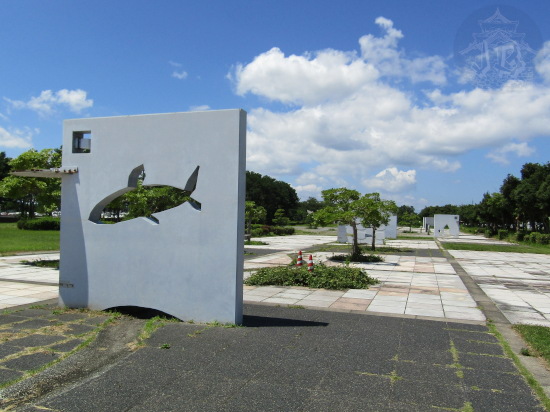
Park with sculptures that depict silhouettes of fish.

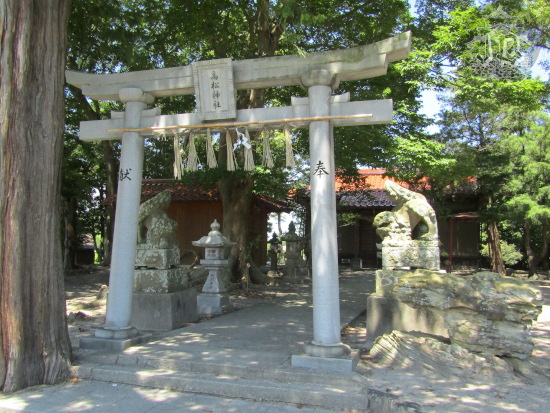
When I arrived at the Takematsucho station, my train had just left, so I snooped around Takematsu Jinja [高松神社], a small shrine next to it.

The torii of a small shrine, next to a sacred tree

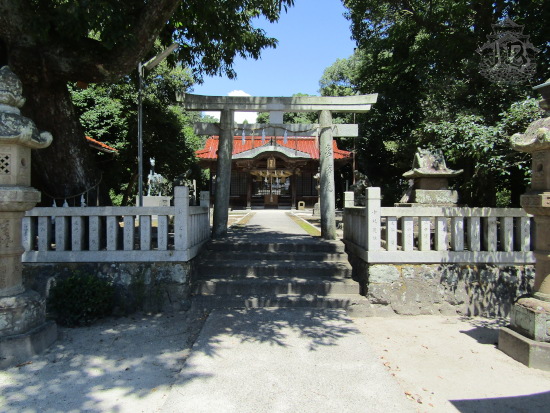
Having to wait forty minutes further, as there is only a train per hour, I decided to walk over to the following station, where I visited Amariko Jinja [餘子神社].

A shrine. The entrance torii frames the main building.

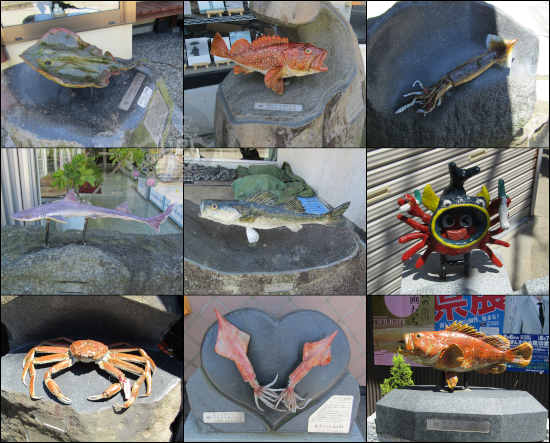
Then, I just sat down to wait and have a drink till the train came. Once back in the centre of Sakaiminato, I realised that even if it was a Tuesday, the Museum of Sea and Life was closed. That did not stop me from hanging around Osakana Road [おさかなロード], the Fish Road, which follows the same ideas as Mizuki Shigeru Road – it has little sculptures here and there. Only these are not yōkai, but fish.

Life-like fish, squids, crabs and sharks from Osakana Road, along a cartoonish mix of them all.

Oh, and I found a… photo-op / trash can shark on the way ʅ(・ω・。)ʃ?? I have no idea, but I could have fit inside. Unfortunately, I would not have been able to climb out.

Head of a white shark

And speaking of fish, I had a great fish-fry snack in Mizuki Shigeru Road as I did an extra sweep to make sure I was not missing any yōkai. I chose this place because the owners seemed nice, and they were. They tried to make some conversation and they were very friendly.

Fish fry with a slice of lemon.

After that, I claimed my certificate at the Tourist Information Centre next to the station Sakaiminato-eki [境港駅]. Although I had done it the previous day, by the time I finished, the office was closed. Of course, nobody had any issue with that – they happily gave me my certificate, dated July 30th and not July 29th (≧▽≦).

Certificate of having finished the Yokai Stamp Rally, dated 30 July 2019.

I finally said goodbye to Sakaiminato, and I took the train back to Yonago, and from there to Okayama, the capital of the Prefecture of the same name. This took around three hours, and I was in Okayama [岡山] around 18:00 or 19:00. I dropped my things off at the hotel and headed off for dinner. I ended up ordering a salmon set in a semi-traditional restaurant in a Takashiyama shopping centre, and although the staff was not the nicest, the food was delicious!

Japanese dinner with fried fish, salad, miso soup and a bowl of raw fish on rice.

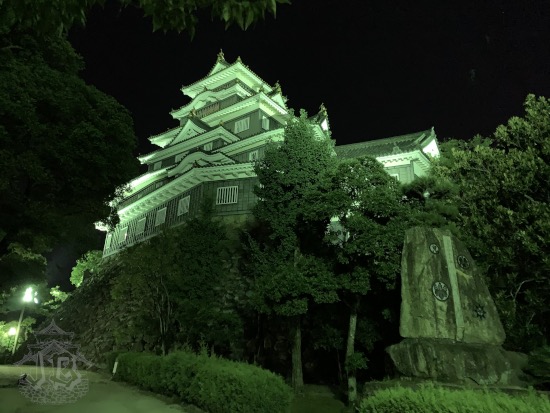
Right after dinner, I walked to the castle, Okayama-jo [岡山城], hoping it would be lit, and it was. They were also rehearsing some summer light show, with music and stuff.

Okayama Castle at night

Afterwards, I went back to the hotel – unfortunately I had a smoking room (yuck), so I had to spray everything with freshener so I could breathe. But I left the window open as I showered, and I slept rather well afterwards. I had started to feel the tiredness.

Walked distance: 22899 steps / 16.3 km. Most under the sun (soooo sunburnt!)

28th July 2019: Wakayama {Japan, summer 2019}

Going to Wakayama [和歌山] was a spur-of-the-moment decision, so I did not prepare for it in advance – I should have. On the one hand, it was super hot, on the other hand, most of the stuff was not covered by my JR Pass and I had not budgeted 3,000 ¥ extra on trains for it. But when I came out of the train on the 27th saw that my platform was the Wakayama platform and thought “why not?” After all, they made HYDE their Tourist Ambassador this year…

First I found my way to the castle, Wakayama-jo [和歌山城] and the adjacent park.

On one of the corners of the park I found Wakayama-ken Gogoku Jinja [和歌山県護国神社].

And then I visited the Wakayama Rekishi-kan [わかやま歴史館], Wakayma History Museum, since the ticket was included in the Castle visit.

Then I missed the train to Kimiidera [紀三井寺], so I had to wait an extra half-hour… that I would later be thankful for because… stairs. Lots of them.

There were a couple of other shrines that I wanted to visit, but it felt like 45ºC and it was just too hot to walk to them – besides the stairs left me exhausted. So I headed back to the station. I did not manage to make a seat reservation, so I had to stand the 90 minutes back to Osaka [大阪]. That was not fun. Once I was in Osaka I took a stroll in Tennoji shopping centre because I wanted a long summer-jacket, preferably in black lace. I was not lucky.

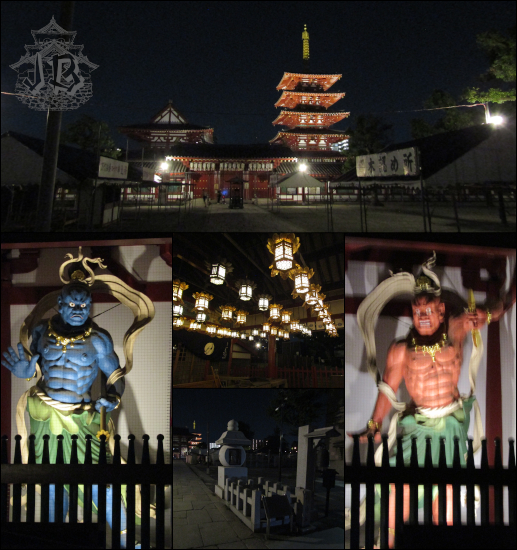
I had dinner and a shower at the hotel, and then I walked past Shinsekai [新世界] and Tsūtenkaku [通天閣] to see Shitennoji [四天王寺] at night. I was closely observed by some cats which roamed the altars and were very offended I was not bringing them any food.

Walked distance: 22995 steps, 16.4 km

25th July 2019: Sekigahara {Japan, summer 2019}

I was staying in Nagoya for another of the HYDE concerts, but I had a free morning, so I decided to take a train to Sekigahara [関ヶ原], which is a nearby little town, which is really only in the books because in October of 1600 a huge battle in the mountains over there decided the establishment of the Tokugawa shogunate, which shaped the history of Japan for centuries. It is known as the Battle of Sekigahara, Sekigahara no Tatakai [関ヶ原の戦い]. Basically there were a bunch of samurai clans warring with each other and Tokugawa managed to convince, bribe and slaughter every one in his way until he was the de facto ruler of Japan.

A vermillion gate with trees in the background

I found a map with a route to follow and thus my first stop was the Higashikubidzuka [東首塚] Mound, where a bunch of samurai were beheaded – this was off to a bloody start. Within the same area there were several monuments signalling different events and encampments – which was to mark how most of Sekigahara is laid out.

Collage of the park, showing a marker, some flags and a torii

Then I continued on to Jinbano Koen [陣場野公園], where I could see the Site of the Battle Camp of Tanaka Yoshimasa [田中吉政陣跡], the Site of Tokugawa Ieasu’s Final Encampment [徳川家康最後陣跡], Kibune Jinja [貴船神社], Mitama Jinja [御霊神社].

Collage of the park, showing a marker, some flags, fences with spikes, and a torii. There are trees and overgrown bushes in the background.

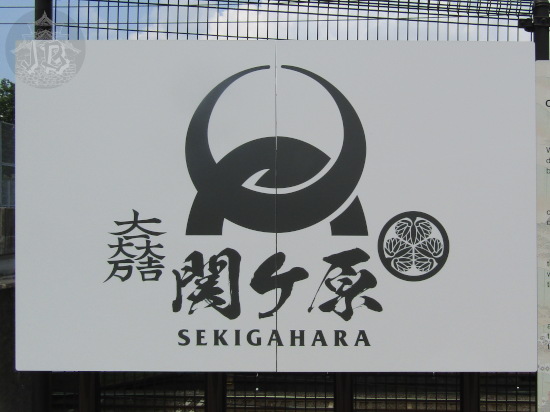
It was hot as could be, so I was not going to do the 17-km route, but I did go to the main area, the Site of Sekigahara Battleground – Sekigahara Kosenjō [関ケ原古戦場], along with the Site of the Battle Camp of Shima Sakon (Sasaoyama) – Shimasako-jin ato [島左近陣跡].

The logo of the city of Sekigahara. It can look like the moon coming up from behind a mountain, or a samurai helmet

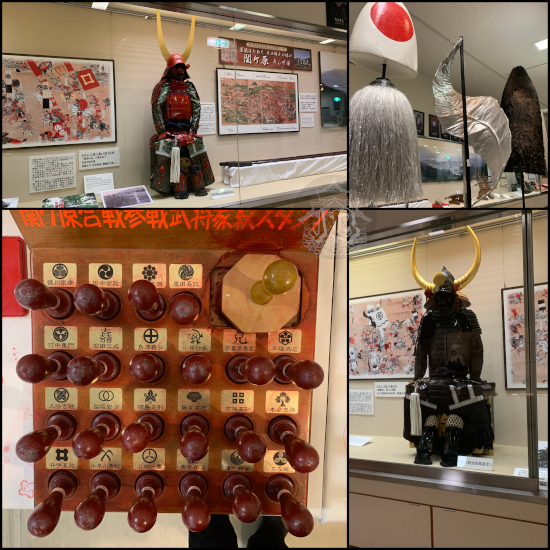
After that, I backtracked to the Sekigahara Town History and Folklore Museum Sekigahara-chō Rekishi Minzoku Shiryōkan [関ケ原町歴史民俗資料館], which I had missed at first because there was construction in the area. There I could see some weapons and armours and get the whole collection of samurai clan stamps and enjoy the air conditioning.

Samurai armours and pennants

I would have liked to go to the Site of Tokugawa Ieyasu’s First Encampment [徳川家康最初陣跡], but it was too far away to walk, so I had to take picture from the train.

A clear in the forest with some white flags

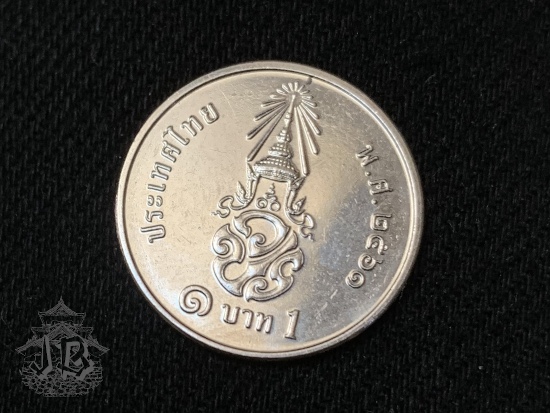
As an interesting anecdote, I found a Thai coin in the battle site, something I would have never expected.

A Thai coin

Once in Nagoya [名古屋], it was time for HYDE concert’s HYDE Live 2019 at the Zepp Nagoya again. As the previous day, it was a fun concert – I stayed at the end of the venue because my entry numbers were so high I had zero chance to find anything mid-venue, but it was all right, it’s not like I’m ever going to do first row in a HYDE concert in Japan. I have accepted that. I had fun anyway, and that is the most important thing.

My impressions were similar to the previous day. The concert made the 2018 tour feel like a rehearsal for this one, or maybe just a way not to “give up” summer touring on HYDE’s part since he has a pretty devout following.

Setlist:
    1. Who’s gonna save us
    2. After light
    3. Inside of me
    4. Underworld
    5. Fake Divine
    6. Two face
    7. Set in Stone
    8. Zipang (Japanese version)
    9. Out
    10. Mad Qualia
    11. Sick
    12. Don’t hold back
    13. Lion
    14. Another moment
    15. Midnight Celebration II
– break –
    16. Duality (Slipknot cover)
    17. Countdown
    18. Ahead
    19. Ordinary World (Duran Duran cover)

After the concert, Sr-san had skipped back to Tokyo, so I just headed off to my hotel to have a shower and relax. I had another concert coming the next day, making it three concerts in a row, so I needed to rest up a little.

Walked distance: 14683 steps / 10.5 km.

23rd July 2019: Arashiyama honours its name {Japan, summer 2019}

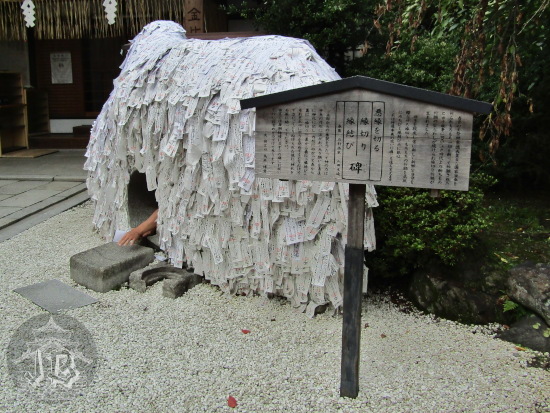
I started off the day at Yasui-Konpira-gu [安井金比羅宮], a shrine with a huge ema-like “mound” called Kushi-zuka [久志塚] with a hole in the middle. It is thought that if you write your wish on a paper, glue it on the mound and then crawl through the hole and back, your wish comes true. In case you’re wondering, no, I didn’t go through.

Then I walked all past Gion again to return to Gion Shirakawa [祇園白川] and Tatsumi Bashi [祇園 巽橋] to see the area by light. I saw Tatsumidaimyojin [辰巳大明神], the Kanikakuni monument, Kanikakuni Ishibumi (Koma-satsu) [かにかくに碑(駒札)], and a very cool heron (or crane?) who totally owned the place.

After this little stroll, it was still early so I headed off to the reconstructed castle Fushimi-Momoyama-jo [伏見桃山城]. It was a very cool castle, but it was not open to the public (this trip was not castle-lucky, now that I think about it).

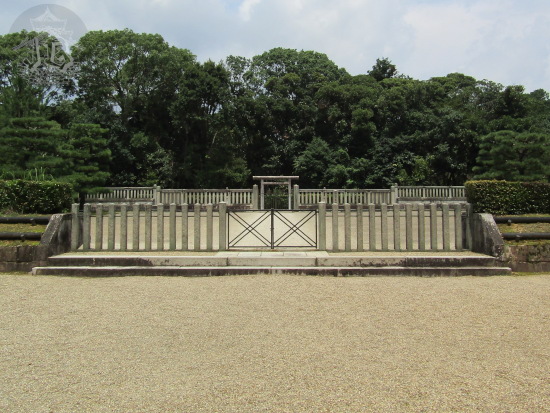
Underneath the castle, I found the Mausoleum of Emperor Kanmu Kanmu Ten’nō Kashiharanomisasagi [桓武天皇 柏原陵].

And then I walked off to the opposite part of the hill. On my way I found some of the original rocks that had conformed the Ninomaru [二ノ丸跡] of Momoyama-Jo.

I kept ascending until I reached Meiji Ten’nō Fushimi Momoyama no Misasagi [明治天皇 伏見桃山陵], Emperor Meiji’s Tomb at Fushimi Momoyama, which was… somehow very sober and somewhat humble for such an important figure in Japanese history (then again I’ve recently visited the Spanish Royal Family Pantheon so… hm… yeah. Anything is more sober than that.)

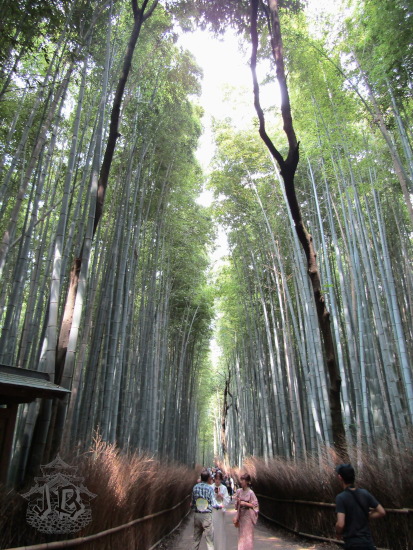
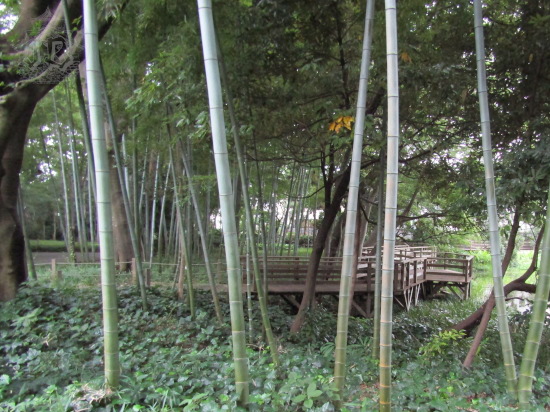
After that I was tired and hot, so I needed a break – and the best way to have a break is a train ride. I rode back to Kyoto Station and from there I headed off towards the Arashiyama area. I wandered around the Bamboo Grove Arashiyama Chikurin no Shōkei [嵐山 竹林の小径] for a while. It was packed so I kept diverting towards other areas.

I walked into Rakushisha [落柿舎], a poet’s house, where I got a shuuin.

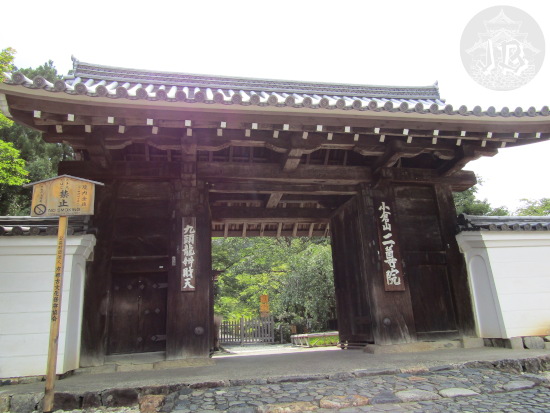
Then I went up the road to Nison-in [二尊院].

On my way back I stopped to admire the lotus flowers, which were in full bloom.

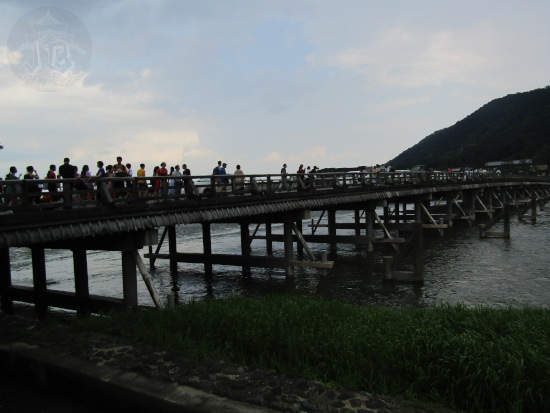
I considered going into the Museum of Korean arts, but as it was closed, my decision was irrelevant, so I decided to head back towards the Arashiyama Koen Nakanoshima Chiku [嵐山公園 中之島地区], the Nakanoshima area of Arashiyama Park. I saw the Kadono Ooi [葛野大堰], the small damn in the river, and crossed the Togetsu-kyō Bashi [渡月橋] bridge.

There I climbed up to Ichitani-Munakata-Jinja [櫟谷宗像神社].

I decided against climbing to the Monkey Park, and I was halfway back through the bridge, when the skies opened and a huge thunderstorm hit – so indeed, Arashiyama became the mountain of storms! I waited half of it under the canopy of a shop, and after twenty minutes I braved running across the street to the Lawson to get myself a sandwich and ate it as the rain dwindled enough for the streets to be walkable again.

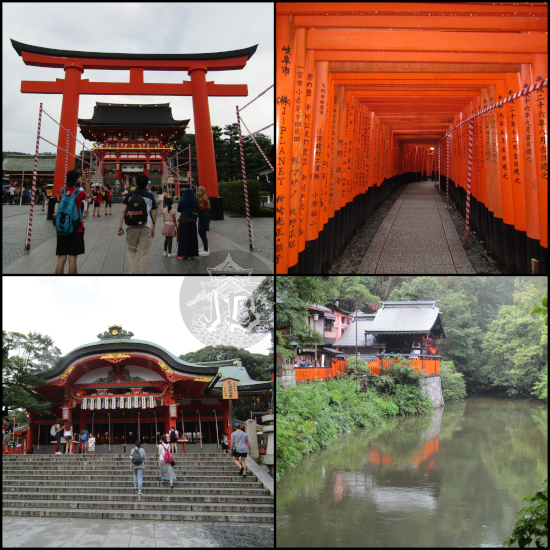
Once that happened, I walked to the station and took a train back to Kyoto and then to Fushimi Inari Taisha [伏見稲荷大社]. I did two sweeps – one with light and once when the sun was setting. Of course I did not climb the whole mountain, I just stayed to see the main buildings and the Senbontorii [千本鳥居] (the loooong torii line) lit.

And finally I headed off back to have some food and rest.

Walked distance: 27897 steps, 19.9 km (so glad I took my cane today!)

20th July 2019: Kawagoe revisited {Japan, summer 2019}

I went to Ikebukuro to exchange my JR Pass, and from there I went to Kawagoe [川越], a small town near Tokyo. The historical centre of Kawagoe is called Koedo [小江戸], Little Edo or Little Tokyo. I have actuallly visited Kawagoe before and I had not thought that much of it, but I wanted to give it another chance as I was going to a fan-event over there the following day, so I got myself a hotel over there and spent the afternoon / evening wandering the town.

I arrived by train at the Kawagoe Station and I headed to the touristic area. My first stop was Kawagoe Kumano Jinja [川越 熊野神社]. I thought about getting a shuuin but there were too many people and I backed off. I thought there would be fewer people the following day but I was wrong. Oh, well. Live and learn.

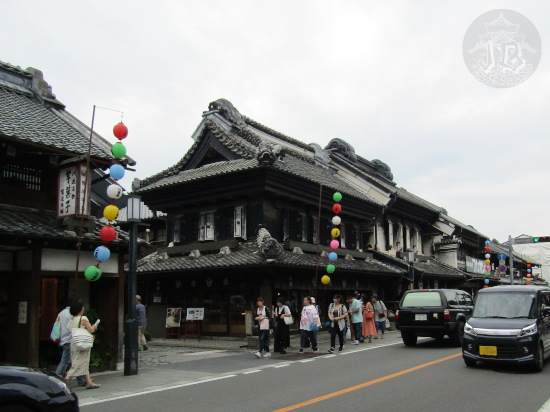
After that I found my way to the Black Warehouse District Kurazukuri no Machinami [蔵造りの町並], which is an area with houses that date from the Edo period. Today they are shops, mostly tourist traps, though. I am not a big fan.

On one of the side ways you can find the Clock Tower, Toki no Kane [時の鐘], which is one of the few historical clock towers in Japan (although it was rebuilt after it burnt down in the 19th century).

And I moved on to the Kawagoe Hikawa Jinja [川越氷川神社], which has a very cool wind chime tunnel, but it was packed at the time.

Later I visited the Kawagoe Castle / Honmaru Residence [川越城 本丸御殿]. The castle is long gone, but the palace was built in the 19th century.

I walked past the Reconstructed Moat of the Castle (I have no idea why there are no pictures of it?) and Yukizukainari Jinja, which was closed off. Then I headed off to the hotel to check in, and after that, I did some walking over the less touristic / known area of town. Right behind the hotel I came across Sugahara Jinja [菅原神社].

My next stop was snooping around Myōzenji [妙善寺] and its adjacent graveyard.

Then over to Fujisengen Jinja [富士浅間神社], a nice little shrine with a historical stelae next to it, the Shishimizuka of Uranaikata [占肩の鹿見塚].

From the grounds I could see Jitsuzaiji [実在寺], which is a very modern temple.

After that I walked towards Senbahikawa Jinja [仙波氷川神社], which I’m sure is haunted by a nekomata which appeared out of nowhere.

Senbagashishiseki Kouen [仙波河岸史跡公園], an awesome and large park with a lake and a ghost-proof bridge.

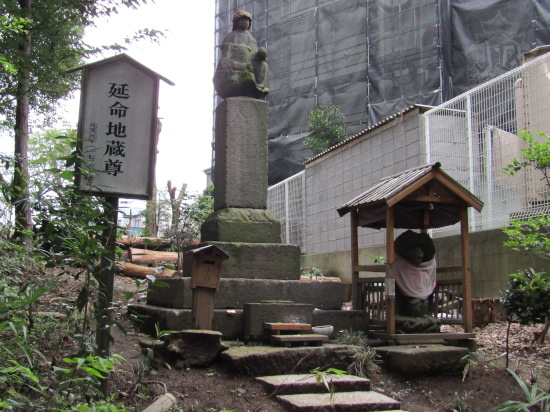
The park has a small temple altar, Enmeijizoson [延命地蔵尊] to one side.

On the other side stands Senbaatago Jinja [仙波愛宕神社] and I bought some takoyaki for dinner.

Walked distance: 22797 steps / 16.3 km

18th & 19th May 2019: Madrid (Spain) for Jupiter (and fesFE[M]!)

The weekend started extremely early on Saturday, when I took the first bus out to Madrid, and I think I was there around 7:30 to meet my friend C*****. She had been having a rough time and she had asked me to “keep her head off things”. Up until a couple of days before, we did not even know whether she would be able to come to the concert, so I had a whole plan up my sleeve. Unfortunately, a couple of steps backfired slightly. The main event – which we had been planned since the previous December – was Jupiter’s concert for the ZEUS Europe Tour on Sunday the 19th, but we made a whole weekend out of it. I was not actively following Jupiter at the time of the announcement, but C***** and I decided to attend because Madrid is easy and convenient, well-communicated and an opportunity to spend a weekend decompressing somewhere. As the time drew near and we could access more material, the excitement built up – I also managed to find the album they were promoting and it sounded really well, actually.

Her bus arrived earlier on Saturday than mine, and when we met, we decided to have breakfast at the coach station, to catch up and to give shops and so on the time to open up. When it was a reasonable time, we took the underground to drop our luggage at the hotel – the lovely EXE Moncloa. I had selected it because it was near the concert venue, and I hoped that we could hang out the terrace and the swimming pool, which unfortunately did not open until June. After getting rid of the luggage, we rode the underground towards the neighbourhood of Chueca, where I had looked up a bunch of Goth apparel shop which were right up her alley and… did not open at 10:00 as the internet said, but at 12:00.

Fortunately, other shops were already open and we were able to pass the time amicably. We were actually close to the Telefonica building, so I suggested we headed up there for the TeamLab exhibit, which I had already seen, and I thought she might like the digital art.

Teamlab logo and digital art: Waves, butterflies in red and green, and a dripping circle as if it were painted with a brush. All of them are light or bright colours on black.

Afterwards, we moved onto Callao Gourmet Experience for a snack. I wanted to introduce C***** to the Niji Mochi shop, and we also shared a chocolate ice-cream shake.

Mochi and coffee with whipped cream

Afterwards, we were shopping for a little longer before we moved on to have lunch. I had a surprise for her. While I care little to nothing about Korean food, she is a fan of everything Korean. Thus, we hit one of the best Korean restaurants in Madrid, called Seoul. I gave her free reign to order for both of us and we shared, though being honest, the only thing I enjoyed was the green tea at the end.
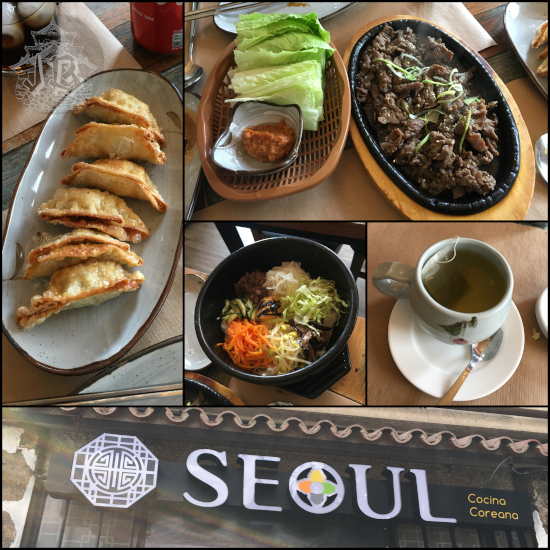
Lunch: fried dumplings, roasted meat, rice with vegetables, and green tea.

After lunch, we went on and found an underground station. We rode towards the Museo Arqueológico Nacional, National Archaeological Museum, although we had not realised that it was museum day so instead of a quiet exhibition I was used to, we had to deal with a ton of families! On the bright side, it was free, though. The museum, which shares a building with the national library Biblioteca Nacional, was founded in 1867, at a time when creating national museums had become popular among European governments. It was the start of the development of archaeology in Spain. I remembered it from the time I was a kid, dark and with wooden floors, but it was recently renovated with wide spaces and modern interiors.

Exhibits at the archaeological museum: bones from a mastodon, boar statue, lady statue, Neanderthal skull, Roman mosaic of an octopus, Horus statue, Iberian stelae, primitive animal that looks like a boar or a bull carved out of stone, Grecian vase

C***** was tired from spending all night in the bus, so we left the museum and headed back to the hotel to finish our check in process and then catch a break. On the way, we stopped and bought a few snacks for the following day because you always have to be ready for a post-concert low.

We had to look for a place to have dinner, and I found a few interesting places. There were not one, but three Japanese restaurants in the area where we were staying. One of them required queueing and sounded quite self-important, so we were left with two options. We decided to try one in the evening and the next for lunch the following day. Thus, I booked a table at the nearby Naniwa. We had some decent sushi, chicken, and takoyaki… then ordered takoyaki seconds because we had a discount (and I was hungry because I barely picked on lunch).

Dinner: sushi, fried chicken, octopus balls, chicken skewers

The next morning, we headed to the venue Sala Copérnico door around 9:00 and upon seeing nobody queueing yet, we went to have breakfast at a nearby café. Then, we walked around the Moncloa park area, mostly chatting, until we went back to the venue – no queue. And later went back to the venue – no queue. And afterwards, we went back to the venue again, just to find there were still no people in the queue.

Coffee and bread breakfast

In the end we ran into the supporting bands went to have lunch to the second Japanese restaurant in the block, Morikaen. It was around 13:30 as we were heading there, and I said something along the lines of “I feel sorry that they’ll arrive and there’s nobody here to greet them”, and as we turned the corner we almost literally ran into the whole crew coming out of the bus. Talk about timing. They looked tired so we just walked by, but we were rather sure that we had been noticed. On our way to the restaurant, we walked past a family all clad in “Sunday church clothes”, and their small girl wearing aaaall white just stared at us – in rock-goth black clothing – with pure envy in her eyes. Here’s to you, little one. You’ll get there too.

Lunch was all right – tuna tataki, tonkatsu, takoyaki. A bit more expensive than the previous day’s dinner, but we also ordered higher-class ingredients and more complicated dishes.
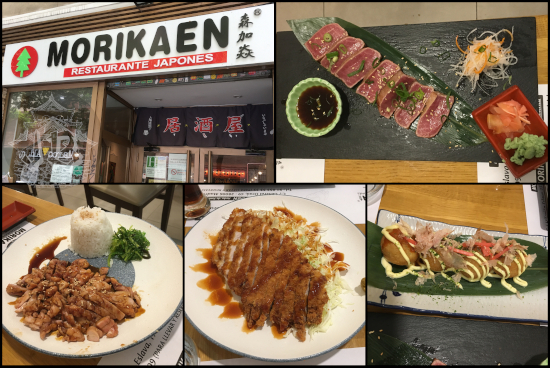
Lunch. Tuna tataki, rice and chicken, breaded pork, octopus dumplings

Jupiter is a Japanese band who define themselves as “melodic metal band”. It could be said that it is a visual kei symphonic power metal, which means they combine a very particular image (or a bunch of images, the most iconic being Hizaki’s Baroque-inspired dresses) with a subgenre of metal that combines hard drumming, metal guitars, and elements of classical music. On the 22th November 2018, Jupiter announced their new album, a Japanese Tour, and a European Tour, ZEUS Europe Tour. Bassist Rucy left between the announcement and the album release due to creative differences, and I really thought they would cancel the tours, but luckily everything went ahead. The remaining members – guitars Hizaki and Teru, current vocal Kuze, and drummer Daisuke were joined by support bassist Shoyo.

Schedule for the tour

There were two promoters involved for this concert. The local promoter, which in Spain was Madness Live, sold general admission tickets – they have a clean and neat webpage and buying from them is easy; I got ours on the 12th of December. The other, Editions Hikari, was in charge of coordination of the European tour, general information, and ticket upgrades. I think they are one of the worst organisers I have ever come across.

Hikari announced those upgrades in January. There would be VIP experiences, on sale on the 14th of February. Besides that there would be two kinds of upgrades, there was no real information about them until a few days before the sale. The best tickets were called “Venus Premium” (40€ face value + 5€ reservation costs) included autographs + handshake + backstage access before or after the show or soundcheck access (if possible) + photo with 1 member taken by a professional photographer (sent by e-mail later after the tour) + priority access to the merchandise, and there were five per show. The “Venus” upgrade (25€ VIP + 3€ reservation costs) comprised autographs + handshake + priority to the merchandise, there were 20 available per show. Getting the tickets was chaotic, but in the end, C***** managed to buy the two Venus Premium tickets we wanted – luckily. A lot of people did not even find out about the option to upgrade. In the end, the backstage pass / soundcheck was not available for any concert in the tour, and the priority access to the merchandise was impossible in Madrid due to the two independent promoters. Either of the VIP upgrades granted the option to buy an “Instax” (Polarid) photograph with the whole band at extra cost.

Hikari’s Facebook instructions were that Venus and Venus Premium ticket holders had to go to the merch booth – to which they supposedly had priority access – at the beginning of the concert. However, as the access to the actual venue was controlled by the local promoter ticket, there was no way they would access the merch booth with any kind of priority unless the managed to somehow skip the queue. Any kind of communication with Hikari was impossible as “they could not check emails, Facebook messaging, nor reply to comments.” However, they still made posts, and that is how we found that the CDs which Jupiter brought to sell at the merchandise booth were confiscated by customs’ officers before the first concert!

On the 10th of May, we received an email form the local promoter, Madness Live, informing us that the door timing had been changed and they were nice enough to send us the following schedule: Doors at 19:00, VII ARC (German support band) at 19:15; fesFE[M] (Japanese support group) at 20:20; Jupiter at 21:30. There was no information on the upgrades, because they had no clue about those, as Hikari was in charge. The day of the concert thus arrived and we had no actual about that, except for rumours and comments of what had happened in previous concerts. That was why, even if there was no queue, we had decided to stick around Sala Copérnico instead of heading into the city centre.

Eventually, after lunch, I decided that I was too tired to keep going up and down the streets, so around 16:00 we settled at the venue doors until they opened so we could get into the chaos that was the concert. At 16:30, other people arrived, so we got talking – that was how we found out that many people had never even heard about the upgrades. Doors opened around 19:00 – without any kind of priority access to the merchandise, nor separating VIPs and GA. C***** and I decided to divide and conquer – she went to secure a spot on the first row, while myself checked in at the merch booth to get the Instax tickets with the whole band.

That is when I saw the lousy, half sheet of paper taped there saying “Venus and Venus Premium ticket holders, gather at the merchandise booth at 20:00”. That placed the “Venus experience” in the middle of the support act, which meant either having very good friends who saved you the first row spot, or sacrificing it. We decided to give the place up and find somewhere more convenient so we could move about. Without holding spots for the VIPs, this was totally unacceptable in my opinion, especially since there had been no early entry, or priority merchandise. A bunch of people who did not want to buy anything missed out on what they had paid for.

The first support band was VII ARC. They were okay, a bit of stereotypical German heavy metal. I can see how they might appeal to the general metalhead crowd, but it feels that they were chosen because “they dress up sometimes”, and Hikari thought they would fit. It is formed by Kay (vocals), Fū (lead guitar), Bena (guitar, screaming), Grazel (Bass) and Z’ev (drums), and they could probably fit a bit on the “visual” style, but they did not bring any distinctive gear.
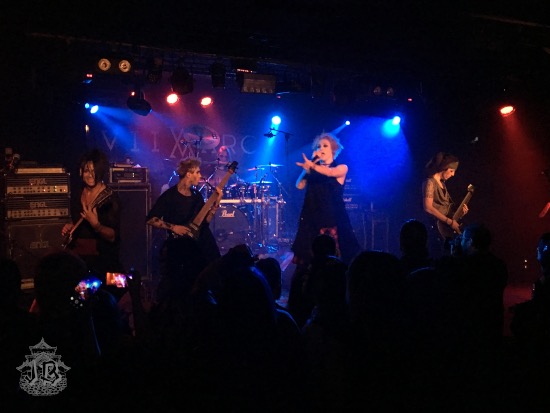
VII Arc playing in Madrid

At 20:00, as fesFE[M] prepared to take the stage, the Venus Premium and Venus ticket holders gathered around the merch booth and we were ushered past a barrier, towards the bar. There, we had to wait for about 10 minutes while the second support act started. A Japanese staff lady with little to no English came to “check” the Premium tickets and “sort of explain” to us the whole thing. First the Venus Premium would be shown backstage one by one for the one-on-one photograph – there were four of us, we never knew if the fifth was never sold, they did not come, or they missed the whole experience. Afterwards, we would come out again and joined the regular Venus for the autographs and handshake, then the Polaroid would be taken for the ones who had bought it. We were ushered past a curtain and the backstage door towards the mess room where the remains of the lunch buffet were.

As I entered, I caught sight of Shoyo, the support bassist, who was sitting down on a low mattress in a room to the left, looking bored. I greeted him in Japanese, and he greeted back. C***** turned to see whom I was talking to and her eyes were wide. I asked Shoyo if he felt lonely, he said a little. Another attendee who also spoke Japanese asked for a picture (beating me to it, actually) but he said he was not allowed.

The conversation died out when it was time to go into the private band area for my picture with one of the members. As I walked in, there was Kuze to my left, Daisuke to my right and Teru and Hizaki in front of me, Teru dead centre and Hizaki a little to the right. I was asked whom I wanted my picture with and chose Teru, as I had long ago decided that I would if I could. He smiled and posed with me, then he shook my hand. I have got to learn to look into Japanese musician’s eyes when I talk to them.

We said good-bye to Shoyo on the way out, and almost left, but it was now time for autographs, handshakes and Instax. I pulled out the CDs I had brought for C***** and myself, and I got to shake hands with all four of them and receive the band’s autographs. Since the CDs the band brought had been seized, we might have very well been the only ones in the whole country that produced some official material for signing. Then, we took the Instax and the staff would ask with a thumbs up sign “okay?” to check the picture was good, before we left.

CDs signed by Jupiter members

All in all, the band was very friendly and amazing, but the timing and organisation was horrid. We lost out first row – despite having “priority access”, and we missed half of the fesFE[M] concert. As Copérnico has two levels though, we found a nice spot at the stairs that connect both, and I could lean against the handrail to watch the rest of the act.

fesFE[M] is a relatively new visual kei band where all the members take up “doll” personas. Their career in 2017 and released their first mini-album in May 2019, just in time to come over to Europe for Jupiter’s tour. For each album / season, the band dons a doll theme, and they were currently on the “horror genre” dolls. The members and their doll types are: Lion [リオン], vocal, Distress Coppelia doll (from the namesake ballet, dressed as a bloody bride); Aito [アイト], guitar, Apathetic Prince doll; Zeno P [ゼノP], guitar, Bloodthirsty Child Killer doll; Toru [徹], bass, Emotional Princess doll; Rensa [蓮沙], drums, Psycho Butler doll; and Jun, keyboards, Scalded Dollmaster doll (dressed as a nun because… reasons?).

The first time I heard a song by fesFE[M], I was not extremely impressed – the PV was a bit too creepy. However, they are really good in person, even with the bad sound quality and reverberation in the venue – and the fact that we missed about half of their act. They were really engaging. The whole visual part was amazing, and the coordination was great! Their music was much more powerful live. The band played some songs from their mini-album enseMble autoMata: Doll in blueberry jam [Doll in ブルーベリィジャム], Arachne ni haitoku wo [アラクネに背徳を], Psychological stolen heart, and Freiya [フレイヤ].
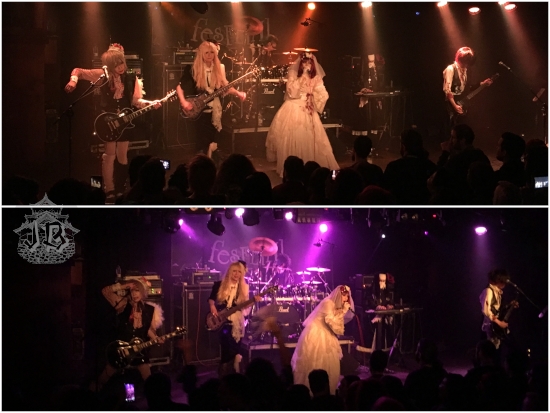
Fesfem live in Madrid

The Jupiter concert was as expected, very energetic and fun – it actually went beyond expectations. Our spot was really good in he end, a bit raised, without getting pushed, and we actually watched the concert next to fesFe[M]’s bass Toru. Sometimes he smiled and waved at us, and we waved back without fail.

Kuze, Jupiter’s vocalist held his ground better than I thought he would be able to. I was kind of impressed when I listened to the Jupiter single Theory of Evolution and later to the album Zeus: Legends never die. While we were expecting the guitar and metal power, Kuze’s voice range in the recording was rather wild, and I did not think that he would be able to keep it up live, especially on a final concert after touring both Japan and Europe. He proved me wring, and he held all his notes and his vocal range, just like the recording. He had practised his English a lot and learnt the MCs, but he switched to Japanese quite often, and he spoke too fast for me to get! He did a great job even with songs that had been released in the previous vocalist’s time.

Daisuke was pretty much hidden by his own drums from where we were, but we did see him bounce a couple of times. Hizaki was on the other side of the stage from us, and he looked divine in his Baroque dress. I don’t understand how he can even move in those clothes, much less play guitar or crouch, which he did so a few times in order to interact to first-row fans. A couple of times I did fear for his safety as someone grabbed either him or the guitar. Most of the songs that were played were his. It’s fun to imagine what he would be thinking when writing “die, die, die, go fuck yourself”, when he presents as such a beautiful and innocent lady, but it surely was fun to yell.

And finally, Teru had a blast. He kept twirling around as he played, his stud-leather coat swirling around him. He played with a huge smile on his face all the time and he gave off the vibes that he was having a lot of fun. He also interacted with fans a lot.
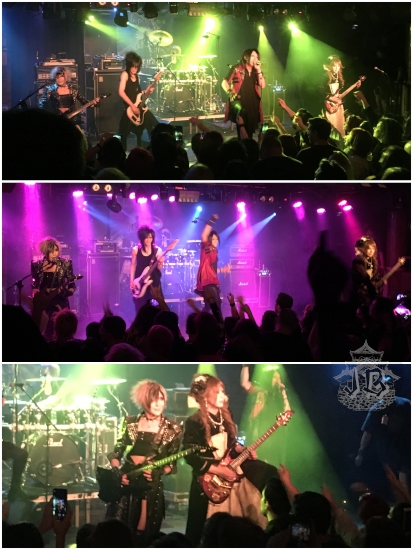
Jupiter Live in Madrid

Setlist:

  1. Arcadia
  2. Last Moment
  3. Angel’s wings
  4. Drastic Night
  5. Bring me out
  6. Show Must Go On
  7. No cry no more
  8. The spirit within me
  9. Tears Of The Sun
  10. Memories of you
  11. B.L.A.S.T
  12. Blessing of the Future
  13. Zeus: I. Legends Never Die / II. Conversations with God
  14. Symmetry Breaking [Encore 1]
  15. Theory of Evolution [Encore 2]

While the concerts were a lot of fun, the whole event was stressful due to the abysmal organisation. I actually feel a bit ripped off, because they did not deliver a lot of what they had sold in the upgrades. At least C***** and I are lucky enough that we managed to get our pictures, autographs, and saw the concert from a relatively good place. All in all, Jupiter are amazing, they were super nice, and so were the guys from fesFE[M]. The concert was great, and we don’t regret going for a second.

After the event, waved at Toru for what we thought was the last time. When lights went on, we also saw Rensa, who stopped for us when we told him he had done a good job. C***** and I decided to pool our money together to buy the CDs fesFe[M] had brought – and not got seized. Apparently, it is typical that the entry-level bands hang around merchandise booths after concerts, and we were lucky enough that they agreed to sign the CDs and take a photo with us. Lion was extremely surprised and nice – or acted so. He complimented me on my poor attempt of Japanese and complied with what we requested.

CD signed by Fesfem members

Finally, C***** and I headed back to the hotel, and we went home the next day – fortunately we left from the same bus station so we could maximise our time together.

Hikari took a few days to send out the VIP pictures, but they eventually arrived on the 1st of June. Getting them was also hard, and amateurish – they wanted to put them in a Google Drive link and post that on Facebook. At least we got them to send them via email, citing European Data protection laws at them… I really, really hope to avoid this promoter in the future, but if I do, I’ll be on the lookout in order not to miss anything.
4th May 2019: Museo Naval & TeamLab in Madrid (Spain)

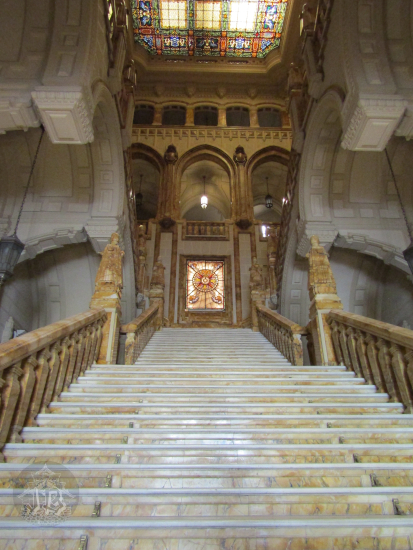
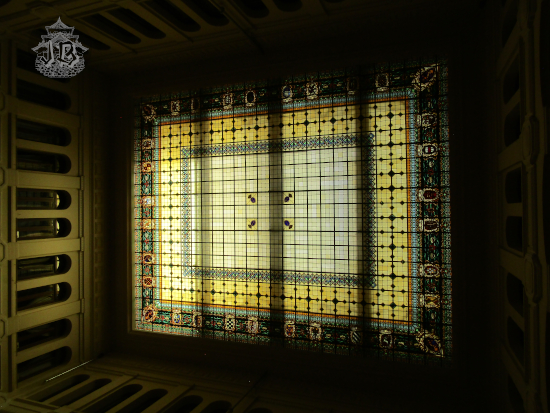
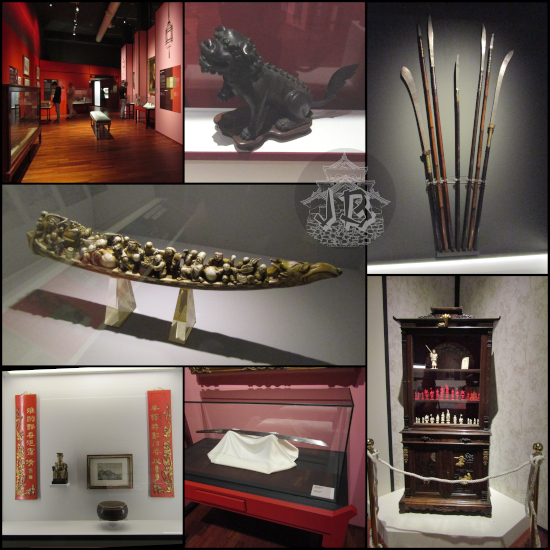
There were a couple of exhibitions in Madrid that I wanted to see, and my mother decided to tag along. We took a train and walked to the Museo Naval, the Navy museum, which was being renovated – so the permanent connection was not being shown. In the end, that turned out to be awesomely lucky because it allowed us to see the marble staircase and stained glass of the classical building, which is very rarely shown.

The exhibition that I wanted to see was related to the trips to Asia, mostly China, Japan and Philippines, and it was interesting for 3€. one of these days I would like to come back to see the whole museum when the renovations are over. It’s on the bucket list, I swear. One of these… I’m not sure, months, because I’d been saying I want to go to the Museo Naval for years.

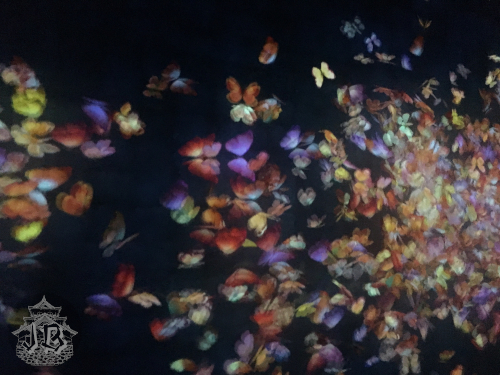
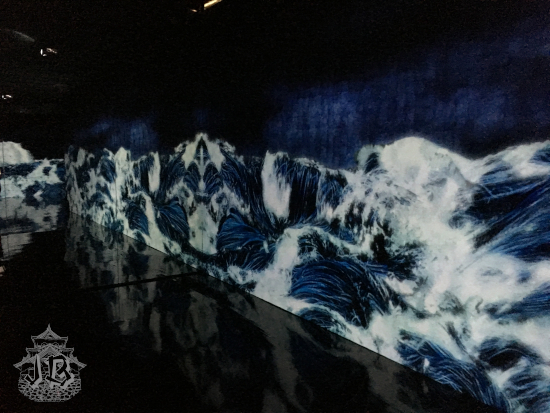
After seeing the “Asia in the Naval Museum” exhibit and the ceiling, we walked towards the Telefónica Building. There, there was an Exhibition by TeamLab, the museum of virtual art from Tokyo! I really want to see it.
There were three exhibits:

  • Flutter of Butterflies, Born from Hands (2019), a magical wall where you can rest your hands for butterflies to come up.

  • Black Waves: Lost, Immersed and Reborn (2016), an amazing scenery of breaking waves.

  • Enso – Cold Light (2017), a self-tracing enso (perfect circle traced with one stroke in calligraphy).

I was very happy to see this, and then we walked around the “Evolution of phones” exhibition- however, I apparently have not taken pictures of that one. I think it was too nostalgic, because god did it make me feel old (≧▽≦).

Before we returned home, we had lunch at a De María restaurant – an Argentinean meat-grill where we got a glass of rose champagne to go. Another place I want to return! However, this time I did not take pictures because the atmosphere did not feel adequate to do so.

2nd January 2019: Jurassic and 19th Century Madrid (Spain)

I was in the middle of winter holidays and a couple of family members asked me if I had plans – I said I was getting tickets for a dinosaur exhibit in Madrid, and they jumped in. We made arrangements to head over there on the 2nd of January and spend the day in Madrid. I don’t think they really realised what it meant to be around me and the “terrible lizards” (≧▽≦). But off we went.

General entry ticket for 2nd January 2019

The Jurassic World: Exhibition was held in Madrid. The whole thing is organised in-verse, as if you actually visited the island.

Jurassic World the Exhibition logo and title

After you walk in, there is first a small introduction on the “boat” as you travel towards Isla Nublar. There you are given the instructions (mainly, keep your hands to yourself), the boat makes dock and you are let into the Park. Keeping in touch with the spirit of the films (not the book though *giggles*) there’s a Brachiosaurus there to greet you, just like the first animal you see in Isla Nublar (and later the last).

Pretencious gate with two columns on the side, reading Jurassic World. A brontosaurus head peers down at you

You also catch a glimpse of a Parasaurolophus.

The head of an herbivore dinosaur (parasaurolophus) peering through the bushes

Then you get to the “stables” where you get to see a Triceratops mama with her baby.

Mom and baby Triceratops behind a fence that reads Gentle giants petting zoo

Afterwards, there is a small room that represents the laboratory where the dinosaurs are made – I could have made it out with a critter but there were only baby Iguanodon.

Fake amber pieces and DNA extactor along with an incubator with eggs and baby dinosaurs

Next, you walk into a tiny museum with some fossil reproductions and actual scientific information…

Reproduction of carnivore dinosaurs skull and bones, along with the drawing of a huge T-rex fooot print drawn on the ground to compare it to a human one

… right before everything goes to hell and back when you’re shown a hologram of Owen Grady talking to his velociraptor Blue and you get a… guy in a velociraptor costume prancing around (≧▽≦).

Person disguised as a verlociraptor

The next room shows the Tyrannosaurus rex cage (by the way #TeamTRex here, in case you did not know) behind her cage, menacing and staring.

T-rex animatronic, showing the huge head behind a fence

The final room is another garden in which you get to see a Stegosaurus being stalked by the made-up Indominus rex.

Stegosaurus

Head of the Indominus rex, looking like it's stalking prey

And at the end of the exhibition, after the shop even, you find the velociraptors, which have apparently escaped and are ready to attack!

Jurassic world velociraptors on a wrecked crate

All in all, being the dinosaur geek I am, I had a blast. I’m not sure that my poor family members that had wanted to tag along with me knew what they were bargaining for (≧▽≦).

However, they were still willing to put up with my for a little longer, and together we drove off to the centre of Madrid, and somehow ended up at the Museo Cerralbo. They asked if there was something I wanted to see, and the Cerralbo Museum was running a couple of Japan-related specials I was curious about. The museum stands in the Palace of the same name, and it holds the collection of the late Marquis Cerralbo.

The museum is… crammed and chaotic, but interesting in its own way. It holds thousands of pieces, from worthless-looking mementos to priceless paintings by masters such as El Greco. Art experts say that the Cerralbo collection was the most valuable of its time.

Collage of cerralbo museum. A room with two samurai armous. A centrepiece made with swords. A long table, set, with chairs along and an ellaborate lamp hanging from the ceiling. The hall of the museum, with a staircase with an ellaborate balaustrade and a glass lamp hanging from the ceiling.
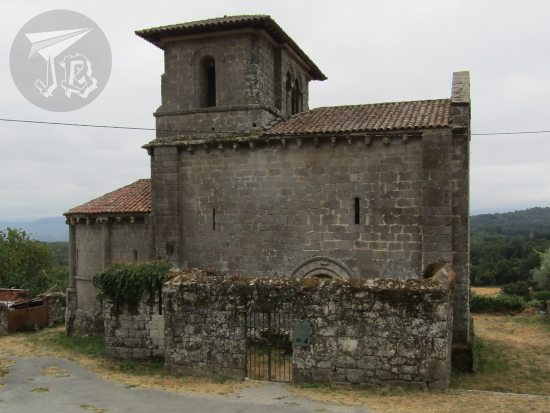
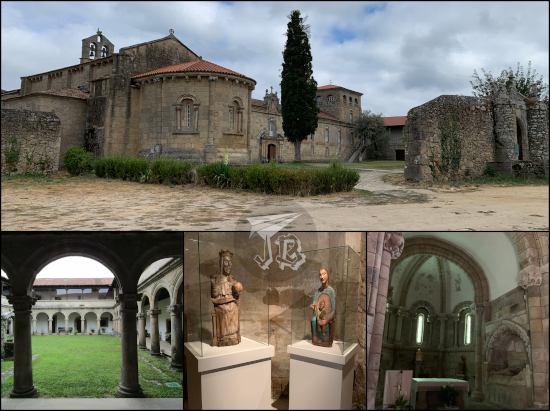
The museum was holding a designated route focused on the Japanese pieces it has, including samurai armours.

Collage of Asian and Japanese pieces of the museum: hars, a samurai armour, and an hexagonal carey box

Furthermore, there was an origami exhibition on the lower floor.

Origami pieces: a phoenix, a snake, an orca, corals, and a life-sized hippo

After the museum we sat down for lunch at a fusion Asian-Japanese restaurant, because the family members “wanted to try” – although they were rather scared of the food. Eventually they managed to enjoy it too, and even have seconds – however I needed to make a run to get my tablet serviced.

Lunch. Sushi, chicken skewers, rice dish and noodles dish

Once it was up and running, and family had come to find me, we walked towards the shopping centre in Principe Pío for dessert – yoghurt ice cream with berries and smarties. A great way to end the day!

An old station from iron architecture epoch repurposed into shopping centre

Frozen yoghurt with berries sauce and smarties

4th September 2018: また今度 with a red rose petal (HYDE LIVE 2018, Strike 3) {Japan, summer 2018}

First thing in the morning, after D****e left for work, I got packed (hoping that my suitcase did not get lost again). Later, I went to Odaiba [お台場] on my own as she was working. It was my last HYDE live for the season, and my last day in Japan, too. It was windy and it rained on and off, but it was not bad especially considering that there was a super typhoon in Osaka that had slammed a ship against a bridge and cut down communications to the airport… I mean, compared to that I won’t even complain that my hairdo went to hell because woah there. I just had to not worry about my own flight a few hours later.
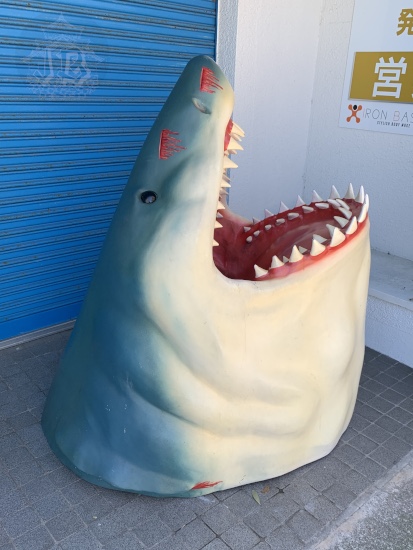
I checked out the Venus Fort to check if there were any new goods, but as there were not, I moved on. There are two exhibit rooms about cars in the area. One deals with newer and racing cars – MegaWeb Toyota City Showcase [メガウェブ トヨタ シティ ショウケース].

A collage with some cool and futuristic-looking car. The logo reads MegaWeb Toyota City Showcase

The other one is quite the opposite, and focuses on classic and historical cars – History Garage [ヒストリーガレージ].

History Garage classic cars.

It was at this time 12:55, so I hurried to the giant Gundam that stands in front of the Diver City. I wanted to check whether it moved at 13:00 and I was lucky. It changed its helmet and all (≧∇≦).

Gundam robot looking up to the sky. it is white and taller than the two-story shopping centre behind it.

After that, I went to eat get some food. The food court in the shopping centre was not too busy as it was a weekday, so I decided to sit down and have some ramen. I really love the way they prepare eggs for ramen, so I wanted ramen with egg. Unfortunately, could not read the super long name of the ramen to save my life, so I just asked for it using the number. The girl just turned to the kitchen and ordered ‘tamago’ (egg), which was pretty frustrating.
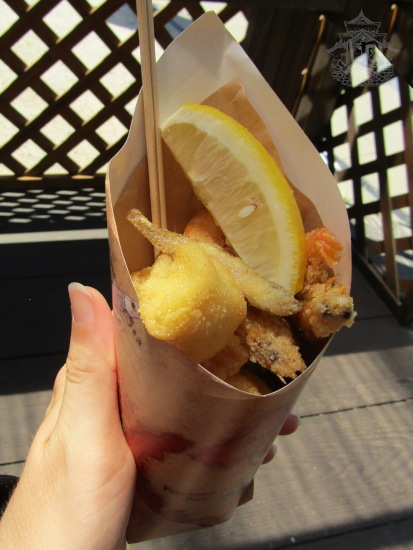
Ramen bowl with algae, chasuu (pork), spring onions and noodles

Once I had eaten, I went to see the waves, because even if the typhoon was making its effect known, and I am still fascinated by hot storms. Odaiba is, in the end, an artificial island in the middle of the bay, so it makes strange patterns sometimes.

A cargo harbour with unsettled sea

And I got a drink at Starbucks.

Starbucks plastic cup. It says thank you and it has a smiley face and a heart

I joined the people wait for HYDE to come in, waved hi at him, and thought that he did not look too awake. Afterwards, I decided that I had not spent enough in this trip (sarcasm). Thus, I went to buy something else: since I liked HYDE’s opening act STARSET, I wanted to get their CD and M&G experience, which included a handshake and an autograph. I felt that they had done an awesome job and deserved the credit and the cheering.
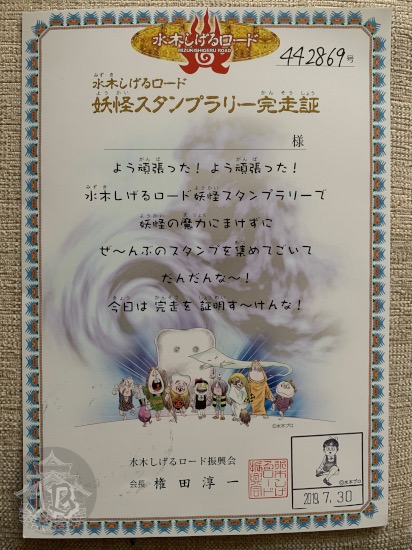
Once D****e made it, we went inside. By now, I had figured out what I had found amiss on Saturday and Sunday regarding HYDE’s live 2018 and made peace with it. Or maybe it was just my last day, and I really wanted to enjoy myself. I found a good spot in Zepp Tokyo – one thing I really like about going to converts there is that they keep the barriers up to separate the areas of the floor. That allows me to lean onto something and I don’t need to stay back to have something to hold on to, so I can get rather close even when I’m tired or sore. This time it was even better – since I was closer than usually, I managed to find a petal from one of the roses HYDE threw as goodbye at the end.
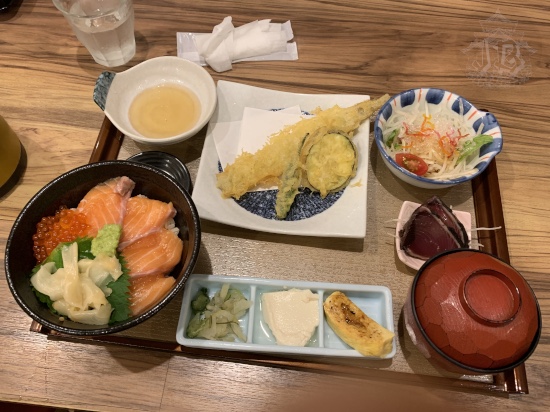
STARSET’s setlist:
1. Frequency
2. Carnivore
3. Gravity Of You
4. Telescope
5. Monster feat. HYDE
6. Ricochet
7. Bringing It Down
8. My Demons

HYDE’s setlist:
1. Fake Divine
2. After light
4. Out
5. Set in Stone
6. Don’t hold back
7. Zipang
8. Who’s gonna save us
9. 監獄ロック [Kangoku Rock]
10. Rise or Die
11. Lion
12. Two Face
13. Devil’s side
14. Midnight Celebration II
(pause)
15. Kiss of Death
16. Ahead
17. Rise up
18. Ordinary World (Duran Duran cover)

After HYDE’s concert was over, I put my rose petal away, and I found my way towards the STARSET M&G. They were were extremely nice. We were around ten people, and they paid attention to each of us and they shook our hands (whoops, I forgot to take my wristband off). They were pretty patient and nice to everybody. Even after they left the venue, they were willing to sign items for people who had not purchased their merchandise (even though 3,500 ¥ for CD and signature is almost a gift).

Zepp Tokyo Venue from above

Starset CD with the band's autographs

A red rose petal

Finally we got home and D****e helped me so I got my trains sorted out to go to the airport the following day.

Night view of Tokyo, with Tokyo Tower lit up

26th August 2018: To the East: Niigata → Aizu-Wakamatsu → Koriyama → Tokyo {Japan, summer 2018}

As there was not much to see in Niigata [新潟], we took a scenic train to the east – Niigata is famous for being ‘countryside’, and growing rice. We saw lots of rice fields.

Our destination was Aizu-Wakamatsu [会津若松], a ‘samurai town’ famous for Tsuruga castle and the story of the Byakkotai [白虎隊], a troop of young soldiers who fought during the Boshin war. Back then the ‘Aizu warrior spirit’ was a very important thing, and 19 youths committed ritual suicide when they thought the castle had fallen. This is called the Tragedy of the Byakkotai.

On the other hand, the town’s mascot is a cartoonish phantom red cow Akabeko [赤べこ]. Because why not?

We headed out to the castle first and foremost. Tsuruga-jo [鶴ヶ城] or Aizu-Wakamatsu-jo [会津若松城]. If you google it, you might think it’s pink. So did we. We were a bit on the amusedly disappointed side (≧∇≦).

But we made-do with some awesome (and ice-cold) Aizu Coke-bottles.

Within the castle grounds we found Tsuruga-jo Inari Jinja [鶴ヶ城稲荷神社].

And Kasama Inari Jinja [笠間稲荷神社].

After the castle it was lunch time so we went to have lunch in the ‘old samurai town’ which to be honest does not feel too old. On the way we stopped by Shinmei Jinja [神明神社], which was rather on the empty side, but still nice.

We ate lunch in a place called Mitsuta-ya [満田屋] to eat miso dengaku [味噌田楽]. We had a course of skewers consisting on two konjac (one with salty and one with sweet miso), fried tofu, mochi (rice cake), sweet potato, shingorou (some kind of rice croquette) and smoked herring. All these were grilled just in front of us, which was on the one hand really cool to see, and on the other, bloody hot because hey, there was a fire burning in front of us. We were told that this was typical samurai food, because it could be prepared and eaten ‘on the go’. Who knows whether it is true, but it was fun and yummy.

Once we had eaten we had to make a run to the station so we could catch the train – as the following one was two hours later – and we made it with three whole minutes to spare despite google maps saying we were too far away. And thus we were off to Koriyama [郡山], which… we had not really heard of before this whole thing? (≧∇≦). There we took the Tourist Office by surprise when we asked what we could see even if it was already ‘late’. Map in hand, we headed off to see Asakakunitsuko Jinja [安積国造神社], which was a little on the creepy side.

Then we saw Nyoho-ji [如宝寺].

And continued to the park Hayama Koen [麓山公園], where we saw the Asaka Canal Hayama Waterfall Asaka Sosui Hayama no Hibaku [安積疏水麓山の飛瀑].

And the so-called Of the 21seikiki nenkouen Hayama no Mori [21世紀記念公園 麓山の杜], the 21st Century Memorial Park Hayama Forest.

Finally we headed back to the station area, where we checked out the Observatory in the Big-i [ビッグアイ] building.

And finally caught a shinkansen back to Tokyo, we had dinner on the go and crashed in bed when we got home.

22nd August 2018: … and I raise you two castles more {Japan, summer 2018}

From Nagoya [名古屋], I got myself to Inuyama [犬山], Aichi Prefecture, to see yet another castle. This is also one of the twelve original castles and a National Treasure of Japan. Inuyama is located about 40 minutes away from Nagoya in a line I had not even heard about, so I had a bit of a hiccup finding the station. But it was no more than a tiny stumble and I was on my way at the expected time. Inuyama is a nice little town with a traditional street leading up to the castle, called “Castle Town street”.

Before getting to the castle I came across two shrines – one was Haritsuna Jinja [針綱神社].

The other one was Sankoinari Jinja [三光稲荷神社 ], which either got you a partner or protected your pets. Inclusive for people who want a partner or not, I guess (≧∇≦).

Then I hiked up to Inuyama-jō [犬山城], the castle.

I diverted from the way to get to Inuyama Jinja [犬山神社].

And I was puzzled by something called Oibokenizu Jizoudou [老い呆け来地ず蔵堂]. But it’s okay. Apparently most people are. It seems to be some kind of love temple.

Finally I met a very relaxed kitty in Akiba Jinja [秋葉神社].

With this, I left Inuyama and headed back to Nagoya, from where I took a Tokyo-bound Shinkansen. I made a stopover at Hamamatsu [浜松] because I wanted to see… yet another castle! I found my way to Hamamatsu-jō [浜松城, Hamamatsu-jō].

Next to it there is the sculpture of Tokugawa Ieyasu Wakaki hi no Tokugawa Ieyasukō-zō [若き日の徳川家康公像]. Ieyasu build the Castle and resided in Hamamatsu and was the first shogun of Edo shogunate. The castle is a reconstruction.

Finally, there is the Ieyasu Armour Hang Pine Tree Ieyasu yoroi-kake-matsu [家康公鎧掛松] which (supposedly) is where the man hung his armour when he was home (aka the original castle).

And with that I headed off back to Tokyo [東京] and D****e’s place to get some rest.

21st August 2018: I see two castles… {Japan, summer 2018}

As I had made it to Nagoya a bit on the early side the previous day, I had some time to plan today carefully. The tentative plan was visiting Gifu and Inuyama, both castle towns. However, a third castle, Kiyosu, was also on the list, and it turned out that to get to Gifu, you go via Kiyosu. So there was a slight readjustment in Castle-visting schedule.

Thus I got myself on the train and 20 minutes later I stopped at Kiyosu [清洲]. I had seen the castle from the Shinkansen before, but I had never found the name until I was doing some pre-planning for this trip. Thus, it was a win/win situation. Everything seemed to be helping towards me seeing that castle this time.

Bonus points for Kiyosu: signs. Awesome, easy to follow signals reading “清洲城” in every crossing . Not in every second crossing. In every actual crossing so you can actually get to the place without even a map!

Anyway, the highlight of Kiyosu is the castle, Kiyosu-jō [清洲城]. It is not original by any means, but it is one of the prettiest ones I’ve seen. I like all the colourful stuff.

Then I snooped around Kiyosu Koen [清洲公園], the park where Oda Nobunaga Nōhime-zō [織田信長・濃姫像] stand, they are the bronze statues of Oda Nobunaga and his wife Nouhime.

Afterwards I returned to the station and continued onto Gifu [岐阜], where I took a while to figure out the bus system, but in the end I managed to get to the feet of the mountain where Gifu Castle is.

Before going into the park, I decided I would not go into the insect museum, and walked off to Shōhōji [正法寺], home of the Great Buddha Gifu Daibutsu [岐阜大仏].

I took the Gifu Safu Kinkazan Ropeway [ぎふ金華山ロープウェー] (Gifu Mt. Kinka Ropeway). As much as it seems that I am getting comfortable with the whole Ropeway thing, I’m not. For the record.

But there I went, up to Gifu-jō [岐阜城], the castle up the muontain.

Later I was wandering around the park for a while and of course I needed to go and see the Gifu Kōen Sanjūnotō [岐阜公園三重塔], the Three-Story Pagoda that stands on the slope of the park.

I was sort of tired, and it was very hot, so I took the bus back to the station, and the train back to Nagoya [名古屋]. When I got there I had rested a little, and I felt up to walking a bit in Nagoya – besides it just felt too early to go to the hotel. I walked by a cute little shrine, Yuzu Akiba Jinja [洲嵜秋葉神社].

I finally made it to Ōsu Kannon [大須観音],

and the adjacent shopping streets,

where I found Hakuryu [白龍], the white dragon.

I did some shopping in Mandarake and Book Off and I walked back to the hotel.

20th August 2018: Ise, the Soul of Japan {Japan, summer 2018}

Ise [伊勢] in the Mie Prefecture, is a coastal town home to the Ise Grand Shrine Ise Jingū [伊勢神宮] dedicated to Amaterasu, Sun Goddess, and said by many to represent the soul of Japan. It is also, according to the legend, the resting place of one of the three Imperial Regalia, the mirror Yata no Kagami [八咫鏡]. The Grand Shrine is actually a compound, but there are two main shrines, the Inner Shrine Naikū and the Outer Shrine Gekū

I left the hotel just in time to make it to the local station and get to Ise stfation, where I checked with the Tourism office and bought a bus pass. As much as I dislike buses in Japan, sometimes it’s the only way to get around. My first stop was the Outer Shrine: Gekū [外宮].

Then I took the bus to the Inner Shrine, which was packed with people and school trips. I crossed another Uji Bridge, Uji-bashi[宇治橋].

Then walked into the Inner Shrine: Naikū [内宮].

My general impression of the Ise Grand Shrine: it felt really severe and not too welcoming, which is different from what I usually feel in Shinto Shrines. It was full of people praying at the different shrines and sub-shrines, and families with grandparents, parents and kids. There were also a lot of children in trips. In the Great Shrine, people usually pray at what is called the third level. When I was there, a woman was shown to the second level for her to pray there, which caused some outrage around the parishioners. That amused me.

After I had seen the Grand Shrine I took the bus again to head off to the coast. On the way we passed by Azuchi-Momoyama Bunkamura, and I filed it for future reference, as it had a castle. But for the time being I was heading off to see the Meoto Iwa.

I got off the bus and first I was distracted by the ocean.

Then I walked through Ryugusha [龍宮社], a dragon Shinto shrine.

I walked around the cliff and got to Futamiokitama Jinja [二見興玉神社].

Which is home to the Married Rocks Meoto Iwa [夫婦岩], two rocks in the ocean that are joined by a sacred rope and represent a married couple.

I had now some time to do something else. I considered the Aquarium, and the Azuchi-Momoyama Bunkamura [伊勢安土桃山文化村]. I decided to give myself some more time to think by taking the bus backtracking towards the Naikū, and I had almost decided on the theme park – featuring samurai, geisha and the castle.

But then I saw the price. It was over 4,000 ¥ and I had spent 10,500 ¥ at the Oiran Experience than expected, so I was a bit off-budget. Thus I decided to just head back to the shopping and restaurant area and grab a bite to eat. (Full disclosure: I might have to go back to Ise just to check this out anyway (≧∇≦).)

I had heard about ‘Ise lobster’ Ise ebi [イセエビ] (Japanese spiny lobster, Panulirus japonicus), but in the end it turned out that I only bought a koroke. It was yummy though.

After this, being already late afternoon, I decided to head back to the station, stopping by Seki Jinja [世木神社] before I left towards Nagoya [名古屋], which would be my operational base for the next couple of days.